The last Pinnacle vehicle left our street before sunset.
No sirens. No shouting. No dramatic arrests. Just marked trucks withdrawing one by one under recorded command, while Shawn’s team stayed exactly where they were, hands visible, cameras running, never once blocking the lane.
That mattered more than people would think. A confrontation like the one that had just unwound in my driveway can become something else entirely in the space of a few seconds. One nervous guard. One misunderstood movement. One person trying to prove his authority by stepping forward instead of stopping. I had spent too many years of my life building contingency plans for exactly those kinds of failures, and I knew, better than almost anyone standing on that gravel that afternoon, how quickly a bad order can turn into a bad headline, or worse.
Shawn kept it clean.
Declan Fairfax did too, once the authenticated scope confirmation finally reached him on his own screen.
I want to back up, though, because if I only tell you about the aftermath, you won’t understand what it cost to get there, or why my hands were still shaking two hours after the last truck pulled away.
It started that morning with my daughter Kate dropping Finn off for the day, the way she did every other Saturday, so she could get some work done at the office before her afternoon shift. Finn was seven, missing his front tooth, obsessed with a blue bicycle Grace and I had bought him for his birthday that still had a bell I hadn’t gotten around to fixing. He’d been ringing it half-heartedly all morning, the little clapper stuck, producing more of a rattle than a ring, and he kept looking up at me with this patient, hopeful expression like today might finally be the day Grandpa fixed it.
I was in the garage with a screwdriver when I heard the first vehicle.
Not one vehicle. Several. The particular low rumble of more than a couple of engines idling together, close, at a volume that told me they weren’t just passing through on their way to someone else’s street. I set the screwdriver down and walked to the end of the driveway, and that’s when I saw them. Marked security trucks, Pinnacle Protective Services stenciled on the doors, six of them at first, then more pulling in behind, parking at angles that blocked both lanes of our quiet residential road.
Thirty guards, in the end. I counted later, from the footage. Thirty guards standing in my driveway on a Saturday morning while my seven-year-old grandson sat on his bicycle in our garage.
A woman in a red blazer got out of the lead vehicle first. I didn’t know her name yet. I would come to know it very well. Astrid Kellerman, president of the Fox Hollow Homeowners Association board, a woman I had exchanged maybe four sentences with in the three years Grace and I had lived in this neighborhood, always about property line hedges or the color of mailbox posts, nothing that should have led to this.
“Mr. Voss,” she said, walking toward my gate with a tablet held against her chest like a shield. “We have an emergency access order for this property.”
“There’s no emergency here,” I said. “My grandson is inside. My gate is closed because that is what closed gates do.”
“The system flagged this address as an unresolved access obstruction. I have the authority to clear it.”
I want to be honest about what I felt in that moment, because the temptation, telling this story after the fact, is to make myself sound calmer than I was. I felt the old cold clarity come up in me, the same feeling I used to get decades ago in briefings when someone brought me a report that didn’t add up, and underneath that clarity was something closer to fear, because my grandson was thirty feet behind me holding a bicycle with a broken bell, and there were thirty adults in uniform standing between him and the rest of the world.
“Ma’am,” I said, as evenly as I could manage, “I’d like to see that order.”
She turned her tablet around. I saw a screen full of technical language I recognized instantly as boilerplate, an emergency mobilization code, a field labeled priority override, and underneath it, buried in smaller text, an address that was, unmistakably, mine.
“This code doesn’t authorize entry into a private residence,” I said. “It authorizes response to a verified life-safety threat. What’s the verified threat here?”
“The gate itself. It’s classified as an obstruction under the community access agreement.”
“There is no community access agreement that puts a private gate under HOA emergency control. I’ve read every governing document for this neighborhood twice.”
Her jaw tightened. Behind her, a man in a Pinnacle uniform, younger, with a badge that read D. FAIRFAX, stepped forward with his own tablet raised, scrolling.
“Ma’am,” he said to Astrid, not to me, “I’m showing an unresolved verification flag on this address. It’s outside confirmed scope.”
“The code was issued,” Astrid said. “Finish it.”
That phrase. Finish it. She would say it three more times before the afternoon was over, each time a little louder, a little more brittle, the voice of someone who had already decided what was true and had simply stopped listening for anything that might contradict it.
Declan hesitated. I watched him hesitate, watched the small war happen behind his eyes between the woman standing in front of him with a red blazer and a tone that suggested she outranked everyone on that gravel, and the screen in his own hands telling him something different.
He placed a hold. I saw him do it, thumb moving deliberately across the glass. But the hold didn’t reach everyone at once. Somewhere in Pinnacle’s dispatch system, a separate crew, led by a young supervisor named Kira Camden, had already been staged forward on an older, stale version of the access map, one that hadn’t been updated when the hold went in.
Kira’s team had tools. Real tools. An impact driver, a hinge spreader, the kind of equipment you’d use to force a stuck gate that was blocking an ambulance, not to break into a private home over a zoning dispute.
“Wait,” Declan said, louder now, holding his tablet up like it could physically stop them. “Wait, I need eyes on scope confirmation before—”
The impact tool hit the hinge guard before he finished the sentence.
The sound was enormous. Metal on metal, a crack that seemed to travel up through the ground and into my chest. I heard Finn, behind me in the garage, drop his bicycle. I heard Grace’s voice from the front door, sharp and afraid in a way I had not heard from my wife in a very long time. “Julian! What is happening?”
“Stay inside with Finn,” I called back, not turning around, because if I turned around and lost sight of that gate for even a second, I did not trust what would happen next.
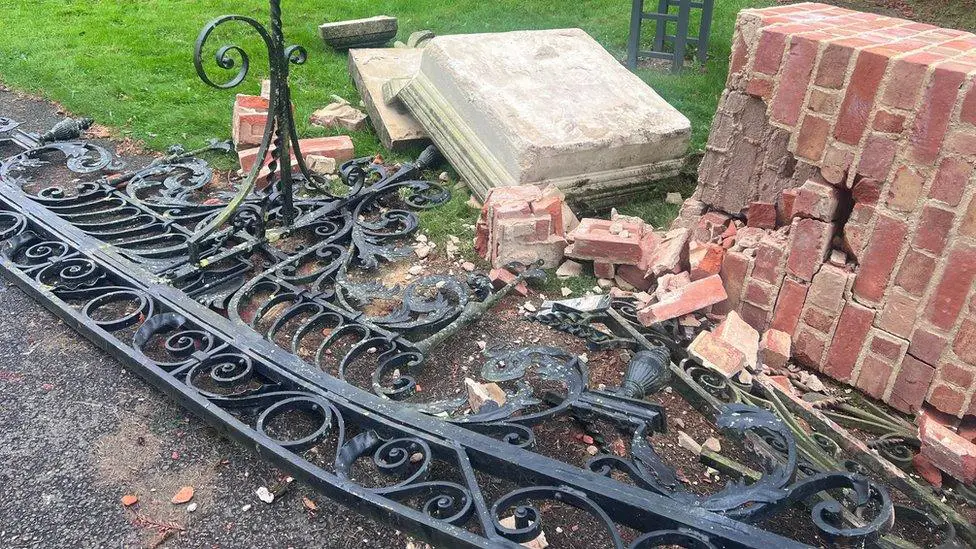
The hinge guard cracked but held. Barely. The hanging wires from the control housing sparked once, and Kira’s crew raised the tool for a second strike.
That was the moment I made the call I had promised myself, in retirement, that I would never need to make again.
I called Shawn.
Shawn Ferris had worked with me for eleven years, back when I still had a job that required people like him, and when I retired he’d started his own private security consultancy, mostly corporate work, executive protection, the occasional threat assessment for people who used to be under my authority and still trusted my judgment more than their own instincts. He picked up on the second ring.
“Julian. What’s wrong.”
“Thirty Pinnacle guards are at my gate. They’re using tools on it. Kate’s not here, Grace and Finn are inside.”
“I’m four minutes out.”
“Shawn, don’t come in hot. This can’t turn into a standoff. I need this handled clean.”
“Understood. I’m bringing confirmation, not confrontation.”
That was Shawn. Even in a crisis, he thought in the same careful, procedural language I had spent a career teaching him. Confirmation, not confrontation. I hung up and turned back to the gate just as Kira’s crew raised the tool a second time.
“Stop,” I said, stepping forward, putting myself between the gate and the tool, which is not a smart thing to do and I knew it wasn’t a smart thing to do even as I did it. “There is a seven-year-old boy forty feet behind me. You are not touching this gate again until someone shows me a verified reason.”
Astrid’s face didn’t soften. If anything it hardened further, the particular hardening of a person who has decided that any resistance to her plan is proof the plan is righteous.
“Sir, please step back from the equipment.”
“No.”
“Finish it,” she said again, to Kira this time, not Declan.
Kira looked at her tablet. Looked at Declan, whose hold notice still hadn’t reached her separate channel. Looked at me, standing in front of a bent hinge guard with my hands empty and raised slightly, the universal, ancient gesture of I am not a threat, please do not make me one.
“Ma’am,” Kira said slowly, “I don’t have current scope confirmation on this address.”
“I said finish it.”
That was when the five black SUVs arrived.
They came in silent, no lights, no sirens, the way vehicles move when the people inside them have done this before and understand that noise is often the enemy of control. Shawn got out of the lead vehicle with four of his own people behind him, and I watched thirty Pinnacle guards, who a moment ago had seemed like an overwhelming, immovable force, suddenly look uncertain about what they were looking at.
Shawn didn’t raise his voice. He walked directly up to Declan, since Declan was the one holding the tablet with the actual authority chain on it, and said, “I need your dispatch supervisor’s direct line. Right now. And I need everyone to stop touching that gate until I have it.”
“Who are you?” Astrid demanded.
“I’m the person about to save your company from a very expensive afternoon,” Shawn said, without looking at her, already dialing.
I don’t know exactly what was said on that call. I know it went up the Pinnacle chain fast, faster than any complaint I could have made myself, because Shawn had numbers in his phone that most people don’t have, the kind of numbers that come from eleven years of doing exactly this work at a level most people never see. Within nine minutes, every radio on that street crackled with the same instruction, relayed from someone far above Astrid Kellerman’s pay grade: all units, hold position, cease all access operations at this address, confirmed out of scope, repeat, confirmed out of scope.
I watched the guards’ shoulders drop, one by one, down the line, the particular posture of people who have just been told, officially, that the thing they were doing was wrong.
Astrid stood alone on the gravel for a long moment after that radio call, her red blazer suddenly looking less like a uniform of authority and more like a costume nobody was going to applaud.
“This isn’t over,” she said to me, quietly, before she got back into her vehicle.
I didn’t answer her. I had learned, decades ago, that some sentences don’t need a reply. They need a record. And I intended to make sure this one got one.
A licensed gate technician arrived at dusk. He isolated the cracked control housing, secured the hanging wires, tested the secondary restraint system, and installed a temporary release so the gate could still function that night. The hinge guard was bent but still holding, barely, and he told me plainly it would need real parts, real calibration, a full inspection, before he’d trust it to do its job again.
Grace stood beside me while he worked, arms crossed against the evening chill, watching sparks occasionally catch the porch light.
“She almost got them through it,” she said.
I looked down the dark road where the last set of Pinnacle taillights had disappeared twenty minutes before.
“No,” I said. “The system almost got them through it.”
Grace glanced at me sideways. I knew exactly what she’d heard in that answer, because I heard it myself the moment it left my mouth. The old version of me had come back for a moment. The man who studied failure chains and command channels and escalation points and accountability structures instead of simply admitting, out loud, to his own wife, that he was furious that strangers had taken tools to his family’s gate while his grandson hid in the garage.
But this time the distinction actually mattered, and I want to explain why, because it took me most of that sleepless night to work it out for myself.
Astrid had caused the confrontation. She had seen, that same morning, an authority summary confirming our residence sat outside the HOA’s emergency access scope, with no consent on file. She had acknowledged reading it — the system logged the acknowledgment with a timestamp. And then, at 3:42 that afternoon, the same credential, hers, had labeled my gate an emergency obstruction anyway.
She knew. Then she acted regardless.
But Pinnacle’s own platform had let urgency outrun verification. That was why thirty guards had been able to appear at my house in the first place. That was why Kira’s subgroup received a removal instruction while Declan’s own command screen still showed an unresolved amber warning that should have stopped everyone in their tracks. That was why an impact tool hit my gate before any hold reached the correct channel.
Astrid pushed. The system moved. Both had to be answered, separately, and I was determined that both would be.
By midnight, Pinnacle placed a full preservation hold on everything connected to the incident. Portal entries. Both versions of the access map, old and current. Dispatch audio. Radio traffic. Vehicle logs. Body camera footage from every unit on scene. Tablet task screens. Supervisor notes. All thirty guards’ roster check-ins for the day. Nia Sherwood, who I’d later learn ran compliance for the region, opened a mandatory self-report for what she termed an out-of-scope deployment involving access tools, which is corporate language for what almost happened to my grandson’s grandfather.
I received the notice at 12:17 in the morning. Grace was asleep by then, finally, after I’d sat with her on the edge of the bed for close to an hour just breathing evenly so she could hear that I was calm even when I wasn’t entirely sure I was.
Kate and Finn had gone home hours earlier, once Shawn confirmed the road was fully clear. Finn hadn’t understood the whole situation. Seven-year-olds rarely do, and I was grateful for that mercy. But he understood enough. He’d hugged me at the car door longer than he usually did, arms locked around my waist, and whispered up at me, “Did the bad guys break the gate?”
I crouched down to his level, the way I used to crouch down for briefings with junior officers who needed something explained plainly and without jargon.
“People made a bad mistake,” I told him. “Now grown-ups have to fix it.”
That was the simplest true answer I had. It would have to be enough for a seven-year-old, even though I was still working out, hours later at my kitchen table with a mug of cold coffee, whether it was enough for me.
The next morning, Shawn came by with the full incident packet printed and organized in a black binder, the kind of thing he knew I’d want even in an age when everything lived on a screen. He hadn’t slept much. Neither had I. We sat in my study, the same room where, years ago, I used to take secure calls before I retired, back when the walls were lined with screens instead of Grace’s family photographs. The desk was smaller now. I’d downsized it on purpose, the year I retired, as a kind of promise to myself.
Shawn set his tablet on the desk between us.
“Pinnacle preserved everything,” he said. “Nia’s office is cooperating fully. No stonewalling so far.”
“Good.”
“Do you want me to reach out to the old contacts?”
I knew exactly which contacts he meant without having to ask. Former executives I’d worked alongside for two decades. State regulators who still owed me favors, or thought they did. People who would pick up my call before the second ring finished, people who could turn a local gate dispute into a multi-agency review by lunchtime if I asked them to.
For most of my working life, I had lived comfortably in that world. Pressure met pressure. Access met access. Problems moved because I knew precisely where and how hard to press. It was a skill, and I wasn’t ashamed of having built it. But retirement was supposed to mean I stopped reaching for that particular lever unless something truly, unambiguously required it.
“Not yet,” I said.
Shawn studied my face for a long moment. “That is not your usual answer.”
“It’s my answer now.”
He nodded slowly, though I could tell, from the small crease between his eyebrows, that he didn’t fully believe I meant it. To be fair to him, I was still in the process of believing it myself, turning the decision over like a stone in my pocket, checking it for cracks.
The formal conduct review that followed separated the thirty guards carefully, by what each of them had actually known and what each had actually done. That distinction mattered enormously to me. I had no interest in punishing thirty people as though every last one of them had personally swung a tool at my gate. Most of them, I learned, had spent the entire afternoon directing traffic, or recording footage, or simply standing by under what had appeared, from where they stood, to be a perfectly valid emergency mobilization order from their own president.
Kira Camden’s access subgroup, it turned out, had acted on a defective downstream release that displayed a stale auxiliary access label, a technical failure that predated that Saturday by weeks. Her task view never clearly showed the unresolved verification flag that Declan’s screen showed. The moment Declan’s hold actually reached her channel, she stopped immediately, tool still raised, and stepped back without a second’s hesitation. I watched that part of the footage twice. She looked, in that frame, exactly like a person relieved to be told to stop.
Declan faced a separate, harder review, a field control review, because he’d done something more complicated than simple compliance or simple failure. He had recognized, correctly and immediately, the contradiction between what his screen told him and what he could see with his own eyes, an occupied family home, not an obstruction. He had requested live scope confirmation. He had placed a hold. But he had also allowed the access subgroup to stage tools at my gate before confirming that their separate channel had actually received his hold.
Pinnacle’s internal report put it in six words that I found, honestly, fair. Correct recognition. Incomplete isolation.
Astrid’s sequence, by contrast, required no interpretation at all.
At 8:18 that morning, her credential had acknowledged a one-page authority summary confirming our residence sat outside the association’s emergency scope, with no consent recorded anywhere in the system. At 3:42 that afternoon, the very same credential had labeled my gate an emergency obstruction and triggered the mobilization. The audit export placed both timestamps on the same digital page, side by side, an accusation with no need for a lawyer to translate it.
She knew. Then she acted anyway.
Fox Hollow’s board tried to contain the story at first, the way boards always do. Their initial message to residents called the whole thing “a misunderstanding involving security mapping,” language so carefully bloodless it could have described almost anything. That framing lasted exactly as long as it took for Pinnacle’s preservation notice to reach the HOA’s own insurer and legal counsel.
Then the tone changed fast.
The board called a closed emergency session. Astrid didn’t attend the first half of it. When she finally arrived, she brought an attorney with her, and by that point the other board members had already seen the portal record, the stale map history, the current confirmed service boundary, and the signed acknowledgment with her name on it.
One board member, a retired pharmacist named Lenora Hale, told me later, over coffee at her kitchen table, in the careful voice of someone still processing what she’d witnessed, “The room went quiet the second we saw the timestamp side by side like that. There was nothing left to spin. Nothing at all.”
No one asked me to attend that session, and I was genuinely grateful for it. I hadn’t wanted a public showdown. I wanted the gate repaired properly, the records preserved completely, and the rules corrected so that no other family in that neighborhood would wake up one Saturday to thirty guards in their driveway because one person had abused a menu option on a tablet.
Four weeks later, the settlement was finalized.
My claim covered only documented costs. Replacement hinge guard. New control housing. Sensor recalibration. Temporary access security during the repair window. Technician labor. Review fees connected directly to the incident. I did not add a punishment figure on top of it. I did not claim emotional distress, or loss of enjoyment of property, or any of the other categories the lawyers gently offered to discuss with me over two separate calls.
Grace asked me why, standing near the repaired gate post one afternoon while the technician ran a final test cycle, the gate swinging open and closed, open and closed, smooth as silk.
“Because I don’t need to make the number louder than the facts,” I told her.
She looked at me for a long moment, the particular look she gets when she’s deciding whether to believe a thing or simply hope it’s true. “That sounds almost healthy.”
“I’m trying.”
“I noticed.”
Responsibility, in the end, was allocated by agreement among Pinnacle, its insurance carrier, the Fox Hollow HOA, and the relevant underwriters on each side. Pinnacle formally accepted its verification failure. Fox Hollow’s carrier formally accepted the documented role of Astrid’s portal misuse. The settlement itself didn’t declare a winner in some dramatic sense. It didn’t rule, for all time, on the exact boundaries of HOA authority. It simply paid for the damage that had actually occurred, and it preserved, permanently, the full record of why it had happened.
Separately, and more importantly to my mind, Pinnacle’s own self-report triggered a state private-security licensing review. That review mattered more than any check I ever received.
The licensing division went through the old platform workflow line by line and eventually issued a consent order requiring Pinnacle to remove every obsolete operational geofence in its system, install a hard verification stop that would prevent access tools from being authorized until scope was confirmed, retrain every field supervisor in the region, and make every emergency code decision fully auditable, start to finish, from the very first roster redirect through the final field action.
Nia walked me through the new process during our closeout call, her voice carrying the particular satisfaction of someone who’d spent a career building systems and finally gotten to fix a broken one.
“A priority code can still move help toward a real emergency,” she explained. “Fire. Active violence. A missing child. Any verified threat. But if an address falls outside confirmed scope, the tool instruction simply cannot turn green until authority is authenticated. Not by a person’s say-so. By the system itself.”
“Movement can begin,” she said. “But forced access can’t outrun authority again.”
That was the sentence I had been waiting weeks to hear.
Fox Hollow acted last, as these things tend to go. The board recorded a formal resolution confirming that the community’s original vote had only ever authorized a general security assessment and additional patrols in shared common areas. It had never authorized routine entry through private homes. It had never authorized the removal of approved residential gates. It had never given any single officer, president or otherwise, the power to convert private property into common access simply by reclassifying it inside a software portal.
Astrid remained on the board for a while afterward, though not as president; that title moved to someone else within the month. She lost her individual emergency mobilization access immediately and permanently. Any future high-priority request from Fox Hollow now required two separate authorized HOA approvers plus Pinnacle’s own independent scope confirmation before a single guard could be dispatched.
There was no apology from her. Not one word, not even a card, not even an awkward hallway moment at the mailboxes. I stopped expecting one fairly early on.
I’ve thought about why since, turning it over the way I used to turn over old case files. People like Astrid rarely apologize, I think, because a real apology requires giving up the private story where they were the only person in the room brave enough to act. She had convinced herself, somewhere along the way, that my gate represented a weakness in the neighborhood’s defenses, and once she believed that, every refusal I gave her became obstruction in her mind, every reasonable boundary became selfishness, and every warning she received, including her own system telling her she was outside her authority, became just one more thing to route around rather than listen to.
But the problem with that kind of control, the kind that insists on running through every warning instead of stopping at it, is that it always leaves records behind. Every single time. That’s the one lesson from my old career that never once failed me.
Six weeks after the confrontation, Kate pulled into our driveway on a bright Saturday morning, sunlight catching off her windshield. Finn’s blue bicycle was strapped to the rear rack, front wheel flashing every time he bounced excitedly in his booster seat.
“Lakeside trail opens in twenty minutes,” Kate called through the open window, laughing. “Anyone still inspecting hardware gets left behind, Dad.”
I was standing near the new control housing with Shawn at the time, going over the final closeout paperwork one last time out of old habit. The replacement hinge guard sat straight and solid against the post. The keypad light glowed a steady, uninterrupted green. The technician had finished the last sensor calibration that very morning, and Shawn was holding the closeout report open on his tablet, waiting for my signature.
For years, that tablet would have trapped me completely. I would have checked every threshold twice, reread the report line by line, questioned the technician about calibration tolerances, reviewed the entire access log going back a month, and in doing all of that I would have turned a simple family bike ride into one more operation nobody had actually asked me to command.
Grace opened the rear door of Kate’s SUV, already climbing in, already smiling back at me over her shoulder.
“Julian,” she said. “The lake.”
I handed Shawn the spare remote.
“You finish the log,” I told him.
He smiled, just slightly, the smile of a man who understood exactly what I was choosing not to do. “Copy that.”
I got into the vehicle beside Grace. The gate began its slow, smooth arc open, no sparks, no cracking sound, nothing but quiet, well-oiled motion.
Finn lowered his window in the back seat. “Grandpa, listen!”
He reached back and flicked the bicycle bell, the one I’d finally, actually fixed two nights earlier at the kitchen table with a tiny screwdriver and more patience than the job really required.
The small bright ring carried clean across the driveway.
That sound hit me harder, somehow, than the impact tool ever had.
It was so ordinary. That was exactly why it mattered so much. The bell I had promised to fix, finally fixed. The ride I had promised him, finally happening. The kind of small, unremarkable family moment I had spent far too many years of my working life postponing, because somewhere, always, somebody needed a plan, a call, a response, a decision only I could make.
The gate completed its smooth, silent arc.
Kate drove forward, out onto the quiet street.
Shawn stayed near the post, already shrinking small in the side mirror, finishing the last of the work I no longer needed to personally own.
The repaired gate swung shut behind us with one quiet, satisfying click.
Finn rang the bell again, delighted with himself, delighted with the sound.
This time, I was inside the car to hear it. And for the first time in longer than I could easily remember, that was exactly, entirely, where I wanted to be.

Laura Bennett writes about complicated family dynamics, difficult conversations, and the quiet moments that change everything. Her stories focus on real-life tensions — inheritance disputes, strained marriages, loyalty tests — and the strength people find when they finally speak up. She believes the smallest decisions often carry the biggest consequences.