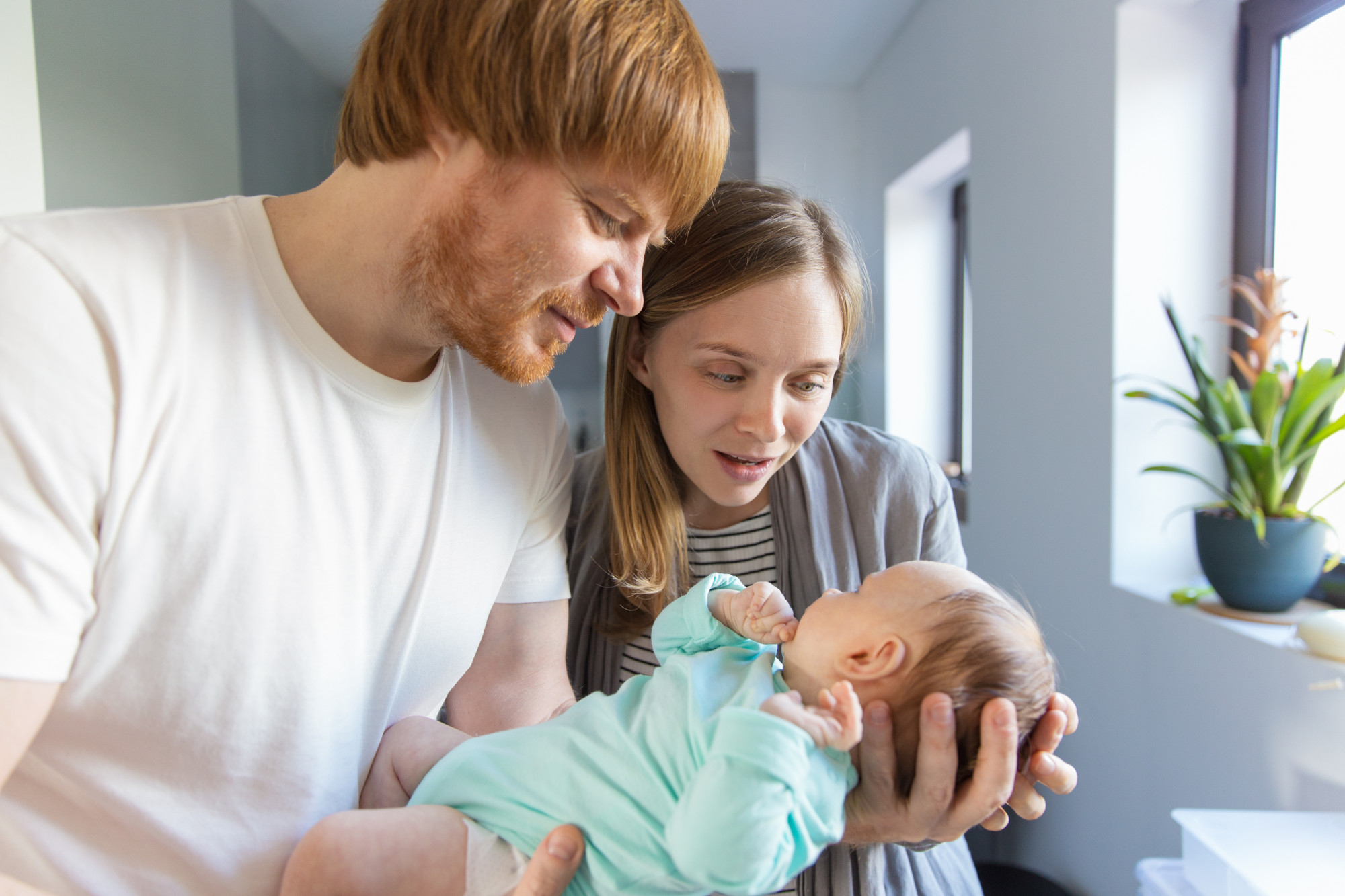
After four daughters, my husband finally got the son he’d been begging for. But when he held our newborn boy for the first time, the words that came out of his mouth made the floor drop out from under me.
Aaron and I had been together for eight years, and from the very start we both said we wanted a big family. That part was never in question. We used to lie awake in the dark early in our marriage and name imaginary children, argue playfully over whether the crib should go by the window or the wall, picture holidays loud enough to rattle the windows. It was one of the things that made me fall for him. He wanted a house full of noise and small feet and cereal spilled on the floor, and so did I.
But somewhere underneath all that warmth, Aaron had a fixation I couldn’t quite reach, and it was always the same shape. He wanted a son. Not instead of daughters, he insisted, but a son had to be in there somewhere. Even before we were married, back when we were young and broke and sharing a one bedroom apartment with a radiator that clanked all night, he would talk about it like a certainty already written down. A family full of girls, he’d say, just wouldn’t feel finished to him. He wanted a boy more than he wanted almost anything, someone to carry his name forward, someone to be the thing he pictured when he closed his eyes and imagined the man he’d become as a father.
I used to tease him about it. I’d tell him the universe had a sense of humor and he should be careful what he demanded from it. He’d laugh and pull me close and say he could take whatever the universe threw at him, as long as somewhere in the mix there was a son.
Soon after the wedding I found out I was pregnant, and I have never seen a man light up the way Aaron did that morning in our bathroom, both of us staring at the little test on the edge of the sink like it might rearrange itself if we blinked. He was thrilled, genuinely, but within about ten minutes the thrill had shaped itself into a specific belief. He was convinced, absolutely and immovably, that we were having the son he’d always wanted. He talked to my stomach that first week. He called the baby by a boy’s name he’d been holding in his back pocket for years.
Instead, we welcomed a beautiful baby girl. We named her Ellie.
He loved her. I want to be clear about that, because everything that came later depends on it. He held her in the delivery room with tears running down his face and he was, in that moment, exactly the father I’d hoped he would be. But I knew him too well by then, and even under the joy I could see the small private disappointment he was trying to fold away where I wouldn’t notice it. It lived in the pause before he answered when people asked if he’d wanted a boy. It lived in the way he said, quietly, later that night when the room was dark and Ellie was asleep against my chest, “We’ll give her a little brother someday.”
So we tried again.
And then again.
Every year and a half or so, another daughter arrived, and each one was her own whole person from the first breath. Ellie, serious and watchful, the kind of child who studied the world before she trusted it. Then Nora, all belly laughs and reckless joy, forever climbing something she shouldn’t. Then Grace, gentle and dreamy, who talked to the flowers in the yard as though they were listening. Then Lily, the baby, sharp and stubborn and hilarious, who at two years old already knew exactly how to run a household of women twice her size.
Aaron loved them. I need to say that again because it’s true and because it’s the hardest part. He loved all four of our girls with his whole heart. He built forts and braided hair badly and stayed up nursing fevers and cried at every school recital. But every single time we sat in that ultrasound room and the technician turned the screen toward us with a smile and told us it was a girl, I watched the same thing move across his face. A flinch he thought he was hiding. A door quietly closing behind his eyes. And every time, on the drive home, he would eventually say some version of the same sentence. Next time.
By the fourth, I was tired in a way that lived in my bones. Four pregnancies had taken more from my body than I let on, and something in me had started to flinch too, though at a different thing than Aaron flinched at. I loved our life. I loved our loud, girl filled house. I did not love the sense that our family, in Aaron’s private accounting, was a thing perpetually not yet complete. That our daughters were somehow a series of near misses on the way to the real prize. I never said it that harshly to him, but I felt it, and I think he felt me feeling it, and the space between us grew a small cold spot that neither of us named.
Sometimes, alone in the kitchen at night, I would wonder how many children he’d be willing to have before he finally let the dream go. I wondered if it would ever be enough. I wondered, in my worst moments, whether he even knew he was doing it.
Then I became pregnant for the fifth time.
From the moment I set the test on the counter and he saw the two lines, Aaron was certain in a way that frightened me a little. This one was different, he kept saying. He could feel it. He put his hand on my still flat stomach in the mornings and murmured to it, and the name he used was a boy’s name. “I can feel it,” he said, again and again, through the weeks and then the months. “This time it’s finally my son.”
Part of me braced for the ultrasound the way you brace for a slap. I remember reaching for his hand in that dim room, my palm sweating, watching his profile more than the screen. I remember the technician’s pause, the little intake of breath, and then her voice.
He was right.
A boy. Our first son, healthy and strong, curled up on that grainy black and white screen with one tiny hand near his face. Aaron made a sound I’d never heard him make, something between a laugh and a sob, and he pressed his forehead to mine and neither of us could speak. On the drive home he didn’t say next time. For the first time in years, there was no next time hanging in the air. He drove with one hand and held mine with the other the whole way, and I let myself believe that a thing that had been slightly out of joint in our marriage was finally sliding back into place.
The pregnancy was hard on me, harder than the others. My body was older and more worn, and there were weeks near the end when I could barely get up the stairs. But Aaron floated through all of it. He painted the nursery a soft slate blue. He built the crib himself and stood back from it looking prouder than I’d seen him in a decade. He bought a tiny baseball glove for a child who wouldn’t be able to hold anything for months. The girls caught his excitement and started calling the bump “our brother,” pressing their small hands to my belly and whispering to him, and I loved that, I loved all of it, and I told myself the cold spot between Aaron and me had melted for good.
The delivery was long. Longer than any of the others, long enough that at one point I saw a flash of real fear cross the doctor’s face and then get carefully smoothed away. But in the end, after all those hours, our son arrived, and his cry filled the room, furious and alive, and I have never felt relief like the relief of that sound.
Aaron looked happier than I had ever seen him in the whole eight years I’d known him. Happier than our wedding. Happier than the day I told him about Ellie. There were tears already standing in his eyes before the baby was even wiped clean.
The nurse finished her checks and stepped over to him and placed our son in his arms. I was wrung out and shaking and half delirious with exhaustion, but I kept my eyes on his face, because this was the moment. This was the thing he’d been waiting eight years for. I expected the tears to break loose. I expected laughter. I expected some quiet, wrecked, grateful “finally” that would close the book on all those ultrasound rooms and all those drives home.
Instead, Aaron went still.
He studied the baby’s face for a long moment, and I watched all that light drain out of his own. The joy didn’t fade the way joy usually fades, slowly and softly. It vanished, like something switched off. His mouth opened and closed. His arms went rigid around our son, holding him too carefully now, the way you hold something you’re afraid of.
Then he looked up at me, and his voice came out flat and strange and far too quiet for a room that should have been full of celebration.
“He looks just like David,” he said.
I didn’t understand. My mind was still floating somewhere near the ceiling, thick and slow.
“Who’s David?” I asked.
Aaron didn’t answer. He was staring down at the baby again, and something was happening in his face that I had never seen there in eight years of marriage, a kind of grief and terror braided together so tightly I couldn’t tell where one ended and the other began. His hands were trembling. When the nurse gently offered to take the baby so I could hold him, Aaron didn’t seem to hear her at all.
“Aaron,” I said. My voice cracked. “Who is David?”
He finally lifted his eyes to me, and they were wet, but not the good kind of wet. “My brother,” he said.
I felt the floor tilt. In eight years, in every long conversation about our families and our childhoods, in every holiday and every argument, Aaron had never once mentioned a brother. His parents were gone by the time we met, both of them, and he’d always spoken of himself as an only child. I had believed it completely. I had built half my understanding of the man I married on it.
“You don’t have a brother,” I said, and it came out almost like a plea, like if I said it firmly enough it would become true again.
“I had one,” Aaron said.
The nurse, sensing something, quietly lifted our son from his arms. Aaron let the baby go without resistance, and that scared me more than anything, because Aaron never let his children go easily. She placed our son on my chest, warm and impossibly small, and I wrapped my arms around him and felt his heartbeat against mine, and even in the middle of my confusion and fear I felt that particular animal completeness of holding a new baby. But I couldn’t look away from my husband, who was standing at the side of the bed looking like a man who had just seen a ghost climb up out of the past and lay itself down in my arms.
They kept us in the hospital two more days. Aaron barely spoke in that time. He held the baby, but he held him the way you hold something borrowed, and every time he looked at that tiny face I watched him go somewhere else, somewhere I couldn’t follow. He slept badly on the fold out chair, or didn’t sleep at all. Once, near dawn, I woke to find him sitting with the baby in the crook of his arm, staring at the wall, tears sliding silently down his face while he made no sound at all. I pretended to still be asleep. I don’t know why. I think I was afraid of what he would say if I asked.
We named our son Theo. Aaron agreed to it too quickly, like the name didn’t matter, like naming him was a formality he had to get through. On the third day we took him home to a house decorated with a paper banner the girls had made, WELCOME BABY BROTHER in wobbly crayon letters, and the four of them swarmed the front door shrieking with joy. Aaron smiled for them. He was good at that, smiling for the girls. But it was a costume of a smile, and I could see the seams.
That first night home, once the girls were finally asleep and Theo was down in the slate blue nursery Aaron had painted with his own hands, I found my husband sitting alone in the dark kitchen, a glass of something amber untouched in front of him. I sat down across from him and I said, “You’re going to tell me now.”
He was quiet for a long time. Then he started to talk, and once he started he couldn’t stop.
David had been his younger brother. Two years younger. Aaron had been eleven and David nine on the day it happened. It was summer, one of those endless bright summers of childhood, and they’d gone down to the lake near their grandparents’ house the way they did most afternoons, just the two of them, because their parents trusted Aaron to watch out for the little one. Aaron had told this story to himself ten thousand times, he said, and the details never softened. The heat of the dock boards under their bare feet. The way David couldn’t swim well yet and wasn’t supposed to go past the rope. The dare. The stupid, ordinary, brotherly dare that Aaron had made, because David was scared and Aaron wanted to see him do it, wanted to be the brave older brother whose little brother would follow him anywhere.
David went past the rope. And David didn’t come back.
Aaron had jumped in after him. He’d screamed until his voice tore. He’d dived under that dark water again and again until his lungs gave out, and by the time the neighbors came running it was already too late, and Aaron had spent the rest of his life carrying the certainty that his brother had drowned because Aaron told him to be brave.
His parents never blamed him out loud. That was almost the worst part, he said. They just went silent. The house they’d been happy in turned into a museum of a boy who wasn’t there anymore, and Aaron grew up in the ruins of it, a surviving son who felt every single day like the wrong one had lived. His mother kept David’s room exactly as it was until the day she died. His father barely spoke to Aaron again. When Aaron left for college he essentially left that whole life behind, sealed it up, and when both his parents passed within a few years of each other he let the last door close on it and told the world he was an only child. He’d told it so many times he’d almost come to believe it himself.
“I thought if I never said his name,” Aaron whispered, “I could carry it alone and it wouldn’t touch anyone else. I could just keep it in me.”
And then it came out, the thing underneath the thing. The reason for all those years of demanding a son, the fixation I had never understood.
“I thought,” he said, and his voice broke completely now, “I thought if I could just have a son, I could get it right. I could be a good brother to a boy, a good protector, the thing I wasn’t for David. I could fix it. I could raise a boy and keep him safe and it would be like paying back what I owed. Every time we had a girl I loved her, God, you know I loved them, but a part of me thought, not yet, I still haven’t fixed it, I still haven’t earned it back.” He put his face in his hands. “And then they handed me Theo and he has David’s exact face. The same eyes. The same everything. And I realized I hadn’t been asking for a son at all. I’d been asking for my brother back. I’ve spent our whole marriage trying to resurrect a nine year old boy who died because of me, and I did it to you, and I did it to our girls, and I never even told you why.”
I sat there in the dark kitchen with my whole understanding of my husband and my marriage rearranging itself in my chest. All those years. All those ultrasound rooms and the flinch on his face and the next time hanging in the car. It had never been about our daughters not being enough. It had never been about legacy or his name or any of the things I’d quietly resented him for. It had been a grief so old and so buried that even he hadn’t been able to look at it directly. He’d been trying to save a drowned boy for thirty years and he’d been using our whole family to do it.
I could have been angry. Part of me was, for the secret, for the years of feeling like our girls were runners up in a race I hadn’t known they were running. But mostly, sitting there watching this man I loved finally break open, all I felt was an enormous aching tenderness, and under it, for the first time, real fear. Because there was a danger in what he’d just told me, a danger I understood immediately even through my exhaustion.
“Aaron,” I said carefully. “Theo isn’t David.”
He looked up at me.
“He isn’t David,” I said again. “He can’t be. If you raise him to be your brother come back, if you look at him and see a boy who drowned thirty years ago every time he walks into a room, you will crush him. You’ll do to him exactly what your parents did to you. He’ll grow up in the shadow of a ghost he never met, trying to be someone he isn’t, feeling like he was born to fix something instead of just to be himself.” My own voice was shaking now. “He’s not here to save you. No child can carry that. It’s not fair to hand it to him.”
Aaron flinched like I’d struck him, and then something in his face collapsed and rebuilt itself, and I watched him understand. He was a man who knew, better than almost anyone alive, exactly what it did to a child to grow up as the living stand in for a dead one. He had lived inside that shadow his whole life. And he had been one breath away from building the same shadow over the crib upstairs.
“I don’t want that,” he said, horrified. “God, I don’t want that for him.”
“Then you have to let David go,” I said. “Not forget him. Never forget him. But let him be your brother who died, a boy you loved and lost, instead of a debt you’re trying to pay with our son’s whole life. Theo gets to be Theo. And you have to grieve David for real, finally, the way you never got to. Out loud. With help. Not by trying to give birth to him again.”
Aaron cried then in a way I don’t think he had ever let himself cry, thirty years of it, ugly and shaking and total, and I came around the table and held him, this big grown man folded down small, and I held him the way I’d held all our babies. Upstairs our four daughters slept, and in the nursery our son slept in his slate blue room, and none of them knew that down in the dark kitchen the whole hidden architecture of our family was finally being torn down and rebuilt on honest ground.
It wasn’t fixed that night. Things like that don’t fix in a night. But that night was where it started to become possible.
In the weeks that followed, Aaron did the hardest thing I have ever watched him do. He found a therapist, a quiet older woman who specialized in grief and childhood trauma, and he went every week, and some nights he came home hollowed out and wrung dry and other nights he came home lighter than I’d seen him in years. He told me about the sessions, haltingly at first and then more freely, and it was like watching someone slowly excavate a house that had been buried under a landslide for three decades, hauling out one heavy piece at a time until light could finally get in.
He told the girls about David, eventually, in a way they could hold. He sat them down, all four of them lined up on the couch with their serious faces, and he told them they’d had an uncle named David who died when Daddy was a little boy, and that Daddy had been very sad about it for a very long time and had never known how to talk about it. Ellie, our watchful oldest, asked if it was Daddy’s fault, because children go straight to the true and terrible question, and Aaron took a breath and said no, it was a terrible accident, and that for a long time he thought it was his fault but he was learning that it wasn’t. I watched him say those words to our daughters and I knew he was saying them to the eleven year old boy inside him too, the one who had been waiting thirty years to be told he was allowed to have survived.
And Theo. Our Theo.
I watched Aaron with him like a hawk in those first months, watched for the ghost to climb back into his eyes. And there were moments. Of course there were. There were mornings I’d catch Aaron staring down into the crib with that faraway grief on his face, seeing another boy in another decade. But every time, I saw him do a thing he had never been able to do before. I saw him come back. I saw him blink and shake his head slightly and look again, really look, until it was Theo he was seeing, Theo with his own particular cry and his own particular smell and his own furious little fists, a brand new person who had never been to a lake and never would be made to carry one.
“Hey,” Aaron whispered to him one night, and I stood in the doorway where he couldn’t see me. “You know you don’t have to be anybody. You just have to be you. That’s the whole job.” He was quiet a moment. “I’m going to keep you safe. Not because I owe it to anyone. Just because you’re mine and I love you.” And then, so soft I almost didn’t hear it, “And I loved him too. Both of you get to be real. Both of you get to be exactly who you are.”
I had to go back down the hall so he wouldn’t hear me crying.
Our marriage changed after that. It got deeper, the way ground gets deeper after you dig down through the shallow topsoil to something solid. The small cold spot that had lived between us for years, the one I’d never had a name for, turned out to have had a name all along, and once it was spoken it began to close. Aaron stopped counting our children as a series of attempts at something. He started seeing what had been in front of him the entire time, a family that had been complete from the very first daughter, complete and loud and spilling over with love, never once a set of near misses on the way to a prize. Ellie and Nora and Grace and Lily. He’d had everything he needed for years. He’d just been looking past it at a lake.
Years have passed now. Theo is a boy of his own making, nothing like the child Aaron once feared or hoped or grieved him into being. He is his own weather system entirely, obsessed with dinosaurs and terrible at sitting still, the adored little brother of four fierce older sisters who boss him and defend him in equal measure. He cannot swim yet, and when Aaron takes him to the lake, and he does take him to the lake now, that’s part of the healing too, Aaron stands in the shallow water with both hands under Theo’s belly and teaches him slowly and patiently and without a shred of fear on his face, and I know exactly what that costs my husband and exactly what it gives him back.
Sometimes, on the anniversary each summer, Aaron drives out to where his brother is buried, a small stone in a small town he hadn’t visited in decades. Sometimes he takes me. Once, when Theo was old enough to ask why Daddy looked sad on that day, Aaron told him about the uncle he never got to meet, told him gently, told him true, a boy named David who loved to swim and laugh and follow his big brother anywhere. Theo listened with his dinosaur clutched in one hand and then he said, with the devastating simplicity of a small child, “I wish I could have met him.” And Aaron pulled him in and said, “Me too, buddy. Me too.” And there was no shadow in it. Just love, the ordinary aching human kind, given to the living and the dead both, each in their own right.
That day in the delivery room, when my husband looked at our newborn son and the joy fell off his face and my stomach dropped through the floor, I was certain I was watching something break beyond repair. I thought the words coming out of his mouth were going to end us. He looks just like David. Four words that cracked our whole life open.
But some things have to break to be seen. Some griefs have to be dropped into the middle of a room and shattered before anyone can finally pick up the pieces and understand what they were carrying all along. Aaron had spent eight years of our marriage, and thirty years of his life, holding his breath. It took our son’s face, our fifth child, the boy he’d begged the universe for, to finally make him let it out.
He got the son he’d been begging for. But that wasn’t the gift, not really. The gift was that in getting him, Aaron finally, at last, got to put his brother down. Not throw him away. Never that. Just lay him gently to rest after carrying him underwater for thirty years, and come up, and breathe, and turn around to find that the family he’d been searching for his whole life had been standing right behind him the entire time, four daughters and a son and a wife, waiting for him to surface.
And when he did, we were all still there. We’d always been there. We just needed him to open his eyes and see us.

Specialty: Quiet Comebacks & Personal Justice
David Reynolds focuses on stories where underestimated individuals regain control of their lives. His writing centers on measured decisions rather than dramatic outbursts — emphasizing preparation, patience, and the long game. His characters don’t shout; they act.