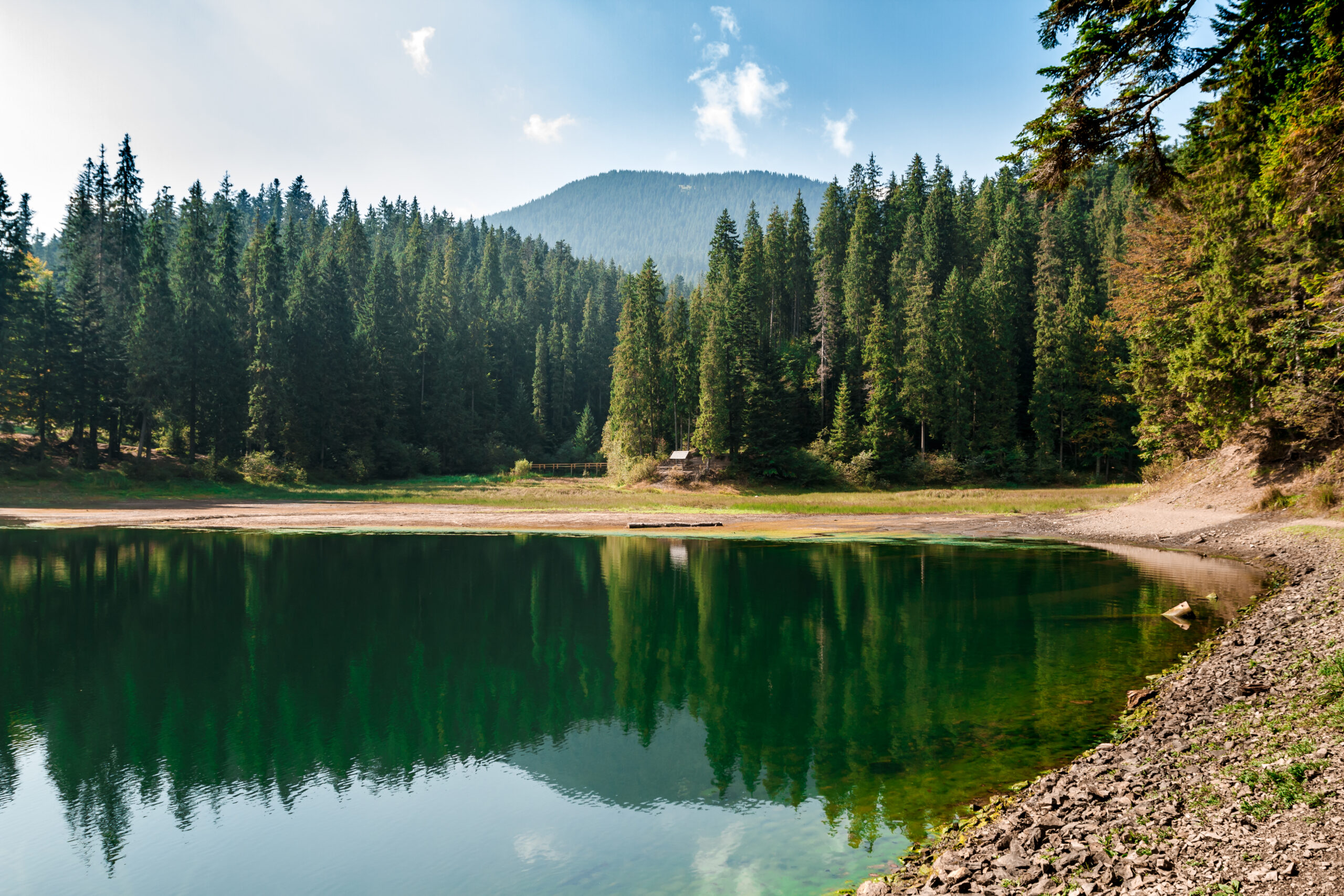
The last coat of stain was still tacky on the porch railing when I stepped back to look at it. Eight months. Every Saturday and most Sundays from April through December, driving forty-two minutes each way with lumber strapped to the roof rack and a cooler of sandwiches on the passenger seat. The cabin had been nothing when I bought it at a county tax sale for fifty-two thousand dollars. A two-bedroom shell with a sagging dock and a kitchen that smelled like raccoon. But I could see it. I could see what it would be.
And now it was finished. The railing was straight. The dock held weight. The bathroom had hot water for the first time in six years. I had sanded every floor by hand because the rental sander shorted out on the second day, and I could not afford another one until the next paycheck. I tiled the kitchen backsplash with ceramic I found on clearance, forty cents a square foot, cutting each piece on a wet saw I borrowed from the school custodian. The porch boards were pressure-treated pine I stained three coats over three weekends. The dock pilings I replaced by wading into the lake in July with a crowbar and a prayer, pulling the rotted posts out and sinking new ones with a post driver I rented by the day. Eight months of weekends and eighteen thousand dollars in materials and the hired labor for the plumbing and electrical I couldn’t do myself. Every other nail, every other screw, every other coat of finish was mine. My hands, my weekends, my money from a cafeteria manager’s salary that left me two hundred dollars a month after bills, if I didn’t eat out.
I reached behind my ear and touched the carpenter’s pencil. Flat, wide, the Dixon stamp faded to a shadow, bite marks on one end from a man who chewed when he was thinking. I had kept it behind my ear every day of the renovation, the way my uncle used to keep his.
I heard gravel crunch in the driveway. Walt’s truck. Behind it, Irene’s sedan. Behind that, Darla’s white hatchback with the college parking sticker still on the bumper. They came inside without knocking. Darla walked through the kitchen first, running her hand along the counter I had installed in September. She opened the refrigerator I had bought with my credit card and looked inside like she was taking inventory. Irene stood in the doorway and looked at the floors. Walt sat at the kitchen table I had built from reclaimed planks and put both hands flat on the surface.
“Your sister is graduating next weekend,” Walt said. “We are hosting her party here.”
I looked at him.
“Sixty people. Saturday afternoon through Sunday morning. Caterer is booked. DJ is booked. Darla has a tent coming for the dock area. It’s already paid for.”
“Paid for with what?” I said.
Walt waved the question away. “The point is it’s happening. The cabin is perfect for it. Darla’s been planning this for weeks. Your mother and I talked about it, and this is the right place.”
“You talked about it,” I said. “Without me.”
Walt leaned back in the chair. The chair I built. At the table I built, in the kitchen I tiled.
“You serve lunch trays at a middle school, Shea. You make thirty-eight thousand a year, and you spend eight months of your weekends sanding floors and scraping paint on a lake cabin that was falling apart when you bought it. Your sister just finished a degree. A real one, from a real university. She has a boyfriend with a real career. She has a plan. You have a carpenter’s pencil and a bucket of wood stain. She is asking for one weekend. One. And you can’t even give your own sister that much without making it about whose name is on a piece of paper.” He looked at me flat. “Keep out of the way or leave. That is not a conversation. That is a fact.”
Darla smiled from the refrigerator. Irene looked at the dish towel hanging from the oven handle. She did not look at me.
I stood in the kitchen I had built from a raccoon-stinking shell and listened to my father tell me I was nothing for building it. My jaw tightened. My hands wanted to close into fists, but I pressed them flat against my thighs and breathed once through my nose.
“Fine,” I said.
I took my jacket from the hook by the door, put the pencil in my pocket, the flat shape pressing against my ribs. I walked out to my car and drove forty-two minutes back to town without turning on the radio.
Fine is a word that sounds like surrender. It isn’t. Fine is the word you use when you’ve already decided what you’re going to do and you don’t need the other person to know yet.
I did not go home. I drove to the school parking lot because I knew Bess would still be there, finishing the attendance report she put off all week. Her car was in the second row, engine running, heat on, phone in her hand. I parked next to her and got in on the passenger side.
Bess looked at my face and set her phone down. “What happened?”
I told her. The truck in the driveway, the party announcement, Walt at the table, the brutal line, all of it. Lunch trays, wood stain, keep out of the way or leave.
Bess was quiet for ten seconds. Then she picked up her phone, opened Instagram, typed a name, and turned the screen toward me.
Darla’s post, three days old. Lakehouse graduation bash, a row of party emojis, five photos. The first was the cabin’s finished living room — the floors I sanded, the windows I reframed, the light fixture I wired with the electrician standing behind me talking me through the connections. The second was the dock I rebuilt, the railing I stained, the lake behind it catching the afternoon light. The third was the kitchen. My kitchen. My tile. My counter. My table.
One hundred and twelve likes. Forty-one comments. Oh my god, your family’s lakehouse is gorgeous. Can’t wait. Love the dock. Your parents must be so proud of this place.
Darla never corrected a single one. Not one reply that said actually, my sister built this. Not one mention of Shea. Not one mention of eight months, or eighteen thousand dollars, or the raccoon kitchen, or the wet saw, or the clearance tile.
“She’s been posting about this for three weeks,” Bess said. “She used your before-and-after photos, the ones you texted me in October. She cropped your shadow out of the dock photo. She never mentioned your name. Not once.”
I stared at the screen. Every board I sanded. Every railing I stained. Every weekend I showed up with my cooler and my tools. Credited to my family’s lakehouse.
Bess closed the app. “That’s not a party, Shea. That’s someone selling a house you built and pretending they picked out the paint.”
“She cropped my shadow out of the dock photo,” I said.
“I know. I saw the original. You sent it to me the weekend you finished the dock. Your shadow’s in the lower left corner. In her version, it’s gone. Three weeks of posts. Nobody corrected her. Nobody knew there was anything to correct. She told everyone it was her family’s cabin. Nobody in her circle knows you exist.”
We drove to Bess’s apartment. She made tea. I sat at her kitchen table, smaller than the one I built for the cabin and costing twice as much, and I told her about Uncle Clyde.
Clyde was my mother’s brother, a retired carpenter. The only person in my family who ever looked at something I did and said it was good without adding a condition. He taught me how to hold a hammer when I was eight, how to read a tape measure when I was ten, how to square a frame when I was fourteen. He took me to job sites on summer mornings and let me carry the toolbox even though it was too heavy, and he didn’t take it back until I asked. He gave it to me at a gas station when I was fourteen. Pulled the pencil from behind his own ear and put it behind mine. Measure twice, he said, because once you cut, you can’t put the wood back.
He died when I was twenty-two. Heart attack in his workshop. Sawdust on his shirt. The paramedics found it on the bench. My aunt gave me the pencil at the funeral. I kept it in my nightstand drawer for four years. The day I bought the cabin, I put it behind my ear, and it stayed there for eight months.
Bess listened to the whole thing without interrupting. When I finished, she set her mug down. “So what are you going to do?”
“I’m going to wait,” I said. “And then I’m going to do the math.”
“What math?”
“All of it.”
I had given Darla a copy of my credit card because she said she was picking up deck screws at the hardware store while I was at work. I had given my parents a spare key because they said they’d check on the cabin when the temperature dropped. I did these things because I thought being generous with the people I loved was the same as being respected by them. Eight months of weekends taught me how to build a porch. It took one Friday evening to learn those aren’t the same thing.
I was at Bess’s kitchen table at 9:15 p.m. when my phone buzzed. Darla’s name on the screen. I opened the text.
Got 60 confirmed at $40 each. That’s $2,400 clear. Caterer and DJ on her card. Dad said she won’t check until the statement.
I read it three times. The first time I thought I was misreading it. The second time my chest went tight. The third time I understood.
Darla hadn’t meant to send this to me. She meant to send it to Kai. One wrong name in the contact list, one tap, and the entire thing was on my screen.
Sixty people. Forty dollars each. Twenty-four hundred dollars. Darla wasn’t just throwing a party at my cabin. She was selling tickets to it. Charging her friends and classmates forty dollars ahead to attend a graduation party at a house she did not own, did not build, and could not unlock without a key I gave her. And the caterer and the DJ were on my card.
And Walt knew. Dad said she won’t check until the statement. He hadn’t just allowed this. He had planned the timing.
I set the phone down. Bess was washing a mug at the sink. She turned and saw my face. “What?”
I showed her the text. Her hands went still on the towel.
“Open your credit card app,” she said.
I did. The charges loaded in a column, most recent first. Twelve hundred dollars to a catering company I’d never heard of, a name with the word “event” in it. Six hundred to a DJ booking service two towns over. Eight hundred to a tent and event rental company. Those were the vendor deposits. Below them, spread across the last two months in a pattern that looked random but wasn’t, three thousand two hundred dollars in charges labeled renovation supplies, from stores I recognized but purchases I did not make.
I scrolled through it line by line. A home goods store, four hundred eighty dollars. A party supply warehouse, three hundred forty. An online retailer, six hundred twenty. Another home goods store, different location, three hundred ninety. A craft supply shop, two hundred eighty. An outdoor recreation store, four hundred ten. A kitchenware outlet, six hundred eighty.
I pulled up my own hardware receipts, the ones I kept in a folder on my phone the way Clyde taught me to, keep every receipt until the job is finished and the paint has dried. None of the thirty-two hundred dollars matched anything I had purchased. The stores were right. The items were wrong. Decorations, not lumber. A portable bar, not pipe fittings. Catering platters, not tile. String lights, not wire. Outdoor speakers, not screws. Disposable table settings, not sandpaper.
They weren’t renovation supplies. They were party supplies. For the “study retreats” Darla had been hosting at the cabin on weekends I wasn’t there.
I kept a guest log inside the cabin’s front door, a notebook where I wrote the date and weather every time I visited. I had noticed entries on six weekends I never went. The handwriting wasn’t mine. Sometimes it wasn’t handwriting at all, just a coffee ring or a smudge where someone had set a cup on the open page. Wine stains on the counter I wiped when I arrived. A broken coaster I didn’t own. A trash bag in the bin that smelled like takeout from a restaurant in the college town twenty miles east.
Darla had been running a rental operation on my property, on my credit card, for two months. Charging her friends thirty to fifty dollars a night for cabin access and calling it study retreats. She had a key. She had my card number. She had six weekends of practice before the graduation party, which wasn’t the beginning of anything. It was the finale of a two-month scheme.
Total unauthorized charges: twenty-six hundred in vendor deposits, plus thirty-two hundred in fake renovation supplies. Fifty-eight hundred dollars. Charged to a card with my name on it, my credit limit, my payment history. Every month for two months, I’d seen the charges come through and assumed Darla was buying deck screws and wood filler, because that’s what she told me she was buying. I had even thanked her once. Sent her a text in October: Thanks for grabbing the supplies. You saved me a trip. She replied with a thumbs-up emoji. That thumbs-up was her acknowledging the lie was working.
I almost let the party happen. My hand was on the phone, and some part of me thought maybe I could talk to Darla in the morning, sort it out, keep the family together, find a way to make everyone happy. But Bess’s words from the parking lot were still sitting in my chest. She used your before-and-after photos. She never mentioned your name. That sentence had a weight I could feel all the way home.
I called the credit card company at 10:02 p.m. The representative confirmed I was the primary cardholder. I disputed all fifty-eight hundred dollars in unauthorized charges. Every one. I told her the card had been used by a family member without my authorization for vendor bookings and personal purchases. She flagged the charges for investigation and confirmed the dispute would reverse the pending amounts within three business days.
She asked if I wanted to cancel the card. I said yes. New card, new number, mailed to my address only. The old card was dead before I hung up.
Then I called the caterer. It rang four times. A woman answered, tired, professional. I told her my name, that the card used to book the December 14 event was mine, that the booking was unauthorized, and that I was canceling it. She asked for the last four digits of the card. I gave them. She pulled up the reservation, asked if I was sure. I said I was sure. She canceled. Confirmation number in my email by 10:20.
I called the DJ service. Shorter conversation. The booking agent said, “Ma’am, the client will lose the deposit.” I said, “The client used my card without my permission. The deposit is already disputed with the bank.” He canceled. Confirmation by 10:30.
I called the tent company. They picked up on the second ring. Same conversation, same result.
By 10:45, every vendor Darla had booked for the graduation party was canceled. Every deposit was in dispute. Every confirmation sat in my email like a row of closed doors.
At eleven, I called the county sheriff’s non-emergency line and reported unauthorized commercial use of my property. The deputy took the address, asked if I wanted to press charges. I said not yet, but I wanted a record. Case number in my phone by 11:15.
I texted Horton, the attorney Bess’s sister had used for a property fence dispute. I need a demand letter by Monday. Unauthorized credit card charges and unauthorized use of my property. $5,800 plus usage fees. I’ll send documentation tonight. He responded at 11:22. Send everything. I’ll have it ready.
I drove to the twenty-four-hour hardware store on Route 6 and bought a combination padlock, heavy duty, four dial. I wrote the combination on the inside of my wrist in pen because I did not trust my own memory at midnight, on four hours of sleep and a stomach full of tea and anger.
I had almost said yes to the party at the cabin, when Walt was sitting at the table and Darla was smiling from the refrigerator and Irene was looking at the dish towel. Some part of me wanted to say yes, because saying yes was what I had always done. But the flat weight pressed against my ribs through my jacket pocket, and I heard Clyde’s voice. You measure twice. Because once you cut, you can’t put the wood back.
I had already measured. I had measured for eight months. I knew exactly what this family thought my work was worth. And the answer was nothing.
I drove to the cabin at four in the morning. December dark. The headlights cut through frost that had settled on the gravel road like a thin white skin. The trees along the lake road were bare and still. No other cars, no other lights except the stars and the porch light I had left on a timer since October, so the cabin wouldn’t look abandoned.
I parked and sat in the car for a minute, watching my breath cloud the windshield. My hands were steady. My chest was not. There is a difference between being ready and being calm, and I was only one of those things.
Then I got out and went to work.
I removed the old padlock from the front door and replaced it with the new combination lock, testing it three times. Open, close, open, close, open. The combination was four digits, and I had written them on my wrist, and also in a note on my phone, and also on the back of a receipt in my glove box, because I was running on four hours of sleep and did not trust myself to remember anything that wasn’t written down in three places.
I checked every window latched. I walked around the cabin once, the way Clyde taught me to walk a job site before the day started. Perimeter first, then interior. The railing I stained was cold to the touch and solid. The dock pilings I replaced in July were holding against the ice forming at the water line. The bathroom pipes had not frozen. Everything I had built was standing.
I carried Clyde’s old folding chair from the back of my car and set it on the porch, unfolded it, felt the rust on the hinges, the same rust that had been there since his workshop. I set up the folding table I had taken from my apartment. On the table, I placed four items in a row. The property deed with my name on it. The printed credit card statement showing $5,800 in unauthorized charges, each line highlighted in yellow marker. A screenshot of Darla’s misdirected text, printed on plain paper. And the vendor cancellation confirmations, stacked together with a binder clip.
I poured coffee from the thermos. I sat down. Clyde’s pencil was in my jacket pocket, flat against my ribs. The porch railing still smelled faintly of stain even in the cold. Frost was on everything — the steps, the table edges, the folding chair arms. My breath came out in clouds.
I waited. I watched the sky lighten from black to gray to a pale blue that crept up from behind the treeline across the lake. I had never been at the cabin this early. I had never seen the light come in like this, slow and even, touching the water first, then the dock, then the railing, then the porch.
It was beautiful. It was mine. And in an hour and a half, someone was going to drive up this gravel road expecting to take it from me for the last time.
At 6:30, first light came gray through the birch trees. The frost on the railing caught the earliest color and held it. I heard the car before I saw it. Tires on frozen gravel make a sound like someone cracking their knuckles, slow and deliberate. Then headlights through the birch trunks. Darla’s white hatchback, college sticker catching the porch light as she pulled in.
She was smiling. She had a box of streamers on the passenger seat and a garment bag hanging from the back hook. She parked, opened her door, stepped onto the gravel in boots not made for frozen ground, looked up at the porch, and saw me.
Her foot stopped on the gravel. The smile went sideways and stuck there, frozen between arrival and understanding. She held the car door open for three full seconds before she closed it.
“What are you doing here?” she said.
I pointed at the table. “Read.”
Darla walked up the porch steps slowly. She looked at the deed first, then the credit card statement, then the screenshot of her own text. Her face went through three changes in ten seconds. Confusion, recognition, and then something I had never seen on my sister’s face before — the understanding that she had been caught by someone she never thought was paying attention.
She pulled out her phone and called Walt.
Walt and Irene pulled into the driveway at 6:55. Walt got out first. He saw the padlock on the cabin door. He saw the table. He saw me in Clyde’s chair with the thermos. He walked up the steps with his shoulders squared, the way he walked into every room, expecting the furniture to move for him.
“What is this,” he said. It was not a question.
“Read the table.”
“I’m not reading anything. Open the cabin. The caterer’s coming at nine.”
“The caterer is canceled. I called them at 10:20 last night. The DJ is canceled. The tent company is canceled. I’m the cardholder. I canceled every booking Darla made on my card.”
Walt’s face changed. The confidence didn’t leave all at once. It left in pieces, the way paint comes off a wall when you scrape it, one strip at a time. He looked at Darla. Darla was looking at the ground.
“You can’t cancel her bookings,” Walt said. “She already confirmed with the vendors. People are expecting—”
“People are expecting a party at a cabin that belongs to me. The vendors were paid with a card that belongs to me. I can cancel anything that has my name on it. And everything on that table has my name on it.”
Walt stepped toward the table. He picked up the credit card statement and read the first three lines. His mouth opened. He set it down.
“Darla, what is this?”
Darla didn’t answer. She crossed her arms and looked at the gravel.
“Darla, answer me. What is this?”
“It’s not what it looks like,” Darla said. “The charges were for the renovation. I was helping.”
“Helping? You charged twelve hundred dollars for a caterer to help with my renovation. You booked a DJ for six hundred to help me sand floors?”
Darla’s mouth closed.
Walt looked at the statement again, then at Darla, then at me. “There’s an explanation for this.”
“There is,” I said. “And I’m going to give it to you.”
I spoke. Darla booked a caterer for $1,200 on my credit card without my permission. A DJ for $600. A tent rental for $800. That’s $2,600 in vendor deposits charged to my name. She also spent $3,200 on what she called renovation supplies over the last two months. Those were not renovation supplies. Those were decorations, a portable bar, and catering platters for the parties she’d been hosting here on weekends I wasn’t there, charging her friends thirty to fifty dollars a night for access to a cabin she does not own, did not build, and cannot unlock without a key I gave her. Sixty people paid her forty dollars each for tonight. That’s $2,400 in her pocket for selling my property. I filed a dispute with the card company at 11:40 last night. There is no party. There is a locked cabin with one name on the deed, and a driveway full of people who paid your daughter for something she never had the right to sell.
Irene’s hand went to her mouth. Darla took a step backward.
“It’s just a party,” Darla said. “You’re blowing this out of proportion.”
My jaw tightened. That was the one crack. The only one.
“You said I have a carpenter’s pencil and a bucket of wood stain,” I said to Walt. “That pencil marked every cut on every board your daughter is standing on. That stain is on every railing. She charged her friends forty dollars to lean against it. These tools built this cabin from a shell that smelled like raccoon and had no hot water. Her degree did not hammer a single nail.”
Walt’s right hand reached behind him for the truck hood. His fingers spread and his knuckles went white, steadying weight that used to hold itself. His jaw worked sideways, mouth opening and closing and opening again, but nothing came out. His left foot stepped back, his heel caught the gravel, and he stumbled half an inch and caught himself on the side mirror. His eyes tracked from the deed on the table to my face to the padlocked cabin door. They moved in a triangle and did not settle.
Walt reached for his back pocket. He pulled out a checkbook. “I’ll write you a check right now. Five thousand dollars. Just let her have the party. One afternoon. Five thousand dollars. That’s more than fair.”
I picked up the credit card statement from the folding table and held it at arm’s length so he could read it. $5,800 in unauthorized charges. My name at the top. Darla’s purchases listed line by line. Caterer, DJ, tent, decorations, portable bar, catering platters, string lights.
“This is what your daughter charged to my name. The bank reversed it at midnight. You knew about it. The text says, dad said she won’t check until the statement.”
I set the paper back on the table. “Five thousand doesn’t cover what she took, and it doesn’t cover what you helped her take. You gave her my cabin for a party. She sold sixty tickets to a house I built with my hands. The deed has one name.”
Headlights on the gravel. Kai’s car pulled in behind Walt’s truck. He got out holding a case of water bottles. Behind him, Angie’s sedan — one of Darla’s college friends, arriving early, phone already out.
Kai walked up the driveway and stopped when he saw the table, the padlock, the faces. He set the water bottles down on the gravel. He looked at Darla. He looked at the deed. He read the name on it.
“You told me this was your family’s cabin,” Kai said.
“It is family,” Darla said.
“Your sister’s name is on the deed. She bought it. She renovated it. You sold tickets to her property.”
Kai stepped back from Darla. She reached for his arm. He moved his shoulder so her hand didn’t land. He looked at the credit card statement on the table, the line items, the total at the bottom, and he did not say another word to her. He picked up his water bottles from the gravel and put them back in his trunk.
Angie stood at the edge of the driveway with her phone in both hands, thumbs frozen over the group chat. The screen was lighting up. Message after message from the other guests. On my way. What should I bring? Is the DJ setting up already? Angie looked from Darla to the padlocked door and back. She did not type anything. She did not know what to say to sixty people who had each paid forty dollars to attend a party at a cabin the host did not own.
More headlights coming down the gravel road. Two more cars, a pickup truck behind them. Guests arriving at a party that was already over before the sun cleared the treeline.
Darla’s phone started buzzing. One text, then another, then a call she did not answer. The group chat was breaking apart in real time. Someone had already driven past the driveway and seen the padlock on the cabin door and the folding table on the porch and the woman in the chair who was not Darla.
“This is the last time you drive onto this property without my invitation,” I said. “The last time Darla touches my credit card. The last time anyone in this family walks into something I built and calls it theirs. The cabin is mine. The key is mine. The lock changed at four this morning. And if anyone is still in this driveway in twenty minutes, the sheriff’s non-emergency number is already in my call history.”
I picked up the deed from the table, folded it, put it in my jacket pocket. I picked up my thermos. I left the credit card statement and the text screenshot on the table for anyone who wanted to read them. I walked down the porch steps, past Kai and his water bottles, past Angie and her frozen thumbs, past the two new cars pulling in with guests checking their phones, confused, looking for a party that was not going to happen.
I got in my car. I closed the door. I did not look at the driveway in the mirror.
On Monday, Horton sent the demand letter. Certified mail, signature required, addressed to Walt and Darla jointly. $5,800 for unauthorized credit card charges, plus $1,200 in property usage fees for the six weekends of unauthorized commercial use. Seven thousand dollars total, thirty-day window. The letter was five pages. It detailed every charge, every vendor, every weekend, every dollar. Horton included the text screenshot as an exhibit. He included the credit card statement as an exhibit. He included the cabin deed as an exhibit.
Walt signed for the letter on his porch on a Tuesday afternoon.
By day seven, Kai had canceled their New Year’s plans. He didn’t break up with Darla in a conversation. He stopped answering. Three texts from Darla, each one longer than the last. The first: can we talk? The second: Kai, I know it looks bad, but I can explain. The third: please just call me back. He did not respond to any of them. By day fourteen, his apartment key was on Darla’s nightstand, returned in a small padded envelope with no note.
In Kai’s apartment on day seven, the conversation that ended it was short. Darla had come over thinking she could explain the way she explained everything else in her life, with confidence and charm and the assumption the person listening would eventually agree because she was Darla and people agreed with Darla. She sat on his couch with her jacket still on, legs crossed, phone in her lap, ready to talk her way through it.
“You told me this was your family’s cabin,” Kai said from the kitchen doorway.
“It is family. Shea is my sister.”
“Your sister’s name is on the deed. She bought it with her own money. She renovated it with her own hands for eight months. You sold tickets to her house. You charged six thousand dollars to her credit card.”
“I was going to pay her back.”
“With what? You owe sixty people their forty dollars and you have six hundred dollars in your account. You were never going to pay her back. You were going to let it ride until the statement came and then say it was a misunderstanding.”
Darla pulled at a thread on her jacket sleeve.
“Your dad knew,” Kai said. “It’s in the text. Dad said she won’t check. He was in on it. Both of you were.”
“It’s not fraud, Kai. It’s family.”
“Those are not the same thing, Darla. And the fact that you keep saying they are is the reason I’m not going to be here for New Year’s.”
He canceled their plans that night.
By day ten, the weight had settled into Walt’s kitchen. The demand letter sat on the counter beside the toaster, still in its envelope, because opening it again meant reading the numbers again. Seven thousand dollars. Horton had calculated the usage fees at two hundred per weekend for six weekends. Clean, simple, defensible.
Walt sat at the kitchen table with his phone open to his bank app. Checking balance: $2,340. He pulled an envelope from the junk drawer and wrote the numbers on the back. Demand letter, $7,000. Checking, $2,340. Darla’s refund obligation, $1,600, because she had collected $2,400 from sixty guests and already spent $800 on decorations she couldn’t return.
The guests wanted their money back. Darla had $600 left in her account. She had texted Walt four times asking him to help cover the difference. Walt’s salary was $54,000 a year. After taxes, after the mortgage, after utilities, after Irene’s car payment, after groceries, he had about $400 a month not already spoken for. The demand letter alone would take seventeen months to pay at that rate, and that assumed he didn’t eat, didn’t drive, didn’t heat the house, didn’t buy a single thing that wasn’t already budgeted.
Darla’s refund problem was separate but connected. Sixty people in her phone had paid for a party that didn’t happen, and the refund texts came in at a rate of four or five a day. She had sent Walt three texts asking him to help cover the difference. He had not responded to any of them, because he did not have the money to respond with.
He closed the banking app. He opened the calculator. He added the numbers again. They did not add up the first time, and they did not add up now.
Irene came downstairs at 7:30 and asked if he wanted coffee. He said no without looking up. She poured herself a cup, stood at the counter, looked at the demand letter envelope, and did not open it. She had not opened it since the day it arrived. Neither of them talked about it. The seven thousand dollars sat between them the way the dish towel had sat between us in the cabin kitchen. A thing everyone could see and nobody would name.
On day fourteen, a Sunday afternoon, Walt drove down the lake road. December light came through the birch trees in long silver lines. Through the gaps in the branches, he could see the cabin. Porch light on. My car in the driveway. Smoke rising from the chimney, a slow gray line that bent once in the wind and straightened. The dock I rebuilt held the weight of the season’s first hard frost without bowing. The railing I stained was the same warm color it was the day I finished it, catching what was left of the afternoon light. The padlock was visible on the gate from the road. New, heavy, four dial. Walt did not know the numbers.
He pulled the truck to the shoulder. Engine running, hands on the wheel at ten and two, the way he drove when he wasn’t thinking about driving. He sat there a full minute, looking at the cabin through the birch trees. It looked exactly the way Darla had described it when she showed him the photos on her phone three weeks ago. Beautiful, finished, warm. Everything his younger daughter had promised it would be when she bought a falling-down shell at a tax sale and said she could fix it. He had laughed at her then. Said it would be a money pit. Said she didn’t know what she was doing. And now the cabin was standing and lit and smoking and locked, and the daughter who built it was inside, and the daughter who tried to sell it was at home answering refund texts she couldn’t cover.
He did not get out of the truck. He did not take his phone from the center console. He did not roll down the window for a better look at the railing or the dock or the padlock on the gate. He sat with the engine running and the heat on and the radio off, and he looked at what his daughter had built, and he did not call her. He put the truck in drive and pulled back onto the lake road and drove home, to a kitchen where a demand letter sat on the counter and a calculator sat on the table and a wife who had not spoken about any of it sat in the living room watching a show she wasn’t following.
The following Saturday, day fourteen, I drove to the cabin early. The gravel road was quieter this time. No urgency, no anger in my hands on the wheel. Just the drive, the trees, the turn at the mailbox, the driveway. The lock combination turned smooth under my fingers. I opened the door and stood in the doorway a moment, letting the cold air from outside meet the warmer air inside. I had left the thermostat at fifty-five to keep the pipes safe. I turned up the heat. I started a fire in the wood stove with splits I’d stacked in October, kindling on the bottom the way Clyde showed me, larger pieces on top, draft open until the flame caught, then half closed to slow the burn. The chimney drew clean. The cabin warmed in layers. First the air near the stove, then the floor, then the walls, then the windows stopped fogging.
I made coffee on the two-burner stove I had installed in August. I stood at the kitchen counter, the one I put in with my own hands, and looked out the window at the dock and the lake and the birch trees along the far shore. Nobody was coming. Nobody was expected. Nobody had a key or a code or a reason to drive down that gravel road except me.
The workbench I built from reclaimed boards ran along the back wall of the main room, under the window that faced the dock. I had built it in August, the same weekend I rebuilt the dock, working inside when the afternoon sun got too strong on the water. It was the kind of thing Clyde would have built first, because a workbench is where you stand to plan everything else. I took the carpenter’s pencil from my jacket pocket and set it on the workbench surface, flat side down, bite marks up. The Dixon stamp caught the morning light coming through the window. It looked right there. Like it had been waiting for that spot since Clyde handed it to me at a gas station fourteen years ago.
In Walt’s kitchen, the demand letter sat on the counter, and his checking balance sat in his phone, and Darla’s refund texts sat unanswered, and Kai’s key sat on Darla’s nightstand, and Irene’s church friends were starting to ask questions she could not answer, because the answers all led back to a cabin that was never theirs and a daughter they told to leave.
In my cabin, the chimney smoked. The dock railing held frost. The fire drew warm through the stove and the walls I insulated in July and the windows I reframed in September. Bess was coming next Friday. She’d already texted: I’m bringing the good wine and a jigsaw puzzle.
The workbench was clean. The pencil rested on the surface, catching light. Through the window, the lake was flat and gray and still.
I opened the cabin log on the workbench. I wrote today’s date, December 28. I wrote the temperature, 29 degrees. I wrote one word in the margin.
Home.
I closed the log. Outside, one set of footprints in the morning snow led from the driveway to the front door.
Mine. Nobody else had a key.

Specialty: Quiet Comebacks & Personal Justice
David Reynolds focuses on stories where underestimated individuals regain control of their lives. His writing centers on measured decisions rather than dramatic outbursts — emphasizing preparation, patience, and the long game. His characters don’t shout; they act.