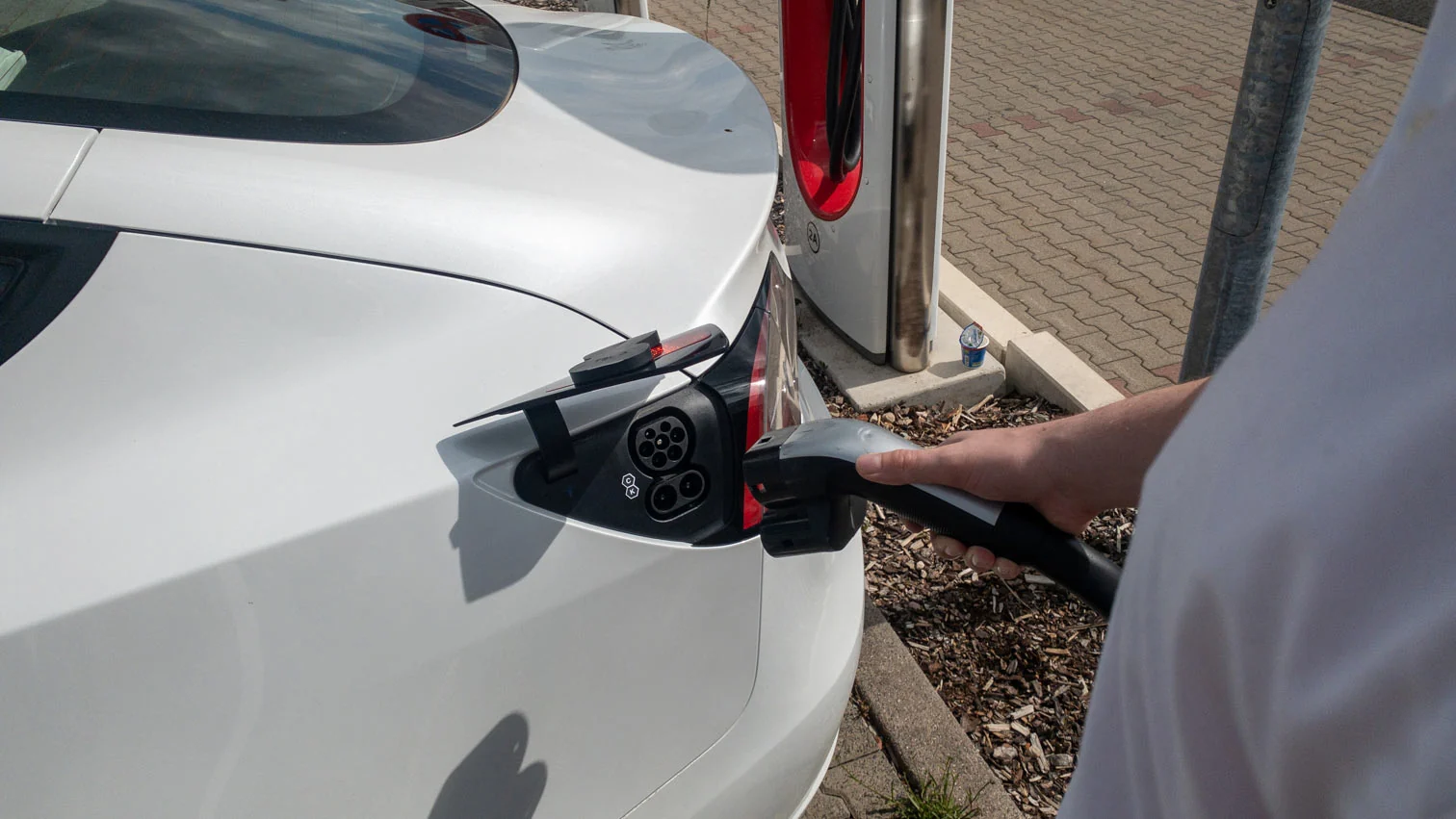
The mediation took place in a conference room three towns over.
No judge. No courtroom. No dramatic opening statements. Just Derek, me, two attorneys, and a mediator named Paul Reynolds who began by saying something I appreciated immediately.
“I’m not here to decide which one of you is a good neighbor.”
That took half the emotion out of the room before we’d even started.
“My job is to help you decide whether there’s a practical agreement you can both live with.”
I want to back up first, though, because if I only tell you about the conference room, you won’t understand why it took months to get there, or why something as ordinary as a Tesla charging cable managed to eat up an entire summer of my life.
I’ve lived in this house eleven years. Bought it right after I went out on my own as a cabinet installer, back when my van was a used thing with a cracked bumper and half my tools rode loose in the back because I couldn’t afford a proper shelving system yet. That driveway matters to my work in a way most people never think about. I back my van in every single night, load it every single morning before sunrise, sometimes carrying eighty-pound hardware cases or full sheets of cabinet-grade plywood. I need that concrete clear, every day, without having to think about it. That’s not vanity about my property. That’s my livelihood parked six feet from my front door.
Derek moved in next door about two years ago. Nice enough guy at first, always waved, once helped me carry a dishwasher up my front steps when my regular helper called in sick. Then he bought the Tesla, had a home charger installed on the side wall of his garage, and discovered, apparently after the electrician had already left, that the cable didn’t quite reach his actual parking spot without crossing over onto my driveway.
The first time, it really was just for a few hours. He knocked on my door, told me his charger placement was a little off, asked if he could run the cord across the edge of my driveway just this once while he figured out a better solution. I said fine. Who wouldn’t? It’s a cord. It’s an afternoon.
Then it was the next weekend too. Then it became something I’d just find lying there on a Tuesday morning without so much as a knock, a black cable stretched low across the corner of my pavement, connecting his garage wall to his car parked in his own driveway on the far side. I mentioned it to him again, and he apologized, said he’d get it sorted, and then the cord came back the following week with a rubber ramp over it, the kind you’d see protecting cables at a construction site, so that, in his words, I could just drive right over it without any trouble at all.
I didn’t want to drive over it. Not because I thought it would electrocute me or damage my tires. I just didn’t want a stranger’s equipment dictating where I could and couldn’t put my own vehicle on my own property, day after day, indefinitely, because he’d decided that was the easiest solution for him.
When I said no to the ramp, the ramp got sturdier. A better one, bright orange, more visible, with a little more give in the rubber, like he thought the object itself was the problem and if he just engineered a nicer object, my objection would evaporate. When that didn’t work either, I came home one afternoon to find two workers on their knees at the edge of my driveway with a drill, starting to sink small anchor bolts into my pavement to hold the ramp permanently in place.
That was the day I stopped talking to Derek directly and started talking to my phone camera instead.
I documented everything from that point forward. Every date. Every photo. Every text message, mine polite, his increasingly exasperated, like I was the unreasonable one for not wanting permanent hardware fastened into concrete I’d paid to have poured. I hired an electrician, a careful, unbiased man named Roy Fenster, to come out and actually test whether Derek’s charger even needed to cross my property in the first place, because at some point I realized the real question wasn’t about ramps or cords or courtesy. It was about whether Derek’s whole setup had ever been physically necessary, or whether it had just been convenient, at my expense, from day one.
Roy’s answer, when it came, was quiet and unambiguous. The charger’s wall location, combined with the cable’s fixed length, combined with the only usable parking spot near it, meant the lead simply would not reach without crossing my driveway. No longer aftermarket cable solved it. No different parking angle solved it. The setup, as installed, structurally depended on my property.
That report is what finally got me a lawyer, a sharp, no-nonsense woman named Sarah Mitchell, and it’s what eventually got us both into that conference room three towns over.
My attorney began with the simplest term she could offer. “My client’s driveway remains completely clear of charging cables, ramps, protectors, fasteners, brackets, or other equipment associated with Mr. Collins’s vehicle charging.”
Derek’s attorney nodded easily. “We can agree there will be no permanent attachment.”
Sarah shook her head. “That isn’t enough.”
Derek leaned forward, arms crossed. “So I can’t even lay down a cable for an hour?”
“Not across his driveway.”
“It’s temporary.”
“That distinction has already failed,” Sarah said, and I watched something in Derek’s jaw tighten, because we both knew exactly what she meant. Every single time, it had started as temporary.
Derek turned to look at me directly for the first time since we’d all sat down. “You really brought lawyers into this because you don’t want to drive over a cord.”
I almost answered him right then, some sharp retort already forming, but Sarah touched my arm lightly, just enough to remind me. Let the process work.
The mediator turned toward Derek instead. “Can the vehicle be charged from the existing unit without crossing his driveway?”
Derek started explaining the protectors again, the ramps, the anchoring plan, how careful the installation would have been.
Paul cut him off gently. “That isn’t what I asked.”
Sarah slid the electrician’s written summary across the table. No dramatic photographs in it. No stack of angry texts. Just a single page of clean technical language. Roy had documented the charger model, the cable’s actual reach in feet and inches, every alternative route he’d physically tested with a tape measure, the available parking positions on Derek’s own property, and the plain fact that no manufacturer-listed longer replacement lead solved the reach problem from the unit’s current wall location.
His conclusion took up two sentences. If the driveway crossing was unavailable, the existing wall location did not serve Derek’s usable parking area. Full stop.
Derek’s attorney read it carefully, twice, before he spoke. “Has anything changed since this test?”
“Different charger?”
“No,” I said.
“Different cable?”
“No.”
“Different parking location?”
“No.”
“Different wall position?”
“No.”
The room went quiet in a way that felt almost physical, the kind of silence where you can hear the air conditioning cycling on.
The mediator leaned back in his chair. “So the current system functions as Derek wants only if the charging lead crosses Marcus’s driveway.”
“Yes,” Sarah said.
Derek frowned, clearly unhappy with how flatly that had just been laid out in front of him. “It functions perfectly.”
“For you,” I said.
Sarah glanced at me, a small warning look, but the words were already out and hanging there.
Derek stared across the table at me. “I put a protector down. You could drive over it.”
“I didn’t want to.”
“Why?”
That question had bothered me for weeks, honestly, turning over in my head at odd hours while I was loading the van or lying awake. Why. As though I needed some deeper, more sophisticated justification than the plain fact of ownership. As though not wanting a stranger’s equipment on my property required an essay.
“Because it’s my driveway,” I said.
He rolled his eyes, an actual eye roll, like a teenager. “That’s not an answer.”
Paul leaned forward. “It actually is.”
Derek looked at him, surprised.
The mediator continued, calm and even. “We can debate whether it’s reasonable for you to want that, Marcus. But if both parties agree Marcus controls the driveway, and I don’t hear anyone disputing that, then the real question on the table is whether Derek wants a settlement that ends the crossing, or wants to litigate the actual right to keep using it.”
Derek said nothing for a long moment.
For the first time since this whole mess started, back in early spring, the dispute was being laid out without any of the noise that had accumulated around it. No talk of Teslas being good for the environment. No electrical-code theorizing Derek liked to bring up when he was losing an argument. No debate about whether rubber protectors were technically safe to drive over. Just one plain, unavoidable fact: one person’s equipment had repeatedly occupied another person’s access route, after permission had been clearly and repeatedly denied.
Derek and his attorney asked for a private caucus. They left the room with Paul. I stayed behind with Sarah.
“You think he’ll agree?” I asked.
“He might.”
“Why?”
“Because the issue is getting expensive for him. Every hour in this room costs him money he didn’t have to spend.”
“He could’ve moved the charger weeks ago. Would’ve cost him less than half of one of these mediation sessions.”
Sarah smiled, the kind of tired, knowing smile of someone who’s watched this exact pattern play out with a hundred other clients. “People don’t always resist because the solution is impossible, Marcus.”
“What else, then?”
“Sometimes they resist because accepting the solution means accepting they were wrong in the first place.”
That described Derek better than any legal argument I’d heard all morning. He wasn’t an evil person. I want to be fair about that, even now, even after everything. He wasn’t trying to destroy my business or ruin my life out of spite. He had installed a charger in a location that only worked conveniently if the cable crossed my driveway, probably without even realizing the constraint until the electrician had already packed up his van and driven off. The first few times, I genuinely believe he thought I would simply accommodate it, the way good neighbors are supposed to smooth over small inconveniences for each other. When I didn’t, when I kept saying no, he treated my refusal as somehow irrational, an obstacle to engineer around rather than a boundary to respect.
So instead of changing the setup itself, he kept improving the crossing. Cable. Then a protector. Then a better protector. Then a larger ramp. Then anchors sunk into my concrete. Every single step invested more money and more effort into preserving the original flawed assumption. That my driveway would simply always be available to him, because it was easier for him if it was.
Paul returned about twenty minutes later. Derek followed him back in, quieter than before.
The mediator sat back down. “Let’s try language.”
The first term came easily enough. No charging cable, protector, ramp, fastener, bracket, or charging-related equipment could cross or be placed on my driveway without my express written permission.
The second term addressed the attempted anchors, the small drilled starts already sitting in my pavement. Derek would pay for the repair. Still easy, no real argument from anyone.
Then we got to the charger itself.
Derek’s attorney proposed leaving the wall unit exactly where it was, but agreeing in writing not to use it in any way that crossed my property.
Sarah refused immediately. “Why?” Derek asked, genuinely seeming not to understand.
“Because this exact wall location has generated every single version of the crossing we’re sitting here discussing,” Sarah said. “The cable. The protector. The ramp. The anchors. All of it traces back to this one spot on your house.”
“I can leave it there and just not use it.”
“Then why leave it at all?”
“Because it cost money to install.”
Sarah slid Roy’s technical note back toward him across the table. “If you find a legal, manufacturer-approved way to use that exact unit entirely on your own property, without it ever needing to cross onto Marcus’s land, that’s a different conversation entirely, and we’d have no objection. But that is not the current configuration you’ve described to us, and it’s not what your own electrician’s warning email suggested either.”
Derek shook his head, frustration creeping back into his voice. “You’re trying to control what’s installed on my own house.”
“No,” I said, before Sarah could answer. “I don’t care what charger you have. I don’t care that you drive a Tesla. I never did.”
“Then stop demanding I remove it.”
“I care that this particular one, in this particular spot, keeps requiring my driveway to function. That’s the whole thing. That’s all it’s ever been.”
Paul raised a hand, cutting through before it turned into a real argument again. “What if the settlement requires the disputed sidewall charging arrangement to be discontinued, and the connector removed or relocated by a specific date? Derek remains entirely free to reuse the exact same equipment somewhere else on his property.”
That was exactly the distinction I’d been trying to make since the very first knock on my door back in the spring. The unit itself had never been the enemy in this. The location was.
Derek and his attorney spoke quietly to each other for a minute, heads bent together. Then Derek looked back up. “I can move the same charger?”
“Yes,” Paul said.
“Use it on the other side of my house?”
“If it’s properly installed and everything stays entirely on your property, nobody in this room objects to that.”
He looked at me directly again. “You really don’t care?”
“No.”
“Then why did this become such a huge deal? Lawyers. Electricians. This whole room.”
“Because you kept putting it across my driveway, Derek. Every single time I said no, you found a new way to keep doing it anyway.”
The answer seemed to genuinely irritate him, precisely because of how simple it was, how little room it left for him to feel like the reasonable party in all this. But after one more short, quiet conversation with his attorney, he agreed.
The final settlement, once we actually wrote it out, was short. No charging equipment on my driveway, ever, under any circumstance. No permanent or temporary crossing without my written permission first. The damaged pavement marks repaired at Derek’s expense. The wall connector at the disputed location removed by an agreed deadline, thirty days out. Any replacement or relocated charging arrangement had to operate entirely without entering my property, full stop, no exceptions carved out.
No one in that room declared Derek’s charger illegal. No one declared his Tesla some kind of nuisance vehicle. No one ordered his electricity disconnected or fined him for anything. He simply agreed, in writing, with his own signature, to retire a setup that had always depended on space he didn’t actually own.
Before we signed, Paul asked each of us the exact same question, looking us both in the eye in turn. “Do you understand that this is a voluntary settlement?”
“Yes,” I said.
Derek hesitated for a second, just a beat too long. Then said, “Yes.”
We signed. There was no handshake afterward. Outside in the parking lot, Derek walked toward his car without looking at me once.
Sarah and I stood near the entrance a minute longer, watching him go. “You got what you wanted,” she said.
“My driveway.”
“That’s what I mean.”
The strangest thing was that nothing looked different at all when I actually got home that evening. The pavement was empty, the way it had been for several days already while the mediation process ground forward. The wall charger still hung on Derek’s house, unchanged. The ramps were still stacked nearby against his garage wall, waiting. The physical scene looked exactly the same as it had that morning.
The difference, the only difference, was that I no longer had to wonder whether the crossing would come back tomorrow. That not-wondering turned out to be worth more than I expected.
A few days later, an electrician’s truck pulled up outside Derek’s house. I was inside my own garage, reorganizing hardware bins, half-listening to a podcast, when I heard the truck door slam shut. I stepped outside without really meaning to, just curiosity pulling me.
The Tesla wasn’t plugged in. The cable hung coiled neatly beside the wall connector, unused. An electrician, not the same one who’d installed it originally as far as I could tell, opened the unit’s housing and checked that the circuit was dead before he touched anything else.
I didn’t go over. I didn’t need to supervise a stranger doing his job. But every few minutes, without really trying to, I glanced up from my own work anyway.
The front cover came off first. Then the internal connections were disconnected one by one. The charging lead itself was secured and coiled properly. The mounting bolts came out of the siding, one at a time, the electrician working with the unhurried patience of someone who does this exact task every week and has no particular feelings about it. Finally, he lifted the black wall connector clean away from Derek’s siding and carried it toward his van.
There was nothing dramatic about the moment, when it actually happened. No sparks. No police showing up. No shouting match on the front lawn. Just a man on a short ladder removing a piece of equipment from one exterior wall, the way electricians do a dozen times a week in any given neighborhood.
Derek stood nearby the whole time, arms crossed, watching. I couldn’t hear what the two of them were discussing, and I didn’t try to. It wasn’t my business anymore, not really, not once that connector came off the wall.
The electrician carried the charger toward his van, set it carefully inside, and closed the doors. And for the first time in months, I looked over at that side of Derek’s house and saw absolutely no obvious reason anything would ever need to cross my driveway again.
The ramps disappeared next, hauled away sometime over the following weekend while I wasn’t paying close attention. Then a small repair crew arrived to patch the marks that had been left behind from the attempted anchoring. The damage turned out to be minor once someone actually looked at it properly. A few shallow drill starts, nothing structural, nothing worth turning into some inflated insurance claim the way I could have, if I’d wanted to be petty about it. They filled the holes, feathered the patch in, checked the edge of the pavement for any hairline cracking, and left within the hour.
I ran my hand over the repaired spot later that afternoon. Smooth. Done. You’d never have known, looking at it, what it had taken to get there.
Then I carried the orange traffic cones from my front entry back into the garage and stacked them in the corner where they belonged. Those cones had become part of my daily routine somewhere along the way, without me ever quite deciding to make them one. Every single time the cable appeared across my driveway, I’d set them down at the edge, not to trap Derek’s equipment, not to make some public statement to the neighborhood, just to make sure nobody, myself included some groggy morning, accidentally drove straight over live electrical hardware while my own access sat blocked. I was genuinely glad to put those cones away for good.
For about a week after that, Derek had no charger at all, and I noticed, driving past, that his Tesla sat in his driveway looking a little forlorn, presumably running down toward empty with nowhere convenient to plug in.
Then another electrical truck showed up, this time on the opposite side of his house, the side that actually faced his own usable parking area rather than the shared boundary line with me. That caught my attention immediately. I watched from a distance, not spying exactly, just naturally curious about my own street.
The workers ran fresh conduit along that far wall. Opened up a section near his existing electrical panel. Mounted new hardware significantly closer to where Derek actually parked his car day to day. A day or two later, I saw the same black wall connector, the very one that had caused all this trouble, being carried around the side of the house by two workers and remounted in its new location.
He was reusing it. Same unit. Different wall entirely.
That made me strangely, genuinely happy, in a way I hadn’t fully expected. Not because I cared one way or another whether Derek saved a few hundred dollars on hardware he’d already paid for once. But because it proved, plainly, without any argument left to have about it, exactly what I’d been saying from the very first knock on my door back in the spring. I had never wanted to take anything away from Derek. I never once objected to him owning an electric car, or charging it, or enjoying whatever convenience that brought him. I only ever wanted his solution to stay entirely on his own property, where it belonged.
The charger, once fully installed in its new spot, sat mounted near Derek’s own driveway, on his own side of the shared boundary. The Tesla parked right beside it. The cable dropped down cleanly from the unit and curved a few short feet across his own pavement before plugging into the car’s charging port.
It reached easily. No ramp needed. No protector needed. No cable crossing anywhere near my access. No inconvenience to me whatsoever. And, as far as I could tell watching him park there over the following weeks, no real inconvenience to him either, beyond the simple adjustment of parking in a slightly different spot than the one he’d originally preferred back before any of this started.
The first evening I actually saw the new setup working, fully installed, cable plugged in and charging, I slowed my van near the entrance to my own driveway, almost without thinking about it. Pure habit by that point, built up over an entire summer of vigilance. For weeks and weeks, I had trained myself, every single time I turned onto our street, to automatically check. Tesla present? Charging right now? Cable crossing anywhere? Ramp out? Can I actually get into my own driveway tonight, or do I need to park on the street again and carry everything by hand?
That particular night, Derek’s car was charging. I could see the small green status light glowing steadily on the connector from the street, visible even in the dusk. The charging cable stayed entirely on his side of the property line, a neat little arc of black cord against his own pale concrete.
My driveway sat completely empty, waiting for me the way it was always supposed to.
I backed the van straight into the garage. Ten seconds, maybe less. That was genuinely all it took. No unloading materials onto the curb because I couldn’t get closer. No carrying heavy clamps and hardware cases fifty extra feet down the sidewalk. No leaving expensive tools sitting overnight in a vehicle parked out on the street where anyone could break a window. No checking whether Derek was almost finished charging before I dared to pull in. No standing awkwardly at his front door wondering whether I should knock and ask him to move his car.
Just normal, ordinary, boring access to my own driveway. The kind every homeowner in America takes for granted every single day without a second thought.
The normality of it actually surprised me, more than I expected it to. For weeks, this whole dispute had occupied enough space in my head that I started thinking about it every single time I turned onto my own street, bracing myself before I even rounded the corner to see what I’d find waiting there. And then, almost overnight, the problem simply disappeared. Not dramatically. Not with any grand final confrontation. It just quietly stopped happening, day after day, until I realized I’d gone a whole week without thinking about it at all.
Derek and I didn’t become friends after all this. I want to be honest about that. We also didn’t become enemies, exactly. We passed each other outside from time to time, taking out trash cans or walking to our cars. Sometimes he nodded at me. Sometimes I nodded back. The wave-and-small-talk relationship we’d had in the very beginning, before the charger ever went in, never quite came back, but something civil and quiet settled in its place instead.
Once, about a month after the mediation, I was carrying a full sheet of plywood from my van toward my garage when he called over from his own driveway, “New charger location works fine.”
I stopped and set the plywood down against my hip. “Good.”
He looked, for just a second, like he wanted to say something more. Maybe an apology. Maybe some kind of explanation for the whole summer. Maybe one last attempt to defend himself and how reasonable he’d actually been through all of it.
Instead, he just nodded once and went back inside his house.
That was enough. I never actually needed an apology from him, not by that point. The settlement had already given me everything I actually wanted.
By then, looking back on the whole mess, I understood something about the entire dispute that I hadn’t understood clearly back at the very beginning, back when it was still just an afternoon favor between two neighbors. The cable itself had never really been the biggest problem. The real problem was how easily a small, temporary inconvenience can quietly calcify into an assumed entitlement, one small step at a time, if nobody stops it early enough.
The first crossing really was, in his mind and mine both, “just for a few hours.” Then it happened again the following weekend. Then Derek added a protector, because in his thinking, apparently, the actual problem wasn’t that his equipment was occupying my driveway at all. The problem, as he saw it, was simply that I was unwilling to drive over it. When I rejected even that solution, he upgraded the protector to something sturdier. Then he tried to anchor the whole route permanently into my concrete with a drill.
Every single improvement he made solved the wrong problem entirely. He kept quietly asking himself, project after project: how can I make my cable easier for Marcus to tolerate? The actual question he should have been asking, from the very first week, was: why does my charging setup require Marcus’s property at all?
Once Roy actually tested the route properly, with a tape measure and an unbiased eye, the answer became completely undeniable. The charger’s original location simply did not serve Derek’s usable parking area without crossing my driveway. Full stop, no way around it. From that point forward, every protector and every ramp had really just been an increasingly elaborate attempt to preserve a setup that had, from the very beginning, depended entirely on somebody else’s space.
That’s exactly why the written settlement mattered so much, more than I initially expected it to. It removed every last bit of ambiguity that had let this drag on for months.
Sometimes neighbors survive perfectly well on nothing but informal cooperation, and I still believe in that, even after everything. You borrow a ladder for an afternoon. Someone rolls your garbage bin back in from the curb while you’re out of town for a week. A delivery truck turns around partly in another driveway because there’s nowhere else to swing a trailer that size. Nobody calls a lawyer over any of that. That kind of everyday flexibility between neighbors is genuinely good, and I’d never want to live somewhere without it.
But cooperation stops being cooperation, I learned this summer, the exact moment one person says no clearly, and the other person just keeps quietly designing new ways around that answer instead of actually hearing it.
My work changed a little because of the whole dispute too, in ways I didn’t expect going in. I became noticeably more conscious of how often people simply assume that convenience creates permission, without ever quite meaning to think of it that way. As a cabinet installer, I’m in and out of other people’s homes constantly, their driveways, their garages, their kitchens, staging materials and running cords of my own. Sometimes customers tell me upfront to stage wherever’s easiest for me. Sometimes they don’t say anything at all, and I used to just assume that meant it was fine.
I started asking more precise questions after that summer. Can I use this side gate to bring materials through? Is this particular parking area actually yours, or does it belong to the unit next door? Can I set my tool cases down here, or would you rather I kept them by the truck? Small things, all of it. Maybe some of my customers thought the questions were a little unnecessary, a little overly cautious for a cabinet job.
But after watching, up close, for months, how easily Derek turned one small assumption into what he genuinely believed was a permanent right, I understood, in a way I hadn’t before, the real value of asking first, before you build your whole plan around a piece of someone else’s space.
A few months later, I had an early installation job clear across town, a big kitchen remodel that needed me on site before sunrise to beat the homeowner’s work schedule. I walked into my own garage in the dark that morning. My van sat exactly where I wanted it. I opened the rear doors and loaded the last hardware case in by feel more than sight.
Next door, through the gap between our houses, Derek’s Tesla was charging. I could see the faint green glow from the relocated wall connector, mounted now on his own far side, well clear of the property line. The charging cable curved neatly toward his car, a small, unremarkable detail of an ordinary morning.
I closed the van doors. Hit the garage-door remote. Started the engine, letting it warm for a second in the cold air.
As I backed slowly down my driveway, my headlights swept across the pavement ahead of me, the way they did every single morning. For weeks and weeks, all through that terrible summer, I had automatically, almost involuntarily, searched that beam of light for a black cable stretched across the concrete.
That particular morning, I realized, halfway down the driveway, that I hadn’t looked for it at all. Not once. I hadn’t needed to.
The route was simply clear. My tires reached the road without slowing, without swerving, without a single thought given to what might or might not be lying across my own property.
Derek could charge his car whenever he wanted to, any hour of the day or night. I could use my own driveway whenever I wanted to, the same way. Nobody had lost electricity. Nobody had lost a car. Nobody had been forced by some town ordinance to rip charging equipment out of the neighborhood entirely. One single charger had simply, eventually, been moved to a location where it no longer required somebody else’s property in order to function properly.
The final solution, once we actually arrived at it, was almost embarrassingly ordinary. That, honestly, might have been the single most frustrating part of the entire ordeal, looking back on it now. Months of photographs. Text messages. Traffic cones. Rubber protectors. Electricians called out to test cable lengths with a tape measure. Attorneys billing by the hour. An entire formal mediation in a conference room three towns over.
All of it, every bit of it, just to arrive at the single most obvious arrangement imaginable. His equipment stays on his property. My driveway stays clear.
Sometimes a boundary dispute really is genuinely complicated, full of murky property lines and ambiguous old easements nobody can quite agree on. This one only became complicated because the simplest boundary imaginable, the literal edge of my own driveway, kept being treated, month after month, like some inconvenience that needed to be solved around rather than simply respected.
In the end, the actual answer was never louder arguments. It wasn’t damaging Derek’s cable out of spite, tempting as that occasionally was on a bad Tuesday. It wasn’t driving straight over it just to prove some point about ownership. It wasn’t trying to get the town to condemn a perfectly legal home charger out of pure irritation.
It was patience. Careful documentation, date by date. One clear technical answer to the single question that actually mattered. And eventually, a short, plainly written agreement that made the boundary impossible for anyone, including Derek, to misunderstand ever again.
Derek’s Tesla still charges next door to this day. My van still backs cleanly into my garage every single night, ten seconds, no thinking required. The two systems operate a few quiet feet apart from each other, my property and his, exactly the way they always should have.
They simply don’t overlap anymore.
And that, from the very first knock on my door back in the spring, was genuinely all I had ever wanted.

Specialty: Legal & Financial Drama
Michael Carter covers stories where money, power, and personal history collide. His writing often explores courtroom battles, business conflicts, and the subtle strategies people use when pushed into a corner. He focuses on grounded, realistic storytelling with attention to detail and believable motivations.