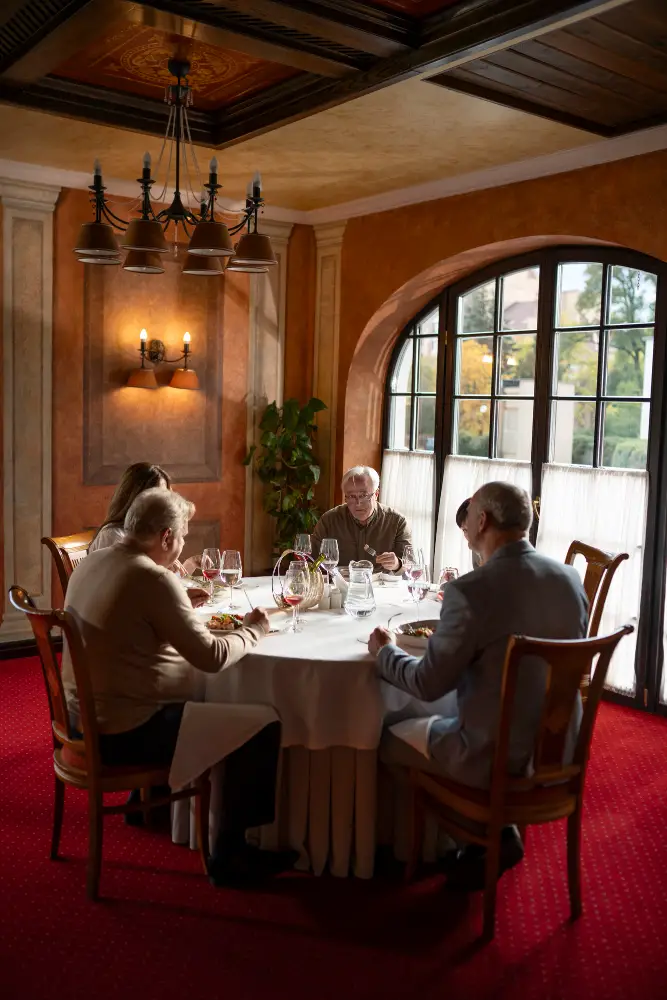
I was reaching for the back of my chair, about to pull it out and sit down at my father’s sixtieth birthday dinner, when he put his hand flat against the frame of it and shoved it away from me across the carpet. He did not even look at me while he did it. He was looking at the wine list, and he said, in the same tone he might have used to send back a dish, “I don’t sit down to eat with a poor, useless kid.”
For about half a second, nobody in that room reacted at all. The silence had a texture to it, the particular held-breath quality of a table full of people deciding, very quickly and all at once, how they were going to pretend this was fine, how they were going to fold this moment into the evening and keep going. That half second told me everything about the people at that table, though I already knew it. Not one of them was surprised. Shocked, maybe, at the bluntness of it, at hearing out loud a thing that was usually left unspoken. But not surprised. Because they had all watched my father treat me this way, in smaller quieter increments, for my entire life, and they had all found their own private ways of going along with it.
Then my aunt laughed. It was a bright brittle little laugh, and she covered it a beat too late with her napkin, and in that beat I saw that the laugh was not cruelty exactly but nerves, the reflexive giggle of a woman who does not know what else to do with a terrible moment and reaches for the sound that has smoothed over terrible moments at family tables her whole life. My cousin smirked down into his wineglass and turned it slowly by the stem, giving himself something to look at that was not my face, because looking at my face would have required him to have a feeling about what was happening, and he had decided long ago never to have feelings about my father that might cost him anything. My mother stared down at her bread plate as though there were something written there in tiny letters that required her complete and total attention. And my younger sister, Vivian, who was twenty-eight and had spent her whole life being the pretty easy one my father approved of, quietly lifted her phone out of her lap, held it just above the edge of the tablecloth, angled it, and started recording. I did not know, in that moment, why she was doing it. I found out later. But I saw her do it, and something in me understood that whatever was about to happen, there would be a witness who was on my side.
My name is Colette Ardan. I was thirty-two years old on the night all of this happened, and I had driven three hours, from one city to another, from the smaller place where I lived to the larger one where my family gathered, for the privilege of standing in a private room at one of the most expensive restaurants in the state and being told by my own father that I was not fit to sit at his table.
My father had spent the entire length of my childhood measuring the worth of every person he ever met by what they could put on display. Cars, first and always, because a car sat in the driveway where the neighbors could see it. Houses, and the neighborhoods they sat in, and the square footage he could work into a conversation within ten minutes of meeting you. Titles on business cards, which he collected and evaluated like a man appraising coins. The particular weight and brand and visibility of a wristwatch, which he believed told you more about a man than an hour of conversation ever could. He could walk into a room and tell you, within a few thousand dollars, what every man in it was worth, and he arranged the temperature of his attention accordingly, more warmth for the ones who had more, a cool and efficient and unmistakable nothing for the ones who had less.
I had grown up watching him do this. I watched him do it to waiters, whom he treated as furniture, and to his own brothers, whom he ranked and re-ranked according to their fortunes, and to men who had been his closest friends for thirty years and who fell out of his favor the moment their businesses stumbled. I watched him become someone else entirely in the presence of money, softer and eager and almost boyish, and I watched that softness vanish like a light switched off the moment the money left the room. And I grew up understanding, without anyone ever once saying it to me directly, that the very same scale he applied to strangers and waiters and friends was always, always being applied to me. That I was, to my father, a number that could go up or down. That his love, if that was even the word for it, was not a fixed thing I could count on but a variable that tracked my visible success, and that I would spend my life either climbing toward it or falling away from it, and never simply resting in it the way a child is supposed to rest in a parent’s love.
And by the measures my father used, I had nothing. No car worth mentioning, no house he had ever seen, no title he recognized, no watch at all. At least, none that he knew about. That distinction would turn out to matter a great deal before the night was over, but he did not know it yet, and so, by the only arithmetic he had ever bothered to learn, his daughter was a failure, and a failure did not get a chair.
Three years before that dinner, I had left his construction company. I had worked there for most of a decade, and I had been good at it, better than good, and in my last two years there I had personally negotiated the two largest commercial contracts the firm had ever signed, deals that kept the crews busy through a lean stretch that put two of his competitors out of business. And when I asked him, after the second of those contracts closed, to promote me past the title of project coordinator, a title I had held for six years while doing work that no coordinator anywhere had ever been asked to do, he refused. He did not even really consider it. He told me, with the air of a man delivering a hard truth for my own good, that I simply could not handle pressure, that I got emotional, that the client-facing world was no place for someone who took things as personally as I did. And then he told the same thing to everyone else. To my mother, to my aunt, to the men on the crews, to anyone who asked why I had gone. Colette couldn’t handle the pressure. It became the official story of me, repeated so often and so confidently that I sometimes wondered whether he had come to believe it himself.
So I left. It was the hardest thing I had done up to that point in my life, harder than any contract, because leaving meant giving up the last hope I had been secretly carrying since childhood, the hope that if I was just good enough for long enough, he would finally see it, finally say it, finally move my chair toward the table instead of away from it. Walking out of that company meant admitting that the day was never coming. I cleaned out my desk on a Friday afternoon while the crews were still in the field so that I would not have to explain myself to anyone, and I drove home, and I sat in my car in the parking lot of my building for a long time before I went upstairs.
I moved out of the nice part of the city into a modest apartment on the wrong side of it, a one-bedroom over a laundromat where the whole place smelled faintly of dryer sheets and where I could hear my neighbors’ televisions through the walls. I kept driving my Honda, which was already eight years old then and is eleven now and which I have absolutely no intention of ever replacing, because it starts every single morning and owes me nothing and does not care in the slightest what anyone thinks of it, which is a quality I have come to prize in a car and in a person. And I started consulting on my own, quietly, one client at a time, working from a folding table in the corner of that one-bedroom with the laundromat humming underneath me.
To my family, all of this read as exactly one thing, and it read as that thing loudly and unanimously. It read as failure. It read as proof. It read as the natural and entirely predictable result of a girl who could not handle pressure going off on her own to try to handle it, and coming, obviously, to grief. My father did not gloat about it. I want to be fair to him, or at least accurate. Gloating would have been almost easier to bear, because gloating at least acknowledges you as an opponent. What he did instead was worse. He pitied me. Warmly, publicly, at family gatherings, in front of my aunts and my cousins, he would ask how I was getting by, in a soft concerned voice, and shake his head gently at my answers, and let everyone in earshot understand that his poor daughter was struggling out there on her own but that the door at the company was always, always open if I ever wanted to come back to a job I could actually manage. He made my independence into a symptom. He made my leaving into a cry for help he was generously choosing not to hold against me.
So when my father shoved my chair away from me at his birthday dinner, he was not joking, and he was not performing, and he was not, whatever he told himself later, having a bad night. He was saying, out loud, in front of the whole family, the thing he had believed about me quietly for years. He was finally saying it to my face because he thought I had become small enough that he could.
“Go on and sit at the bar,” he said, gesturing vaguely toward the door of the private room. “There are stools out there. This table is for people who actually accomplished something with their lives.”
My face was burning. I could feel it, the heat climbing up my neck and into my cheeks, the old childhood shame arriving right on schedule, my body still loyal after all these years to the reflex he had trained into it. But my voice, when it came out of me, was perfectly calm.
“Okay,” I said.
I saw my sister Vivian’s phone lower, just slightly, just an inch. She had heard the tone. She knew that tone. She had grown up in the same house I had, and she knew that when I went quiet and even and agreeable like that, it did not mean I had given up. It meant the opposite. It meant I had stopped hoping and started deciding. My father, who had never once in his life paid close enough attention to me to learn my tones, did not know it. He heard okay and he thought he had won.
I reached into the bag on my shoulder, and I took out a navy folder, and I set it down on the white tablecloth beside his plate, square and quiet.
“You just made a very expensive mistake,” I said.
He finally looked at me then. Actually looked at me, for the first time all evening, his eyes coming up from the wine list to my face with an expression of irritation that was just beginning to curdle into something more uncertain.
“What is this?” he said.
“Open it and see,” I said.
He did not want to. I watched him not want to. But there were people watching, and a man like my father cannot bear to look uncertain in front of an audience, and so he flipped the folder open with two fingers as though it might be something distasteful. And the smirk that had been sitting on his face went out like a blown candle the instant he saw the letterhead on the first page.
Six weeks before that dinner, my father’s company, Ardan Construction and Development, the company that was his whole identity, the thing he had spent thirty-five years building so that he would have something to measure himself by, had defaulted on a commercial loan of six and a half million dollars. The loan was tied to a large apartment project on the edge of the city, an ambitious build he had staked a great deal on, that had stalled out halfway to the sky and been sitting there ever since, a gray concrete skeleton wrapped in chain-link, weeds coming up through the staging area, bleeding him money in interest and security and idle equipment for well over a year. He had missed three payments on it. Three. In the world of commercial lending, three missed payments is not a rough patch, it is a flare going up over a sinking ship, and every lender in the state can see it.
The bank that had originally made the loan did what banks quietly and unsentimentally do with bad debt they no longer wish to nurse along. It sold the loan off, at a discount, to a private investment firm, taking its loss and washing its hands of the whole affair and moving on, because a bank is not in the business of feelings, it is in the business of not holding paper that has stopped performing. And my father, for the several weeks before his birthday, had been in a series of increasingly tense and increasingly desperate negotiations with that private firm, hat in hand, a posture that did not come naturally to him, trying to persuade them to grant him an extension, more time, a restructuring, anything, before they moved to seize the collateral and end him. He had been telling the family, meanwhile, that everything was fine. That there had been a little cash-flow timing issue with one project. That it was handled. That it was under control. He was very good at under control. He had been saying it my whole life.
What my father did not know, could not have imagined, was that the small consulting business he pitied me for had grown, over three years of quiet relentless work, into something considerably larger than a woman and a laptop in a cheap apartment. And what he most certainly did not know was the name of the private investment partnership that now held his loan.
“You,” he said slowly, reading the page, and I watched the understanding arrive behind his eyes. “You bought my loan.”
“Not just the loan,” I said.
I reached over and turned the page for him, because his hands had gone still.
Clipped behind the loan assignment was a formal notice of foreclosure, naming the warehouse, the equipment yard, and the office building that secured the debt, the physical body of the company he had spent thirty-five years building, all of it now pledged against a note that belonged to me.
The private room, which a moment before had been full of the small sounds of a dinner party, went completely silent. My aunt was no longer laughing. My cousin had set down his wine.
And my father, when he finally spoke, did not shout. He whispered it, and there was something in the whisper that I had never once heard from him in thirty-two years, a thin thread of genuine fear.
“Colette,” he said. “What did you do?”
I pulled the chair back out from where he had shoved it, the same chair, the very one, and I sat down in it, unhurried, and I settled my bag on the floor beside my feet where I could reach it, and I looked at him across the flickering birthday candles. There was a symmetry to it that I confess I enjoyed. He had used the chair to say a thing about where I belonged. I was going to use the same chair to say the opposite.
Nobody laughed now. Nobody smirked. My cousin was studying the weave of the tablecloth as though he might be tested on it later. My aunt had discovered something enormously important in her own lap. My mother had not moved. The whole vast familiar apparatus of my family, the laughter that greeted his cruelties and the pity that dressed up his contempt and the confident, endlessly repeated story of who I was and what I could and could not handle, all of it had simply stopped working at once, every gear of it seized, and into the silence where it had been you could hear the ordinary restaurant murmuring pleasantly on the far side of the door, the clink and hum of a whole world of people who did not know that anything at all was happening in the private room, a world where a Tuesday was just a Tuesday.
My father read the foreclosure notice a second time, all the way through, and then a third, his thumb rubbing back and forth along the edge of the paper as though if he worried at it enough the words might smudge and rearrange themselves into something he could live with.
“You did this to punish me,” he said. It was not quite a question.
“No,” I said. “I bought a distressed commercial note because acquiring distressed commercial notes is what my firm does. Yours came across my desk the way a dozen others have. I recognized the name. I made a decision. But I didn’t go looking for a way to hurt you, if that’s what you’re asking. I didn’t have to. You defaulted all on your own.”
His eyes narrowed at that. “Your firm,” he said, and there was disbelief in it, the disbelief of a man who has spent three years telling everyone his daughter runs errands out of a studio apartment.
“My firm,” I said.
Vivian was still recording. I could see the small dark eye of the phone over the top of the flower arrangement, and I did not ask her to stop, because I had spent my whole life having the story of me told by other people, and for once there was going to be a record that told itself.
I explained to the table what not one of them had ever bothered to learn, because not one of them had ever asked me a single real question about my work in three years. That the consulting I had started in the corner of that laundromat apartment had not stayed consulting for very long. That I had drifted, almost by accident in the beginning and then very deliberately once I saw the shape of it, into restructuring, into the specific, unglamorous, deeply necessary work of helping struggling contractors and small developers survive. When a builder took on a project he could not finish, or a developer got caught by a downturn with too much debt and not enough coming in, I was the person they called, or the person their bank quietly suggested they call. I would go in and look at everything, all of it, the loans and the leases and the equipment and the receivables and the payroll, and I would find the way through, the renegotiation, the asset sale, the hard cut, the deal that let them stagger back from the edge of bankruptcy still breathing and still employing their people.
It turned out I was very good at it. It turned out, and this is the part I have thought about most, that the exact same clear-eyed unsentimental way of looking at a company’s books that my father had called being emotional and too personal and unfit for pressure, when I turned it on his company, was worth an enormous amount of money the moment I turned it on other people’s. The thing he had used to dismiss me was the thing everyone else paid me for. One of my earliest clients, a decent overextended man whose framing business I helped pull out of a nosedive that would have cost forty people their jobs, liked the result so much that he asked, almost shyly, whether he could put money into whatever I did next. I said yes. Then another former client did the same, a woman who had watched me save her contracting firm and wanted in on the next one. And then a third. And somewhere in the middle of all that, without any single dramatic moment, I stopped being a consultant with clients and became a managing partner with capital and a strategy. I let the lease on the laundromat apartment’s role as an office quietly lapse. I signed a real lease on a real office with my own name on the door, and I built a small tight firm with three silent money partners standing behind me, and I gave it a simple mandate. We would go out and buy exactly the kind of distressed trouble my father was, at that very moment, drowning in and telling everyone was under control.
I had never told him any of it. Not one word. And I want to be honest about why, because it was not entirely strategy, though it became strategy later. I never told him because every single conversation I had ever had with my father, my whole life, had somehow become a contest that I had never agreed to enter and could not win, in which anything good that happened to me was either luck or an exaggeration or a thing that had happened to him first and better. To tell him about the firm would have been to hand him something to diminish. So I kept it in the dark, and I let him go on pitying me, and I told myself I was protecting my peace, which was true, and I did not let myself notice that I was also, slowly and patiently, keeping my powder dry.
My father shoved the folder a few inches away from himself across the tablecloth, a small childish gesture, as though putting distance between himself and the paper could put distance between himself and what it meant.
“Fine,” he said. “Fine. Extend the loan. Give me the extension I’ve been asking that firm for. You want to play at being a businesswoman, here’s your chance. Extend it.”
“Your company missed three payments,” I said.
“I said extend it, Colette.”
“I’m not your employee anymore,” I said. “You don’t get to tell me what to do in that voice. Not about this. Not about anything.”
That hit him harder than I had expected it to. I watched it go in and land. Because that voice, the flat command voice, the one that expected to be obeyed and always had been, was very nearly the only way my father had ever known how to speak to me across my entire life. It was the sound of my childhood. And hearing it come out of him now and simply bounce off me and fall to the floor between us, dead, having accomplished nothing, seemed to disorient him at a level below thought, the way it had disoriented him a few minutes earlier when I answered his cruelty with okay instead of the tears he had been counting on. He was a man who had gone through his whole life with exactly one tool in his hand, the ability to make people do what he said by saying it hard enough, and he was discovering, live, in real time, in front of his assembled family, on the evening of his sixtieth birthday, that the tool had finally and completely stopped working on the one person in the world he had always been most certain of. And a man with only one tool, when the tool breaks, does not suddenly grow a second one. He just stands there holding the broken handle.
My father’s attorney, a careful gray man named Douglas Reyes, had been sitting two seats down the table the whole time, saying nothing, being the kind of guest who is really there to work. He reached over now, without being invited, and drew the navy folder toward himself, and began to read through the loan assignment with the slow attention of a professional who has just realized that the dinner party has become a deposition. I watched his face change as he read. I knew exactly what he was seeing, because I had built the file to be seen by exactly his kind of eye, airtight, correct in every particular, nothing to argue with.
“Warren,” he said quietly, when he had finished, using my father’s first name in the low tone lawyers use when they are about to disagree with the man who is paying them. “This is valid. All of it. This is a properly executed assignment. She holds the note.”
“Stay out of this, Douglas,” my father snapped.
But Douglas Reyes did not stay out of it, because he was, whatever else, a competent man, and competent men have a threshold past which they will not pretend. He turned another page, and studied it, and then he looked up at me, and asked the question that mattered.
“You personally control the majority of the partnership that acquired this note,” he said. “Fifty-one percent or better.”
“Fifty-one percent,” I said. “Better, actually. But fifty-one is enough.”
My mother spoke for the first time since I had walked into the room. She had been silent through all of it, staring at her plate, and when she finally raised her head her voice was thin.
“Colette,” she said. “Your father could lose everything. Do you understand that? Everything he built. Everything.”
I looked at her, my mother, who had spent thirty-two years looking down at her plate while my father said whatever he wanted to whomever he wanted, and I felt something that was not quite anger and not quite pity.
“He was already losing everything, Mom,” I said, gently, because it was not her I was angry at, or not only her. “That’s what a default is. That’s what three missed payments on six and a half million dollars means. I didn’t create this. The hole was already dug and he was already standing at the bottom of it, waving that firm off, telling everyone it was under control. I didn’t push him in. I just bought the ladder.”
My father stood up so abruptly that his chair skidded back and struck the wall behind him with a crack that made my aunt flinch.
“You think buying a piece of paper makes you powerful?” he said, and his voice was climbing now, the fear turning into fury the way it always did with him, because fury was the only feeling he knew how to be seen having. “You think you can walk in here with a folder and lord it over me at my own birthday? You think that’s what power is?”
“No,” I said. And I reached into my bag again, and I took out a second envelope, and I laid it on the table beside the first. “I don’t think a folder is power. This, though. This might be.”
Inside the second envelope was a letter of intent from a well-regarded regional developer, a firm I had spent the better part of two weeks quietly bringing to the table, expressing their formal interest in purchasing my father’s stalled apartment project, the concrete skeleton behind the chain-link, and finishing it themselves. The number in that letter was enough to cover the entire overdue loan, protect the payroll of every worker on my father’s books, and leave Ardan Construction and Development solvent and standing on the other side of it. I had negotiated the whole thing before I ever got in my car to drive to the dinner. I had come to that restaurant with my father’s rescue already folded up in my bag.
He stared down at the number in the letter. And instead of relief, what came over his face was outrage, because the number was two million dollars less than what he had convinced himself the project was worth.
“That’s insulting,” he said. “That’s a lowball. That project is worth two million more than that and you know it.”
“That project has been sitting half-built behind a fence for fourteen months bleeding you dry,” I said. “It’s worth exactly what someone is willing to pay for it, and this is what someone is willing to pay for it, and this offer keeps seventy-three people employed. Seventy-three, Dad. I counted. I have the payroll. Every one of them keeps their job if you sign this. That’s what the number buys. Not your pride. Their jobs.”
He looked around the private room then, slowly, and I watched the second thing arrive in his face, right behind the outrage. I watched him remember, all at once, that there were witnesses. That this was not happening in a closed office where he could rage and then quietly capitulate and let no one ever know. That his brother’s wife was sitting three feet away with her napkin still half-raised, and his nephew was there, and his lawyer, and his wife who never spoke, and both of his daughters, one of them holding a phone. That every single person he most needed to appear strong in front of was arranged around this table watching him be handed his own survival, wrapped and tied with a bow, by the child he had shoved away from the table ninety seconds earlier and called poor and useless in front of all of them.
And I understood, watching his face do its arithmetic, that the witnesses were going to make everything worse instead of better, and that I had perhaps made a mistake in letting there be witnesses at all, though it was far too late to unmake it. Because a private man, alone with me in a conference room, might have swallowed hard and signed the offer and saved his company and lived to rebuild his pride in private. But a proud man being watched by everyone whose opinion he had spent his life managing could not possibly sign. Signing, in front of them, would mean admitting in front of them that his useless daughter had just saved him, and that admission was a thing my father was constitutionally incapable of making. I had, without quite meaning to, arranged the one set of circumstances under which he was guaranteed to choose his own destruction over his own rescue, because destruction at least let him keep the story that he had never bent the knee.
It was my cousin who broke the silence, my cousin Grant, who was not really cruel, only weak, and who muttered into the quiet, not unkindly, “Just take it, Uncle Warren. Come on. Just take the deal.”
And my father’s face hardened into something I recognized from my whole childhood, the particular granite set of his jaw that meant he had decided to burn the house down rather than admit he had left the stove on.
“No,” he said. “No. She wants me on my knees. That’s what all this is. She wants the whole family to watch me beg my own daughter. And I won’t do it.”
I stood up.
“I wanted you to sign by Friday,” I said. “That was the plan I drove here with. Save the project, save the jobs, save your company, and let the rest of it, the chair, the bar stool, all of it, let that be a bad night we didn’t talk about. That was genuinely what I wanted. But you’ve made it very clear how you see me, in front of everyone, on the record. So here’s what happens now. After tonight, I’m withdrawing the extension. The offer stays on the table because the offer isn’t about you, it’s about the seventy-three. But the extension is gone.”
My mother gasped, a small sharp sound.
My father leaned across the table toward me, both hands flat on the white cloth.
“You wouldn’t dare,” he said.
I picked up my bag and settled the strap on my shoulder.
“I came here tonight prepared to save your company,” I said. “I built the whole thing. The debt, the buyer, the offer, all of it, so that you could keep everything and never even have to know how close it came. I came here to hand it to you quietly and let you keep your dignity.”
I looked at the chair. The one he had shoved away from me. The one I had pulled back and sat in and was now standing up out of.
“And you decided,” I said, “that I wasn’t worth a seat at the table.”
I turned and walked toward the door of the private room, and I had my hand on the handle when my father’s attorney, Douglas Reyes, called out behind me.
“Colette. Wait. Please.”
Something in his voice stopped me, some new note that had not been there before. I turned around. He was holding a single sheet of paper, the last page from deep in the loan file, one I had honestly not studied as closely as the rest because it had seemed, at acquisition, to be routine. He was staring at it, and the color had drained out of his face, and he was no longer looking at my father at all. He was looking at my mother.
“There’s another guarantee attached to this debt,” he said. “A secondary personal guarantee. Additional collateral, pledged behind the main note.”
The room had gone very still again.
“It’s in Diane’s name,” he said, and he looked at my mother. “It’s your house, Diane. The lake house.”
My mother lifted her head slowly, and her face was blank with incomprehension.
“What do you mean, in my name?” she said. “What house?”
Douglas slid the page across the table to her, past the birthday candles, past the untouched bread. It was a personal guarantee, a standard enough instrument on its face, and it pledged my mother’s lake house, a modest cabin on the water a few hours west in the mountains, as additional collateral that the lender could seize if Ardan Construction and Development failed to repay the loan. And that lake house was the one thing in the world that was purely and only my mother’s. It had belonged to her parents. She had inherited it. My father had no ownership interest in it whatsoever, had never had, by my grandmother’s very deliberate design, because even my grandmother, thirty years ago, had seen what my father was.
My mother looked at the document for a long moment. Then she looked at the signature at the bottom of it, the signature that was supposed to be hers, the loops and the slant of her own name rendered by a hand that was not her hand. I watched her look at it. I watched her recognize that it was meant to be her, and understand, in the same instant, that it was not her, that she had never made those particular marks on this particular page. And she shook her head, slowly at first, and then more firmly, twice.
“I never signed this,” she said. Her voice was strange, flat and far away. “I have never seen this piece of paper in my life. That is supposed to be my signature and it is not my signature. I did not sign this. I did not sign anything about the lake house. Nobody ever asked me to sign anything about the lake house.”
And for the first time all evening, for the first time maybe in years, my father stopped shouting. The fury went out of his face all at once, drained straight out of it, and what came in to replace it was so much worse than fury. It was a caught, cornered, hunted blankness. It was the face of a man who has just heard a door close quietly somewhere behind him, a door he was certain he had locked, and who understands in that sound that everything is about to be different. He did not look at my mother. That was the thing I noticed. In the whole moment, he could not bring himself to look at her. He looked at the table, at the candles, at his own hands, at the far wall, anywhere in the room except at the wife whose name he had signed.
Douglas Reyes, to his credit, did not look away from it. He asked, quietly, professionally, where the guarantee had come from. How it had gotten into the file.
My father said the bank must have made a mistake. He said it too fast. He said the bank must have mixed up the paperwork, gotten some other Ardan, some clerical error, these things happen, it meant nothing.
But I had the underwriting file. My whole firm ran on underwriting files. And I knew, because I had skimmed it at acquisition and would now read every line of it, that the guarantee had been submitted to the original lender bundled with a scanned copy of my mother’s driver’s license and a notarized acknowledgment, sworn out by a notary who happened to be an employee in my father’s own office. This was not a bank error. Banks do not manufacture a borrower’s wife’s driver’s license. This was a thing that had been assembled, by hand, by someone with access to my mother’s documents and my father’s office, and submitted deliberately.
Vivian had lowered her phone. She was not recording anymore. She was staring at our father with an expression I had never seen on my little sister’s face, and when she spoke her voice was very small and very clear.
“Dad,” she said. “Did you use Mom’s house? Did you put up Mom’s house without telling her?”
He turned on her. “Stop recording. Turn that thing off, right now.”
But she wasn’t recording anymore. She had already stopped. And the fact that he did not notice, the fact that his entire instinct in that moment was still to control the record rather than to answer his own daughter, told everyone at that table everything they needed to know.
I did not withdraw the extension that night. Everything changed the moment that page came out of the file, because it stopped being a story about my pride and my father’s pride and became a story about a crime committed against my mother, and those two things required completely different tools.
The next morning, back in my own city, at my own desk, I put my attorney on it. She contacted the original lender and formally requested the complete underwriting file for the loan, every page, every scan, every certification. It came back thick. The lender’s own security and intake records showed that the secondary guarantee had been hand-delivered to their offices, in person, by my father himself. Not mailed. Not couriered. Carried in by hand. And the notary, an anxious young woman who worked in the front office of my father’s company and who folded almost immediately when she understood the size of what she was standing in, admitted under questioning that she had affixed her stamp to my mother’s signature without ever watching my mother sign it, without my mother being anywhere in the building, because my father had waved it off as a formality, a renewal, just paperwork, honey, she’s already signed her copy, I just need the stamp.
My investment partnership immediately suspended all foreclosure activity while the fraudulent guarantee was investigated. I made that call myself, the same morning, before I did anything else. Because I want to be clear about what I wanted and what I did not want. I wanted my father held accountable for what he had actually done. I had wanted that, in some form, for most of my life. But I did not, under any circumstances, want my mother to lose the one thing that was hers, the house her own mother had left her precisely so that she would always have something my father could not touch, over a document she had never signed and never seen. Holding him accountable and protecting her were not in conflict. They were, it turned out, the same act.
The investigation moved quickly, because the facts were not complicated once you had the underwriting file open in front of you. There is not much to argue about when the driver’s license is right there in the packet and the notary is prepared to admit she never watched anyone sign. Within about two weeks, the board of Ardan Construction and Development, a board that had existed mostly as a formality for years, a few old associates of my father’s who signed where they were told and collected their small fees, discovered that it had real and serious fiduciary obligations the instant the word fraud entered the room. A board can look the other way at a great many things. It cannot look the other way at a chief executive who has forged a personal financial instrument, because to do so is to join him in the liability. So they did the only thing they could do. They stripped my father of all financial control of the company, immediately, and began the work of separating him from it entirely.
The regional developer, the one whose perfectly fair offer my father had called insulting and a lowball across his own birthday table, renewed its letter of intent for the stalled apartment project, unchanged, the very same number he had spat at. And this time, crucially, the offer did not come to my father to accept or reject, because my father no longer possessed the authority to reject anything at all. It went to the board. And the board, looking down at the exact same cold arithmetic I had been looking at for weeks, the six and a half million in debt against the value of the assets against the payroll of seventy-three human beings and their families, did the sane and obvious thing that my father’s pride had made impossible for him to do. They accepted it, within the week, with something I imagine was very close to relief.
The sale of the project paid down most of the debt. To cover the remainder, the company, under new financial management, sold off two of its vehicles and a vacation property that had been carried on the corporate books for years, a lake-view condo my father had used mostly for entertaining clients he wanted to impress. And when the dust of all of it had settled, the thing that survived was the thing that had always actually mattered. Ardan Construction and Development survived. It came out the other side smaller, cleaner, solvent, and under adult supervision, and every one of the seventy-three employees kept their job. Not one of them lost a paycheck. That was the number I had cared about from the beginning, and that was the number that held.
What did not survive was my father’s title. He resigned as chief executive during the restructuring, technically of his own accord, though everyone understood the shape of it. And some months after that, he pleaded guilty to submitting a fraudulent financial instrument, which is what the forging of my mother’s guarantee was called in the language of the court. Because he had no prior record, because the loss had by then been fully repaid, and because he cooperated once cooperating was his only remaining option, he was not sent to prison. He received probation, a long stretch of community service, and a fine large enough to be felt. I have made my peace with that outcome. There was a version of me, in the worst weeks of it, that wanted him to go to a cell. But that version of me was not thinking about my mother, who did not want to be married to a felon in prison any more than she wanted to be married to a man who had forged her name, and who deserved, after thirty-plus years, to have the ending of the thing be about her freedom and not about his punishment.
The young notary lost her commission. I was sorry about that, in a complicated way, because she had been a small frightened person doing what her powerful boss told her to do, which is a thing I understood better than most. But a notary’s stamp means nothing at all if it can be applied to a signature the notary never witnessed, and the whole point of her office was the one thing she had failed to do, and there was no version of accountability for my father that did not also touch her. I hope she found other work. I think she probably did.
My mother filed for legal separation three months after the birthday dinner. She kept the lake house. Of course she kept the lake house. It had never been anyone’s but hers, and the entire ordeal had, if it did nothing else, made that fact permanent and unforgettable in a way it had somehow never quite been before, back when she had simply trusted that her husband would never reach for the one thing she had been left.
At first, my father blamed me for all of it. Naturally he did. The voicemails he left me in those first weeks were long and they were ugly, and their theme was always the same, that I had destroyed the family, that I had done all of it out of spite, that this was my revenge for being embarrassed at a dinner, that I had been so wounded by a chair being moved that I had burned my own father down to the ground to soothe my ego. I saved one of those voicemails. I did not save it because I enjoyed hearing it, because I did not, it hurt every time, even after everything. I saved it because it was the purest possible example of a thing I wanted to remember, which is how quickly and how completely people will rename a consequence when the true name of it embarrasses them. He had forged his wife’s name on a six and a half million dollar debt. That was the thing that had happened. And in his voice, on my phone, it had become a story about his daughter’s hurt feelings. It was almost a kind of genius, the way he could do that. I kept the recording to inoculate myself against ever doing the same.
After the restructuring finally closed, Vivian sent me the video from the dinner. She sent it with a short message that said only, I kept this in case you ever needed it. That was why she had recorded it, I understood then. Not to post, not to shame anyone, not for herself. She had lifted her phone above the tablecloth because some instinct told her that her big sister was about to need a witness, and she had wanted me to have one. It was, I think, the first genuinely protective thing my little sister had ever done for me, and it undid something in me that a lifetime of her small easy favoritism had built up.
I had known she was recording, and I had let her, and now here it was in my hand, the whole of it, forty seconds long. I watched it once, alone, in my apartment, sitting on the edge of my bed with the lamp on. I watched my father put his hand flat on the back of my chair and shove it away from me across the carpet without once looking at my face. I watched my aunt laugh and reach up too late with her napkin. I watched my mother lower her eyes to her plate and keep them there. And I watched myself, thirty-two years old, standing beside the shoved chair with my face carefully, deliberately arranged into something like calm, pretending with every resource I had that it did not hurt, that the oldest and deepest wound of my whole life had not just been torn open again in a private dining room in front of every person I was related to. I could see, on the video, in a way I had not been able to feel in the moment, how hard my own face was working to hide what was underneath it. I could see the effort of the calm.
And then I turned the phone off, and I deleted the video, and I did not save a copy anywhere, not in the cloud, not on a drive, nowhere. I had genuinely thought I would want to keep it. I had imagined, before I watched it, that there might be some future day when I would need it to prove what he had done, or, more honestly, some future evening when I would want to play it again and feel the clean righteous certainty of that night wash back through me. But watching it, I found that I did not want to own a recording of the moment my father told me I was worthless, not even a recording that ended in my complete and total victory. Especially not that one, maybe. Some things you do not archive. You let them happen, and you let them cost you exactly what they cost you, and then you let them go, because carrying the proof of your own wounding is just a way of agreeing to be wounded forever.
Six months after the dinner, my mother invited me to lunch. Not in a private room, not at a restaurant with a wine list bound in leather. A small ordinary café near where I lived, with mismatched chairs and paper menus and no one at any table measuring the worth of anyone at any other. She had driven the three hours to me, which she had never once done in my adult life, because in my family it had always been understood that the children traveled to the parents and never the reverse.
She apologized. Not for one specific thing, not for a single moment she could point to and set right, but for the whole long shape of it, for the entire architecture of a lifetime spent looking down at her plate while my father said whatever he wanted to whomever he wanted. She apologized for the birthday dinner, and then she apologized for the thousand smaller dinners before it, the years of small cruelties she had witnessed and smoothed over and never named, the countless times she had watched him move my chair, literally or otherwise, and had said nothing, and had later told me privately that that was just how he was, as though how he was were weather, a thing to be endured rather than a choice he was making every day.
“I always thought,” she said, turning her coffee cup slowly around and around on the table, not quite able to look at me, “that keeping quiet was how you held a family together. That if I just didn’t make waves, if I kept the peace, if I absorbed things so you children didn’t have to, then we’d all come through in one piece. That is the story I told myself about my own silence for thirty-five years.”
“Keeping the peace almost always just protects the loudest person in the room,” I said. I did not say it harshly. It was not an accusation anymore, only something I had learned and wanted her to have. “That’s the thing nobody warns you about, Mom. It feels like fairness while you’re doing it. It feels like being the calm one, the reasonable one, the grown-up who doesn’t take sides. But silence is never actually neutral. It only ever feels neutral. In the real world it always takes a side, every single time, and the side it takes is whoever already has the power. Every time you were quiet to keep the peace, the peace you were keeping was his.”
She started to cry, quietly, right there at the little café table, and I reached across and took her hand, and I cried too, a little, which I had not planned to do. We sat there and held hands and cried in a café over sandwiches neither of us finished, two women who had spent decades in the same house learning the same lesson at different speeds, finally arriving at it together.
My father and I did not reconcile quickly. I want to be honest about that, because the tidy version, where the wronged daughter and the humbled father fall into each other’s arms once he has learned his lesson, is a lie, and it is a lie that does a particular kind of harm, because it teaches people that consequences should be brief and forgiveness should be fast, and neither of those things is true or fair. It took a long time. It took him a long time to stop leaving the ugly voicemails, and then a longer time after that to stop believing the thing the voicemails said. But eventually, more than a year on, he wrote me a letter. An actual letter, on paper, in his own hand, and the remarkable thing about it, the thing that made me read it three times, was that it contained no excuses. Not one. He did not explain himself. He did not contextualize. He did not remind me of anything he had done for me or point out anything I had done to him. He simply wrote that he had spent his whole life confusing money with authority, and confusing a person’s net worth with a person’s actual worth, and that he had done it to me longer and worse than to anyone, and that he was sorry, and that he did not expect the letter to fix anything and was writing it anyway because it was true and I deserved to have it in writing.
I accepted his apology. I read it three times, and then I sat with it for a week, and then I wrote him back, a short letter of my own, and I told him that I forgave him, and I meant it, as fully as I have ever meant anything in my life. Forgiveness turned out not to be a gift I was giving him so much as a weight I was finally allowed to set down, and I set it down gladly, because carrying an unforgiven father up a hill for the rest of my life was a burden I had no further use for.
But I never again gave him control over anything that mattered to me. Not my business, not my decisions, not my time, and above all not the story of who I was, which he had held the pen on for thirty-two years and would never hold again. That part I kept for good. Forgiveness and trust are two entirely different things, and the great mistake people make, the mistake that keeps them tied to the people who have hurt them worst, is believing that to forgive someone is to owe them your trust again, as though the two came bundled together. They do not. You can forgive a man completely and still never once hand him back the keys. My father, to his lasting credit, came to understand this too, at the very end, better than he had ever understood anything. He had confused so many things for so many years, money with authority, status with worth, being obeyed with being loved. But he finally, in his sixties, learned the last and most important distinction of all, the one between being forgiven and being trusted, and he never once, in all the years after that letter, asked me for the keys. He knew better. He had finally, expensively, learned better.
The night of that birthday dinner, my father thought that shoving my chair away from the table would prove, in front of everyone, exactly where I belonged. He thought he was putting me in my place. What he actually did was show me, with total clarity, in a single ugly gesture, what all those years of patience and silence and hoping he would finally see me had been quietly costing me the entire time. I had spent my whole life trying to earn a seat at a table run by a man who would always, always find a reason to move my chair. And the chair was never the point. The table was never the point. The point was that I had built, in the dark, while he pitied me, something he could not move and could not diminish and could not take away, something with my own name on the lease.
The company recovered. It is smaller now, and cleaner, and it is run by people who read the whole file before they sign it, and it is doing, by every account I hear, quietly well. My mother kept her house, the lake house her own mother left her, and she kept her name, and slowly, over the following couple of years, she got her whole life back, a life that turned out to have been waiting underneath the silence the entire time. She comes to see me now. She drives the three hours without being asked. Seventy-three people I have never met and never will meet went on getting their paychecks every two weeks through all of it, and their kids stayed in their schools, and not one of them ever knew how close it came or that a woman in an eleven-year-old Honda had stood between them and the dark. I like that they never knew. That is the good kind of power, the kind nobody sees.
And I finally understood the one thing it had taken me thirty-two years and one shoved chair to learn, the thing I would give to anyone who has ever sat at a table where they had to keep earning the right to stay. When a person makes you prove, again and again, year after year, that you deserve a seat at their table, the single most valuable thing you can ever do is stop trying to prove it. Stop. Set down the argument you have been making your whole life. Stand up out of the chair they are always threatening to move. Pick up your bag. And walk out, and go build a table of your own, a real one, with your own name carved into it where no one can shove it away, and set it with as many chairs as you can find, and fill every last one of them with the people who were told, somewhere, by someone, that they were not worth a seat. That is the whole of what I know. That is what the chair taught me. It is the only inheritance from that family I ever actually wanted, and I had to build it myself, and it was worth every year it cost.

Laura Bennett writes about complicated family dynamics, difficult conversations, and the quiet moments that change everything. Her stories focus on real-life tensions — inheritance disputes, strained marriages, loyalty tests — and the strength people find when they finally speak up. She believes the smallest decisions often carry the biggest consequences.