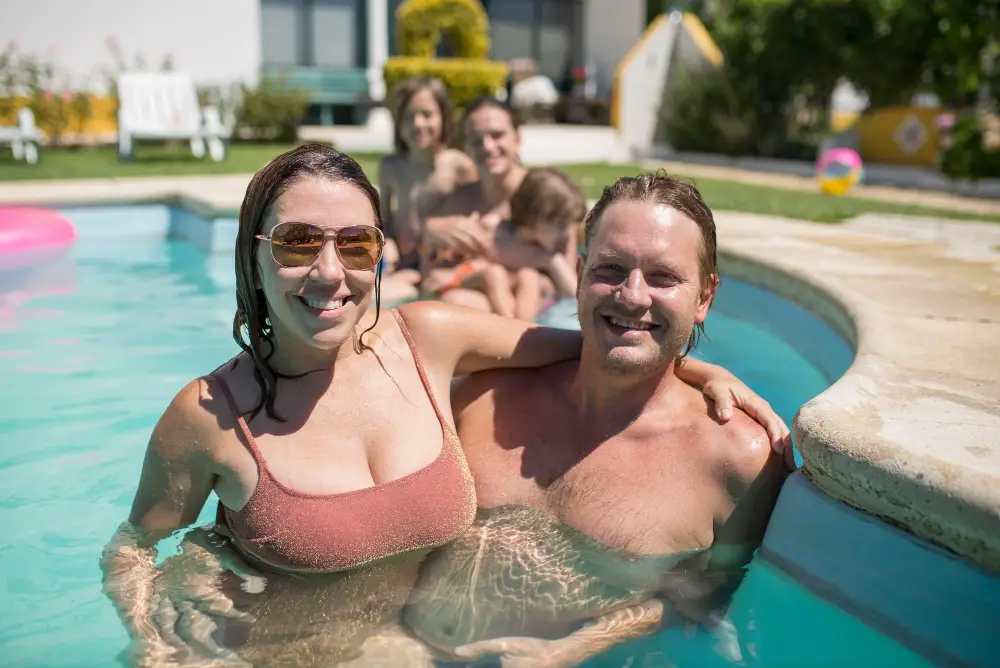
For years I brushed off every cruel little comment and told myself, each time, not to take it personally. Looking back now, from the far side of it, I understand that there was always going to come a day when I finally reached the end of what I could brush off. I just didn’t know it would arrive at a pool party, in a swimsuit, with a microphone in my hand.
Five in the morning glowed blue on the nursery clock, and Iris had finally gone quiet against my shoulder. I was rocking in the same worn armchair where I had fed her older brother Theo three years before, the one with the stuffing coming out of the left arm that we always meant to reupholster and never did. In an hour my phone alarm would go off and tell me to start pumping before my shower, before the day began in earnest, before I became the version of myself that the world outside this dark little room got to see.
A small voice floated in from the hallway.
“Mama? Is it morning-morning, or is it nighttime-morning?”
“It’s shhh-morning, buddy,” I whispered back. “Go crawl in with Daddy. I’ll come and get you soon.”
“Daddy’s snoring,” Theo reported, with the gravity of a boy delivering important field intelligence.
“I know, sweetheart. He’s very good at it.”
I heard tiny feet pad away down the hall, then a soft thump as he climbed up onto the bed, then silence. I closed my eyes for exactly four seconds. Then Iris hiccupped herself awake against my collarbone and the four seconds were over, and I started rocking again, and I did not let myself cry, because if I started I was not sure I would be able to stop, and there was oatmeal to make.
By seven I was in the kitchen, pumping under my blazer with one hand and stirring a pot of oatmeal with the other, a trick of coordination I had developed the way you develop any survival skill, out of pure necessity. My laptop was open on the counter, a marketing deck already loading for my nine o’clock meeting, the little spinning wheel turning while I bounced on the balls of my feet to keep Iris settled in the carrier. This was the shape of my mornings now. Three things at once, always, every one of them urgent, none of them for me.
I had gone back to work only weeks after having Iris, far sooner than I wanted to, far sooner than any book or any doctor would ever have recommended, my body still healing, my nights still shattered into ninety-minute fragments. I went back because my husband, Marcus, had been laid off a few months before her birth, in a wave of cuts his old company gently called a restructuring, and my paycheck, which had always been one of two, had become, overnight, the only one. There was no cushion. There was a mortgage and a daycare bill and a new baby, and there was exactly one income now standing between all of that and disaster, and the income was mine.
So I did what you do. I strapped the blazer on over the nursing tank every morning. I learned to pump in parking lots, hunched in the driver’s seat with a cover over the whole operation, timing it so I could still make the meeting. I answered emails one-handed during the two o’clock feeding, the phone balanced against my shoulder while Iris nursed in the dark. And I told myself, through all of it, the story that let me keep going, which was that this was temporary, and that we were a team, and that a marriage is a long game in which sometimes one person carries the other and then, later, the carrying reverses, and that this simply happened to be my stretch to carry. I had carried him before. He had carried me, once, years ago, through a bad season of my own. That was what I thought marriage was. I still think that is what marriage is. I have only revised my opinion about whether I was in one.
Marcus shuffled into the kitchen around then, his hair sticking straight out sideways, his phone already in his palm.
“Coffee ready?” he asked.
“You’ll have to make it yourself this morning,” I said. “My hands are a little full.”
“Rough night?”
“She was up at two, and again at four, and then at five. I’ve been up since.”
He grunted, scrolled through something on his screen, and when I glanced over he tilted the phone away from me, a small reflexive motion, angling it toward his own chest. Sports scores, probably, I thought. Or the job listings. I chose to believe it was the job listings, because believing anything else required an amount of energy I simply did not have at seven in the morning with a breast pump running under my blazer. I had gotten very good, that year, at choosing the version of things that let me keep moving.
“My friend Dana stopped by yesterday,” I said, trying to make my voice bright, trying to start the kind of ordinary pleasant conversation two married people are supposed to have over breakfast. “She brought a whole chicken casserole. She said I looked exhausted, but she said it kindly, you know? Like she actually meant it, like she was worried about me.”
“Yeah,” Marcus said, not looking up. “Dana’s good like that. Her husband got lucky with her.”
“Mm,” I said, and stirred the oatmeal, and let the silence come back, because it was easier than the talking.
On my way to grab Theo’s little sneakers from beside the door, I caught myself in the hallway mirror, the tall one that had hung there since we moved in. A stained gray hoodie, one of Marcus’s actually, because it was soft and it was there. Yesterday’s ponytail, gone lopsided in the night and never redone. Dark half-moons pressed under both eyes, the particular bruised look of a person who has not slept properly in months and does not expect to for months more.
There used to be a woman who lived in that mirror. I remembered her. She wore real shoes to Friday dinners, heels even, and she painted her lips a bold red just to carry the trash bag down to the curb, not for anyone to see, but because she liked the small private jolt of feeling put together, of feeling like herself, even for the length of a walk to the bin. She had opinions and a laugh you could hear across a restaurant. She was still in there somewhere behind the exhausted stranger in the hoodie, I was fairly sure of it, most days. She was just very, very tired, and she had lain down somewhere deep inside me to rest, and I could not always find her, and some mornings, looking in that mirror, I honestly wondered whether she was coming back at all, or whether this was simply who I was now, and that thought frightened me more than almost anything else that year, more than the money, more than the exhaustion. The thought that I had misplaced myself somewhere in the diapers and the deadlines and might never turn her up again.
I dropped both kids at daycare, kissed their heads, promised Theo I would ask the dinosaur questions in the car on the way home, and made it to my meeting with about thirty seconds to spare, sliding into my chair as the client dialed in. And all through it, half my brain running the presentation and the other half already worrying about the evening, I told myself the same thing I had been telling myself for weeks now, like a rosary. I had carried Marcus through his rough patch when it was his turn to be carried. Now it was simply my turn to lean on him for a little while. That was how a marriage worked. You took turns being the strong one. I believed that. I still believe it, actually. I just no longer believe I was married to someone who did.
That night, after I had finally gotten both children down, after the last glass of water and the last trip to the bathroom and the last monster checked for under the last bed, I let myself collapse onto the couch beside my husband. He was watching something, some show with explosions in it, the volume too loud.
“Long day,” I said.
“Yeah, mine too,” Marcus said. “Job stuff. Lot of job stuff.”
“How’d it go?”
“Slow,” he said, and then, in the same flat tone, with his eyes still on the television, he said, “Hey, babe. Not to be a jerk about it, but once things settle down a little, you should really think about getting back to the gym. You’ve put on a lot of weight lately.”
I turned my head and looked at the side of his face. “I’m sorry,” I said. “What?”
“I just mean, look at Dana. She makes it look so easy, the classes and all that. Might be good for you, is all I’m saying.”
Dana was my husband’s new sister-in-law, the wife of his younger brother Simon. She was twenty-eight. She did not have a newborn strapped to the front of her body eighteen hours a day.
I actually laughed. Out loud, a short strange bark of a laugh that surprised both of us and that I could not entirely explain, even to myself. Because the alternative to laughing, in that exact moment, sitting on that couch in my sweatpants with a body that was four months out from making a person, was to cry into a throw pillow that still smelled faintly of spit-up, and I simply did not have the crying in me. Crying takes a certain energy, a certain reserve, and I had spent all of mine. So the feeling came out sideways, as a laugh, the way water will find whatever crack it can. Marcus looked at me like he was not sure what the laugh meant, and honestly neither was I, and the moment passed, and the explosions on the television went on, and I did not say any of the things that were rising up in me, because saying them would have started something, and I was too tired to finish anything I might start.
I was, in those weeks, drowning. That is the plainest word for it. I was drowning under work and exhaustion and a baby who did not sleep and a three-year-old with the energy of a small weather system, and a house that generated dishes and laundry and sticky surfaces faster than any one person could ever clear them. Somewhere in all of it I had simply stopped taking care of myself, not as a decision but as a casualty. I had forgotten what a gym felt like. I had forgotten what it was to put on makeup, or heels, or a dress that was not chosen for how easily it unbuttoned for nursing. There was no time. There was genuinely, mathematically, no time, and my husband was sitting on the couch he had not left in what felt like weeks, telling me I should find some.
“Marcus,” I said. “I have not gone to the bathroom by myself in three years.”
“I’m just saying.”
“I know,” I said. “It’s fine.”
And I let it go. I let it go because I was certain, or told myself I was certain, that he did not mean it the way it had sounded, that he was tired too, that people say clumsy things. I was certain of a great many things back then that turned out not to be true.
The weeks after that blurred together into one long exhausting smear. I pumped in the office parking lot before meetings, hunched down in the driver’s seat with a nursing cover over the whole apparatus, praying no colleague would walk past. I warmed up leftovers one-handed while bouncing Iris with the other arm. I answered Theo’s fifty nightly questions about dinosaurs before I had even managed to get my shoes off at the door. And Marcus, meanwhile, developed a routine of his own, a very consistent one. The routine was the couch. He had made the couch his office, his gym, his social life, and his throne, and from it he governed.
“Did you send out any applications today?” I asked him one evening, stepping carefully over a pile of laundry I had not yet had a chance to fold.
“I’m networking,” he said, without looking up from his phone.
“With who?” I asked. “Which people? Anyone I know? Anything I can help with? I’ve got contacts from the agency, you know that, I could make some introductions if you tell me what you’re looking for.”
“People,” he said. “It’s not really something you’d understand, Bianca. It’s more of an industry thing.”
I let it go. I always let it go. It was the single thing I did most reliably that year, the one skill I had honed to a fine and terrible edge while everything else in me went slack from exhaustion. I let it go. Somebody said something that did not sit right, and rather than pull the thread, rather than ask the second question, rather than say the hard true thing, I smiled and I nodded and I let it go and I went back to the endless work of keeping everyone alive and fed and clean. And I had refined that letting-go into something almost like a virtue in my own mind, a form of patience, of generosity, of being the bigger person. I never once noticed, until it was nearly too late, that the art of letting everything go was slowly and quietly costing me the one thing I could not afford to lose, which was myself, handed over an inch at a time, every time I chose the peace over the truth.
The Dana comments started small and then multiplied, the way those things do, breeding in the dark until they were everywhere, at breakfast, over coffee, in the middle of me changing a diaper on the living room floor.
“You should see Dana’s dance class videos,” Marcus said one morning, holding his phone up though I was elbow-deep in a diaper change. “She dances beautifully. Look at her. Athletic. Wears those little skirts. And then, I mean, look at you.”
“That’s great for her,” I muttered, wiping a smear of applesauce off Theo’s chin.
“You used to have that kind of energy.”
I stopped wiping. My son looked up at me with enormous eyes, a fleck of applesauce still stuck comically on one eyebrow, sensing, the way small children always sense, that something in the room had just changed temperature.
“Marcus,” I said, keeping my voice very level for Theo’s sake. “I had a baby. Recently. As in, my body is still recovering from a thing it did a few months ago.”
“I’m just saying. Dana still finds the time for her classes.”
“Dana is twenty-eight years old and does not have a newborn attached to her chest for most of every day.”
He shrugged, as though I had just proven his point for him, and went back to his phone, and I went back to the applesauce, and Theo, watching us both, decided the danger had passed and asked me whether a stegosaurus could beat up a car.
That night I tried, one more time, to have an actual adult conversation with my husband.
“I need help around the house,” I said. I made myself say it plainly, without apology, which was harder than it should have been. “You’re home all day. I’m not asking for miracles here. I’m asking for the dishes. Sometimes. That’s all.”
“I’m dealing with a lot right now, Bianca.”
“So am I,” I said. “I’m dealing with all of it, actually. That’s sort of the point.”
“It’s different.”
“How?” I asked. “How is it different, Marcus? Genuinely. Explain it to me. You’re home all day and I’m working full time and doing the nights and the mornings and the daycare and the meals, so tell me how the thing you’re dealing with is so different that it means you can’t run the dishwasher.”
He didn’t answer. He never answered that question, not once, in all the times I asked it in all the different ways, because there was no answer that would survive being said out loud. He just reached for his phone again, and I watched him do the thing, the small quiet thing I had spent weeks telling myself I was imagining, the way he tilted the screen away from me before his thumb had even touched the glass, angling it in toward his own chest like a hand of cards held close by a man who does not trust the table. And I told myself, once more, standing there over the laundry, that I was imagining it. That I was tired and paranoid and seeing things. I was so deeply committed, that whole year, to imagining it, because the alternative to imagining it was a thing I did not have the strength to hold, and so I set it down, again, and stepped over the laundry, and went to check on the baby.
The small things kept stacking up, one on top of the next, like a game of Jenga played by someone who wanted the tower to fall.
Marcus started showering before Simon and Dana came over. Not an ordinary shower. A full production. The good razor. The cologne he used to save for our anniversaries, the one I had bought him years ago and that used to mean something.
“Big plans?” I teased him one afternoon, watching him fuss with his shirt collar in the hall mirror, the same mirror where I kept meeting my own exhausted face.
“Just want to look decent,” he said.
“You looked decent yesterday in gym shorts you haven’t washed in a week,” I said. “For the record.”
“Very funny.”
At a family lunch that weekend, Marcus abruptly volunteered to drive Dana home afterward, because, he said, Simon had somewhere he needed to be. Except that I did not remember Simon mentioning anywhere he needed to be, and neither, apparently, did Simon, judging by the puzzled look that crossed my brother-in-law’s face before he smoothed it over. And across the table, in that small strange moment, Dana caught my eye. She held it a beat longer than she needed to. I did not understand it then. I understood it completely later.
Later that same week, Dana texted me. Not about any of Marcus’s strange behavior, not a word about that. Just: How are you doing, really? I made way too much lasagna again. Can I drop some off?
And then she started showing up. With food, always, casseroles and soups and a shepherd’s pie and once an entire roast chicken with the vegetables still steaming around it, as though she had privately appointed herself to the single dedicated task of making sure that I, specifically, ate something warm at least a few times a week. She would arrive in the late afternoon at the exact hour when everything in my house tipped over into chaos, the hour when Iris fussed and Theo melted down and dinner had to somehow appear, and she would simply take the baby out of my arms and settle her against her own shoulder and say, go on, sit, eat. And I would sit down at my own kitchen table and eat an actual meal with two free hands, both of them, a thing that had become so foreign to me that the very first time she did it I felt my throat close and my eyes sting and I had to blink hard down at the lasagna so she would not see.
She asked about my work, too, and not in the polite way people ask a thing they don’t want the answer to. She asked as though she were actually curious about the campaigns I ran and the clients I managed, and then she listened to what I said, and asked a follow-up question, and remembered it the next time. Nobody had asked me about my work in months. In my own house it had become invisible, just the thing that paid for everything and took me away and came home in my face as exhaustion. Dana made it real again by being interested in it. And the whole time, some wary animal part of me kept waiting for the catch. For the favor she would eventually need. For the moment the kindness turned out to be a transaction. Because I had gotten so used, that year, to everything being a transaction, to my own worth being a number that went up and down. But the catch never came. There was no other shoe. There was only Dana, cross-legged on my kitchen floor, being steadily and inexplicably kind to me at a stretch of my life when almost no one else was, and I did not understand it, and I did not yet know that the kindness had a reason behind it, a reason she was carrying quietly and painfully the whole time she buttered my children’s toast.
“You seem so tired, Bianca,” she said one afternoon, sitting cross-legged on my kitchen tiles while Theo solemnly walked her through his entire dinosaur collection, one plastic creature at a time.
“I’m okay,” I said, automatically.
“You don’t have to be okay with me,” she said. “You really don’t.”
And I almost cried, right there, and I blamed the hormones, because blaming the hormones was easier than admitting how starved I had become for someone to simply say that to me.
That week I made an attempt to reclaim some small piece of myself. I decided I would do one squat. Just one, while the oatmeal spun around in the microwave. How hard could a single squat be, I thought. I used to do this. I used to do a great many things.
Very hard, as it turned out. Something in my lower back gave a loud and alarming pop halfway down, and I froze there, crouched, arms flung out to either side as though I were surrendering to a very small invading army. And that, of course, was the moment Theo wandered into the kitchen. He stopped, took one long thoughtful look at me, and tilted his head to the side.
“Mommy, why are you stuck like a frog? Are you gonna hop?”
“No, sweetheart,” I said, from my crouch.
“Can you hop?”
“Not currently, no.”
He nodded, accepting this, then opened the refrigerator, helped himself to a string cheese, and wandered back out, leaving his mother crouched and quietly panicking by the microwave. I started laughing, and then I was laughing so hard I was crying, and then I very slowly straightened myself back up, unfolding one vertebra at a time like a lawn chair with deep trust issues. That was the highlight of my week. A three-year-old comparing me to a frog. I want you to understand the size of the hole I was in, that this was the highlight.
That evening, Marcus was at it again.
“Have you seen Dana lately?” he said. “She’s, I mean, she’s literally the definition of beauty. She really is.”
I had started to notice, by then, how often my husband and his brother talked about how perfect Dana was, how the two of them narrated her like commentators at a sporting event. But I tried, still, to keep the peace, because keeping the peace was the only tool I had left and I was terrified of what was underneath it.
“That’s nice of you to notice her,” I said, as calmly as I could manage. “But honestly, Marcus, right now, beauty is about the last thing on my mind. I’m just trying to survive a schedule that would flatten a grown man. That’s all I’ve got the strength for.”
I held onto the hope, saying it, that he would hear me. That some part of him would understand what I was telling him about my life. I was wasting my breath, and some part of me already knew it.
Then, on a Friday night, Marcus came home practically bouncing on his heels.
“So,” he announced, cracking open a beer he had not bought, from a six-pack I had, “I’ve decided. I’m throwing a pool party. For my fortieth. A big one. The whole thing.”
“Here?” I said.
“Where else? Simon’s coming, obviously. Dana too, obviously.”
Obviously.
“Marcus, I am exhausted,” I said. “Iris still isn’t sleeping through the night. Theo has been a handful, and I’m working full time, and I don’t know how I would even begin to pull off a party on top of all of it.”
“Bianca. It’s my fortieth birthday.”
I looked at him. I looked at the fresh haircut he had gotten and not mentioned. I thought of his phone lying face down on the counter, always face down now. I thought of how he used to bring me flowers for no reason at all, just because it was a Tuesday and he had thought of me at the grocery store, and how long it had been since he had thought of me at the grocery store or anywhere else.
“Fine,” I said. “We’ll have a party.”
And quietly, standing there in my stained top with a baby monitor clipped to my waistband, I made myself a small private promise. Whatever it took, I was going to walk out to that pool, at that party, looking like the woman I remembered being. Not for him. I want to be clear that it was not for him, though I might have told myself it was, at the time. It was for her. The one in the mirror. The one who was only napping.
Four in the morning came very fast that Saturday. I had been up twice already with Iris before I finally gave up on sleep entirely and came downstairs to get a head start, because I knew, with the grim certainty of experience, that if the cupcakes were not iced before the children woke there would be no icing them at all. So I stood in my dark kitchen with a piping bag in one hand and a bottle warmer heating in the other, icing two dozen cupcakes for my husband’s fortieth birthday while my daughter dozed in her bouncer at my feet and my husband slept, deep and untroubled, in our bed one floor up.
I piped a small blue wave onto the top of each one, working in the quiet, the only sounds the hum of the refrigerator and Iris’s soft breathing and the occasional creak of the house. And I did not resent it. Or I told myself I did not resent it, which is a different thing, and I had become an expert that year in the difference, in the fine art of telling myself I was fine while some deeper part of me kept a silent, meticulous ledger of every four-in-the-morning I stood alone in that kitchen while he slept. I was so good at telling myself things. It is a survival skill, that kind of self-deception, and it kept me upright and moving through a year that might otherwise have flattened me. But survival skills have a cost, and the cost of that one was that I had stopped being able to hear my own true feelings over the noise of the reassurances I kept issuing myself. I iced the cupcakes. I told myself I was happy to. Somewhere underneath, the ledger recorded the hour.
By nine I had strung lights all around the patio, inflated a ridiculous six-foot palm tree, wrestled Theo into his tiny swim trunks, and taped a HAPPY 40TH banner across the back fence, standing on a kitchen chair to reach. Marcus wandered down about an hour after that, yawning hugely, scratching his stomach.
“Wow,” he said, surveying my work. “Place looks decent. You didn’t overdo it on the cheesy stuff, right?”
“Just the right amount of cheesy,” I told him, and I meant several things by it, and he heard none of them.
The guests started arriving around noon. Simon came in first with a cooler balanced on one shoulder. And Dana came in behind him carrying an enormous platter of cut fruit, and the moment she saw me across the yard she set the platter down and came straight over and pulled me into a hug before I had even managed to say hello.
“Bianca, sit down. I mean it,” she said, low, into my ear. “Give me that baby. Let me hold her. Go and eat something that is not a Goldfish cracker off the floor.”
I laughed, surprised by her as I always was, by the sheer uncomplicated force of her kindness. “You sure?”
“Give me that baby,” she said, already lifting Iris out of my arms and settling her expertly against her own shoulder with the ease of a woman who had held a great many babies, patting her back in a slow practiced rhythm. And so I ate a deviled egg. Standing up, hunched slightly over the table, glancing around like a raccoon that has gotten into a campsite and expects at any moment to be chased off, shoveling it in before anyone could need me for anything. And it was wonderful. It was a single deviled egg eaten standing up in my own backyard, and it was one of the nicest things that had happened to me in weeks, and I have thought since about what it says about the state I was in, that a woman taking my baby so I could eat an egg registered as an act of profound and memorable grace. It says everything. Dana saw the state I was in. She had seen it for weeks. She was the only one who had.
Around two in the afternoon, once the party was in full swing and Dana had firm hold of the baby and waved me off, I finally went upstairs to change. I dug the one swimsuit that still fit me out of the back of a drawer, and then I stood in front of the bedroom mirror for a long time before I put it on, longer than I meant to. I made myself look at my own body in the afternoon light. The soft new roundness of it, low across the belly. The pale silver marks a baby leaves behind, the map of what a body can do. I had been avoiding this mirror for months, dressing quickly, looking away, and now I made myself stand in front of it and actually see.
And I told myself, out loud, quietly, in the empty bedroom, that I looked fine. I said it like an instruction, because I did not entirely believe it yet and I was trying to. I told myself that this body had built two entire human beings, one of them only months ago, that it had done the single most extraordinary thing a body can do, twice, and that this was not nothing. That it was, in fact, the exact opposite of nothing, that it was everything, that the softness and the marks were not damage but evidence. I put on the swimsuit. And then, on an impulse that felt almost like defiance, I reached into the bottom of my makeup bag and I found the red lipstick, the bold one, the one the woman in the mirror used to wear to take out the trash, and I put it on for the first time in longer than I could remember. And I looked up, and there she was. The woman I had been missing. Tired, still, always a little tired now, that would not fully leave for a while. But there. Present. Looking back at me out of my own face. I straightened my shoulders, and I walked back downstairs, and I stepped out toward the pool with my head held high, feeling, for the first time in months, something close to myself.
Nearly everyone who could swim was in the water by then. Simon was standing in the shallow end next to Marcus, holding a beer he was not really drinking. Dana was on a lounge chair in the shade with Iris asleep on her chest, one hand cupped protectively over the baby’s back. I stepped out onto the warm concrete of the pool deck, and that was the moment my husband looked over at me and burst out laughing.
It was loud. It was ugly. It came up out of him in a great honking bray, and Simon, beside him, started to laugh too on reflex before he had even seen my face, and then he did see my face, and he stopped, and he looked down at the water as though he wished very much that he could sink into it and disappear.
I stood there on the warm concrete in my red swimsuit and my red lipstick, feeling, a half second before, more like myself than I had in months. “What’s so funny?” I asked.
Marcus wiped at his eyes with the back of his wrist, still laughing, milking it. “Sorry, sorry,” he gasped, not sorry in the slightest, performing the apology the way he performed everything. “I couldn’t help it. Dana was just swimming there, and, I mean, come on. Look at her, and then, you know. She clearly looks a lot better in a swimsuit than you do. Sorry. It’s just true.”
The whole patio went silent. Not a gradual quieting, not the natural ebb of a conversation, but an instant and total silence, the specific airless hush of a dozen adults all deciding in the very same instant that they had not heard what they had just plainly heard, all of them suddenly fascinated by their drinks, by the pool, by the middle distance. Somewhere off to the side a single fork clinked against a plate and the small sound was enormous in the quiet, obscene. On her lounge chair in the shade, with my sleeping baby still on her chest, Dana’s face had gone absolutely to stone, white and rigid, and I did not understand why her reaction was so much larger than simple secondhand embarrassment, not yet. I understood everything about it twenty minutes later. In that moment I only registered, dimly, that my sister-in-law looked less like a woman who had been complimented and more like a woman watching a crime be committed.
It hurt to hear. I want to be honest about that, plainly and without armor, because this kind of story is so often told as though the wronged woman is made of steel, as though the cruelty simply bounces off her and she is above being wounded by it, and that is a lie, and it is a lie that does real women a real disservice. It did not bounce off me. It went in like a blade, clean and deep, in front of my family and my friends, on the pool deck that I myself had strung with fairy lights at nine o’clock that same morning while he slept. I felt it land in my chest and I felt the old familiar heat climb up my neck, the shame he had spent months teaching my body to feel on cue.
But this time, underneath the hurt, for the first time in a very long time, there was something else. Something clear and cool and strangely, unexpectedly peaceful, rising up beneath the pain like bedrock under water. And the something else did not say I can’t take this anymore, which is the cry of a person still hoping things will change. It did not say this is unbearable, which is a plea. It said, very quietly, very calmly, with a finality that felt almost like relief: enough. That was the whole of it. Just, enough. Not a scream. Not a sob. A door, closing, softly, all the way, and latching. I had reached, at last, standing there dripping-eyed in the sun, the precise and simple end of what I was willing to carry, and the reaching of it was not a breakdown. It was the opposite of a breakdown. It was the quietest and most solid thing I had felt in a year.
I did not say anything. I turned around, and I walked back into the house, and up the stairs, and I shut the bedroom door quietly behind me. I sat down on the edge of the bed and pressed both hands over my mouth and breathed.
A soft knock came a moment later, and then Dana slipped in and shut the door behind her.
“Bianca,” she said quietly. “I have to tell you something, and I have been sick over it for weeks. Truly sick.”
“Dana, please,” I said. “I really cannot right now. I can’t. Whatever it is.”
“You can,” she said. “And you need to. Right now, before you go back down there. Trust me.”
She sat down next to me on the edge of the bed, and she took out her phone, and she held it in her lap for a moment as though gathering herself.
“Marcus has been texting me,” she said. “For weeks. Photos of himself. Asking me to meet him for coffee, alone. Telling me his marriage is basically over, that you two are just going through the motions. I never answered a single one of them, Bianca, not once, I swear that to you on anything you want. But I saved every message. All of them. And I told Simon this morning, before we came, because I couldn’t carry it anymore.”
The room seemed to tilt very slowly to one side and then right itself.
“What?” I said. It was the only word I could find.
“That’s why I’ve been coming around so much,” she said. “Checking on you. Bringing the food. I wanted to find the right way to tell you, the right moment, in private, not in front of everyone. I did not want to be the woman who detonated your whole life in your own kitchen. So I kept trying to find the moment, and there was never a good one, and then he said what he just said down there, and I thought, no. No. She needs to know now.”
She handed me the phone, and her hand was shaking slightly as she did it.
I scrolled. I scrolled through weeks of them, message after message, his name at the top, his words in the gray bubbles, her silence in the space where replies should have been, because there were no replies, she had told the truth, she had never once answered him. And as I scrolled, every strange and lonely and confusing month of the last part of my life quietly picked itself up off the floor and rearranged itself, in front of my eyes, into a shape that, at last, made perfect and total and sickening sense. The cologne before the family lunches. Marcus volunteering three separate times to drive Dana home. The phone always face down on the counter, always tilted away, the little cards held close to the chest. His mouth forever full of Dana, Dana, Dana, praising her to me, holding her up in front of me like a measuring stick, again and again and again, as though he were auditioning her, openly, in my own house, at my own kitchen table, to my own tired face, and daring me not to notice.
It had never once been about my body. That was the thing that came clear and cold as I sat there on the edge of the bed with Dana’s phone in my two hands, scrolling. It had never been about the weight, or the gym I did not have time for, or the dance classes, or the short skirts, or any single one of the hundred small cuts he had made across those months. Every bit of that had been set dressing. Scenery. Props for a play he had been quietly writing the whole time, with me in it, cast without my knowledge in a role I would never have taken.
Because what he had been building, patiently, comment by comment, was a story. A tidy, self-serving, airtight little story in which he got to be the one who left, and got to stand there afterward in front of his family and his friends and point back at my tired, postpartum, milk-heavy body as the reason he had been forced to go. A story in which I was not a woman drowning under the double weight of a newborn and a full-time job while her husband ran out the clock on the couch. A story in which I was, instead, the wife who had let herself go, who had stopped trying, who had become someone a man could hardly be blamed for drifting away from. He needed me to be the villain of my own exhaustion so that his leaving would read, to everyone watching, as something that had regrettably happened to him rather than something he had chosen and engineered and done. He had spent months casting me, in advance, as the person it would be reasonable for him to be disappointed in and to leave. And the thing that turned my stomach, sitting there, was how close it had come to working. Because I had almost agreed to play the part. I had almost believed the story myself. I had stood in front of that hallway mirror hating the woman in it, exactly as he needed me to, doing his work for him from the inside.
I looked up at Dana.
“You told Simon.”
“Yes. This morning. He’s with us. He’s completely with us on this, Bianca. He’s furious. He’s downstairs right now not knowing what to do with himself.”
I laughed once, a single sharp sound with nothing funny in it at all.
“My husband,” I said slowly, “compared me, unfavorably, to a twenty-eight-year-old woman, out loud, at his own birthday party, in front of everyone I know.”
Dana didn’t say anything. There was nothing to say. She just put her hand on my back, the way she had held my baby all afternoon, and let me sit with it.
I wiped my face with the back of my hand. I stood up. I walked over to the mirror and looked at myself, red swimsuit, red lipstick, the marks of two children, the tired clear eyes of a woman who had just, in the space of five minutes, put the entire puzzle together.
“Can I borrow your phone,” I said, “for one more minute?”
“It’s yours,” Dana said.
I walked back downstairs. The guests were still in and around the pool, all of them pretending, with tremendous collective effort, that they had not heard a single thing, murmuring too brightly about the weather and the fruit platter. On the table by the food was the little microphone Marcus had rented for himself, for the speech he had no doubt planned to give, the toast to his own fortieth year.
I picked it up. It was still warm from sitting in the sun. I tapped it twice with my finger, and the two dull thumps rolled out across the yard through the speakers he had rented for himself, and the careful murmuring died all at once, and every face turned toward me.
“Everyone,” I said. “Hi. I would like to make a toast. I’d like to wish my husband a very happy birthday. So please, everyone, listen carefully.”
Drinks lifted around the pool, a little uncertainly, a few people glancing at one another. And Marcus, standing in the shallow end with the water at his waist, smiled. He actually smiled. He stood up a little straighter and settled his shoulders and arranged his face into the pleasant, expectant expression of a man about to be toasted on his birthday, because it did not occur to him, even then, even standing there minutes after what he had said, even with the whole yard still ringing from it, that the microphone in his wife’s hand could possibly be anything other than a gift for him. That was the truest measure of the man, I think, that smile. He had spent months laying the groundwork to humiliate me and discard me, and he still could not conceive of a world in which I might pick up a microphone and not use it to praise him. His confidence in his own story was total. It had never once included a version where I got to speak.
“For months now,” I said, “my husband has been generous enough to let me know, on a regular basis, that I’ve gained weight. That I ought to look more like Dana. That Dana, and I am quoting him directly here, is ‘the definition of beauty.'”
A few nervous, uncertain laughs rippled across the yard and then thought better of themselves and stopped.
“And this afternoon,” I went on, my voice steady, steadier than I had any right to expect, “at his own party, in front of all of you, he shared with us that Dana clearly looks better in a swimsuit than I do. So. I think I finally understand why my husband has been quite so focused on Dana these past few months.”
I lifted the phone.
I read two short lines aloud from his messages to her. Just two. I did not need more than two, and I did not want more than two, because this was not about humiliating anyone the way he had humiliated me, it was about telling the truth once, cleanly, in the light, in front of the same people he had performed his story for. I mentioned, without describing them, without reading them, the photographs he had sent of himself, shirtless, posing in our bathroom mirror. And I read, word for word, the one message where he told my own sister-in-law that his marriage was, and I am quoting him again here, basically over.
The yard was so silent I could hear the pool filter humming.
“Dana,” I said, “never once answered him. Not a single time. She saved every message he sent, and she told Simon, and she came here today and told me, because she has more loyalty to me than my own husband has ever had. So I would like, publicly, in front of all of you, to thank her for that. Thank you, Dana.”
Simon set his beer down on the edge of the pool with a small deliberate click. He hauled himself up out of the water, and he walked across the wet concrete, dripping, past his own brother, not looking at him, and he came and stood beside Dana and me. Next to us. With us. On our side of the line that had just been drawn across that yard. He did not say a single word. He did not need to. In a family, in a crisis, the most eloquent thing a person can do is choose where to stand, and Simon crossed the entire patio in his wet swim trunks to stand beside his sister-in-law and his wife rather than beside his own brother, and there was not one person in that yard who missed the meaning of it. Marcus watched his little brother cross to the other side, and something went out of his face, some last hope, because if Simon was standing with us then the story was truly over, the story in which Marcus was the wronged and reasonable one, and everyone could see it was over, and Marcus could see that everyone could see.
“Happy fortieth, Marcus,” I said into the microphone. “I truly hope that this is the year you find whatever it is you’ve actually been looking for. I just wanted everyone to know that you won’t be looking for it at this address anymore.”
Marcus had gone the deep humiliated red of a man who has just watched his own careful story turned inside out and held up to the light in front of every person whose opinion he cared about. He stood there in the shallow end of the pool, dripping, opening and closing his mouth, and nothing came out, because there was nothing to say, because I had said it all, and it was all true, and everyone had heard it.
And then Theo tugged on the hem of my swimsuit.
“Mommy,” he said, looking up at me, entirely unbothered by any of it, operating on the only agenda that had ever mattered to him. “Is the party over yet? I want cake.”
I looked down at my son, at his hopeful upturned face, and I laughed, and this time it was a real laugh, the first real one in longer than I could remember, and it came all the way up from somewhere deep and true.
“Yes, baby,” I said, and I crouched down to his level, my knees complaining, and looked him in his hopeful little face. “The party’s over. Let’s go get you some cake.”
And I walked him over to the table, past his father standing speechless in the pool, past the guests who were now openly staring, and I cut Theo the very first slice, a big one, with a blue frosting wave on top, and I put it on a plate and handed it to him, and he beat it flat with his fork the way he always did, and the ordinary sweetness of that, my boy and his cake, was worth more to me in that moment than any apology Marcus could ever have offered and never would.
A great deal happened in the weeks and months after that party, most of it slow and unglamorous and entirely necessary, the ordinary grinding machinery of a shared life coming apart and being sorted into two. Marcus moved out within the week. He went first to Simon’s couch, which lasted only a handful of nights, because Simon, it turned out, had a great deal to say to his brother once the two of them were alone, and none of it made Marcus comfortable enough to stay. From there he took a rented room across town, and then a small apartment, and the physical distance of him leaving the house was strange at first and then, quite quickly, was simply relief, a lightening, as though a piece of furniture that had been blocking a doorway for a year had finally been carried out.
There were lawyers, eventually, and long careful conversations conducted in flat neutral voices, and a custody arrangement that came together with far more decency and far less warfare than I had braced myself for. And the reason it came together so easily, I understood before long, was not that Marcus had grown generous. It was that Marcus, confronted for the first time with the actual hour-by-hour physical labor of caring for a newborn and a three-year-old, the night wakings and the diaper changes and the meals and the endless relentless nothing-glamorous grind of it, discovered with almost comical speed how very little of that labor he actually wanted to be responsible for. He negotiated, in the end, for less time than I offered him. He was not, when it came down to it, a monster, and I have never told the children that he was, and I never will. He was something more ordinary than a monster, and more disappointing. He was a man who found the weight of his own life too heavy to carry, and went looking around for a lighter one, and who decided, rather than ever once admit that plainly, to point at his exhausted wife and make the weight her fault. That is a smaller and sadder thing than villainy. But it will end a marriage just the same.
Dana and Simon did not fall out over any of it, which had honestly been my one real and gnawing fear through the whole ordeal, the fear that I would somehow become the crack that ran through their marriage too, that my disaster would spread and take theirs with it. It did not. If anything, the whole thing seemed to draw the two of them closer together, the way a hard shared honesty sometimes does, the way surviving something as a team welds a team. Dana had carried Marcus’s secret alone and sick for weeks before the party, and telling Simon had cost her something and frightened her, and his response, standing with her, believing her instantly and completely, seemed to deepen whatever was already good between them.
Dana kept coming around, except now she came openly, as my friend, with no secret weighing her down, no reason to keep waiting for the right moment because the moment had come and gone and we were on the other side of it together. She still brought lasagna. She still took Iris out of my arms and told me to sit and eat. And slowly, over the following months, without either of us ever deciding it, she became one of the very small handful of people in my life whom I knew, with total certainty, I could call at three o’clock in the morning if the world were ending, and who would answer, and who would come. Simon came around too, sheepish at first, forever apologizing for his brother as though the apology were somehow his to make, until finally I took him by the arm one afternoon and told him to stop. That he was not responsible for the man Marcus had decided to become. And that where he had chosen to stand, dripping wet, in front of everyone, on that pool deck, had told me everything I would ever need to know about the kind of man Simon himself was, and that it was a good kind, and that he could let the apologizing go now.
I started sleeping again, eventually, in pieces at first and then in longer and longer stretches, as Iris finally, mercifully, learned to sleep through the night, the way they always eventually do, long after you have stopped believing they ever will. And as the sleep came back, so, slowly, did I. Rest turned out to be the thing I had been most starved of, more than anything, and with even a little of it returned I began to recognize myself again, to find the woman who had been napping somewhere deep inside me all that year, and to coax her back up into the light.
I started, here and there, in the small cracks and margins of my weeks, doing things that were only and entirely for me. Not the gym, particularly, though I did drift back to it now and then. But when I went, I went for reasons that were mine. Not because a man on a couch had told me to, not to shrink myself, not to look like anybody else or to earn anybody’s approval or to become a woman it would be harder to leave. I went, when I went, because it felt good to move my own body through space, to be reminded in my muscles that this body was a place I lived in and not a thing that was being measured and graded and found wanting by someone keeping score. That turned out to be the whole difference, the only difference that mattered, the difference between moving your body as punishment and moving it as pleasure, and I had never once understood it in all the months he spent telling me to get to the gym. I wore the red lipstick more often, on ordinary days, for no occasion. I put real shoes on sometimes, just to feel them, just because I wanted to. I took myself back, one small reclaimed thing at a time.
And one Saturday morning, some weeks after the party, I was moving through the house getting the kids ready for our usual weekend walk, Iris balanced on my hip and Theo sitting on the floor by the door tugging at his own sneakers, insisting he could do it himself, and I passed the hallway mirror. The same mirror. The one where, for a whole exhausted year, I had kept catching a stained hoodie and a lopsided ponytail and a woman I had started to lose track of.
I stopped, and I looked.
Red dress. Red lipstick. My daughter laughing on my hip and reaching for my earring. My son at my feet, narrating his own shoelaces. Dana’s car pulling into the driveway outside, come to walk with us the way we did most Saturdays now. And the woman in the mirror looked back at me, tired still, always a little tired, but clear, and present, and unmistakably herself, and I understood, standing there, the thing it had taken me a whole year and a microphone and a borrowed phone to finally understand.
The woman in the mirror had never once been the problem. She had never needed fixing, or shrinking, or replacing with someone younger in a shorter skirt. She had only needed someone to stop telling her she was the problem long enough for her to remember who she actually was. And in the end, the person who finally stopped telling her that, the person who walked her out to that pool with her head held high and cut her son the first slice of cake and put the red lipstick back on, the person who set her free, turned out to be her.
Theo got his shoes on, both of them, on the correct feet even, and stood up, and threw both hands over his head in triumph.
“I did it myself,” he announced, to the hallway, to the world.
“You did,” I said, and I meant it about more than the shoes, though he would not understand that for many years. “You did it all by yourself. I’m proud of you.”
I looked once more at the mirror, at the three of us caught in it, my daughter reaching for my earring and laughing, my son victorious over his own sneakers, and the woman holding it all together in her red dress with her clear tired steady eyes, and I did not look away this time, and I did not flinch, and I did not go looking in that glass for everything that was wrong with her. There was nothing wrong with her. There never had been. That was the whole thing, the entire lesson, the one truth it had taken me a lost year and a cruel joke at a pool and a borrowed phone full of another man’s lies to finally, fully understand. The woman in the mirror had never been the problem. She had only ever needed the world, and one particular man in it, to stop insisting that she was, for long enough that she could hear her own voice again and remember who she was.
Outside, a car door shut. Dana was in the driveway, come to walk with us the way she did most Saturdays now, waving through the window, already reaching to take the baby so I could have my hands free.
I opened the front door onto the bright ordinary morning.
“Come on, you two,” I said. “Dana’s here. Let’s go.”
And we went out into the sunlight, all of us, together, and I did not once look back at the house behind us, because everything I wanted was walking out the door at my side.

Lila Hart is a dedicated Digital Archivist and Research Specialist with a keen eye for preserving and curating meaningful content. At TheArchivists, she specializes in organizing and managing digital archives, ensuring that valuable stories and historical moments are accessible for generations to come.
Lila earned her degree in History and Archival Studies from the University of Edinburgh, where she cultivated her passion for documenting the past and preserving cultural heritage. Her expertise lies in combining traditional archival techniques with modern digital tools, allowing her to create comprehensive and engaging collections that resonate with audiences worldwide.
At TheArchivists, Lila is known for her meticulous attention to detail and her ability to uncover hidden gems within extensive archives. Her work is praised for its depth, authenticity, and contribution to the preservation of knowledge in the digital age.
Driven by a commitment to preserving stories that matter, Lila is passionate about exploring the intersection of history and technology. Her goal is to ensure that every piece of content she handles reflects the richness of human experiences and remains a source of inspiration for years to come.