I thought that letting my neighbor borrow my backyard for one single afternoon was the simplest favor in the world, the kind of thing you do without thinking twice. But when I came home that Sunday evening, one small detail felt wrong before I even understood why, and the uneasy silence hanging around his house made me start to wonder why he had ever asked me in the first place.
My name is Skye, and I am thirty-two years old, and I live on an ordinary street in an ordinary town. Until last weekend, I believed I knew the people who lived around me. Not deeply, of course. I did not know their private fears or the secrets their families kept behind closed doors. But I knew the surface of them, the way you know the people on your own street. I knew who lifted a hand in greeting while dragging the trash cans to the curb. I knew whose dog lost its mind at every delivery truck that dared to slow down. I knew which neighbor borrowed a ladder or a drill and always, without fail, returned it clean and on time, and which one you had to go and pry your things back from weeks later. That is the kind of knowing I had. I thought it was enough. I thought it told me who a person was.
Nathan had lived next door to me for almost two years. He was quiet, and polite, and remarkably easy to overlook, which I now understand was not an accident of temperament but a genuine skill, something he had cultivated and honed the way other people cultivate a garden or a golf swing. Being forgettable is not a passive state. It takes work. It takes a man who has decided that the safest thing he can be, in the eyes of the people around him, is unremarkable, and who then arranges every visible detail of his life to support that impression, and Nathan had done it so well that in two years I had never once thought about him for longer than the length of a wave.
He kept his lawn trimmed to the millimeter, edged and even, never too lush and never neglected, the lawn of a man who does not want to stand out in either direction. He brought my garbage cans up from the curb once during a bad autumn storm, unasked, and set them neatly against the side of the house where the wind could not catch them, and I remember thinking at the time what a considerate thing that was, what a good neighbor he was, and feeling a little warm toward him for days afterward. When my kitchen sink clogged one winter so badly that gray water backed up foul and standing into the basin and would not drain, he leaned over the fence while I was out there peering hopelessly down the drain and gave me the name of a plumber, the cousin of a friend of his, he said, and that plumber came the very next morning and cleared the whole line and charged me less than half of what the first big company I’d called had wanted just to come out and look. He was helpful in exactly that way, in small, specific, forgettable increments, each one too minor to remember and too kind to question. We were not friends, not really, we never once sat down to a meal or a drink together, but we were friendly, and on a suburban street, in the small economy of nods and waves and borrowed tools, that friendliness counts for a great deal, and it had counted, in the end, for exactly what he needed it to count for.
That was why I felt no flicker of unease at all when he knocked on my door last Friday afternoon.
I had just finished zipping up an overnight bag. My mother lived about an hour away, out past where the highway thins into two lanes and the strip malls give way to fields, and I had promised to spend the weekend at her house. She had been telling me, in the particular wounded way mothers have, that I never stayed long enough anymore, that I breezed in and breezed out and treated her home like a rest stop, and there was enough truth in it that I had decided to make a real weekend of it, two nights, no rushing off.
When I opened the front door, Nathan was standing on my porch with both hands pushed down into the pockets of his jacket, his shoulders slightly hunched, a man arranging himself to look harmless. Which, I would learn, is exactly what a person does when he is about to ask you for something he has thought about for a very long time.
“Hey, Skye,” he said. “Sorry to bother you.”
“No bother at all. What’s up?”
He glanced toward the side of my house, toward the wooden gate that led around to the back, and then gave me a small, sheepish smile, the kind that asks for grace in advance. “I wanted to ask you something,” he said. “And I know it’s going to sound a little strange.”
That should have made me careful. In every version of this story I have told myself since, that is the sentence where a wiser woman narrows her eyes. Instead I laughed.
“Well, now you have to tell me,” I said. “You can’t lead with that and then not say it.”
He shifted his weight from one foot to the other. “So my brother’s birthday is this weekend,” he said. “I wanted to throw him something small, nothing big, just a little gathering. But you’ve seen my backyard. There’s no room back there. It’s all shed and gravel.”
That much was simply true, and I nodded, because I had seen his backyard, a narrow strip of dead grass mostly swallowed by an old aluminum tool shed that had been there long before he moved in. My own yard, by contrast, was wide and green, a real yard, with a proper patch of lawn, a small flagstone patio, and two flower beds that ran along the base of the fence, which I had spent the whole of that spring planting and tending and fussing over.
He kept going before I could say anything, the words coming a little faster now, rehearsed. “And I remembered you mentioning that you were going to be at your mom’s place this weekend. So I was wondering, and please just say no if it’s weird, I was wondering if maybe I could use your backyard. For the party. Just Saturday afternoon.”
I stared at him for a second. “My backyard,” I said.
“Just for a few hours Saturday,” he said quickly. “A handful of people. Some food, maybe a little music. Nothing wild, I promise. Everybody’s in their forties, it’s not going to be a rager.”
I hesitated. I want to be honest about the hesitation, because I have gone back to it many times since, turning it over, wondering what part of me sensed something and what part of me simply liked my privacy. I did like my privacy. That was real. The idea of strangers wandering around my yard, sitting in my chairs, using the space I thought of as mine, did not thrill me. And more than the privacy, I cared about those flower beds. I had put most of a spring into them. Roses, deep red ones, along the sunny stretch by the gate. Lavender in the middle, which had just started to come in silver-green and fragrant. And a scatter of small white daisies all along the fence line, the cheerful kind that come back year after year.
Nathan seemed to read the worry right off my face, because he was watching me closely, more closely than the moment seemed to call for, though I did not register that until much later. “I promise you,” he said, “I’ll clean up everything before you get back. Every cup, every crumb. You won’t even be able to tell anyone was there. You’ll come home and it’ll be exactly like you left it.”
And his request sounded so harmless. That was the thing. It sounded more than harmless. It sounded ordinary, the most ordinary thing in the world, a neighbor throwing his brother a birthday party and needing a little more room to do it. I pictured it clearly, standing there in my doorway. A folding table with a plastic cloth. A few lawn chairs. Paper plates weighted down against the breeze. A grocery-store sheet cake with a candle in it. Somebody’s kid running around. I had no reason on earth to imagine anything other than that, because nothing in my two years of knowing Nathan had given me a single reason to imagine anything else.
“All right,” I said. “Yes. That’s fine. Just, please, keep everyone away from the flower beds. I worked really hard on those.”
“Absolutely,” he said. “Not a soul near the flowers. I’ll put chairs in front of them if I have to.”
“And nobody goes inside my house.”
“Of course not. God, no. We’ll be outside the whole time.”
I looked at his face for another moment, and he looked relieved, deeply relieved, more relieved than a man usually looks over a birthday venue, though again, that is a thing I can only see now, with the terrible clarity of hindsight.
“Thank you,” he said. “Seriously, Skye. You’re saving me here.”
I went to the kitchen drawer where I keep the odds and ends, the takeout menus and the spare batteries, and I dug out the spare key to the side gate, the one I almost never used. When I came back and handed it to him, his fingers closed around it immediately, at once, a fast little grab, and something about the speed of it registered somewhere below my conscious mind, a note slightly off in an otherwise pleasant song, gone before I could name it.
“I’ll get it back to you Sunday morning,” he promised.
“Sunday evening’s fine,” I said. “That’s when I’ll be back anyway.”
He nodded. “Everything will be spotless. You have my word.”
I stood in the doorway and watched him cross the strip of lawn between our houses toward his own place. Halfway across he looked back at me over his shoulder and raised the little gate key in a small wave, and I waved back, and I remember, standing there, feeling genuinely pleased with myself. I remember thinking that I had done a kind thing, a neighborly thing, that this was how a street was supposed to work, people helping people, and that I was a good sort of person for having said yes so easily. I carried that warm little glow of my own decency out to my car, and I loaded my overnight bag into the trunk, and I drove off to my mother’s house feeling, of all things, good.
The weekend itself was quieter than I had braced myself for, and quieter than my mother would have liked. She cooked enough food for a family of eight, as she always does, as though a table groaning with more than anyone could eat were the only reliable way to say the thing she has never quite known how to say out loud, which is that she misses me. She complained at length about the way I take the turns on her narrow road too fast, and about my job, which she does not entirely understand and therefore distrusts, and she asked me twice, in her practiced sideways way, whether I had started seeing anyone. I dodged the question both times, once by getting up to refill the water glasses and once by simply pretending I had not heard it, and both dodges she noticed, and both she filed silently away in the great ledger mothers keep, to be produced again at some future date when I least expected it.
We watched two of her shows in the evening, the ones she narrates over as though I have not seen them, which I have, because she describes them to me on the phone. We did a jigsaw puzzle of a lighthouse on a rocky coast that turned out to be missing a single piece, one maddening gap of gray sky up in the corner, and my mother turned the whole house upside down looking for it, checking under the couch cushions and inside the box twice, unable to let it go. It was, in every ordinary way, a completely ordinary weekend at my mother’s house. And I have thought many times since about the strangeness of that, about how, while I sat at her kitchen table hunting for a missing piece of gray sky and eating a third helping of pot roast I did not want, a man was an hour away running a machine back and forth across my lawn in the dark, unearthing something that had been buried since before I owned the house, and reshaping, though I did not know it yet, the entire way I would move through the world for the rest of my life. We never know, do we, which of our ordinary afternoons is the one the axis turns on.
On Saturday afternoon, I did briefly wonder about the party. I pictured it in my mind, people standing around in my yard with plastic cups, Nathan at a grill, somebody’s playlist coming out of a phone propped in a bowl to make it louder. I even picked up my own phone at one point, thinking I might send him a light little text, just a friendly reminder about the flower beds, nothing heavy. But I stopped myself before I typed it. I did not want to be that person, the controlling neighbor, hovering over her flowers from an hour away, texting reminders to a grown man who had given me his word. He had never once given me a reason not to trust him. So I set the phone back down, and I went back to the puzzle, and I did not think about it again.
By Sunday afternoon my mother was deploying every tactic she had to keep me another night.
“You could leave first thing tomorrow, beat the traffic,” she said.
“I have work in the morning, Mom.”
“You can work from here. You’re always saying you can work from anywhere.”
“I also have laundry piling up. And I want to sleep in my own bed.”
She frowned at me over her reading glasses. “Laundry. That is the single saddest excuse I have ever heard a grown woman give.”
I laughed, and I hugged her, and I got myself out the door before she could load another plastic container of leftovers into my car, though she managed to get two into the passenger seat while I was in the bathroom, so I did not entirely win.
When I pulled into my own driveway that Sunday evening, everything looked completely normal from the front. My house sat there the way it always sat there. The porch light I leave on a timer had come on. And next door, Nathan’s house was quiet and dark, which did not strike me as strange in any way. His car was not in his driveway. I assumed he had run out somewhere, or, more likely, that he was off returning the rented tables and chairs from the party, being responsible, cleaning up after himself the way he had promised.
I carried my bag inside. I put my mother’s leftovers in the refrigerator, wedging the containers in among my own things. I glanced into the living room out of habit, and everything was exactly as I had left it, the throw pillows squared away, the remote on the arm of the couch, a thin layer of undisturbed quiet over all of it. And for one peaceful minute, standing in my own kitchen, I genuinely believed that Nathan had kept his promise, that the weekend had gone off without a hitch, that I would find the gate key on the patio table and a spotless yard beyond it and would feel a little foolish, later, for the vague unease I could not quite name.
Then I remembered the key. I walked toward the back door to go out and retrieve it, expecting to find it sitting on the little table on the patio where I’d asked him to leave it.
The moment I stepped out through the back door onto the patio and looked up, I stopped dead, and I did not move again for what felt like a very long time.
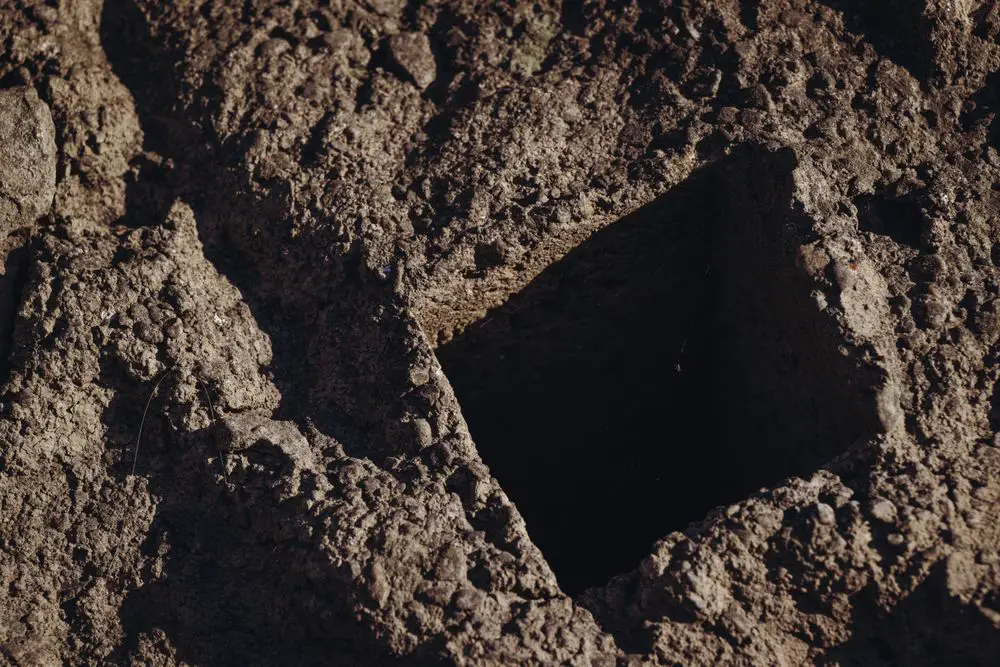
There was a hole in the middle of my yard.
No. Not a hole. A hole is a thing you can name and move past. This was a pit, a vast rectangular excavation gouged straight down into the center of my lawn, wider across than a car is long and deep enough that in the failing evening light I could not make out the bottom of it at all, only a darkness where the bottom should be. My mind kept trying to shrink it into something I could understand and kept failing. This was not the shallow scorched circle of a backyard fire pit. It was not the neat modest hollow a person digs to plant a young tree, or to set a fence post, or to bury a beloved dog. This was excavation, industrial and deliberate and enormous, and standing on my own patio looking at it I had the vertiginous sense that a small quarry had opened up overnight in the middle of my grass, as though the earth itself had simply given way.
Great mounds of fresh dark earth were heaped all around the ragged edges of the pit, slumping and sliding, more soil than I would have believed was under my yard, and over all of it hung the heavy wet mineral smell of deep turned ground, a smell like a freshly dug grave, which is a comparison I did not want to make and could not stop myself from making, standing there in the dusk.
And my flower beds were gone. Not damaged. Gone. The roses I had put in along the sunny stretch by the gate had been crushed flat under great falling clods of dirt, their red heads mashed into the mud. The lavender had been torn out of the ground entirely, roots and all, and flung aside in a tangled silver-gray heap. The daisies along the fence had simply vanished under the spoil piles, buried alive. Whatever had happened in my yard had not been quick. It had taken hours, real hours, of real heavy work, and it had left my green private yard looking like the site of a war.
I could not move. My mind, for a strange stretched moment, simply refused to assemble what my eyes were sending it into anything that made sense. It was too far outside anything I had imagined. There was supposed to be a folding table out here. There was supposed to be a cake.
And then the shock cracked, and underneath it was a hot clean rage that brought me back into my body all at once.
“Nathan!” I shouted, to no one, to the empty ruined yard, and I was already moving.
I stormed back through my house and out the front door and across the strip of lawn to his place, my heart slamming, ready to stand on his porch and demand that he explain to me what in God’s name he had done. I pounded on his front door with the side of my fist.
Nobody answered.
I knocked again, harder, hard enough to hurt my hand. “Nathan! Open the door!”
Silence. Complete silence. I stepped back and looked at the house properly for the first time, really looked at it, and a cold understanding began to seep in around the edges of the anger. His car was gone. The blinds were open, which they never were, and through the front windows, in the last of the daylight, I could see into his living room, and there was nothing in it. No lamps. No pictures on the walls. No couch, no chairs, no television. The room was completely, echoingly empty. It was the emptiness of a house that no one lived in anymore.
I was still standing there, staring into the hollow shell of my neighbor’s house, when a voice came from behind me.
“Are you looking for Nathan, honey?”
I turned around. It was another neighbor, a woman named Coretta who lived across the street, a woman of about sixty who had lived on that block for decades and who noticed, I think it is fair to say, absolutely everything that happened on it. She had come out to the end of her own driveway and was watching me with concern.
“Yes,” I said. “Yes. Do you know where he is? He had a party in my backyard this weekend, his brother’s birthday, and now his house is empty and there’s a, there’s a huge hole in my yard, and I don’t understand what’s happening.”
Coretta’s face folded into confusion. “A party?” she said. “Honey, there wasn’t any party over here. Nobody had a party.”
I just stared at her. The words did not fit anywhere. “There wasn’t,” I said.
“No.” She shook her head slowly. “I’ll tell you what I saw, though. Saturday morning, early, there was a moving truck backed right up to his place, and he was loading all his furniture into it. All of it. To be honest with you, it looked to me like the man was moving out.” She paused, watching my face change. “And the rest of the weekend, I never saw one single guest come. What I saw was him, back behind your fence, working. All day Saturday and half of Sunday. Digging. That was the whole of it. He was just digging, back there in your yard, the entire time.”
My stomach pulled itself into a small tight knot. I thanked Coretta, though I hardly heard myself do it, my own voice reaching me as if from the far end of a tunnel, and I walked back across the street and up my own front steps and into my own house, and I sat down heavily on the arm of the couch because my legs did not feel entirely reliable underneath me, and I sat there in the gathering dark and tried to make the pieces fit together into any shape at all, a party that was not a party, a neighbor who was moving out, a man who had spent a weekend digging in my yard, and I could not. Nothing fit. Nothing I knew explained anything I had seen.
I had barely been sitting there a minute when the doorbell rang.
I got up and opened the front door, and standing on my porch were two uniformed police officers.
“Evening, ma’am,” the nearer one said, and his tone was careful, level, watchful. “I think you probably know why we’re here.”
He gave me a long serious look.
“Mind if we step inside?”
I stood aside and let them in, because what else do you do, and the whole time a small voice in the back of my head was snagging on that first sentence, I think you probably know why we’re here, turning it over, not liking the shape of it at all. The taller officer introduced himself as Officer Hale. His partner, shorter and broader, was Officer Ruiz. They both kept their faces carefully neutral, pleasant even, but I could feel that they were watching me, reading me, the way you read a person you have not yet decided about.
“Can I ask what this is regarding?” I said, and I was proud that my voice came out steady.
Officer Hale glanced past me, toward the back of the house, toward the yard. “We got a report,” he said, “about some suspicious digging on this property.”
Something in me let go, and it came out as a sound halfway between a laugh and a cough. “Suspicious digging,” I said. “My neighbor destroyed half of my backyard. He tore out my flower beds and left a crater in my lawn. I would love for someone to look into the suspicious digging.”
“Your neighbor,” Officer Ruiz said, taking out a small notebook. “That would be the gentleman next door? Nathan?”
“Yes. Nathan. He’s lived next to me for almost two years.”
Officer Hale and Officer Ruiz exchanged a look, a quick one, the kind of look that has a whole conversation folded up inside it. “And how well would you say you know him?” Hale asked.
“I don’t, really,” I said. “Not well at all. We’ve been neighbors for two years, we’ve been friendly, that’s it. He asked to borrow my backyard this weekend for his brother’s birthday party. I gave him the key to the side gate and I went to stay at my mother’s house. I got back an hour ago and found, well. You’ve seen the report. I found that.”
Ruiz’s pen moved across the notebook. “And when exactly did he ask you? To borrow the yard.”
“Friday afternoon. Late Friday afternoon.”
“And how long after that did you leave for your mother’s?”
“About an hour. Maybe a little more.”
“Did he say when the party was supposed to happen?”
“Saturday afternoon. He said Saturday afternoon.”
Officer Hale folded his arms across his chest. “Ma’am,” he said, not unkindly, “there was no party.”
“I understand that now,” I said. And I heard my own voice crack right down the middle, and I hated it, hated how thin and frightened it sounded. “He lied to me. He dug an enormous hole in my yard and then he vanished. I don’t understand why you’re both looking at me like I had anything to do with it.”
“Nobody’s accusing you of anything,” Hale said, and his voice softened by a degree. “We’re just trying to establish what happened here. That’s all this is. Would you mind showing us the yard?”
I led them out through the back door onto the patio, and for a moment neither of them said anything at all. Under the flat white light of the porch lamp, the hole looked even worse than it had in the dusk, more deliberate, more violent. It was nearly rectangular, with strangely sharp, clean sides and a deep center, and the loose soil at its edges had already begun to slump and slide back down into it, softening the shape.
Officer Ruiz walked slowly along the near edge of it, looking down. “This wasn’t dug with a shovel,” he said. “Not just a shovel, anyway.”
“What does that mean?” I asked.
“Means he had equipment. Machinery of some kind. You don’t move this much earth this clean by hand, not in a weekend, not one man.”
And I thought about my quiet weekend at my mother’s house, the pot roast and the lighthouse puzzle and the questions about my love life, and I thought about Nathan out here the entire time, running some machine, tearing my yard apart clod by clod, and it made me feel physically ill, a cold turning in my stomach.
Officer Hale crouched down near one of the piles of dirt and, with a gloved hand, plucked something small out of the loose soil. He held it up to the light. It was a torn strip of blue plastic, stiff and heavy.
“You own a tarp, ma’am? Anything blue like this?”
“No,” I said. “Nothing like that.”
“Did Nathan?”
“I have no idea. I’ve never been inside his yard, let alone his shed.”
He turned the strip over once, then slipped it into a small clear evidence bag and sealed it. I stared past him at the hole.
“What was he looking for?” I said. “What was down there?”
Neither of them answered me.
Officer Ruiz had wandered toward the back fence, and now he crouched and ran his flashlight beam slowly across the churned earth near the corner where my roses had been. “Got tire marks back here,” he said.
Hale went over and looked. “Small excavator, looks like. Tracked, not wheeled. He’d have brought it in on a trailer, run it around through the gate.”
I wrapped my arms around myself. The evening had gone cool and I had not put on a jacket and I was starting to shiver, though not entirely from the cold. “Can you please just tell me why you’re actually here?” I said. “Somebody reported digging, fine, I get that. But you said, when you got here, you said I probably knew why you’d come. What did that mean?”
For the first time, Officer Hale looked faintly embarrassed. “That was poor wording on my part,” he said.
“It was very poor wording.”
“You’re right. It was. I apologize.” He paused, and seemed to decide something, and went on. “The person who called it in reported that early this morning, a large metal container was removed from your yard. Loaded up and hauled off.”
The ground seemed to tilt very slightly under my feet.
“A metal container,” I said.
“Yes, ma’am.”
“I didn’t know there was anything buried in my yard. I swear to you, I had no idea there was anything down there at all.”
“We believe you,” Hale said.
“Do you?” I said. “Because it doesn’t entirely feel like you do.”
Officer Ruiz closed his notebook and looked at me, and his expression was, for the first time, almost gentle. “At this stage,” he said, “what we think is that Nathan used you. Used your yard, used your key, used the fact that you’d be gone. To get at whatever was buried down there without anybody watching him do it.”
The words settled over me slowly, one at a time.
Used you.
That part, at least, I understood immediately and completely, in a way that went all the way down to the floor of me. Because those two words reorganized the entire past two years in a single instant, the way a certain kind of picture, once you finally see the hidden image inside it, can never again be seen as anything else. Nathan had not chosen my yard because it happened to be bigger than his, though it was, and that was the reason he had given me. He had not wanted it for a birthday party, because, I now understood, there had almost certainly never been a birthday party, and quite possibly never been a brother at all. He had chosen my yard, out of every yard on the street, because of the thing that had been buried in it for eighteen years, buried before I ever signed the papers, and he had chosen this specific weekend out of all weekends because he had known that I would be gone, and he had known that I would be gone because I had told him so myself, in some passing friendly exchange over the fence that I could no longer even remember, and that he had certainly not forgotten.
He had planned the entire thing around the exact size and shape of my kindness. He had spent two years, I understood, studying me the way you study a lock, learning my habits and my schedule and my temperament, learning that I was a person who said yes, a person who liked to feel helpful, a person who would hand over a gate key to a polite request without a second thought. He had found the lever. And then, when the moment came, he had pulled it, gently, with a sheepish smile and a story about a brother, and I had swung open exactly as he had known I would.
“I want to know what was in that container,” I said.
Officer Hale’s jaw tightened. “So do we, ma’am. So do we.”
The two officers stayed for nearly two hours that night. They took photographs of everything, dozens of them, the flash lighting up the ruined yard again and again. They measured the hole. And they asked me the same handful of questions over and over, coming at them from slightly different angles each time, the way I understand now that police do when they are still deciding whether to believe you. Had Nathan ever been in my backyard before this weekend, even once? Had I ever noticed him watching my house, my yard, my comings and goings? Had I seen anyone else around the property, any strangers, any cars I didn’t recognize? Had the previous owner ever said anything to me, anything at all, about something being buried on the land?
My answers were useless to them, and useless to me. I had bought the house four years earlier from an elderly man named Alton, who had lived in it alone for a long time and moved into an assisted living facility not long after the sale closed. Our entire relationship had consisted of a handful of polite exchanges through a real estate agent and one brief walkthrough during which he had shown me how the finicky water heater worked and told me the gutters needed cleaning in the fall. He had never, not once, said a single word to me about anything buried beneath the lawn, and why on earth would he have.
Before they left, Officer Hale told me firmly not to touch the dirt, not to go near the hole, not to disturb anything.
“Somebody from the department will be back in the morning to process it properly,” he said. “Just leave it exactly as it is tonight.”
“What about Nathan?” I asked. “Where is he?”
“We’re working on locating him.”
“Is he dangerous?”
Officer Hale hesitated, and the hesitation was its own answer, but he made himself say it anyway. “We don’t know yet, ma’am. Lock your doors tonight. If you see him, or see anything that worries you, you call us right away. Don’t approach him.”
That answer, we don’t know yet, kept me awake the entire night, every minute of it. I lay in my bed in the dark with every light in the house switched off, because a lit window felt like an advertisement of exactly where I was, and I held my phone in my hand on top of the blanket with the emergency screen one thumb-swipe away, and I listened. And in that state, alone and frightened and wired, I listened to all the ordinary sounds of my own familiar house turn sinister one by one, the way sounds do when fear has hold of you. The copper pipes ticked and pinged as the heat went out of them inside the walls, the way they had ticked every night I had lived there, and now each tick was a footstep on the stairs, a person moving carefully through my house. A bare branch scraped along the outside of the kitchen window in a gust of wind, a sound I had heard a hundred times, and I sat bolt upright with my heart hammering in my throat, certain, for one long terrible second, that someone was working at the glass.
And around two in the morning a car came slowly, slowly down the street in front of the house and seemed to pause, and I slid out from under the blankets and crossed the cold floor and stood pressed against the wall beside the bedroom window, holding the very edge of the curtain, barely breathing, watching the dark shape of it through the gap. It sat there. Or I imagined it sat there. And then, after what felt like a year, it rolled on, and its red taillights swung around the far corner and were gone, and I stayed at that window for another twenty minutes anyway, waiting to see if it would come back around, and it did not, and still I did not sleep.
And the whole night, over and over, I kept seeing Nathan on my porch on Friday afternoon. The sheepish smile. The way he’d said you’re saving me. The way he had promised, so warmly, that everything would be clean, that I would come home and it would be exactly as I left it. He had looked me in the eye and said all of that, and the whole time he had known precisely what he was going to do to me, and had done it anyway, and had counted on my kindness to make it possible.
By morning I was exhausted and hollow and furious, which turned out to be a more useful state than fear.
The police came back not long after sunrise, and this time there was a detective with them, a woman named Lorraine who looked to be in her forties and who spoke to me with considerably more warmth than the two officers had managed the night before. She sat down across from me at my own kitchen table, declined my offer of coffee, and then reconsidered and accepted it, which for some reason made me trust her.
“We found Nathan’s truck,” she said.
“Where?”
“At a self-storage facility, about forty miles from here.”
“Was he there? Did you get him?”
“He wasn’t there, no. But the container was.”
My hands went cold around my own coffee mug, cold all the way through, though the coffee in it was still hot. “What was in it?” I said. “What was inside the container?”
Detective Lorraine opened a slim folder on the table between us and glanced down at it, though I had the distinct sense she already knew every word on the page and was looking down only to give me a moment to brace. “Cash,” she said. “A fair amount of it, older bills. Jewelry, some of it old and quite valuable. Several watches, the expensive kind, the kind people collect. A few documents we’re still working through. And I’ll tell you the part that matters, because you’re going to hear it eventually and I’d rather you heard it from me at your own kitchen table. A number of the items in that container have already been matched to an armed robbery that took place in this area about eighteen years ago. A serious one. People were hurt.”
I stared at her across the table. “That makes no sense,” I said. My voice sounded far away to me. “None of that makes any sense to me at all. I’ve owned this house for four years. It’s a three-bedroom on a quiet street. It’s just a house. I bought it from an old man.”
“The man you bought the house from,” she said gently. “Alton. Did you know he had a son?”
“No. He never mentioned any family at all.”
“He had a son named Declan,” she said. “And eighteen years ago, Declan was suspected of taking part in that robbery. He was questioned, but there was never enough to charge him, and then, a few months later, Declan disappeared. Dropped out of sight completely. Nobody’s had a confirmed sighting of him since.”
“And the money,” I said slowly, “the container, was buried in my backyard. In Alton’s backyard. By his son.”
“That’s what the evidence points to, yes. We think Declan buried the proceeds of that robbery on his father’s property, meaning to come back for it, and then something happened, or he got scared, and he ran, and he never came back. And it sat down there under that lawn for eighteen years. Under your lawn, for the last four of them.”
I sat with that for a moment, the strangeness of it, all that violent history buried under the very grass where I’d planted my daisies. “And where does Nathan fit into any of this?” I asked. “He’s my neighbor. He’s a quiet guy who fixed me up with a plumber.”
“His name isn’t Nathan,” Detective Lorraine said. “Not legally. His name is Marcus. And Marcus and Declan grew up together. They were close, thick as thieves as a boy, if you’ll forgive the phrase. When the robbery happened eighteen years ago, Marcus was questioned too, as a known associate. He swore up and down he had nothing to do with it, and, like Declan, he was never charged.”
The name Marcus meant nothing to me at all. It slid off the surface of my mind without catching on anything. Nathan had been Nathan. I had known him as Nathan for two years, had said the name Nathan a hundred times, hey Nathan, thanks Nathan, morning Nathan, over the fence and across the driveway. The man had a whole other name, a whole other self, an entire history with a vanished robber and an eighteen-year-old crime, and he had carried all of it next door to me and folded it up small and hidden it behind a trimmed lawn and a helpful manner, and I had never seen so much as the edge of it. But of course I had not. That was the entire point of him. I had not known him at all. I had known the costume he wore to stand next to me. The realization that a person can live twenty feet from you for two years and be, in every way that matters, a complete stranger wearing a familiar face, was one of the coldest feelings I have ever had, and it has never entirely left me.
“So he moved in next door to me,” I said, and I could hear the thing assembling itself even as I spoke it, “because he knew the money was buried here.”
“We think he’d been looking for it for a very long time,” she said. “We think Declan may have told him about it, back before he vanished, told him roughly where it was, maybe as a way of hedging, of trusting one person. And then Declan was gone, and Marcus spent years, we believe, trying to work out exactly where on the property it was buried. That is not a small area to search. He couldn’t just go digging up a stranger’s yard. He needed access, and he needed time, and he needed to be certain.”
A short, bitter laugh came out of me before I could stop it. “He could have just asked me,” I said. “I would probably have let him look. If he’d told me some crazy story about buried treasure I’d have thought it was funny. I’d have handed him a shovel.”
Detective Lorraine gave me a small, sad smile. “He couldn’t take that risk,” she said. “If he’d told you the truth, you might have called us. And he was right to think so, wasn’t he? You would have.”
“Yes,” I said. “I absolutely would have.”
They found Marcus that same afternoon, at a bus station two towns over, sitting alone in the fluorescent light waiting for a departure that was still three hours off. He had bought his ticket under yet another name, a third one, a name that belonged to neither Nathan nor Marcus, and he was carrying nearly thirty thousand dollars in cash on his person, which he had apparently skimmed off the top of the container before stashing the rest of it at the storage unit for later. He did not resist arrest. By every account I heard, he simply looked up when the officers approached, and set down the coffee he was holding, and put his hands flat on his knees, and waited to be told to stand, like a man who had known all along, somewhere down underneath the two years of planning, that it was always going to end exactly this way, on a hard bench under bad light, alone.
I did not see him again until several weeks later, when I went to the courthouse for a preliminary hearing. I did not have to go. The detective had told me I was not required to be there. But I found that I needed to, that I could not let the thing simply happen at a distance, that I needed to see him with my own eyes and have him see me.
He looked smaller in the courtroom than he had ever looked over the fence. His hair was uncombed and his shoulders sagged under the shapeless county clothes, and when his eyes swept the gallery and landed on me, I watched shame move across his face, plain and unmistakable. During a recess, he leaned over and said something to his lawyer, and the lawyer came over and asked me, politely, whether I would be willing to speak with his client for a moment, and I almost said no. Everything sensible in me said no. And then I realized that I needed to hear him try to explain it, that I would never be free of the not-knowing if I did not, so I said yes.
They let us stand a few feet apart in a corner of the hallway, with an officer standing close by, watching.
“I’m sorry, Skye,” Marcus said.
“Don’t say my name like that,” I said. “Like we’re still neighbors. Like we ever were.”
He lowered his eyes. “I never wanted to hurt you,” he said. “You have to know that part is true. Hurting you was never the point.”
“You dug a crater in my yard,” I said. “You tore out flowers I spent a whole spring planting. You looked me in the face on my own porch and lied to me, and then you disappeared, and for one whole night I lay awake wondering whether whoever you stole from was going to come to my house looking for it. Looking for me. Do you understand that? You left me holding that.”
“I was desperate,” he said. “I’d been chasing this thing for so long.”
“That doesn’t make any of it better.”
He glanced toward the courtroom doors, and then back at me. “Declan told me about the container before he ran,” he said, quietly. “Told me his old man’s backyard, told me it was there. For years I honestly thought he’d been lying, messing with me, that there was nothing. And then a long time later I came across one of his old things, a map he’d drawn, rough, but it pointed right at that property. Your property.”
“So you moved in next door,” I said. “And you waited.”
“Yes.”
“For two years.”
“I kept trying to find another way to do it,” he said. “One that didn’t involve, that didn’t involve someone like you. I told myself I was looking for another way the whole time.”
I felt the sting of tears rise up behind my eyes, and I refused, absolutely refused, to let a single one of them fall in front of him. “The plumber,” I said. “The garbage cans in the storm. Bringing the cans up so they wouldn’t blow away. Every single kind thing you ever did. Was all of it just part of this? Just, what, keeping me comfortable? Keeping me from looking too closely?”
He did not answer. He looked down at the scuffed courthouse floor, and his silence answered the question for him, completely, and it hurt far more than I had expected it to, more than the ruined yard had hurt, more than the crater and the crushed roses, more even than the lie itself. Because the lie I could hold at arm’s length as a fact, a thing he had done. But this went into a softer place.
Because I had liked him. That was the part that landed hardest of all, standing in that hallway a few feet from him with an officer watching us. Over two years I had built a small, warm, entirely unconscious story about the man next door, a story in which he was a reserved and decent and slightly lonely person, the good kind of quiet neighbor, the kind you are lucky to live beside, a little sad maybe, a man who brought your cans up in a storm and knew a cheap plumber and asked for nothing in return. I had liked that man. I had been glad he lived next to me. And now I understood that every single beam and nail and brick of that warm little story had been placed there deliberately, by him, one small calculated kindness at a time, not because he was decent but because he needed me to believe he was decent, needed me kept comfortable and unsuspecting and well-disposed toward him, right up until the weekend he needed my key. I had mistaken his patience for decency. I had mistaken years of cold calculation for character. The garbage cans in the storm had not been kindness. They had been an investment, and this was the payout.
“You knew I trusted you,” I said, and my voice had dropped to almost nothing.
“I did,” he said.
“And you used it. You used the fact that I’m a person who says yes.”
He nodded, and there was something almost like grief in his face. “I’m sorry,” he said again.
I took a step back from him. “No,” I said. “You’re not sorry you did it. You’re sorry it ended with you in that chair. Those are different things, and I think we both know which one this is.”
And I turned and walked away before he could say anything else, and I did not look back, and that was the last time I ever spoke to him.
The yard took the better part of a year to come back. My homeowner’s insurance covered some of the damage, after a long fight and a great deal of paperwork, and once the police had finished with the property and released it, the city sent a crew to fill in the excavation, because it turned out that a pit that size in a residential yard was a hazard they had an interest in resolving. For a long stretch of months there was just a raw brown scar of settled fill dirt where my green lawn had been, and I would look out at it through the kitchen window while I did the dishes and feel the whole thing all over again.
The following spring, when the ground had finally settled and firmed, I planted flowers again. But I did not plant roses this time. I thought about it, standing in the garden center, holding a potted rose in my hands, and then I put it back. Roses had felt, that first spring, like a statement, like something delicate and cultivated and precious that announced how carefully I tended my life. And look what had happened to them. They had been crushed flat in an afternoon by a man I trusted.
So instead I bought wildflower seed. Whole fat packets of it, a rough uncultivated mix of a dozen kinds, the sort you do not plant in careful rows but scatter by the fistful and let sort themselves out. Because wildflowers are tougher than roses, and I had learned, that year, something about the value of tough. Wildflowers do not need to be coddled or staked or protected or fussed over through the cold. They do not need a gardener bent over them every evening with a watering can, worrying. They spread wherever they happen to find a patch of open ground, without asking anyone’s permission and without waiting to be invited, and they come back year after year after year, stubborn and reseeding, even after a hard killing frost, even after a long dry summer, even after the very worst a bad season can throw at them. Nothing about them is delicate. Nothing about them announces how carefully they are tended, because they are not tended at all. They simply endure, and multiply, and bloom anyway.
I scattered the seed by the handful all along the fence line where the roses and the lavender and the little white daisies had been so briefly and so beautifully before Nathan buried them, and I watered it once, and then I mostly left it alone, which is what wildflowers want. And by the middle of that summer the entire length of that fence had come up in a wild bright unruly tangle of orange and purple and yellow and white, taller than the roses had ever been, messier, louder, alive with bees from morning to dusk, and completely, gloriously impossible to kill. I liked it far better than I had ever liked the roses. It looked less like a thing I was protecting and more like a thing that was protecting itself, and I found that I understood the difference now in a way I had not before.
For a long time after all of it, I blamed myself, and I blamed myself hard. That was the reflex, and it ran deep, deeper than reason, down into some old place where women in particular are taught to keep a running tally of their own responsibility for the harm other people choose to do to them. I turned it over and over in the dark on the nights I could not sleep. If only I had been more suspicious. If only I had not been so quick to say yes, so foolishly pleased with my own generosity, so hungry to feel like a good and kind and helpful person that I handed a near-stranger a key to my property without so much as a follow-up question. If only I had listened to that one small note that had gone off-key when his fingers closed too fast and too eagerly around that gate key, that flicker of wrongness I had felt and dismissed. I handed him the key, I would think, lying awake. With my own hand, from my own drawer, I placed it into his. Nobody made me. This is my fault. I let this happen. I practically invited it.
But eventually, slowly, over the course of that long year, watching those wildflowers push up stubborn and bright out of the very ground where the crater had been, I came to understand something that I think I had needed my whole life to understand and had never quite managed to. Trusting my neighbor had not been my failure. Let me say it as plainly as I have learned to say it to myself. Being a person who says yes to a neighbor in need, who plants roses along a fence, who lends a spare key without a background check, who wants, genuinely, to believe the best about the people who live their lives twenty feet from hers, that is not a flaw in a person. It is not a weakness or a naivety to be ashamed of. It is, in fact, most of what makes a street a neighborhood and a life worth living. And his choice, Nathan’s choice, Marcus’s choice, to take that trust and turn it deliberately into a weapon, to study my kindness the way a thief studies a lock and then pick it, that choice belonged wholly and entirely to him. It was his. It was never once mine to carry. I had done a decent and ordinary human thing, and he had done a calculated and monstrous one, and I finally understood that those two facts could sit side by side in the same story without the first one being in any way to blame for the second. The person who abuses your trust is the only one responsible for the abuse. Not you, for having had trust to abuse.
I still help people. I want to be very clear about that, because there was an easy lesson available to me at the end of all this, a small mean shriveled lesson, and it would have been to stop. To pull all the way inward. To become the kind of person who trusts no one and lends nothing and reads every friendly face as a con already in progress, who takes the one betrayal and uses it as a reason to close every door for the rest of her life. That lesson was right there, and plenty of people would have taken it, and no one would have blamed me. I refused it. I refused, absolutely, to let Nathan reach forward out of that courtroom and reshape me into a smaller, colder, more frightened person than I had been before I met him, because that would have been a second theft, and I had already given him enough.
So I still wave to my neighbors while I drag the cans to the curb. I still know whose dog loses its mind at the delivery trucks and whose teenager has started driving and whose lights stay on too late. When the young family that eventually bought Alton’s old house on the other side of me locked themselves out one evening last month, the mother standing in the driveway with a baby on her hip and a panicked look, I brought them onto my own porch and let them use my phone and looked up a locksmith for them and waited with them until he came, and I did not spend one second of it standing there wondering what they were secretly after, because they were not after anything, because almost no one is, because Nathan was the exception and not the rule, and I will not let the exception rewrite the rule.
But one thing did change, and it is the single thing I am genuinely glad came out of any of it, the one small treasure I dug up from the whole ruined year. Now, when someone asks me for access to my home, to my yard, to my time, to my life, I listen. And I do not just listen to the words, because words are easy, words are cheap, words can be arranged by a patient man to sound like absolutely anything, like a brother’s birthday party, like two years of helpful decency. I listen instead to the quiet feeling underneath the words, the small true instrument in the back of the mind, the one that went off-key when Nathan’s fingers closed too fast and too hungrily around that gate key, the note I felt clearly and then talked myself out of hearing. I do not talk myself out of it anymore. I have learned, at real cost, that kindness and caution are not opposites and never were, that they are not even in tension, that you can be a genuinely generous and open-hearted person and still ask the second question, still notice the off note, still decline, still keep the boundary firm and clear.
Kindness is not weakness. It never was, whatever the people who prey on it would like us to believe. It is one of the best things a person can be. It simply deserves boundaries, the way a garden deserves a fence, and I have come to think of the two the same way now. A fence around a garden is not there to keep the whole world out. It is not built from suspicion or fear. It is there to make plain where the tended ground begins and where it ends, to mark what is cultivated and cared for and loved, to say, quietly but without apology, this ground is mine, and I decide what grows here, and I decide who is welcome to walk in it. I keep my gate now. I still open it, often, gladly, to the people who ask honestly. But I keep it. And that, in the end, is the only thing the man who called himself Nathan ever really taught me, though it was not remotely the thing he came to teach.

Lila Hart is a dedicated Digital Archivist and Research Specialist with a keen eye for preserving and curating meaningful content. At TheArchivists, she specializes in organizing and managing digital archives, ensuring that valuable stories and historical moments are accessible for generations to come.
Lila earned her degree in History and Archival Studies from the University of Edinburgh, where she cultivated her passion for documenting the past and preserving cultural heritage. Her expertise lies in combining traditional archival techniques with modern digital tools, allowing her to create comprehensive and engaging collections that resonate with audiences worldwide.
At TheArchivists, Lila is known for her meticulous attention to detail and her ability to uncover hidden gems within extensive archives. Her work is praised for its depth, authenticity, and contribution to the preservation of knowledge in the digital age.
Driven by a commitment to preserving stories that matter, Lila is passionate about exploring the intersection of history and technology. Her goal is to ensure that every piece of content she handles reflects the richness of human experiences and remains a source of inspiration for years to come.