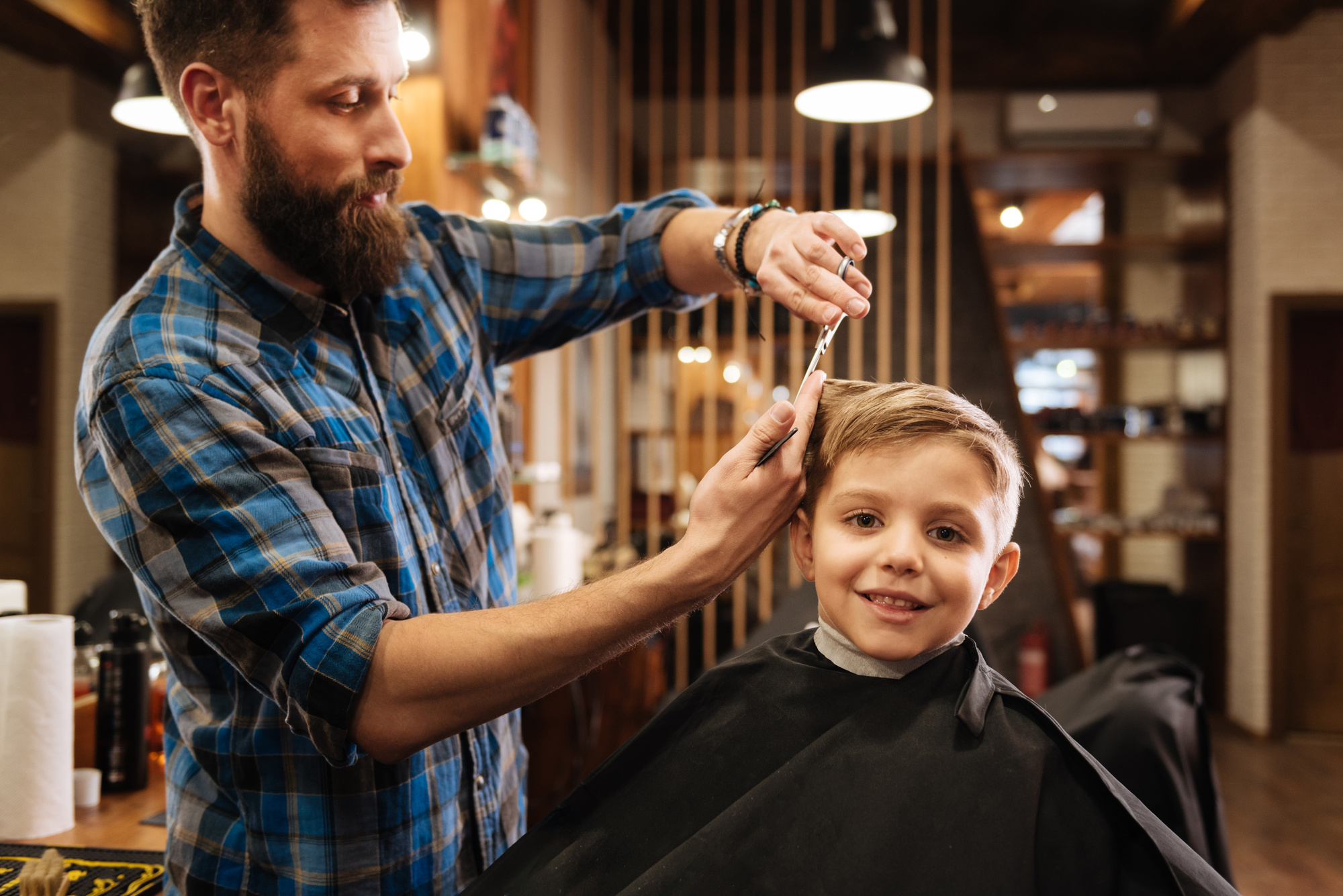
Tyler came through the front door with his backpack slung over one shoulder and the right side of his head neatly tapered above the ear, the left side hanging exactly as long and untouched as it had been forty-five minutes earlier when he’d walked out of the house humming some cartoon theme song under his breath. For a second I genuinely thought my eyes were playing tricks on me, some trick of the kitchen light catching his hair wrong.
“Can I have two dollars for a lollipop?” he asked, already heading for the junk drawer where I kept loose change.
“Tyler, honey. What happened to your hair?”
He wouldn’t meet my eyes. He looked down at his sneakers instead, the same careful, evasive posture he’d used since he was four whenever he’d broken something and hadn’t figured out yet how to explain it.
“Mr. Lewis stopped,” he said.
“Stopped? Why would he stop in the middle of a haircut?”
He shrugged, one small shoulder rising and falling under his jacket, the universal gesture of an eight-year-old who has decided that silence is safer than whatever’s actually true.
I want to back up, because none of what happened that night makes sense without understanding what an ordinary morning in our house looked like. An hour before Tyler came home with half a haircut, I’d been drinking my second cup of coffee at the kitchen counter while he laced up his sneakers by the door, humming that same cartoon tune, completely unbothered, the way eight-year-olds are unbothered by almost everything except the genuinely large things.
“Mom, can I have two dollars for a lollipop?” he’d asked that morning too, before he left.
“Mr. Lewis gives you those for free, sweetheart. He always has.”
“I know. But I wanna buy him one this time.”
That was my son. Eight years old and already softer-hearted than most grown men I knew, the kind of kid who worried about whether the crossing guard had eaten lunch and saved half his birthday cake for the mail carrier without anyone suggesting he do it.
He’d been going to Mr. Lewis’s barbershop, three blocks over on Chestnut, since he was four years old. Mr. Lewis knew Tyler liked the Cardinals, kept grape lollipops behind the counter specifically for him, and always let him pick the radio station during his cut. It was one of the small, steady rituals of our life together, one of the things that made our neighborhood feel like a real place instead of just a collection of houses.
“You gonna walk carefully?” I’d asked him that morning, the way I always did, even though the walk to Mr. Lewis’s shop was about as safe a three blocks as existed anywhere in town.
“Mom. I’ve done it a hundred times.”
“Humor your old mother.”
He’d rolled his eyes, but he’d let me kiss the top of his head before he left, and I’d watched from the front window until he disappeared around the corner, then gone inside and checked the lock twice, the way I always did. My mother used to say I could turn worrying into a full-time profession if someone would pay me for it.
My parents died in a car accident the winter Tyler turned five, and I’d moved us into their old house on Larkin Street because I couldn’t bear the thought of selling it, of some stranger repainting my childhood bedroom or tearing out my mother’s garden. Their coats still hung on hooks by the back door three years later. I told myself I’d get to it eventually. I never did.
Lately, though, Tyler had been unusually chatty about a new friend, someone he’d mention in passing while we did homework or ate dinner. I hadn’t questioned it much, honestly. “He tells the best stories, Mom,” he’d said one evening, not looking up from his math worksheet.
“Yeah? Someone from your class?”
“Kinda. He knows about baseball from a long time ago. Like, old-timey stuff.”
I’d assumed he meant a classmate’s grandfather, someone who volunteered at the school or hung around the little league field on weekends. Tyler was shy and didn’t make friends easily, so an older man taking an interest in his baseball trivia hadn’t struck me as anything worth worrying over. I’ll think about that assumption for the rest of my life.
That morning, when Tyler left for his haircut, I’d checked the clock at twenty minutes, the way I always did. Tyler’s haircuts never took long. At thirty minutes, I’d started glancing at the door more often than I wanted to admit. At forty-five minutes, I heard the front door finally open, and then his footsteps, slower than usual — not the excited stomp of a boy freshly barbered and clutching a lollipop, but something quieter, more hesitant.
“Tyler?”
He appeared in the kitchen doorway, and I nearly dropped my coffee mug.
I called Mr. Lewis’s shop right away, expecting some simple, forgettable explanation — a broken clipper, an emergency, anything ordinary. Instead, when he picked up, he was crying. Actually crying, his voice thick and unsteady in a way I’d never heard from him in four years of watching him cut my son’s hair with a kind of patient, unhurried care that had made me trust him instantly.
“I couldn’t finish,” he said. “After what Tyler did, I couldn’t finish.”
“What happened? What did he do?”
“Please. Just come with him, Rachel. He brought something here you need to see.”
“What? What did he bring?”
“A photograph,” Mr. Lewis said, and then he wouldn’t say anything more, no matter how many times I pressed him.
I grabbed my purse and my keys, and Tyler and I walked the three blocks back to the shop together, mostly in silence. I tried everything I could think of, the entire way, to get him to tell me about the photo. He wouldn’t say a word. He just kept his eyes on the sidewalk, his hands jammed into his jacket pockets, walking a half step behind me like he was bracing for something.
When we arrived, Mr. Lewis silently led me to his barber chair, the one Tyler had been sitting in when whatever happened, happened. An old photograph lay on the counter beside his clippers, slightly curled at the edges like it had been carried in a wallet for years. A young man stared out of it, unsmiling, a dark birthmark visible just above his left eye.
“Why did you stop in the middle of his haircut?” I asked.
Mr. Lewis’s eyes went to Tyler, standing quietly near the door, and then back to the photograph on the counter.
“Buddy,” I said, crouching down to Tyler’s level, keeping my voice as steady as I could manage. “The man who walked you here. How long have you known him?”
Tyler stared at his sneakers. “Just a friend.”
“What friend? What man, Tyler?”
“He sits by the ballfield sometimes. We talk about baseball.”
“How many times have you talked to him?”
“I don’t know. Maybe five.”
My stomach tightened into something hard and cold. “An adult man has been meeting you at the park. Alone.”
“He’s old, Mom. And he’s nice.” Tyler said it like it was the most obvious, reassuring fact in the world, the way only a child could say it.
I looked up at Mr. Lewis. “Who is he?”
His eyes returned to the photograph, and he was quiet for a long moment before he answered. “I think I know. That birthmark — I’ve seen it before. But I need to be sure.”
“Sure about what?”
“Rachel.” He said my name carefully, like he was handling something fragile. “How much do you remember from when you were five?”
“What does that have to do with any of this?” I demanded. “What does that have to do with Tyler?”
“Did your parents ever tell you about anything that happened before you started school? Did they ever hide anything from you?”
“Stop,” I said. “You’re scaring me.”
“That man didn’t choose Tyler by accident,” Mr. Lewis said, stepping closer, and something in his voice had shifted into something almost pleading.
“Then tell me who he is.”
“I can’t. Not until I’m certain.”
I grabbed Tyler’s hand, my pulse hammering in my ears. “You’re crazy,” I told Mr. Lewis, though even as I said it, some part of me already suspected he wasn’t.
“Go home and check your parents’ papers,” he called after me as I pulled Tyler toward the door. “Look for the year you turned five.”
“Don’t call us again,” I said. “Tyler isn’t coming back here.”
I didn’t turn around on my way out. I could feel him standing there behind me, and I didn’t turn around.
Back home, I sat Tyler on a kitchen stool and evened out his lopsided hair myself with the kitchen scissors, trying to keep my hands from shaking as I worked. He watched me in the little mirror propped on the counter, quieter than any eight-year-old had a right to be.
“Did that man ever tell you his name?” I asked, snipping carefully around his ear.
Tyler shook his head.
“Did he ever ask where we live?”
“No,” Tyler said. “He already knew.”
My scissors stopped mid-motion. I didn’t ask anything else after that. I put a movie on for him, and he curled against my side on the couch, and I stared at the screen without seeing a single frame of it, my mind circling back, again and again, to that photograph, that birthmark, my parents’ careful silences about my childhood that I’d never once thought to question.
A memory surfaced, uninvited, sharp and sudden the way old memories sometimes are. I was nine years old, digging through a shoebox on the floor of my mother’s closet, looking for a missing shoe, and I’d found instead a scattering of photographs, none of them showing me younger than about five or six.
“Mom, why don’t we have pictures of me as a baby?” I’d asked her.
She’d smiled that soft, careful smile she always used when she was steering a conversation somewhere else. “We lost a lot of things in the move, sweetheart. You know how your father is with boxes.”
I’d accepted that answer at nine. I hadn’t thought about it again until years later, at the dinner table, twelve years old, watching my father cut my pancakes into pieces even though I was plenty old enough to do it myself.
“Dad, when’s my exact birthday? Sarah at school said her mom remembers the hour she was born.”
He’d chuckled, but his eyes had flicked toward my mother, just for a second, a look I hadn’t understood at the time and had never thought to examine since. “I don’t remember the hour. I just remember you were five when—” He’d stopped himself abruptly. “Five pounds. About five pounds.”
I’d laughed at what I assumed was just a funny slip of the tongue and forgotten about it almost immediately. Children forgive their parents’ small stumbles without a second thought. It’s one of the things that makes childhood so dangerous, in retrospect — how easily a strange sentence gets absorbed into the ordinary noise of family life.
By eight o’clock that evening, Tyler was asleep on the couch. I carried him up to bed, checked the front door lock twice, and then went down to the basement, where three years’ worth of my parents’ boxes still sat mostly unopened, stacked against the far wall since the move.
It took nearly an hour of digging through folders and envelopes before I found the one with my name on it, tucked inside a manila folder marked simply “Rachel — Records” in my mother’s careful handwriting.
I carried it upstairs to the kitchen table and opened it there, under the overhead light, my hands not quite steady.
The certificate inside was printed on cream-colored stock, an official seal embossed in the corner. My name. My parents’ names — the only parents I’d ever known, the two people whose coats still hung by the back door. And a date.
I had been five years old.
“No,” I whispered to the empty kitchen. “No, no, no.”
I read it three times, waiting for the letters to somehow rearrange themselves into something less impossible. They didn’t. My eyes went, almost involuntarily, to my parents’ coats hanging by the door, the ones I’d kept there for three years because moving them had always felt too much like admitting they were really gone. Now I found myself wanting my mother alive for just five minutes. Long enough to ask why she’d let me grow up believing there was nothing before her. Nothing before that house, that name, that life.
That was when I heard it. A soft crunch of gravel outside the kitchen window. I went still, telling myself it was probably just a neighbor’s dog, some raccoon knocking over a trash can. Then a shadow crossed the porch light.
I grabbed my phone off the counter and walked toward the front door.
“Who’s there?”
Nothing. Silence, except for my own heartbeat.
“I’m calling 911,” I said, loud enough to carry through the door, my thumb already sliding across the screen toward the emergency dial.
I opened the door two inches, just enough to see. The porch itself was empty, but near the mailbox at the end of my front walk stood an elderly man in a dark coat, his hands folded together beneath the streetlight, standing there like he’d been waiting a very long time and had finally worked up the nerve to approach.
He took one step forward, and the streetlight caught a large, dark birthmark above his left eye.
“I’m sorry to come this late,” he said softly. “But I needed to see you.”
I felt the porch tilt beneath me, the whole world going slightly sideways for a second. Behind me, somewhere in the house, Tyler was sleeping, safe, unaware. And the stranger my son had called his friend from the ballfield was standing in my front yard in the middle of the night.
“Get away from my house,” I said, my voice cracking despite everything I did to keep it steady. “I’m calling 911.”
He moved forward slightly, the careful, hesitant walk of someone who had rehearsed this exact moment for years and still couldn’t quite manage it gracefully. “Please,” he said. “Just hear why I came.”
My throat closed up entirely. I stepped back toward the doorframe, phone shaking in my hand, my finger hovering over the call button.
Then footsteps hit the driveway behind him, quick and heavy, and a second figure came into view, out of breath, jacket thrown on hastily over what looked like a work shirt.
It was Mr. Lewis.
“You need to leave,” I told both of them, my voice cracking on the words. “Right now. Both of you.”
Mr. Lewis didn’t answer me right away. He wasn’t even looking at me anymore. He was staring, fixed and unblinking, at the old man’s forehead — at that dark birthmark above the eye — and his face was draining of color in real time, right there under my porch light.
“Dad?” The word came out of him cracked, almost childlike, nothing like the calm, steady voice I’d known for four years of Saturday morning haircuts.
The old man’s knees seemed to buckle for a moment. He caught himself on the porch railing before he went all the way down.
“So I wasn’t wrong,” he whispered.
I looked between the two of them, the adoption certificate still crumpled in my fist from where I’d carried it out here without realizing it. “What is happening?” I said. “Somebody tell me what is happening right now.”
Mr. Lewis turned toward me slowly, like he was afraid I might disappear if he moved too fast. “How old were you when your parents adopted you, Rachel?”
“Five,” I said, before I could even think to stop myself. “I just found out tonight. I never knew. I never once knew.”
He closed his eyes.
“I had a sister,” he said, his voice barely above a whisper. “She was five when they took us to the orphanage. I was thirteen. They adopted her out within a month. I never saw her again.”
The porch tilted under me a second time. “No,” I heard myself say. “No, that isn’t — that can’t be.”
The old man finally spoke, tears running freely now into the deep lines of his weathered face. “Your mother — our mother — died,” he said. “I couldn’t feed you both. I couldn’t keep the lights on, not with two kids and no job and no family left to help. I told myself a family would take you together, that I was doing right by both of you. They only took her. Only you.”
“Don’t,” Mr. Lewis said sharply, cutting him off. “Don’t stand on her porch and make it sound gentle. Don’t do that.”
“I’m dying,” the old man said quietly. “The doctors gave me months, not years. I found Rachel six weeks ago. I couldn’t make myself knock on her door. I told myself I just wanted to see her from a distance, just once, and then I saw the boy at the ballfield, and he looked so much like my sister at that age that I couldn’t make myself walk away.”
I stared at him, something cold and furious rising up through the shock. “So you went through my son instead. You used my eight-year-old to get close to me because you were too afraid to knock on my actual door.”
“I talked to him,” the old man said, his voice pleading now. “That’s all I did. I never touched him, never took him anywhere, never once left the park with him. I just wanted to know one small thing about the family I threw away thirty years ago.”
I pressed my hand against my mouth, trying to hold something in that didn’t have a name yet.
“Mr. Lewis,” I said, and my voice sounded strange to my own ears, distant. “My barber. The man who has kept grape lollipops behind his counter for four years, who let my son pick the radio station every single week.” I looked at him, this man I’d trusted with something as small and as large as my child’s Saturday mornings for four years, and tried to reconcile him with what I was hearing. “You’re my brother.”
“I am,” he said quietly. “Rachel. You’re my sister.”
“I don’t know you,” I whispered.
“You do,” he said. “You just didn’t have the word for it yet.”
Behind us, the screen door creaked. “Mom?”
Tyler stood in the doorway in his pajamas, rubbing one eye, hair still slightly uneven from my hasty kitchen-scissors repair job. “Why is Mr. Lewis here?” he asked. Then his eyes moved past him, to the old man standing near the mailbox, and his whole face brightened with recognition. “Hey — that’s my friend from the ballfield. The one with the mark over his eye.”
Three faces turned toward him at once, and something in me chose, before I’d even consciously decided anything, to protect him from the rest of this conversation for at least one more night.
I crossed the porch and knelt down in front of my son, smoothing his crooked hair with one hand, my other hand still gripping the crumpled certificate.
“Is Mr. Lewis staying?” Tyler asked, looking past me at the two men still standing on our lawn.
“Come on, baby,” I said, ignoring the question for now. “Let’s get you back to bed. We have some things to talk about tomorrow, but right now you need to sleep.”
“Is everything okay?”
I looked back once at Mr. Lewis, still trying to fully absorb the idea that the man who had cut my son’s hair for four years, who I’d exchanged small talk with about weather and school and the Cardinals’ bullpen, was also, somehow, impossibly, my brother.
“I think it will be,” I told Tyler, and I hoped it was true.
I walked him back to his room, tucked the blanket carefully under his chin, and kissed his forehead the way I did every night. “Is Mr. Lewis staying?” he asked again, already half-asleep.
“For a little while,” I said. “Go back to sleep, sweetheart.”
When I returned to the kitchen, the two of them were sitting at my table, waiting, like men awaiting a verdict from a judge who hadn’t decided yet how she felt about either of them. I stayed standing, the certificate still in my hand.
“You don’t get thirty years of silence and then just show up and get a daughter,” I said, looking at the old man. “And you don’t get to use my son as a bridge because you were too afraid to face me directly.”
He lowered his eyes to the table.
“You knew where I lived,” I said. It wasn’t a question.
“I found your name six weeks ago,” he admitted. “Then your address. I drove past this house once. I couldn’t make myself knock. That’s when I saw Tyler heading toward the ballfield with his glove, and something in me just — followed him. I’m not proud of it.”
“So you followed my son.”
He flinched at the plainness of the accusation. “The first time, yes. I followed him from the park entrance to make sure he got home safely, honestly, that was the whole of it that first day. Then I saw him at the park again the following week, and he looked so much like your brother did at that age, that same walk, and I couldn’t stay away after that. I told myself I was being careful. I told myself I wasn’t doing any harm.”
“So instead of talking to me,” I said, “you talked to my eight-year-old son. For weeks. Instead of me.”
“I was afraid,” he said.
“Being afraid isn’t a reason,” I told him. “It’s an explanation. Those aren’t the same thing, and I need you to understand that difference before we go any further with this conversation.”
He lowered his head.
“And understand me clearly,” I went on, my voice steadier now than I expected it to be. “Tyler will know the truth when I decide he’s ready to know it. Not before. He is eight years old. He is not the bridge you get to walk across to reach me.”
“I agree,” he said quickly. “Whatever you need. He isn’t. He won’t be. I promise you that.”
For most of my life, other people had decided which truths I was allowed to handle and when. My parents had done it out of love, I believed that even now, sitting there with their coats still hanging by the door. This man had done it out of fear, thirty years of fear that had finally curdled into a kind of desperate, sideways trespass through my son’s Saturday afternoons at the ballfield. Either way, I had always been the last person allowed to know my own story. That ended that night, whatever else came of it.
Mr. Lewis reached across the table and covered my hand with his, gently, the way he might have steadied a customer’s head before making a difficult angle on a haircut.
“All this time,” he said quietly. “You coming into my shop. Tyler sitting in my chair every few weeks. I kept seeing something familiar in both of your faces and telling myself I was imagining it, that I was just a lonely man inventing connections that weren’t really there.”
“Why didn’t you say something? All those years, you knew — or you suspected.”
His mouth tightened. “Because hoping you were my sister, and being wrong, would have meant losing you twice. I’d already lost you once, when I was thirteen and you were five and there was nothing I could do to stop it. I couldn’t survive imagining I’d found you again and then finding out I was wrong.”
We sat like that for a long time, the three of us, somewhere between anger and exhaustion, and something in me loosened, not all the way, not close to all the way, but enough that I could finally breathe normally again.
“I don’t know if I can forgive you,” I said finally, looking at the old man — my father, biologically, a stranger in every way that mattered. “And I don’t know if I want you in Tyler’s life. Not yet. Maybe not for a long time.”
His face tightened, but he nodded slowly. “I understand.”
“If there’s another conversation between us,” I said, “I’ll be the one who starts it. You don’t come here uninvited. You don’t wait for Tyler at the park, not ever again. You don’t contact him directly, not a phone call, not a note, nothing. Do you understand me?”
“I understand.”
“Give me your number,” I said. “That’s all I’m offering tonight. Nothing more than that.”
“And if I never call?” he asked quietly.
“Then I live with that,” he said, before I could even answer, and something about the resignation in his voice, the way he’d clearly already braced himself for exactly that outcome, softened something in me that I hadn’t expected to soften so soon.
I turned to my brother — my brother, a word I was still testing in my mind, trying to see if it fit — and looked at him across the table.
“All these years,” I said, “Tyler kept coming home talking about Mr. Lewis. The lollipops. The stories. The music he got to pick.”
He gave me a tired, small smile. “Mostly the lollipops, probably.”
I laughed, unexpectedly, and it nearly broke something open in my chest, that laugh arriving in the middle of everything else I was feeling. “I’m glad it was you,” I told him. “Of all the people who could have turned out to be my brother, standing behind that barber chair for four years — I’m glad it was you.”
The first pale light of dawn was starting to touch the kitchen window by then. The old man wrote his phone number on the back of an envelope with a pen from my junk drawer and slid it across the table toward me. I didn’t promise to use it. I put it in my pocket anyway.
A few minutes later, I watched him walk down the porch steps alone, his shoulders bent in a way that made him look older than he probably was, and get into a car parked a little way down the street.
When I came back inside, Mr. Lewis was still sitting at the table.
“I don’t know what I’m supposed to call you now,” I said, sitting down across from him.
A tired smile touched his face. “Lewis still works. It’s been my name a long time, however I came by half of it.”
For some reason, that was the first thing all night that made me really laugh, a genuine laugh instead of the strange, disbelieving one from before. I rested my forehead against my brother’s shoulder for just a moment, letting myself feel, briefly, what it might be like to have this particular kind of family back in some form, after thirty years of not even knowing it had existed to lose.
Upstairs, Tyler was still asleep, blissfully unaware of everything that had shifted underneath our house that night. In the morning there would be questions, plenty of them, and later, harder ones still, ones I’d need to answer carefully and honestly when the time actually came.
This time, at least, I wouldn’t answer them with a lie.

Specialty: Quiet Comebacks & Personal Justice
David Reynolds focuses on stories where underestimated individuals regain control of their lives. His writing centers on measured decisions rather than dramatic outbursts — emphasizing preparation, patience, and the long game. His characters don’t shout; they act.