Most mornings, the biggest decision I had to make was whether the tomatoes needed watering before breakfast. At sixty-four, I liked it that way. I’d had enough surprises for one lifetime, and after thirty-two years in the same little suburban house, there wasn’t much left in it that could surprise me.
That morning, I poured my coffee, opened the mail, and found out I was wrong. I blinked. Then I blinked again. “That can’t be right,” I said aloud, to nobody but the cat, who was busy weaving figure eights around my ankles, entirely uninterested in my financial crisis. The number was nearly double. Not a few dollars off. Double.
I checked the account number. I checked the meter reading. I even walked out to the little box on the side of my garage and squinted at it, as if the digits might apologize and correct themselves the way a rude comment might, if you just stared at the person long enough. They didn’t.
I came back inside and called my daughter Diane, because that’s what widows do when something doesn’t add up. We call our daughters and pretend we just wanted to chat. “Mom, did you leave the AC running with a window open again?” “I did not,” I said. “I haven’t touched the thermostat since April.” “Maybe it’s the fridge. Old fridges eat power.” “The fridge is younger than you are, honey.” She laughed. I did not.
After we hung up, I stood at the kitchen window a long while, coffee going cold in my hand, running through everything in the house that could possibly account for that number. The washing machine, ancient but not that ancient. The water heater, replaced only two years ago. The little window unit in the guest room I hadn’t used since March. None of it added up to double.
I stared across the low fence at my neighbor Monica’s yard. Monica, thirty-something, three kids, a husband who traveled for work more than he was home, and a shiny white Tesla always parked crooked in her driveway, nosed up close to the fence we shared, as if the mulch beds and the solar lights along the property line were only for show. Her habits, however, were not.
I already knew Monica had trouble understanding where her property ended and everyone else’s began. I just didn’t know yet how far she’d taken it.
Six months ago, my garden gnome disappeared. A silly little thing my husband bought me at a flea market the summer before he passed. He’d pressed it into my hands and grinned. “For the garden, El. Every yard needs a little nonsense.” I’d kept it by the tomato bed ever since, moving it once when I redid the mulch, tripping over it more than once while weeding and laughing at myself every time.
Two days after it vanished, I spotted it sitting cheerfully by Monica’s front steps, wearing a fresh coat of blue paint like it had always lived there, like thirty years of sun-fade and one very specific chip on its nose from the year my husband dropped it moving the wheelbarrow hadn’t happened at all. I never said a word. I told myself she probably thought it had blown into her yard during a storm, that she’d meant to ask, that she’d simply forgotten, the way busy young mothers forget things. I told myself she was busy.
Then the lawn mower went missing from my garage. I noticed because I went out one Saturday to do the front strip before it got too hot and the mower simply wasn’t there. It came back a week later, sitting innocently just inside the open garage door as if it had walked itself home, tank empty, blade dull enough that it tore the grass instead of cutting it, and no note. I told myself she was busy. Three kids. Give grace. I had been telling myself some version of that sentence for years, ever since Monica and her family moved in across the low fence, back when her oldest was still in a stroller and she used to wave at me over the hedge with genuine warmth, before warmth curdled slowly into something closer to entitlement.
I wasn’t the only one who’d noticed the pattern, either. Frank across the street had complained once, at a block barbecue two summers back, about a ladder Monica had “borrowed” and forgotten to return for the better part of a season. At the time, I’d laughed it off along with everyone else standing around the grill. That was Monica. She borrowed first and asked later, if she asked at all, and somehow it had become a running joke among the neighbors rather than a problem anyone actually addressed.
Looking back, I should have realized that people like Monica don’t stop when nobody stops them. Every small thing I let slide became, in her mind, permission for the next thing, and the next, until the fence between our yards had stopped meaning anything at all except a place for her to park closer to my garage than to her own.
“Keep the peace, Eleanor,” I muttered, the way I had been muttering it for a decade, ever since my husband died and I found myself the only widow on a street full of young families, uncertain of my footing in a neighborhood that had changed considerably around me. I looked down at the bill in my hand. Two hundred and twenty-seven dollars, for a woman who watches PBS in the evenings and boils one kettle a day for her tea. Something in this house was drinking electricity like a thirsty horse, and I intended to find out what, even if it took me sitting up half the night to do it.
But one night, I couldn’t sleep at all, and even my pills weren’t helping. I lay there listening to the house settle, to the refrigerator cycling on and off in the kitchen, to every ordinary sound a house makes at two in the morning when a person is far too awake to ignore them. The hum was faint, the kind of sound a person notices only at midnight, when everything else is quiet enough to let it through. I was sitting up in bed, staring at the ceiling, running through my grocery list for the third time just to have something to occupy my mind, when I heard it again through the open window.
I pulled the blinds back an inch and squinted out at the driveway. For one second, I thought I was imagining what I saw, that my tired eyes were simply playing tricks in the dark. Then I followed the cable with my eyes, tracing it from one point to the other like I was solving a puzzle I already suspected the answer to.
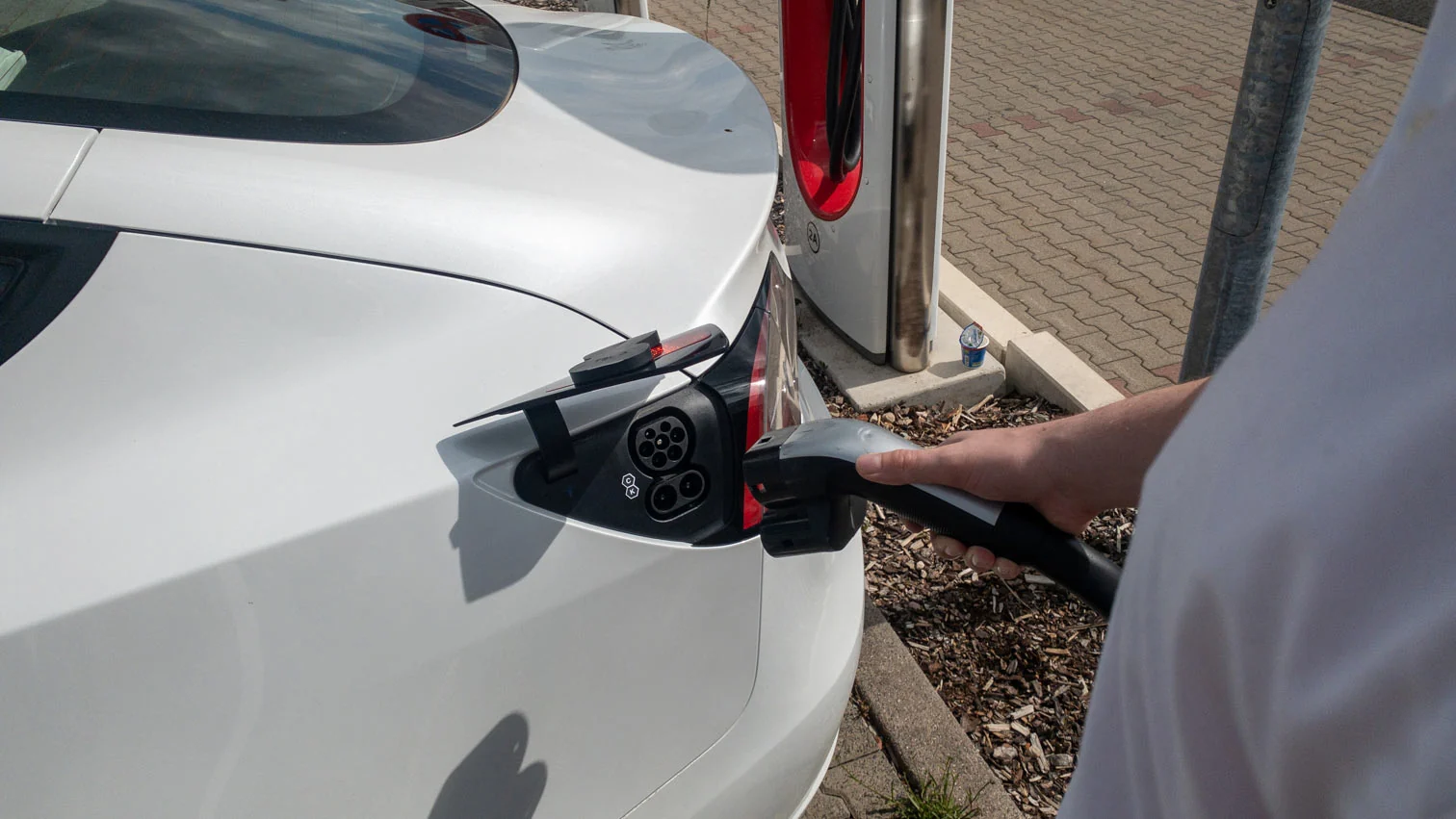
Monica’s white Tesla sat pressed up close to my property line, headlights dark, and a thick black cable ran from the side of the car straight to the outdoor outlet on my garage wall, the one I used maybe twice a year for the hedge trimmer.
I threw on my robe and slippers and walked out into the cool night air, my heart beating harder than it had in months, harder than it had since the night the hospital called about my husband. Monica leaned against her car, scrolling on her phone, calm as a Sunday morning, as though standing in someone else’s driveway at midnight stealing electricity were the most natural thing in the world.
“Monica,” I said, my voice tighter than I meant it to be. “What exactly are you doing?”
She looked up without a trace of shame, her face lit blue by the phone screen. “Charging my car. What’s the big deal?”
“The big deal,” I answered, folding my arms across my robe, “is that cable is plugged into MY house.”
She rolled her eyes and slipped the phone into her back pocket, the picture of a woman being mildly inconvenienced by an unreasonable request. “Eleanor, come on. You live alone. How much electricity could you possibly need?”
“That isn’t the point.”
“It kind of is, though,” she went on, waving a hand at my quiet little house, the porch light, the single lit window of my bedroom. “I have three kids. I’m running errands all day. You’re retired. You just sit inside.”
I felt the heat rise up the back of my neck, a slow burn that had nothing to do with the mild summer night. “My bill doubled last month, Monica. Doubled. Because of THIS.” I gestured at the cable, coiled thick and confident across my driveway like it had every right to be there.
She gave an irritated little laugh, the kind that manages to be both dismissive and somehow accusatory at once. “Fine. I’ll give you ten bucks if it matters that much. Don’t be greedy, Eleanor. It’s just a little electricity.”
Greedy. That word landed harder than she knew, harder maybe than anything else she could have said in that moment. I had spent forty years being the woman who baked casseroles for grieving families the week after a funeral, who watered plants for neighbors on vacation without ever once expecting a thank-you card, who let people borrow tools and ladders and lawn mowers without keeping score, because keeping score had always felt small to me, unkind in some way I couldn’t quite articulate. Being called greedy, by a woman who had been quietly siphoning electricity from my house for what I now suspected had been weeks, maybe longer, was almost funny. Almost.
“Please unplug the cable,” I said quietly, keeping my voice as level as I could manage.
“I’m almost done. Ten more minutes.”
“Now, Monica.”
She sighed like I was a child asking for a second cookie before dinner, then made a slow, deliberately unhurried show of tugging the cable out and coiling it in her hands, taking her time about it in a way that felt less like compliance and more like a performance of reluctance meant to remind me who was inconveniencing whom. “You know,” she added over her shoulder as she walked back toward her own driveway, “this is why I didn’t ask. I knew you’d make a whole thing out of it.”
I did not answer. I forced my mouth into the smallest, tightest smile I could manage, the kind of smile I’d perfected over decades of swallowing things I wanted to say, turned on my heel, and walked back into my house. The door clicked shut behind me, and I stood in the dark hallway for a long moment, listening to my own breathing, waiting to feel calmer. I didn’t.
Then I walked to the kitchen table, sat down, and stared at the electric bill that was still sitting there under the fruit bowl where I’d left it that morning. Two hundred and twenty-seven dollars. I thought about every small thing I’d let slide over the past six months. The gnome. The lawn mower. Frank’s ladder. All of it small enough, on its own, to laugh off at a barbecue, but together forming a pattern so obvious I felt almost embarrassed I hadn’t named it sooner.
I had let all of it slide at first. Because I was tired. Because I was alone. Because being “the nice one” was easier than the alternative, easier than confrontation, easier than being the difficult old woman on the street who made a fuss over a ladder or a lawn mower. But there is a particular kind of exhaustion that comes from being the nice one for too long, a tiredness that settles into your bones rather than your muscles, and sitting at that kitchen table at nearly one in the morning, I felt every bit of it.
I picked up my phone and texted Diane. Mystery solved. I know why my electric bill doubled. And I have a plan.
My phone rang less than ten seconds later. Diane, calling instead of texting, which meant she was either genuinely worried or genuinely delighted, possibly both. I looked at her name flashing on the screen and smiled, but I didn’t answer. I’ll tell you tomorrow. Love u. By the time I climbed back into bed, I was almost smiling for real. I didn’t know exactly how Monica would react to whatever I ended up doing. But I knew her well enough, after three years of watching her operate, to know she wouldn’t leave that gnome alone if it turned up somewhere inconvenient for her.
The next morning, I woke up with a clarity I hadn’t felt in years, the particular sharp-edged clarity that comes after a decision has finally, quietly, been made somewhere in the back of your mind while you slept. I made my coffee, sat at the kitchen table, and let the plan take shape as naturally as breathing, sketching it out on the back of an old envelope the way I used to plan garden layouts with my husband, one step leading logically into the next.
First things first: I walked across the lawn in broad daylight, marched right up to Monica’s flower bed, and picked up my garden gnome. The one Monica had slapped a fresh coat of blue paint over, though I could still see the chipped nose underneath and the faint outline of the little red hat bleeding through where she’d been too lazy to prime him properly before painting. The one that had been “decorating” her yard for six months while I said nothing, swallowed the theft along with my pride, and told myself repeatedly that it wasn’t worth the argument.
Nobody stopped me. Monica’s Tesla was gone, probably off running errands with all that free electricity in the battery, ferrying kids to whatever summer activities filled her days. I carried the gnome home under one arm like a small, painted hostage rescued at last, and set him down near the outdoor outlet on the side of my garage. Then I spent the better part of an hour getting everything else ready, digging through the garage for the leftover fishing line from a tackle box my husband hadn’t touched in years, rigging up a can of hot pink exterior paint I’d bought on impulse at the hardware store that morning, testing the tension twice to make sure it would trip cleanly without giving itself away too early. I felt, at various points during that hour, like an actual criminal mastermind, which struck me as both absurd and enormously satisfying for a woman my age standing in her own garage on a Tuesday morning.
When I finally stepped back to admire my work, the gnome looked perfectly innocent sitting beside the outlet, exactly where Monica’s charging cable would need to reach if she tried the same trick again. That was exactly the point. Monica had no idea what kind of surprise that little gnome had waiting for her.
Around lunchtime, my daughter Diane called, unable to wait any longer for the full story I’d promised. “Mom, you sound too cheerful. What are you doing?” “Just tidying up the yard, sweetheart.” “You’re plotting something. I can hear it.” “Only if Monica gives me a reason to.” I laughed and told her I loved her. Then I hung up before she could talk me out of anything, before her practical, slightly anxious daughter-brain could start listing all the ways this could go wrong.
For one small moment that afternoon, watering my tomatoes with the hose looped over my shoulder, I did wonder if I had lost my mind entirely. Sixty-four years old, and rigging up a garden gnome like a cartoon trap from an old cereal-box comic. Was I being petty? Or was I finally, after all these years, refusing to be invisible? I turned the question over a few times while I finished watering, and by the time I coiled the hose back up, I decided invisible had lasted long enough.
My late husband used to tease me about it, gently, the way he teased me about everything. I would send back the wrong order at a restaurant for him, argue with a mechanic who overcharged Diane on a brake job, stand up for anyone who needed it, anyone except myself. “You’d fight a bear for someone else, El,” he used to say, “but you’ll let a stranger cut you in line at the pharmacy without a word.” He wasn’t wrong. Somewhere along the way, keeping the peace had become an excuse for letting people decide what I would tolerate, and I’d let that excuse run my life for longer than I cared to admit.
I looked at the gnome sitting by the garage, waiting patiently for his moment. “Not tonight,” I told him, because I wanted Monica good and comfortable first, wanted her certain enough of her own impunity that she wouldn’t think twice before plugging in.
The sun went down. I turned off the porch light, poured myself a glass of iced tea, and sat in the dark behind the geraniums on my side porch, settling in with the patience of a woman who had spent thirty years waiting for tomato plants to ripen and knew better than most that good things came to those who simply waited them out. I felt like a woman a third my age on a stakeout, and I found myself grinning in the dark more than once, thinking how absurd I must look to anyone passing by, sitting bolt upright in my bathrobe with a glass of iced tea and a phone held ready in my lap.
All Monica had to do was leave my property alone. She didn’t.
The Tesla drifted in with its headlights off sometime after eleven, coasting the last few yards into her driveway the way a person moves when they’re trying very hard not to be noticed. Monica stepped out in her yoga pants and slippers, cable in hand, humming under her breath, some pop song I half recognized from Diane’s car radio. She looked so comfortable, so entirely at ease in her assumption that this had become simply how things worked now, that my garage belonged, in some practical sense, to her.
Then she stopped. “What in the world,” she muttered, more to herself than to anyone. She stared down at the gnome sitting right where she needed to plug in. My gnome. Her sloppy blue paint job, sitting there like a tiny, chipped-nose witness to everything.
“Ugly little thing,” she said. “Move.” She nudged him with the toe of her slipper. When he did not budge, she gave him a harder shove, more annoyed now than curious. Something thin snapped tight behind the gnome. She stood there frozen for half a second, sensing something was wrong but not yet understanding what. Too late. I had already started recording on my phone, my thumb steady despite how hard my heart was pounding.
The can tipped, wobbled, and emptied itself in one glorious, unhurried splash directly onto the top of Monica’s head. Pink paint poured down her hair, her shoulders, her yoga pants, her slippers, spreading in a bright, cheerful wave that looked, in the dim porch light, almost festive. She stood there frozen for one full second, bright cotton-candy pink from crown to toe, utterly speechless in a way I had genuinely never witnessed from her before.
Then the scream came. It was not a scream, really, it was a shriek that could shatter porcelain, the kind of sound that carries across an entire quiet suburban street at eleven-thirty at night and wakes up every household within earshot. Lights snapped on up and down the street, one after another, like dominoes falling. Doors opened. Somewhere a dog started barking like the world was ending, and somewhere else a baby began crying, disturbed by the commotion.
Monica stood in the middle of my driveway, dripping pink onto the concrete, still clutching her charging cable like a leash on an invisible dog. Her mouth opened and closed several times without producing any actual words, her whole body rigid with the particular fury of someone who has just been made to look, quite literally, ridiculous.
I stepped out from behind the geraniums with my phone held steady in front of me, my robe pulled tight, my slippers slapping softly against the driveway as I approached. And that was when the whole neighborhood came running. Doors flew open up and down the street. Neighbors poured onto the sidewalk in various states of undress, slippers and robes and one man, I noticed, in nothing but a Cardinals t-shirt and boxer shorts, phones already out and recording before anyone had even asked what was happening.
“YOU DID THIS ON PURPOSE!” Monica shrieked, pink paint dripping from her hair onto the concrete in a widening puddle. I lifted my phone a little higher from where I stood in my own driveway and kept my voice steady, the calmest I’d sounded all evening.
“Monica, you’re stealing electricity at midnight and arguing with a garden gnome. I’m not sure I’m the problem here.” Somebody behind me actually snorted, a woman I recognized vaguely as living two houses down, whose name I’d never quite managed to learn.
Monica spun in the driveway, pointing a shaking pink finger at the gnome, still lying on its side where the cable’s snap had knocked it over. “AND YOU STOLE MY GNOME!” I kept recording, kept my hand steady. “Your gnome? The one you took from my yard six months ago?” Monica went silent. Her face changed, visibly, in the yellow glow of the streetlight, as the reality of her situation began settling over her, layer by layer. For the first time all night, she seemed to realize how many phones were pointed at her, how many of her neighbors were standing right there in the street witnessing every second of it.
“Turn those off,” she snapped at the gathered neighbors, spinning in a slow, dripping circle. Then she looked back at me. “Eleanor, tell them. Tell them this was an accident.” “Which part?” “You know exactly what I mean.” “The paint?” I asked, tilting my head slightly. “Or you plugging your car into my house after I specifically told you not to, twice now?”
Her mouth tightened into a thin line. “I wasn’t stealing anything.” “Then why were you doing it after midnight?” Monica opened her mouth to answer, but someone else answered for her before she could. “Same reason she borrowed my ladder while I was at work, probably.” Frank stood across the driveway in plaid pajama pants and an undershirt, arms folded across his chest, clearly enjoying himself. Monica spun toward him, grasping for some kind of defense. “I gave that back.” “Three months later.” Someone laughed again, and this time several other people joined in, a ripple of quiet amusement moving through the small crowd that had gathered on the sidewalk.
Monica looked from Frank to me, suddenly less furious than trapped, her shoulders sagging under the weight of pink paint and public scrutiny both. “This is ridiculous. You’re all ganging up on me over nothing.” “No,” I said, and I meant it as plainly as I’d ever meant anything. “We’re finally saying something.” The laughter that broke out at that was the sweetest sound I’d heard in years, not cruel exactly, but honest, the collective release of a neighborhood that had apparently been quietly cataloguing Monica’s small transgressions for far longer than I’d realized, waiting, the same as me, for someone to finally say it out loud.
I thought Monica’s humiliation ended there, dripping pink in my driveway under the amused eyes of half the street. As it turned out, the paint was the least of her problems.
After everyone finally went home, doors closing one by one, lights switching off up and down the block, I stood alone in the driveway looking at the pink streaks on the concrete, already drying tacky in the warm night air. My hands had started shaking. Not from fear. From the strange, unfamiliar realization that Monica had yelled, threatened, embarrassed me in front of the whole street, and the world had not ended because I’d refused to back down. Nothing catastrophic had happened. The sky hadn’t fallen. I had simply, finally, said no and meant it, and somehow survived the saying.
Two weeks later, Mr. Alvarez, Monica’s landlord, knocked on my door around midmorning, hat in hand, looking a little uncomfortable on my front step. I’d known him for years, he’d been a good friend of my late husband before moving out of state to be closer to his grandchildren, though he still owned a handful of rental properties in the neighborhood and stopped by every so often to check on them. “I thought you deserved to hear this from me,” he said. “I saw the video.” “And?” I raised my eyebrows, bracing myself for some kind of lecture about neighborly conduct. “Her lease is up next month,” he continued. “I won’t be renewing it.”
I blinked, genuinely surprised. “Because of the video?” “No. I decided to take a closer look at everything, once I heard what had been going on.” “Something else was wrong?” “She’s behind on several utility payments, actually, has been for a while. I inspected the house too, when I came out to look into all this. There’s damage she never reported, water damage in the basement that’s clearly been sitting for months, and a few repairs she made without permission, including some electrical work in the garage that isn’t up to code.” He shook his head slowly. “That explains a few things I’d been wondering about myself.”
I glanced toward Monica’s house, its windows dark in the midday sun, and felt something complicated settle in my chest, not quite triumph, not quite pity, something in between the two.
A month later, I sat on my porch with a glass of iced tea and watched Monica load the last of her boxes into a moving truck, her husband home for once, helping her haul furniture down the front steps while the kids sat on the curb with their bikes, waiting to be told where they were going next. She never looked my way, not once, through the entire hour it took to load everything, and I found I didn’t particularly need her to.
My gnome sat proudly by the mailbox, back where he belonged, freshly cleaned of the last traces of blue paint, his chipped nose showing plainly in the afternoon light, exactly as my husband had left him all those years ago. I could almost hear my late husband’s voice saying it, the sentence I’d carried around in my head for weeks by then, turning it over like a smooth stone. Kindness isn’t the same as silence, El.
This time, I didn’t mistake keeping quiet for keeping the peace. And when the moving truck finally pulled away from the curb, disappearing down the street toward whatever came next for Monica and her family, I sat on my porch a while longer, finishing my tea, watching the tomatoes catch the last of the afternoon light, feeling, for the first time in longer than I could easily remember, entirely and comfortably visible.

Laura Bennett writes about complicated family dynamics, difficult conversations, and the quiet moments that change everything. Her stories focus on real-life tensions — inheritance disputes, strained marriages, loyalty tests — and the strength people find when they finally speak up. She believes the smallest decisions often carry the biggest consequences.