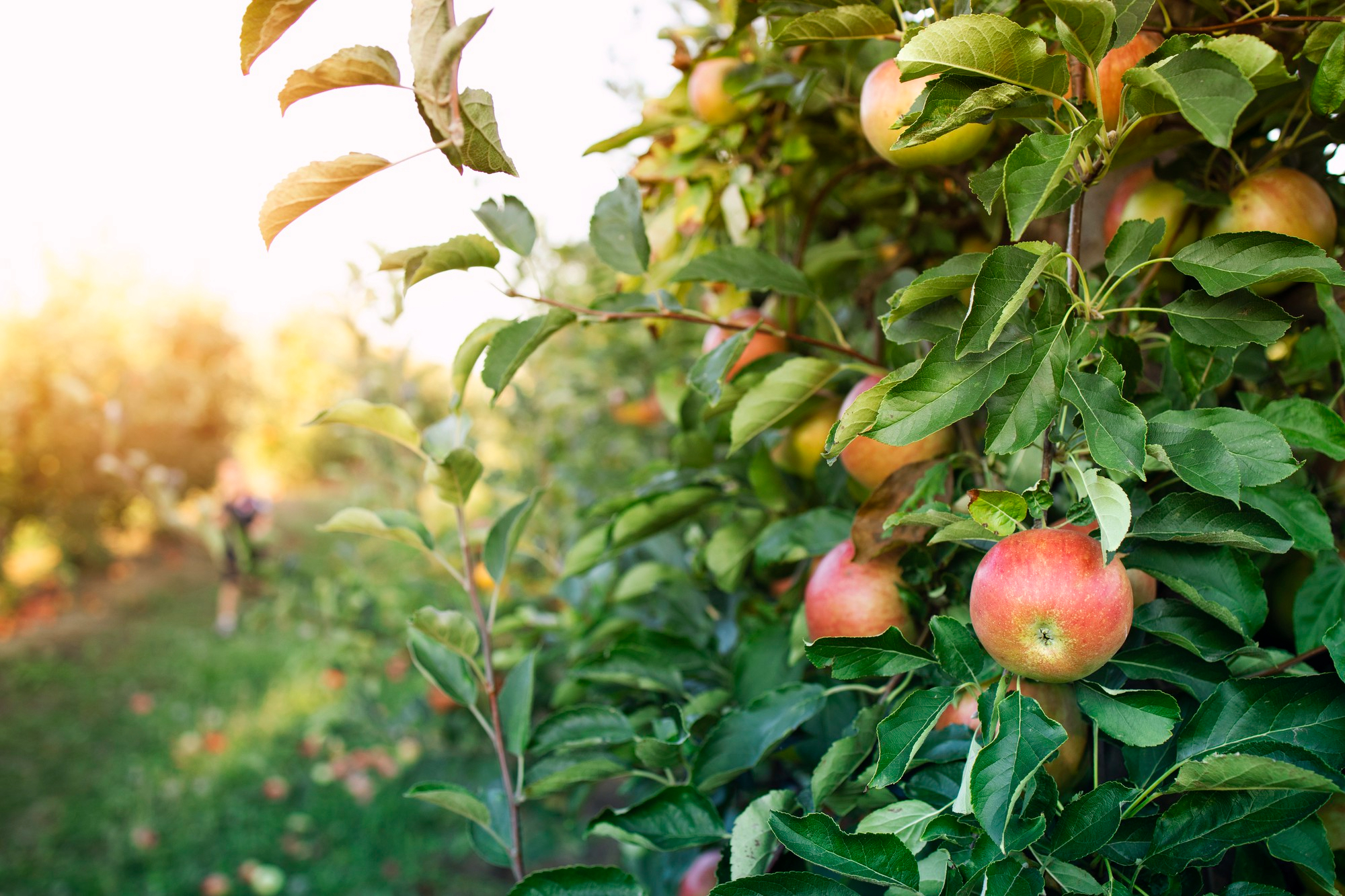
My neighbor stood at the fence and made my six-year-old carry apples across the yard to him, one armful at a time.
The tree is his. About a third of it hangs over our fence, which means every August and September we get apples in our grass, in the flower bed, under the swing set, in the driveway.
I’ve raked them. I’ve bagged them. Two years ago one rotted into the paint on our shed and left a mark that’s still there.
Last Sunday the kids were out back after lunch.
Maya’s six, Leo’s seven. They’d found a soft one and were seeing how far it would come apart against the fence post.
Then Dale came out on his side.
He’s fifty-eight. He’s lived there longer than we have.
He never opened the gate, never set a foot on our grass, he just stood at the fence with his arms folded and looked at my children through the slats.
“Those are mine. Bring them here.”
Leo said, “What?”
“All of them. Every one that came off my tree. Bring them to the fence.”
“They fell on our side.”
“Doesn’t matter where they land. It’s my tree.”
And they did it. That’s the part I can’t get out of my head.
My kids went around their own backyard picking apples out of the flower bed and out from under the swing set and walking them over to the fence in their arms, and he stood on his side and took them one load at a time and dropped them into a bag.
Maya couldn’t carry more than three at a time. She made four trips.
She kept looking up at the deck at me.
I said his name. He didn’t turn his head.
When they were done he pulled the bag shut, and then he looked up and saw me standing there, and he said, “Nice. Raising thieves young, are we?”
Maya cried. Leo didn’t, which was worse, he just stood in the middle of the yard with his hands dirty, looking at the ground, ears going red.
I got two photos through the deck rail.
I sent them to Rob at work with one line: He stood at the fence and made them bring him every apple in our yard.
He called me forty seconds later.
“Say it again.”
I said it again.
“Send those photos to my personal email, not my work one. And don’t delete them off your phone.”
“Rob.”
“Sarah, I need you to not rake this year. Not one. Leave every single one exactly where it falls.”
I stood on the deck with the phone against my ear, watching Leo walk slowly toward the back door, still not saying anything, and I felt something in my chest that was half fury and half a strange, disoriented confusion, because Rob’s voice on the other end of the line didn’t sound angry the way I expected. It sounded focused. Almost calm, in the particular way he gets when he’s already three steps ahead of a problem and working out the fourth.
“What are you talking about, don’t rake,” I said. “Rob, he made our kids walk apples to him like they were, I don’t even know what, like they were in trouble for something. Maya’s inside crying right now.”
“I know. I heard you the first time, and I’m not saying we don’t deal with that part too. We are. But I need you to trust me on the apples specifically. Don’t touch them. Don’t bag them, don’t compost them, don’t do anything you’d normally do this time of year. Just let them lie.”
“Why?”
“Because I want to know exactly how many apples that tree drops onto our property in a season, and I want him to watch the number grow instead of watching us quietly clean up after his tree the way we have for six years. I’ll explain the rest tonight. Can you get the kids settled? I’m leaving now.”
He was home in eleven minutes, which meant he’d left in the middle of something, and by the time he came through the door I had Maya on the couch with a blanket and a rerun of a cooking show she doesn’t even really watch but finds soothing, and Leo sitting at the kitchen table doing the thing he does when he’s upset where he lines up small objects in perfectly straight rows, that day it was a handful of Legos, sorted by color, arranged with an intensity that made my throat tight to watch.
Rob crouched down next to Leo’s chair before he did anything else. He didn’t touch him, just got down to his eye level.
“Hey, bud. I heard what happened.”
Leo kept lining up Legos.
“You didn’t do anything wrong. You know that, right? Somebody bigger than you told you to do something, and you did it, because that’s what we teach you to do when a grown-up gives you an instruction. That’s not you being a thief. That’s you being a kid who listens, which is a good thing, and the problem here is entirely about the grown-up who used that against you.”
Leo stopped lining up the Legos. He looked up. “He said we were stealing.”
“You weren’t stealing anything. You were picking up apples in your own backyard. He was the one who did something wrong, not you, and I promise you, I am going to take care of it.”
“Are you going to yell at him?”
“No,” Rob said. “I’m not going to yell at him. Yelling doesn’t actually fix anything, it just makes everybody feel bad for a while and then things go right back to how they were. I’m going to do something better than yelling.”
That got the first flicker of curiosity out of Leo since he’d come inside, and I watched some of the tension go out of his shoulders, though his ears were still faintly red.
Once both kids were down for the night, Rob and I sat at the kitchen table with his laptop open and the two photos I’d taken pulled up side by side on the screen, Maya’s small arms wrapped around a stack of apples nearly too big for her to carry, Dale’s arms folded across the fence rail, his face unreadable in the way faces get when someone believes they’re completely in the right.
“Okay,” I said. “Explain the not raking thing to me like I’m one of your engineers who missed the meeting.”
Rob almost smiled at that, which was the first almost-smile I’d seen out of him since he walked in the door.
“So here’s what I know,” he said, “and here’s what I don’t know yet, and I want to be honest about the difference, because I don’t want to build a plan on something I only half understand. What I know is that in this state, and honestly in most states, fruit that falls from a tree onto someone else’s property generally belongs to the property owner it landed on, not the tree owner. There’s old case law on this going back well over a century, it’s sometimes called the law of gravity fruit, informally, and it comes up in property disputes between neighbors more than you’d think. The general principle is that a landowner has no right to enter someone else’s property to reclaim fallen fruit, and definitely no right to demand that the other property owner collect and hand over fruit that fell on their own land.”
“So he was wrong. Legally wrong, not just morally wrong.”
“I believe so, yes, though I want to confirm it properly before we do anything that depends on it. What I don’t know yet is the exact statute or the exact case law for our specific state, and I want that nailed down before we ever say a word to Dale again, because I am not walking over there and getting into a legal argument I can’t actually back up.”
“Okay. So what’s the plan for tomorrow, then? Because he’s going to see us not raking and he’s going to think we just gave up, or that we’re being lazy, and knowing him he’ll probably come over here and say something about that too.”
“Let him think whatever he wants to think for now,” Rob said. “I want two things to happen at the same time. One, I want documentation. Photos of the yard every few days, dated, showing the apples accumulating, showing exactly how much fruit that tree is actually dropping onto our property over the course of a season, because I suspect once we actually look at it honestly, it’s going to be a genuinely significant amount, more than either of us has ever really tallied up because we’ve just been quietly dealing with it as it comes. Two, I want to talk to a lawyer, not to sue anybody, just to get a clean, accurate letter written up laying out exactly what our rights are regarding fallen fruit and regarding the branches themselves, because there’s a separate piece of this too.”
“What separate piece?”
“The branches,” Rob said. “In a lot of jurisdictions, if a tree overhangs your property line, you actually have the right to trim back the overhanging portion yourself, up to the property line, without needing the tree owner’s permission, as long as you don’t kill the tree or go onto their property to do it. I want to confirm that’s true here too. Because if it is, Sarah, we don’t have to keep living with a third of somebody else’s tree dropping fruit into our kids’ swing set every single September for the rest of the time we live in this house. We have options we’ve just never used because we’ve been trying to be decent neighbors about it.”
I sat with that for a minute, turning over six years of raking and bagging and scrubbing rotted apple stains out of shed paint, six years of what I’d always framed to myself as simply an annoying but unavoidable part of having a shared fence line with an apple tree, and felt something shift, the recognition that we had been quietly absorbing a cost that we never actually had to absorb, because nobody had ever bothered to find out what our actual rights were.
“Why now,” I asked. “Why didn’t we ever look into this before?”
“Because it was apples in the yard,” Rob said. “Annoying, but not a big deal, not worth a legal consultation over. It’s different now. He made our six-year-old make four trips across her own backyard with an armful of fruit because a grown man stood at a fence and told her to, and then he looked at you and called our kids thieves. That’s not an annoying-apples problem anymore. That’s a problem I intend to solve completely, properly, and in a way he can’t argue with, because every single fact will be on our side.”
I remember the drive to Priscilla’s office for the follow-up meeting, about a week after that first video call, Rob quiet behind the wheel in the way he gets when he’s turning something over methodically, checking it from every angle before committing to it out loud.
“Can I ask you something,” I said, somewhere around the halfway point. “Why does this matter so much to you? I mean, I know why it matters, obviously, but you’ve been almost, I don’t know, clinical about it. Like you’re running a project at work instead of dealing with something that happened to our kids.”
He was quiet for a second before he answered. “I think if I let myself feel it the way you’re feeling it right now, I’d have gone over there that first night and said something I couldn’t take back, and it would have felt good for about ten minutes and then made everything worse for years. I grew up next door to somebody like Dale. Did I ever tell you about Mr. Halvorsen?”
“No.”
“My dad’s age, lived next to us the whole time I was growing up. Had very strong opinions about where our dog was allowed to be, where our bikes were allowed to be, whose responsibility the drainage ditch was. My dad used to get into it with him at the property line every few months, real shouting matches sometimes, and it never actually resolved anything. It just reset the clock until the next thing. I watched that happen probably a dozen times growing up, and I remember thinking, even as a kid, that none of it ever actually fixed the underlying problem. It just let everybody blow off steam and then go back to being exactly as annoyed with each other as before, just quieter about it for a while.”
“So this is the opposite of that.”
“This is the opposite of that,” he agreed. “I don’t want to blow off steam at Dale. I want the actual problem solved, permanently, in a way that doesn’t require either of us to be angry ever again. That takes longer. It’s less satisfying in the moment. But I think it’s the only version of this that actually protects the kids going forward, instead of just making us feel better for an afternoon.”
I sat with that for the rest of the drive, understanding, more clearly than I had in the kitchen a week earlier, exactly what kind of patience this whole process was actually going to require, and feeling, underneath my own lingering fury, a genuine gratitude that Rob was the one steering it.
I want to explain what those next several weeks actually looked like, because from the outside, I imagine it looked like nothing was happening at all. That’s rather the point, in hindsight, but living through it felt strange, almost unbearably slow at points, especially in the early days when the apples were piling up faster than either Maya or Leo were comfortable looking at out the window.
We took photos every three or four days. Rob kept a folder on his laptop, dated, organized by week, apples scattered across the flower bed, apples collecting in soft brown clusters under the swing set, one especially dramatic photo from the third week where a whole section of grass near the fence had gone almost entirely invisible beneath fallen fruit, the smell of it, sweet and faintly fermented, drifting across the yard on warm afternoons.
Maya asked me, about ten days in, why we weren’t cleaning it up like we always did.
“Daddy’s working on something,” I told her, which was true, if incomplete. “We’re letting them sit for a little while so he can figure out the best way to handle it.”
“Is it because of what happened with Dale?”
“Yes, sweetheart. It’s because of that.”
She thought about that for a second, standing at the window with her nose almost against the glass, looking out at the mess accumulating in her own play space, and then she said, with the particular gravity six-year-olds sometimes bring to things adults think they haven’t noticed, “Good. He shouldn’t get to have them if he’s going to be mean about it.”
Out of the mouths of babes, Rob said later, when I told him that. He laughed, but it wasn’t really a laugh, it was more like something tightening and then releasing in his chest, because I think some part of him needed to hear that his kids understood, on some basic level, that what had happened to them mattered enough that their parents were doing something serious about it, not just quietly moving on the way we’d moved on from every other small unpleasantness with Dale over the years.
Rob found a lawyer through a coworker, a woman named Priscilla Odom who specialized in residential property disputes, and their first consultation happened over video call on a Wednesday evening while I sat just out of frame with a legal pad, taking notes because Rob wanted a second set of ears in case he missed something.
Priscilla was maybe sixty, silver-haired, with the unhurried, precise way of talking that made you trust every word before she’d even finished the sentence.
“I want to walk you through both pieces separately,” she said, once Rob had explained the situation, showing her a couple of the photos, describing what Dale had said and done. “First, the fallen fruit. In this state, the rule is exactly what you suspected. Fruit that falls from a tree, of its own accord, onto adjoining property belongs to the owner of that property, not the tree’s owner. There is no obligation whatsoever to collect it and return it, and frankly, no right on the tree owner’s part to demand it, request it, or come collect it themselves without your permission. If your neighbor stepped onto your property to collect fallen apples without your consent, that would actually constitute trespass, and if he directed your children, minors, to gather and hand over property that was legally theirs to keep, under something approaching intimidation given his tone and his positioning at the fence, that edges into territory I’d want documented very carefully, because depending on how it’s characterized, it could rise to a level worth a formal cease and desist letter at minimum.”
“Cease and desist,” I repeated, writing it down.
“I want to be careful here,” Priscilla continued. “I’m not suggesting you sue your neighbor over a bag of apples. That would be disproportionate and it would poison a relationship you presumably need to maintain for as long as you’re neighbors. What I am suggesting is that you’re entitled to something firmer than an angry conversation over the fence. A formal letter, on legal letterhead, stating clearly and calmly what the law actually is, what happened, and what you expect going forward, tends to land very differently than a homeowner shouting the same information. People who are used to being the loudest voice in a disagreement often become quite reasonable very quickly once they realize the other side has actually done their homework.”
“And the branches,” Rob said. “What about the branches themselves?”
“That’s the second piece, and it’s good news for you as well,” Priscilla said. “The general common law rule, which this state follows, gives a landowner the right to trim back branches, and roots for that matter, that cross onto their property line, up to the boundary itself. You cannot go onto his property to do it, you cannot go past the property line, and you cannot do anything that would kill the tree outright, courts take a dim view of that, it can shift you from a property rights position into a liability position very quickly. But trimming back the overhanging limbs to the fence line, on your own side, using a licensed arborist so there’s no question about the work being done properly and safely, is entirely within your rights, and you do not need his permission to do it.”
I remember looking at Rob across the kitchen table during that part of the call and watching something settle into his face, a kind of quiet, contained satisfaction that told me he’d already been hoping this was true before Priscilla ever confirmed it.
“So we could just remove the part of the tree causing the problem,” Rob said.
“You could,” Priscilla said. “Whether you want to is a separate question from whether you’re allowed to, and that’s really a decision about what kind of neighbors you want to be going forward, not a legal one. But yes. That option exists, cleanly and legally, whenever you’re ready to use it.”
We didn’t use it immediately. I want to be honest about that, because I think if I’d been the one steering this alone, in the raw fury of that Sunday afternoon, I might have called an arborist the very next morning and had that overhang gone by the weekend, and some petty, satisfied part of me still thinks about how good that would have felt. But Rob wanted to build the whole case first, wanted every piece documented and confirmed before we did anything, because he kept saying, more than once during those weeks, that he didn’t want this to look like an overreaction. He wanted it to look, and to actually be, an entirely reasonable, well-supported response to something Dale had done that was neither reasonable nor supported by anything except his own assumption that being older and having lived there longer meant he got to make the rules.
Priscilla drafted the letter about two and a half weeks after the incident. It was two pages, formal, calm in exactly the way she’d described, laying out the legal principle regarding fallen fruit, referencing the specific incident with careful, neutral language, a minor child was directed to gather and surrender fruit that had fallen onto the family’s own property, an instruction issued in a manner the family considers to have been intimidating given the child’s age and the tone described, and closing with a clear, simple request: no further instructions of any kind to be given to the children regarding the property, and an acknowledgment that any future collection of fallen fruit would need his written request and our consent, not an assumption of entitlement.
It didn’t threaten legal action. It didn’t need to. Rob told me, reading it over that evening, that the letter’s entire power came from what it didn’t say, from the plain fact of its existence on a law firm’s letterhead, addressed by name, sitting in Dale’s mailbox with no warning and no argument attached, just facts.
We mailed it on a Thursday. Rob wanted it to arrive on a weekday, he said, so Dale would have time to read it and sit with it privately before any weekend interaction might happen at the fence line.
In the meantime, the apples kept falling and kept lying there, four weeks of them by that point, the smell stronger now on warm days, a few wasps starting to take an interest in the older, softer ones, which Rob assured me was actually part of the point, though I didn’t fully understand what he meant until the following Saturday.
That Saturday, Dale was out in his own yard in the late morning, and I watched him through the kitchen window, working near his side of the fence, and I saw him stop and look over at our side, at the drift of fallen fruit stretching across a third of our lawn, at this point genuinely impossible to ignore, an entire season’s worth of apples sitting exactly where they’d fallen, untouched.
He stood there for a long moment. I couldn’t see his face clearly from that distance, but I could see the particular stillness of someone recalculating something.
He didn’t come to the fence that day. He didn’t say anything to us at all, in fact, for the better part of two weeks, and I remember feeling almost unbearably impatient during that stretch, wanting some kind of visible reaction, some confirmation that the plan, whatever it fully was, was actually working.
The letter arrived at his house on a Monday, according to the tracking Priscilla had set up, and Rob told me not to expect anything immediate, that people usually needed a few days to sit with something like that before they responded, if they responded at all.
Dale came to our door on a Thursday evening, five days after the letter arrived, which was itself unusual, since in six years of living next to him he had never once actually rung our doorbell. Every previous interaction had happened at the fence, on his terms, in his territory in every sense that mattered even though half the fence line technically belonged to both of us.
I remember the sound of the doorbell that evening more clearly than almost anything else from that whole stretch of weeks, because it was so genuinely unexpected that Leo, who was doing homework at the kitchen table, looked up and said, “Who’s that?” in a voice that carried real alarm, the particular alarm of a seven-year-old who has learned, over the preceding month, that the world sometimes contains grown-ups who show up unannounced and say things that hurt.
“It’s okay,” I told him, though I didn’t actually know that yet myself, walking toward the front hall where Rob was already reaching for the door.
Rob answered. I stood a few steps behind him in the front hallway, close enough to hear everything.
Dale had the letter in his hand, folded, slightly creased from what looked like being read more than once.
“I got this,” he said, holding it up slightly.
“I figured you would,” Rob said. His voice was even. Not cold, not warm, just level.
“I want to talk about it.”
“Okay. I’m listening.”
Dale seemed to have expected more resistance, or maybe more heat, because he paused for a second like he was recalibrating something.
“I’ve had that tree for twenty-two years,” he said. “Before you two ever moved in. I don’t think I was wrong to want my own apples back.”
“You may not have thought you were wrong,” Rob said. “But you were, in a couple of different ways, and I want to walk through them, because I think it matters that we’re both clear on this before we figure out how to move forward as neighbors. First, legally, fruit that falls onto our property is ours. Not because we’re trying to claim something that isn’t rightfully yours, but because that’s simply how the law treats it, in this state and in most others. You can check that with any property attorney, we did. Second, and honestly this is the part that actually matters most to me, you had my six-year-old daughter making four separate trips across her own backyard, carrying armfuls of apples to hand over to you at the fence, because you told her to, and then when my wife saw what was happening, you called our kids thieves. That’s the part I can’t let go of, Dale. Not the apples. What you did to my kids over apples.”
Dale’s jaw tightened. For a second I thought he was going to get defensive, the way he’d been at the fence that Sunday, arms folded, absolutely certain of his own position.
Instead, something in his face shifted, and he looked, briefly, older and more tired than I’d ever seen him look.
“I didn’t think about it that way in the moment,” he said. “I was frustrated. Those apples take work, spraying, pruning, I put real time into that tree every year, and watching them just sit there in your yard every fall, it’s felt like watching something I worked for get wasted for years. I wasn’t thinking about how it would land on a six-year-old. I was thinking about the tree.”
“I understand being frustrated about the fruit,” Rob said. “I don’t understand directing that frustration at a child, or calling her a thief for picking apples up off the ground in her own backyard. Those are two different things, and I need you to actually sit with the difference, not just explain the first one and hope it covers the second.”
Dale was quiet for a long moment. I watched him glance past Rob, toward me, and something crossed his face that might have been embarrassment, or might have just been the discomfort of being looked at while being told something true and uncomfortable.
“You’re right,” he said finally. “I owe them an apology. Both of them. I said something to a kid that I wouldn’t have said to an adult, and I know that, even if it didn’t feel that way to me in the moment.”
“I appreciate you saying that,” Rob said. “I do. But I want to be honest with you about where we are right now. We’ve had an arborist out to look at the tree already, on our side of the fence.” This wasn’t entirely true yet, though it would be within the week, and I remember being slightly startled that Rob had chosen to say it as though it had already happened, a small strategic liberty that I understood, watching Dale’s face, was doing exactly what it was meant to do. “We’re within our legal rights to trim the overhang back to the property line, and depending on how the rest of this conversation goes, we may or may not do that. I’d rather not, honestly. I’d rather find a version of this where the tree stays exactly as it is and everybody just treats each other like decent human beings. But that depends on you, not on us.”
“What do you want,” Dale said. It wasn’t quite a challenge. It came out more like a genuine question, the words of someone who had walked over expecting an argument and instead found himself being handed something closer to an actual choice.
“I want you to apologize to Leo and Maya, in person, meaning it, not because a lawyer told you to but because you understand what you did,” Rob said. “I want you to never again give either of them an instruction of any kind without going through me or Sarah first. And going forward, if you want fallen apples off our side of the fence, you’re welcome to ask, politely, like a neighbor, and we’ll probably say yes most of the time, because we don’t actually want your fruit rotting into a stain on our shed either. But it starts with asking, not demanding, and it never again involves my kids being the ones responsible for delivering it to you.”
Dale nodded slowly. “That’s fair,” he said, and I remember being surprised at how quickly and how completely he said it, no qualifier, no but here’s my side of it, just, that’s fair.
He apologized to the kids two days later, on a Saturday afternoon, standing at the fence but this time with his hands loose at his sides instead of folded across his chest, and he did it carefully, the way you can tell someone has thought about the words beforehand rather than reaching for whatever comes out first.
“I said something to you two that I shouldn’t have said,” he told them, looking mostly at Leo, then at Maya, then back at Leo again, like he was making sure to actually include both of them rather than letting his attention drift to whichever one seemed easier to look at. “Calling you thieves. You weren’t stealing anything. You were picking up apples in your own yard, and I was the one who was wrong, not you, and I’m sorry.”
Maya, who had been holding my hand through the whole thing, said, “Okay,” in the small, uncertain voice she uses when she isn’t sure whether something is actually resolved or just supposed to sound resolved.
Leo studied Dale for a second, the way he studies most things, carefully, without immediately reacting, and then he said, “Are you still going to be mad about the apples?”
“No,” Dale said. “I’m not going to be mad about the apples anymore. If you want to leave a few for me sometimes, that’d be nice, but you don’t have to, and I’m not going to say anything else about it either way.”
It wasn’t a perfect moment. I don’t want to make it sound like everything dissolved into warmth right there at the fence line, because it didn’t, not immediately. Maya stayed a little wary of him for a couple of months afterward, would find reasons to stay closer to the house when he was outside, and I don’t blame her for that at all, six-year-olds don’t necessarily process an apology the same way adults want them to, as a clean, closing chapter. For her, I think, it took longer than a single sentence at a fence to feel safe again in that part of the yard.
But something did genuinely shift. We never did call the arborist, in the end. Rob told me, a few weeks later, that he’d looked into it seriously enough to get a rough quote, mostly because he wanted to actually be able to follow through if Dale hadn’t come around, but once the apology happened and held, once a full season passed without Dale saying another word to either of the kids that wasn’t warm or at minimum neutral, Rob decided the tree could stay exactly as it was.
The next fall, when the apples started dropping again, I noticed something different happening at the fence line. Dale would come out most Sunday afternoons, and instead of watching our yard fill up the way he used to, he’d knock lightly on the fence post, which had become a kind of signal between the families, and ask if it was a good time.
I remember the first time it happened, actually, because it caught me so off guard. I was in the kitchen and heard three light knocks against wood, an oddly formal sound, and when I looked out the window I saw Dale standing at his side of the fence, hands in his pockets, waiting, not a single word spoken yet, just waiting to see if anyone would come.
Leo got there before I did, pushing through the back door in his socks, and I watched through the window as Dale said something to him I couldn’t quite hear, and Leo nodded and ran to grab the bucket.
Leo, especially, took to this new arrangement with real enthusiasm, would grab the bucket we’d started keeping by the back door specifically for this purpose and fill it up himself, then hand it over the fence, and Dale would take it and thank him by name every single time, which I think mattered more to Leo than either of us fully understood at first, being thanked, specifically, using his actual name, for something he’d chosen to do rather than been told to do.
By the second October, Dale started leaving things at our back gate in exchange, a jar of applesauce he’d made from the fruit, once an entire pie, still warm, wrapped in a dish towel, with a note that just said thanks for the apples, D. Maya, who had spent the better part of a year keeping a careful, watchful distance from him, was the one who ended up warming to him first through the pie, oddly enough, eating two slices at the kitchen table and then asking if we could invite him over sometime so she could tell him it was good.
We did, eventually, near the end of that second autumn, a small, slightly awkward dinner where Dale sat a little too formally at our table at first, clearly still working out exactly how much space he was allowed to take up in a house where he’d once made a six-year-old cry, but by the end of it he was telling Leo a long, meandering story about planting that tree twenty-two years earlier, before Rob and I had even met, back when the whole street had looked different, and Leo was listening with the same intense, careful attention he brings to sorting his Legos, and I remember looking across the table at Rob and feeling something settle in my chest that had been unsettled since that Sunday afternoon on the deck.
I want to describe a little more of that dinner, because I think it mattered, watching it unfold in real time after so many months of careful, deliberate distance. Dale had brought a bottle of sparkling cider, of all things, apparently made from his own apples the previous season, and he set it on the counter almost sheepishly, like he wasn’t sure it would be welcome.
“I wasn’t sure what to bring,” he admitted, when I thanked him for it. “Wine felt strange, given everything. This felt right, somehow. Like closing a loop.”
Over dinner, he told us about his late wife, who had died six years before we’d ever moved in, and how she was the one who’d actually wanted the apple tree in the first place, had picked out the exact spot for it, had talked about someday making pies for the whole street. He said he’d kept up with the tree every year since she passed partly out of habit and partly because it felt like the last project the two of them had started together that he could still, in some small way, finish.
“I don’t think I ever really separated the apples from her,” he said, quietly, mostly to his plate rather than to any of us directly. “Every year they’d start falling and it felt like watching something of hers get wasted if I didn’t do something with every single one. I know that doesn’t excuse what I said to your kids. Nothing excuses that. But I think it’s part of why it mattered so much to me in a way that probably looked completely disproportionate from your side of the fence.”
I felt something shift in my own understanding, hearing that, a fuller picture forming of a man I’d spent six years knowing only through the narrow, irritated lens of rotting fruit and folded arms.
“I appreciate you telling us that,” Rob said. “It doesn’t change what needed to happen. But it helps to understand it.”
“I know,” Dale said. “I’m not asking it to change anything. I just wanted you to know.”
Maya, who had been quietly working her way through a second slice of the applesauce cake Dale had also brought, looked up at that point with the particular directness only children seem able to manage. “Was her name the same as the apples?”
Dale laughed, a real laugh, the first genuinely unguarded sound I think I’d ever heard from him. “No, sweetheart. Her name was Margaret. But I like that you asked.”
By the time he left that evening, Leo had extracted a promise that he’d come back in the spring to show him how the pruning was done, and Dale had agreed without hesitation, and I remember standing at the door watching him walk back across the yard toward his own gate, no longer someone we watched warily through the kitchen window, just a neighbor heading home after dinner.
I think about that phone call often, still, the one where he told me not to rake a single apple, and how strange it felt in the moment, being asked to do nothing when every instinct in me wanted to march across the yard and say something sharp and immediate to a man standing at our fence line. I understand now what he was actually doing in that moment, and in the weeks that followed. He wasn’t avoiding the confrontation. He was refusing to let it be small, refusing to let it get settled the way these things usually get settled between neighbors, with a tense exchange over the fence that everyone agrees never to mention again, old grievance quietly folding itself back under the surface, waiting to resurface the next time something similar happened.
He wanted something that actually held. Something built on facts instead of heat, patient enough to let the apples pile up until even Dale could see, with his own eyes, exactly what he’d been asking two children to hand over one exhausting armful at a time. Something that gave Dale an actual, honest choice, rather than simply a reason to feel cornered and defensive.
I don’t know if I would have handled it that way if it had been left entirely to me. I think some part of me still occasionally imagines the version where I marched over there myself that first Sunday afternoon and said something sharp enough to make him flinch, and some small, unrepentant part of me still thinks that version might have felt satisfying too, in its own immediate way. But I don’t think it would have gotten us here, to a Saturday afternoon eighteen months later, Dale leaning against the fence post while Leo hands him a bucket of apples and calls out that there are more coming if he wants them, both of them entirely at ease, no folded arms, no bag pulled shut with something taken rather than given.
Maya still keeps three apples in a bowl on her windowsill every September, the first three that fall each year, before any of them go to Dale or into a pie or anywhere else. I asked her once why she does that, and she looked at me like the answer should have been obvious.
“Because they’re mine,” she said. “And I like getting to decide.”
I think that’s the whole thing, really, distilled down into something a seven-year-old could say without a moment’s hesitation. It was never really about the apples. It was about who got to decide, and for one difficult, unbearably long August afternoon, somebody decided that wasn’t going to be my kids. Rob spent the following weeks making absolutely sure it would be, permanently, in a way nobody standing at that fence line would ever be able to take back from them again.
Specialty: Emotional Turning Points
Rachel Monroe writes character-driven stories about betrayal, second chances, and unexpected resilience. Her work highlights the emotional side of family conflict — the silences, the misunderstandings, and the moments when someone quietly decides they’ve had enough.