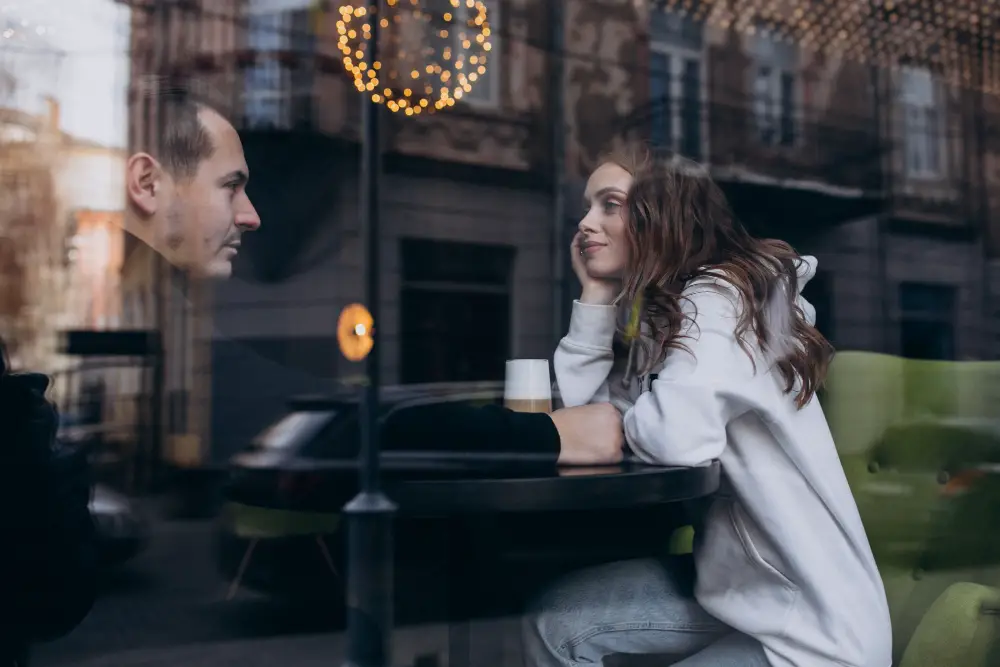
By our tenth anniversary, almost everyone we knew had quietly decided that David and I were married in every way that counted. I understood why. We had built a life that looked, from the outside, exactly like the thing people meant when they said settled. There was the house with the blue shutters that we had painted ourselves one long weekend, arguing cheerfully over the exact shade of blue and then agreeing, in the end, that we both loved it. There was the joint checking account we had opened years ago because splitting every bill down the middle had started to feel absurd for two people who shared a bed and a bathroom and a future. There were the streaming passwords, the mingled book collections, the drawer in the kitchen full of takeout menus and spare keys and the small archaeology of a shared life. And there was the dog, Baxter, who had come home with me as a nervous rescue puppy a year before David and I moved in together and had, over time, become ours in the way that a dog becomes the property of whoever is warmest and most reliably present.
Our friends introduced him as my husband. It happened constantly, at dinner parties and barbecues and the weddings of people younger than us. This is Sarah and her husband David, someone would say, and David would smile and shake the hand offered to him and never, not once in ten years, correct them. And I never corrected them either. I told myself it was easier that way. I told myself that fixing the mistake would have required me to name the thing that David so carefully never named, and that naming it in front of other people would have been a kind of accusation, and that I loved him too much to make him feel accused at a party. So I let it stand. I let strangers and acquaintances and even some of our closer friends believe that we had already crossed a line David kept, gently and endlessly, refusing to cross.
There is a particular skill you develop, living that way, though I didn’t recognize it as a skill until much later. You become fluent in a kind of managed silence. At a wedding, when the officiant would say those words about the couple choosing each other, choosing each other again and again, I would feel David’s hand find mine and I would squeeze it and tell myself that we, too, chose each other, and that the choosing didn’t need a ceremony to be real. When a colleague of mine got engaged and I sat through the whole giddy story of the proposal, I would smile and coo in all the right places and drive home afterward feeling a small hollow ache I refused to name. I got very good at not naming things. I got very good at translating every disappointment into a virtue, telling myself that my patience made me generous, that my willingness to want less than I wanted made me easy to love, that the women who demanded rings and dates and paperwork were somehow less evolved than I was. I built a whole private philosophy out of my own settling, and I mistook it, for ten years, for wisdom.
I want to be fair to myself here, because for a long time I wasn’t. I had brought up marriage before, more than once over the years, but never the way he later described it. Never as an ultimatum, never with a folder of venue brochures or a Pinterest board of dresses or one of those speeches about forever that people imagine women deliver in kitchens. It was always smaller than that. It came up the way natural things come up between two people who have been together a long time, in the ordinary settled moments when our life felt solid enough to make the question seem not just reasonable but obvious. We would be lying in bed on a Sunday morning, or driving home from his parents’ house, or standing in the kitchen doing dishes, and I would say something light, something like, do you ever think about making this official, and I would watch him do the thing he always did.
Because David had a gift for it, the sliding. He never said no. That was the trick of it, the thing that kept me hoping for ten years. If he had ever once said no, plainly, I think I would have understood much sooner what I was dealing with. Instead he would deflect. He would make a joke about how much weddings cost, about how we could put a down payment on a boat for what people spent on one afternoon of chicken or fish. Or he would get almost tender about it, would pull me close and say that we were already more committed than half the married couples we knew, which was probably even true, and which felt, in the moment, like a compliment rather than an evasion. Or he would kiss my forehead, that maddening forehead kiss, and ask me softly why I cared so much about labels, as if wanting to marry the person I had built my entire adult life around were a small vanity I should be a little embarrassed about. And I would let it go. Every single time, I would let it go, because the alternative was to push, and pushing felt like the opposite of the easy, generous love I thought we had.
So when he booked a nice restaurant for our tenth anniversary, a real restaurant, the kind we usually only went to for other people’s celebrations, I let myself hope. I couldn’t help it. Ten years is a milestone even by David’s careful logic, and something about the effort of it, the reservation made in advance, the mention that I should wear something nice, made a small stubborn part of me start to build a picture I knew better than to build. I didn’t say any of this out loud. I didn’t tell my sister, didn’t let myself write it down anywhere it could be found and mocked later. But I got dressed that evening with my hands not quite steady, and I looked at myself in the mirror, and I let the hope live in my chest for one night, quiet and warm, like something I was cupping in my hands to keep it from blowing out.
I want to be honest about how much I let myself imagine, because the size of the hope is part of the shape of what came after. Standing in front of the mirror in the dress I had chosen carefully, doing my earrings, I let a whole small film run in my head. I pictured him waiting until dessert. I pictured some clumsy, endearing speech, because David was never good at sincerity and I found his awkwardness with it touching. I pictured the moment when I would finally get to call my sister and hear her shriek down the phone, and the moment I would get to stop performing that managed silence at other people’s weddings because I would have a wedding of my own to talk about. I even, God help me, thought about which of my grandmother’s things I might wear. I stood in front of that mirror and let myself want it fully, without hedging, for the first time in years, and I told myself that ten years had earned me the right to want it out loud. Then I turned off the bathroom light and went downstairs to where David was waiting by the door, checking his phone, and I told myself to be calm, and I got in the car.
The restaurant was warm and low-lit, all dark wood and candles in little amber glasses, the kind of place where the waiters move like they have somewhere to be but are in no hurry to get there. David looked relaxed when we sat down, easy in his shoulders in a way I took, foolishly, as a sign. He ordered a bottle of wine we would normally have rolled our eyes at, the two of us doing the math on the price and deciding we were not those people. When it arrived he lifted his glass and looked at me across the flickering candlelight and said, ten years deserves something decent.
I smiled at him. That almost sounds romantic, I said.
Don’t get used to it, he said, grinning, and I laughed, because it was the kind of thing he always said and it had always charmed me, this refusal to be caught being sincere, this way he had of undercutting every soft moment before it could become dangerous.
Dinner was easy at first. Genuinely easy, the way our best evenings were. He told me a story about a guy from his office whose fiancée wanted a destination wedding in Italy, three days of events in Tuscany, and how the poor man was quietly going broke trying to keep her happy. I laughed at all the right places. I even noticed, distantly, that the story was about a wedding, and I let myself read it as a good omen, as evidence that the subject was in the air, warm and welcome, and not the loaded thing I had always feared it was. That is the cruelty of hope. It reads every sign in its own favor. We shared a dessert, some molten chocolate thing that we fought over with our two spoons, knocking them together and laughing, and at one point he reached across the table and brushed his thumb slowly over the inside of my wrist, a gesture so familiar and so tender that it disarmed me completely. It felt normal. It felt safe. And that, more than anything, is why I chose that moment, because after ten years of careful timing I had finally stopped being careful, because I trusted the warmth in the room and the warmth in his eyes and the ten years behind us to hold the weight of an honest question.
I set down my fork.
I don’t want Italy, I said. I don’t want a ballroom. I don’t want two hundred guests or a string quartet or any of it.
He looked up from the last of the dessert. No?
I shook my head. I want something small, I said. Just family. Maybe the backyard. Maybe a courthouse on a Tuesday afternoon, I honestly don’t care. I just think that after ten years, I’d like to make it official.
And I watched his face change. That is the part I keep coming back to, even now, long after it stopped having any power to hurt me. His face changed so fast it shocked me, the warmth draining out of it and something else settling in, something I had never seen aimed at me before. He put his fork down. He leaned back in his chair, putting distance between us, and he gave a short, cold laugh, a laugh with no humor in it at all, a laugh like a door closing.
I’m never marrying you, Sarah.
The room seemed to sharpen and tilt. At another table, someone laughed too loudly at a joke I couldn’t hear. A server passed behind me with a tray of drinks, the ice clinking, and the ordinariness of it all felt obscene against what had just been said. I heard myself speak, my voice smaller than I wanted it to be.
You don’t have to say it like that.
He shrugged, one shoulder rising and falling, an insultingly casual motion. Better than dragging this out again, he said.
Again. That word landed somewhere under my ribs and stayed there. Again, as if I were tedious. As if I had been badgering him for a decade, waving venue contracts in his face, making his life difficult with my needy little questions, instead of what I had actually done, which was to raise the subject of our shared future a handful of gentle times over ten years and let it drop every single time he wanted me to.
So that’s it, I said.
Marriage is a useless piece of paper, he said, and he said it the way you’d recite something you had said many times before, in your own head if nowhere else. It changes absolutely nothing. If you need a legal contract to feel secure, Sarah, that’s your problem, not mine.
I looked at him. Not the quick, forgiving look I had given him a thousand times, the look that slid over the surface of him and found only the man I loved. This time I really looked, and I let myself see him, the contempt sitting easily on his face, the impatience, the total absence of anything that resembled love or even regret. And the strange thing, the thing I did not expect, was that the contempt hurt more than the refusal. I could have survived a man who was afraid of marriage. What I was looking at was a man who found my wanting it beneath him.
I thought I might cry. I felt the pressure of it behind my eyes, the whole ten years of it gathering. But I didn’t cry. Something colder and clearer moved in instead, some quiet mechanism at the very center of me clicking over into a new position, and in that moment, looking at him across the wreckage of a dessert we had been fighting over playfully ten minutes before, I made a decision. It didn’t feel like a decision so much as a recognition, the way you don’t decide the sun has set, you just notice that it has.
I nodded. Okay, I said.
That was all. Okay.
He mistook it. I would understand that much later, but I understood it fully then. He heard my okay as surrender, as the sound of a woman folding, giving up the argument, agreeing to go back to the comfortable arrangement where he got everything he wanted and I got to keep hoping. He relaxed again. The rest of dinner passed in a kind of unreal calm. He talked about the wine, about whether we should get the check, and on the drive home he complained about the parking situation downtown as though nothing at all had happened, as though he had not just told me, plainly and cruelly, the truth about the last ten years of my life.
When we got inside, I slipped off my shoes by the door and set them neatly against the wall, and Baxter came clicking across the floor to greet us, his tail going, oblivious. David loosened his tie in the dark hallway and said, not unkindly, in the tone of a man being reasonable with an unreasonable person, don’t spend all night working yourself up over this.
I stood there in the dark for a moment. I looked at the shape of him.
I’m not, I said.
Good, he said. And he went straight to bed.
I listened to him move through the house, the bathroom faucet, the creak of the mattress, the particular sounds of a man settling comfortably into a life he believed was still exactly as he had left it. And then I went into the kitchen and I opened my laptop and I pulled up everything. The shared accounts, the mortgage folder, the utility logins, the homeowners insurance, all of it, the whole tangled infrastructure of two lives grown together over ten years, because if this was really the end, and I already knew that it was, then I was going to need to understand precisely how deep the roots ran before I started cutting.
It is a strange thing to do, in the hours after your life ends, to open a spreadsheet. But I think it saved me that night. There is a mercy in logistics. As long as I was noting down account numbers and figuring out which bills were in whose name and how the mortgage was held, I did not have to sit inside the enormity of what had happened at that candlelit table. I could keep my mind on the middle distance, on the practical, on the small solvable problems, and let the large unsolvable one wait at the edge of the room. I made a list on a yellow legal pad. I noted what was mine outright, which was less than I would have liked, and what was truly joint, which was more than I had realized, and what was legally his even though we both used it. I saw, laid out in my own handwriting, exactly how thoroughly I had entwined my one finite life with a man who had decided years ago that he would never fully claim me, and who had never once had the decency to tell me so.
I worked steadily, methodically, in the pool of light from the screen with Baxter asleep against my feet, and somewhere between the savings account and the insurance policy, a memory rose up out of nowhere and stopped my hands on the keyboard.
Christmas, two years ago. David’s parents’ house, warm and loud and full of family, the smell of his mother’s cooking and the noise of his nieces and nephews. At some point in the evening, while everyone else was crowded into the living room arguing good-naturedly over the rules of a board game, Elaine, David’s mother, had drawn me aside near the kitchen. She had touched my arm, the way she did, and she had looked at me with a kind of soft, hopeful earnestness and said, I hope that when you’re ready, you’ll give David the chance to make things official. He loves you very much.
At the time, I had smiled and squeezed her hand and thought, how sweet, how old-fashioned, this dear woman still living in a world where the woman is the one who needs convincing. I had filed it away as nothing, as a mother’s gentle nudge, and I had never given it another thought.
But now, sitting alone at my kitchen table at nearly one in the morning with my whole life pulled up on a laptop, I understood that Elaine had not been making an assumption at all. She had not been old-fashioned. She had been repeating something. She had been telling me a story she had been told, and the story was about me, and it was not true, and I had smiled and thanked her for it.
I picked up my phone and I called her.
She answered on the fourth ring, her voice thick and disoriented with sleep. Sarah? she said. Is everything okay?
I need to ask you something, I said. And I need you to answer me honestly.
There was a silence on the line, the particular silence of someone waking up fully and quickly, sensing that something has changed. All right, she said.
I told her what David had said at dinner. I repeated his words back to her exactly, the way he had said them, the cold laugh and the useless piece of paper and your problem, not mine. I kept my voice level the whole way through, and when I finished, Elaine said nothing at all for so long that I pulled the phone away from my ear to check whether the call had dropped.
Then she said, very quietly, in a voice that had gone strange, he told us you were the one who didn’t want to get married.
I closed my eyes and pressed my free hand flat against the cool surface of the table. What, I said. Not really a question.
He said marriage made you anxious, Elaine went on, the words coming faster now, spilling. He said you got panicky about it. He said he didn’t want to pressure you, that he was giving you space, that he was waiting until you were ready. He said it for years, Sarah. He said he loved you too much to push.
And another memory surfaced, sharp and ugly, the way they were coming now, unlocked one after another. Two Thanksgivings ago, his sister at the sink, drying a dish, squeezing my hand in passing and saying warmly, you’re lucky he’s so patient. I had laughed at the time because I hadn’t understood what she meant, had assumed it was some general comment about David’s easygoing nature, and had let it float away unexamined. Patient. He had let his sister believe he was being patient with me. With my nerves. With my fear of a thing I had asked for over and over and been laughed out of every time.
My grip tightened around the phone until my fingers ached. On the other end, Elaine let out a breath that had gone shaky, and I heard her say, half to herself, oh, David. Oh, David.
And then she told me something worse.
Three years ago, she said, David had come to her privately and asked for his grandmother’s ring. His grandmother, whom he had adored, who had died when he was in college. The ring was an heirloom, an old European-cut diamond in a delicate setting, and it had been promised, in the loose way of families, to whichever grandchild married in a manner the family would have wanted. David had told his mother that he was going to propose to me, that he had it all planned, that he was going to do it in the fall during our trip to Maine. And Elaine, overjoyed, had taken the ring to a jeweler and had it cleaned and appraised so that it would be perfect when he gave it to me. She still had the receipt somewhere, she said. She still had a photo of it, cleaned and gleaming, that she had texted to her sister at the time because she had been so happy, so excited that her son had finally found his moment.
I remembered that trip to Maine. I remembered it in sudden vivid detail now, the whole weekend rearranging itself around this new information like iron filings around a magnet. The little inn with the crooked stairs. The cold beautiful water we were both too timid to swim in. The lobster we ate at a wooden table on a dock, our hands greasy and happy, gulls wheeling overhead. And I remembered one evening in particular, the last one, when we had walked out to the end of a pier at dusk and David had gone quiet and strange, and had stood looking out at the darkening ocean with an expression I couldn’t read, and had seemed on the verge of saying something several times before turning away and suggesting we head back for dinner. I had felt it then, some charge in the air, some sense that a moment had almost happened. I had told myself, sternly, not to hope, and I had been right not to, because no proposal came. Of course no proposal came. I understood now that he had brought his grandmother’s ring all the way to Maine, had carried it in his luggage the entire trip, and had, at the last, decided against it, and had then gone home and told his mother that I was the one who had gotten cold feet. We had come home from that trip and slid right back into our lives, and I had felt a small private disappointment that I had been too proud and too well-trained to ever mention, and he had watched me swallow it and had known exactly what I was swallowing and why.
Every time she asked him about it afterward, Elaine said, every time she gently wondered what had happened in Maine, David had told her the same thing. He said that I had panicked. He said that when the moment got close, I had gotten frightened and begged him to wait, and that he was respecting my feelings, honoring where I was, not wanting to rush a woman who wasn’t ready. He said it so many times, and with such a convincing air of wounded patience, that the entire family had simply accepted it as fact. It had become the settled truth about Sarah, the anxious one, the commitment-shy one, and David the good man waiting kindly at her side.
I pressed my hand harder against the table to keep myself steady. The floor of my life was rearranging itself in real time, ten years of ground I had thought was solid revealing itself to be a set painted on canvas.
Elaine’s voice came again, and it had hardened now, not at me but at her son. I’m coming over, she said.
It’s after midnight, I said.
I don’t care, she said. I’m coming over right now.
She arrived before sunrise, while the sky outside the kitchen window was still that deep bruised blue that comes just before the gray. I had not gone to bed. I sat at the table through the last of the night, and somewhere in those hours the shock began, very slowly, to cool and harden into something I could stand on. I made coffee I didn’t drink and spread the printed documents across the table, and Baxter had woken up and settled again at my feet, sensing that something was happening and choosing to stand guard. I kept thinking about Elaine on the phone, the sound she had made when she understood, that small broken oh David, and I understood that she had been lied to as thoroughly as I had, that she had spent three years thinking her son was a good and patient man and thinking, gently, that I was the problem. We had both been characters in his story. The difference was that she was his mother, and the moment she saw the truth, she got in her car. When I opened the door, Elaine was standing on the step in a coat thrown over what looked like pajamas, her face set, her eyes bright with something between fury and grief. She came in and put her arms around me for a long moment, and then she stepped back and said, I want it back from him. His grandmother’s ring. I want to see it with my own eyes.
We sat at the table together in the blue predawn light and waited, and eventually we heard David moving upstairs, and then his feet on the stairs, and then he shuffled into the kitchen in his sweatpants, still half asleep, rubbing his face. He stopped dead in the doorway when he saw his mother sitting at his kitchen table at five in the morning with the receipt for his grandmother’s ring in her hand and the entire architecture of his lie spread out on the wood between us.
Elaine looked up at him. Why, she said, her voice very quiet and very steady, did you tell us Sarah was the one who never wanted to get married?
He stared at her. Then at me. Then down at the papers on the table, and I watched him understand, all at once, the shape and size of the trap he was standing in.
What is this, he said.
Elaine held up the receipt. It’s proof, she said, that I gave you your grandmother’s ring three years ago so that you could propose to Sarah in Maine.
His face changed, the sleep burning off it, something defensive and hard rising up in its place. This is private, he said.
No, Elaine said. It stopped being private the moment you used her as your excuse.
He turned to me then, and there was accusation in it, as if I were the one who had done something. You called my mother, he said, in the middle of the night?
Where is the ring, David, I said. I didn’t raise my voice. I didn’t need to. Something in how flat and calm it came out seemed to unnerve him more than shouting would have.
He gave a strained little laugh, the ghost of the cold laugh from the restaurant, but with none of its power now. This is ridiculous, he said.
Bring it here, Elaine said.
He looked at her, his jaw working. I was going to give it back, he said.
You had three years, Elaine said, and she did not blink.
He stood there another moment, and then, because there was nothing else left for him to do, he turned and went back up the stairs. We listened to him moving around above us, a drawer opening, a pause, his feet again. When he came back down, he was holding the ring, and I felt Elaine go very still beside me, because it was not in the velvet heirloom box she remembered. It was in a cheap black jewelry box, the flimsy kind you get for nothing, the kind that comes with a costume-jewelry purchase at a mall kiosk. He set it on the table, and Elaine reached over and opened it, and there, sitting untouched in the cheap plastic, was his grandmother’s diamond, cleaned and gleaming exactly as it had been in the photo she had texted her sister three years earlier.
He had not lost it. That was what settled over me as I looked at it. He had not lost it, and he had not sold it, and he had not given it to some other woman. He had simply hidden it in a drawer. For three years he had kept his grandmother’s ring in a drawer in the house we shared, in a plain forgettable box, exactly as forgettable as he had wanted the whole idea of marrying me to become, and he had let me carry the story for him, had let his entire family believe I was the frightened one, while he collected the quiet credit for being such a patient, loving, long-suffering man.
And in that moment, with the ring open on the table and the sky going gray in the window, everything finally sharpened into focus. I saw the whole machine of it, elegant and cruel. With our friends, he had performed the enlightened modern man, the one too evolved to care about a piece of paper, the one who loved me so purely he had no need of the state’s approval. He had said it at dinner parties, that line about labels, and our friends had nodded along, half of them a little envious of how secure and unbothered we seemed. With his family, he had performed the devoted traditionalist, the man ready and waiting with his grandmother’s ring, held back only by his nervous partner’s fear. He had said it at their kitchen tables, that story about my anxiety, and his mother and his sister had nodded along, half of them a little sorry for him, this good patient man saddled with such a skittish woman. Two completely opposite stories, contradicting each other so directly that they could never have survived being placed side by side, which is precisely why he had been so careful to keep his two audiences apart. Each version was perfectly tailored to the people who would hear it, and in both of them David came out looking wonderful, generous in one, patient in the other, blameless in both. In both of them, he got exactly the life he wanted, the comfort and the companionship and the house and the dog and the warm bed, with none of the commitment he had decided, somewhere along the way, he would never actually give me. And in neither of them, not once, in ten years, was I ever told the truth. I had been the raw material of both stories and the audience of neither. I had been written into a role in my own life and never handed the script.
David was looking at me now with a new expression, a careful, calculating one, the look of a man who has just felt the room turn against him and is trying to figure out how to turn it back. Sarah, he said. Come on.
I stood up from the table. And Baxter, feeling me move, stood up too, and pressed himself against my leg.
I’m staying with my sister for now, I said.
His face went slack. You’re leaving?
Yes.
Over this?
I looked at him, at the man I had loved and defended and made excuses for across a decade of my one and only life. I didn’t answer the question, because the question itself, over this, contained everything I finally understood about him. As if ten years of being lied to were a small thing. As if my whole life were a this.
Elaine shut the ring box with a small final snap. She is leaving, Elaine said, because you lied for years, David. To me. To your sister. To this whole family. And to her.
I went to the door and got my overnight bag, which I had packed badly in the dark hours before, with mismatched socks and no phone charger and a single earring I would find days later at the bottom. I bent down and clipped Baxter’s leash to his collar, and David watched me do it with something like disbelief.
You’re taking him too, he said.
He was mine before we moved in together, I said. You know that.
Sarah, he said, and he followed me toward the door, his voice climbing now into something almost pleading. Don’t do this like it’s final.
I stopped at the door and I turned back and I looked at him one last time, this man in his sweatpants in the gray morning light, in the kitchen of the house with the blue shutters we had painted together, laughing, a hundred years ago.
You made sure this was final, I said, long before tonight.
And I left.
I stayed at my sister’s for six days. I slept badly on her guest bed, waking at strange hours with my heart pounding and taking a moment each time to remember why I was there. I cried exactly once during those six days, and it was not for any of the big reasons. It was in her laundry room, folding the clothes I had thrown into the bag, when I found one of David’s socks tangled up in mine, mixed in by the machine and by ten years of two lives washed together, and something about the sheer smallness of it undid me. It felt obscene that something so trivial, one gray sock, could still have a claim on my life. I sat down on the floor of my sister’s laundry room and cried, and then I stopped, and I threw the sock away, and I went back to folding.
Mostly, though, I didn’t feel what I expected to feel. I had imagined, in the abstract, that leaving would come with some rush of vindication, some clean sense of triumph, the satisfying music of a woman who had finally seen the truth and walked out with her head high and her dog at her side. It wasn’t like that. Mostly I just felt tired. Bone tired, the specific exhaustion of realizing how much energy I had been spending, for years, without knowing it, on believing a version of a man that had never been real. There was no music. There was just the quiet, and my sister making me tea I didn’t drink, and Baxter following me from room to room as if he understood.
My sister was careful with me in those days, in the way that only someone who has known you your whole life knows how to be. She didn’t lecture me. She didn’t say the things I could see her wanting to say, the I never trusted him and the I always thought something was off, which she saved, mercifully, for much later, when I could laugh about them. Instead she simply made space. She left me alone when I needed to be alone and appeared with food when I hadn’t eaten, and one evening she sat down next to me on the guest bed without a word and put her head on my shoulder and stayed there while I stared at the wall, and that was the closest I came, in those six days, to feeling held together. I kept thinking about the years. That was the thing that circled and circled. Not the cruelty at the restaurant, which had at least been honest, but the years of the other thing, the smiling and the deflecting and the forehead kisses, all of it a performance staged for an audience of one, and I the only person in the world who hadn’t been let in on the plot.
David called every day. I didn’t answer any of them. I watched his name appear on the screen and I let it ring out, and each time, the not answering got a little easier. On the sixth night, he left a voicemail. I listened to it once. In it, his voice was different, softer, unsteady, and he said that he finally understood, that he saw what he had done, that he was sorry. I didn’t call back.
The next afternoon, he showed up at my sister’s house. My sister was at the front window and she texted me from ten feet away, because that is the kind of sister she is: he is outside making bad decisions. I looked out and saw him standing on the porch, and I could see even from inside that he had the ring with him, the cheap box clutched in his hand.
I went out and shut the door behind me so that whatever this was going to be, it would happen out there, on the porch, and not seep back into the house that had become, in six days, a kind of refuge.
Can we talk, he said.
We are talking, I said.
His eyes were red-rimmed, and he had the shattered, sleepless look of a man who has spent a week discovering that the story he told about his own life was not the story other people were living. I messed this up, he said.
Yes, I said.
I was defensive, he said. And I was stupid. And I kept putting off giving you a real answer for years because, the truth is, I liked things exactly the way they were. I liked our life. I didn’t want anything to change.
And then, right there on my sister’s porch, he dropped to one knee.
Sarah, he said. Marry me.
I just looked at him. He fumbled the cheap black box open with shaking fingers, and there was his grandmother’s diamond again, catching the afternoon light, offered up to me at last after ten years and only because he had been caught.
At dinner on our anniversary, when I had said okay in that quiet voice, David had heard surrender. He had been so sure of me, so certain of the shape of us, that he mistook the sound of a woman leaving for the sound of a woman giving in. But that okay had not been surrender at all. It had been the exact opposite. It had been the single moment in ten years when I finally heard his answer clearly enough to believe it, and believing it had set me free.
I mean it, he was saying, kneeling on the porch, the ring held up between us. I get it now. I want this. I want you. Please.
This isn’t a proposal, I said. It’s damage control.
He flinched as though I had struck him. It’s not like that, he said.
It is exactly like that, I said. You didn’t decide you want to marry me. You decided you don’t want to lose me. Those aren’t the same thing, and I spent ten years not knowing the difference, and I’m never going to not know it again.
He stayed there another second, still down on one knee, the posture holding him in place, and I watched the moment stretch until the kneeling itself became unbearable, for both of us, a man performing devotion on a porch to a woman who had already gone. Then he stood up.
What can I do, he said. His voice was quiet now, the fight gone out of it. What can I do.
I thought about it. I actually thought about it, because it was a real question and it deserved a real answer, and because I found that I wanted to give him something true to do, not for his sake but for mine, so that the whole rotten thing might come to rest a little more cleanly.
You can tell the truth, I said, to every single person you lied to. Not to win me back. That’s over, and no amount of truth-telling is going to change it. You tell them the truth because it’s the truth, and because I spent ten years being the villain in a story I never even got to read.
He nodded slowly. And to his credit, and it was almost the only credit I would ever be able to give him, he did it.
His first call was to his sister, the one who had told me two Thanksgivings ago how lucky I was that he was so patient. Elaine told me about it afterward, and she told me he had not softened it or spun it or found some new angle that made him look good. He had said, plainly, that I had never once refused him. That I was not the anxious one, not the frightened one, not the reason we never married. That he had been the one who refused me, over and over, and that he had let the whole family believe otherwise because it was easier and because it made him look kind. He said it to his sister, and she was, by Elaine’s account, furious with him in a way she had never been before, furious on my behalf, which moved me when I heard it, because it meant that somewhere underneath the false story she had believed there had been real affection for me all along. Over the following months he said the same thing to the rest of them, the aunts and uncles and cousins who had all quietly filed me under the same false heading of the woman who wouldn’t commit. He admitted that I had raised the subject more than once across the years. He admitted that he had laughed it off each time, made his little joke about labels, kissed my forehead, and then gone home to his family and told a different story entirely. He let people be angry with him. He didn’t defend himself or explain himself or ask them to understand. He let the correction be permanent, and I have to believe that some part of him, forced at last to hear the true story said out loud in his own voice, over and over, to person after person, finally understood the size of what he had done, though by then it no longer had anything to do with me.
I still didn’t go back. I think a part of him believed, right up until the end, that the truth-telling was a kind of transaction, that if he confessed thoroughly enough the door might open again. But I had already walked through it, and it had already closed, and no honesty offered after the fact could make ten years of the other thing disappear. Truth is not a currency you can spend to buy back trust. It’s just the floor you were supposed to have been standing on all along.
I signed a lease on a small apartment with good light in the kitchen, the kind of light that pools on the counter in the late afternoon, and a park nearby where Baxter could run in the mornings before I left for work. David and I separated our finances, and to my surprise it went fairly and even quietly, the joint account divided, the mortgage sorted, the whole tangle undone strand by strand. I bought new dishes, plain white ones I picked out alone in a store on a Saturday, and I changed every password I could find, and I learned, slowly, over those first weeks, how quiet a room can feel when no one in it is withholding anything from you. It’s a specific quiet. I hadn’t known, until I had it, how much noise a lie makes even when no one is speaking.
The first weeks alone were an education in small freedoms I hadn’t known I’d given up. I could leave a light on all night if I wanted to. I could eat cereal for dinner and answer to no one’s raised eyebrow. I hung pictures exactly where I wanted them without a negotiation, and I discovered that my taste, when it wasn’t constantly being met halfway, was more particular and more mine than I’d remembered. Baxter took to the new place with the total, uncomplicated ease of a dog, claiming a square of afternoon sun on the kitchen floor as his own within the first hour, and watching him settle there, I felt something in my own chest settle too. I had worried, in the abstract, about being lonely. What I found instead was that I had already been lonely for years, in a house full of a man and his stories, and that this new solitude, chosen and honest, was not loneliness at all. It was just peace, and it had simply been so long since I’d felt it that I’d needed a few weeks to recognize its face.
A few months later, Elaine asked me to meet her for lunch. We had stayed in touch, carefully, tentatively, texting now and then, because she had been my family too for ten years and neither of us wanted to lose that entirely just because her son had turned out to be who he was. It was a strange grief of its own, losing a family you had married into without ever having married in, and Elaine felt it too, I think, from the other side. We met at a little place with a patio, under a striped awning, and we talked for a while about small safe things, her garden, a cousin’s new baby, the weather, both of us circling whatever it was she had brought me there to say. Then, when the plates had been cleared, she reached into her bag and set a box on the table between us and slid it across to me. It was the velvet box this time, the real one, the heirloom box, and I knew before she opened it what was inside.
I stared at it. Elaine, I said.
David returned it to me for good, she said. It’s mine again, to do with as I choose. And I spoke to my sister, and to the rest of the family, before I called you. I told them what I wanted to do. They all agree with me.
She opened the box, and there was his grandmother’s diamond, the same one that had sat in a drawer for three years while I carried a lie I didn’t know I was carrying.
I can’t take that, I said.
Yes, you can, she said.
It should stay in your family, I said. It’s a family ring. It’s his grandmother’s.
Her expression softened, and she reached across the table and put her hand over mine, the way she had at Christmas, two years and a whole lifetime ago. Sarah, she said. You were my family for ten years. Every holiday, every birthday, every ordinary Sunday. You are more my family than the story my son told me about you. This ring was supposed to become part of a marriage, and instead it became part of a lie, and I am done letting it belong to that story. And if David ever marries someone else someday, then he can go and choose a ring with his own two hands and his own honesty, and this one has nothing to do with it.
It should stay in your family, I said again, more weakly.
You are my family, she said, and would not take it back.
I looked at the box for a long time before I picked it up. And then I picked it up.
A month later, I took the ring to a jeweler, a small shop I had walked past a hundred times without going in, with a bell over the door and an old man behind the counter who listened to what I wanted without a single strange look, as if women came to him all the time to unmake the meaning of a ring and remake it into something else. Maybe they do. I asked him to take the stones out of the setting and reset them into a pendant. I told him a little of the story, more than I meant to, and he listened while he turned the ring under his loupe, and at the end he only nodded and said that the diamond was a fine old stone and deserved a setting its wearer actually loved. Nothing bridal, I said. Nothing that whispered of aisles or vows or the thing that ring had once been meant to promise. Just something simple, something small, something I had chosen entirely for myself, to wear at the base of my throat where I could feel the small weight of it against my collarbone and know exactly where it came from and exactly what it now meant.
When he was finished, weeks later, he placed the pendant in my open palm, and it looked, at first, almost unfamiliar. For so long that ring had been two things at once, a promise David had never actually made, and a lie I had never known I was carrying, and I had to hold the pendant in my hand and turn it in the afternoon light for a moment before I could see it as what it now was.
Because it was mine now. Not because he had finally, cornered and caught, chosen me. Not because his family had pitied me, or because I had won some argument, or because the story had resolved itself the way stories are supposed to. It was mine because I had chosen what it would become. The diamond was the same diamond it had always been. But everything around it, the meaning of it, the story it belonged to, the hands it rested in, all of that I had taken and remade, deliberately, on my own terms, in the good light of a kitchen that was only mine, with a dog asleep in the sun and no one anywhere in my quiet, honest rooms keeping a single thing from me.

Lila Hart is a dedicated Digital Archivist and Research Specialist with a keen eye for preserving and curating meaningful content. At TheArchivists, she specializes in organizing and managing digital archives, ensuring that valuable stories and historical moments are accessible for generations to come.
Lila earned her degree in History and Archival Studies from the University of Edinburgh, where she cultivated her passion for documenting the past and preserving cultural heritage. Her expertise lies in combining traditional archival techniques with modern digital tools, allowing her to create comprehensive and engaging collections that resonate with audiences worldwide.
At TheArchivists, Lila is known for her meticulous attention to detail and her ability to uncover hidden gems within extensive archives. Her work is praised for its depth, authenticity, and contribution to the preservation of knowledge in the digital age.
Driven by a commitment to preserving stories that matter, Lila is passionate about exploring the intersection of history and technology. Her goal is to ensure that every piece of content she handles reflects the richness of human experiences and remains a source of inspiration for years to come.