The Tent
My daughter-in-law Gabrielle has hated me for six years, and she has never once tried to hide it. I want to start there, honestly, because I’ve turned this story over so many times in my mind that I’ve learned there’s no use pretending otherwise, no use softening it the way I softened everything else for so long. She hated me. She had her reasons, or thought she did, and for a long time I made myself small trying to accommodate a hatred that no amount of accommodation was ever going to satisfy.
My name is Eleanor. I’m sixty-eight years old. I live alone in a modest little house two states away from my son, in the same town where I raised him, where his father and I built a life before his father passed nine years ago. I have a bad back, the kind that comes from a lifetime of standing on my feet as a school nurse, and a heart condition that my cardiologist watches carefully, and a small fixed income made up of my late husband’s pension and my own Social Security that stretches if I’m careful, and I am always careful.
My son Luke is the great blessing of my life. He always was. Even as a boy he had a tenderness in him, a way of noticing when someone was hurting and quietly moving to help. He grew up into a good man, a kind man, an engineer with a steady job and a heart that never hardened the way the world so often hardens young men. And because he is who he is, he worries about his mother living alone two states away with a bad back and a bad heart, and every few months he flies out or drives out to see me, to help with the things I can’t manage anymore, the gutters and the high shelves and the heavy bags of mulch for the little garden that’s my one great pleasure.
And that, I came to understand, was the original sin. That was what Gabrielle could never forgive. Not anything I’d done. Simply that her husband loved his mother, and gave that mother his time, and that this was time and attention and care that flowed toward me instead of toward her.
Because Gabrielle needs to be the center. I say that without malice now, though it took me years to be able to. It’s simply true, the way it’s true that some plants need full sun. She needs to be the axis around which the household turns, the first thought and the last, and Luke’s devotion to me registered in her not as a lovely quality in the man she married but as a theft. Every hour he spent helping me was an hour stolen from the orbit that was rightfully hers. She experienced my very existence as competition.
I saw it at the wedding, if I’m honest, though I told myself I was imagining it. The way her smile didn’t reach her eyes when Luke danced with me. The way she inserted herself, physically, between us in photographs. And in the six years since, through the birth of my two grandchildren, through holidays and visits and phone calls, it only sharpened. She would schedule things to conflict with my visits. She would develop a headache the moment I arrived. She would, in that bright brittle voice, make the little comments, the ones designed so that if you objected you’d seem paranoid. Oh, Eleanor, you’re staying a whole week? Luke will be so busy with work, I hope you won’t be lonely.
I let it go. Every time. Because I loved my son, and I loved my grandchildren, Sophie who was five and little Ben who was three, and I had decided long ago that I would not be the mother-in-law who made her son choose, who forced a war, who poisoned a marriage. I would swallow it. I would keep the peace. I would be so relentlessly, unfailingly gracious that no one could ever accuse me of being the problem.
I thought that was wisdom. I’ve since learned it was something closer to cowardice, though a gentle kind, the kind that dresses itself up as virtue. But I’ll get to that.
The visit I want to tell you about started with joy. Luke called me one evening in the early fall and said, “Mom, come stay with us. Come see the kids. Sophie keeps asking about you and Ben’s talking now, you won’t believe it, you have to come.” And my heart lifted, because I had missed those children so much it was a physical ache, the specific hunger a grandparent feels for grandchildren who live too far away. I said yes before he’d even finished asking.
I booked the flight. It wasn’t nothing, a plane ticket on my budget, but I’d been setting aside a little each month in a coffee can in the kitchen for exactly this kind of thing, and I counted it out and I bought the ticket and I was happier than I’d been in months. I bought presents for the children. A picture book for Ben. A little art set for Sophie, who her father said had become quite the artist. I wrapped them myself at the kitchen table, taking my time, imagining their faces.
Then, two days before I was to fly out, Luke called again, and his voice was apologetic and frustrated. “Mom, I’m so sorry. Work is sending me out of town. Some emergency at the plant in another state, they need me on site. It’s terrible timing, I know. But it’s only two or three days, and Gabrielle will be there with you and the kids, and I’ll be back before you leave. Please still come. I don’t want you to miss this.”
I hesitated. Two or three days alone in a house with a woman who couldn’t stand me. But I thought of Sophie and Ben. I thought, surely, surely even Gabrielle and I could manage a few civil days together for the sake of the children. Surely she wouldn’t do anything truly unkind with Luke away.
I told him I’d come. God help me, I told him I’d come.
The flight landed in the early evening, delayed, so it was already getting dark by the time I got my one small suitcase and found the rideshare Luke had arranged and paid for, and rode the forty minutes out to their house in the suburbs. I was tired in the bone-deep way that travel makes you tired when you’re sixty-eight with a bad back. My spine ached from the cramped airplane seat. All I wanted was to see the children, if they were still awake, and then to lie down somewhere flat and quiet and sleep.
The house was lovely from the outside, a two story colonial with a big yard, warm light in the windows. I rang the bell. Gabrielle answered, and her face when she saw me did the thing it always did, the flicker of displeasure quickly smoothed into a hostess’s smile that fooled no one.
“Eleanor,” she said. “You made it. The kids are already asleep, I’m afraid. Long day.”
My heart sank a little, but I understood. It was late. “Of course,” I said. “I can see them in the morning. I don’t want to wake them. I’m quite tired myself, Gabrielle, it was a long trip. Would you mind showing me where I’ll be sleeping? I’d love to just lie down.”
And Gabrielle’s smile changed. I didn’t understand it at the time, that small private curve at the corner of her mouth. I understand it now. It was the smile of someone about to enjoy herself.
“Right this way,” she said.
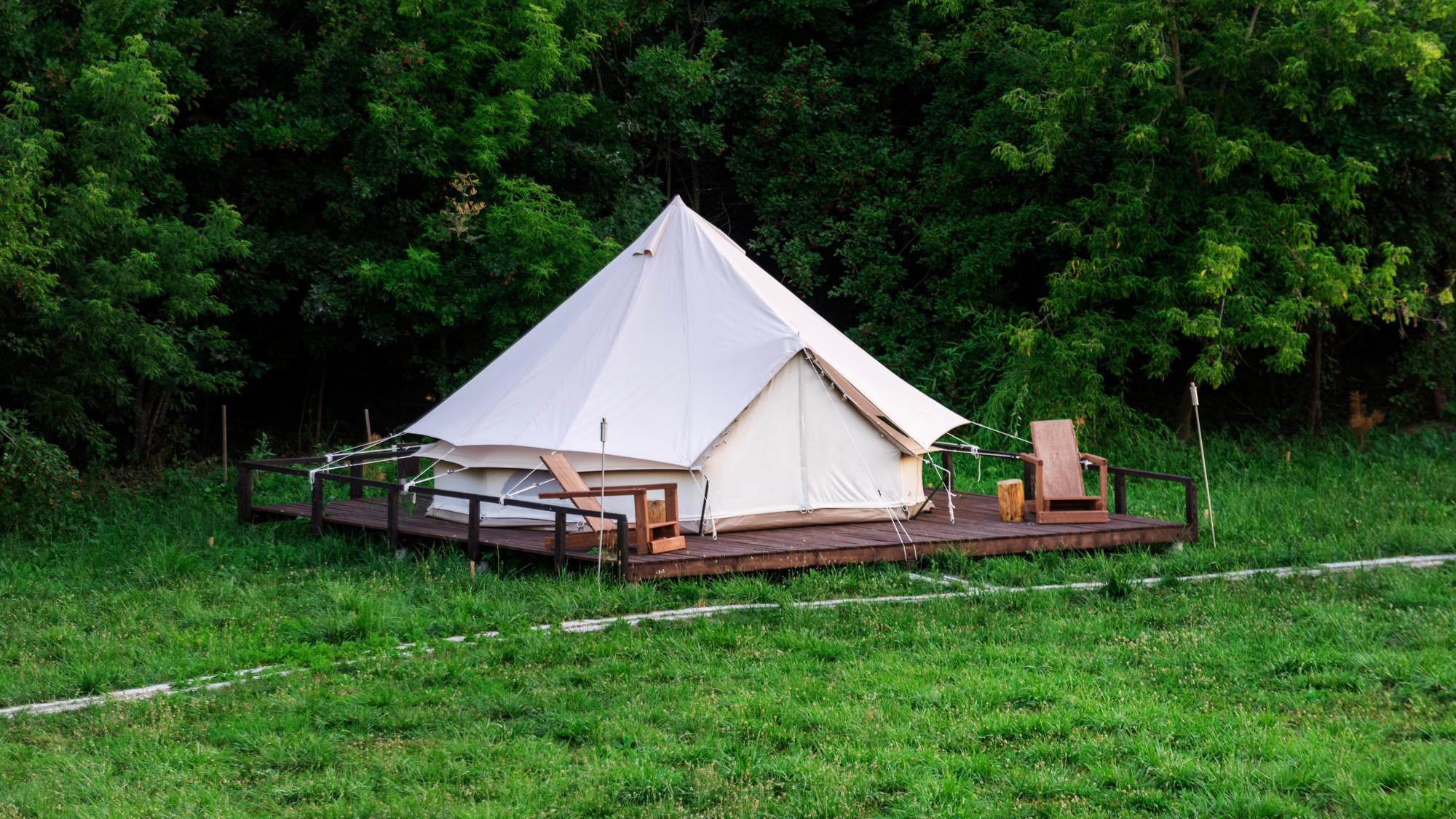
And she led me through the house, through the kitchen, to the back door, and out into the backyard, into the cool dark of the evening, across the grass, and she stopped and gestured, and I looked, and there, set up on the lawn, was a tent.
A camping tent. A dome of nylon staked into the grass, with a sleeping bag visible through the unzipped flap.
I laughed. I actually laughed, because I was certain it was a joke, some strange attempt at humor, and I waited for her to laugh too and lead me back inside to the guest room.
She didn’t laugh.
“The thing is,” Gabrielle said, and her voice was pleasant, so pleasant, “all the rooms were painted just this morning. The fumes are terrible, you really can’t breathe in there. There’s only one room that hasn’t been painted, and I’ll be sleeping there with the kids, since they get scared with Luke away. So there’s really nowhere to sleep inside the house. But you like camping, if I remember correctly, right?”
I stood there in the dark yard, in my traveling clothes, with my one small suitcase, and I felt the whole thing land on me at once.
I did not like camping. I had never particularly liked camping. The one time I’d mentioned camping to Gabrielle, years ago, was to tell a story about a single disastrous trip Luke’s father and I had taken a decade earlier, from which I’d returned with a wrenched back and a vow never to sleep on the ground again. She knew that. If she remembered anything, she remembered that. She had taken a story about how much I disliked camping and weaponized it, twisted it into permission to put a sixty-eight-year-old woman with a bad back and a bad heart out in the yard like a dog.
I opened my mouth. And then I closed it.
Because here is the thing, the thing I’m least proud of. My whole instinct, six years deep, was still to keep the peace. To not make a scene. To not be difficult. I stood in that dark yard, humiliated to my core, my back already aching at the mere sight of that sleeping bag on the hard ground, and my trained, obedient, peacemaking self said, don’t make trouble. Luke will be home in two days. Don’t cause a war. Don’t be the mother-in-law who can’t get along. Swallow it. Swallow it one more time.
And I looked at the alternative, which was to stand my ground, to demand to be let inside, to force a confrontation with a woman who was clearly, obviously lying, who had clearly planned this, who had set up a tent in advance and waited for me with that private little smile. And I did not have it in me. I was tired, and old, and far from home, and heartsick, and I did not have it in me to fight.
“I don’t want to breathe paint fumes,” I heard myself say. Giving her the excuse. Helping her lie to me. “I suppose the tent will be fine for a night or two.”
“I knew you’d understand,” Gabrielle said warmly. “There’s a flashlight in there. The bathroom, well, I’d rather you not track through the house so late, but there’s the one at the gas station just down the road if you need it. Sleep well, Eleanor.”
And she went back inside, and I heard the deadbolt turn. She locked the door. She locked me out of the house, in the yard, in the dark.
I stood there for a long moment. And then, because there was nothing else to do, I crawled into that tent, and I lay down on top of the sleeping bag in my clothes, and I stared up at the nylon ceiling a foot above my face, and I did not cry, though I wanted to, because I was too tired even for that.
I want to tell you what that night was like, because it matters for everything that came after.
The ground was hard. The thin foam pad beneath the sleeping bag did nothing. My back, which hurts on a good mattress, screamed against the packed earth. I couldn’t find any position that didn’t send a bolt of pain down through my hip. The temperature dropped, the way it does in the fall once the sun’s been gone a few hours, and the sleeping bag was thin and I hadn’t packed for cold. I lay there shivering and aching and listening to the sounds of the suburban night, a dog somewhere, a car, the vast indifferent hum of a world in which a woman my age was lying on the ground in a stranger’s backyard because her son’s wife wanted to punish her for being loved.
I thought about my husband, gone nine years. I thought about how he would have reacted if he’d been alive to see this, and I almost smiled, because the answer was that he never would have permitted it, not for one second, that he’d have picked up that suitcase and me along with it and marched us to a hotel and dealt with Gabrielle in the morning. I’d lost some of my spine when I lost him, I think. He’d been the one who stood up to the world so that I could be the one who smoothed it over. Without him I’d become all smoothing and no spine at all.
I thought about the children asleep inside, and how much I loved them, and how I’d flown all this way to see them, and how their mother had just locked me in the yard.
And somewhere in the small dark hours, my back throbbing, my heart doing the little irregular flutter that my cardiologist tells me to pay attention to, I felt something begin to change in me. Not anger, exactly. Something quieter and more permanent than anger. A kind of clarity. I lay there and I thought, very calmly, I have spent six years making myself small so that this woman would have no reason to hate me. And she hated me anyway. All my smallness bought me was this. A tent. The cold ground. A locked door.
Keeping the peace, I understood at last, is not the same as making peace. All these years I’d told myself I was being the bigger person, the wise one, the one who wouldn’t force her son to choose. But I hadn’t been keeping any peace. I’d just been surrendering, one accommodation at a time, teaching Gabrielle with every swallowed insult that there was no floor, no limit, nothing she could do that I wouldn’t absorb with a gracious smile. I’d trained her to treat me this way. My own gentleness had built this tent.
I didn’t know yet what I would do about it. But I knew, lying there on the cold hard ground, that something in me had finished. The swallowing was over. I didn’t have the strength that night to fight. But I had, finally, the will. And I decided that when the moment came, whenever it came, I would not protect Gabrielle from the consequences of what she had done. I would not help her lie. I would simply, quietly, tell the truth, and let the truth do what truth does.
I did not know the moment would come so soon.
Morning came gray and cold. I woke, if you can call it waking when you’ve barely slept, with my back locked so badly I could hardly move. It took me several minutes just to get myself upright, to crawl out of that tent on my hands and knees like an animal, to struggle to my feet in the wet grass, holding onto the tent pole, gasping at the pain. Sixty-eight years old, in yesterday’s clothes, my hair a mess, my whole body one long ache.
I went to the back door and tried it. Locked, still. I knocked. Nothing, at first. Then, after a while, Gabrielle appeared at the kitchen window, saw me, and came to the door but did not open it. She spoke through the glass.
“The paint’s still drying,” she said. “You really shouldn’t come in yet. Why don’t you wait out there and I’ll bring you some breakfast in a bit? The kids are having theirs.”
The kids. Sophie and Ben. Right inside that window, eating breakfast, not twenty feet away, and their grandmother locked in the yard, forbidden even to see them.
I could hear Sophie’s voice, faintly. Mama, who’s that outside?
And Gabrielle’s voice, bright, dismissive. Nobody, sweetheart. Just eat your cereal.
Nobody. She told my granddaughter I was nobody.
I turned away from the door before I could let her see my face. I went and sat down on the little bench by the garden, my back shrieking, and I waited, because what else was there to do, for a woman who despised me to decide when and whether to bring me breakfast in her own backyard.
And that was where I was, sitting on that bench in yesterday’s rumpled clothes, cold and aching and hollowed out, when I heard a car pull into the driveway.
I knew the engine. A mother knows. It was Luke’s car.
He came around the side of the house, because he’d seen my suitcase or heard something or simply followed some instinct, and when he saw me sitting there on the bench he broke into a smile and hurried over and I stood, wincing, and he wrapped me in a hug, and oh, the relief of it, my son’s arms around me, the smell of him, safe, home.
“Mom,” he said into my hair. “I’m so glad you’re here. The trip wrapped up early, thank God, I just drove straight through the night to get back, I couldn’t stand missing your whole visit.” He pulled back to look at me, and something in my face, or in my rumpled clothes, or in the way I was standing all crooked from the pain, made his smile falter. “Mom? Are you okay? You look, did you sleep alright?”
And then he saw it. Over my shoulder. The tent, staked there in the middle of the backyard, the sleeping bag visible through the open flap.
“What,” he said slowly, “is that tent doing in the yard?”
And here it was. The moment. The fork in the road I had lain awake all night approaching. On one side, the old path, the peacemaker’s path. I could laugh it off, make an excuse, say I’d wanted some fresh air, protect Gabrielle, keep the peace, swallow it one final time. I could see how easy it would be. The words were right there. Oh, it’s nothing, honey, don’t worry about it.
And on the other side, the truth.
I looked at my son’s face, open and confused and beginning to worry. And I made my choice. Not with anger. Not with drama. Just, finally, with honesty.
“Well, honey,” I said quietly, “you’re having the rooms renovated, aren’t you? Gabrielle said all the bedrooms were painted yesterday and the fumes were too strong to sleep inside, and that the only unpainted room was where she and the children were sleeping. So she set up the tent for me. I slept out here last night.”
I watched the words land on him.
I watched my son’s face change.
Luke went white first, and then he went red, a deep flush climbing from his collar up into his cheeks, and his jaw set, and I saw in that moment his father, my husband, the man who would never have permitted this, looking out of my son’s eyes.
“Mom,” he said, and his voice was very controlled, the control of a man holding something enormous very carefully. “There is no renovation. Nothing was painted. There are no fumes. I personally made up the guest room for you before I left. New sheets. I put a vase of flowers on the dresser because I know you like them. The bed is made. The room has been sitting there, ready, empty, all night.” He turned and looked at the tent again, and then at the house, and then back at me. “She made you sleep outside. On the ground. With your back. In the cold. And locked you out of the house.”
I didn’t say anything. I didn’t have to. My silence, and my rumpled clothes, and the way I was standing, said all of it.
“How long have you been out here this morning?” he asked.
“A little while,” I said. “She said she’d bring breakfast out.”
“She wouldn’t let you in for breakfast.” It wasn’t a question. His voice cracked on it.
The back door opened then. Gabrielle had seen the car, had seen us, and she came out onto the little patio with a plate in her hand, some toast on it, her breakfast-bringing performance, her face already arranging itself into surprise and delight at Luke’s early return, and she called out, “Luke! You’re home early! What a wonderful surprise, we—”
She stopped. Because she saw his face.
I have never in my life seen a person understand so quickly that a game was up. Gabrielle looked at her husband’s white-and-red face, and at me standing there in yesterday’s clothes beside the tent, and at the plate of toast in her own hand, and all the color drained out of her the way it had drained into Luke, and the bright hostess smile died on her lips.
“Luke,” she started, “I can explain, the rooms, there was—”
“There’s no paint, Gabrielle.” His voice was terrible in its quietness. “I made up the guest room myself. Before I left. Two days ago. Don’t. Do not stand there and lie to my face about paint while my mother is standing in the yard where you made her sleep on the ground all night.”
The toast plate trembled in Gabrielle’s hand.
And what happened next is the part of this story that I have thought about more than any other part, because it is the part where my son showed me exactly who he had become, and because it is the part that carried the meaning I’ve been circling this whole time.
Because Luke did not scream at her. I braced for it, and it didn’t come. He did not rage, did not call her names, did not do any of the ugly things that a betrayed and furious man might do. He just looked at her for a long moment, and then he looked at me, and then he took a breath and did something I did not expect at all.
He smiled. A strange, sad, resolved little smile.
“I need to run to the store,” he said. “Twenty minutes, maybe thirty. Mom, come inside. Come sit in the real guest room, the one with the bed and the flowers. Get warm. I’ll be right back.”
He walked me inside, past a frozen Gabrielle, into the house, and showed me the guest room, and it was exactly as he’d described. A made bed with clean sheets. Fresh flowers in a vase on the dresser, a little wilted now after two days, but there, evidence, proof of the lie. He sat me down on the edge of that soft, real bed and he knelt in front of me and took my hands.
“I’m so sorry, Mom,” he said, and his eyes were wet. “I’m so sorry. I should have seen how bad it had gotten. I should have protected you. I knew she wasn’t warm with you but I never imagined, I never thought she’d, God, on the ground, with your back.” He pressed my hands to his forehead for a moment. “You should have called me. Last night. The second she pointed at that tent, you should have called me and I’d have turned the car around.”
“I didn’t want to cause trouble,” I said, and hearing myself say it, the old reflexive phrase, I finally understood how hollow it was. “I didn’t want to make you choose. I’ve spent six years not wanting to make you choose, honey.”
Luke looked at me, and there was something heartbreaking in his face.
“Mom,” he said gently. “You never had to make me choose. There was never a choice to make. You’re my mother. She locked you out of my house. The choosing already happened. She did it, not you.” He stood, and kissed the top of my head. “Rest. I’ll be back in half an hour. There’s something I need to take care of.”
And he left.
I heard low voices in the kitchen, his and Gabrielle’s, hers rising toward tears and pleading, his staying low and level. I couldn’t make out the words and I didn’t try to. Then I heard the front door, and his car starting, and pulling away.
I sat on that bed, in that room that had been prepared for me with such love, and I waited. Gabrielle did not come to me. I heard her moving around the house, heard once what might have been crying. The children had gone quiet, sensing, the way children do, that the weather in the house had changed.
Thirty minutes later, Luke’s car pulled back into the driveway.
I heard him come in. I heard him call the household together, his voice calm. “Gabrielle. Come to the kitchen, please. Mom, you too, if you’re up to it.”
I rose, my back protesting, and made my way to the kitchen. Gabrielle was already there, her eyes red, standing by the counter with her arms wrapped around herself. Luke stood by the table, and on the table was a box. A cardboard shipping box, medium sized, sealed, that he’d carried in from the car. Something from the store, or something he’d had waiting.
The children hovered in the doorway, Sophie’s arm around little Ben, both of them wide-eyed.
Luke picked up the box and held it out to Gabrielle.
“I got you something,” he said. “Open it.”
Gabrielle looked at the box like it might bite her. Her hands were shaking. But she took it, and set it on the counter, and pulled back the flaps, and looked inside.
And she screamed. A short, shocked, wailing cry, so loud the whole kitchen seemed to ring with it, and she recoiled from the box, her hand flying to her mouth.
Now. I have to tell you what was in the box, and I have to tell you that it was not what six years of resentment had half-hoped it might be, not what the ugly part of any wounded heart might imagine. It was not something cruel. Luke was not a cruel man, not even in that moment, not even for me.
Inside the box was a tent.
A brand new camping tent, still in its packaging, and folded on top of it, a receipt, and a small stack of printed papers, and a hotel keycard in a little paper sleeve.
Gabrielle stared at it, uncomprehending, her scream still hanging in the air, and Luke spoke, and his voice was steady and quiet and it filled that kitchen more completely than any shouting could have.
“You made my mother sleep in a tent in the cold,” he said. “So I bought you a tent. A nice one. Because starting tonight, you and I are going to be doing some hard talking about this marriage, and about how you’ve treated my mother for six years while I looked the other way, and I think it’s better if we do that with some space. So here’s what’s in the box.” He touched the papers. “That’s the confirmation for a hotel room, for me and the kids, for the next week, so my mother can have her visit with her grandchildren in peace, in this house, in a real bed, the way it should have been. That’s a keycard. And that tent is for whenever you decide you’d like to understand what you did to a sixty-eight-year-old woman with a bad back by trying it yourself.”
He wasn’t smiling anymore. But he wasn’t cruel either. He was just, finally, immovably, telling the truth, the way I had told the truth in the yard, and I understood that he’d learned it from watching me do it thirty minutes earlier, that my one small act of honesty had given my son permission for his own.
“I don’t want a tent,” Gabrielle whispered. She was crying now, really crying. “Luke, please. I’m sorry. I don’t know why I, I got so, I was jealous, I know how that sounds, I’ve always been so jealous of how much you love her and I—”
“I know,” Luke said, and there was even, God help me, a thread of gentleness in it. “I know you have. And that’s something we’re going to have to deal with, together, seriously, maybe with someone’s help, because it’s gotten to a place where you locked my mother out of our house in the dark. That’s not something we just move past. But it’s not something I’m giving up on either, not yet, not for the kids’ sake and not for ours. So.” He nodded at the box. “That’s not really a tent, Gabrielle. It’s a choice. You can spend this week however you want. But you’re going to spend it understanding that there are limits, that my mother is not nobody, and that I heard you tell our daughter that she was.”
Gabrielle flinched as though he’d struck her. She’d forgotten Sophie had heard that. Nobody. Just eat your cereal.
The room was silent except for Gabrielle’s weeping and the sound of the refrigerator humming.
And then little Sophie, five years old, let go of her brother and crossed the kitchen and came to me, and she looked up at me with her mother’s eyes and her father’s tender heart, and she said, “Grandma, did you sleep outside? In the cold? All by yourself?”
And I knelt down, my back howling, because some things are worth the pain, and I gathered my granddaughter into my arms and I said, “I did, sweetheart. But I’m okay. I’m okay now.”
“That’s not nice,” Sophie said, with the absolute moral clarity of a child. “You should sleep inside with us. In a bed.” She looked at her mother, confused and a little frightened. “Mama, why did Grandma sleep outside?”
And I watched Gabrielle look at her daughter’s face, at the pure uncomprehending goodness in it, and I watched her see herself reflected there, the woman who had made a child’s grandmother sleep on the ground, and I watched something in her finally, truly crack, not the performance of remorse but the real thing, the terrible moment when a person catches an honest glimpse of what they’ve become.
“Because Mama made a very bad mistake,” Gabrielle said to her daughter, and her voice broke completely. “A really, really bad one. And Mama’s so sorry.”
She looked at me over Sophie’s head. “Eleanor,” she said. “I’m so sorry. There aren’t, there’s nothing I can say that’s enough. I’m so sorry.”
And here is the last thing, the thing that carries the whole meaning of it for me, the reason I’ve told this story so many times and will keep telling it until I can’t anymore.
I could have refused her. I had earned the right to. Six years of it, and a night on the frozen ground, and being called nobody to my own grandchild’s face. Every ledger in the world would have balanced if I’d looked at that weeping woman and said, no, it isn’t enough, and let her drown in it.
But I had spent one very long night learning the difference between keeping the peace and making it. Keeping the peace is what I’d done for six years, swallowing and smoothing and surrendering, and it had built a tent in a backyard. That was the false peace, the coward’s peace, the peace of a person too frightened of conflict to ever insist on being treated well.
Making peace is a different thing entirely. Making peace requires the truth first. It requires the confrontation, the naming of the wrong, the consequence. Luke had understood that. He hadn’t screamed and he hadn’t surrendered. He’d told the truth, set a real and serious limit, refused to pretend, and only then, from that foundation of honesty, left a door open. You can’t make real peace on a lie or on a wound you refuse to acknowledge. But you can make it, sometimes, on a truth fully faced, if the person who wronged you is capable of facing it too.
And looking at Gabrielle, for the first time in six years, I thought maybe she was.
So I did not refuse her. But I did not do the old thing either, the instant absolution, the oh it’s nothing dear, don’t worry about it, the swallowing. I had swallowed my last insult in that tent.
“Gabrielle,” I said, still holding my granddaughter, meeting my daughter-in-law’s eyes across the kitchen. “I accept that you’re sorry. I believe you are. But I’m not going to tell you it’s nothing, because it wasn’t nothing. What you did was cruel, and it hurt me, and my back is going to hurt for a week, and my heart, the other kind of heart, is going to hurt longer than that. I’ve spent six years being so afraid of you disliking me that I let you treat me worse and worse, and I see now that that was my mistake as much as anything was yours. I taught you there was no line I’d defend. So this is me, finally, telling you where the line is. I am your children’s grandmother and I am your husband’s mother and I am a person, and I will not be put in a tent, or called nobody, or locked out of a family I love, ever again. If we can start from there, from the truth of it, then yes. I’d like to try. For their sake.” I nodded at the children. “And honestly, for yours. Because a person who does what you did is a person who’s suffering too, in her own way, and I don’t wish that on anyone.”
Gabrielle put her face in her hands and wept, and after a moment she crossed the kitchen and, tentatively, terrified, put her arms around me and Sophie both, and I let her, and I felt her shaking, and I understood that I had done, at last, the thing I’d been too frightened to do for six years, which was not to make myself small, and not to make war, but to stand up straight to my full height and tell the truth and demand to be treated as what I was.
Luke didn’t go to the hotel, in the end. He canceled it. We didn’t need the space in the way he’d thought, because the box, and the truth, had cracked the whole thing open and let the poison out. Instead we all stayed, in the house, together, and it was awkward and raw and real, and over that week something genuinely began to heal, slowly, the way a broken thing heals when it’s finally been set properly instead of left crooked.
They did get help, the two of them, in the months that followed. A counselor. Gabrielle did the hard work of looking at where her need to be the center came from, the old wounds underneath it, the childhood things that aren’t mine to tell. It didn’t transform her into a different person overnight. But it changed things. The comments stopped. The little cruelties stopped. And slowly, over the years since, something I never would have predicted has grown up between Gabrielle and me. Not a warm mother-and-daughter closeness, maybe. But a real respect. An honesty. She knows exactly where my line is now, and knowing it, she’s never once approached it again, and freed from having to defend it, I’ve been able to actually like her, to see the frightened, striving person underneath the jealousy, and to be, at last, something like family.
The tent, the real one, the one that had sat in my humiliation on the lawn, Luke took down that first afternoon and folded up and put in the garage. But the new one, the one from the box, we kept. And here’s the meaning I promised you, the thing this whole long story has been walking toward.
Two summers later, all of us, the whole family, Gabrielle included, went camping together. On purpose. In the mountains. And we set up that tent, the box tent, and we roasted marshmallows and the children caught fireflies and Gabrielle and I sat in camp chairs by the fire and talked, really talked, the way we never could have before, and my back ached the whole time and I did not care one bit.
Because a tent, it turns out, is just a tent. It’s not cruel or kind on its own. What it means depends entirely on the truth of the people inside it. One tent, pitched in the dark by a jealous woman to punish and diminish, was one of the worst nights of my life. The same tent, pitched in the sunlight by a family that had done the hard work of telling each other the truth, was one of the best.
The difference wasn’t the tent. The difference was that I finally learned, at sixty-eight, on the cold ground in a backyard, that love without honesty isn’t love, it’s just fear wearing love’s face, and that keeping the peace by disappearing yourself isn’t peace at all. Real peace has a spine in it. Real peace can say, this is my line, and mean it. And only once I found the courage to say it did any of us, Gabrielle most of all, have the chance to become something better than we’d been.
My son knew that, somehow, when he handed her that box. It’s not really a tent, he’d said. It’s a choice.
He was right. And thank God, in the end, we all chose well.

Specialty: Quiet Comebacks & Personal Justice
David Reynolds focuses on stories where underestimated individuals regain control of their lives. His writing centers on measured decisions rather than dramatic outbursts — emphasizing preparation, patience, and the long game. His characters don’t shout; they act.