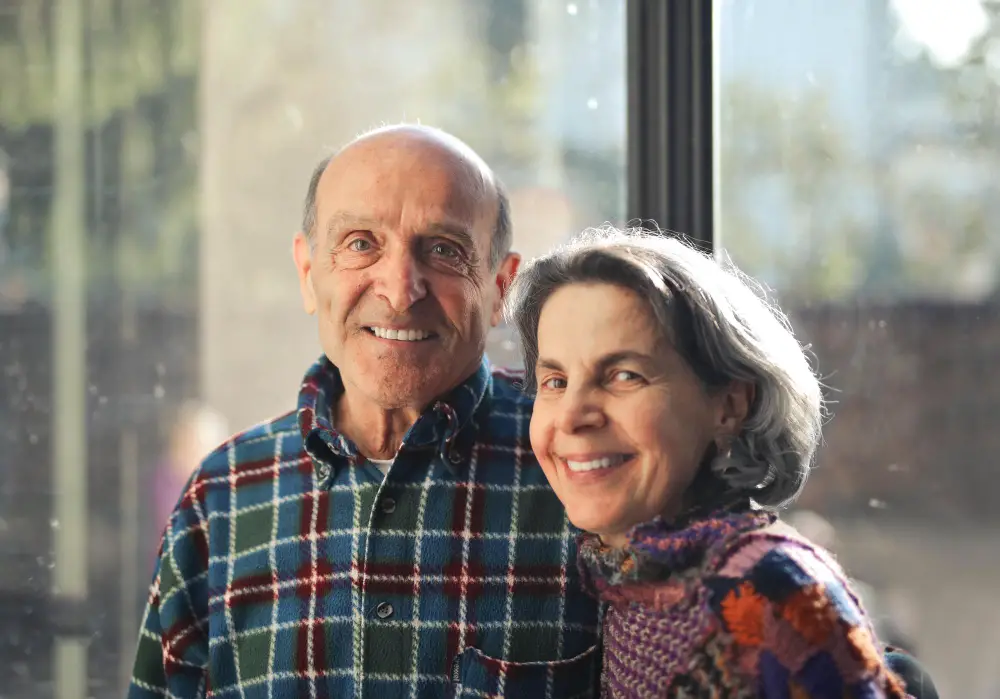
For the first time in almost a year, my husband was smiling at a hotel website instead of a medical chart.
I noticed it before he said a word. The way his shoulders dropped down from his ears, the way the tight little line between his eyebrows finally loosened. For eleven months that line had been carved into his face like something permanent, something the surgeons had left behind along with the scar on his chest. And now it was gone, just because of a photograph of a pool.
“Look at this one, Margaret,” Richard said, turning his laptop toward me across the kitchen table. “It has a pool.”
I laughed before I could stop myself.
“You hate swimming.”
“I hate exercise,” he corrected, holding up one finger like a man making a very important legal distinction. “But sitting in warm water while someone brings me lemonade is an entirely different activity. That’s not exercise. That’s civilization.”
That was the Richard I had married forty-three years ago. The one who could make me laugh in a grocery store parking lot, the one who used to leave notes tucked inside my lunch when I was still teaching. Somewhere in the past year I had almost forgotten what he sounded like when he wasn’t tired. When he wasn’t measuring his breath, or counting his pills into the little plastic organizer with the days of the week printed on the lids.
For months, our lives had shrunk down to the size of waiting rooms. Appointments. Medications lined up on the counter like tiny soldiers. The particular hum of hospital fluorescent lights that I could probably still hear in my sleep. And underneath all of it, the quiet fear that neither of us was willing to say out loud, because saying it might somehow make it real.
Richard had undergone open heart surgery the previous spring. A triple bypass. I remember the surgeon coming out to talk to me afterward, still in his scrubs, and I remember not hearing a single word he said for the first thirty seconds because I was too busy studying his face for bad news. The operation went well. That was what everyone kept telling me. It went well, Mrs. Callahan, he did great, he’s a fighter.
But recovery was slow in the way nobody warns you about. Nobody tells you that a heart can be repaired in a matter of hours and a man’s confidence can take the better part of a year to follow. He got winded climbing the stairs. He napped in the afternoons, something he had never once done in the whole time I’d known him. There were nights I woke up and put my hand on his back just to feel it rise and fall, just to be sure.
And then, as if the universe wanted to be thorough about it, my own body decided to join the parade. By the time Richard could walk the length of the driveway without stopping, my right hip had started grinding like a rusty hinge. The orthopedist showed me the X-ray, pointed to the place where the cartilage had worn thin, and I spent the next several weeks in physical therapy, gritting my teeth through exercises with names that sounded gentle and felt like medieval torture.
We had become experts at waiting rooms. We knew which office had the good magazines and which one only had pamphlets about cholesterol. We knew the receptionists by name. We had a whole system worked out for who drove on which day, depending on whose appointment hurt more.
Then, during one of Richard’s follow up visits, his cardiologist leaned back in his chair, crossed his arms, and said something that neither of us expected.
“You’re stable,” he told us. “Both of you. And I’m going to say something that isn’t strictly medical advice, so take it for what it’s worth.” He looked from Richard to me and back again. “You two need to stop living like the next crisis is already in the room. Because right now, it isn’t. And you’re wasting good days waiting for it.”
Richard glanced at me, then back at the doctor.
“What exactly are you suggesting?”
“Take a trip. Nothing that’s going to put you back in here. Just go somewhere pleasant. Sit in the sun. Eat food somebody else cooked. Remember that you’re alive, because the two of you seem to have forgotten.”
We took him seriously. Maybe more seriously than he intended.
You have to understand something about Richard and me. We had spent our entire marriage being careful with money, and I mean careful in a way that people half our age might find hard to imagine. Richard worked as an electrician for thirty eight years, most of them for the same commercial outfit, running conduit and pulling wire in office buildings and schools and the occasional hospital. I taught fourth grade until I retired, and if you’ve never tried to raise two children on an electrician’s wages and a teacher’s salary, let me tell you, it required a certain kind of discipline.
We paid our bills on time, every time. We put money aside even in the years when there was almost nothing to put aside. We saved for retirement before I fully understood what a 401k even was, back when Richard’s union rep sat us down at our own kitchen table and explained why the small deductions from every paycheck would matter someday. We helped both our children through college so they wouldn’t start their adult lives buried under student loans the way so many of their friends did. We rarely bought anything we could not pay for outright, and we drove our cars until the odometers rolled past two hundred thousand miles and the mechanic started shaking his head.
We were not wealthy. But we were solvent, and dignified, and we owed nobody anything. In our world, that counted as a kind of quiet success.
So when we found a modest hotel three states away, a place with generous off season rates, a free breakfast that included actual eggs and not just those sad little muffins in plastic wrap, and a heated indoor pool, it felt perfect. Four nights. A quiet town on a lake. No hospital bracelets, no appointment reminders, no plastic pill organizer.
We were so genuinely excited that we did what parents do. We invited our two grown children over for dinner so we could tell them the good news in person.
I roasted a chicken. I made the mashed potatoes the way Kevin had loved as a boy, with too much butter and a little garlic, and I set the table with the good plates, the ones we only use for holidays and birthdays. Richard pulled up the hotel’s website on his tablet and practiced showing me the photos so he could present them at just the right moment. He was like a little boy with a report card he was proud of.
I want you to remember that. I want you to remember that we were happy, and that we thought we were about to share our happiness with people who loved us.
Our daughter, Melissa, arrived first.
She was forty one now, married, with two children of her own, and she carried a particular kind of tension in her body that I had learned to recognize over the years. She was successful by any measure. She and her husband both worked in finance, they lived in a four bedroom house in a good school district, they drove newer cars than we had ever owned. And yet Melissa was perpetually, exhaustingly worried about money. She earned more than Richard and I ever had, combined, and she still spoke about her finances the way a person clings to the edge of a cliff.
She hugged me at the door, and I could feel the stiffness in her shoulders.
“Something smells good,” she said, which was her version of hello.
Our son, Kevin, arrived twenty minutes later with his wife, Lauren. Kevin was thirty eight, and he moved through the world with a comfortable ease that his sister never quite managed. He kissed my cheek, said hello to his father, and then opened the refrigerator without asking, the way he had done since he was fifteen years old.
He frowned into it.
“You stopped buying that sparkling water?”
“You don’t live here,” I reminded him.
“I visit.”
“Twice a month.”
“That still counts for something.”
I laughed, because I honestly thought he was joking, and we all sat down to eat.
Dinner was good. That’s the part that still catches in my throat when I think about it. Dinner was genuinely good. The chicken came out tender, Lauren told a funny story about their neighbor’s dog, and for a little while it felt like the family we used to be, back before everything narrowed down to health and worry. Richard even had color in his cheeks. He ate more than he had in weeks.
After we’d cleared the plates and I’d brought out coffee, Richard reached for his tablet.
“So,” he said, and I could hear the pride in his voice, “your mother and I have some good news.”
Melissa’s face changed instantly. She went pale, her fork frozen halfway to the dessert.
“Is it about Dad’s heart?”
“No,” I said quickly, because I understood that fear, I had lived inside it too. “No, sweetheart, everything is fine.”
“Better than fine,” Richard added, and he turned the tablet around. “Your mother and I are taking a little trip.”
He showed them the photos. The hotel was simple but cheerful. Yellow curtains in the windows. A small blue pool. A modest restaurant with tables that overlooked the lake. Nothing extravagant. Nothing that anyone could reasonably object to.
I waited for Melissa to smile. I was already imagining it, the way her face would soften, the way she might reach across the table and squeeze her father’s hand and say something like, oh Dad, that looks lovely, you two deserve it.
Instead, she leaned in and studied the nightly rate at the bottom of the screen.
“How many nights?”
“Four,” I said.
“And what does that cost, with taxes and everything?”
I blinked at her. Something cold began to gather in my stomach.
“Not much,” I said.
“That’s not a number, Mom.”
Richard set the tablet down slowly. “Why do you need a number, Melissa?”
She folded her arms across her chest. It was a gesture I recognized from her childhood, the way she used to stand her ground about bedtime. “Because you said you had important news. I assumed it involved your health. Or the house. Something serious.”
“It involves us getting out of the house,” Richard said. “I’d call that fairly serious, considering the year we’ve had.”
Kevin had picked up the tablet and was scrolling through the pictures, his mouth slightly pursed.
“Didn’t you two just take that train trip last fall?”
“It was two nights,” I said. “And that was before your father’s surgery. That was before any of this.”
Melissa leaned back in her chair, and what she said next arranged itself in the air of my kitchen and refused to leave.
“You can’t keep spending our inheritance like this.”
I stared at my daughter. I was so certain I had misheard her that I actually asked.
“What did you say?”
She did not look embarrassed. That was the part that I would turn over in my mind for weeks afterward, lying awake at two in the morning. She did not flinch, or blush, or reach to take it back. She said it again, more slowly, as though I were the one being unreasonable.
“You need to start thinking about the future,” she said. “That money doesn’t only affect you two. Whatever you spend now is money that we won’t inherit later. It’s just something you have to consider.”
Before I could gather any kind of response, Kevin nodded along, setting the tablet down on the table.
“Do you even need another trip?” he asked. “I mean, most people your age just stay home and take it easy. You two are always buying something or going somewhere. At this rate there’s not going to be anything left when you’re gone.”
The room went completely silent. I could hear the refrigerator humming. I could hear a car passing on the street outside.
My son and daughter were sitting at the dinner table I had set with the good plates, in the house they grew up in, and they were discussing our deaths the way you might discuss a payment coming due. As though Richard and I were an account they were monitoring. As though the beating of my husband’s newly repaired heart was an inconvenient delay on a check they were waiting to cash.
I felt the tears rise up hot behind my eyes, and I hated them for coming, because I did not want to cry in front of my children over something so ugly.
Under the table, Richard’s hand found my knee and squeezed.
I turned toward him, expecting to see my own hurt reflected back at me.
He was smiling.
Not a bitter smile. Not a wounded one. A calm, almost peaceful smile, the kind of expression a man gets when a difficult problem has just quietly solved itself in his mind.
“You know,” Richard said, setting down his coffee, “maybe you’re both right.”
Melissa’s shoulders came down from around her ears.
“Your mother and I clearly need to make some better arrangements,” he continued. “We’ve been careless. You’ve given us a great deal to think about.”
“I’m glad you understand,” Melissa said, and the relief in her voice was so complete, so uncomplicated, that it took my breath away.
“Oh, I understand perfectly,” Richard said.
Kevin gestured at the tablet. “So are you canceling the trip, or what?”
Richard reached over and closed the tablet’s cover with two fingers.
“We’ll think about it,” he said.
They left not long after that, and they left satisfied. I stood at the window and watched them walk to their cars, and I could see it in the way they moved, the loose easy confidence of people who believe they have finally gotten through to someone. Kevin said something to Melissa on the walkway and she laughed. They thought they had done us a favor. They thought they had talked some sense into two foolish old people who didn’t understand their own finances.
Richard waited until both cars had turned the corner and disappeared. Then he walked to his office, sat down at his laptop, and began making phone calls.
“What are you doing?” I asked him from the doorway.
“Making better arrangements,” he said, without looking up.
I came and sat in the chair beside his desk, the one where I used to sit while he paid the bills at the end of every month, a ritual we’d kept up for four decades.
“Richard.”
He looked at me then, and his face was serious.
“Do you know what hurt me most?” I asked him.
“That they said it at all?”
“No.” I shook my head slowly. “That neither one of them hesitated.”
He was quiet for a moment, because he knew I was right. There had been no awkward pause. No half second where one of them caught the other’s eye and realized they had crossed a line that should never be crossed. No apology, no walking it back, no shame. They had discussed the arithmetic of our mortality as easily as if they were splitting a restaurant check.
Over the next hour, Richard called three people. He called our attorney, a man named Benson who had drawn up our original will nearly twenty years ago. He called our financial adviser, a soft spoken woman named Diane who managed the modest investment account we’d built up over the decades and who had steered us gently but firmly through the market’s various tantrums. And he called the director of the cardiac rehabilitation center, the same place that had helped him relearn how to trust his own body after the surgery.
By the time he hung up the last call, I understood the rough outline of what he was thinking. And I have to be honest with you. My first instinct was to protect my children, even then. Even after what they’d said.
“I don’t want to disinherit them,” I said.
“Neither do I,” Richard answered, and I believed him.
“Then what exactly are we doing?”
He turned his chair to face me fully.
“We’re finding out,” he said, “whether they see us as their parents, or as an account balance they’re waiting to withdraw.”
We spent the next several days going through everything we owned, and I’ll admit the process was clarifying in a way I hadn’t expected. We laid it all out on the dining room table. The house, which we had bought in 1987 and paid off completely fourteen years later, a fact we had celebrated with a bottle of cheap champagne and a mortgage statement we set on fire in the backyard grill. Our retirement savings, the accounts we’d fed faithfully for decades. The small investment portfolio Diane managed. Our checking and savings. The modest life insurance policy. Even the value of the two paid off cars in the driveway.
We had more than I had realized, when you added it all up. Enough to be comfortable, enough to cover whatever medical care the coming years might demand, enough to be generous. But nowhere near enough to justify the way Melissa and Kevin had spoken. It was not the kind of fortune that people betray their parents over. It was just a lifetime of two ordinary people being careful.
Our attorney, Mr. Benson, met with us the following Wednesday. He was a patient man in his sixties who had handled the legal affairs of half the retired teachers and tradespeople in town. He read through the changes Richard wanted, and when he finished, he took off his glasses and folded them carefully on the desk.
“You’re certain about this?” he asked.
“Yes,” Richard said.
Benson looked at me. “Margaret?”
I thought about Melissa’s folded arms. I thought about Kevin asking whether we even needed another trip. I thought about the cold, practical way they had done the math on our deaths while sitting in the chairs where they used to eat their birthday cake.
“Yes,” I said. “But I want them given a chance to understand why. I don’t want this to be something we do behind their backs. I want it to be a conversation.”
Benson nodded, and then he suggested something that hadn’t occurred to either of us. Rather than a simple change to the will, he recommended we establish a family trust.
“A will only takes effect after you’re gone,” he explained. “But a trust can protect you while you’re alive. It can be structured so that your health, your comfort, and your independence come first, ahead of everything and everyone else. Your children would still inherit whatever remains, but they would have no say, none whatsoever, over how you two spend your own money for as long as you live.”
It was, I realized, exactly what we needed. A structure that said, in the plain language of the law, this life belongs to us until the day it doesn’t.
We set it up carefully, with Diane and Benson working together. The trust placed our needs first. If either of us required long term care, if we needed to renovate the house to make it accessible for a wheelchair or a walker someday, if we wanted to spend a winter somewhere warm, the money was ours to use. Freely. Without justification to anyone.
And then Richard added the part that would set everything in motion. A substantial portion of whatever remained after we were both gone, forty percent, would go to a charitable fund. The fund would support cardiac rehabilitation and in home care for elderly patients who couldn’t afford it. People like the ones Richard had met during his own recovery, people who’d looked at the cost of the care that saved their lives and wondered how they would ever manage.
Melissa and Kevin would still inherit. They would still receive the remaining sixty percent, split between them, which was a meaningful amount by any honest measure. But it would not be the windfall they had apparently been counting on. It would not be the lottery ticket they seemed to think their parents’ deaths represented.
Richard insisted on one more condition, and this was the one that surprised even me. Before either child could receive their portion, they would have to do two things. They would have to read a letter that Richard and I wrote together, a letter explaining exactly how we had felt sitting at that table. And they would have to attend a meeting with the trustee, in person, to hear it discussed.
I thought that would be enough. I thought that laying out our reasoning honestly, in writing and in person, would be sufficient.
Richard did not think so.
“We need to know if they’re actually sorry,” he said one evening as we sat on the back porch watching the light fade. “Or whether they’re only afraid of losing money. Those are two completely different things, Margaret, and I need to know which one we raised.”
“How do we find that out?” I asked.
He gave me the same small, calm smile he had worn at the dinner table.
“We tell them just enough to make them panic,” he said. “And then we watch what they do.”
We did not have to wait long. As it turned out, our test began sooner than we intended, and not by our design at all.
One week after our meeting with Benson, Kevin called me, and he was practically screaming into the phone.
“Mom, what did Dad do? What did he do? All of it was supposed to come to us!”
I looked across the living room at Richard, who had been reading in his chair. He raised an eyebrow, then quietly slid a document across the coffee table toward me and mouthed the words, tell him to check the final page.
“What on earth are you talking about, Kevin?” I asked, keeping my voice steady.
“Lauren saw Dad coming out of Benson’s office last week. She didn’t say anything at first, but then she mentioned it, and I called the office, and the receptionist let it slip that you two had changed your estate plan. So what did you do?”
I stared at Richard. Apparently the universe had decided to start our little experiment ahead of schedule.
“So?” I said to Kevin.
“So what changed? Tell me what changed.”
“That’s private, Kevin.”
“I’m your son.”
“You were also the person who sat at my dinner table,” I said slowly, “and told your father and me to stop spending your inheritance.”
There was a pause on the line. A long one.
“I didn’t mean it like that,” he said.
“Then how did you mean it?”
“I was concerned.”
“About our happiness?”
“About the future.”
“Whose future, Kevin?”
He exhaled, a sharp frustrated sound I’d been hearing from him since he was a teenager. “Can you just tell me what Dad did? Please?”
Richard tapped the document. I picked it up and turned to the final page, where the charitable provision was laid out in clear, unemotional legal language. The name of the fund. The percentage.
Forty percent.
“Your father and I created a trust,” I told him. “A large portion of what remains one day will go to support cardiac patients and elderly people who need home care but can’t pay for it.”
There was silence. And then Kevin’s voice came back, tight and rising.
“Forty percent?”
“You found the number quickly,” I observed.
“That’s, Mom, that’s hundreds of thousands of dollars.”
“Potentially. If we’re careful and live modestly and don’t need much care, then yes, potentially.”
“You’re giving our money to strangers?”
My hand tightened around the phone until my knuckles ached.
“It is not your money, Kevin,” I said. “It has never been your money. It is our money. It is money your father earned crawling through the ceilings of office buildings for thirty eight years. It is money I earned teaching other people’s children to read. It was never yours.”
“Mom, come on, be reasonable.”
“I am being perfectly reasonable.”
“Can Dad reverse it? Can he undo it?”
I glanced at Richard, who had heard the question and was already shaking his head slowly.
“Probably,” I admitted.
“Then tell him to. Tell him to fix this.”
Richard leaned toward the phone. “Goodbye, Kevin,” he said, loud enough to be heard.
I hung up.
Melissa called nine minutes later. I know it was nine minutes because I watched the clock, half expecting it. But Melissa did not scream. Melissa never screamed. My daughter had always been the strategic one, the one who thought two moves ahead, and her approach was correspondingly more careful.
“Mom,” she said, her voice soft and reasonable. “Can I come over? I think we really need to talk.”
“About what happened at dinner,” I asked, “or about the trust?”
There was a small, telling silence.
“Both,” she said finally.
They arrived together that evening, which surprised me. Neither of them brought their spouses. Richard had made a pot of coffee and set four folders on the dining room table, one at each place, though he had not said a word to me about what was inside them.
Melissa sat down but did not remove her coat, as though she wasn’t sure how long she’d be staying. Kevin remained standing, his hands jammed in his pockets, radiating the particular sullen energy he’d perfected at sixteen.
“Dad, this has gone too far,” he said before anyone had even poured the coffee.
Richard poured his own cup, unhurried. “What has, exactly?”
“You changed everything. Everything. Because of one conversation.”
“One honest conversation,” Richard replied, stirring in his cream.
Melissa leaned forward, and I could see her choosing her words the way she probably chose them in negotiations at work.
“We were worried, Dad. That’s all this was. We were worried about you.”
Richard sat down across from her and looked at her steadily.
“About us?”
“Yes.”
“Then tell me what worried you. Specifically.”
She hesitated, just for a moment. “That you might spend too much and end up regretting it. That you’d run short later, when you really need it.”
“Spend too much on what?”
“On trips. On renovations. On things you don’t really need at your age.”
“I needed heart surgery,” Richard said, and his voice was very quiet now, which with Richard has always been more dangerous than shouting. “Your mother needed months of physical therapy for her hip. Those things cost real money, Melissa, and we paid for them without complaint because that is what the savings were for. And that hotel we wanted to visit? We were going to spend less on four nights there than you spent on the phone you’re holding in your hand right now.”
“That’s not the point,” she said.
“Then what is the point? Say it plainly. I’m asking you honestly. What is the actual point?”
Melissa looked at Kevin. Something passed between them, and Kevin finally pulled out a chair and sat down heavily.
“The point,” Kevin said, “is that you two worked hard your whole lives to build something. For the family. And now you’re just, giving it away.”
“No,” Richard said. “We didn’t work hard to build something. We worked hard to build a life. Ours. There’s a difference.”
Kevin frowned. “It’s the same thing.”
“It is not remotely the same thing,” Richard said, “and the fact that you can’t tell them apart is exactly why we’re all sitting here.”
I placed both my hands flat on the table, the way I used to when I needed my class to settle down and listen.
“I want to ask you both something,” I said, “and I want an honest answer. Did either of you go home after that dinner and feel ashamed? Even a little?”
Melissa looked away toward the window. Kevin stared down at the folder in front of him.
“Did you think about what it sounded like,” I went on, “to tell your own parents that they should stay home, that they should stop enjoying the years they have left, so that there would be more money for you when they died?”
“We worded it badly,” Melissa said. “I know that. We could have said it more gently.”
“Did you apologize just now,” Richard asked, “because you hurt us? Or because you found out about the trust?”
Neither of them answered. And in that silence, I think, we all heard the answer clearly enough.
Richard opened one of the folders in front of him.
“I want to be clear about something,” he said. “This is not a punishment.”
Kevin laughed, a short bitter sound. “It sure feels like one.”
“It’s an arrangement,” Richard said evenly. “Our money will support your mother and me for as long as we’re alive. However long that is, and whatever we need. And afterward, part of it will go to the two of you, and part of it will go to help people who are frightened and sick and can’t afford the care that I was lucky enough to receive.”
“Forty percent is almost half,” Kevin said.
“Your math has certainly improved since dinner,” Richard said mildly.
“Dad.”
And then Richard’s face changed. The mildness fell away and something raw came up underneath it, something he had been holding down for a very long time.
“I nearly died last year,” he said.
The room went absolutely still.
“I spent two nights in intensive care with tubes coming out of me,” he continued, his voice low. “And your mother sat in a plastic chair beside that bed the entire time, not knowing whether she was going to go home a widow. She didn’t sleep. She barely ate. She just sat there and held my hand and waited to find out if forty three years was all we were going to get.” He paused, and I saw his jaw tighten. “And when I came out the other side, when I finally understood that I’d been given more time, I made myself a promise. I promised myself we would stop postponing joy. We had done enough postponing for one lifetime.”
Melissa’s face had softened. I could see it happening, the hard set of her mouth beginning to give.
“So when we sat you both down,” Richard went on, “and told you we wanted to take four nights at an inexpensive hotel by a lake, you did not ask whether I felt strong enough to make the drive. You did not ask whether your mother was excited about it. You did not ask a single question about us at all. You asked what it was going to cost you.”
“That’s not fair,” Melissa whispered.
“It is exactly fair,” Richard said. “It is the fairest thing I have said in this entire room.”
She turned to me, and there were tears standing in her eyes now. “Mom. Please.”
And oh, how I wanted to comfort her. That instinct never leaves you, no matter how old your children get, no matter what they’ve done. The urge to wipe away my daughter’s tears was as strong at that moment as it had been when she was five years old and had scraped her knee on the sidewalk.
But I made myself remember how easily she had spoken about our deaths. How the words our inheritance had rolled off her tongue without so much as a stumble.
“What do you want us to do, Melissa?” I asked her.
“Change it back,” she said. “Please. Just change it back the way it was.”
“Why?”
“Because we’re your children.”
“And what does that mean, exactly? To you?”
“It means family comes first. It’s supposed to mean family comes first.”
Richard leaned back in his chair, and I saw the corner of his mouth twitch.
“Interesting,” he said.
Kevin glanced at him warily. “What?”
“Family came first,” Richard said, “when we paid every dollar of your college tuition so you could both graduate without owing anybody a cent.”
Kevin’s jaw tightened. “Dad, that’s not, ”
“Family came first,” Richard continued, “when we covered Melissa’s mortgage payment for six months after her divorce, so she wouldn’t lose the house she’d worked so hard to keep.”
Melissa looked down at the table.
“Family came first when we gave you both the down payments on your homes. When we watched your children every single week for years so you wouldn’t have to pay for daycare. When we quietly paid bills you couldn’t cover and never once mentioned it again, never held it over your heads, never asked for a word of thanks.”
“We never asked you to do any of that,” Kevin said, and there was defensiveness in it now.
“No,” I said quietly. “You didn’t have to ask. We did it because we love you. We did it gladly. Every single time.”
“Exactly,” Melissa said, and she leaned forward, and I watched my daughter make the mistake that would tell us everything we needed to know. “So why stop now? If you’ve always given, why would you stop giving now?”
The words hung in the air of that dining room, and I felt Richard go very still beside me.
There it was. There was the whole thing, laid bare on the good tablecloth.
She had not asked how to repair what was broken between us. She had not asked how to earn back our trust, or how to make things right, or even how her father’s heart was healing. She had asked why the giving had stopped. As though our love were a faucet, and her only concern was that someone had turned it off.
Richard reached into the folder and withdrew a single sheet of paper.
“Everything we’ve done,” he said, “these changes, this trust, all of it, was meant to answer one question. One single question.”
“What question?” Melissa asked.
“Whether you wanted your parents,” Richard said, “or whether you wanted our bank account. That’s all. That’s the only thing I needed to find out.”
Kevin stood up so fast his chair scraped against the floor.
“That’s manipulative,” he said. “That’s, you set a trap for us. Your own kids.”
“No,” Richard said, and he did not raise his voice at all. “Manipulative is telling your elderly parents that they should stop enjoying their lives because you’ve grown impatient waiting for them to die.”
“I never said I wanted you dead,” Kevin snapped.
“You were already budgeting the proceeds,” Richard said.
Kevin shoved his chair the rest of the way back. “I don’t have to sit here and be insulted like this.”
I looked up at my son, standing there with his face flushed and his fists clenched, and I felt something break open in my chest.
“Then don’t stay because you’re insulted,” I said. “Stay because your father almost died last spring, and your mother is sitting here asking whether you care about anything in this world besides money.”
He froze. For one long, suspended moment, I honestly thought he might sit back down. I saw something flicker across his face, something that might have been the boy I raised, the one who used to cry at sad movies and bring me dandelions from the yard.
Then he grabbed his coat off the back of the chair.
“Call me when you’re ready to be rational,” he said, and he walked out. The front door shut behind him, not quite a slam, but close.
Melissa stayed where she was.
The tears were spilling over now, running down her cheeks, and she made no move to wipe them away.
“Are you really giving it away?” she asked, so quietly I almost didn’t hear her. “That much of it?”
“Some of it,” I said. “Forty percent of whatever remains after we’re gone.”
“To people you don’t even know?”
“To people who may someday need the exact same care your father received. Yes.”
She wiped her cheek with the back of her hand, a gesture from her childhood I hadn’t seen in decades. “What about my kids? Your grandchildren?”
“Their parents are healthy and employed and doing far better than your father and I ever did at your age,” I said gently.
“That’s not the point.”
“Then say the point, Melissa. Say it clearly, once, without dressing it up. I’m your mother. You can tell me the truth.”
She stared at me for a long moment, and I watched her fight with herself, watched all her careful strategy fall away.
“I thought we’d be secure,” she whispered at last. “I thought, no matter what happened, no matter how bad things got, there’d be this, this cushion. This thing underneath us. And now it’s, now it feels like the floor is gone.”
“You’re forty one years old, Melissa.”
“That doesn’t mean I’m not scared, Mom.” Her voice cracked. “It doesn’t mean I don’t lie awake at night doing the math on the mortgage and the car payments and the kids’ college accounts and wondering how we’ll ever, ”
She stopped, and pressed her lips together.
And that, finally, was the first honest thing she had said all evening.
Richard’s expression softened, but he did not rush to rescue her. He let the honesty sit there between us where we could all see it.
“What are you actually afraid of?” he asked her.
Melissa was quiet for a long time. When she spoke, her voice was smaller than I’d heard it since she was a girl.
“Losing the house,” she said. “Losing my job in the next round of layoffs, because there’s always another round. Not being able to help my own kids the way you helped us. Ending up with nothing to fall back on.”
“Then build savings,” Richard said, and there was no cruelty in it, only a kind of steady tenderness. “Make a real plan. Sit down with a financial adviser and take an honest look at what you’re spending and what you’re keeping. Do what your mother and I did. We started with nothing, Melissa. Less than nothing, some years.”
“It’s harder now,” she said. “Everything costs more. You have no idea how much everything costs now.”
“Maybe it is harder. I believe you that it’s harder.” Richard leaned forward and looked her in the eye. “But your parents’ deaths are not a retirement strategy. They can’t be. I won’t let them be, not for your sake as much as ours. You cannot build your security on the day your mother and I stop breathing. It’s not sound. And it’s not right. And it will poison every good moment you could be having with us in the meantime.”
She covered her face with both hands and cried, really cried, the way she used to when she was small and the world had disappointed her. For several minutes nobody spoke. Richard reached over and put his hand on my back, and we let our daughter weep at the table where she’d learned to do her multiplication tables.
Finally she lowered her hands and looked at me.
“I’m sorry,” she said.
“For what?” I asked. Because it mattered. It mattered enormously which words came next.
“For the way I said it. At dinner. I should never have put it like that.”
And there it was. Not enough. Not nearly enough. She was apologizing for the phrasing, for the delivery, for the choice of words. Not for the belief underneath them.
“Melissa,” I said, and I chose my own words carefully now. “Do you think that money belongs to you?”
She hesitated, and I could see her wanting to give the right answer instead of the true one.
“I think,” she said slowly, “that parents usually want to leave something to their children.”
“We do,” I said. “We very much do. But leaving something is a gift, sweetheart. It’s a gift we give freely, if we’re able, because we love you. It is not a debt we owe you. It is not something you’re entitled to collect. And the moment you started treating it like a debt, something between us broke.”
She began to cry harder, and I could not stand it any longer. I got up from my seat and moved around the table to the chair beside her, and I took her hand in both of mine, the way I had a thousand times when she was young.
“I love you,” I told her. “I have loved you every single day since the moment they put you in my arms. But love does not require me to make myself smaller so that you can inherit more. It doesn’t require your father and me to sit quietly in this house, afraid to spend a dollar, counting down the days, so that the number in an account grows a little larger for you. That isn’t love. That’s just fear wearing love’s coat.”
She nodded, though I wasn’t entirely sure she understood yet. Understanding, I’ve learned, sometimes takes a long time to arrive after the words do.
Before she left, she reached across the table and picked up the letter from the folder, the one Richard and I had written together over three difficult evenings.
“Can I read this?” she asked.
“Yes,” Richard said. “That’s what it’s for.”
She carried it out to the hallway and stood there under the light, reading it in silence. I watched her from the dining room. I saw the exact moment she reached the passage we’d struggled hardest to write, the part where we described what it felt like to be reduced, in a single conversation, from a mother and father into a pair of assets awaiting distribution. I saw her stop. I saw her read it twice. I saw her hand come up to her mouth.
Then she folded the letter along its creases, very carefully, and placed it in her bag. She said goodnight quietly and let herself out.
Kevin did not speak to us for almost two months.
The silence was hard. I won’t pretend it wasn’t. There were nights I second guessed everything, nights I said to Richard, maybe we went too far, maybe we broke something we can’t fix. And Richard would take my hand and say, we didn’t break it, Margaret. We just finally looked at it clearly. Whatever’s broken was broken long before we drew up a single document.
Melissa called after three weeks. And here is the thing that told me the letter had done its work. She did not call to ask about the trust. She did not mention the money at all.
She called to ask how Richard’s heart was doing.
It was a small thing. Just a phone call, just a question. But it was the first call in years, and I mean years, that did not contain a request tucked somewhere inside it. She just wanted to know how her father was feeling. Whether he was sleeping better. Whether the last checkup had gone well.
After that, she began to visit more often. Sometimes she brought groceries, the good sparkling water Kevin used to complain about, without being asked and without making it into a thing. Sometimes she came alone in the afternoon and stayed for coffee, and we would sit in the kitchen and talk about her kids, about the garden, about nothing in particular. The kind of talking we used to do before everything got tangled up in numbers.
She never once mentioned the inheritance again. Not to argue, not to plead, not to negotiate. It was as though that part of her had quietly closed a door and walked away from it.
Kevin took longer. Kevin always did, even as a child. He was the one who had to reach his own conclusions in his own time, who couldn’t be pushed toward anything, who would dig in twice as hard the moment he felt cornered.
His first message came near the end of the second month. It was short.
Can we talk without Dad attacking me?
I read it three times. Then I typed back: Your father told you the truth, and the truth isn’t an attack. But yes, you can come. Come for dinner.
When he arrived, he looked tired. Older than his thirty eight years, somehow, with shadows under his eyes. He sat down at the kitchen table, the same table, and for a while he just stared at his own hands.
“I was angry,” he said finally.
“We know,” I told him.
“I’m still not thrilled about it. Forty percent.” He shook his head. “That’s still a lot of money to give to people you’ve never met.”
Richard, sitting across from him, raised one eyebrow but said nothing.
Kevin caught the look, and almost, almost, he smiled.
“But,” he said, and then he stopped, and started again. “But I also know that I acted like it was already mine. Like it was money in my account and you two were spending it without permission. And it was never that. It was never mine.”
“No,” Richard said. “It wasn’t.”
“I’m sorry.”
I looked at my son very carefully. “Sorry for what, Kevin? I need you to tell me.”
He met my eyes, and something in his face had shifted, some hardness that had been there for years had cracked and fallen away.
“Not for losing the money,” he said. “For making you feel like I was, like I was standing around waiting. Waiting for you to be gone. Sitting at your dinner table doing arithmetic while Dad was still recovering.” His voice thickened. “That’s, that was a terrible thing to make you feel, Mom. And I did it without even noticing I was doing it. That’s the part that scares me. That I didn’t even notice.”
That apology was different. That apology was for the belief, and not just the wording. I heard the difference the way you hear a lock finally turn.
I believed him.
We did not change the trust.
That surprised both of them, I think. I believe Melissa, in some corner of her heart, had expected that once she softened, once she started visiting and asking about her father’s health, we would quietly reverse the whole thing as a reward. And I believe Kevin, once he apologized and meant it, expected the same. That the trust had been a lesson, and now that the lesson was learned, the teacher would take it back.
But we left it exactly as it was. The forty percent stayed. The fund stayed. The letter stayed in the folder for the day it would be needed.
Because the trust was never a punishment, and it was never really a test in the way they thought. It was the truth, made permanent. It was Richard and me finally deciding, after a lifetime of putting ourselves last, that our own lives were worth living fully, all the way to the end, and that what we chose to do with the fruit of our own labor was ours and ours alone.
And so we took our trip.
We drove the three states in Richard’s sensible sedan, the one we’d bought used and kept meticulously maintained, and we stopped whenever we felt like stopping, at little diners and roadside overlooks and one truly excellent pie stand somewhere in the middle of nowhere. We checked into the modest hotel with the yellow curtains. Richard sat in the heated pool with a glass of lemonade, exactly as he had promised, and grinned at me like a boy who’d gotten away with something.
On the second evening, we walked down to the edge of the lake and sat on a wooden bench while the sun went down behind the trees, turning the water gold and then rose and then a deep, quiet blue. Richard took my hand, the same hand he’d been holding across kitchen tables and hospital beds and church pews for forty three years.
“Do you regret it?” he asked me.
“The trust?”
He nodded.
I watched the light fade off the water for a moment before I answered.
“No,” I said. “I don’t.”
“Even if they’d stayed angry? Even if Kevin had never come back?”
I thought about that honestly, because he deserved an honest answer.
“They can be angry and still love us,” I said. “And we can love them without financing every fear they’ve ever had. Those things were always true. We just spent too long pretending they weren’t.”
Richard smiled, and squeezed my hand, and we sat there until the first stars came out over the lake.
We have taken three more trips since then. Nothing extravagant. A long weekend at the shore. A week in the mountains in the fall when the leaves turned. A road trip to see an old friend of Richard’s from his working days, a man he hadn’t laid eyes on in twenty years.
Melissa asks us to send pictures now. She keeps them on her phone and shows them to the grandchildren. Last time we visited, I saw that she’d framed one, Richard and me squinting into the sun at the top of a mountain trail, and hung it in her hallway.
Kevin still teases us about spending his inheritance. But now, when he says it, he adds something.
“Spending my inheritance again, huh?” he’ll say, when we come back tanned and rested. And then, with a crooked grin, “As you should. As you absolutely should.”
Maybe they finally understand. I like to think they do. I like to think that somewhere in that hard year, sitting at the table where they grew up, my children learned the difference between a life and an estate, between a gift and a debt, between loving your parents and waiting for them.
Our children will still inherit something one day. A real amount, enough to matter, enough to help. That was never in question.
But they will not inherit the version of Richard and me that sat silently in a quiet house, afraid to book a hotel room, afraid to buy the good sparkling water, afraid to enjoy the years we’d earned, because every dollar had already been spoken for by someone else’s future.
Richard and I spent decades preparing for a future that finally arrived. And now, at long last, we are allowing ourselves to actually live inside it.
If our children receive a little less because their parents chose a few more sunsets over a lake, a few more hotel breakfasts, a few more slow mornings drinking coffee together in a place with no appointments on the calendar, then so be it.
I would not trade a single one of those mornings. Not for all the money in the world.

Laura Bennett writes about complicated family dynamics, difficult conversations, and the quiet moments that change everything. Her stories focus on real-life tensions — inheritance disputes, strained marriages, loyalty tests — and the strength people find when they finally speak up. She believes the smallest decisions often carry the biggest consequences.