“You really did this to me?”
Ethan’s scream burst through my phone at four o’clock in the afternoon, so loud and so sudden that I flinched.
Tara startled against my chest and let out a thin, surprised wail. Timothy kicked hard inside his bassinet, working himself up toward a cry of his own. And Tessa, who had been fussing on the edge of hunger for ten minutes, chose that exact moment to tip fully over into screaming, before I’d even finished warming her bottle.
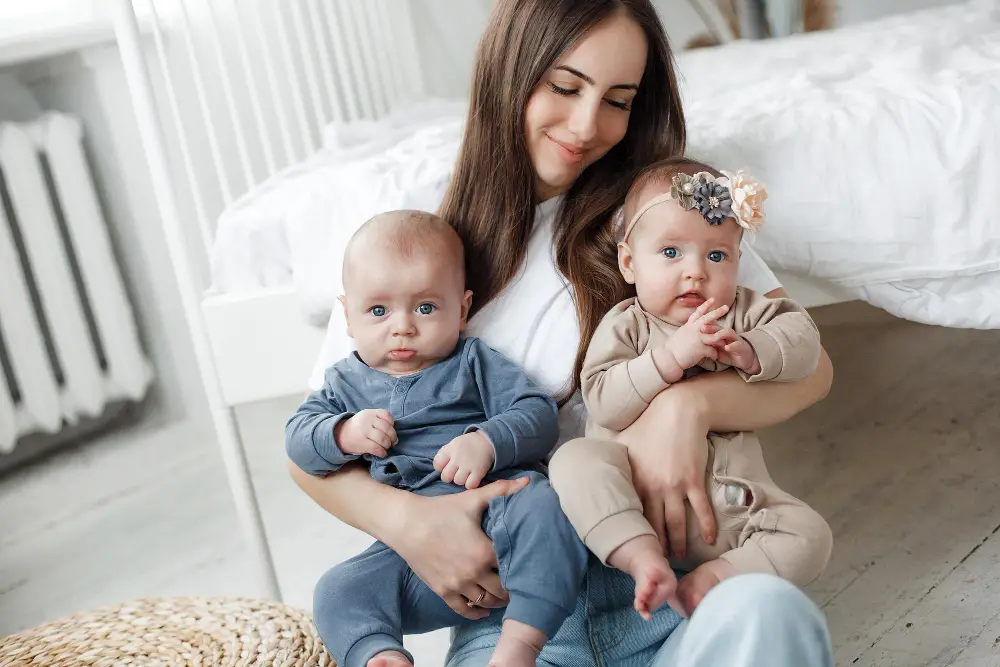
Three babies. One phone. One pair of hands that had not had a full night of sleep in six weeks.
I lowered the volume with sticky fingers, tucked the phone against my shoulder, and kept swaying on my feet the way I did now without even thinking about it, the permanent slow rocking motion of a mother of newborns.
“What did I do, Ethan?” I asked, keeping my voice level.
“You emptied my suitcase!”
Somewhere in the background, a door slammed. Then I heard a man’s voice, one of his friends, ask, “Whoa, what is all that?”
And I knew, with a small cold flicker of satisfaction, that Ethan had opened the suitcase in front of them. In front of Marcus and Ben. In front of the exact audience I had packed it for.
Just as I’d planned.
“My clothes are gone, Kyra,” he snapped, his voice dropping lower now, tighter, aware suddenly that people were listening. “All of them. You packed diapers. Feeding charts. That stupid shirt. A baby book.”
“The book you promised to read,” I said.
“You made me look like a liar.”
Behind him, I could hear the resort. Music, faintly. The clink of glass. The sounds of a vacation happening in real time while I stood in a nursery that smelled of formula and desperation.
Tessa’s cries climbed higher. I shifted Tara up onto my shoulder and stretched for the warm bottle on the counter with my free hand.
“No, Ethan,” I said. “I didn’t make you look like a liar. I just stopped helping you look like a good husband.”
There was a silence on the line then, a real one, the kind that happens when a person realizes the ground has shifted under them and they don’t yet understand how far they’re going to fall.
To understand how I got to that moment, standing in a nursery with three screaming babies and telling my husband the truth for the first time in months, you have to go back six months. Because six months earlier, I would never in a thousand years have believed those words could come out of my mouth.
Back then, Ethan was the man who rubbed my swollen feet at the end of every long day. He was the one who brought me toast in bed on the mornings when the nausea was bad, cut into little triangles the way I liked it, and who pressed his mouth to my belly every single night and talked to the babies in a soft voice, telling them about the world they were coming into.
He had been the one who wanted a big family. Long before I was ready, he’d talk about it, a house full of kids, chaos and noise and love. When the ultrasound technician went quiet and then smiled and turned the screen toward us and said the word triplets, Ethan cried harder than I did. He gripped my hand so tight it almost hurt and he laughed through the tears and said it was the best day of his life.
We were both terrified, of course. Three at once is not a thing you can fully prepare for, financially or physically or in any other way. We spent that whole pregnancy getting ready. We refinanced the mortgage to pull a little cash out of the house for the nursery renovation, knocking down the wall between the small spare room and the office to make one big room that could hold three cribs, and I remember sitting across from the loan officer feeling the weight of what we were taking on. We met with a financial adviser to figure out how on earth we were going to manage childcare costs for three infants at once, and we came out of that meeting pale and quiet and holding hands in the parking lot, because the numbers for full time care for triplets were the kind of numbers that don’t feel real until you see them written down. We priced out our health insurance so many times I could have recited the deductible and the out of pocket maximum in my sleep, trying to understand what a C-section and a possible NICU stay would cost us, calling the insurance line during my lunch breaks to ask the same questions in slightly different ways.
We bought in bulk, cases of diapers stacked in the garage like sandbags before a storm. We accepted every hand me down anyone offered, three of everything or nothing at all. We updated our life insurance and, for the first time, sat down with a lawyer to write actual wills and name guardians, because suddenly we were people with three dependents and responsibilities that outlived us. We built a whole careful scaffolding around the life we were about to begin, and Ethan was right there beside me for every part of the planning, nodding, agreeing, promising.
And through all of it, Ethan kept saying the same thing.
“We’re going to be a team,” he promised, over and over. “Every feeding. Every diaper. Every terrible night. We do it together, all of it. You’re not going to be alone in this for one second.”
I believed him. Why wouldn’t I? He was my husband, and he was crying at ultrasounds, and he meant it when he said it. I’m sure he meant it.
At a backyard barbecue during my seventh month, when I was enormous and swollen and could no longer see my own feet, Ethan’s two closest friends, Marcus and Ben, handed him a gift bag with tissue paper sticking out of the top. He dug through it and pulled out a black t-shirt, and he held it up so everyone could read the white lettering across the front.
WORLD’S MOST EXHAUSTED FATHER.
Everyone laughed. Ethan grinned and pulled it on right over the shirt he was wearing.
“I think I’m the one who’s actually going to be exhausted,” I said from the lawn chair where I’d been more or less installed for the afternoon, one hand resting on the enormous curve of my belly.
But Ethan was already posing, flexing, playing to the crowd. “Diapers, bottles, laundry, night feedings,” he announced, ticking them off on his fingers. “I’ve got it all. This is going to be me. Running on empty, three babies, doing it all.”
I laughed and took his picture on my phone, the two of us caught in the golden light of that warm evening, him mugging in his brand new shirt, me huge and happy and completely convinced of him.
“I’m saving that speech to memory,” I told him.
He leaned down and kissed my forehead, right there in front of all his friends.
“Save it,” he said. “I’ll prove it, my love.”
I did save it. I saved the photo and I saved the speech, though not in the way either of us imagined at the time.
Then Tara, Timothy, and Tessa arrived, and everything Ethan had promised evaporated so fast it was as though he had never said any of it at all.
The C-section was hard. Harder than I’d let myself expect. Three babies is a major surgery and a long recovery, and I came home from the hospital moving like every part of my body had been stitched together a little too tightly. Sitting up hurt. Standing hurt. Laughing hurt, and coughing was almost unbearable, a sharp tearing pull across my whole middle that made me press a pillow against my stomach every time I felt one coming. I had a prescription for the pain and strict instructions from the surgeon about what I wasn’t supposed to lift for the first six weeks, a limit measured in pounds that was, ironically, less than the combined weight of any two of my own children. The discharge nurse had gone over it with both of us, with Ethan standing right there, nodding along. No heavy lifting. Rest when you can. You need support at home. Do you have support at home? Yes, Ethan had said. Absolutely. She’s got me.
Our first night home, all three of them started crying within minutes of each other, the way they would learn to do with uncanny coordination for months to come. It was past two in the morning. The room was dark. I lay in bed beside my husband, and I reached instinctively for Tara in the bassinet closest to me, and I gasped out loud at the pull across my incision.
“Ethan,” I whispered. “Can you bring her to me? I can’t reach her.”
He opened one eye. “I just lay down.”
“I can’t lift her from here. It hurts too much.”
He sighed, a long put upon sigh, and got up, and carried Tara the four feet from her bassinet to my arms, and set her down against me. And then he climbed straight back into bed and pulled the blanket up over his shoulder.
“Timothy needs his bottle too,” I said quietly, because Timothy’s cries were escalating and I already had a baby latched and another one who would need feeding the moment this one was done.
“You’re already awake,” Ethan said, his back to me.
I stared at the outline of him in the dark. “So are you.”
“I’ve got work tomorrow.”
I looked at the three bassinets lined up beside our bed, at the three tiny faces, and something in my chest that I couldn’t name yet began, very quietly, to crack.
“And I’ve got three babies who can’t survive without us,” I said.
He turned toward the wall and said nothing else.
By the third night, he came into the bedroom carrying his pillow under his arm.
I was sitting up against the headboard with Tessa on my shoulder, patting her back. Timothy had milk running down his chin and needed to be burped. Tara was starting to cry again from her bassinet. I was, as I would be for weeks, a woman with three needs and two hands.
“I’m moving into the guest room,” Ethan announced.
I looked up at him. “For how long?”
“Until they sleep through the night. I need real sleep, Kyra. I can’t keep waking up every hour.”
“They’re newborns,” I said. “It’s going to be months before they sleep through the night. You know that.”
“I need eight hours if I’m going to function at work.”
“I need more than forty minutes at a stretch if I’m going to function here,” I said. “And I’m not getting it either.”
“You don’t have meetings,” he said, as if that settled it.
I looked down at our children, at the small warm weight of Tessa against my neck. “No. Just three tiny human beings whose entire lives depend on me being awake.”
Ethan rubbed his face with both hands. “Why do you always have to make me feel guilty?”
“I thought guilt was supposed to come after you’d done something wrong,” I said.
His mouth tightened into a hard line. “I’m not arguing about this.”
And he left, and the guest room door clicked shut down the hall, and that was the end of my husband as a nighttime parent. Just like that. On the third night.
I lay there in the dark afterward with all three of them finally quiet, and I told myself it was temporary. I told myself he was overwhelmed and would come around. I told myself a lot of things in those early weeks, most of them designed to keep me from looking directly at what was actually happening, because looking at it directly was more than I had the strength for while I was still bleeding and stitched and running on no sleep. It’s a strange thing, how much energy it takes to not see something. I was spending it freely, and I couldn’t afford it, and I didn’t know how to stop.
The days weren’t much better, though the failures during daylight were sneakier, dressed up in the language of effort.
Because during the day, Ethan started keeping score. He counted every small thing he did as though each one were an enormous sacrifice deserving of applause.
“I changed two diapers,” he announced one afternoon, coming into the kitchen like a man reporting for a medal.
I was standing at the sink washing bottles, rocking Timothy’s carrier with my foot to keep him from waking. Without looking up, I glanced at the care sheet taped to the front of the refrigerator, the one where I logged everything because I genuinely could no longer remember from one hour to the next what had been done and what hadn’t.
“There have been twenty three,” I said. “Today. Since six this morning.”
“You don’t have to keep score,” he said.
“I’m not keeping score to catch you,” I said, and it was true, at least at first. “I started writing everything down because I can’t remember what hour it even is anymore. It’s for survival, not for you.”
“You always make it sound like I’m doing nothing,” he said.
I turned off the water. “You held Tessa for six minutes this morning. I timed it, not on purpose, I just happened to notice. Six minutes, Ethan.”
“I work all day,” he said.
“So do I.”
“You’re home.”
My hands went still in the soapy water. “So are the babies,” I said. “Being home isn’t the same as resting. This house is my workplace now, and it never closes.”
He walked away before I could say anything more, which was becoming his signature move, ending conversations by simply removing himself from them.
And still, God help me, I covered for him. That’s the part I’m least proud of now, looking back. I protected his image even as he abandoned the reality.
When his mother called to check in and asked, pointedly, whether he was helping, I looked toward the closed guest room door down the hall and I lied.
“He’s tired from work,” I said.
“Is he doing the night feedings? A new mother needs her rest, especially after surgery.”
“He’s trying,” I said.
“Well, don’t overwhelm him,” she warned me, in the confiding tone of a woman passing down ancient wisdom. “Men don’t always know what to do with newborns. He’s probably afraid he’ll drop one, poor thing. You have to be patient with them.”
I almost told her the truth. I almost said that I hadn’t left the hospital with a secret instruction manual sewn into my body, that I was just as afraid and just as clueless as he was, the only difference being that I got up anyway. I almost said that nobody had asked whether they might overwhelm me. But I didn’t. I swallowed it, the way I was swallowing everything in those days, and I got off the phone and went to feed the babies.
Ethan stepped into the hallway just as I hung up. He was heading for the guest room, and he paused with his hand on the doorknob.
“Hey,” he said. “Try to keep them quiet tonight, okay? I’ve got an early call in the morning.”
I looked at him. Really looked at him.
“Did you hear yourself just now?” I asked.
“What?”
“I had major surgery six weeks ago. I am feeding three babies around the clock, alone, all night, every night. And you’re asking me to keep them quiet so you can sleep.”
“I can’t lose my job, Kyra,” he said. “Somebody has to keep the paychecks coming.”
“And I can’t collapse,” I said. “Somebody has to keep the babies alive.”
He opened the guest room door. “You’ll be fine,” he said. “You always are.”
And he closed it.
That night broke something open in me, though I didn’t fully understand it until later.
Tessa wouldn’t settle unless I held her completely upright against my chest, which meant I couldn’t lie down, which meant I couldn’t rest. Timothy needed another bottle before I’d even finished feeding Tara. My water glass sat three feet away on the dresser, and I was so thirsty my lips were cracking, but I couldn’t reach it without setting down a baby and waking at least one of the others.
So I called Ethan. From inside our own house, I called my husband on his phone, because I needed help so badly and he was twenty feet away behind a closed door.
I heard his phone buzz through the wall.
And then I heard it stop.
He had declined the call. He had looked at my name on his screen, in the middle of the night, while I sat feet away drowning, and he had pressed the button to send me away.
I stared at my phone in the dark. Then I looked around the room at the three tiny faces, all of them needing me, all of them mine to keep.
“All right,” I whispered, to them and to myself and to no one. “I heard you. I hear you.”
Something in me had made a decision, even if I couldn’t have put it into words yet.
The next morning, I began to log everything. Not the loose survival notes I’d been keeping on the fridge, but everything, carefully, with times. Every feeding. Every diaper change. Every pumping session. Every load of laundry, every bottle washed, every minute of sleep I managed to steal. I filled a notebook and started a second one. I didn’t entirely know why I was doing it. I only knew that I was tired of the story Ethan told about our life bearing no resemblance to the life I was actually living, and that a record was the only thing that couldn’t be argued with.
A week into my careful logging, Ethan walked into the kitchen one morning with his sunglasses pushed up on top of his head, looking pleased with himself. He set a printed booking confirmation down on the counter in front of me with a little flourish.
“I booked a trip to Cabo,” he said.
I looked down at the paper. A resort. A flight. Two weeks.
“For us?” I asked, though even as I said it I felt the floor beginning to tilt.
“For me,” he said.
I waited for him to laugh, to tell me he was joking, to say of course not, of course he wouldn’t leave me alone with three six week old babies to go lie on a beach.
He didn’t laugh.
“You booked yourself a vacation,” I said slowly.
“I need to recover,” he said.
“From what, exactly?”
“From work. From the crying. From this whole house.” He waved one hand vaguely in the direction of the nursery, in the direction of our children.
“I haven’t slept longer than forty minutes at a stretch in six weeks,” I said. “I had my abdomen cut open. I am feeding three infants alone through every single night. If anyone in this house needs to recover, Ethan, it’s me.”
“That’s different,” he said.
“Why? Tell me why that’s different.”
“Because this is what you wanted, Kyra.” He said it flatly, like it was obvious, like it was a reasonable thing to say to your wife. “You wanted a big family. This was your choice.”
I felt that land somewhere deep. “I wanted children,” I said. “I did want them, and I love them more than I knew it was possible to love anything. What I did not want was to become a single mother while I was still married. Those are not the same thing.”
“I love them,” he said, his jaw setting.
“Then help take care of them.”
“I can’t help anyone if I fall apart. I’m burned out.”
“You haven’t helped anyone even while you were holding yourself together,” I said. “So don’t tell me you’re too burned out to do a job you were never doing in the first place.”
“I need two weeks,” he said. “I deserve a proper break. Any reasonable person would understand that.”
I looked down at Timothy, at his impossibly tiny hand curled around my finger, holding on with that fierce newborn grip.
“And who takes care of me while you’re gone?” I asked quietly. “Who brings me water in the night when I can’t reach it? Who takes one baby so I can feed another? Who lets me sleep, even for an hour? Who drives me to my own follow up appointment next week, the one where they check my incision? Do you even know I have one?”
He blinked. He hadn’t known.
“You’ll manage,” he said, recovering. “You always manage.” And then, because apparently that wasn’t quite dismissive enough, he added, “Honestly, Kyra, your hormones are making this into a much bigger deal than it actually is.”
I looked down at the baby in my arms.
Three children. Six weeks old. A body that still hurt when I stood up too fast, that still wasn’t fully healed. And a husband packing sunscreen for the beach.
“No,” I said. “I don’t think my hormones are making this bigger than it is. I think I’ve finally started seeing everything exactly for what it is.”
He left the room rather than answer, and this time I didn’t try to stop him. Something had gone very clear and very quiet inside me.
That evening, I picked up our shared tablet to order more diapers, because we went through them faster than I could have believed, and a message notification slid across the top of the screen. It was from Marcus, synced to the shared account Ethan never remembered was shared.
We’ll meet you at the resort Thursday. Ben already booked his flight. Gonna be an epic trip, brother.
Ethan walked into the room at that exact moment, and he saw me looking at the tablet, and he froze.
“You invited your friends,” I said. It wasn’t a question.
“Only for a few days,” he said. “It’s not, it’s not what it looks like.”
“You told me you needed to be alone. You called it a solo adventure. You said you needed space to recover from all of this.” I set the tablet down. “And instead you planned a boys’ trip. You planned a vacation with your friends and told me it was a recovery you desperately needed.”
“I need to be away from all of this,” he said, gesturing again toward the nursery, toward the crib where our daughters slept.
I stood up, slowly, carefully, because standing fast still cost me.
“All of this has names, Ethan.”
“Kyra, don’t start.”
“Say them,” I said.
“What?”
“Our children’s names. Say them to me. Right now.”
He rubbed his forehead like I was giving him a headache. “I know their names.”
“Then say them.”
There was a pause. A pause that told me everything.
“Kyra, I need a break with the guys,” he said instead. “That’s all this is. That’s all it ever was.”
“You lied to me,” I said.
“I left out some of the details,” he said, “because I knew you’d react exactly like this.”
I picked up my phone and walked into the other room, and I called Ben. Of Ethan’s two friends, Ben was the one with a heart, the one who had a baby of his own. He answered on the second ring.
“Hey, Kyra,” he said, warm and easy. “How are the babies? How are you holding up?”
“Ben,” I said. “Did Ethan tell you why he’s going on this trip? Did he tell you the reason he’s leaving?”
There was a slight pause, the sound of a man who could tell a question had more underneath it than he’d expected.
“He said you wanted some quiet time,” Ben said carefully. “He said you wanted to bond with the babies, just you and them, and that you’d asked him for space. He said you’d basically pushed him to go, that you thought it would be good for everybody.”
I looked slowly around the room. Three bassinets. Two overflowing baskets of laundry I hadn’t had a free minute to fold. Six bottles lined up by the sink waiting to be washed. A prescription bottle on the counter. A woman standing in the middle of all of it, alone.
“He said that,” I said. “He said I asked him to go.”
“Yeah. And he said his mom was coming to help you out while he was gone. So we figured you’d have plenty of support, and honestly we thought it was kind of generous of you.” Ben’s voice was starting to change now, starting to catch up. “That’s what he told us, Ky.”
“No one is helping me, Ben,” I said. “No one. His mother is not here. She calls to make sure I’m not overwhelming him. I am completely alone with three six week old babies, recovering from surgery, and my husband told you I sent him to a resort.”
The silence on the other end stretched out long.
“Kyra,” Ben said finally, and his voice had gone quiet and stricken. “I didn’t know. I swear to you, I had no idea. That’s not, that’s not what any of us thought was happening.”
“Well,” I said. “Now you know.”
And I ended the call.
That night, after all three babies were finally, blessedly asleep at the same time, a small miracle that happened maybe once a day, I walked down the hall into the guest room where Ethan had been sleeping alone in peace for weeks.
His suitcase lay open on the bed, already half packed for his trip. His resort clothes were folded in neat, careful rows, nicer than anything he’d worn in months. His new swim trunks were laid out beside a box of brand new sandals. His toiletries were tucked into a side pocket. He had put real thought into this. Real care. More care than he’d put into a single night feeding.
I stood there and looked at it for a long moment.
Then I got to work.
I unpacked all of it. I hung his resort clothes back in the closet, one by one, taking my time. I put the swim trunks and the sandals away. And then I began to repack the suitcase with different things entirely.
I packed a fresh box of newborn diapers, filling most of the main compartment. I packed the printed feeding charts and one full week of my handwritten logs, every feeding and every diaper and every sleepless hour documented in my own tired, slanting handwriting, page after page of the invisible work he’d never once seen. I packed the parenting book he had promised, at that barbecue, to read cover to cover, its spine still perfectly, accusingly uncracked. I packed the earplugs and the sleep mask he’d bought for the flight, because he’d wanted quiet so badly. I packed the black t-shirt. WORLD’S MOST EXHAUSTED FATHER, still crisp, barely worn. And I packed the photo from the barbecue, the two of us in the golden light, him grinning and flexing in that shirt, me huge and trusting and six months away from understanding what was coming.
On the back of the photo, I wrote three words.
Your audience is waiting.
I left him exactly one clean outfit and his basic toiletries, enough that he wouldn’t be truly stranded, enough that he could get himself home. I wanted him exposed. I didn’t want him helpless. There’s a real difference between the two, and it mattered to me, even in the middle of my anger. I wasn’t trying to endanger him or humiliate him past the point of dignity. I was trying to make him carry, for one single afternoon, in front of the friends he’d lied to, the exact truth of what he’d left me holding for six weeks.
Then I placed one more note on top of everything, where he couldn’t miss it.
You survived six weeks by leaving every hard part to me. Congratulations.
I zipped the suitcase closed, wheeled it back to where he’d had it, and went to feed the baby who was just beginning to stir.
The next morning, Ethan kissed my cheek on his way out the door, oblivious, cheerful, wheeling the suitcase behind him.
“Try not to stay angry the whole time I’m gone,” he said.
I was adjusting Tara’s blanket and didn’t look up. “Try not to mistake consequences for anger,” I said.
He frowned at that, not quite understanding it, but he was in too much of a hurry to chase it down. He never opened the suitcase. He never checked it. He just picked up his wallet and his sunglasses and left, pulling the door shut behind him, off to the airport and his epic trip.
And I settled in to wait.
At four o’clock that afternoon, the phone rang, and it was Ethan, screaming.
I had Timothy in the crook of my arm, finishing his bottle, and I listened to my husband rage from his resort room a thousand miles away.
“Marcus and Ben saw everything!” he shouted. “I opened the suitcase in the room and they were right there and they saw all of it!”
“I know,” I said. “That was the idea.”
“You planned this. You planned the whole thing.”
“Yes, Ethan,” I said. “I did.”
“You had no right to drag my friends into our marriage!”
“You dragged them into it,” I said, “when you invited them on your fake solo recovery trip and told them your recovering wife had sent you off with her blessing.”
“I told them I needed a break,” he said.
“You left your recovering wife alone with three newborns,” I said, “and you lied to everyone about why. I just made sure the story matched the facts.”
“I deserve time away,” he said.
“And I deserved a partner,” I said. “We don’t always get what we deserve.”
“You make it sound like I abandoned a war,” he said. “It’s a vacation, Kyra. People take vacations.”
“People with three six week old babies and a wife who can’t lift a laundry basket don’t get to take a two week vacation and call it a right,” I said. “Not without their partner’s agreement. And you didn’t ask me. You informed me, and then you lied to everyone else about it. That’s not a vacation. That’s a man leaving his family and building a cover story.”
Then, behind him, I heard Marcus’s voice, closer to the phone than Ethan probably realized.
“You told her she wanted you to leave?” Marcus said. He sounded appalled. “That’s what you said to us. You said Kyra wanted you gone.”
Ethan’s voice moved away from the receiver, muffled. “Stay out of this. This is between me and my wife.”
“You told us she had help,” Marcus pressed. “You said your mother was there.”
“This is between me and my wife,” Ethan said again, louder.
And then Ben, quieter, but I could hear him clearly. “Then maybe you should have stayed home with your wife, man.”
Ethan lowered his voice, but I still caught it. “You two don’t know what my house is like right now. You don’t know what I’m dealing with.”
“That’s exactly the point,” Marcus said. “You don’t know what your house is like either. You haven’t been in it.”
Then I heard a sound I recognized, even through the phone. The long zip of a suitcase being closed.
“Why are you packing?” Ethan asked, and now there was something new in his voice. Fear, maybe. The first crack of it.
“I’m going home, Ethan,” Marcus said.
“What? We just got here.”
“My wife struggled when I went back to work, and we only had one baby. One. You left Kyra with three, six weeks after a C-section, and you lied to us to get us here so it wouldn’t look like what it is. I’m not spending a week at the pool over that. I’m going home to my own family.”
“I’m leaving too,” Ben said.
“You’re both just taking her side?” Ethan’s voice cracked. “You haven’t even heard me out.”
“We heard you,” Marcus said. “In the room. Just now. That was more than enough.”
A door closed, hard. And then another. And Ethan came back to the phone, and his voice was smaller than I had ever heard it.
“They walked out on me,” he said. “They just, they left. Both of them.”
Tessa began to cry from her bassinet, working herself up.
“Well,” I said. “Now you’ve got the solo trip you told everyone you wanted.”
There was a silence. Then, with a childish spite that would have been funny if it weren’t so sad, he said, “I’ll stay the full two weeks. Just to spite you. I’ll stay every single day.”
“That’s your choice, Ethan,” I said. “I genuinely can’t stop you. You’re a grown man. You can stay on a beach for two weeks while your children learn to exist without you. That’s entirely up to you.”
“You can’t stop me from coming home either,” he said, contradicting himself already.
“I’m not trying to,” I said.
I lifted Tessa out of her bassinet and settled her against my shoulder.
“But I need you to hear something,” I said. “When you do come home, you are not moving back into the guest room. You are not going to keep living in this house like a single man who happens to have roommates who cry. That’s over. That ended the night you declined my call through the wall.”
“It’s my house too,” he said.
“Then come home and live in it like it’s yours,” I said. “Live in it like a father lives in a house with his children. That’s all I’m asking.”
“Kyra, listen to me, I—”
“Tara’s been changed,” I said. “Timothy’s been fed. Tessa needs me right now, and I don’t have time for a tantrum from someone who isn’t even in the building. I have to go.”
And I ended the call.
I set the phone down on the counter, and I noticed that my hand was shaking.
I want to be honest about that. In the version of this story people might want to hear, I felt triumphant in that moment, vindicated, powerful. And there was some of that. But mostly, when I put the phone down, I felt terrified. I had just drawn a line in my marriage that could not be uncrossed. I had humiliated my husband in front of his friends, on purpose, and told him our old arrangement was finished, and I did not know what he would do, or whether the marriage would survive it, or whether I had just chosen to be a truly single mother instead of a married one.
I didn’t feel brave. I felt scared down to my bones.
But I was learning that terror and helplessness are not the same thing. You can be frightened and still refuse to go back to the way things were. I held Tessa and I breathed and I let my hand shake, and I did not pick the phone back up to apologize.
Two days later, the front door opened.
I hadn’t expected him back so soon. Ethan stepped inside with a duffel bag over his shoulder, and he stopped dead in the entryway, because Ben was standing in our kitchen, putting containers of food into our refrigerator.
“What are you doing here?” Ethan asked him.
“Dropping off dinner,” Ben said, his voice cool and even. “Marcus and I put together a meal rotation with our wives. Someone has to make sure Kyra eats.”
“You left me at the resort and came here?” Ethan said. “To my house?”
“Yes,” Ben said simply, and kept unloading food.
Ethan turned to look at me, and there was accusation in it. “You let people into our house to judge me? While I was gone?”
“They came,” I said, “because you left.”
Ben straightened up, picked up one of Timothy’s bottles from the drying rack, and held it out toward Ethan across the kitchen.
“Your turn,” Ben said.
And Ethan, on reflex, without thinking, took it.
Ben watched him take it, then grabbed his keys off the counter. “I’ll bring more tomorrow, Kyra,” he said.
“Thank you, Ben,” I said. “I mean it. I appreciate it more than you know.”
The door closed behind him. And Ethan and I stood in the kitchen, the bottle in his hand, our three children asleep down the hall, and the whole ruined truth of the last six weeks standing between us.
He set the bottle down on the counter.
“I’m sorry things got this far, Ky,” he said.
I looked at him for a long moment.
“Things didn’t get this far,” I said. “You took them here. Step by step. Every night you slept through, every call you declined, every lie you told your friends and your mother and me. Nothing about this just happened. You did it.”
“I was overwhelmed,” he said, and his voice cracked. “I wasn’t coping. I didn’t know how to be a father to three babies at once and I panicked, and I ran.”
I felt something soften in me, just slightly, because that, at least, was honest.
“You were allowed to be overwhelmed,” I said. “You were allowed to be exhausted and terrified. You were allowed to admit you had no idea what you were doing, because I didn’t either. I still don’t, half the time. All of that would have been fine. More than fine.”
“Then why are you treating me like I’m the enemy?” he asked.
“Because being overwhelmed didn’t give you the right to make me carry your entire share and then call it my choice,” I said. “You weren’t just struggling, Ethan. You were struggling and then handing me the bill for it. You were drowning and pushing me under so you could breathe. That’s the part I can’t forgive. Not the fear. The lying about it.”
His eyes dropped to the floor.
“I want to fix this,” he said quietly. “I do. Tell me how.”
I reached over to the counter and picked up a sheet of paper I had prepared, and I held it out to him.
“What is that?” he asked.
“A schedule,” I said.
He took it and read it. Evening feedings, assigned to him. Bottle preparation, assigned to him. Laundry. Overnight shifts, split, real ones, not the theater of walking a baby for six minutes and declaring the night a wash. Doctor’s appointments, with the dates and times filled in, because there were many, three babies means triple the pediatrician visits, the weight checks, the vaccinations. And built into all of it, carved out and protected in ink, blocks of time for me. Time to eat a meal sitting down. Time to shower without a baby monitor propped on the sink. Time to sleep in an unbroken stretch long enough to dream.
“This feels like punishment,” he said.
“Responsibility often feels like punishment,” I said, “to someone who’s spent six weeks watching another person carry theirs. It isn’t punishment. It’s just your half. It only feels heavy because you’ve never picked it up before.”
“And if I refuse?” he asked. It wasn’t quite a threat. It was more like a man testing the walls of a room to see if they were real, to see whether the old escape routes were still open.
I held his gaze steadily.
“Then we stop pretending this is a partnership,” I said. “And I start planning a life where I do this alone officially, instead of doing it alone while married. Because I am already a single mother, Ethan. I’ve been one for six weeks. The only real question left is whether I have to keep supporting a fourth person on top of the three who actually need me.”
Ethan looked up sharply. “Are you threatening me with divorce?”
“I’m not threatening you with anything,” I said. “I’m telling you, as plainly as I know how, what refusing would mean. So that this time, unlike Cabo, there’s no confusion at all about what you’d be choosing, and no story you can tell yourself or anyone else afterward about how you didn’t know.”
For once in his life, he didn’t argue. He looked down at the schedule in his hands, and he was quiet for a long time. And then he nodded.
The month that followed did not erase what he’d done. I want to be clear about that, because these things don’t wrap up neatly, and it wasn’t easy, and there were days I still looked at him and felt the cold echo of that declined phone call through the wall.
But he tried. Clumsily, at first, and badly. He mixed up which bottle belonged to which feeding. He left a full load of laundry sitting wet in the washer overnight until it soured and had to be run again. One night he simply forgot to prepare clean bottles before the babies woke, and I came out to find him at the sink at two in the morning, frantically washing, while all three of them screamed in the nursery.
“Tell me what to do,” he said, turning to me, and there was no defensiveness in it this time. Just a man out of his depth, asking for help instead of running from it.
“Start washing,” I said. “I’ll feed them this time. But tomorrow, you prepare the bottles before they’re hungry, not after. You get ahead of it. That’s the whole trick. You never let yourself fall behind, because with three, you never catch up again.”
He nodded, and he did it. The next night, the bottles were ready.
A few nights after that, he called out to me from the nursery, and there was an edge of panic in his voice.
“Kyra, Timothy won’t settle. I can’t get him to stop.”
“What have you tried?” I called back.
“Walking. Rocking. I sang to him. Nothing works. He doesn’t want me.”
I came to the doorway and looked in at him, my husband, standing in the dim light with our son wailing against his chest.
“He doesn’t not want you,” I said gently. “He just doesn’t know you yet. You haven’t been here. He’s learning who you are right now, in real time. So let him learn. Keep going.”
That silenced him. And then, instead of doing what he’d always done before, instead of handing the baby back to me and retreating, he sat down in the rocking chair with Timothy and stayed. He kept walking, kept rocking, kept at it. And about ten minutes later, Timothy’s cries eased, and then stopped, and my husband sat in the dark holding his sleeping son with an expression on his face I hadn’t seen since the ultrasound.
A week after that, his mother called.
“I heard he came home early from his trip,” she said, fishing.
“He did,” I said.
“And is everything all fixed now?” she asked, in that tone that expected me to say yes, to smooth it over, to protect him the way I always had.
“No,” I said. “It’s not all fixed. But he’s finally doing the work. For the first time, he’s actually doing it.”
Ethan was in the room. He heard me say it. And this time, I didn’t soften it for his mother’s comfort, and I didn’t soften it for his. I just said the true thing and let it stand.
The support from Ben and Marcus didn’t stop, either. Their wives folded into it, and a real meal rotation formed, dinners appearing at our door several nights a week. I stopped saying no to help. That was its own lesson. When someone offered to hold a baby, I no longer used the free hands to clean or catch up on chores. I used them to lie down and close my eyes, even for twenty minutes. I was learning that letting people help me wasn’t a failure. It was just what raising three babies actually required, from everyone, all at once.
One morning, a few weeks into the new arrangement, Ethan found the black t-shirt folded on top of the dresser. WORLD’S MOST EXHAUSTED FATHER. I’d washed it and left it out.
“Are you giving this back to me?” he asked, picking it up.
“No,” I said.
He frowned, turning it over in his hands. “Then why is it out?”
“You wanted the title,” I said. “You put it on and posed for a whole crowd. Now earn it. When you’ve actually earned it, you can wear it. Until then it’s just a costume.”
At that exact moment, Tara started crying from the nursery.
Ethan set the shirt down on the dresser. “I’ve got her,” he said.
And he went. Without waiting for instructions. Without waiting for me to tell him how. Without pausing to be thanked or praised for going. He just heard his daughter cry and went to take care of her, the way a parent does, the way I’d been doing alone for so long.
I sat down at the kitchen table and wrapped both my hands around my mug of coffee.
It was still warm. I had made it, and I was going to get to drink it, while it was still warm, sitting down at my own table, because someone else had the baby. Someone whose job it was. Someone who had finally understood that it was his job too.
Such a small thing. A warm cup of coffee. And such an impossibly enormous thing, after everything, that it made my eyes sting.
Ethan had come home expecting forgiveness. He’d expected that a duffel bag and a mumbled apology would reset everything to the way it was, that I would soften the way I always had, that I would take the weight back onto my own body because that was where it had always landed. Instead, he’d been handed a schedule and a real share of the load and the plain, unsoftened truth that love without labor isn’t love at all, not when there are three lives depending on it, not when the person you promised to be a team with is drowning three feet away from you.
He was still learning. We both were. The marriage wasn’t healed, exactly, and I want to be honest about that rather than tie a bow on it. It was under construction, which is a different thing than healed, and slower, and harder, and far more honest. There were still nights the memory of that declined phone call rose up in me cold and sharp. Forgiveness, I was learning, isn’t a single moment. It’s a thing you decide over and over, or don’t, depending on what the other person actually does, day after day, when no one is watching and there’s no audience to perform for.
But for the first time since our triplets came home from the hospital, I was no longer carrying four people on my own. I was carrying three, with help, and three with help was a life I could actually live.
I lifted the warm coffee to my lips, and down the hall, I heard my husband singing to our daughter. Badly. Off key. Making up the words as he went, the way I used to when it was only ever me. And she was quieting under the sound of him.
And so, at last, after all of it, was I.

Lila Hart is a dedicated Digital Archivist and Research Specialist with a keen eye for preserving and curating meaningful content. At TheArchivists, she specializes in organizing and managing digital archives, ensuring that valuable stories and historical moments are accessible for generations to come.
Lila earned her degree in History and Archival Studies from the University of Edinburgh, where she cultivated her passion for documenting the past and preserving cultural heritage. Her expertise lies in combining traditional archival techniques with modern digital tools, allowing her to create comprehensive and engaging collections that resonate with audiences worldwide.
At TheArchivists, Lila is known for her meticulous attention to detail and her ability to uncover hidden gems within extensive archives. Her work is praised for its depth, authenticity, and contribution to the preservation of knowledge in the digital age.
Driven by a commitment to preserving stories that matter, Lila is passionate about exploring the intersection of history and technology. Her goal is to ensure that every piece of content she handles reflects the richness of human experiences and remains a source of inspiration for years to come.