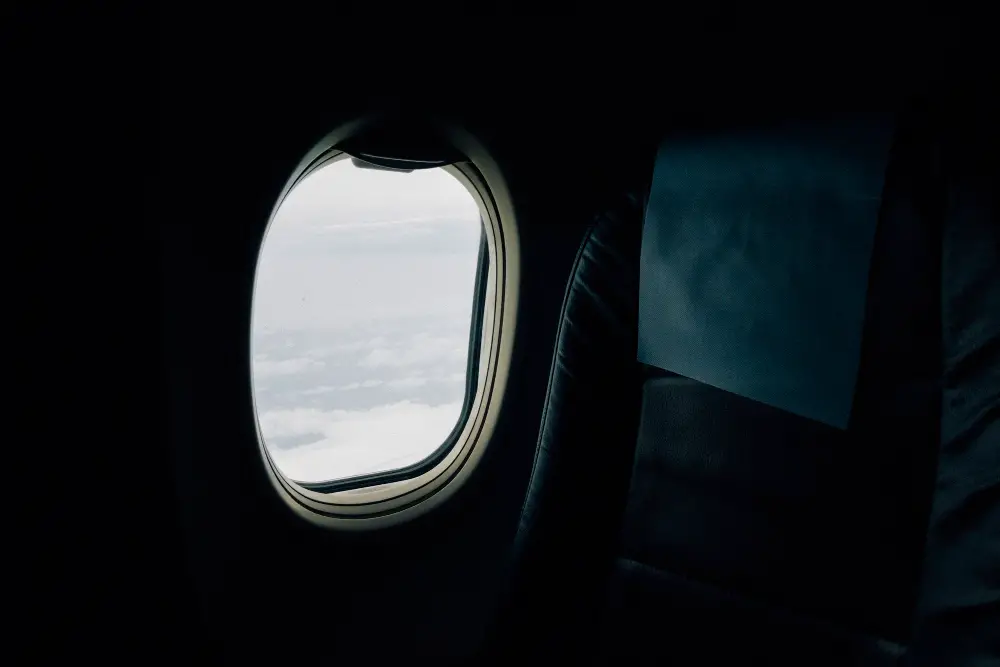
I had paid extra for the window seat and was already settled in with my book open and my carry-on stowed when the woman appeared in the aisle beside me with a boy who looked about ten.
She had the practiced smile of someone who expects the next few seconds to go a particular way.
“Would you mind switching seats with my son?”
I looked at the boy, then back at her. “Where’s your seat?”
“32B.”
I understood the geometry immediately. She wanted me to give up the window seat I had specifically selected and paid an additional fee for, move back ten rows, and spend a three-hour flight in a middle seat between strangers.
“I’m sorry, I’m going to keep my seat. I paid extra for it.”
Her expression shifted in the specific way of someone who has reclassified you from cooperative to obstacle.
“He’s ten.”
“I understand. I’m still going to keep my seat.”
She stared at me with the look of someone who cannot believe the response they are receiving. “You’re making a child sit alone because you want a window.”
People in the surrounding rows had started to look over. I recognized the social pressure being applied, the implication that only a truly unreasonable person would hold their position here, and I felt the familiar pull of it and held anyway.
“I’m not making him do anything. He has an assigned seat. I have mine.”
She stood there another moment as though I might reconsider if she gave me the opportunity. Then she turned.
“Fine.”
The boy moved past her and settled into 14B, the seat directly beside me. His backpack bumped my arm as he sat down.
“Sorry,” he said quietly.
“Don’t worry about it.”
He was slight and dark-haired and had the careful, watching quality of a kid who has learned to read rooms. He looked at his hands in his lap and didn’t say anything else.
I went back to my book.
About five minutes later, I heard footsteps stop beside our row.
The woman was back, and she had brought a flight attendant with her.
The flight attendant had the professional composure of someone who handles these situations regularly and has developed strong opinions about them. She smiled at me.
“Ma’am, I understand there’s been some confusion about the seating.”
“No confusion. I’m in 14A. That’s my assigned seat.”
The woman cut in immediately. “She agreed to switch with my son and now she’s refusing to move.”
I turned to look at her fully. “I never agreed to anything.”
“Yes, you did.”
“I didn’t. I told you I was keeping my seat.”
The flight attendant checked my boarding pass and confirmed my seat assignment without any ambiguity. The woman’s expression hardened. She crossed her arms.
“So that’s just it? He has to sit in the middle alone?”
“I’m afraid I can’t require another passenger to give up their assigned seat,” the flight attendant said.
And then the woman pointed at me.
“And she shoved him. When he was sitting down.”
The words landed so unexpectedly that for a moment I genuinely wasn’t sure I had heard them correctly.
“Excuse me?”
“She pushed my son.”
“I never touched him.”
“I saw you do it.”
Now the entire section of the plane was paying attention. I could feel it, the subtle reorientation of people who were pretending to look at their phones while tracking every word.
The woman pulled out her phone and pointed the camera at my face.
“Go ahead. Say it again. Tell everyone how you shoved a ten-year-old.”
“I didn’t touch your son. Put the phone down.”
“I’m just documenting the situation.”
Then the boy beside me shifted.
“Mom.”
She didn’t look at him. “Not now, Ethan.”
“But she didn’t—”
“Ethan.” The sharpness in her voice was complete and practiced, the sharpness of someone who has used it enough times to know exactly how it lands. “Stop.”
He stopped.
But the flight attendant had heard enough. She managed the situation with the efficiency of someone who is paid to move things forward. The boy was assigned to 14B, and he would stay there. The mother would return to her assigned seat in row 32. The conversation was over.
For the first time, the woman seemed uncertain. Something passed across her face that I couldn’t quite identify.
“He can’t stay here.”
“Why not?” the flight attendant asked.
The woman had no answer to that. She looked at me with an expression that had changed again, something tighter and less performative underneath the anger now.
She bent toward the boy. “Don’t talk to her.” Then she straightened and walked back down the aisle.
I sat with the residue of what had just happened and tried to make sense of it.
The boy, Ethan, was quiet beside me. He was staring at the seat back in front of him with the stillness of someone who has learned not to show what they are feeling in certain situations.
I felt bad for him. He had not asked for any of this.
“Hey,” I said. “I’m sorry about all that.”
He shrugged with the practiced casualness of someone trying very hard to seem unbothered. “It’s okay.”
I turned back to the window. The gate crew was still moving around below us, and the other planes on the tarmac were doing the slow, patient work of being large objects repositioned by small vehicles.
A few seconds passed.
“You really don’t remember her?”
I turned back to him. “Your mom?”
He nodded.
“I’ve never met your mother before today.”
He frowned. “She showed me your picture.”
Everything went very still.
“What?”
He looked toward the back of the plane and then back at me, and I could see him recalibrating, understanding that he had said something he had been specifically told not to say.
“I wasn’t supposed to tell you that.”
“Why did your mother have a picture of me?”
He hesitated.
“Ethan.”
He leaned toward me slightly, dropping his voice.
“She said you’re why Dad left us.”
I spent a full three seconds believing I had misheard him over the ambient noise of the cabin.
“What did you say?”
His face changed immediately. “I shouldn’t have told you that.”
“Who is your dad?”
He looked toward the back of the plane again.
“I can’t tell you.”
“You just told me I’m the reason your father left your family. I think you can tell me his name.”
He turned it over for a moment, the visible deliberation of a ten-year-old deciding how far down a road he has already started walking.
“Daniel,” he said.
The name sat on the surface of my recognition without sinking in immediately. I knew more than one Daniel.
“Daniel what?”
He told me the last name.
My stomach dropped in a long, cold slide.
I knew exactly who his father was. Daniel had been married to my older sister Claire. They had been together for seven years. Claire had died of an aggressive cancer twelve years ago, when she was thirty-one and I was twenty-two and the world had rearranged itself around that fact in ways I was still, more than a decade later, periodically discovering.
Daniel and I had stayed in contact for several years after the funeral. Not closely, not with any regularity, but in the way of people who share a grief that nobody else quite understands, a check-in here, a remembered anniversary there. Then the contact had thinned the way contact does when keeping it costs more than it gives. There had been no argument. No rupture. Just the gradual, mutual decision to let the distance grow, because sometimes speaking to someone brings back more pain than comfort, and sometimes you both know it.
The last time I had seen Daniel in person was nearly eight years ago.
“Your father was married to my sister,” I said.
Ethan turned to look at me fully. “What?”
“Before he married your mother. He was married to my sister Claire.”
He stared at me. “You knew my dad?”
“Yes.”
“Mom said he started talking to you again.”
“He did. Recently.”
His face fell in the way of someone absorbing confirmation of something they had been hoping was wrong.
“Not for the reason you think,” I said quickly.
“Mom said he left because of you.”
“Your dad and I have never been together. Not when he was married to my sister, not after she died, not ever.”
“Then why did she have your picture?”
I did not have an answer to that yet. I had not known the woman sitting in row 32 existed until twenty minutes ago. I had known, somewhere in the background of my life, that Daniel had remarried. You hear these things through the peripheral people who stay loosely connected to both sides after a marriage ends in death. I had heard he had a son. But I had not sought out any details, and Daniel and I had not been in contact for years before six months ago.
Six months ago, he had sent me a message.
It was brief and came without any preamble. He asked whether I still had Claire’s things.
I did. After my parents died, I had inherited several boxes of belongings from my sister’s life. Most of them I had gone through. One I had not. It contained things from a particular period of their marriage, and I had understood without anyone telling me that it was not mine to open.
Claire and Daniel had lost a baby.
She had been five months pregnant when they found out something was wrong. They had already named her. They had already bought small things, a coming-home outfit, a mobile with birds on it. My mother had started knitting a blanket and finished it a week after the loss, unable to stop. Claire had packed everything into a single box and put it away, and when she died the following year, Daniel could not bring himself to take it. He left it with our family. He did not ask for it, and none of us offered it, and for twelve years it had sat in my storage unit like a question nobody wanted to open.
Then he asked for it back.
I had found the box and messaged him. There had been a few exchanges. I had asked whether his wife knew he was reaching out. He had said not yet. I had told him he needed to tell her before he came to get it. He said he knew. Claire would have wanted him to have those things, I had written, because it was true and I believed it.
There had been nothing else. Nothing hidden in those messages, nothing that warranted what was sitting two rows away from me, but I could see suddenly, with a clarity that made my chest tighten, how those messages might have looked to a wife who did not know the full history. A wife who found her husband exchanging private messages with a woman about a box, asking whether she knew, being told to tell her first.
Context is everything. Without it, the most innocent thing in the world can look like exactly what it is not.
The flight attendants completed their final cabin checks. I stopped asking Ethan questions, because he was ten years old and whatever was unraveling between his parents was not something I intended to use him to investigate. He put on his headphones and started a movie, and I turned to the window and thought about Daniel, about Claire, about the box that was now in Daniel’s possession and the messages that had apparently ended a marriage I hadn’t known was fragile.
About forty minutes into the flight, Ethan tapped my arm.
“Can I ask you something?”
“Sure.”
“Were you my dad’s girlfriend?”
“No. Never.”
“Not even a little?”
The question was so genuinely innocent that it almost made me smile despite everything. “Not even a little. Your dad loved my sister. When she died, he was devastated. We stayed in touch for a while because we were both grieving her, and then we lost touch, and that was it.”
He looked at his hands.
“Then why did he leave after Mom found out about you?”
I chose my words with the care you use when speaking to a child about something that is not yours to fully explain.
“I don’t know everything that’s happening between your parents, Ethan. What I can tell you is that I was not involved in it. Whatever they are going through started before they found my messages.”
“He moved out,” he said.
“I’m sorry.”
“He’s got an apartment now. I see him on Wednesdays.”
Something in the flatness of that sentence, the resigned, factual way he listed his visitation schedule, was harder to hear than anything the woman in row 32 had said to me.
“And every other weekend.”
“Then your dad didn’t leave you,” I said. “He left the house. That’s not the same thing.”
He considered this. “Doesn’t feel different.”
He was right. I knew he was right. To a ten-year-old, the fact of his father’s new address was the entire reality of the situation, and any distinction I drew around it was adult reasoning that did not reach the place where the loss actually lived.
“I think your parents are dealing with some hard things between them,” I said carefully. “Grown-up things that have nothing to do with you and nothing to do with me. But I need you to know that I didn’t cause any of it.”
Before he could answer, I heard footsteps in the aisle.
“Ethan.”
Rachel stood beside the row. She looked at the two of us and something moved through her face that was past anger now, into something more complicated and less comfortable.
“I told you not to talk to her.”
Ethan removed his headphones. “She said that Aunt Claire was her sister.”
Rachel went completely still.
There it was. The moment she had been trying to prevent from the instant she spotted me in seat 14A.
I looked up at her.
“Why does your son believe I’m the reason your marriage fell apart?”
“Stay out of this.”
“You put a camera in my face in front of a full cabin and told everyone I pushed your child. I think we’re past the point where this is a private matter.”
Several nearby passengers had abandoned all pretense of not listening.
Rachel lowered her voice. “You involved yourself in my marriage.”
“Daniel contacted me about his first wife’s belongings.”
“And you answered him.”
“He was asking about a box of things that belonged to my dead sister. Yes, I answered him.”
“My sister,” I added. “Claire was my sister.”
“I know who Claire was.”
“Then you understand why he reached out.”
“I know what he told me.”
“What did he tell you?”
She looked at Ethan. “We are not doing this here.”
That, I agreed with entirely.
“Fine. Then go back to your seat.”
She looked at Ethan with the expression of someone making a decision they know they cannot enforce. “We’ll talk when we land.” Then she looked at me with something that had moved past hostility into something closer to exhaustion. “Please don’t say anything else to him.”
“Okay.”
She walked back down the aisle.
I turned to the window and let the pieces assemble themselves.
The window seat request had not been about Ethan wanting to see the clouds. She had recognized me the moment she walked through the gate. She had seen my face and understood that her son, who had seen my photograph and been told a version of a story that made me the villain of it, was about to spend three hours sitting beside me. She had tried to move me. When I wouldn’t move, she had tried to have me moved. When that failed, she had panicked and done the worst thing available to her, which was to accuse me of something she knew was not true, hoping the disruption would be enough to get me out of that seat.
She had not been protecting Ethan from a difficult flight.
She had been trying to protect a lie from the person who could contradict it.
I spent the rest of the flight looking out the window and thinking about my sister, which was something I still did regularly and probably always would.
Claire had been the kind of person who made other people better at being themselves simply by being around them. She had a quality of absolute attention that made whoever she was talking to feel like the only person in the room. She had been funny in the dry, observational way of someone who paid close attention to the world. She had loved Daniel with the particular intensity of someone who had not expected to find what she found in him and was still, years into their marriage, quietly delighted that she had.
I had loved him too, in the way you love someone who made your sister happy. Not romantically, not remotely, but with the straightforward warmth of extended family, of someone who had become part of the furniture of your most important relationships.
Watching what his silence had done to his second marriage, I felt something that was not quite grief and not quite frustration but some honest mixture of both.
When we landed and the cabin began the usual slow shuffling of people collecting overhead bags and checking their phones for messages accumulated at altitude, I assumed the story was finished. I had played an unwitting role in something I had not known was happening, and now I was going to collect my suitcase and get in a cab and go about my life.
I was wrong.
I had just pulled my suitcase off the carousel when I heard my name. Not my name exactly, just: “Wait.”
Rachel was walking toward me. She was alone, and when I looked past her I saw Ethan with a woman farther down the baggage hall who had the same dark coloring as Rachel and was clearly a sister.
“My sister has him,” Rachel said, stopping in front of me.
We stood on opposite sides of my suitcase and neither of us said anything for a moment.
She looked exhausted in the way of someone who has been holding a position that required more energy than she had anticipated.
“Daniel moved out three days after I found the messages,” she said.
“I haven’t spoken to Daniel since I gave him the box.”
She looked at me. “He came and got it?”
“About two weeks after we first exchanged messages. He picked it up and we spoke for maybe twenty minutes. That was the last time we had any contact.”
“He never told me that.”
“I don’t know what he told you.”
She looked away toward the baggage carousel, at the bags moving past in their slow orbit. “He told me about the baby eventually. After I found the messages and confronted him. He explained what the box was, why he had wanted it, who you were.” She paused. “He told me everything he should have told me before he ever sent you the first message.”
“But he didn’t.”
“No. He decided I wasn’t ready. Or he wasn’t ready. Or he wanted to handle it first and tell me after.” She said it with the flatness of someone who has worked through their anger enough times to have arrived at something on the other side of it. “He has a habit of making those decisions for me.”
“I know he does,” I said. “He did it with Claire too, sometimes.”
She looked at me with a kind of curious pain, the expression of someone being reminded that their husband had an entire life before them that they can never fully access.
“I told Ethan you were the woman his father had been secretly talking to,” she said. “That was technically accurate.”
“And when Daniel moved out and Ethan connected the two things, you let him believe it.”
She didn’t answer.
“You let a ten-year-old boy believe a stranger on the internet was the reason his father moved to an apartment.”
“I was furious with Daniel.”
“Then be furious with Daniel. He earned it. What you did was hand your son a target that had nothing to do with his actual loss.” I kept my voice level. It was not my place to be loud about this, but it was my place to say it. “He told me he sees his father on Wednesdays. In the same sentence, he told me it didn’t feel different from being left.”
Rachel pressed her lips together. Her eyes filled in the controlled way of someone who is refusing to cry in a public place.
“I didn’t mean for it to go that far.”
“You showed him my photograph.”
“I was angry and I wasn’t thinking clearly and I know it was wrong.” She looked at me directly. “I know it was wrong. I’ve known it was wrong since approximately ten minutes after I did it.”
“And on the plane.”
She exhaled. “I panicked when I saw you. I saw you in that seat and I thought about Ethan beside you for three hours and I just—I couldn’t think of anything else to do.”
“You could have told me the truth.”
“What would that have looked like?”
“It would have looked like a person having an honest conversation.”
“We had just met.”
“You had already decided I was the villain of your marriage. We were well past the getting-to-know-you stage.”
Something shifted in her face. Not quite a smile. More like the recognition of a point she could not argue with.
“If you had just told me what was happening,” I said, “I probably would have moved.”
She stared at me. “You would have given up the seat.”
“I paid for it and I wanted it. But I wouldn’t have wanted to sit next to a ten-year-old for three hours knowing he’d been told I destroyed his family. I would have moved.”
She looked at the floor.
“I made everything worse,” she said.
“Yes. Considerably.”
A long pause.
“I’m sorry.” She said it without preamble or qualification. “For the accusation especially. That was wrong. You didn’t touch him, and I knew you didn’t, and I said it anyway because I was desperate and I needed you out of that seat.”
“I know.”
“I’m sorry.”
I let it sit for a moment. I was not ready to tell her it was fine, because it wasn’t entirely fine, and she knew that too. The accusation had been serious, and the lie she had let Ethan carry was serious, and sorry did not undo those things. But I believed she meant it.
“Talk to your son,” I said. “Whatever is happening between you and Daniel, Ethan is not equipped to carry a story about a stranger being the cause of it. He told me it doesn’t feel different, being left. He’s using that word.”
She flinched visibly.
“He needs to understand that his father left a marriage, not him. And he needs to hear it from both of you together, clearly, without anyone else to point at.”
Rachel nodded.
We said goodbye without warmth but without hostility either, which felt like the appropriate register for two people who had been involuntarily joined to each other by other people’s choices.
Two days later, my phone showed a message from Daniel.
“I’m sorry. Rachel told me what happened on the flight.”
I looked at it for a long time before I wrote back.
“Don’t apologize to me first.”
His reply came quickly. “I know.”
I typed: “Your son used the word left when he was talking about you. He said it doesn’t feel different.”
This time there was a longer pause. Then: “What?”
I explained what Ethan had told me, only what he had said to me himself. Daniel called within a few minutes.
I almost didn’t answer.
I answered.
“I didn’t leave him,” he said. “I see him every week.”
“I know.”
“Then why would he think—”
He stopped. We both understood why. Children do not organize loss around the intentions of the adults who produce it. They organize it around the simple, concrete facts of their daily life. Dad’s shoes used to be by the door. Now they aren’t. Dad used to be home when I woke up. Now he isn’t. And if someone offered Ethan a name for the reason that was true, a photograph and a story and a target that was outside the family and therefore easier, he would have accepted it the way anyone accepts an explanation that is offered with confidence.
“You need to fix this with Ethan,” I said. “Both of you, together.”
“We will.”
“And Daniel.”
“Yeah?”
“If you want your marriage to survive, stop deciding which parts of your history your wife is allowed to know. Claire was real. Your daughter was real. You were allowed to grieve them and to want those things back. Rachel needed to know that. She deserved to know that. Making those decisions for her is what caused all of this. Not the messages.”
He was quiet.
“You’re right,” he said finally.
That was the last conversation we had.
About a week later, a message arrived from a number I didn’t recognize. I figured out quickly that it was Rachel.
“We talked to Ethan. Together.”
A second message followed a few minutes later.
“We didn’t tell him everything. Just enough. That you had nothing to do with us, and that his dad didn’t leave him.”
Then: “I’m sorry again. For all of it.”
I sat with my phone and thought about what to write back for several minutes.
Finally I wrote: “Thank you.”
That was everything.
I did not need Rachel to become someone I knew. I did not need Daniel back in my life, and I did not need any further involvement in the particular wreckage of two people working out whether a marriage built on incomplete information could survive the completion of it.
What I needed was for a ten-year-old boy named Ethan to stop using the word left when he talked about his father.
I hoped they had managed that.
I thought about the window seat. About the extra fee I had paid for it, the deliberate selection of it, the stubborn refusal to give it up, which had felt in the moment like a simple matter of principle and had turned out to be the thing that put me in exactly the right place to hear what I needed to hear and say what needed to be said.
Rachel had spent half a flight trying to remove me from that seat because she was afraid of what would happen if Ethan spent three hours sitting beside me.
In the end, what happened was the thing that needed to happen.
He told me what he believed.
And I told him the truth.
Sometimes the window seat is worth keeping for reasons you could not have anticipated when you paid for it.

Laura Bennett writes about complicated family dynamics, difficult conversations, and the quiet moments that change everything. Her stories focus on real-life tensions — inheritance disputes, strained marriages, loyalty tests — and the strength people find when they finally speak up. She believes the smallest decisions often carry the biggest consequences.