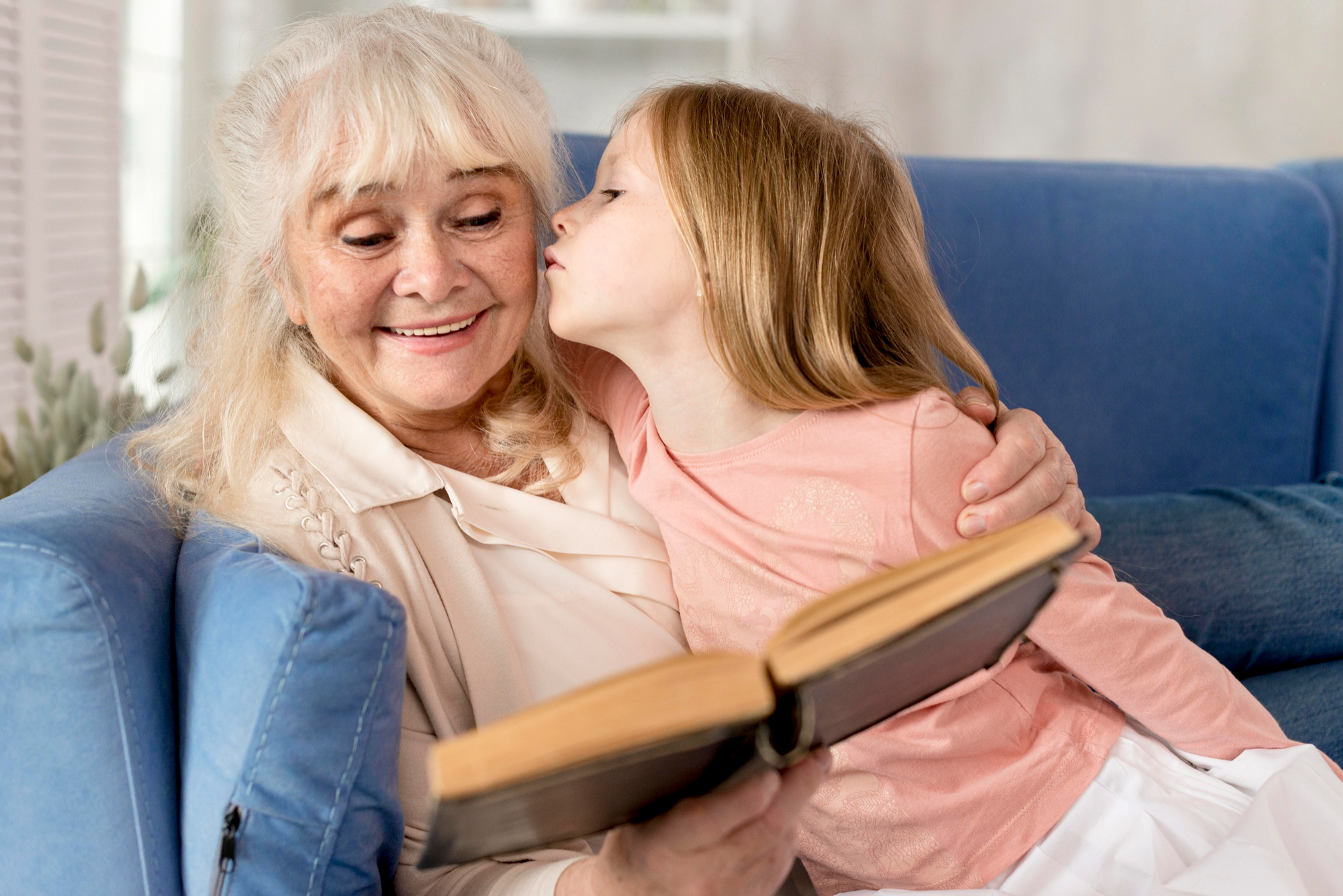
The Crescent Scar
I was cleaning out the attic with my granddaughter Ellie on a gray Saturday in November when she found the photo album beneath the boxes of Christmas decorations, and by the time that afternoon was over, everything I believed about my own life for forty-two years had come apart in my hands.
Let me tell it properly, because the ending doesn’t mean anything without the beginning, and the beginning is a love story.
My name is Laura. I’m sixty years old now, a grandmother, a widow, a retired schoolteacher who spent thirty years teaching other people’s children to read in the same town where I grew up. I have a good life, a full one, and I want you to understand that before I tell you the rest, because the rest is going to sound impossible, and I need you to know that I am not a fanciful woman. I am practical. I balance my checkbook. I do not believe in ghosts.
Or I didn’t, until Ellie found the album.
She was eight that November, my son’s daughter, a bright watchful child with a gap where she’d lost a front tooth and an endless curiosity about the world. We were up in the attic because I’d finally decided to sort through decades of accumulated boxes, and Ellie had come along to help, which mostly meant exploring, opening things, exclaiming over the artifacts of a past that to her was as distant and exotic as ancient Rome.
She found the album under the Christmas boxes. An old vinyl-covered photo album, the kind with the sticky pages and the plastic overlays that yellow with age. She hauled it into the light of the single bulb and opened it, and almost immediately she started laughing.
“Grandma, look at your hair!”
And there I was. Eighteen years old, in a pale blue prom dress, my bangs teased and sprayed into a formation that could have withstood a hurricane, because it was 1984 and that was simply what we did to our hair. I laughed too, looking at that girl, so young, so certain the future was going to unfold exactly as she’d planned it.
And beside me in the photograph stood David.
My first love. My high school sweetheart. The boy I’d been with since sophomore year, since I was fifteen and he was sixteen and he’d walked me home from a football game and neither of us had been able to stop grinning the whole way. David, with his kind eyes and his crooked smile and the way he had of making me feel like the most interesting person in any room. David, who worked evenings at his father’s hardware store and saved almost every dollar he made, because the two of us had a plan. We were going to go to the community college together after graduation. And then we were going to get married, and rent what David used to joke was going to be “the smallest apartment in America,” and we were going to build a life, an ordinary beautiful life, the two of us against the world.
We were so sure. That’s the thing about being eighteen and in love. You don’t doubt. You can’t imagine anything strong enough to break what you have, because what you have feels like the strongest thing in the universe.
Six weeks after that prom, David’s family’s house caught fire before dawn.
I’ve spent forty-two years not letting myself remember the details, so I’ll give them to you the way I’ve carried them, compressed and terrible. A fire, in the small hours, the whole house going up. David was pulled out alive but badly burned. He was taken to the hospital, to the burn unit two counties over, and for three days I lived in a suspended agony of hope, because alive was alive, because badly burned was not dead, because I was eighteen and I believed love could hold a person to the earth through anything.
And then, on the third day, David’s mother called me. I remember the phone ringing. I remember my own mother’s face as she handed me the receiver. And I remember David’s mother’s voice, thick with tears, telling me that he hadn’t made it. That the burns had been too severe. That David was gone.
I was eighteen years old, and the boy I was going to marry was dead, and the world simply ended.
For weeks afterward I barely ate. I barely spoke. My parents worried over me, hovered, tried to feed me and coax me back into the world. And David’s parents, in their grief, did something that at the time I understood as the natural response of a shattered family. They left town. Sold the burned-out property, packed up what they had, and moved away, somewhere out west, to start over somewhere the memories couldn’t reach them. There was no funeral I was invited to. His mother said, over the phone, that they were having something small and private, just family, out of state, that it was too painful to do it here. And then they were gone, and David was gone, and I had nothing left of him but a prom photograph and a hole in my chest the exact size and shape of the future we’d planned.
Eventually, because you do, because the young are resilient in ways that feel like betrayal, I forced myself to accept it. David was dead. My first love was gone. I had to keep living.
And I did. I went to college, though not the community college we’d planned, because I couldn’t bear the town anymore and went away instead. I met a good man named Robert a few years later, and I married him, and we had two children, and it was a happy marriage, a real one, thirty-four years until Robert passed three years ago. I loved my husband. I want to be clear about that. What David and I had was first love, young love, and what Robert and I built was the deep sustaining love of a whole shared life, and both were real, and I have no regrets about the life I lived.
But I never threw away that prom photograph. Through all the moves, all the decades, all the sortings and cullings of a long life’s possessions, I kept it. David’s crooked smile. My hurricane bangs. The two of us, eighteen and sixteen and certain. Some part of me could never let that go, could never quite close the door on the boy who was supposed to be my whole life and instead became a six-week wound that never fully healed.
So that was the photograph Ellie was laughing at in the attic. That was the boy standing next to teenaged me.
Ellie studied the picture for a few seconds after she stopped laughing at my hair. And then she did something that changed everything. She tapped David’s face with one small finger and said, matter-of-factly, “That’s him.”
I smiled, not understanding. “Who’s him, sweetheart?”
“The man at my school,” Ellie said. “The one who gives me extra desserts.”
My smile faded.
“What do you mean, the man at your school?”
Ellie explained, in the easy chattering way of an eight-year-old, that a new custodian had started working at her elementary school a few weeks earlier. He cleaned the cafeteria after lunch, and he was nice, and he had started saving her things, an unopened cookie here, a pudding cup there, extra desserts that would otherwise have been thrown away, slipping them to her with a wink. And lately, she said, he’d started asking her questions. About her family. About her grandmother.
“He asked if my grandma’s name was Laura,” Ellie said.
A chill went through me, cold and total. Because how would a custodian at my granddaughter’s school know to ask that? How would a stranger connect an eight-year-old girl to a sixty-year-old woman named Laura?
I told myself there was an explanation. A coincidence. A misunderstanding. Children get things confused. The man in the photo was fifty-eight years dead, or would have been fifty-eight, was forty-two years dead, a boy frozen forever at sixteen in a prom photo. It could not be him. That was not a thing that could be.
And then Ellie pointed at the photograph again, at David’s face, at a spot just above his left eyebrow.
“He has that little moon mark too,” she said. “The custodian. Right there. The little moon.”
The attic seemed to tilt around me.
Because David had a scar there. A small crescent-shaped scar, just above his left eyebrow, that he’d gotten when he was sixteen, falling off my brother’s bicycle on a summer afternoon, going too fast down the hill by the creek and wiping out on the gravel. A little crescent moon of a scar, so faint that most people never noticed it. I noticed it because I had spent years looking at that face from inches away. I knew that scar the way you know the details of a face you’ve loved. And there was no way, no possible way, that my eight-year-old granddaughter could know about a faint crescent scar on the face of a boy who had died twenty-four years before she was born, unless she had seen it. On a living face. Recently.
“Ellie,” I said, and my voice didn’t sound like my own. “Are you sure? About the moon mark?”
“Uh-huh,” she said, unbothered by the earthquake she was setting off inside me. “It’s the same. Grandma, are you okay? You look funny.”
Before I could answer, before I could even begin to form the impossible questions crowding into my throat, Ellie’s face brightened with sudden memory.
“Oh! I almost forgot,” she said. “He gave me something. For you. Yesterday. He said to give it to you.” She was already shrugging off her backpack, unzipping it. “He said you’d know exactly what it meant.”
My mouth had gone completely dry. My hands, I noticed distantly, were shaking.
Ellie reached into the front pocket of her backpack, rummaged for a second, and then pulled something out and placed it in my open palm.
The moment I saw it, my knees nearly buckled, and I had to put a hand out against the attic wall to keep from falling.
It was a ring. A small, cheap, silver-toned ring, a promise ring, the kind teenagers give each other when they can’t afford anything real. And I knew this ring. I knew it the way I knew my own name. Because I had given it to David. In the spring of 1984, six weeks before the fire, I had saved up my own money from babysitting and I had bought David this ring, this exact ring, with a tiny blue stone meant to match my prom dress, and I had given it to him and told him it was a promise, that someday I’d give him a real one, and he had worn it on a chain around his neck because it was too small for his fingers, and he had promised never to take it off.
He’d been wearing it, on that chain, the night of the fire. I had always assumed it burned with him. I had grieved that ring along with everything else, the small foolish token of a love that never got to grow up.
I had not seen this ring in forty-two years. And I was never, ever supposed to see it again, because the boy I’d given it to had died wearing it.
And now it was in my hand, placed there by my granddaughter, given to her by a custodian at her school who had a crescent scar above his left eyebrow and had asked whether her grandmother’s name was Laura.
There was a note attached to the ring, a small folded piece of paper tied to it with a thread. My hands were shaking so badly I could barely open it. Inside, in handwriting I did not recognize but that something in me responded to anyway, it read:
Call this number. The truth isn’t what it seems. You shouldn’t have trusted your family.
And below that, a phone number.
I don’t remember getting down from the attic. I remember Ellie’s worried face, and I remember the ring in my fist, and I remember sitting at my kitchen table with the note smoothed out in front of me and the phone in my trembling hand, and I remember dialing the number, because there was nothing else in the world I could possibly do, because I had to know, because the ground of my entire life had just opened up beneath me.
The phone rang. Twice. Three times.
And then a man answered. An older man’s voice, roughened by age, unfamiliar and yet, underneath, threaded with something that made my heart stop, some cadence, some warmth, some ghost of a voice I had loved when I was eighteen years old.
“Laura?” the voice said. “Is that you? Is this Laura?”
“Who is this,” I whispered. “Who are you. This isn’t possible. David died. David died forty-two years ago.”
There was a long silence on the line. And then the man said, gently, so gently, “No, Laura. I didn’t. I’ve been alive this whole time. And I have spent forty-two years believing that you were the one who didn’t want me anymore.”
I heard Ellie’s voice from somewhere far away, frightened, Grandma, Grandma, are you okay, and I realized I had slid halfway out of my chair, that the room was spinning, that I couldn’t breathe, and I heard my granddaughter, my brave eight-year-old granddaughter, pick up my cell phone and call for an ambulance, and then the world went gray and small and far away.
I hadn’t had a heart attack, the doctors told me later, though it had felt like one. I’d fainted, from shock, my blood pressure crashing, and I’d hit my head on the way down, and Ellie had done exactly the right thing calling for help. I spent a night in the hospital for observation. And it was there, in the hospital bed, over the next several days, that the truth came out, piece by impossible piece, and reassembled forty-two years of my life into a shape I could barely stand to look at.
David was alive. That was the first and largest fact, the one everything else hung from. David had survived the fire.
He had been badly burned, yes, terribly burned, and he had spent nearly a year in the hospital and years more in surgeries and recovery. But he had lived. The phone call from his mother, telling me he hadn’t made it, had been a lie.
It took days to piece together why, and even now some of it I only understand in outline. But here is the shape of it, the terrible shape of what was done to two eighteen-year-olds in love.
David’s family had never approved of me. I hadn’t fully understood that at the time, the way you don’t, when you’re young and inside your own love. But David’s parents, it turned out, had bigger plans for their son than the smallest apartment in America and a local girl whose family ran a modest farm. They’d had ambitions, connections, a whole future mapped out that didn’t include me. And when the fire happened, when David was lying burned and helpless in a hospital bed, dependent on them entirely, they saw an opportunity.
And, God forgive me for the part I never knew, my own family helped them.
That was what the note meant. You shouldn’t have trusted your family. Because it wasn’t only David’s parents. My own parents, it emerged, had never thought David was good enough either, or perhaps had simply thought we were too young, too serious, too likely to throw our futures away on each other. And when David’s parents came to my parents with a plan, in the confusion and grief of those terrible days, my parents had gone along with it.
The plan was cruelly simple. Tell each of us that the other was gone. Tell me David had died. And tell David, when he was well enough to understand anything, that I had moved on, that I couldn’t cope with his injuries, that I’d asked them to tell him goodbye. Let each of us grieve. Let each of us believe the love was over, one through death and one through abandonment. And then move David away, out west, to recover far from the town and the girl his family wanted him to forget.
They were sure we’d both move on. And in a terrible way, they were right. I grieved a dead boy. David grieved a girl who, he’d been told, hadn’t wanted him once he was scarred. And both of us, believing what we’d been told by the people we trusted most in the world, our own parents, eventually did move on, did build other lives, did marry other people, because what else can you do when the love of your life is taken from you and you’re told there’s no way back.
David had married, out west. Had children. Had a whole life, same as me. His wife had passed a few years ago, same as my Robert. And in his grief and his aging and his loneliness, David had started thinking about the past, the way you do. He’d started thinking about me, the girl he’d loved and lost, the girl who, he’d always believed, had abandoned him when he needed her most.
And then, a few years ago, his mother died. And in going through her things, David had found letters. My letters. Dozens of them, that I had written to him in the hospital in those first weeks, before his mother called me to say he was dead. Letters full of love, full of hope, full of I’ll wait for you and I don’t care about the burns and please get better so we can start our life. Letters his mother had intercepted and hidden and never given to him, so that David would believe I’d gone silent, gone cold, gone away.
David read those letters, forty years late, and he understood, all at once, that he had been lied to. That I had never abandoned him. That the whole architecture of his adult life had been built on a lie told by his own parents and, he would later learn, mine. That somewhere out there, an old woman named Laura had spent forty-two years believing he was dead, while he’d spent forty-two years believing she hadn’t wanted him.
So he came looking. At seventy-something years old, David sold his house out west and moved back to the town where we’d grown up, the town I’d never left for long, and he set about, quietly, carefully, trying to find out if I was still here, if I was still alive, if there was any way to reach me after all this time. He was afraid to simply appear on my doorstep, an old ghost, terrified of frightening me, terrified I might have a family who wouldn’t understand, terrified after so long of getting it wrong. So he’d taken a job as a school custodian, a quiet job, a watching job, and through some small-town thread he’d learned that my granddaughter attended that very school, and he had, gently, cautiously, begun to make contact through her. The extra desserts. The careful questions. And finally, when he was sure, the ring.
He’d kept the ring all those years. It hadn’t burned. He’d been wearing it on its chain the night of the fire, and it had survived, and it was the one thing he’d held onto through four decades, the small silver promise from a girl he thought had stopped loving him. And when he finally understood that she never had, he’d sent it back to her, through her granddaughter, with a note, as the only proof he had that would make her understand, instantly and beyond doubt, that he was real, that he was alive, that the truth was not what she’d been told.
You’d know exactly what it meant, he’d told Ellie. And I did. The moment I saw that ring, I knew.
I saw David three days later, when I was out of the hospital.
I want to tell you what it was like, but I’m not sure I have the words. To see, walking toward me across the parking lot of a coffee shop where we’d nervously agreed to meet, an old man, gray-haired, his face and hands marked with the old scars of burns four decades healed, walking with a slight stiffness, an old man I had never met.
And to look at his face, and find, above his left eyebrow, a faint crescent scar. And to look into his eyes, old man’s eyes now, and find, unmistakably, undeniably, the boy I had loved when I was eighteen years old. David. Alive. Standing in front of me in the flesh, forty-two years after I’d been told he was dead and grieved him and built a whole life around the hole he’d left.
We didn’t speak, at first. We just stood there, two old people in a parking lot, looking at each other across forty-two years, across all the life we’d each lived believing the other was lost, and then, without a word, we were holding onto each other, both of us weeping, the way you weep when something you buried alive comes back to you, when the dead turn out to have been living all along, when a grief you carried for a lifetime dissolves in a single impossible moment.
“They told me you were dead,” I said, into his shoulder. “Your mother called me. She told me you didn’t make it.”
“They told me you didn’t want me,” he said. “That you couldn’t handle the burns. That you’d asked them to say goodbye for you.” He pulled back and looked at me, his old face streaming. “I believed it, Laura. For forty-two years, I believed you’d left me. And you never did. You wrote me letters. I found them, in my mother’s things. You wrote me letters and she hid them from me. All that time, you were writing me letters.”
We sat in that coffee shop for six hours. We told each other everything. The lie, in all its dimensions. His parents’ ambitions, my parents’ complicity, the plan to separate us, the story told to each of us to make us give up. The lives we’d each gone on to live. Robert, and David’s wife, both good people, both loved, both gone now. Our children. Our grandchildren. Everything the lie had cost us and everything, despite the lie, we’d each managed to build.
I was angry. I want to be honest about that. I was angrier than I have ever been in my life, a deep, bone-deep rage at my own parents, both gone now, who had done this to me, who had stolen David from me and me from David and let both of us grieve a living love, who had sat across from me at holiday dinners for decades knowing what they’d done and never once told me. My mother had held my hand while I cried over David’s death. My mother, who had helped arrange the lie that he was dead. I don’t know if I’ve fully forgiven them. I’m not sure I ever will. Some betrayals are too large, and the fact that they believed they were doing it for my own good, protecting me from a hard life with a scarred boy and a small apartment, only makes it worse, because they took a choice that was mine to make and made it for me, and stole forty-two years to do it.
But sitting across from David in that coffee shop, the anger was not the largest thing. The largest thing was gratitude. Because against every odd, after everything, we had found each other again. We were old now, both of us in our sixties, most of our lives behind us. But we were both alive, and both free, our spouses passed, our children grown, and we had been given the one thing that almost never comes, a second chance at a love that was stolen, a door reopened forty-two years after it was slammed shut.
We are together now. I know how that sounds, two people in their sixties, talking about young love rekindled, and I don’t care how it sounds. David moved out of the sad little apartment he’d taken when he came back to town, and eventually, after a proper courtship that made our grandchildren roll their eyes and our friends cry, we married. At sixty and sixty-two, in a small ceremony, I married David, the boy I’d loved at fifteen, the man I’d grieved at eighteen, the ghost who turned out to be alive. We got, after everything, our smallest apartment in America, except it’s a comfortable little house, and we fill it with our combined grandchildren, and we are, in the strange late evening of our lives, building the future that was stolen from us at eighteen.
Ellie, my brave granddaughter, the one who found the album and recognized the crescent scar and carried the ring in her backpack and called the ambulance when I fainted, Ellie is the hero of the whole thing, and she knows it, and she is insufferably proud, and she should be. Without her, without a child’s clear eyes noticing a faint scar in an old photograph, David and I would have died as we’d lived, each believing a lie about the other, two old people in the same small town who never knew the truth. She reunited us. An eight-year-old, and a custodian’s extra desserts, and a fifty-cent promise ring that survived a fire.
I think about the lie constantly, and about what it teaches me, the meaning I’ve pulled from the wreckage of those stolen years.
We trust the people closest to us to tell us the truth, and mostly they do, but not always, and the lies told by the people who love us, told for our own good, told to protect us, are sometimes the most devastating of all, because we never think to question them. I never once, in forty-two years, doubted that David was dead. Why would I? My own mother told me. His mother told me. The people I trusted most in the world told me, and so it became the bedrock of my life, unquestioned, unquestionable. And it was a lie. The whole foundation of four decades was a lie, and I built a life on it, a good life, but a life shaped entirely by a wound that never needed to exist.
But here is the deeper thing, the thing that keeps me from drowning in the anger. Love, real love, does not die when you bury it. David and I were told the other was lost, and we grieved, and we moved on, and we loved other people truly. And yet the thing between us never actually died. It waited. It survived a fire and forty-two years and two other marriages and an ocean of lies, and the moment the truth was spoken, it came back whole, undiminished, as strong at sixty as it had been at eighteen. You cannot kill that kind of love with a lie, even a lie that lasts a lifetime. You can only delay it. You can only steal its years. But the thing itself, if it’s real, waits, patient as a seed, for the truth to finally let it grow.
I lost forty-two years with David. I’ll never get them back, and the people who took them are beyond my reach now, dead and unaccountable. But I have the years I have left. And I intend to spend every one of them with the boy I loved when I was young, the man I grieved and buried and found again, the ghost who turned out to be alive, saving extra desserts for a little girl who had his lover’s eyes.
The prom photo hangs in our house now, framed, on the wall. Eighteen-year-old me with my hurricane hair, and sixteen-year-old David with his crooked smile and his faint crescent scar. Ellie points at it sometimes and says, that’s Grandpa David, when he was little, and she’s right.
We got there in the end. Forty-two years late, but we got there.
And I keep the ring, the little silver promise ring, on a chain around my own neck now, the way David wore it all those years. The promise I made at eighteen, that someday I’d give him a real one. I kept it, finally. Late, but I kept it.
Some promises wait a lifetime. But the true ones, the real ones, they wait.

Specialty: Quiet Comebacks & Personal Justice
David Reynolds focuses on stories where underestimated individuals regain control of their lives. His writing centers on measured decisions rather than dramatic outbursts — emphasizing preparation, patience, and the long game. His characters don’t shout; they act.