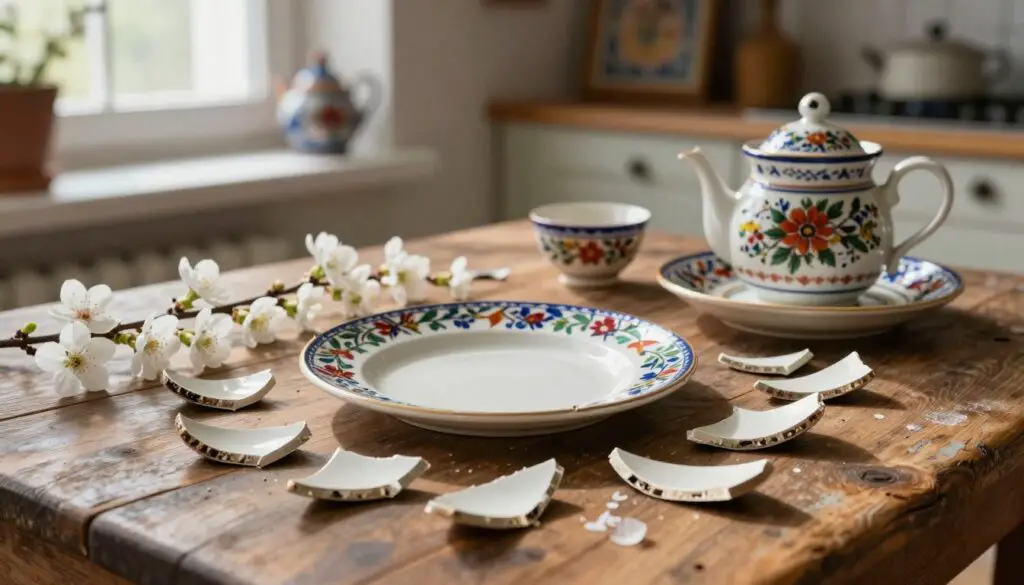
The plate missed my face by maybe six inches. It hit the white oak cabinet behind me at 7:18 on a Sunday evening, shattered into four large pieces and a spray of smaller porcelain chips, and sent a streak of tomato sauce running down the cabinet door I had installed eleven months earlier, back when this kitchen still felt entirely like a fresh beginning rather than the site of a family reckoning.
My sister Lauren stood on the other side of my kitchen island with both hands clenched into fists.
“You’re an egoist,” she screamed.
My mother didn’t even look at the broken plate. She looked at me, then at my house, then at the keys sitting beside my phone on the counter, then at the guest room hallway that Lauren had apparently already decided belonged to her.
Then my mother said, with an extraordinary, almost surgical calm, “Don’t call me your mom anymore.”
My father stared down at his napkin, refusing to lift his eyes.
Lauren’s eight-year-old son, Noah, started crying, and I smiled. Not because anything about the moment was funny, but because I had just fully understood, in one clean, cold instant, that the arrangement I had spent five years quietly protecting was finally, irreversibly over.
I picked up my phone, stepped carefully around the largest piece of broken porcelain, and called my lawyer. His name was Nathan Cole.
He answered on the third ring.
“Aubrey. Talk to me.”
“Remember the contingency documents?”
There was a short silence on his end, the particular silence of a man reaching for a specific file in his memory.
“Yes. Get them ready.”
That night, at 10:43 p.m., Nathan texted me: Everything is set. Your parents owe you $240,000 in back rent. Activate the plan?
I looked at the message for almost a full minute, sitting alone at my kitchen table with the lights dimmed, listening to the refrigerator hum in the silence of my own house.
Then I typed one word. Send.
Two hours later, I had ninety-four missed calls.
My name is Aubrey Bennett. I’m thirty-six years old. I live just outside Charlotte, North Carolina, and I’m an executive chef and co-owner of a restaurant called Alder and Ash.
I’ve spent seventeen years working in professional kitchens. That matters, because it shapes everything about how I think.
People who have never worked in restaurants tend to assume being a chef is mostly about food — knives, open flames, beautifully plated dishes, dramatic shouting during a busy dinner service. Food, honestly, is maybe forty percent of it. The rest is systems. Inventory. Timing. Labor scheduling. Waste management. Vendor relationships. Contracts. Knowing exactly how much product you have on hand, exactly what it costs down to the penny, exactly who touched it last, and exactly what happens the moment someone decides the rules are optional for them specifically.
A well-run kitchen can survive one honest mistake. It cannot survive a culture where mistakes carry no real consequences, where the same person keeps making the same error because nothing meaningful ever pushes back against it.
I learned that lesson professionally, in walk-in coolers and during hundred-and-twenty-cover dinner rushes, long before I ever learned it about my own family. But I’m getting ahead of myself.
The night Lauren threw the plate was supposed to be a simple Sunday dinner. I had made braised short ribs, parmesan polenta, roasted carrots finished with brown butter, and a bitter greens salad, because my father likes to pretend he dislikes salads and then quietly eats half the bowl himself once there’s enough lemon in the dressing to disguise how much he’s enjoying it.
I remember stupid, small details from that evening with unsettling clarity. The Dutch oven was still warm on the back burner. There were six wine glasses set out on the table, though only four adults were actually drinking. My mother had brought a grocery store cheesecake, even though I had told her three separate times over the preceding week that dessert was already handled. Lauren’s son, Noah, had left one sneaker in my mudroom and was wearing only the other one while he played some game on his tablet, cross-legged on my living room floor.
Everything looked completely, deceptively normal. That normalcy was the camouflage.
Lauren had called me three days earlier.
“I need a favor,” she’d said, and I already knew, from long experience, that when Lauren said favor, she meant something closer to restructuring someone else’s entire life to accommodate hers.
Her lease was ending. She had been living in a two-bedroom apartment in Matthews with Noah for almost three years. She worked inconsistently as a freelance social media consultant, which meant she had months where she brought in eight hundred dollars total and reacted to both the good months and the bad ones by spending approximately the same amount regardless. Her landlord had raised the rent from seventeen hundred and eighty dollars to twenty-six hundred. Lauren had decided, somewhere in the middle of processing that increase, that this constituted a form of financial abuse against her personally.
Her solution was my house.
I had a four-bedroom house. I was single. I worked long, demanding hours. Therefore, according to Lauren’s particular mathematics, I possessed unused bedrooms that had somehow, through no action of my own, become family inventory available for redistribution.
“I’m not asking forever,” she’d said on that call.
“How long, then?”
“Six months. Maybe a year.”
“That’s not temporary, Lauren.”
“No.”
She laughed at that — not because I had made a joke, but because she genuinely believed my flat “no” was simply the opening position in a negotiation she still had room to win.
“You haven’t even thought about it.”
“I have. For thirty seconds. And for thirty-six years.”
She went quiet for a moment. That should have been the end of the conversation.
Instead, she said, “Mom thinks it makes sense.”
And there it was — the family escalation ladder, activated exactly on schedule. Lauren asks. I say no. Mom converts the request into a moral obligation, something I now owed as a matter of basic decency. Dad stays quiet until his silence itself becomes a kind of agreement, a passive vote cast against me by simply refusing to speak. Then everyone, collectively, explains to me why my boundary is really just proof of some underlying defect in my character.
I told Lauren plainly, “You cannot move into my house.”
She hung up on me.
Sunday dinner, it turned out, was apparently the appeal hearing for a case I hadn’t agreed to reopen. I didn’t know that when they arrived. I should have.
Lauren brought three plastic storage bins in the back of her SUV. I saw them through the dining room window while I was setting the table, though at the time I genuinely, foolishly assumed she’d brought things over for my mother — old clothes for a donation drive, maybe, or dishes from some cabinet cleanout. I actually stood at the stove, spooning sauce over the short ribs, watching my father help her close the tailgate, and I thought nothing of it at all. That’s how long I kept extending them innocent explanations, even after years of evidence suggesting I shouldn’t.
Dinner lasted thirty-two minutes before Lauren finally brought it up directly.
She set her fork down with a small, deliberate click against the plate. “So, I talked to the apartment office.”
I kept eating.
“They won’t extend month-to-month.”
“Okay.”
“So I’ll need to be out by the thirty-first.”
“Okay.”
She stared at me, waiting for something more. My mother sighed audibly across the table.
“Aubrey, don’t do that,” Mom said.
I looked up. “Do what?”
“That cold thing.”
“What cold thing, exactly?”
“Pretending you don’t understand what’s happening here.”
I set my own fork down carefully. “I understand perfectly.”
Lauren leaned back in her chair, arms crossing. “Noah and I can take the two rooms upstairs. I already measured my sectional. It’ll fit in the bonus room, easily.”
I looked at her. “You measured?”
She hesitated for just a fraction of a second. “Mom gave me the dimensions.”
I turned to my mother. She didn’t look embarrassed at all, which was, in its own way, deeply important information. She looked impatient instead, as though I were the one being unreasonable by even asking.
“I still had them from when you bought the place,” she said.
“No. You didn’t.”
My mother blinked, caught slightly off guard by my certainty. I knew exactly where those measurements had actually come from — the builder’s folder I kept in my home office, an office I had found slightly disturbed, papers shifted just enough to notice, after my parents had visited two weeks earlier. At the time, I’d assumed my cleaning service had simply moved something while dusting.
“Why does that even matter?” my mother asked.
“It matters because you went through my office.”
“Oh, please.”
Lauren gave an exaggerated, theatrical sigh. “This is exactly what I mean. You make absolutely everything into a federal case.”
“You are not moving in,” I said, quiet and final.
Noah looked up briefly from his chicken, sensing the shift in tone even at eight years old.
Lauren’s face changed then. It wasn’t hurt, exactly. It was disbelief — the particular, specific disbelief that pure entitlement produces when reality suddenly fails to cooperate with its assumptions.
“You have four bedrooms,” she said.
“Yes.”
“You use one.”
“I use all four.”
“For what, exactly?”
“One is mine. One is my office. One is a guest room. One is storage and recipe development.”
Lauren laughed, sharp and derisive. “Recipe development. Jesus Christ, Aubrey.”
I felt something cool settle into my chest. Not anger, exactly. Recognition. I’ve had line cooks do this exact thing — you explain a standard clearly, and they mock the standard rather than admit its legitimacy, because admitting it would require them to actually change their own behavior.
My mother reached across the table toward me. “Aubrey, your sister has a child.”
“I know that.”
“She needs stability.”
“I agree completely.”
“Then give her some.”
I looked directly at Lauren. “What’s the plan after a year?”
“Why do you always need a plan for everything?”
“Because eventually, a year ends.”
“I’ll figure it out by then.”
“Then figure it out before you move, not after.”
My father finally spoke, his voice quiet. “You could help her, Aubrey.”
I looked at him. “I have helped.”
He dropped his eyes back to the table. Lauren caught the particular emphasis in my voice immediately.
“What’s that supposed to mean?”
I should explain, here, exactly what it meant.
Five years before that particular dinner, my parents had very nearly lost their house. Not metaphorically. Not simply “money was tight” in the vague way families sometimes describe minor financial stress. Actual foreclosure, with an actual notice of sale already issued.
The house where Lauren and I grew up was a four-bedroom brick colonial in Huntersville. My parents had bought it in 1998 for two hundred and fourteen thousand dollars. By 2021, they owed two hundred and eighty-seven thousand dollars on it. Yes — more than they had originally paid for the entire property, more than two decades earlier. There had been a refinance, then another refinance, then a home equity line of credit, then a second mortgage my father had described to me, at the time, as “temporary financing,” a phrase I now understand functions in our family roughly the same way “I’ll pay you back next week” functions for a gambling addict.
You need to understand my parents to fully understand any of this. My father, Dennis Bennett, had been a sales manager for a commercial flooring company for the better part of two decades, and he made genuinely good money throughout most of that time. My mother, Patricia, worked part-time as a dental office administrator, steady but modest income. They were never poor, not even close. They were simply, fundamentally incapable of allowing their lifestyle to shrink whenever their income did.
My father was laid off at fifty-eight. Instead of meaningfully cutting expenses, he spent roughly eighteen months quietly pretending the next equivalent job was just around the corner, always one more interview away. My mother, throughout that entire stretch, kept hosting a full Christmas dinner for thirty extended family members every single year. They kept their country club membership active. They helped Lauren buy a car she genuinely couldn’t otherwise afford. They renovated the primary bathroom, tearing out perfectly serviceable fixtures for something more current. They took a seven-day anniversary trip to Aruba, specifically because, as my mother explained it to me afterward, “it had already been planned months in advance, and canceling would have been such a waste.”
Money left the household steadily, month after month. Pride, notably, stayed exactly where it was.
By the time my father finally called me, they were four months behind on the mortgage and had already received a formal notice of sale in the mail. He called at 6:12 on a Tuesday morning. I remember the exact time because I was standing inside the walk-in refrigerator at Alder and Ash, counting cases of sea bass for that evening’s delivery reconciliation. Chefs remember precisely where they were when family emergencies land, because emergencies have an uncanny, almost deliberate habit of arriving exactly during inventory.
“Aubrey,” he said, his voice tight in a way I’d rarely heard from him before, “we have a problem.”
I stepped out of the cooler, letting the heavy door swing shut behind me. “How much?”
He paused, thrown by the directness. “What?”
“How much is the problem, Dad.”
That was simply how my brain had been trained to work by that point in my career. Not why, not whose fault it was. How much.
It took three full days to get the actual truth out of them, and even then, it didn’t come from my parents directly — it came from the documents themselves, once I finally got my hands on the paperwork. My parents had initially told me they needed nineteen thousand dollars to fix everything. The actual figure required to cure the mortgage arrears, clear the outstanding property taxes, satisfy the HELOC, and formally stop the foreclosure proceedings entirely was sixty-three thousand, four hundred and twelve dollars.
I could have simply given them the money outright. I didn’t. That single decision, I’ve come to believe, probably saved all three of us in the long run.
I called Nathan Cole. Nathan was forty-eight at the time, a real estate attorney with prematurely silver hair, a permanently loosened tie regardless of the hour, and the patient, unhurried expression of a man who had personally watched hundreds of families slowly turn money into mythology. He had handled the lease negotiations for Alder and Ash when my business partner, Matteo, and I opened our second location the year before.
I brought him every single document I could find. Nathan read through all of it for roughly forty minutes without saying a word, his expression giving nothing away.
Then he finally looked up. “Do not simply loan them sixty-three thousand dollars, Aubrey. They’ll lose the house anyway, just on a slightly longer timeline. If you hand them that check today, you’re not solving anything. You’re just delaying the exact same outcome by a year or two.”
I genuinely hated him for about ten seconds. Then I understood, with real clarity, that he was completely right.
“So what do I do instead?”
“Buy it.”
I actually laughed out loud at that. He didn’t laugh back.
The house, as it turned out, had enough remaining market value to make the entire structure genuinely workable as a transaction. On Nathan’s advice, I formed a company called Bennett Residential Holdings LLC. We negotiated directly with my parents’ lender. I paid off the arrears in full. I satisfied the second mortgage entirely. I assumed and then refinanced the remaining debt through the LLC, at terms considerably more favorable than what my parents had been drowning under.
My parents formally sold the property to my company for the outstanding obligations plus closing costs. The entire transaction was not, in any sense, secret or hidden from them. They signed every single page themselves. Nathan insisted, as a matter of professional ethics, that they retain their own separate attorney, because he flatly refused to represent both sides of the deal. They initialed the purchase agreement, the deed transfer, the new lease, the occupancy rider, and the deferred rent addendum.
That last document — the deferred rent addendum — became, five years later, the single most important piece of paper in my entire family’s history.
Here is how it actually worked, in plain terms. Fair market rent for that specific property, at that specific time, was roughly thirty-six hundred dollars a month. We set the contractual rent at an even four thousand dollars, because I was personally covering property taxes, homeowner’s insurance, all major structural repairs, and ongoing capital expenses on top of the mortgage itself. My parents, obviously, could not actually afford four thousand dollars a month, not on their reduced income.
So, under the addendum’s specific language, that monthly payment was deferred. Not forgiven — deferred, a legally meaningful distinction Nathan made certain everyone in that room fully understood before anyone signed anything. Each month, four thousand dollars accrued on a formal rent ledger that Nathan’s office maintained. I would not demand payment on that accruing balance as long as both my parents continued complying with the occupancy terms of the agreement, and as long as I continued voluntarily extending the deferral on a rolling basis.
Nathan insisted, over my parents’ mild objection at the time, on including language that explicitly allowed me to terminate the deferral entirely with written notice. Once terminated, the full accrued balance would become due, subject to whatever payment schedule the law required and whatever settlement terms we subsequently negotiated together.
My parents understood every part of this. I want to be precise about that point, because it matters enormously to everything that came afterward. My mother asked, sitting right there at the closing table, “So technically, we’ll owe Aubrey rent?”
Their attorney, a sharp, no-nonsense woman named Sheila Morrison, answered plainly: “Yes.”
My father asked the follow-up question immediately. “Will she ever actually collect it?”
Sheila looked over at me, deferring the answer to the one person who could actually give it.
I said, honestly, “Not unless something changes.”
That was the entire deal, laid out clearly and signed by everyone involved. Five years. Sixty months. Four thousand dollars a month. A total potential balance of two hundred and forty thousand dollars.
During those five years, my parents paid me exactly zero dollars in actual rent. I, meanwhile, paid eighteen thousand seven hundred dollars for a new HVAC system when the old one finally died in July. I paid seven thousand nine hundred and forty dollars for roof repairs after a bad storm tore through several shingles. I paid three thousand two hundred and eighty dollars when the water heater failed without warning on a Christmas Eve. I paid two thousand one hundred and sixty dollars for emergency tree removal after a storm dropped a massive oak limb dangerously close to the house. I paid eleven thousand four hundred dollars in property taxes in the most recent year alone.
I did not complain about any of it, not once, not even privately to close friends. I did not send reminders about the accruing balance. I did not tape the ledger to the refrigerator as some kind of passive-aggressive reminder. I let my parents live, entirely undisturbed, in the house they emotionally still considered fully theirs, because they were my parents, and because love, when you happen to be the competent child in a family, very often disguises itself simply as quiet, ongoing administration.
My family adapted to this arrangement quickly. Too quickly, in hindsight.
Within a single year, the story they told each other, and eventually themselves, had already started shifting. They stopped saying, even casually, that Aubrey saved the house. They started saying, instead, that Aubrey helped refinance, a phrase that subtly, deliberately understated the entire scope of what had actually happened. Two years in, my mother told an aunt at Thanksgiving dinner, well within my hearing, that I had “put my name on some paperwork” to help them out. By year four, Lauren had apparently come to genuinely believe, in some functional sense, that our parents still fully owned the house outright.
I know this for certain because she once said, casually, over some unrelated family dinner, “At least Mom and Dad didn’t need you to buy them a house.”
I looked directly at my mother in that exact moment. She changed the subject within seconds, smoothly, without any visible discomfort at all.
That, I eventually came to understand, was the actual architecture of my family. My competence became invisible the precise moment they benefited from it. And Lauren, notably, had always benefited from it, in one form or another, for most of her adult life.
When she was twenty-three and short on tuition money, I gave her eighty-six hundred dollars, no strings attached. When she was twenty-six and separating from Noah’s father, I paid the security deposit on her new apartment. When she needed daycare coverage during an awkward job transition, I covered six full months of it. When her car’s transmission failed catastrophically, I covered forty-three hundred and eighty dollars in repairs without a second thought.
She called each one of these, individually, a lifesaver. She never once, in all those years, called any of them a pattern.
Meanwhile, the house I actually lived in had taken me twelve years to earn — not inherit, earn, dollar by dollar, shift by exhausting shift. I started in professional kitchens at nineteen years old, peeling fifty-pound bags of onions until my fingers smelled faintly of sulfur even after three separate showers, a smell that seemed to seep permanently into my skin during those early years. I worked my way up through pantry, then prep, then grill, then sauté, then sous chef, then chef de cuisine, and finally executive chef. I spent Christmas after Christmas cooking elaborate holiday meals for other families while my own sat empty back home. I burned the inside of my right forearm badly enough during a hotel banquet at twenty-four that the scar still looks, to this day, like a pale river running just beneath my skin. I once worked sixty-eight consecutive days without a single day off during a restaurant opening, running almost entirely on adrenaline and bad coffee.
At thirty-two, Matteo Ruiz and I bought into Alder and Ash together, when the original owner finally decided to retire. At thirty-five, I bought my house — four bedrooms, three and a half bathrooms, a genuinely huge kitchen built around a six-burner gas range I’d specifically negotiated into the closing, a butler’s pantry, and a fenced backyard with rosemary already established along the back wall from some previous owner’s garden.
The first night I slept there, I didn’t even own a sofa yet. I sat on the bare kitchen floor eating takeout noodles straight from the carton and looked around at the empty rooms stretching out around me. I remember thinking, with a kind of quiet, private satisfaction I hadn’t expected to feel so strongly: this is mine. Not because ownership itself makes a person more valuable than anyone else. Because boundaries do. For the first time in my entire adult life, I had a physical place that nobody in my family could simply access by reminding me that we shared the same DNA.
So when Lauren announced, over my carefully braised short ribs, that she had already measured my rooms for her furniture, I wasn’t actually hearing a straightforward housing request. I was hearing, very clearly, the sound of a door being deliberately, forcefully pushed open.
I said it again, flat and unmistakable. “No.”
Lauren’s eyes filled — not with tears, exactly, but with something closer to pure anger. “You don’t even have kids,” she said.
There are certain sentences every family keeps in reserve, sharpened and ready, understood by everyone involved to function as weapons. That was one of hers, deployed with practiced precision.
I had wanted children once, genuinely and seriously. I had also spent my twenties and early thirties building an entire career while dating a string of men who liked the idea of dating a chef right up until they discovered that dinner service happens on Friday nights, that Mother’s Day is one of the single worst, most grueling shifts of the entire year, that holidays generally meant longer hours rather than family time. At thirty-four, I’d ended a serious relationship with a man who told me, in almost those exact words, that my career had become inconvenient to his own plans.
Lauren knew all of this history intimately.
“You have all this space,” she continued, gesturing around my kitchen with one hand. “And it’s just you, rattling around in it.”
My mother added, quietly, “She has a point, Aubrey.”
I stared at her. “No. She doesn’t.”
“She’s your sister.”
“That doesn’t make my house hers.”
Lauren pushed back sharply from the table. “You are unbelievable.”
“No. I’m simply saying no.”
“You always make everything about money, and property, and paperwork.”
I almost laughed out loud at that particular accusation. People who benefit quietly from paperwork, I’ve noticed, tend to hate paperwork intensely the moment it stops working in their favor.
My mother’s face tightened. “You’ve changed, Aubrey.”
“I bought a house.”
“No. Success changed you.”
I looked slowly around my own kitchen — the copper pans hanging in a neat row, the knives arranged along the magnetic strip, the framed menu from my very first night as an executive chef, the small ceramic salt cellar Matteo had given me after our first genuinely profitable quarter together. Nothing in that room had come easily. Nothing in it had been handed to me.
“I think,” I said slowly, “success made it harder for all of you to keep pretending my things automatically belong to everyone.”
Lauren grabbed her plate off the table. I saw it happen a fraction of a second before she actually threw it. Chefs develop a strange, almost involuntary awareness of hands — where knives are at any given moment, where hot pans are, what someone nearby is reaching for. Her fingers curled tight under the rim. Her elbow drew back sharply.
I had just enough time to turn my head.
The plate left her hand. It struck the cabinet behind me. Crack. Noah screamed from the living room. Sauce ran down the freshly painted wood in a thin red streak. One piece skidded all the way under the refrigerator. Another landed on the floor beside my shoe, close enough that I felt a small chip of porcelain nick against my ankle.
Lauren stood there breathing hard, her chest heaving. “You’re an egoist.”
My mother stood up from the table. For one brief second, I genuinely thought she was about to tell Lauren to leave, to apologize, to acknowledge what had just happened in my kitchen.
Instead, she pointed directly at me. “At least she cares about family,” she said, meaning Lauren.
I looked down at the broken plate scattered across my floor, then back up at my mother. “If you truly believe that,” I said evenly, “you should take her in yourself.”
My mother’s mouth opened. Lauren stopped moving entirely. It was, in its own terrible way, almost funny.
Almost. My parents, after all, lived in a four-bedroom house — my four-bedroom house, legally speaking — with two currently unused bedrooms sitting empty. One had become my mother’s sewing room. The other had quietly transformed, over the preceding year, into my father’s television den.
Lauren said, defensive now, “Mom and Dad need their space.”
There it was, laid bare. Their space mattered, was worth protecting, was untouchable. Mine was simply inventory, available for redistribution whenever the family collectively decided it was needed elsewhere.
“Exactly,” I said.
My mother went pale. “You would choose a house over your own sister?”
“No. I’m choosing the right to decide who lives in a house that is legally, entirely mine.”
“After everything we did for you.”
That particular sentence nearly, genuinely impressed me with its audacity. I looked over at my father. His eyes stayed fixed on the table, unmoving.
My mother pressed on. “You think because you make money now, you’re somehow better than the rest of us?”
“I never said that.”
“You don’t have to say it.”
“Patricia,” my father murmured, barely audible.
She snapped at him instantly. “Stay out of this.”
Then she turned back to me and said the words that changed the entire trajectory of everything that followed.
“Don’t call me your mom anymore.”
The room wasn’t quiet after that. It was ringing, the particular high, pressurized silence that follows something irreversible being said out loud. Noah sniffled somewhere behind me. The refrigerator compressor kicked on with its familiar low hum. A single drop of short rib sauce hit the floor with an audible, oddly loud plink.
I remember the exact moment I stopped trying to preserve the family’s preferred version of events. It wasn’t when Lauren threw the plate. It wasn’t even, technically, when my mother formally disowned me over a housing dispute. It was a moment later, when my father finally lifted his eyes and looked at me with an expression I recognized instantly and completely — the expression that asked me, without a single word, to fix it again. He wanted me to absorb the plate, the insult, the threat, the housing problem, his wife’s cruelty, Lauren’s instability, all of it at once, the way I always had before. Because Aubrey could handle things. Aubrey always handled things.
I smiled at him. Small, controlled, entirely unlike my usual expression in family arguments.
My mother saw it and grew visibly uncertain for the first time all evening. “What?”
“Nothing,” I said.
I picked up my phone. Lauren scoffed loudly. “Oh my god. Are you calling the police on your own family?”
“No.”
I called Nathan. When he answered, I asked him, calmly, to prepare the contingency documents. My father’s face changed immediately, visibly, the moment he heard those specific words.
“What documents, Aubrey?”
I ended the call without answering him directly.
He knew. I could see it settle over his face — he knew exactly what those documents were, had known for five years that they existed as a possibility, and had simply never allowed himself to believe I would actually use them.
My mother looked between the two of us, sensing something she didn’t fully understand yet. “Dennis?”
He rubbed both hands slowly over his face. “Aubrey,” he said, my name carrying an entire unspoken plea inside it.
I walked over to the utility drawer and pulled out a roll of blue painter’s tape. Lauren stared at me, genuinely confused now. “What are you doing?”
“Marking the sharp pieces, so Noah doesn’t step on any of them barefoot later.”
That, somehow, made her angrier than almost anything else that had happened all evening. “You’re psychotic.”
“No. I work with broken glass and porcelain professionally, every single day. This is just muscle memory.”
I placed a small square of tape on the floor beside each visible shard of the broken plate, methodical and unhurried, while three adults and one crying child watched me do it. Then I told them, plainly, that dinner was over.
Lauren grabbed Noah and her purse and headed for the door without another word. My mother followed a moment later. My father stayed behind for maybe fifteen more seconds.
“Aubrey,” he said quietly, “don’t do anything stupid.”
I looked at him. “I never do.”
That, I think, was exactly what scared him the most.
By eight o’clock that evening, I had fully cleaned the kitchen myself. I threw away the ruined short ribs and polenta. I photographed the cabinet damage carefully, from multiple angles, for the file I already knew Nathan would eventually need. I saved the security footage from my kitchen camera — yes, I had a camera installed, though not because I ever anticipated family violence. I traveled occasionally for work, and I’d wanted a clear view of the main entrance while I was away.
The plate throw had been captured perfectly, start to finish, timestamped and unambiguous.
At 8:34, Nathan called. “You’re sure about this?”
“Yes.”
“You understand this fundamentally changes the relationship.”
“The relationship changed at 7:18 tonight, Nathan. I’m just responding to it now.”
He exhaled slowly on the other end of the line. “Fair enough.”
Nathan had kept the rent ledger meticulously current for years, because I paid his office an annual retainer specifically to review the property file at least once a year, whether or not anything active was happening. Sixty months. Two hundred and forty thousand dollars, exactly. He had actually already prepared most of what we needed three years earlier, back when my mother had let Lauren store furniture in my garage without asking my permission first, and then, when confronted about it, told me that “ownership is really just a technicality between family.” Nathan had advised me, even then, to quietly prepare a full contingency file, just in case something eventually escalated.
A chef would call that mise en place. Everything in its designated place, fully prepped, before the actual heat of service begins.
The plan itself was never some magical button designed to instantly throw my parents out onto the street. That would have been illegal, genuinely cruel, and frankly stupid from a legal standpoint. The plan was documentation, structured consequences, and a clear, deliberate off-ramp built in for anyone willing to take it.
First: formal, written termination of the voluntary rent deferral arrangement. Second: a formal demand for a full accounting and payment of the accrued two hundred and forty thousand dollars. Third: written notice that any future occupancy of the property would require actual, market-rate monthly rent under an entirely new agreement, should we choose to negotiate one at all. Fourth: revocation of any standing permission for additional occupants beyond my parents themselves, explicitly including Lauren and Noah. Fifth: transfer of day-to-day property management to an independent management company, so that my parents would no longer need to deal with me personally for routine matters. Sixth: if they refused every proposed set of new terms outright, lawful termination of tenancy proceedings and eventual sale of the property.
Nathan had also, quietly and without my initially requesting it, prepared an alternative settlement option, because the truth was, I never actually wanted two hundred and forty thousand dollars from my own parents. I wanted separation, clean and legally enforceable. If they vacated voluntarily within ninety days, kept the property in reasonably good condition, and signed a mutual release of claims, I was fully prepared to forgive a substantial portion of the accrued balance outright.
They didn’t know that particular option existed yet. Consequences, I’d learned from years of managing difficult kitchen staff, work considerably better when people are first shown the real, full number, before any softer alternative is ever offered.
At 10:43, Nathan’s message finally arrived. Everything is set. Your parents owe you $240,000 in back rent. Activate the plan?
My thumb hovered over the screen for a long moment. I thought about my mother’s exact words: Don’t call me your mom anymore. I thought about Lauren, standing in my kitchen with a tape measure, planning furniture placement in rooms she’d never once asked to see. I thought about my father, telling me not to do anything stupid, as though protecting myself had somehow become the reckless option in this particular story.
Then I typed a single word. Send.
Nathan’s office used electronic service where legally permitted, overnight certified delivery for everything else, and formal notices routed through the property management portal we had established years earlier, back when the original lease was first drawn up.
At 10:51, the notices officially went out. At 10:56, my father called. I didn’t answer. At 10:58, my mother called. At 11:01, my father again. At 11:02, Lauren. At 11:04, my mother once more.
Then the family group chat exploded, message after message stacking rapidly on my lock screen. What did you do? Aubrey, call me right now. You cannot evict your own parents. This is completely insane.
Lauren alone sent seventeen separate messages in nine minutes. At 11:19, she finally wrote something I actually stopped and read carefully: You planned this?
I stared at that particular message for a while before answering. Then I typed back: Yes. Not the dinner, not the plate, not the cruelty. But the paperwork itself — absolutely, yes, I planned for that possibility years ago.
I had planned, quietly and patiently, for the very real possibility that people who treat sustained generosity as though it were simple weakness would, eventually, inevitably push too far.
At midnight, I finally put my phone on do not disturb and tried to sleep. At 12:47 a.m., curiosity got the better of me anyway. Ninety-four missed calls by then, the vast majority from my parents and Lauren, a few from my Aunt Denise, three from my cousin Mark, and one — genuinely, almost impressively — from Lauren’s ex-husband Caleb.
I turned the phone face down on my nightstand and went to sleep.
At 5:10 the next morning, my alarm went off exactly on schedule. I had a fish delivery arriving at six. Life, I’ve found, is deeply, almost comically rude that way. Your entire family can implode overnight in dramatic, irreversible fashion, and forty pounds of halibut still need their internal temperature checked the very next morning regardless.
I was at Alder and Ash by 5:52. Matteo took one look at my face and said simply, “Family?”
I nodded. Restaurant people understand that particular answer instinctively, without requiring further explanation.
At 6:13, while I was inspecting a delivery of fresh scallops, my father walked in through the back kitchen door. He had never once, in the entire history of our relationship, entered my kitchen during active morning prep before. He was wearing the same khaki pants from the previous night’s dinner and a blue jacket zipped up wrong at the very bottom, the zipper pull sitting crooked.
“Aubrey.”
My sous chef, Jenna, glanced over at me questioningly. “Office,” I said to her, and she nodded, understanding.
My father followed me into the small back office. He placed the formal notice down on my desk. His hands were visibly shaking.
“Two hundred and forty thousand dollars?”
“Yes.”
“We don’t have that kind of money.”
“I know.”
“You told us, years ago, that you’d never actually collect it.”
“No. I said something changed.”
His jaw tightened. “Your mother was upset last night.”
“Lauren threw a plate at my head, Dad.”
“She wasn’t actually trying to hit you.”
“Dad.”
He stopped talking. I opened my laptop, where the security footage was already saved and cued up. I played it for him without further comment. Lauren’s arm drawing back. The plate leaving her hand. The plate striking the cabinet exactly six inches from my face.
My father watched the entire thing in silence. His shoulders dropped visibly by the end of it. I paused the video.
“I’m not here to debate whether that actually happened,” I said quietly.
He looked, suddenly, considerably older than he had the night before. Not fragile, exactly — just tired, worn down in a way I hadn’t fully registered until that exact moment.
“What do you actually want, Aubrey?”
That was the first genuinely useful question anyone in my family had asked me in five full years.
“I want the arrangement to end,” I said.
“What arrangement, specifically?”
“The one where I carry all the financial responsibility, and everyone else retains all the moral authority over my life.”
He stared at me for a long moment. I continued.
“You and Mom have lived in a house I personally own for five years without paying a single dollar of rent. I have maintained it, insured it, paid every property tax bill on it. And last night, Mom told me I wasn’t her daughter anymore, purely because I wouldn’t let Lauren take over part of another property I also own outright.”
“She didn’t mean it, Aubrey.”
“She said it out loud, in front of everyone.”
“People say things when they’re angry that they don’t fully mean.”
“Then people,” I said evenly, “should live with what they choose to say.”
My father sat down slowly in the chair across from my desk. “What happens now?”
“Nathan will speak directly with your attorney.”
“I don’t want attorneys involved in this.”
“I do.”
His face tightened further. “We’re family, Aubrey.”
I looked at him steadily. “Mom already clarified that particular point for all of us last night.”
He closed his eyes at that. It genuinely hurt him — I could see it land, could see something in his posture crumple slightly. I know it did. I loved my father. That’s the complicating detail people generally prefer to leave out of stories like this one, because it’s so much cleaner to imagine that setting a boundary means you’ve simply stopped loving someone.
I wasn’t dealing with strangers in that office. I wasn’t remotely thrilled about any of this. But love without any real boundaries had gradually, steadily turned me into family infrastructure over the years. And infrastructure, by its very nature, doesn’t get thanked for functioning correctly. It only gets noticed, suddenly and loudly, the moment it stops working the way everyone had quietly come to expect.
My father left the restaurant at 6:41. At 7:03, my mother called the restaurant’s main line directly. At 7:11, Lauren called the restaurant. At 7:16, someone claiming to be an ordinary customer asked Jenna, at the host stand, whether Chef Aubrey was really making her own elderly parents homeless.
That was the exact moment I stopped taking any family-related calls entirely, full stop. Nathan sent formal cease and desist letters specifically regarding any further contact directed at my workplace. Lauren posted something deliberately vague online about narcissistic relatives who weaponize money against their own families. She deleted it about four hours later, apparently after her ex-husband Caleb reminded her, somewhat pointedly, that family court judges are perfectly capable of reading public social media posts.
Two days after that, my parents formally retained Sheila Morrison again as their attorney. I was genuinely relieved to hear it. She was competent, thorough, and entirely unsentimental about the actual facts. Competent people, in my experience, tend to shorten disasters rather than prolong them.
The first joint meeting happened the following Thursday, in Nathan’s office. My mother wouldn’t look directly at me the entire time. Lauren wasn’t invited to attend, by mutual agreement between the attorneys. My father looked like he genuinely hadn’t slept properly in days.
Sheila placed the original lease on the conference table between us. My mother said, quietly, “I didn’t know this could actually happen.”
Sheila answered before Nathan even had the chance to. “Patricia, I explained the deferred rent provision to you personally, in detail, the day you signed it.”
My mother looked genuinely betrayed by that. “You were our attorney.”
“I still am,” Sheila said evenly. “Which is exactly why I’m telling you, plainly, that pretending this document doesn’t say what it clearly says will not help your position in any way.”
I found myself liking Sheila considerably.
My mother turned to look at me directly, for the first time since the previous Sunday. “So you want our house.”
Nathan spoke up. “It is Aubrey’s house. Legally and entirely.”
“It’s our home.”
I said, “Those are two different statements, and you know it.”
She looked at me then, really looked at me, for what felt like the first time in years. “You would actually make your father and me leave our own home.”
“I will not continue financing a situation where you’ve come to believe that financing you somehow grants you rights over the rest of my life.”
“That is not what this is about.”
“It is exactly what this is about.”
She began crying then, quietly. Real tears, not theatrical ones. That made the whole exchange considerably harder to sit through. I remember looking at the box of tissues sitting between us on the conference table and feeling, from pure old muscle memory, the powerful urge to fix it immediately — to say forget the rent, forget the plate, forget everything that sentence meant, let’s just go home and pretend none of this happened.
That particular instinct, over the years, had cost me an enormous amount. So this time, deliberately, I simply let the silence exist between us instead of rushing to fill it.
Eventually, Sheila asked Nathan directly about settlement options. He slid a two-page proposal across the table.
My parents, the document explained, could choose between two distinct paths forward. Path one: remain in the house under an entirely new lease, at twenty-eight hundred and fifty dollars a month, notably below current market rate, with the full two hundred and forty thousand dollars converted into a formal, unsecured repayment obligation, capped at five hundred dollars monthly, subject to periodic review and partial forgiveness after five consecutive years of full compliance. Path two: vacate the property voluntarily within ninety days, leave it in mutually agreed-upon condition, and I would forgive two hundred and ten thousand of the accrued balance outright, leaving a considerably more manageable thirty-thousand-dollar settlement payable over five years.
My father read both options carefully, twice through. Then he asked, “Why forgive that much money?”
“Because I never actually wanted your money in the first place,” I told him honestly.
My mother laughed, sharp and bitter. “You just want control, then.”
“No,” I said, looking directly at her. “I want you to genuinely understand that my help, all these years, was real. That it cost something real.”
She stopped laughing abruptly at that.
Here is what actually mattered, underneath all of it. For years, my family had needed my ongoing support to remain functionally invisible, because openly acknowledging its full scope would have fundamentally changed the internal hierarchy everyone had quietly agreed to maintain. I was supposed to remain the difficult daughter. Lauren was supposed to remain the vulnerable, sympathetic one. My mother held the authority. My father played the reasonable, neutral mediator. You simply cannot preserve those particular roles once it becomes undeniable that the so-called difficult daughter actually owns the roof over everyone’s head.
So the roof, over time, had quietly become emotionally theirs again, in the family’s collective retelling. The actual financial records simply disappeared from the shared family narrative until the exact moment I forcibly brought them back into the room.
My parents ultimately chose to move. Not immediately, and not without considerable resistance first. There were tense phone calls routed entirely through the attorneys. There were two full weeks where my mother insisted, repeatedly, that she intended to fight the entire matter in court. Sheila apparently explained to her, in careful, specific detail, exactly how expensive that fight would actually be, and exactly how unlikely she was to win given the clarity of the original signed documents.
By the end of the third week, they finally signed the settlement agreement. They found a two-bedroom townhouse eleven minutes from the original house. Rent there: twenty-two hundred and forty dollars a month. My mother had to give up her sewing room entirely. My father sold roughly half the furniture he’d accumulated over three decades in the larger house. They canceled their country club membership, a decision my mother apparently found more painful than almost anything else in the whole ordeal.
They also discovered something people, in my experience, often only discover once someone else finally stops quietly subsidizing their choices. Their actual life was entirely affordable. Just not the specific, elevated version of it they had insisted, for years, on maintaining regardless of cost.
Lauren, notably, did not move into my house. She also, somewhat surprisingly, did not end up moving in with my parents either. That particular detail turned out to be genuinely interesting. Once their new townhouse suddenly had real, limited space of its own, my mother’s earlier certainty that siblings should simply make sacrifices for one another became considerably more flexible in practice.
Lauren ended up renting a smaller apartment on her own, forty minutes farther from Noah’s school than her previous place. For roughly six weeks, she blamed me openly for essentially everything — the longer commute, the new security deposit, the moving company’s fees, the fact that her new kitchen had laminate countertops instead of the granite she’d grown used to. Then Caleb, her ex-husband, formally petitioned to adjust their existing custody schedule, since her move had directly affected Noah’s school transportation logistics.
Reality, it turned out, arrived at Lauren’s door from several directions at once, in fairly rapid succession. She started taking on considerably more freelance client work, not because she’d undergone some sudden personal transformation, but because genuine consequences, for the first time in a long while, had created real deadlines she couldn’t simply push off onto someone else.
I understand deadlines. I’ve built an entire career around them.
Three months after the plate incident, Lauren sent me an actual email — not a text message, a full email, with a subject line that simply read: Apology. It ran seven paragraphs long. The first three paragraphs were mostly excuses — stress, fear, the ongoing pressure of single parenting, general housing insecurity. The fourth paragraph finally landed on something closer to the truth: I threw something at you because you told me no. That was wrong. I’ve read that sentence back three times now, and it still doesn’t feel like enough, but it’s true.
She continued: I think I genuinely believed your life was simply easier than mine because you had more than I did. I never once really thought about how you actually got it. I also never really thought about how much you’d already been quietly doing for Mom and Dad this whole time, because they never once told me the full truth of it.
That particular part made me genuinely angry, though not specifically at Lauren. At all of us, collectively, as a family unit. Secrets, I understood clearly by that point, had directly helped build the entitlement in the first place. My own generosity had stayed quiet for years because I never once wanted leverage over anyone. My parents’ dependence had stayed equally quiet, for their part, because they never wanted to sit with the shame of it. The eventual result was an entire family fantasy in which nobody technically owed anyone anything, and therefore, by that same convenient logic, everyone felt free to demand anything at all from anyone else.
I wrote back two days later, keeping it brief and deliberate: Thank you for apologizing. I’m not ready to have you in my home. That particular boundary remains in place. I genuinely hope things improve for you and Noah going forward.
That was the entire message. No extended lecture, no dramatic, sweeping forgiveness. Just information, plainly stated.
My mother took considerably longer to reach out. Five full months passed. For those five months, all communication between us went strictly through my father or through the respective attorneys. Then, one ordinary Monday afternoon, she showed up in person at Alder and Ash, sometime around 3:20, in the quiet window between lunch and dinner service.
She sat down alone at the bar. I was in the kitchen at the time, carefully portioning duck breasts for that evening’s menu, when Jenna came back to find me. “There’s a woman out front asking for you.”
I already knew. I washed my hands, changed into a clean apron, and walked out to the bar.
My mother looked smaller somehow than I remembered her. She had cut her hair considerably shorter than usual. There was a small paper bag sitting on the stool beside her.
“I brought something,” she said.
I didn’t sit down right away. “What is it?”
She reached into the bag and carefully pulled out an object. A plate. White ceramic, with a thin blue line traced around the outer edge. The exact same pattern as the one Lauren had thrown at my head five months earlier.
“I found one online that matched,” she said quietly.
I stared at it for a long moment without speaking. My mother touched the rim gently with one finger.
“I know this isn’t really about a plate,” she said.
“No. It isn’t.”
“I know that.”
For a while, neither of us said anything further. The ordinary sounds of the restaurant moved around us in the background — the ice machine cycling, the dishwasher running its cycle in the back, someone in the kitchen steadily chopping parsley.
Finally, she said, “I shouldn’t have said what I said that night.”
I waited, letting her continue at her own pace.
She swallowed hard. “I was angry because you wouldn’t solve the problem the exact way I wanted you to solve it.”
That answer was closer to something genuine, at least.
“And I think,” she continued, more quietly now, “I was also embarrassed.”
“About what, specifically?”
“The house.”
I looked at her directly. She stared down at the bar top instead of meeting my eyes.
“I told people your father and I had simply worked everything out ourselves,” she admitted.
“You didn’t, though.”
“No.”
“You told Lauren you still fully owned it, all these years.”
“Yes.”
“Why would you do that?”
Her eyes filled with fresh tears. “Because I was ashamed, Aubrey.”
There are certain moments when being objectively right stops feeling especially good. This was one of them. My mother, in that moment, wasn’t some cartoonish villain. She was a sixty-three-year-old woman sitting alone at an empty restaurant bar, finally admitting out loud that pride, held onto for long enough, eventually becomes genuinely, materially expensive.
“I could have handled hearing the truth,” I told her.
“I know that now.”
“You made me into the family secret instead.”
“I know.”
I finally sat down beside her. She pushed the replacement plate gently across the bar toward me.
“I don’t expect things to simply go back to how they were,” she said.
“They won’t.”
She nodded slowly, accepting that. “That’s probably fair, honestly.”
I touched the edge of the plate with one finger. Then she said, almost in a whisper, barely audible over the sound of the ice machine.
“Can I still be your mother?”
I looked at her for a long moment. I could have punished her further, right there. There was certainly a version of me — maybe the version some people would find more satisfying to read about — who would have simply repeated her own sentence back to her, word for word, letting her sit with exactly what she’d handed me five months earlier. Don’t call me your daughter anymore.
I didn’t do that. Revenge, I’ve come to understand, is genuinely satisfying primarily in theory, because theory conveniently ends at the exact moment someone loses. Real life, inconveniently, always continues on into the next Tuesday regardless.
“I’m not going to pretend that dinner never happened,” I told her.
“I’m not asking you to pretend that.”
“And you don’t get to make decisions about my house.”
“I know.”
“Or about my money.”
“I know.”
“Or use Lauren as a way to pressure me into anything, ever again.”
She nodded, accepting each condition in turn. I let the silence settle between us for a while longer.
Then I finally said, “You’re still my mother.”
She cried quietly at that, her shoulders shaking slightly. I got her a napkin from the stack four feet away — not because everything between us was suddenly, magically fixed, but simply because she was crying, and there happened to be napkins close enough to reach without either of us having to make it into a larger moment than it needed to be.
That, I think, is the actual difference I had finally, fully learned. Compassion is not the same thing as surrender.
Six months after the plate incident, my parents were fully settled into their townhouse. They made the first six installments of five hundred dollars each on the remaining thirty-thousand-dollar balance, right on schedule every single month. Then, after talking things over with Nathan and carefully reviewing my own finances, I decided, unprompted, to reduce their remaining balance by an additional fifteen thousand dollars.
I didn’t tell them beforehand. I simply sent the amended statement directly to their address.
My father called me the same afternoon it arrived. “Is this some kind of mistake?”
“No.”
“Why would you do this?”
“Because you’ve honored the agreement fully, every single month.”
He was quiet for a long moment on the line. Then he said something he had never once said to me, not once, during the entire five years I’d carried the full weight of that house on my own.
“Thank you.”
Two simple words. That, somehow, turned out to be entirely enough.
Lauren and I eventually had coffee together, in a public place, deliberately not at my house. She apologized again, this time without wrapping it in any surrounding excuses. She had recently started working full-time with a small regional real estate company, managing their social media accounts under an actual steady salary with real benefits attached. Noah, she told me, was doing considerably better overall.
At the end of our coffee, she asked, quietly, “Do you hate me?”
“No.”
She looked genuinely surprised by that answer. “I hated what you did that night,” I clarified. “That’s different from hating you.”
“Yes,” she agreed slowly. “It is.”
Then she said, almost to herself, “I really thought you had everything figured out. That your whole life was easy.”
I smiled at that. “I have bills with nicer countertops than most people’s, Lauren. That’s really the whole difference.”
She laughed, genuinely, for the first time in months. So did I. It was, I realized, the first time we had actually laughed together since the plate shattered against my cabinet.
She still, to this day, has never once been back inside my house. Maybe someday she will be. Maybe not. I’ve stopped using access to my home as some kind of ongoing test of love or loyalty. That, more than almost anything else, has been the largest change in me.
A full year after everything happened, I finally replaced the damaged cabinet door. I could have done it immediately, in the days right after — the contractor had offered, more than once, to swap it out on short notice. I kept the damaged panel instead. For twelve full months, there was a small, barely visible dent in the oak exactly where the plate had struck, noticeable only when the evening light came through the kitchen windows at precisely the right angle. People who visited generally assumed I simply hadn’t gotten around to fixing it yet.
That wasn’t true at all. I’m a chef. I get around to things, without exception, every single day.
I kept it deliberately, because I wanted to remember, clearly and without softening it over time, the exact difference between generosity and permission.
Then, one Sunday afternoon, almost precisely a year to the day after that original dinner, I finally unscrewed the damaged panel myself. My father held the new replacement door steady while I carefully aligned the hinges. My mother stood at the island nearby, slicing lemons for that evening’s dinner. Lauren wasn’t there that particular day. That detail mattered too, in its own quiet way. We were rebuilding one specific relationship at a time now, deliberately, rather than simply pretending that family membership alone automatically meant everyone had unrestricted access to everyone else, all at once, forever.
My father tightened the final screw. I stepped back to look at it properly. The new cabinet door matched perfectly. No dent remained anywhere. No sauce stain. No visible mark where a plate had once shattered inches from my face.
My mother noticed me studying it. “You okay?”
I thought, in that quiet moment, about the ninety-four missed calls. About the two-hundred-and-forty-thousand-dollar ledger. About Nathan’s original text message, still saved somewhere in my phone. About the exact expression on Lauren’s face when I’d said no for the last time. About my mother’s sentence that had briefly, terribly, ended our relationship entirely. About the townhouse, the apology, the replacement plate now sitting quietly in my pantry among all the others I’d accumulated over the years.
“Yes,” I said, and I genuinely meant it.
Because the strangest thing about real boundaries, I’ve come to understand, is that most people mistake them for walls. They aren’t walls at all. Walls exist purely to keep everyone out, indiscriminately, permanently. Boundaries create doors instead. Doors you’re free to open, whenever you genuinely choose to. Doors you’re equally free to close, whenever you need to. Doors that, crucially, belong entirely to you, and to no one else.
I spent most of my adult life being the one person my family could always, unconditionally count on. And for years, I genuinely believed that meant remaining available without any real limit at all — money, time, physical space, solutions to every problem, forgiveness on demand, whatever anyone needed from me at any given moment.
Professional kitchens eventually cured me of that particular belief, slowly and thoroughly, over years of hard experience. Every single ingredient in a working kitchen has its designated place. Every station carries its own specific responsibility. Every person, without exception, has real limits. And when something finally, inevitably crosses the line, you don’t stand there screaming uselessly at an open flame.
You shut off the gas at the source.
That particular Sunday night, when my sister threw a plate directly at my head and my mother told me, in front of everyone, never to call her my mother again, they both believed, in that moment, they were forcing me to choose cleanly between family loyalty and pure selfishness.
They were wrong about that. I was actually choosing, in that exact instant, between love and simple surrender. Those two things, I’ve come to understand with real clarity, have never once been the same.
I still love them. All of them, genuinely, even now. I simply no longer finance the ongoing privilege of being disrespected by the people I love most.
And sometimes, late at night, alone in my kitchen after a long, demanding dinner service, I take that replacement plate down from its shelf in the pantry. I turn it over slowly in my hands. A completely ordinary white plate, with one thin blue line traced around the edge, probably worth no more than twelve dollars at any retail store.
It reminds me, every time, of the one that shattered against my cabinet that Sunday evening.
But more importantly, far more importantly, it reminds me of the one that finally, deliberately, did not.

Lila Hart is a dedicated Digital Archivist and Research Specialist with a keen eye for preserving and curating meaningful content. At TheArchivists, she specializes in organizing and managing digital archives, ensuring that valuable stories and historical moments are accessible for generations to come.
Lila earned her degree in History and Archival Studies from the University of Edinburgh, where she cultivated her passion for documenting the past and preserving cultural heritage. Her expertise lies in combining traditional archival techniques with modern digital tools, allowing her to create comprehensive and engaging collections that resonate with audiences worldwide.
At TheArchivists, Lila is known for her meticulous attention to detail and her ability to uncover hidden gems within extensive archives. Her work is praised for its depth, authenticity, and contribution to the preservation of knowledge in the digital age.
Driven by a commitment to preserving stories that matter, Lila is passionate about exploring the intersection of history and technology. Her goal is to ensure that every piece of content she handles reflects the richness of human experiences and remains a source of inspiration for years to come.