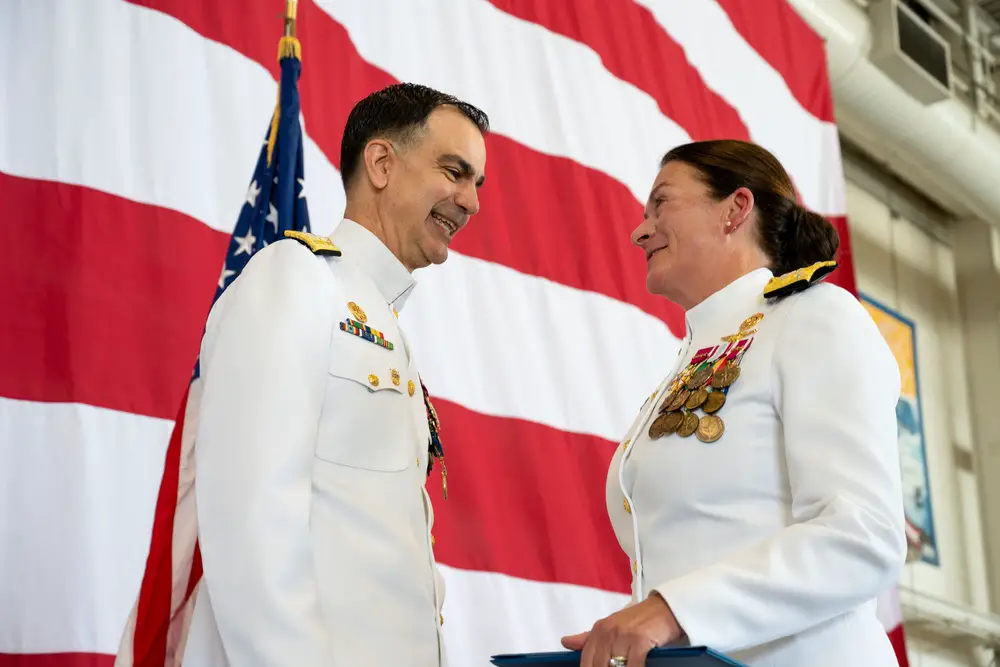
Luke received his Navy SEAL trident beneath a ceiling draped with American flags while I stood quietly beside the auditorium’s rear exit. I wore a simple gray blazer, dark trousers, and shoes chosen specifically because they made almost no sound against polished military floors. Nobody announced my arrival, which suited me perfectly, because I had spent most of my adult life becoming extremely comfortable with being unnoticed.
The auditorium smelled of floor wax, polished brass, expensive cologne, and the nervous excitement of families witnessing careers they had sacrificed years supporting. Camera flashes jumped across the crowded rows as new SEALs stood beneath brilliant lights, their uniforms immaculate and their expressions carefully controlled.
My parents occupied seats near the front, exactly where Luke had arranged for them, surrounded by officers, spouses, relatives, and several family friends. My father, Edward Mercer, had deliberately chosen the aisle seat, although retirement had done absolutely nothing to soften his commanding posture. His silver hair remained clipped close, and an old captain’s pin sat above his pocket like a warning against questioning anything he said. My mother, Marianne, sat beside him wearing cream, pearls, and the expression of someone attending the greatest accomplishment in her family’s history.
Neither had looked backward since the ceremony began, so neither knew their oldest daughter had entered the building twenty minutes earlier. That was not unusual, because for twelve years my family had perfected the strange art of pretending I barely existed.
To them, I remained Claire Mercer, the promising Naval Academy midshipman who suddenly disappeared during her third year without offering an acceptable explanation. They called me the weak daughter, the quitter, the embarrassment, and sometimes, when relatives asked uncomfortable questions, simply “the one who left.”
Luke preferred a harsher word, especially when he had an audience large enough to reward him with sympathetic laughter. “Claire couldn’t handle the pressure,” he would say, shaking his head like someone mourning a predictable failure. If someone asked why I left, Luke usually smiled before delivering the answer he had repeated for years. “She dropped out because Navy life was harder than she expected.”
My father never corrected him. Neither did my mother. Eventually, silence became their endorsement, and Luke’s version became family history.
Now Luke stood beneath those bright ceremony lights in spotless white, broad-shouldered, confident, and looking exactly like the son Dad always wanted. When his name was announced, my father rose so quickly that the woman sitting beside him instinctively moved her purse.
“That’s my boy,” Dad announced proudly, loud enough for several nearby rows to hear.
Luke approached the stage wearing an expression I remembered from childhood, whenever he knew everyone in the room was watching only him. A decorated instructor placed the trident upon his uniform, stepped back, and offered a formal handshake. Applause thundered through the auditorium. Mom covered her mouth. Dad’s eyes glistened.
I clapped too. Despite everything between us, Luke had completed something brutally difficult, and I refused to pretend otherwise simply because he had treated me cruelly.
Then the secure phone hidden inside my blazer vibrated once against my ribs, followed immediately by two shorter pulses. Priority traffic. My hand slipped discreetly inside my jacket while applause continued rolling across the room. The screen recognized my thumb. Four lines appeared.
PACKAGE RECOVERED. ALL PERSONNEL ACCOUNTED FOR. PHASE THREE AUTHORIZED. RETURN WINDOW CONFIRMED.
I stared at the message slightly longer than necessary. Twenty-seven hours earlier, six people had been trapped beyond a collapsing extraction corridor somewhere outside official American involvement. Local forces were closing rapidly, communications had failed, and every conventional escape option had already been compromised. Three departments had rejected the final approach because weather conditions, surveillance exposure, and terrain made successful extraction statistically unlikely. I had disagreed. The alternative route had been mine. So had the timing. The six people rescued that morning were alive because a plan nobody inside that auditorium would ever hear about had worked.
I deleted the message, locked the phone, and looked toward Luke again.
My family believed I processed insurance claims inside a government office somewhere outside Arlington. Mother occasionally mailed me information about federal clerical examinations, convinced even my imaginary administrative career required improvement. Once, Dad sent me a listing for a civilian logistics position and wrote, “Something stable might finally suit you.” I thanked him. Arguing would have required explanations I had spent twelve years being legally forbidden to provide. Luke had made the silence easier for everyone by filling it with his own assumptions.
He spotted me eventually. His eyes traveled casually over the audience until they reached the rear of the auditorium. Then they stopped. For half a second, genuine surprise cracked his ceremonial confidence. Afterward came the familiar smirk.
Three weeks before the ceremony, Luke had called me late one evening while I was preparing for an overseas departure.
“I heard you’re coming,” he said.
“That was the invitation.”
“Mom invited you.”
“Yes.”
A pause followed. Then Luke sighed. “This isn’t one of your office mixers, Claire.”
I looked across my temporary apartment at three classified folders spread over the dining table. “I understand.”
“Try not to look like you don’t belong.”
That almost made me laugh. “I’ll do my best.”
“And please don’t start talking about Annapolis.”
“I wasn’t planning to.”
“Good, because today isn’t supposed to become another conversation about your old failures.”
I remembered staring at the encrypted map glowing on my computer while Luke said those words. “No problem,” I answered.
Now his smirk across the auditorium carried the same message. Stay invisible. I intended to.
Unfortunately, Luke was still looking at me when the senior officer standing near him followed his line of sight.
Major General Thomas Rourke had spent most of the ceremony wearing the controlled expression expected from someone carrying several decades of command responsibility. The moment he saw me, that expression vanished. His eyebrows lifted. His posture changed. Then he said something nobody expected.
“Oh wow,” Rourke called across the auditorium. “You actually came?”
The applause died unevenly. One section stopped first, then another, until strange silence swallowed the room. A woman holding her phone halfway above her shoulder slowly lowered it. Two officers near the aisle stopped whispering.
My mother turned. My father remained half-standing beside his chair, staring from General Rourke toward the back exit. Luke’s expression changed fastest. His confident smile disappeared. His mouth opened. For the first time that afternoon, nobody was looking at his trident. They were looking at me.
Luke turned sharply toward Rourke. “Sir, you know my sister?”
Rourke glanced at him. “Your sister?” The confusion in his voice landed harder than any dramatic announcement could have.
Luke pointed toward me. “Claire Mercer, sir.”
Rourke looked back at me slowly. Then he gave a short laugh. “That explains more than you realize.”
Dad finally sat down. Mom whispered something I couldn’t hear. Rourke stepped away from Luke and walked directly toward the rear rows. Every head followed him. I considered escaping through the door behind me. Unfortunately, leaving would have looked far stranger than staying.
Rourke stopped several feet away. “Mercer,” he said.
“General.”
“You disappeared again.”
“I had work.”
“I noticed.”
Several nearby officers exchanged looks. Luke left his place near the stage and moved closer.
“Sir, I’m confused.”
Rourke studied him. “That makes two of us.”
Luke attempted a nervous laugh. “My sister left the Academy years ago.”
“Yes,” Rourke answered.
Luke waited. Rourke did not continue. Finally Luke said, “She works civilian insurance now.”
The general stared at him for nearly three seconds. Then he looked at me. “You told them insurance?”
“I didn’t tell them anything.”
That answer made several officers suddenly interested in the floor.
My father approached next, followed closely by my mother. Dad extended his hand toward Rourke. “General, Edward Mercer. Retired captain.”
“I know who you are.”
Dad seemed pleased by that. “This is my daughter Claire.”
“I’m aware.”
Mom forced a polite smile. “You’ve met her professionally?”
Rourke looked at me again. I gave him a warning glance. He noticed. Unfortunately, Luke noticed too.
“What does that mean?” Luke asked.
“Nothing relevant to your ceremony,” I said.
Luke folded his arms. “You’re doing that thing again.”
“What thing?”
“Acting mysterious instead of answering a simple question.”
Dad nodded. “Claire, if you know the general, simply explain how.”
“I can’t.”
Luke laughed loudly. “There it is.”
Several families nearby pretended not to listen. Nobody was convincing.
Luke shook his head. “She always does this, sir. Whenever somebody asks about those missing Academy years, suddenly everything becomes secret.”
Rourke’s face hardened slightly. “Missing years?”
Luke looked surprised. “You don’t know?”
“Know what?”
“She quit Annapolis.”
The general stared at him. “She did not quit.”
The room became silent again. Dad’s face tightened. “General, with respect, she withdrew during her third year.”
Rourke nodded slowly. “Yes.”
Luke spread both hands. “That means she quit.”
“No,” Rourke replied. “It means you were never told why she withdrew.”
Dad’s jaw shifted. “Neither were we.”
“That should have told you something.”
Mother clutched her handkerchief tighter. “Are you saying the Navy ordered Claire to leave?”
Rourke hesitated. I spoke quickly. “General.”
He looked at me. “No operational details.”
“I know the rules.”
Luke laughed again, although this time there was no confidence behind it. “Operational details? Claire was twenty-one.”
Rourke turned toward him. “How old do you believe people are when difficult organizations begin noticing unusual abilities?”
Luke did not answer. Rourke continued. “Your sister wasn’t failing when she left Annapolis.”
Dad’s face lost color. “What exactly are you saying?”
Rourke chose his words carefully. “I’m saying her departure was connected to an opportunity unavailable through ordinary commissioning channels.”
Mother blinked several times. “That makes absolutely no sense.”
“It wasn’t supposed to.”
Luke glanced toward me. “You expect me to believe she walked away from the Academy because somebody recruited her?”
I finally answered. “Yes.”
Luke stared. Dad spoke quietly. “Recruited you for what?”
“I still cannot answer that.”
“For twelve years?” he demanded.
“For as long as required.”
Dad stepped back as though those words had physically struck him. Mother looked between us. “You let us believe you failed.”
“I let you believe what I was permitted to let you believe.”
“That’s not the same thing.”
“No.”
Luke shook his head violently. “This is ridiculous.”
Rourke’s expression sharpened. “Careful.”
Luke straightened immediately. “Yes, sir.”
The general lowered his voice. “Your accomplishment today deserves respect. Don’t damage it by speaking arrogantly about service you don’t understand.”
Luke swallowed. Rourke turned toward me. “I heard about last night.”
My stomach tightened. “General.”
“Relax. I’m not discussing details.”
Luke noticed my reaction. “What happened last night?”
“Nothing you need to know.”
“Was she actually deployed?”
Rourke smiled without humor. “I didn’t say that.”
Luke stared at me differently now. His confusion had become calculation. Dad looked even worse. “How often have you been overseas?”
“Dad.”
“How often?”
“I can’t answer.”
Mother covered her mouth. “You told me you were attending a compliance conference in Baltimore last Christmas.”
“I was working.”
“In Baltimore?”
I hesitated. Mother’s eyes widened. “Oh my God.”
Luke stepped closer. “So all those business trips—”
“Were business trips.”
“What business?”
“The kind I cannot discuss.”
He looked toward Rourke. “Sir, what rank is she?”
I almost smiled. Rourke actually did. “That question assumes a structure that may not apply.”
Luke’s jaw tightened. “I’m a SEAL now. Surely I have clearance.”
Several officers nearby visibly winced. Rourke’s voice became cold. “Never confuse possessing a clearance with possessing a need to know.”
Luke’s shoulders stiffened. “Yes, sir.”
Then another officer entered through the rear doorway behind me. Commander Alexis Grant stopped upon seeing the gathering. “Mercer, there you are.”
Luke closed his eyes briefly. I almost felt sorry for him.
Grant approached and handed me a sealed envelope. “Transportation changed. Wheels up at twenty-three hundred.”
My father stared at the envelope. “You’re leaving tonight?”
“Yes.”
Mom whispered, “Where?”
I looked at her. “You already know the answer.”
She nodded slowly. “You can’t tell me.”
“No.”
Grant glanced toward Luke’s trident. “Congratulations.”
“Thank you, ma’am.”
Luke seemed desperate to regain control. “Commander, how do you know my sister?”
Grant looked surprised. “Your sister?” The exact same confusion Rourke had shown appeared again. Luke’s embarrassment deepened. Apparently, nobody who worked with me knew I had a brother.
Grant recovered quickly. “We’ve crossed paths.”
Rourke coughed into his hand, hiding what suspiciously resembled amusement. Luke looked between them. “How many people here know her?”
Nobody answered. That was the answer.
Dad slowly removed his old captain’s pin from his jacket. He rolled it between his fingers before looking at me. “I spent years ashamed of you.”
“I know.”
“I told people you lacked discipline.”
“I know.”
“I told Luke not to follow your example.”
Luke looked away.
My father’s voice weakened. “And you never corrected me.”
“I couldn’t.”
Dad shook his head. “No. You could have told me enough.”
“Would you have believed me?”
He looked at me. Neither of us needed to answer. Throughout childhood, Dad believed achievement should be visible, documented, ranked, awarded, and displayed beneath official lighting. My silence had looked like failure because he had never imagined important service could require disappearing completely.
Mom stepped forward first. “Claire, I’m sorry.” Her voice broke.
I had imagined hearing those words for years. Strangely, they brought no triumph.
“Mom, today belongs to Luke.”
Luke looked at me sharply. “You’re still saying that?”
“Yes.”
“After everything I said about you?”
“Yes.”
His face tightened. “Why?”
“Because becoming a SEAL is difficult, and your behavior toward me doesn’t erase what you accomplished.”
Luke looked almost offended by the answer. “You should be furious.”
“I was.”
“Was?”
“I stopped needing you to understand me.”
That hurt him more visibly than anger would have.
Around us, families slowly resumed conversations. The ceremony organizers began directing guests toward a reception hall beside the auditorium. Rourke stepped closer before leaving. “For what it’s worth, Mercer, congratulations.”
“For Luke?”
He smiled. “For both of you.”
Luke heard him.
The reception became unbearable almost immediately. People who had ignored me earlier suddenly wanted introductions. One retired officer approached holding champagne. “Claire Mercer?”
“Yes.”
“We met in Stuttgart.”
I shook my head. “You met someone else.”
His eyebrows lifted. Then he smiled. “Of course I did.”
Luke watched the entire exchange. Eventually, he cornered me beside a display of SEAL history photographs.
“Who are you?”
I looked at him. “Your sister.”
“That isn’t what I mean.”
“I know.”
He lowered his voice. “Did you really get recruited from Annapolis?”
“Yes.”
“By whom?”
“I cannot answer.”
“What did they see?”
“That I was useful.”
Luke laughed bitterly. “You always hated attention.”
“That helped.”
“You hated Dad’s speeches.”
“That also helped.”
“You disappeared whenever relatives visited.”
“Excellent preparation, apparently.”
For the first time, he almost smiled. Then his expression collapsed again. “I told my entire team you washed out.”
“I know.”
“How?”
“You’ve been telling that story for years.”
He looked toward his teammates. “They’re never going to let this go.”
“Probably not.”
“I deserve that.”
“Probably.”
Luke exhaled. “Could you stop agreeing so calmly?”
“No.”
That actually made him laugh.
Dad joined us several minutes later carrying two untouched glasses of champagne. He handed one to Luke, then offered the other to me. I declined.
“Working?”
“Always.”
He looked toward the officers speaking across the room. “Do they respect you?”
The question surprised me. “Yes.”
“More than I did.”
I said nothing. Dad stared into his glass. “My father judged everything by ribbons, promotions, commands, and titles. I suppose I inherited more than his uniforms.”
Luke shifted awkwardly. Dad looked at me. “I taught your brother to measure you that way too.”
“That was his choice eventually.”
Luke flinched. “No,” he said. “Some of it was mine from the beginning.”
I turned toward him. Luke swallowed. “I liked being the successful child.”
Dad’s eyes lowered. Luke continued. “When you left Annapolis, everyone suddenly compared us differently. I became the one who stayed.”
“So you protected that story.”
“Yes.”
“Even when you didn’t know whether it was true.”
“Yes.”
Mother approached quietly behind Dad. Tears had ruined the careful makeup beneath her eyes. “I mailed you clerical examination brochures.”
Despite myself, I laughed. Mom started laughing too. Within seconds she was crying harder. “I thought I was helping.”
“I know.”
“I thought you were struggling.”
“Sometimes I was.”
Mother reached for my hand. “Were you ever in danger?”
The question froze something inside me. Images returned briefly. Dark water. Rotor wash. Blood across concrete. An encrypted voice saying three people would not survive another hour.
“Yes,” I said.
Mom closed her eyes. Dad looked away. Luke stared at me for a long time. “How bad?”
I answered softly. “Bad enough.”
Nobody asked again.
An announcement eventually called newly pinned SEALs forward for photographs. Luke took two steps, then stopped. He looked back at me. “Claire.”
“Yes?”
“Come with us.”
Mom smiled nervously. Dad looked hopeful. I shook my head. “Family photograph.”
“You are family.” The sentence sounded strange coming from him.
“You sure?”
Luke nodded. “Yes.”
We stood beneath the flags together. Dad positioned himself automatically beside Luke. Then he hesitated. He moved slightly. “Claire, stand here.” He placed me beside him. Mom took my other side. Luke stood beside her.
The photographer raised his camera. “Everyone ready?”
Before the flash, Luke leaned toward me. “One question.”
“What?”
“Were you actually at an insurance conference last month?”
I looked straight toward the camera. “Absolutely.”
Luke stared. I smiled. The flash went off.
Several hours later, I was walking alone through the parking structure when footsteps approached quickly behind me. Luke appeared carrying a garment bag over one shoulder.
“You were really leaving without saying goodbye?”
“You were surrounded.”
“So?”
“So I dislike dramatic exits.”
“That’s ironic.”
I stopped. Luke stood several feet away. Without the ceremony lights, he suddenly looked younger. “Claire, I’m sorry.”
“I heard you earlier.”
“No. Not enough.” He placed the garment bag on the concrete. “I made you a joke because it made me feel important.”
I remained silent. “I told teammates you broke under pressure because I wanted them believing pressure was something I handled better than you.”
“That was dishonest.”
“I know.”
“And cruel.”
“I know.”
He looked down. “You could destroy me with one conversation.”
“Yes.”
Luke looked up. “But you won’t.”
“No.”
“Why?”
“Because humiliating you wouldn’t repair anything.”
He nodded slowly. Then he glanced toward my blazer. “Are you leaving the country tonight?”
“I can’t answer.”
“Of course.”
A black government vehicle entered the parking level and stopped twenty yards away. Luke watched it carefully. Its rear door opened. Commander Grant stepped out. “We need to move.”
“I’m coming.”
Luke looked at Grant, then back toward me. “Claire.”
“Yes?”
“Be careful.”
I smiled faintly. “You too.”
He held out his hand. I stared at it. Then I pulled him into a brief hug. Luke froze before returning it. When we separated, his eyes were wet. He pretended they weren’t.
I walked toward the vehicle. Before getting inside, I heard him call after me. “Claire!”
I turned. Luke stood beside the concrete pillar, still wearing the trident everybody had gathered to celebrate. “I’m proud of you.”
For twelve years, I had imagined proving him wrong. I had imagined exposing every insult, every dinner-table joke, every conversation where my family treated me like wasted potential. Standing there, I realized I no longer wanted victory. I only wanted truth to stop being necessary.
“Congratulations, Luke,” I said.
Then I entered the vehicle. The door closed.
Three minutes later, another secure message appeared across my phone.
NEW DEVELOPMENT. IMMEDIATE REVIEW REQUIRED.
I opened the encrypted attachment while city lights streaked past the dark window. Behind me, my brother remained inside a Navy auditorium learning that the sister he had spent twelve years calling a dropout had never actually failed.
And somewhere ahead, another group of people I would probably never meet was depending on the decisions of a woman whose own family barely knew. That was the strange truth about invisible service. Sometimes strangers trusted you with their lives while the people closest to you misunderstood everything you had become.
I looked once toward the shrinking auditorium through the rear window. Then I locked my phone, opened the mission file, and returned to the life nobody had ever believed I possessed.

Laura Bennett writes about complicated family dynamics, difficult conversations, and the quiet moments that change everything. Her stories focus on real-life tensions — inheritance disputes, strained marriages, loyalty tests — and the strength people find when they finally speak up. She believes the smallest decisions often carry the biggest consequences.