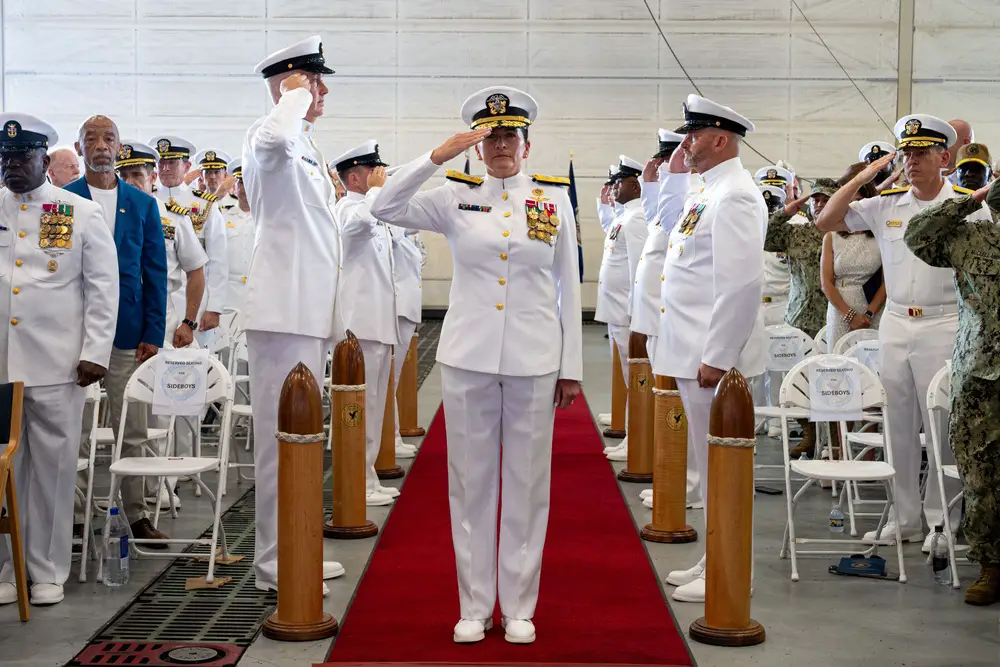
The morning air outside Fort Halder still carried the chill of early spring when I pulled up to the visitor gate at 0730, forty-five minutes before I strictly needed to be there. Old habit. In my line of work, early isn’t punctual — it’s the only acceptable arrival time. I’d flown in the night before, checked into a hotel off the interstate, ironed my dress uniform myself because I didn’t trust a hotel laundry service with the fold of a general officer’s blues, and slept maybe four hours out of some combination of jet lag and nerves I refused to name.
The young private at the gate checkpoint had a laminated list clipped to a board, the kind every installation uses for events like this. He scanned it twice.
“Ma’am, I’m not seeing your name on the cleared list for the Vale retirement ceremony.”
I gave him my ID card. “Try Vale. Sable Vale.”
He scanned again, slower this time, the way people do when they’re hoping the second pass will fix what the first pass got wrong. “I have a Harlan Vale as the honoree. I have a Penn Vale, plus one, under family. I don’t have a Sable listed anywhere on this sheet.”
For a moment I simply stood there in the cool morning air, holding my ID card back out toward him, feeling something I hadn’t felt in a long time — not since a young captain, decades ago, had looked at my orders and asked whether I was sure I had the right unit. I was thirty years past needing anyone’s permission to exist in a room. And yet here I was, standing at a chain-link gate outside my own father’s retirement ceremony, quietly being told I did not exist on paper.
“Check under General officer attendees instead of family,” I said. “I should be separately listed. Brigadier General Sable Vale, confirmed through public affairs three weeks ago.”
He typed something into a handheld device, frowned, typed again. “I’m showing a confirmation record, ma’am, but it’s not reflected on the gate sheet somebody printed this morning.” He looked apologetic, the specific apologetic of a junior enlisted person who has just realized they are standing squarely in the middle of somebody else’s family situation and would very much like to be anywhere else. “I can call it up to the event coordinator.”
“Don’t trouble yourself,” I said. “I’ll sort it out inside.”
I drove through on my own credentials rather than his goodwill, parked in a section reserved for command staff because that’s what my rank entitled me to whether or not anyone had bothered to write my name on a clipboard, and walked the long paved path toward the auditorium with my service cap tucked under one arm, the early sun throwing my shadow out long in front of me like it was in more of a hurry to arrive than I was.
That was the walk I thought about, later, standing in the lobby with the commander’s words still settling into me. That was the moment the day had actually started, whatever the printed program said.
The auditorium itself held maybe four hundred people by the time the ceremony began — folding chairs in even rows, an American flag and an Army flag crossed on stage behind a podium, a color guard standing at parade rest near the wings. I found a seat near the back on the left side, close enough to see, far enough that I wouldn’t be an obvious presence to anyone glancing toward the front. Old habit again.
The ceremony moved the way these ceremonies always move — an invocation, the national anthem, a series of speakers building toward the man of the hour. I watched my father from a distance for the first time in what must have been close to two years, his hair fully gray now, his posture still perfectly upright in the way the Army trains into you and never fully lets go of. My mother sat beside him in the front row in a pale blue dress, and beside her, Penn, and beside Penn, his wife Liora, adjusting a fussy toddler on her lap who I understood, from a photo my mother had sent eighteen months earlier and never followed up on, was my niece. I had never met her in person. She was two.
I filed that fact away the way I filed away everything uncomfortable. Later. Deal with it later.
The commander’s voice carried across the auditorium as he announced, “Brigadier General Sable Rowan Vale.”
Around my parents, people rose almost at once. The applause hit in a solid wave. My father didn’t move. Neither did my mother. Penn had started to stand on instinct, then seemed to realize everyone around him was looking in my direction rather than the stage, and he sat back down, confused. Liora’s smile disappeared as she looked from my uniform to my father’s face, some private calculation happening behind her eyes that I wouldn’t fully understand until much later that afternoon.
I walked toward the stage.
For twenty years, I had learned how to cross rooms without attracting attention. Rooms in Kabul, rooms in Brussels, rooms where the entire point was that nobody remembered your face five minutes after you left it. That morning, every step sounded too loud, my dress shoes against the polished floor of an auditorium that suddenly felt enormous, four hundred strangers and a handful of relatives who barely counted as less than strangers all turning to watch a woman they apparently hadn’t been told anything meaningful about.
The commander met me at the stairs and extended his hand. “General Vale, Fort Halder is honored to recognize your service today.”
A citation was read. Nothing classified. Nothing dramatic enough to explain the nights I had spent staring at moving dots on satellite feeds, or the decisions that still woke me at three in the morning more than a decade after I’d made them. It mentioned two decades of intelligence leadership, overseas assignments, joint commands, operational planning. It mentioned lives preserved through decisions made under pressure — a sentence so carefully generic that only I, standing there receiving it, knew exactly which specific pressure, which specific decisions, which specific lives.
Then the commander handed me the installation’s highest command honor.
When I turned back toward the audience, I saw something I had never once seen on my father’s face before. Not anger. Exposure. He had spent years reducing my career to phrases like “government work” and “something in intelligence,” delivered with the particular vagueness of a man changing the subject before anyone could ask a follow-up question. He had apparently done such a thorough job of it that even relatives scattered through that auditorium — cousins, an aunt I hadn’t seen since a funeral a decade earlier — were now staring at me as though I had arrived from an entirely different family than the one they’d been told about at every holiday gathering I’d missed.
I returned to my seat after the applause settled. My father didn’t look at me again until the ceremony paused before his retirement remarks.
Then a staff officer appeared beside my chair, leaning down with the particular discretion junior officers learn to project when they’ve been handed an awkward errand by someone senior.
“General Vale, Lieutenant General Vale would like a word with you backstage.”
Of course he would.
I followed the officer through a side door into a narrow corridor lined with framed photographs of previous commanders, decades of stern faces in decades of slightly different uniforms, all looking equally certain of their own importance. My father was already waiting there with my mother and Penn. Liora, I noticed, had stayed behind in the auditorium with the toddler, which struck me even then as either tact or self-preservation, possibly both.
The door had barely closed before he said, “You could have warned me.”
I stared at him. “Warned you that I was attending the retirement ceremony I was invited to?”
His jaw tightened. “Don’t play games with me, Sable.”
“I’m not.”
Penn folded his arms, his voice carrying the particular certainty of someone repeating something they’ve believed for weeks. “Dad said you wanted to keep your attendance quiet because of your work.”
That made me turn toward him. “He told you that?”
Penn’s certainty slipped slightly, just around the edges. “Yes.”
I looked back at my father. “My office confirmed my attendance three weeks ago. In writing. To your protocol officer.”
He said nothing.
“Publicly releasable information included my rank, current command, and the fact that I’m your daughter. I restricted operational details, as I always do, as I am required to do. I did not restrict my name.”
My mother’s fingers moved against her necklace, a small nervous gesture I remembered from childhood, from every dinner table conversation that had gone somewhere she didn’t want it to go.
My father finally said, “There are security considerations you don’t understand.”
I almost laughed, and the almost-laugh must have shown on my face, because his own expression tightened further. “Dad, I am the security consideration. I have briefed four-star generals on threat assessments. I do not need you managing my exposure at a retirement luncheon.”
The corridor went silent.
Before he could answer, the commander came through the door carrying a folder, his expression pleasant in the specific way of a man who has no idea he’s about to walk into the middle of something.
“Harlan, there you are.”
My father’s posture changed instantly. His shoulders straightened and his voice became controlled, almost warm, the voice I recognized from thirty years of watching him perform for an audience of exactly one important person at a time. “Just clearing up a family misunderstanding.”
The commander glanced at me, then at him. “About General Vale’s attendance?”
My father didn’t answer fast enough.
The commander opened the folder, flipping through a few pages with the unhurried confidence of a man who keeps excellent records. “Because protocol sent your office the attendance confirmation on March eighteenth. Your aide acknowledged it the same morning. I have the email chain right here, if it’s useful.”
Penn slowly uncrossed his arms.
My father looked at the folder as though it had personally betrayed him, as though a piece of paper had somehow chosen sides against him in a fight it had no business knowing about.
The commander continued, not unkindly, in the tone of a man simply relaying administrative facts rather than laying a trap. “We also received a request from your retirement team not to include General Vale in the family acknowledgment section of the program. I assumed that was her preference — some officers in her line of work prefer to keep family connections quiet for professional reasons — until her staff clarified that it wasn’t.”
That was the moment the missing name at the gate stopped being personal pettiness and became something deliberate. Something with a paper trail, an email chain, a series of decisions made across multiple weeks rather than a single bad morning.
I looked at my father. “You removed me twice.”
“Sable—”
“From the guest list and from the program.”
Penn turned toward him fully now, some final piece falling into place behind his eyes. “You told me she asked for that.”
My father ignored him. Instead, he looked at the commander. “This is a private matter.”
The commander closed the folder gently. “Then I’ll leave you to it.” He paused before going back through the door, one hand resting on the frame. “But the recognition segment stays exactly as scheduled.”
My father’s face hardened, and something in the specific set of his jaw told me — the way twenty years of reading faces for a living had trained me to read — that there had been a third attempt I didn’t yet know about.
I waited until the door shut fully.
“You tried to cancel that too?”
He looked at me as though I had cornered him unfairly, as though the facts themselves were somehow bad manners. “This ceremony is about forty years of my service.”
“I know. I came here for that.”
“Then why did your command have to turn it into a spectacle?”
For years I had imagined what I might say if my father ever admitted, even obliquely, that my accomplishments bothered him. I’d rehearsed versions of this conversation on long flights, in hotel rooms overseas, during the specific kind of insomnia that comes from being too far from home and too aware of how little home had ever actually felt like home. When the moment came, standing in that narrow corridor with old photographs of strangers staring down at both of us, I didn’t feel triumphant.
I just felt tired.
“They didn’t make me a brigadier general this morning,” I said. “They just said it out loud.”
Penn looked down at the floor.
My mother whispered, “Sable, please. Not here.”
I turned toward her. “Where would you prefer? Christmas? I stopped getting invited.”
She flinched, a small physical recoil that I registered even through the sharpness of my own anger.
I regretted the sharpness immediately, but not the truth behind it. Some things you can say gently and some things simply have edges, and there’s no version of “you stopped inviting me to Christmas” that doesn’t cut a little, no matter how carefully you phrase it.
My father stepped closer, his voice climbing slightly. “You made choices. You disappeared for years.”
“I deployed.”
“You missed family events.”
“Because I was working.”
“Penn managed to serve and still show up.”
There it was. The comparison that had been running beneath everything for years, finally surfacing in a hallway lined with dead men’s portraits.
Penn’s expression changed, something wounded and immediate crossing his face. “Dad.”
My father kept going, apparently unable to stop now that he’d started. “Your brother understood that family matters.”
I looked at Penn. “Did you know he left me out of his official biography?”
Penn blinked, genuinely thrown. “What?”
“The retirement biography, the one printed in this morning’s program. ‘One son carrying on the Vale military legacy.’ Singular. Not two children who served. One son.”
Penn looked genuinely confused, his brow furrowing in a way that couldn’t be faked, not by anyone I’d ever interrogated across a table for a living.
That mattered. Until that exact moment, part of me had assumed my brother had been enjoying the erasure from the beginning, quietly benefiting from being the only Vale child our father cared to mention. His comment at the gate — repeated secondhand through the private, but clearly something Penn himself had said aloud at some point — had been smug enough, in the retelling, to support that theory.
But the look on his face wasn’t satisfaction. It was recognition. He had believed a story too, one told to him carefully enough that he’d never thought to check it against anything.
“Dad told me you didn’t want your career associated with his because of classification,” Penn said slowly, working it out even as he spoke it.
“I never said that.”
Penn turned toward our father, something hardening in his own posture now. “You said she wouldn’t even allow her assignments mentioned.”
“Her assignments can’t be mentioned.”
“That’s not the same thing.”
My father stared at him, and for the first time in the whole exchange, he seemed to understand that he had lost an ally in that corridor, not just an argument.
Penn had made one mistake that morning. He had seen me stopped at the gate and assumed I had created the problem myself, some deliberate mystery-woman entrance meant to upstage our father’s day. Now he understood who had actually created it, and I watched something in him recalibrate in real time — thirty-some years of assumed family history quietly, visibly rearranging itself.
A staff member opened the corridor door and reminded my father that the reception line was forming.
He straightened his jacket, smoothed one lapel with a practiced hand. Just like that, General Harlan Vale returned, the private version of him folding back down into the public one like a map returning to its creases.
“We will discuss this after the ceremony,” he said.
I shook my head. “No. We discuss it when you stop giving orders and start answering questions.”
He walked away without responding.
The reception took place in a room beside the auditorium. Coffee, small sandwiches, framed photographs of my father shaking hands with various dignitaries over four decades, polished silver trays arranged with the kind of military hospitality my father had always loved, because every object in a room like that had an assigned place, a correct orientation, nothing left to chance or improvisation.
For twenty minutes, nothing exploded. That almost made it worse — the ordinary hum of a reception, people balancing small plates, someone’s laugh carrying a beat too long over the general murmur, all of it proceeding as though the corridor conversation hadn’t happened at all.
Officers I had known years earlier came over to shake my hand, several of them visibly surprised and delighted to see me, which told its own quiet story about how little they’d expected me to be there. A retired colonel named Whitfield reminded me of a winter exercise, years back, when I had forced his team to reroute an entire supply convoy because I didn’t trust the intelligence report his unit had been handed from another command. He laughed, genuinely, the memory clearly still fond despite whatever irritation it had caused him at the time.
“You were right, by the way,” he said, shaking his head. “I hated you for six months after that.”
I smiled. “Only six?”
People around us laughed, a real, easy laugh, the first moment of the day that felt entirely uncomplicated.
Across the room, my father heard it. I watched him hear it, watched his eyes track toward the sound the way a man tracks a sound he can’t quite place but instinctively distrusts.
Liora drifted toward the coffee urn eventually, filled a cup, then left it untouched on a side table, hovering near me with the particular hesitation of someone working up to a conversation she’d already decided to have.
When she finally approached, her voice was quiet. “I owe you an apology.”
“For what?”
“I thought you didn’t come around because you looked down on everyone. On this whole life. Military family stuff, Sunday dinners, all of it. I thought you’d outgrown us.”
That surprised me more than I wanted it to, something tightening briefly in my chest.
She glanced toward Penn, who was across the room now, talking with two of my father’s old colleagues, his hands moving the way they always did when he was working something out loud. “That’s how your absence was always explained. To me, anyway, when I first married into the family and started asking why there was this whole other sister I never met.”
“By my father?”
“Mostly.” She paused, turning her untouched coffee cup slowly on the small table. “Sometimes by your mom, when I pushed. But mostly your dad.”
Before I could fully respond, my mother appeared beside us, her expression careful, deliberate.
“Sable, can we speak privately?”
I followed her into an empty conference room just off the reception area, one of those beige, forgettable rooms every military installation seems to have a dozen of, a long table, a whiteboard someone had wiped only partially clean.
She shut the door, then stood there with both hands wrapped around her purse strap, twisting it slightly.
For several seconds, she couldn’t meet my eyes.
“Your father didn’t start this because he hated you,” she said finally.
I felt my patience thin, exhaustion pressing up against the edges of my composure. “That isn’t comforting.”
“I’m not trying to comfort you.”
That made me listen. Something in her tone had shifted, dropped its usual careful softness.
She sat down slowly at the long table, setting her purse in front of her like a small barrier.
“When Penn was younger, everything became a comparison. Your grades. Your academy record. Your first promotion. Your deployments. Harlan would talk about you at dinner — proudly, at first, genuinely proudly — and Penn would shut down. Go quiet. Push food around his plate. He was twelve, thirteen. He didn’t have the words for what he was feeling, but I could see it happening to him every single time.”
“So you stopped talking about me?”
Her eyes filled, but she didn’t look away this time, holding my gaze with an effort I could see costing her something.
“At first, just a little. A conscious choice to give Penn more room at the table, conversationally. Nothing dramatic.”
I said nothing, waiting.
“Then your father said Penn needed room to become his own man, separate from constantly measuring himself against you. He said your work was classified anyway, so there was no real reason to explain in detail where you were or what you were doing. It started sounding almost reasonable, the way he explained it. Protective, even.”
“And after that?”
Her grip tightened on the purse strap until her knuckles paled.
“It became easier.”
Those three words hurt more than anything my father had said in that corridor. Not safer. Not necessary. Easier.
“The birthday slideshow?” I asked, an old wound I hadn’t planned on reopening that day — a slideshow my father had put together for my mother’s sixtieth birthday, years back, that I’d only learned about secondhand, months later, because nobody had thought to include me in a single one of its photos despite my having been present for at least half the events pictured.
She nodded.
“The Christmas cards?” Another year, another photo I’d never appeared in, sent out to two hundred people who apparently believed our family consisted of exactly three children fewer than it did.
Another nod.
“His biography?” The one printed that very morning, sitting folded in four hundred laps in the auditorium next door.
She swallowed hard. “I saw the draft. Weeks ago.”
I leaned back against the conference table because my legs suddenly felt unreliable beneath me, some structural certainty I’d been standing on for the whole day giving way at once.
“You knew.”
“Yes.”
That was the collapse I hadn’t prepared for. Not my father’s cold recalibration in the corridor, which I had, on some level, been braced for my entire adult life. This.
I had spent years treating my mother like collateral damage in my conflict with my father. Quiet. Passive. Uncomfortable but trapped, a woman caught between a controlling husband and a daughter who’d learned early to stop asking for things she wasn’t going to receive.
She hadn’t been trapped. She had participated, because participation was easier than opposing him, and there is a particular, specific kind of grief in learning that the parent you’d quietly excused for decades had simply chosen the path of least resistance, over and over, at your expense, and called it protecting the family.
The door opened behind us. Penn stood there, one hand still on the frame, and from his expression, he had heard enough of it through the door to piece together the rest.
“You both did this?”
My mother stood quickly, the chair scraping against the floor. “Penn—”
“No. You told me she didn’t want contact. You told me that specifically, more than once, whenever I asked why we never saw her.”
“Sometimes she didn’t answer when I called.”
I looked at him, at both of them now, something steady and clear-eyed settling over me even as the room felt increasingly unsteady. “Because after enough calls where nobody asks anything about your life — where the whole conversation is Dad’s health, or Penn’s promotion, or some cousin’s wedding, and never once ‘how are you, where are you stationed, are you safe’ — you stop rushing to return them. That’s not mystery. That’s just what happens to a person over time.”
His face tightened, some old certainty visibly cracking.
“At the gate,” he said quietly, “I thought you were doing your usual thing. Showing up without telling anyone and expecting everybody to adjust around you.”
“I know.”
“I was a jerk about it. To the private at the checkpoint, I mean, when I heard him ask around about the missing name. I said something like ‘that sounds about right, that’s Sable for you.'”
“I heard some version of that secondhand, yes.”
He almost smiled, some old reflex trying to lighten the moment, but there was nothing funny enough in the room to actually support it, and the attempt died on its own.
“I’m sorry.”
It was the first clean apology I had heard all day, no qualifiers attached, no “but you have to understand.”
My mother tried to step closer to me then, one hand half-raised, reaching.
I moved back.
“Not yet.”
She stopped, her hand falling back to her side.
I didn’t punish her. I didn’t forgive her either. I simply stood there in that beige conference room with both of them, feeling the particular exhaustion of having finally, after twenty years, gotten the truth I’d always suspected but had never quite let myself fully believe.
When we returned to the reception room, my father was surrounded by former commanders and old colleagues, laughing at something, gesturing with the easy confidence of a man at the exact center of his own celebration. He looked completely composed again, no trace of the corridor visible anywhere in his bearing.
For a moment, I thought that was how the day would end. He would retire with a perfect speech, polished and warm and full of the right names in the right order. I would drive away with an award I hadn’t expected, quietly proud of it in the private way I was proud of most things. And my family would promise to talk later, the way families do, until “later” turned into another ten years of holiday cards without my face in them.
So I picked up my coat from where I’d left it draped over a chair near the door.
I had reached the lobby, coat half on, when the commander called my name.
“Sable.”
I turned.
He wasn’t smiling now. His expression had settled into something more careful, more deliberate, a man about to hand someone information he’d clearly debated whether to share at all.
“I thought you should know something before you leave.”
I waited, coat still half on, one arm through the sleeve.
“Your father saw the final ceremony schedule yesterday afternoon. Print version, timestamps and all. He asked me personally to remove your recognition segment entirely.”
I stared at him, something cold moving through my chest.
“What reason did he give?”
“He said it would distract from the purpose of the day.”
That was worse than the guest list. Worse than the biography.
The guest list could have been prepared weeks ago, a mistake made in the abstract, before the day itself had any real shape. The biography could have been part of an old, established pattern, drafted so long ago it had simply never occurred to anyone to revise it.
But yesterday, my father had known exactly who I was, exactly what the command intended to honor, and exactly how much of my life the recognition actually represented — twenty years, condensed into a citation, standing right there on the printed schedule in front of him.
He had still tried to erase it. Not weeks in advance, out of some old habit. The day before. Deliberately, with full knowledge of what he was cutting.
“Why didn’t you?” I asked.
The commander looked back toward the auditorium, toward the now-empty stage visible through the propped double doors.
“Because your service isn’t his to approve.”
I stood there holding my coat, half in, half out, feeling something in me settle in a way it hadn’t settled all day.
Then I took it off again.
Not because I wanted another confrontation. Because I wanted to hear my father’s retirement speech knowing the truth, all of it, standing on my own two feet in that room with nothing left hidden from me.
When Harlan Vale returned to the stage, the room gave him the standing ovation his career deserved. I stood too. Whatever kind of father he had been to me, forty years of service were still forty years of service, and I wasn’t going to let one terrible corridor conversation and a discovered pattern of deliberate cruelty rewrite the entirety of what those forty years had actually been. He had saved lives too. He had led soldiers well, by every account I’d ever heard from people who weren’t related to him. That could be true at the same time as everything else.
He stepped behind the podium and unfolded his prepared remarks, smoothing the paper flat with both hands.
For the first few minutes, he followed them perfectly. He thanked commanders, troops, mentors, friends, each name delivered with the particular warmth of a man who had genuinely valued the people he was naming.
Then he reached the section about family. I knew because his eyes moved toward my mother and Penn, seated together again in the front row.
He stopped reading.
The silence stretched, long enough that a few people in the audience began to shift slightly in their seats, that particular restlessness of a room sensing something has gone off-script.
My father looked at the paper, then at me, seated further back now than I’d been that morning, close to where I’d started.
Finally, he set the prepared speech down on the podium, both hands flat on either side of it.
“There is something I need to correct before I finish,” he said.
The room became completely still.
My mother covered her mouth with one hand. Penn stared at the stage, unmoving. My father gripped both sides of the podium, his knuckles visibly pale even from where I sat.
“For years, I told people I had one child carrying on the Vale tradition in uniform. That was false.”
No one moved. Somewhere behind me, I heard a single chair creak as someone shifted their weight.
“I have two children who served this country. One of them built a career I did not know how to speak about, partly because much of it was classified and partly because her success stopped fitting the story I had chosen to tell about my family.”
I felt every eye in the room shift toward me, a physical sensation, warmth moving up the back of my neck.
He continued, his voice steadier now, as though the hardest part had already been said and everything after it was simply momentum.
“Yesterday, I asked for her recognition to be removed from today’s program. I told myself I was protecting the focus of this ceremony. The truth is that I wanted control over how my legacy was presented. I wanted the day, and the story of my career, to look exactly the way I had already decided it should look, and my daughter’s accomplishments did not fit neatly into that picture.”
That cost him something. I could hear it in his voice, in the slight unsteadiness underneath the careful delivery.
Not his rank. Not his pension. Not his medals, gleaming there on his chest under the auditorium lights. Something he valued almost as much, maybe more, in a career built entirely on it: the image of absolute control.
“General Sable Rowan Vale is my daughter,” he said. “Her service belongs to her. Her achievements belong to her. And excluding her was my decision, not hers.”
He looked directly at me, across the full length of that auditorium, four hundred people between us, and for a moment it felt like there was no distance there at all.
“Sable, I was wrong.”
The room stayed silent for another second, long enough that I genuinely didn’t know what would happen next.
Then the commander began clapping.
Others joined him, but this applause felt different from the first round that morning. The first had been for my career, genuine and warm and entirely mine. This was not for me at all. It was the sound of my father being forced to stand inside the truth he had finally, publicly spoken, four hundred witnesses now holding him to it in a way no private conversation ever could.
I didn’t clap. I sat very still, my hands folded in my lap, and let the sound wash over both of us.
After the ceremony, people crowded around him again, congratulating him on forty years, on a distinguished career, on his obvious devotion to family — but the conversations around him were quieter now, more careful, people sensing something had shifted even if they couldn’t name exactly what.
Penn found me near the auditorium doors as the crowd began to thin.
“I don’t know how much of my relationship with him was built on being the easy son,” he said, his voice low.
“Probably not all of it.”
“But some.”
“Probably.”
He nodded slowly, looking down at his own hands for a moment.
Then he said, “I should have asked questions. Years ago. Any point along the way, really. I just took whatever he told me and ran with it, because it was easier than sitting with the version where my sister was actually just… gone. Missing. Like something had happened that nobody wanted to explain.”
That mattered more to me than another apology would have.
My mother approached a few minutes later, standing slightly apart, giving both of us room.
“Can we fix this?” she asked.
I looked at her, at the careful, hopeful line of her mouth.
“I don’t know.”
Her face crumpled slightly, but she accepted the answer without arguing it, which was itself something new.
“What do I do?” she asked finally.
“Stop telling people I disappeared.”
She nodded.
“Tell them I called. Tell them I came when I could, given the work. Tell them that sometimes, you and Dad chose not to include me, and that wasn’t something that happened to me from a distance. It was a decision made close up, at your own kitchen table.”
“I will.”
“And don’t turn today into the day everything became fine. Because it isn’t. Not yet. Maybe not for a long time.”
“I won’t,” she said, and something in the way she said it made me believe her, at least a little, at least enough to leave the door open a crack rather than closing it entirely.
My father was the last one to reach me. By then, most of the auditorium had emptied, folding chairs standing in their long rows, a custodial crew beginning to move quietly along the edges of the room collecting stray programs.
He carried one of the folded ceremony programs in his hand. Of course he did. Clean paper, sharp crease, every name exactly where someone had decided it belonged, printed that morning before any of what happened had happened.
“Public affairs is adding a correction to the archived copy,” he said. “Your name will be included in the official family record. Retroactively, but included.”
I looked at the program in his hand.
That morning, being missing from it had felt like proof that I had been erased entirely, decades of a career condensed into a single omitted line. Now, standing there in an emptying auditorium with my father’s voice still hanging somewhere in the rafters — his own voice, in front of four hundred people, admitting exactly what he’d done — it looked smaller. Still important. But smaller than it had felt at seven-thirty that morning, standing at a chain-link gate being told, politely, that I didn’t exist.
“Good,” I said.
He held the program toward me, an offering.
I didn’t take it.
“Keep it.”
His hand lowered slowly.
“Sable, I don’t expect today to fix anything.”
“It doesn’t.”
He nodded once, a small, contained gesture, and for the first time in my life, my father seemed genuinely unsure what order came next, standing there in his dress uniform for the last official time, a man who had spent forty years always knowing exactly what came next.
“I was proud of you,” he said, quietly enough that I had to lean in slightly to catch all of it. “I just—”
I stopped him.
“Don’t say you were proud if nobody could tell.”
He went quiet, his mouth closing around whatever the rest of that sentence had been going to be.
I buttoned my jacket and glanced through the glass doors toward the same pavement I had crossed that morning after discovering my name wasn’t on his list, the sun higher now, throwing shorter shadows than it had at seven-thirty. Then I looked back at him.
“If you want to change this, start somewhere simpler than a ceremony.”
He waited, watching me with an expression I didn’t have a clean name for.
I pointed at the folded program still in his hand.
“The next time somebody asks how many children you have, say two.”
I drove back to the hotel that evening with the medal in its presentation box on the passenger seat beside me, the late afternoon light going gold and then rose across the flat stretch of highway, and I didn’t call anyone. Not Penn, not my mother, not the handful of friends who would have wanted to know how the day went. I ate dinner alone at a diner near the interstate, ordered something I didn’t particularly want simply because it was on the menu, and sat there for a long time afterward with a cup of coffee going cold in front of me, turning the whole day over in my mind the way I’d once turned over intelligence reports, looking for the piece that didn’t quite fit, the detail that would finally make the whole picture resolve into something coherent.
It didn’t resolve, not that night. Some things don’t.
My mother called two days later, once I was back at my duty station, and asked, tentatively, whether she could send me some old photographs she’d found while going through boxes in the garage — pictures from my own childhood she said she’d forgotten she had. I told her yes. It felt like a small thing, and it was a small thing, but small things were apparently where we were starting from now, and I decided I could live with that.
Penn started texting more, awkward at first, updates about his daughter, a question here and there about where I was stationed, what the weather was like, nothing important, exactly the kind of conversation I’d told my mother I’d stopped getting years earlier. It felt strange, receiving it now, like a limb slowly waking up after sitting wrong for too long, all pins and needles before it settled into something usable.
My father didn’t call. I hadn’t expected him to, not right away. But six weeks later, an envelope arrived at my office, forwarded through two different addresses before it finally found me, and inside was a single printed page — an updated version of his official retirement biography, the corrected copy public affairs had apparently circulated to the installation newsletter and a handful of veterans’ publications that had covered the ceremony.
Two children served their country in the United States Army, it read now. Lieutenant General Harlan Vale is survived in service by his son, Colonel Penn Vale, and his daughter, Brigadier General Sable Rowan Vale, whose distinguished career in military intelligence spans two decades and multiple joint commands.
There was no note attached. No apology folded in alongside it, no further explanation. Just the page itself, corrected, circulated publicly, existing now in the permanent record in a way that couldn’t be quietly walked back later, couldn’t be softened at some future family dinner into another version of the old, easier story.
I read it twice, the way I read everything, and then I put it in a folder in my desk drawer, not because I’d fully forgiven him — I hadn’t, not entirely, and I wasn’t sure I ever fully would — but because it was, finally, true. And after twenty years of being erased a little at a time, in slideshows and Christmas cards and a biography nobody thought I’d ever read, true was worth keeping, even when it arrived six weeks too late and folded into a plain envelope with no name attached to the sender line at all.

Specialty: Quiet Comebacks & Personal Justice
David Reynolds focuses on stories where underestimated individuals regain control of their lives. His writing centers on measured decisions rather than dramatic outbursts — emphasizing preparation, patience, and the long game. His characters don’t shout; they act.