“Can I have ice cream?”
I didn’t even turn around from the stove. “No. Close the freezer.”
Tyler stood in the kitchen doorway with the freezer door wide open, cold air curling around his bare feet, one sock on and one sock off because, according to him, the missing one had felt “too tight emotionally” that afternoon. He’d announced this diagnosis at breakfast with total seriousness, and I’d decided a long time ago that some battles with a seven-year-old weren’t worth fighting.
“But there’s chocolate,” he said.
“I know.”
“And vanilla.”
“I’m familiar with our inventory, Tyler.”
He frowned at me like I’d personally betrayed both flavors by simply acknowledging their existence. “Can I have chocolate?”
“After dinner.”
His shoulders shot up around his ears, the universal seven-year-old posture of maximum injustice. “But I’m hungry now.”
“Excellent news. Dinner is almost ready.” I gave the sauce another stir, the smell of garlic and tomato filling the kitchen, steam curling up off the pan.
“I don’t want spaghetti.”
“You loved spaghetti on Tuesday.”
“That was Tuesday.”
I turned the burner down low and finally faced him fully. My son was seven years old, stubborn enough to negotiate with the weather if he thought it would work in his favor, currently standing there with his arms crossed and his chin jutted out like he was preparing to file a formal complaint.
“Close the freezer,” I said again.
He did, but not before staring into it one last time, the way a prisoner might look back at the sun before the door shuts. Then he crossed his arms tighter.
“You’re the meanest mom ever.”
“Put it on my resume.”
“I’m serious.”
“So am I. Ice cream after dinner.”
“You’re the meanest mom ever,” he repeated, apparently deciding the line worked well enough the first time to deploy again, and then he stomped off down the hallway. His bedroom door slammed a second later, not hard enough to rattle anything, just hard enough to make his point.
I shook my head and went back to the sauce.
Being a single mother for the last three years had taught me which battles were worth fighting and which ones weren’t. I let bedtime slide by ten minutes most nights. I pretended not to see socks abandoned in the middle of the living room floor. I had learned, mostly through trial and a lot of error, that picking my battles was the only way either of us stayed sane.
But dessert before dinner wasn’t a negotiation. It never had been, not since Tyler was old enough to ask, and I wasn’t about to start now just because he’d found a new way to phrase the same request four times in ninety seconds.
Tyler’s father, Mark, had moved to Phoenix the year Tyler turned four, chasing a job opportunity that turned into a whole new life out there, one that increasingly didn’t seem to have much room in it for a son back in Ohio. The support checks came when they came, which was to say inconsistently, some months on time and some months not at all, and I’d stopped counting on them the way you stop counting on weather forecasts after enough of them turn out wrong. I worked the front desk at a pediatric clinic downtown, decent pay, decent hours, decent enough that we had a roof and groceries and Tyler had soccer cleats that fit. Decent wasn’t the same as comfortable, though, and I’d spent a lot of quiet nights at the kitchen table after Tyler went to bed, calculator in hand, moving numbers around like a puzzle that never quite solved itself.
I finished making dinner, plated two servings, and called Tyler back down the hallway. He came, because he always did, dessert negotiations aside. He was, underneath all the theatrics, a genuinely sweet kid, and I loved him with the kind of ferocity that made every hard month feel survivable.
We hadn’t even sat down to eat when somebody knocked on the front door.
I wiped my hands on a dish towel, mildly annoyed at the interruption, and went to answer it, already running through the short list of who it could be. A neighbor. A delivery I’d forgotten about. Definitely not what it turned out to be.
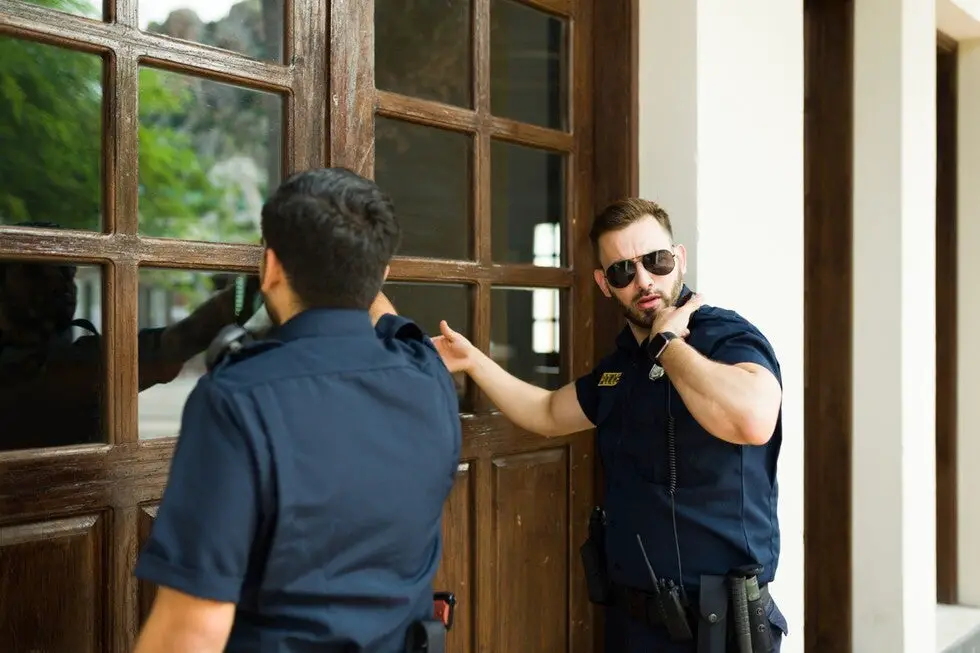
A uniformed police officer stood on my porch.
For half a second I genuinely forgot how doors worked, my hand just resting on the frame while my brain caught up to what I was looking at. A patrol car sat at the curb behind him, no lights flashing, which I registered as a small mercy even in my confusion.
“Ma’am?” he said.
“Yes?”
“We received a call regarding a possible issue involving a child at this address. I just need to make sure everybody’s okay.”
My hand tightened on the edge of the door hard enough that I felt it in my knuckles. “What kind of issue?”
Before he could answer, I heard socked feet slapping fast down the hallway behind me, and then Tyler was there, wedging himself into the doorway beside me with the triumphant energy of somebody who’d been expecting backup and was delighted it had actually arrived.
“I called!” he announced.
I turned slowly, already knowing, somehow, in the pit of my stomach, exactly what I was about to find out.
Tyler held up my old cell phone, the one I kept charged in the junk drawer specifically so he’d have a way to call for help if something ever happened to me while I was at work and he was home with a sitter, or if there was ever a real emergency and he needed to reach someone fast. It had exactly one purpose in my mind. Apparently it had a second purpose in his.
“My mom is the worst!” Tyler announced to Officer Bruce, jabbing a finger toward the kitchen like he was presenting evidence at trial. “She won’t give me ice cream!”
I closed my eyes for one long second.
My child had called the police over dessert.
“I’m so sorry,” I said, reaching down to take the phone out of his hand. “I never imagined he’d use it for this. It’s for emergencies. I keep it charged in case something happens while I’m at work.”
Tyler looked genuinely offended by the implication that this hadn’t qualified. “I’m seven.”
“Thank you for confirming the age listed on your birth certificate,” I said, and I felt the heat crawling up my neck, that particular mortification of having a police officer standing on your porch because your child decided a bowl of chocolate ice cream constituted a civil rights violation.
I expected Officer Bruce to laugh it off, maybe crack a joke, write something quick in a little notebook and head back to his car with a good story to tell at the station. He didn’t. His nameplate read Bruce, no last name visible from where I stood, just Bruce, and he looked at Tyler, then at me, with an expression that was patient in a way I wasn’t quite prepared for.
“Mind if I ask him a couple of questions?” he said.
“Please,” I said, half hoping that hearing directly from a uniformed officer that ice cream wasn’t a constitutional right might accomplish something seven years of motherhood apparently hadn’t.
Officer Bruce crouched down slightly so he wasn’t towering over Tyler, bringing himself closer to eye level, the way I’d seen good teachers and pediatricians do, the kind of small gesture that tells a kid you’re actually listening instead of just tolerating them.
“Did your mom hurt you?” he asked.
Tyler’s outrage evaporated instantly, replaced with something closer to alarm. “No.”
“Are you afraid of her?”
“No! She’s my mom.”
“Do you have food in the house?”
Tyler pointed dramatically back through the open door toward the kitchen. “She’s literally making spaghetti.”
Officer Bruce glanced past me, and I watched him register the smell of garlic and tomato sauce drifting out into the evening air, watched something in his shoulders relax just slightly, the posture of a man crossing something off a mental checklist.
“Does she stop you from eating when you’re hungry?” he asked.
“No.”
“Do you feel unsafe here?”
Tyler scrunched his whole face up like the question personally offended him. “I said no.”
Officer Bruce nodded slowly and straightened back up. “Okay. There’s no emergency here.” He looked down at Tyler again. “So tell me. What did you actually need the police to fix?”
Tyler answered without a shred of hesitation, like the question had been sitting right there waiting for him.
“The ice cream.”
I wanted to slide beneath the welcome mat and disappear into the porch boards. Instead of laughing, though, Officer Bruce did something I didn’t expect. He sat down on the edge of the porch step, lowering himself right down to Tyler’s height, settling in like he had all the time in the world, which struck me as strange for a man presumably in the middle of a shift with other calls waiting.
“If you call us because you need help, Tyler, we have to take what you say seriously,” he said. “That’s our job. When the phone rings, we come.”
Tyler shifted his weight from one foot to the other. “I was serious.”
“I believe you were.” Bruce rested his forearms on his knees. “But police don’t come because everything feels unfair. Sometimes things are just disappointing, and that’s a different thing than being in danger.”
Tyler frowned, working through this distinction with visible effort. “Police fix unfair things.”
Officer Bruce glanced up at me, and I shrugged helplessly from the doorway. “I told him police help people,” I admitted. “I guess I never explained the fine print.”
“Mom said if something bad happens, you call police,” Tyler added, like he was submitting supporting documentation.
“That’s true,” Officer Bruce said. “But being disappointed isn’t the same thing as being unsafe. If your mom says you can’t have ice cream until after dinner, that’s disappointing.”
“Very,” Tyler said, with total conviction.
“But it isn’t an emergency.”
Tyler didn’t look convinced, his arms still crossed, his jaw set in the particular way that told me he was building an internal case for appeal.
“What was unfair about waiting?” Officer Bruce asked him, tilting his head.
Tyler’s answer came slower this time, some of the fight draining out of his voice. “Because she waits too much.”
I blinked. “What?”
“Because she waits too much,” Tyler said again, quieter, looking at his own feet now instead of at either of us.
Officer Bruce glanced at me, then back down at Tyler. “Your mom waits too much for ice cream?”
“For everything.”
The embarrassment I’d been carrying since I opened the front door shifted into something else entirely, something colder, a confusion that had nothing to do with a badge on my porch and everything to do with the way my son had just said that sentence, quiet and certain, like he’d been holding onto it for a while.
“Tyler, honey, what are you talking about?” I asked.
He shoved his hands into the pockets of his shorts and wouldn’t look at me. “Nothing, Mom.”
“No,” I said, more gently than I felt. “You just called the police because apparently I wait too much. You’re finishing that sentence.”
Tyler looked toward the kitchen instead of answering. Officer Bruce followed his gaze, and from where he sat on the porch step, he could see straight through the open door to part of our refrigerator.
“What’s that on your freezer?” he asked.
I turned to look, even though I already knew what was there. Our weekly calendar hung on the freezer door, held up by two magnets, one shaped like a taco Tyler had picked out at the grocery store checkout line last spring, the other a small broken plastic dinosaur he refused to let me throw away because, in his words, “he’s still working, he’s just resting.” Most of the squares on the calendar were filled with ordinary things. School library day. Laundry. Soccer practice. Trash pickup on Thursdays.
On Friday’s square, in Tyler’s careful seven-year-old handwriting, he’d drawn a tiny bowl with three brown circles inside it.
“Ice cream night,” he said, when he saw me looking.
“Family tradition?” Officer Bruce asked.
“Kind of,” Tyler said, with a small sigh, like the whole institution of Friday nights was a burden he carried alone.
I laughed despite myself, some of the tension in my chest easing for a second. “Friday nights we have ice cream and watch a movie together. It’s been our thing since he was maybe four.”
Tyler immediately said, “I have ice cream.”
I looked down at him. “You have ice cream?”
“You don’t anymore, Mom.”
I felt my arms fold across my chest almost on their own. “Tyler, that’s not true.”
“Yes, it is.”
“I had some last week.”
“You had two bites because you said you were full.”
The memory surfaced fast, sharper than I expected, sitting on the couch with Tyler two Fridays back, the bowl in my hands, taking two small spoonfuls before setting it down on the side table and telling him I was too full from dinner to finish it. I remembered exactly how it tasted, sweet and cold, and I remembered exactly how relieved I’d felt setting the spoon down, because the freezer had been running low and payday was still four days out.
“So?” I said, because it was the only thing I could think to say.
“You don’t anymore, Mom,” he repeated, and this time his voice had an edge to it that wasn’t anger exactly. It was something closer to frustration, the kind that comes from watching something happen over and over and not having the words yet to explain why it bothers you.
Officer Bruce had gone quiet, watching this unfold with the stillness of a man who’d apparently decided this conversation mattered more than whatever call had probably come in on his radio five minutes ago.
“You always say you’re full,” I tried.
“Yesterday you gave me the big pancake,” Tyler said, like he’d been keeping a list, and maybe he had. “And you ate the weird little one.”
“Because you’re growing.”
“It tasted the same,” Tyler shot back. “On pizza night, you eat my crust.”
“I like crust.”
“You do not.” Tyler rolled his eyes so hard and so completely that I almost admired the technique despite myself. “You said crust was boring when Grandma brought that stuffed-crust pizza in March. You said, and I quote, ‘crust is the worst part.’ And then two weeks later you were eating all my regular crust and saying you liked it.”
Of all the things this child could have chosen to memorize with perfect accuracy, it had to be this.
“Excuse me?” I said, mostly to buy myself a second.
Officer Bruce leaned against the doorframe now, arms loosely crossed, not intervening, just present, the way you’d want a person to be present for something like this.
Tyler’s voice dropped lower, and some of the performance went out of it entirely. No crossed arms anymore. No dramatic scowl. Just my seven-year-old standing on our porch, staring hard at the kitchen floor like it owed him an explanation.
“Your tummy makes noises when you say you’re full,” he said.
I looked at him. Really looked at him, the way you sometimes forget to do with your own kids because you’re so used to seeing the same face every day that you stop actually noticing it.
He was seven. He wasn’t supposed to be listening for that. He wasn’t supposed to be counting bites, or remembering pizza crust conversations from six months ago, or noticing the particular silence a stomach makes when it’s lying.
I realized, standing there on my own front porch with a police officer as an unintentional witness, that my son had been paying attention to something I had worked very hard to convince myself he couldn’t hear.
For the last year, money had been tight. Not catastrophe tight, not the kind of tight that makes the news or gets you a case number with a social worker attached to it. We had a roof over our heads. Tyler had food, school supplies, clothes that fit, soccer shoes that hadn’t worn through yet. But there had been months where everything seemed to land on the same week, car insurance and a dentist bill and then, in February, the washing machine finally gave out entirely, flooding half an inch of water across the laundry room floor at eleven at night while I stood there in my pajamas with a stack of wet towels, doing math in my head that didn’t come out right no matter how many times I ran it. School picture day had come around in March, and somehow the packages cost about the same as a minor outpatient procedure, and I’d bought the smallest one and told Tyler the bigger package “just wasn’t as nice a photo, trust me,” which wasn’t remotely true, I just couldn’t justify the extra forty dollars that month.
So I’d adjusted. Quietly, the way you do when you don’t want anyone, especially your own child, to notice the adjusting. I bought Tyler the yogurt with the cartoon characters on it that he liked and got myself the plain store brand. If there were three decent pieces of chicken in the skillet, he got two of them and I told myself the third, smaller piece was plenty, that I’d never really been that hungry anyway. I finished the crusts off his sandwiches and told myself it was because wasting food annoyed me, which was true, just not the whole truth. And yes, on Friday nights, more times than I’d realized until that exact moment on the porch, I’d given Tyler the bigger bowl of ice cream and told him I wasn’t really in the mood for any, that I was still full from dinner, that he should go ahead and finish it before it melted.
I had genuinely believed that was what good mothers did. You made the math invisible. You made dinner look normal, effortless, like there had never been a single moment of doubt about whether there’d be enough. You made absolutely sure your child never had to count what was left in the fridge, because counting what’s left in the fridge is a kind of worry no seven-year-old should ever have to carry.
Apparently my son had been counting something else the whole time. He’d been counting me.
Officer Bruce broke the silence that had settled over the porch. “Tyler, why was the ice cream such a big deal today?”
My son shrugged, though it wasn’t the careless shrug from earlier. It was smaller now, more tired. “Because there’s still some.”
I looked toward the kitchen, toward the freezer, like I could see through the walls. “Some what?”
“Ice cream,” Tyler said.
“I know there’s ice cream.”
“You keep saying we have to save it. For Friday,” Tyler said, and then his voice sharpened again, the frustration flaring back up like apparently seven-year-old vulnerability had a strict time limit before it needed to convert back into anger to feel manageable. “But then Friday comes and you don’t eat it, Mom. So I wanted some now.”
I rubbed my forehead, feeling the beginnings of a headache that had nothing to do with dinner or dishes or any of the ordinary things I’d been worrying about twenty minutes earlier. “You called the police because you wanted extra dessert?”
“Yes.” He stared down at his own toes. “I was mad.” Then he looked up, straight at me, something raw in his face that I wasn’t used to seeing outside of scraped knees and nightmares. “But I don’t like when you don’t have any.”
There it was. Not a plan. Not some carefully engineered rescue mission a seven-year-old had spent weeks plotting. Just Tyler logic, plain and a little bit heartbreaking in its simplicity. Ice cream existed in the freezer. Mom liked ice cream, or at least she used to, back before Fridays started quietly skipping her. Mom kept not eating the ice cream anyway. Therefore, in some seven-year-old calculus of fairness, everybody involved was behaving incorrectly, and somebody needed to fix it, and the only authority figure he knew capable of fixing incorrect behavior wore a badge and drove a car with lights on top.
“Why didn’t you just ask her to eat some?” Officer Bruce asked him.
Tyler looked at him like that was possibly the dumbest question anyone had asked him all week. “I do.” Then, glancing at me: “She says no.”
“Tyler,” I said quietly, feeling something crack open in my chest. “Honey.”
His arms folded again, though there wasn’t much fight left behind the gesture anymore. “Moms have to eat too.”
For one awful second I nearly laughed, not because any of this was funny, but because he sounded so genuinely furious about it, so completely certain that this was an injustice worth escalating to the level of law enforcement, and there was something in that certainty that undid me a little.
Officer Bruce looked down at the radio clipped to his shoulder, rubbing his thumb along the edge of it, quiet for a moment before he spoke again. “My mom used to tell me she didn’t like the good pieces either,” he said. “Whenever we split something. She’d always take the smaller half and tell me it was because she preferred it that way. Took me years to figure out that wasn’t true.”
I looked at him, surprised, and he gave a small shrug, the kind that carries more weight than the gesture itself suggests.
Tyler pointed at me like he’d just won a case in front of a jury. “See?”
Officer Bruce immediately held up a finger. “No. Don’t look at your mother like you’ve won.” Tyler’s hand dropped. “Because we’re not done with your part of this.”
Tyler suddenly became very interested in the state of his own toes again.
“You called the police because your mom told you no,” Officer Bruce said, and his tone had shifted into something firmer, though not unkind.
Tyler muttered, “Yes.”
“That wasn’t okay.”
Silence stretched on the porch, the streetlight two houses down flickering on as the sky dimmed behind it.
“When you call us, somebody has to come,” Officer Bruce continued. “We have to treat it like it might be serious, because sometimes it is. And while I’m standing here figuring out whether you’re actually in danger, I can’t be somewhere else helping somebody who might really need it right now. Somebody whose mom really did hurt them, or who’s really scared, or who’s really alone with no food in the house.”
Tyler glanced up at him, and I watched something land, some understanding settling into his face that hadn’t been there thirty seconds earlier. Officer Bruce hadn’t scared him with some horror story, hadn’t reached for anything dramatic to make the point. He didn’t need to.
“You don’t use emergency services to win an argument, buddy,” Bruce said simply.
Tyler nodded slowly.
“If your mom says no ice cream tomorrow, do you call us?”
“No,” Tyler said immediately.
“Why not?”
Tyler sighed with the exhaustion of a man filing his taxes a day late. “Because ice cream isn’t an emergency.”
“Good,” Officer Bruce said.
Then he looked up at me, straightened off the doorframe, and gestured toward the kitchen. “Finish making dinner.”
I blinked. “Sorry?”
He glanced back down at Tyler. “Your mom said ice cream comes after dinner. That rule still stands.” Tyler’s face fell right on cue. “But,” Bruce added, looking at me now, something more careful in his voice, “I think he called because he doesn’t believe you’re actually going to have any afterward.”
I looked toward the kitchen, and I couldn’t come up with a single answer that didn’t sound like another excuse, so I didn’t try.
Officer Bruce gave Tyler one last look. “Dinner first.”
“Okayyyy,” Tyler said, drawing the word out into at least four extra syllables.
“And police?”
“Not for ice cream,” Tyler mumbled.
“We’re making progress,” Bruce said, and there was the faintest trace of a smile behind it now.
He started down the porch steps, and I thought that was the end of it, that he’d get back in his cruiser and drive off to whatever came next on his shift and I’d spend the rest of the night replaying every word of this conversation in my head, which, as it turned out, I did anyway. But before he reached the walkway, Tyler called after him.
“Officer Bruce?”
He turned back.
“What if she says she isn’t hungry again?”
Bruce looked at me before he answered, and I felt that look land somewhere deep, somewhere I hadn’t let anyone look in a long time.
“I think that’s between you two,” he said.
Then he walked back to his cruiser, lights still off, and pulled away from the curb, and Tyler and I stood in the doorway together until the car turned the corner and disappeared.
I knew, standing there, that the harder conversation hadn’t even started yet.
Finally I looked down at him. “You called the police on me.”
“Yup.”
“Over ice cream.”
He studied the porch floor like it had suddenly become very interesting. “It sounded better before he came.”
Despite everything, despite the mortification and the strange ache still sitting in my chest, I laughed, a real one, surprising myself. “Go wash your hands. Dinner’s getting cold.”
At the table, I spooned spaghetti onto two plates, and without even thinking about it, without any conscious decision at all, I gave Tyler the larger portion, the way I apparently always did, the way he’d apparently been watching me do for longer than I realized.
He immediately pushed the plate back toward me. “You take this one.”
I looked down at the two plates, at what I’d done without noticing I’d done it, and something in my chest tightened.
“No,” I said.
“But you’re hungry,” Tyler said.
“I am.”
“So take it.”
Instead of arguing, I picked up the serving spoon and moved some of the spaghetti from his plate onto mine, evening things out, closer to fair than I think either of us had managed in a while. “How about nobody automatically gets the smaller one,” I said. “From now on.”
Tyler considered this with the gravity of a seven-year-old weighing a genuinely important proposal. “Okay.”
We ate. Halfway through, he watched me reach for a second piece of garlic bread, watched it with such open, unguarded curiosity that I felt my face go warm.
“Don’t make it weird,” I told him.
“I’m not,” he said, in a tone that made it very clear he absolutely was.
“You are completely making it weird.”
He grinned down at his plate and didn’t argue further, which felt, somehow, like its own small victory.
After dinner, Tyler shot up from the table and sprinted toward the freezer.
“Walking!” I called after him, and he slowed down dramatically, exaggerating every step for my benefit, and I laughed again, the tightness in my chest easing another notch.
I took out the carton of chocolate ice cream and set two bowls on the counter. I scooped his first, a generous helping, the way I always did. Then I started on mine, and out of pure habit, some deeply worn groove in my brain, my hand started to pull back after the first small scoop.
I caught myself. My hand stopped mid-motion, hovering there over the bowl.
Then I put another full scoop in anyway.
Tyler didn’t say anything. He was watching the television remote, flipping through channels, not paying particular attention to what was happening at the counter. But somehow the fact that he wasn’t watching, wasn’t checking, wasn’t monitoring whether this time would be different, mattered more to me than if he had been.
We carried our bowls to the couch.
“You having all of yours?” he asked, settling in beside me, legs tucked underneath him.
“That’s the plan.”
“Good,” he said, with real satisfaction, like he’d just confirmed something important.
I pointed my spoon at him. “You still committed a pretty serious offense today, you know. We’re not skipping past that part.”
“I know,” he said, not even trying to argue it.
“If I tell you no dessert before dinner tomorrow?”
“I don’t call the police.”
“Excellent progress.”
He took another bite, chewing thoughtfully, and then, with the particular mischief of a kid who’s just remembered a fantastic idea, he asked, “What about Grandma?”
“Don’t you dare.”
He giggled so hard he nearly lost his spoon into the bowl, chocolate ice cream wobbling dangerously close to the rim, and I found myself laughing along with him, really laughing, the kind that unknots something in your shoulders you didn’t realize was tight.
Later, while I was washing the bowls, Tyler climbed up onto one of the kitchen chairs to watch, chin propped on his folded arms on the counter’s edge.
“I’ll make you a deal,” I told him, scrubbing at a bit of dried sauce on the pot from dinner. “If I’m hungry, I’ll stop pretending I’m not.”
“Fine,” he said.
“And you stop trying to solve family disagreements with emergency services.”
“Okay,” he agreed, easily, like we’d just settled something that had been much bigger than either of us wanted to say out loud.
I dried my hands on the towel hanging from the oven handle. There was a little ice cream left in the carton, not much, just enough for one more small bowl.
“Save that for Friday,” I said, nodding toward it.
Tyler looked inside the carton, then back up at me. “That’s yours.”
My automatic answer was already halfway up my throat. You can have it. I actually felt the shape of the words forming before I caught them and stopped.
“Okay,” I said instead.
I pulled a marker out of the junk drawer, the same drawer where the old phone lived, and I wrote across the lid of the carton, in block letters: MOM.
Tyler held out his hand. “My turn.”
I gave him the marker. Underneath my word, in huge, crooked, seven-year-old letters that slanted almost off the edge of the lid, he wrote: NOT 911.
I stood there looking at it for a long moment.
“So you remember?” I asked him.
He nodded, solemn in the particular way only a seven-year-old delivering a genuinely important promise can manage. “So we both do.”
I put the carton back in the freezer, right next to the calendar with its little drawn bowl of three brown circles on Friday’s square, and I stood there a second longer than I needed to, just looking at it.
That night, after Tyler was asleep, I sat at the kitchen table with the calculator again, the same one I always pulled out, running the same numbers I always ran. Car insurance was due in eleven days. The dentist bill still had a balance. But for the first time in longer than I could remember, I wrote myself into the grocery list the next morning the same way I wrote Tyler in, no adjustments, no smaller portion penciled in beside my name out of habit.
I told my coworker Carla about it the following week, sitting in the break room at the clinic during our lunch, and she went quiet for a second before she said, “You know I do the exact same thing with my boys. The bigger piece, the I’m-not-hungry thing. I didn’t think anybody noticed.”
“I didn’t think Tyler noticed either,” I said.
“They always notice,” Carla said. “They just don’t always have the words for it until they do something wild enough that we finally have to listen.”
I thought about that a lot in the weeks that followed. About how Tyler hadn’t had the vocabulary to sit me down and say, Mom, I’m worried you’re not eating enough because I think we don’t have much money, because he was seven, and seven-year-olds don’t carry conversations like that, not with the words for it anyway. What he had was a freezer full of ice cream, a drawn bowl with three brown circles on a calendar, and an old phone meant for real emergencies. And in his own seven-year-old logic, faced with something that felt unfair and important and impossible to explain any other way, he’d used the only tool he had.
It wasn’t the right tool. Officer Bruce had made that clear, gently but firmly, and Tyler understood it too, understood it well enough that two Fridays later, when I told him we were having leftovers instead of pizza because the week had run long, he just shrugged and said, “Okay,” no drama, no theatrics, no reach for the phone in the junk drawer.
But it had been the right message, even wrapped in the wrong tool. And I don’t know that I would have heard it any other way. I don’t know that I would have caught myself, that day at the counter, hand hovering over the ice cream carton about to shortchange myself out of habit, if a police officer hadn’t sat down on my porch step and asked a seven-year-old why waiting felt so unfair.
Fridays are still ice cream nights in our house. The calendar still hangs on the freezer with the taco magnet and the broken dinosaur holding it up, and Tyler still draws his little bowl with three brown circles in the square every week without being asked. But now there are two bowls when dessert actually happens, both of them full, and neither of us pretends otherwise.
The carton still says MOM on the lid in my handwriting, and underneath it, in letters that have started to fade a little from the freezer frost but that neither of us has ever bothered to touch up, it still says NOT 911.
Some nights, scooping out dessert, Tyler will glance at it and grin like it’s still the funniest thing he’s ever pulled off. And some nights, when I catch myself doing the math out of old habit, reaching for the smaller piece or the smaller scoop without meaning to, I’ll glance at it too, and I’ll remember a police officer named Bruce sitting on my porch step in the evening light, telling my son that being disappointed and being unsafe aren’t the same thing, and telling me, without quite saying it outright, that going hungry so your child never has to isn’t the quiet, invisible sacrifice you think it is. Somebody is always watching. Sometimes it’s the person you’d least expect to notice, and sometimes they don’t have the words to tell you directly.
Sometimes they just call 911 over a bowl of ice cream, and you have to be willing to listen to what they actually meant.

Lila Hart is a dedicated Digital Archivist and Research Specialist with a keen eye for preserving and curating meaningful content. At TheArchivists, she specializes in organizing and managing digital archives, ensuring that valuable stories and historical moments are accessible for generations to come.
Lila earned her degree in History and Archival Studies from the University of Edinburgh, where she cultivated her passion for documenting the past and preserving cultural heritage. Her expertise lies in combining traditional archival techniques with modern digital tools, allowing her to create comprehensive and engaging collections that resonate with audiences worldwide.
At TheArchivists, Lila is known for her meticulous attention to detail and her ability to uncover hidden gems within extensive archives. Her work is praised for its depth, authenticity, and contribution to the preservation of knowledge in the digital age.
Driven by a commitment to preserving stories that matter, Lila is passionate about exploring the intersection of history and technology. Her goal is to ensure that every piece of content she handles reflects the richness of human experiences and remains a source of inspiration for years to come.