“Sarah, I need to apologize before I thank you.”
I read the first line twice, standing in my kitchen still wearing my coat, the mail spread across the counter where I’d dropped it a minute earlier.
Larry’s letter had arrived six days after his funeral, in a thick white envelope covered in the shaky handwriting I’d seen on his hospice forms. The postmark was dated the day before he died.
I’d smiled when I found it, tucked between a credit card offer and a reminder postcard from my dentist. I thought Larry had written a goodbye. The man couldn’t accept a coffee without thanking me three times, so a whole letter felt, in a strange way, entirely in character.
Then I read the next sentence.
“Nobody was going to bury me as a John Doe.”
The blood drained from my face. I sat down right there on my kitchen floor, my back against the cabinet, coat still on.
“No,” I said out loud, to nobody, to the empty apartment.
To understand how I ended up sitting on my kitchen floor reading a letter from a dead man that would eventually send me back to a courthouse to learn things about him I never expected to learn, you have to understand who I was before Larry ever showed up outside my subway station holding a piece of cardboard across his knees.
My name is Sarah Kessler. I’m thirty-four, and at the time all of this happened, I worked as a communications coordinator for a mid-sized nonprofit downtown, the kind of job that paid decently but demanded long hours and an endless capacity for solving other people’s problems, which, in hindsight, might explain quite a lot about how I ended up married to a homeless man with one month left to live.
I grew up in Ohio, the oldest of three kids, in a house where my mother worked two jobs after my father left when I was eleven, and somewhere in those years I developed what my therapist, years later, would diagnose as a fairly textbook pattern of finding my own worth in fixing things for other people. I was the kid who organized my younger siblings’ school supplies, who called the utility company when the power got shut off because my mother was too embarrassed to make the call herself, who learned, early and thoroughly, that being useful was a reliable way to matter.
I moved to the city after college, built a career, dated occasionally, never seriously enough to bring anyone home for a holiday, and settled into a comfortable, busy, slightly lonely single life that I mostly didn’t examine too closely, because examining it too closely tended to surface uncomfortable questions about why, exactly, a reasonably attractive, reasonably successful thirty-four-year-old woman kept ending up alone on Friday nights with takeout and a stack of work emails.
My best friend, Priya, who I’d known since our first week at the same company eight years earlier, used to tease me about it constantly. “You’ll fix a stranger’s flat tire before you’ll let a man buy you a second date,” she said once, over margaritas, not entirely joking. She wasn’t wrong. I liked problems with clear solutions. People were messier than problems, and I’d built an entire adult life, without quite meaning to, around the comfortable, manageable version of caring for others that a to-do list provides.
Which brings me to Larry, and the subway kiosk, and the two years that came before that freezing Tuesday when everything changed.
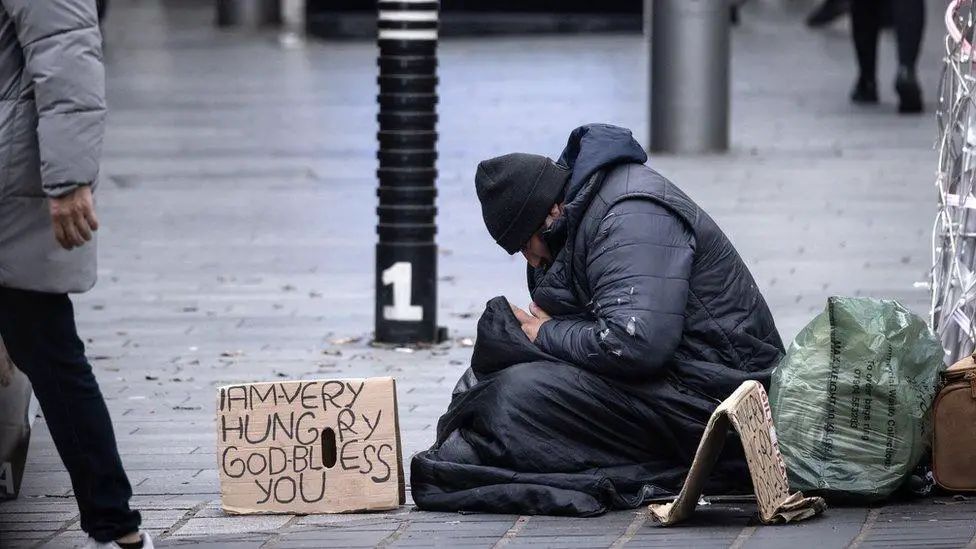
I first noticed him about two years before all of this, sitting against the brick wall beside my subway station, a cardboard sign propped against his knees that read something forgettable, the kind of sign you walk past a hundred times without really reading. I don’t know exactly what made me stop the first time. I think it was raining, and he had no umbrella, and some old, worn-in instinct from watching my mother struggle with dignity through hard years kicked in before I’d fully decided to act on it. I bought him a coffee from the kiosk beside the station entrance, the same kiosk I bought my own coffee from every single morning, and I sat down beside him for exactly the length of time it took me to finish explaining that I worked two blocks over and would probably see him again.
I did see him again. Every weekday morning after that, for two years, I bought two coffees from that same kiosk. Mine with cream. His black.
Larry never begged me for anything, which I think is part of why our routine settled so easily into something that felt less like charity and more like an actual friendship. Some mornings we discussed the weather, ordinary small talk that could have passed between any two neighbors. Other mornings he complained about the pigeons that congregated near his usual spot, or told me my office shoes looked “designed by somebody who hated feet,” a comment that made me laugh out loud on the subway platform more than once. He had a dry, quick wit that surfaced at unexpected moments, and over those two years, I came to genuinely look forward to those five minutes before rushing off to work, more than I probably admitted to myself at the time.
I learned pieces of his life the way you learn things about anyone you see regularly but don’t fully know, in fragments, offered casually, never as a full confession. He’d mention a job he used to have without specifying what it was. He’d reference a period of “bad luck” that had cost him his apartment, vague enough that I never pushed for details, telling myself that pushing would feel invasive, that our arrangement worked precisely because I didn’t demand his whole story in exchange for two dollars of coffee.
I usually stayed about five minutes before rushing to work, the way you do when your whole life runs on a tight morning schedule and a friendship exists mostly in stolen fragments of time between larger obligations.
That freezing Tuesday, though, everything about our routine shifted.
Larry looked terrible when I approached, worse than I’d ever seen him. His skin had taken on a yellowish cast that I registered immediately as wrong, medically wrong, the kind of color you notice and file away with alarm even if you don’t have the vocabulary to name exactly what it means. His hands trembled visibly when I handed him his coffee, badly enough that some of it sloshed over the rim onto his glove.
Propped against his knees, instead of his usual sign, was a new piece of cardboard, the lettering shakier than his usual careful print.
MARRY ME. I HAVE ONE MONTH LEFT TO LIVE.
“What is this?” I asked, pointing at the sign, my voice coming out higher than I intended.
“The clinic gave me about a month,” he said, like he was reporting the weather.
The traffic noise around us seemed to disappear entirely, the whole street narrowing down to just the two of us and that piece of cardboard.
“What?” I said.
“Liver failure.”
I sat down beside him on the cold concrete, ignoring the fact that my dress pants would need dry cleaning after, ignoring the fact that I had a nine o’clock meeting I was now certainly going to be late for.
“Larry, I’m so sorry.”
“Don’t make that face,” he said.
“What face?”
“The one people make when they’re already at your funeral.”
Even then, dying, he could make me laugh, a short, surprised sound that felt entirely wrong given the circumstances and entirely right given who Larry was.
But the sign wasn’t funny, and I made myself look back at it.
“Why marriage?” I asked.
His eyes dropped to his coffee cup, turning it slowly in his trembling hands. “I don’t want to die belonging to nobody.”
“You don’t,” I said quickly. “You have people. The guys at the shelter. Me.”
“That’s nice to say, Sarah. It’s different on a form.”
He explained, haltingly, in a way that made it clear this was costing him something to say out loud, that without legal family, strangers would eventually handle his remains, that the county had procedures for exactly this situation, procedures he’d apparently researched or been told about, procedures that ended, more often than not, with an unclaimed body and a number instead of a name on whatever paperwork closed the file.
“It’s different on a form,” he said again. “I just want somebody who can say, ‘He’s mine. I’ll take him.'”
I sat there on that cold sidewalk turning the request over in my mind, aware, even in that moment, of exactly what Priya would have said if she’d been standing there watching. I was single. He was dying. And I had always been better at solving problems than walking away from them, a pattern so deeply worn into me by then that even a request this enormous somehow processed, in my mind, as simply a bigger version of the same instinct I’d been running on for years.
“Okay,” I said.
He looked up at me, genuinely startled. “Okay?”
“Okay,” I said again. “Let’s do it.”
Two days later, we went to the courthouse. Larry wore a clean blue shirt someone at the shelter had apparently given him for the occasion, pressed carefully despite the circumstances. I wore my navy work dress, the same one I’d worn to at least a dozen client meetings, because I hadn’t quite known what else you were supposed to wear to marry a dying man you’d known for two years through a coffee routine.
When the clerk asked about rings, Larry patted his pockets theatrically. “Knew I forgot something,” he said, and I laughed despite the strange gravity of everything happening around us.
Eleven minutes later, I was his wife.
I called Priya from the courthouse hallway right after, still slightly stunned by how quickly the whole thing had unfolded. She was quiet on the phone for a long moment.
“Sarah,” she finally said, “please tell me you’re joking.”
“I’m not joking.”
“You married a man you met at a subway stop.”
“I married a man I’ve known for two years who is dying and doesn’t want to disappear,” I said, and even as I said it, I heard how it sounded, reasonable and insane in equal measure.
Priya sighed. “Okay. Okay. I’m not going to lecture you. But Sarah, are you doing this because you love him, or because you can’t say no to a problem?”
I didn’t have a good answer for her that day. I told her I’d think about it, and I did think about it, more than once, over the following three weeks, though I never quite landed on an answer that felt complete.
Exactly three weeks after that courthouse ceremony, I sat beside Larry’s bed at the state hospice facility while his breathing slowly, gently stopped.
Those three weeks deserve more than a single sentence, though, because they were, in their own strange way, some of the most vivid weeks of my entire adult life.
I visited every single evening after work, taking the subway straight from my office to the hospice facility instead of home, a routine that quickly became as automatic as our old morning coffee ritual had been. I’d arrive carrying something, always something, a habit I couldn’t seem to break even once Larry no longer needed anything practical from me at all. Better socks, because his feet were always cold. A phone charger, so he could keep the ancient flip phone the shelter had given him charged enough to call if he needed anything overnight. A soft blanket from a store two blocks from my apartment, because the hospice blankets were thin and institutional. Enough toiletries, eventually, to last six months, an absurd amount for a man with three weeks left, though neither of us mentioned the math out loud.
Every visit began roughly the same way. I’d walk in carrying whatever I’d brought that day, and Larry would say, “Sit down, Sarah,” in that dry, patient tone of his.
“In a minute,” I’d answer, already moving toward whatever task had presented itself, another nurse to track down about his pain medication schedule, another form the facility needed signed, another small problem I could solve instead of simply sitting in the chair beside his bed and being present with him.
I met the hospice staff quickly and thoroughly, on a first-name basis within the first week. Nurse Patricia, who ran the evening shift and had a gentleness about her that made even the worst nights slightly more bearable. A social worker named Diane who helped me navigate paperwork I hadn’t known existed, forms about end-of-life decisions that felt surreal to be filling out for a man I’d married eleven days earlier. I threw myself into learning the entire machinery of Larry’s dying the way I’d throw myself into any work project, thoroughly, competently, at arm’s length from the actual grief sitting underneath all of it.
Larry noticed, of course, the way he noticed most things about me by then.
“You know,” he said one evening, about ten days in, watching me refold a blanket that was already perfectly folded, “you could just sit down.”
“I am sitting.”
“You’ve refolded that blanket three times.”
I looked down and realized he was right. I sat, finally, in the chair beside his bed, my hands suddenly empty and unsure what to do with themselves.
“There,” he said. “Was that so hard?”
“Yes,” I admitted, and he laughed, a weak, rattling sound that had grown thinner over the previous week, and I felt something in my chest twist painfully watching him laugh at his own dying with more grace than I could manage sitting beside him.
We talked about ordinary things during those visits, mostly, the way you talk to someone you’re used to seeing every day rather than performing some profound deathbed conversation for the occasion. He asked about my work, my family back in Ohio, a difficult client I was dealing with that month. I asked him, gently, occasionally, about pieces of his past, and he answered some questions and deflected others with the same easy, practiced skill he’d used for two years on that sidewalk, never fully closing a door but never quite opening it all the way either.
“What did you do before?” I asked one evening, about two weeks in. “Before all this.”
He was quiet for a moment, looking at the ceiling. “This and that,” he said. “Paperwork, mostly. Boring stuff.”
“That’s not an answer.”
“It’s the only one you’re getting tonight,” he said, with a small, tired smile, and I let it go, the way I’d let a hundred similar deflections go over two years, never imagining how much that particular non-answer would eventually matter.
Our last Tuesday together, before the final decline that would take him three days later, I’d brought his usual coffee, black, from a shop near the hospice that I’d discovered made something close enough to the kiosk’s brew to satisfy him.
“You staying?” he’d asked, the same question he’d asked a hundred mornings on that sidewalk.
“Five minutes,” I said, an old joke between us by then, since I always stayed longer.
“Big spender,” he said.
I stayed twelve minutes that particular visit, twelve minutes that felt, at the time, like nothing, one small exchange among dozens over three weeks. It would take me weeks after his death to understand how much those twelve minutes, unhurried, undistracted by folded blankets or paperwork, might have actually mattered more than everything else I’d brought him combined.
Three days later, on a Friday evening, I sat beside his bed holding his hand while his breathing slowed, then stopped, Nurse Patricia standing quietly in the doorway giving us privacy in the particular, practiced way hospice staff learn to give families space even while staying close enough to help.
I planned his funeral the following week, small, mostly attended by shelter staff and a handful of people from the subway station who’d apparently known him in their own smaller ways over the years. I didn’t cry as much as I expected to during the service itself, some numb, functional part of me still running on the same problem-solving momentum that had carried me through the previous three weeks. The grief arrived later, in pieces, at unexpected moments, standing in my kitchen or riding the subway past his old spot, feeling the sudden, sharp absence of a routine I hadn’t realized had become load-bearing in my life.
Six days after the funeral, his letter arrived.
I forced myself to continue reading, sitting there on my kitchen floor, coat still on, the letter shaking slightly in my hands.
“The liver failure was real. The month was real. The lie was why I asked you to marry me.”
I set the letter down for a second, my chest tight, then picked it right back up, unable to stop myself from continuing even as some part of me wanted desperately to look away.
“My arrangements were already handled. I knew somebody from hospice or the county would deal with the paperwork. I wasn’t going to disappear without a name.”
I stood so quickly my chair scraped backward against the kitchen tile.
“What did you do, Larry?” I said out loud, to an empty apartment, to a man who couldn’t hear me anymore.
There was nowhere for the anger to go. He was dead. I couldn’t call him. Couldn’t demand an explanation. Couldn’t even make him sit through the particular expression I could feel forming on my own face.
I kept reading anyway.
“If I gave you a problem you could solve, I knew you’d solve it.”
That was the line that hurt most, sitting there on my kitchen floor with cold coffee cooling on the counter above me. Because he was right, entirely right, in a way that made the whole two years suddenly reorganize themselves in my memory into something I hadn’t fully recognized while I was living inside it.
I had spent two years offering Larry things. Coffee. Food, occasionally, when I brought extra from a work lunch. Socks in winter. Phone numbers for shelters when the weather turned dangerous. Once, when temperatures dropped well below freezing, I’d spent half my lunch break at my desk, headset on, calling around the city for an available emergency bed, eventually finding one twenty minutes from his usual spot and personally making sure he knew exactly how to get there.
Larry had thanked me every single time, warmly, genuinely, in a way that had never once felt performative to me. I’d never considered, not once in two years, that he might have learned exactly how to ask me for something, might have understood, with more precision than I’d credited him for, exactly which version of a request would guarantee my help.
At the bottom of the page he’d written: “Before you decide what kind of jerk I was, go back to the courthouse where we got married. Ask for Margaret. Tell her you’re my wife.”
I nearly threw the letter away right there, standing in my kitchen, some raw, immediate impulse rising up that wanted nothing more to do with whatever else Larry had left behind for me to untangle.
Instead, an hour later, after changing out of my coat and sitting with the anger long enough for it to settle into something closer to a determined, aching curiosity, I was standing in the courthouse lobby.
Couples filled the plastic chairs waiting their turn, the ordinary, hopeful churn of a Friday afternoon at the county clerk’s office. A woman in a white jumpsuit fixed her lipstick in a small compact mirror while her fiancé held her bouquet awkwardly, clearly unsure what to do with his hands. A toddler crawled beneath two chairs while his father tried, without much success, to catch him.
Three weeks earlier, Larry and I had sat in that same row of chairs, waiting our own turn. He’d rubbed his palms against his pants over and over, a nervous habit I remembered now with a different weight than I’d given it at the time.
“You’re shaking,” I’d told him then.
“I’m dying. I’m allowed to shake,” he’d said, and I’d accepted that explanation without questioning it further, because it made perfect, obvious sense given everything I understood about him in that moment.
Now I wondered what else I’d accepted, over two years and three weeks, simply because it was easier than asking another question.
At the records counter, a young clerk pointed me toward an older woman in red glasses sitting at a desk near the back, sorting through a stack of files with the unhurried efficiency of someone who’d clearly worked in that building for a very long time.
“Margaret?” I asked, approaching her desk.
She looked up. “Yes?”
“I’m Sarah. Larry’s wife.”
Her hands stopped over the keyboard entirely, her whole body going still in a way that immediately told me this was not going to be a simple, administrative conversation.
“Larry?” she said.
I nodded.
Her chair rolled backward, and she stood up so fast it nearly toppled. “Oh, honey.”
She came around the counter and hugged me, tight and unexpected, a stranger’s embrace that somehow felt entirely genuine. I stood there stiffly at first, unsure how to respond, before finally letting myself lean into it slightly.
When she released me, her eyes were wet. “When did he pass away?”
“A week ago.”
She looked away, blinking rapidly. “I knew he was sick. I didn’t realize it was that close.”
“You knew Larry?” I asked, something in my chest tightening further.
“I knew he was sick,” she said, as though that answered a different question than the one I’d asked.
Margaret frowned slightly, seeming to catch herself. “Of course I knew Larry.”
“How?” I pressed.
She glanced around the courthouse, at the couples waiting, the general bustle of a busy county office, and gestured for me to follow her toward a quieter corner near the windows.
“He worked here,” she said.
I stared at her. “Here?”
“For twenty-eight years.”
“Then how did he end up outside?” I asked, the question tumbling out before I could soften it.
“His health failed after he retired,” Margaret said. “He had some savings, but medical bills took most of it fast, faster than you’d think. When he lost his apartment, he was too proud to call any of us for help. I think he was embarrassed. Some people are like that. The prouder they are about a job, the harder it is for them to admit when everything else falls apart.”
“What did he do here?” I asked.
“Marriage licenses, mostly,” Margaret said. “Processing them. Filing them. He knew this department better than anyone who’s worked here since.”
She removed her glasses, cleaning them absently on her sleeve, a habit that seemed to buy her a moment to think.
“He never told you?” she asked.
“No,” I said. “Not any of it.”
“That sounds like Larry,” she said, with a small, sad smile.
“What does that mean?”
She hesitated, glancing back toward her desk, toward the binder of files stacked there. “Come with me.”
She led me down a quiet hallway, away from the main lobby, into a small civil ceremony room I recognized instantly, a wooden arch mounted against the far wall, simple chairs arranged in a loose semicircle.
“This is where we got married,” I said.
“I know,” Margaret said.
“You were here?” I asked, confused, since I distinctly remembered our small ceremony with no witnesses beyond the required clerk.
“No,” Margaret said. “But Larry was, the afternoon before.”
I turned toward her sharply. “Why?”
Margaret crossed to a locked cabinet along the wall, produced a small key from her cardigan pocket, and unlocked the bottom drawer. “I asked him the same thing.”
She pulled out a thick binder, its cover worn soft at the corners, and placed it carefully on the small table near the arch.
“He sat right there for almost an hour,” she said, pointing to a chair beside the wooden arch, the same chair, I realized, that Larry had sat in eleven days later during our own eleven-minute ceremony.
“What did he want?” I asked.
“Nothing,” Margaret said, a faint smile crossing her face. “He said he was nervous.”
I almost laughed at the absurdity of it. “A man who worked around weddings for twenty-eight years?”
“That’s what I told him,” Margaret said. She rested one hand gently on the closed binder. “He looked at that arch and said, ‘Tomorrow I’m standing on the other side of the desk.'”
The memory of Larry’s shaking hands on our own wedding day came back to me suddenly, vivid and reframed. I had blamed the illness entirely, assumed the tremor was simply his failing body. Maybe, I understood now, standing in that quiet ceremony room, I’d been watching something else entirely, some deeper nervousness that had nothing to do with liver failure.
Margaret opened the binder finally, turning to a page marked with a faded ribbon.
“Look,” she said.
An old marriage record lay beneath a protective plastic sleeve, yellowed slightly with age. Two strangers’ names appeared at the top, a couple I’d never heard of, married decades earlier. Near the bottom was a signature I recognized immediately, narrow and slightly slanted.
Larry.
Beside it, one word.
Witness.
Margaret turned several pages further into the binder. Another couple, another era judging by the fashion described in an attached note. Larry. Witness. Then another, and another, the dates jumping forward through the decades, different couples, different years, the same steady, narrow handwriting appearing again and again beside the same single word.
“What is this?” I asked, my voice barely above a whisper.
“People sometimes came in without anyone else,” Margaret explained. “No family. No friends willing to make the trip, or available on a workday, or simply nobody left in their lives at all. Larry would step out from behind the counter and witness for them, whenever it was needed. He never once said no, in all the years I worked alongside him.”
She turned another page, more signatures, more decades. “He hated the thought of somebody getting married with nobody standing there for them.”
I touched one of his signatures gently through the plastic sleeve, struck by how strange it felt seeing Larry’s handwriting from decades before I’d ever known him, the same narrow L, the same crooked, distinctive y I recognized from his hospice forms.
“How many?” I asked.
Margaret shrugged, a small, fond gesture. “Hundreds, probably. He used to joke that he’d attended more weddings than anyone in the entire building and never once had to remember an anniversary.”
A laugh escaped me, surprising myself, but it disappeared almost immediately when the obvious question finally arrived, the one I realized I’d been circling since Margaret first mentioned his twenty-eight years in this building.
“Was he ever married?” I asked. “Before me?”
Margaret closed the binder slowly, her hand resting on its cover for a long moment. She didn’t answer right away.
“Margaret?” I pressed.
“Once,” she finally said.
My eyes searched her face, searching for the answer before she gave it to me. “To who?”
She looked directly at me. “You.”
I sat down hard in one of the small chairs beside the arch, my legs suddenly unable to hold me.
For twenty-eight years, Larry had watched strangers enter that building as two separate names and leave, minutes later, legally connected, bound together on paper in the particular, official way that marriage requires. Whenever those strangers had nobody beside them, no family willing to stand in the room, no friend available to sign as witness, Larry had stepped forward, again and again, hundreds of times across nearly three decades, and signed his own name so that someone else’s wedding day wouldn’t feel entirely, hollowly alone.
His name appeared again and again in that binder, but never once, in all those years, beside the word spouse.
Not until me.
Margaret opened another drawer in the same locked cabinet, this one shallower, and removed a clear plastic sleeve, placing it carefully on the table in front of me.
Inside was a copy of our own marriage certificate. My name. Larry’s name. And beside his, printed in the same official font as every other certificate in that binder:
SPOUSE.
“There’s something else,” Margaret said. “Larry asked me to pull this after the marriage was recorded, in case you ever came looking for me.”
I remembered, with sudden clarity, how carefully Larry had folded his own copy after our ceremony, how he’d asked the clerk twice where exactly to sign, small details I’d noticed at the time and filed away as simple nervousness about an unfamiliar process.
“You’re acting like this is a real wedding,” I’d teased him, right there in that same small room, eleven days before his death.
Larry had gone quiet for a second, his hands still on the paper, and then he’d smiled.
“First marriage,” he’d said. “Let me have my nerves.”
I’d laughed at the time, thinking it a simple joke about his general nervous energy that day.
I couldn’t laugh now, sitting in that chair with the plastic sleeve in my hands, understanding exactly what that sentence had actually meant, delivered so lightly that I’d completely missed its weight.
Margaret sat down beside me, her expression gentle, patient. “Did Larry tell you why he wanted to marry you?”
“He told me a reason,” I said, and I explained, haltingly, about the letter, the burial story, the way he’d admitted, in his own careful handwriting, to making the situation sound worse than it needed to be because he’d known, with a kind of practiced certainty, that I would help.
When I finished, Margaret didn’t defend him, didn’t rush to soften what I’d just described.
“That wasn’t fair to you, dear,” she said simply.
“He knew you’d say yes to a problem,” she continued, after a moment. “Larry was always better at asking for practical help than asking anybody to choose him. Twenty-eight years watching other people’s weddings will do that to a person, I think. Makes you an expert at the paperwork and a stranger to the actual asking.”
Margaret closed the binder fully, but I kept looking at Larry’s signature through the plastic, that narrow, familiar handwriting suddenly carrying decades of quiet, unacknowledged loneliness I’d never once suspected.
“What was I really saying yes to?” I asked, mostly to myself.
Margaret looked at the certificate between us. “That isn’t my story to tell,” she said gently.
I wanted to demand an answer anyway, some part of me still raw and reaching for certainty. Then I remembered the remaining pages of Larry’s letter still folded in my purse, the ones I hadn’t finished reading yet. He’d told me to come here first. He’d wanted me to see this, exactly this, before I read whatever came next.
I thanked Margaret, promised to visit again, and left the courthouse with the binder’s images still vivid in my mind, the witness signatures stretching back decades, the certificate with its single, unprecedented word.
I took the subway toward home, but when the train reached Larry’s old stop, some instinct I didn’t fully examine made me get off instead of continuing on toward my apartment.
At the coffee kiosk, the woman behind the counter recognized me immediately.
“Two?” she asked, already reaching for a second cup out of two years of habit.
I almost said yes automatically. Then I looked toward the empty place beside the station entrance, the spot where Larry’s sign used to lean against the brick wall.
“Yeah,” I said finally.
She handed me my coffee with cream, and Larry’s black, the same order I’d placed hundreds of times over two years, and I carried both outside and sat down in his usual spot on the cold concrete.
For two years, I’d never once stayed there long enough to finish a full cup before rushing off to work. I put Larry’s coffee down beside me, steam curling up into the cold air, and unfolded the next page of his letter.
Larry had written only one sentence at the top of that page.
“I didn’t need a wife to make my life matter, Sarah.”
Underneath it, another line.
“But I did want to know what it felt like once to have somebody choose that word with me.”
I stopped reading for a moment, the black coffee beside me steaming, cooling slowly in the cold air, untouched.
Then I read the next line.
“I knew if I’d told you the truth, you might still have said yes.”
My eyes filled, the letter blurring slightly before I blinked hard enough to keep reading.
“So why didn’t you?” I whispered out loud, to the empty spot beside me, to a man who could no longer answer.
Larry’s answer was waiting directly underneath, like he’d anticipated the exact question I would eventually ask.
“Because then I’d have to hear you decide whether being lonely was a good enough reason.”
And suddenly, two years of mornings with Larry began to reorganize themselves entirely in my memory, every small joke, every deflected question, every warm, grateful thank-you, all of it recoloring itself into something far more complicated and far more tender than I’d understood while I was living inside it.
Larry’s next line read: “I made it easier for you to say yes by turning loneliness into paperwork. You had the right to know. I’m sorry.”
I stared at the page for a long moment. “You should’ve told me,” I said out loud, my voice cracking slightly on the last word.
A train rumbled beneath the pavement, the familiar vibration I’d felt a thousand times sitting near that station, though it had never once carried this particular weight before.
The letter continued. “You always wanted to fix things for me. I liked that about you, even when you drove me crazy.”
I almost smiled through the tears gathering at the corners of my eyes, thinking of the socks, the phone charger, the blanket, the six months’ worth of toiletries I’d bought a man with three weeks left to live.
His letter said: “I didn’t need better socks as much as you thought I did.”
I laughed through my tears, a wet, uneven sound. “You’re welcome, Larry,” I said to the empty concrete beside me.
Then I read the next line.
“I needed you to sit down.”
I looked at the empty place beside me, at the exact spot where he used to sit, cardboard sign or coffee cup in hand, and I understood, with a clarity that hurt more than the anger had, exactly what he meant.
Every hospice visit, every refolded blanket, every form tracked down, every nurse consulted, all of it had been, in its own way, a means of avoiding the twelve unhurried minutes he’d actually wanted from me, the simple, undistracted act of being present beside him instead of managing him.
Maybe those twelve minutes, that final Tuesday, had been the actual gift, not the socks or the blanket or the phone charger, but the twelve minutes I’d stayed instead of the five I’d promised.
The final paragraph began: “Don’t turn me into one more person you failed to save.”
My fingers stopped moving across the page entirely. Since his funeral, I realized, sitting there on that cold sidewalk, I’d done exactly that, in the quiet, unspoken way grief sometimes twists itself. If I’d noticed sooner. Found better doctors. Found him housing before things got so dire. Done more, somehow, faster, better, the way I always believed I could have.
Larry had written beneath it: “You were not my failed rescue. You were my wife for three weeks. I liked it.”
A laugh broke out of me, sudden and startled, loud enough that a passerby glanced over briefly before continuing on. “Idiot,” I said, fondly, to the empty spot beside me, my voice thick with everything I was feeling all at once.
I folded the letter carefully around the copy of our marriage certificate, both of them creased now from being carried and unfolded and refolded throughout that long, strange afternoon.
For decades, Larry’s name had appeared beside one word in a binder locked in a courthouse cabinet.
Witness.
For three weeks, it had appeared beside another.
Spouse.
A shadow crossed the sidewalk in front of me.
“Excuse me. Is this seat taken?”
I looked up. A man with a worn backpack stood a few feet away, nodding toward the empty space beside me on the concrete, the space that had belonged, for two years, to exactly one person.
My hand automatically moved toward my purse, an old, ingrained instinct rising before I’d even fully processed the question. Then it stopped, mid-motion, Larry’s final line still echoing somewhere in my chest.
“No,” I said. “It’s not taken.”
He sat down carefully, setting his backpack beside him, and for a moment I nearly asked whether he needed coffee, the same automatic question I’d have asked a year earlier, the same reflexive problem-solving instinct that had carried me through two years with Larry and three weeks of marriage and a week of grief since.
Instead, I remembered Larry’s final instruction, written in that same shaky, familiar hand, near the very bottom of the last page.
“Next time you start fixing somebody’s life, ask them what they actually want first.”
For a moment, the two of us simply sat there together, watching people hurry toward the station entrance the way they always did, rushing past without a second glance at two strangers sharing a small stretch of cold concrete.
Then I held out my hand.
“I’m Sarah.”
The man looked surprised, glancing down at my hand for a beat before shaking it. “Jeremy.”
“Nice to meet you.”
I took a sip from the second coffee cup beside me, the black one, out of habit more than thought.
I made a face immediately, the bitterness landing wrong on my tongue.
Jeremy glanced over. “Bad?”
“No,” I said, looking at the empty spot that had belonged to Larry for two years, now filled, however briefly, by a stranger with a worn backpack and a question I’d finally learned to answer differently. “Just not mine.”
I stood, walked back to the kiosk, and the woman behind the counter saw me coming, already reaching for the same black coffee out of habit.
“Another black?” she asked.
I shook my head. “Actually, could I get some cream?”
When I sat back down, Larry’s letter and our marriage certificate resting carefully beside me on the concrete, Jeremy still sitting quietly a few feet away, I realized I wasn’t rushing anywhere, not toward a meeting, not toward another problem waiting to be solved, not toward anything at all except simply staying there a while longer.
And the coffee in my hands, finally, tasted like mine.

Lila Hart is a dedicated Digital Archivist and Research Specialist with a keen eye for preserving and curating meaningful content. At TheArchivists, she specializes in organizing and managing digital archives, ensuring that valuable stories and historical moments are accessible for generations to come.
Lila earned her degree in History and Archival Studies from the University of Edinburgh, where she cultivated her passion for documenting the past and preserving cultural heritage. Her expertise lies in combining traditional archival techniques with modern digital tools, allowing her to create comprehensive and engaging collections that resonate with audiences worldwide.
At TheArchivists, Lila is known for her meticulous attention to detail and her ability to uncover hidden gems within extensive archives. Her work is praised for its depth, authenticity, and contribution to the preservation of knowledge in the digital age.
Driven by a commitment to preserving stories that matter, Lila is passionate about exploring the intersection of history and technology. Her goal is to ensure that every piece of content she handles reflects the richness of human experiences and remains a source of inspiration for years to come.