My eight-year-old daughter, Kelly, learned football sitting beside her dad.
I never cared much about the sport myself. Austin cared enough for all three of us.
Every Sunday, our living room became his classroom. “Okay,” he’d say, pointing at the screen. “What does the safety do?”
Six-year-old Kelly would squint at the television, working through the question with a seriousness that didn’t match her age. “Stops people from being safe?”
Austin would laugh, the deep, full laugh that used to fill up our whole apartment. “Close enough for today.”
By seven, she knew positions, penalties, coaches, and half the players in the league. She also knew exactly when she could manipulate her father.
“Dad, the game isn’t over.”
“It’s bedtime.”
“But you said fourth quarters build character.”
“I absolutely did not say that.”
“You said it last week.”
Austin would look at me, eyebrows raised, like I might have the answer. “Did I?”
“You probably did,” I’d say, because it was easier than fact-checking a man who genuinely couldn’t remember half the things he said during a close game.
Kelly would grin, victorious, and then she’d stay up another twenty minutes, sometimes still correcting him before he finished explaining anything, sometimes falling asleep against his shoulder halfway through the fourth quarter before he carried her to bed.
Football became their thing, entirely theirs, the way certain things settle between a parent and a child and simply belong to the two of them. I watched from the other end of the couch most Sundays and pretended to understand what they were yelling about, mostly content just to watch the two of them light up together, Austin’s patient explanations, Kelly’s fierce, six-year-old opinions about referees she’d never met.
But to understand everything that happened at that stadium, the football, the woman, the boy named Ethan, and the man who ended up meaning so much more to my daughter than any football player reasonably should, you need to understand what came before it, the year that turned our living room silent.
Austin and I met in our late twenties, both of us working at the same marketing firm downtown, him in accounts, me in design, and we married three years later in a small ceremony his college roommates spent most of planning because neither of us particularly cared about the details as long as we ended up married by the end of it. Kelly came along four years after that, and Austin took to fatherhood with the same steady, easy enthusiasm he brought to most things in his life, though nothing quite matched the specific joy football brought him once Kelly got old enough to actually sit through a full game.
He’d grown up watching this particular team with his own father, back in a small house two states over, and something about passing that same tradition down to Kelly seemed to matter to him in a way I only partially understood at the time, some thread connecting three generations of Sunday afternoons that I watched from the sidelines with genuine affection even without sharing the passion myself.
Then, last year, on an ordinary Tuesday morning, Austin kissed me goodbye at the door and reminded Kelly, on his way out, to finish her spelling homework before dinner. That afternoon, a police officer stood at our front door, and our entire life folded in around that single, unbearable moment, a car accident on his commute home from a client meeting, over before anyone could do anything at all.
For months afterward, our house went quiet in a way I still don’t have adequate words for. Kelly stopped asking to watch football entirely. Austin’s team jersey stayed folded over the back of his chair exactly where he’d left it the last Sunday he was alive, and neither Kelly nor I moved it, some unspoken agreement between us that touching it would mean accepting something neither of us was ready to accept yet.
Every Sunday, out of habit more than anything, Kelly still sat beside me on the couch, but she stared at the empty cushion where her dad used to sit rather than at whatever game happened to be playing on the muted television, and I kept expecting noise from rooms that stayed painfully, permanently quiet.
I want to be honest about that period, because it wasn’t simply grief in some clean, textbook sense. It was watching my eight-year-old, then still seven, navigate something none of the parenting books I frantically read late at night had adequately prepared me for. She stopped talking about football entirely, but she also stopped talking about a lot of things, retreating into a kind of careful quiet that worried me more than tears would have. I took her to a child grief counselor a family friend recommended, a patient woman named Dr. Alvarez who saw Kelly weekly for months, and slowly, gradually, some of the color came back into my daughter, piece by careful piece.
Then, about six months after the accident, Kelly came into the kitchen while I was making lunch on an ordinary Saturday.
“Mom?”
“Yeah?”
“Do you know what time the game starts?”
I turned around, genuinely startled. “What game?”
She rolled her eyes in a way that looked so much like Austin that my chest hurt instantly, sharp and sudden. “Dad’s team.”
“Oh,” I said, recovering. I checked my phone. “Four thirty.”
“Can we watch?”
I tried not to react too much, terrified of somehow scaring the moment away. “Sure.”
She nodded, satisfied, and then she went into the living room, picked up Austin’s jersey from the back of his chair, and put it on. It hung almost to her knees, the sleeves swallowing her small arms entirely, and she wore it anyway, settling onto the couch in her father’s old spot for the first time in six months.
That was the first Sunday football returned to our house. She watched every Sunday afterward, even when the team lost badly, even when the losses seemed to hurt her more than they logically should have for an eight-year-old watching strangers play a game, though I understood, watching her, that the losses had never really just been about football.
For Kelly’s eighth birthday, coming up that spring, I wanted to do something special, something that honored what football had become between her and Austin’s memory without me fully understanding, at first, exactly how to make that happen.
Money had been tighter since Austin died. His life insurance helped, but not as much as people assume, and between the mortgage and Kelly’s afterschool care and the counseling sessions I never once considered skipping, our finances stayed stretched thin enough that I did most of my budgeting at the kitchen table late at night with a calculator and a spreadsheet Austin used to tease me for being too meticulous about. I’d been setting aside a little whenever I could over the previous several months, an envelope tucked in my nightstand drawer that I added to whenever I found ten or twenty dollars I could spare.
Finally, about a week before her birthday, I had enough.
When I showed Kelly the two tickets, she screamed, a full, unrestrained shriek of joy I hadn’t heard from her since before the accident. Not amazing seats. Not terrible ones either, somewhere in the middle level where you could actually follow the game without needing binoculars.
“Are these real?” she asked, staring at the tickets like they might dissolve in her hands.
“No, I printed fake tickets to mess with you,” I said, and she looked at me, stunned, before I laughed. “Yes. They’re real.”
She threw herself into my arms so hard I nearly stumbled backward. “Dad always said we’d go.”
I hugged her tighter, my own throat tight. “I know.”
She slept with the tickets on her nightstand that night, propped carefully against her lamp where she could see them the moment she woke up.
The night before the game, Kelly disappeared into her room with markers and poster board she’d asked me to buy at the craft store that afternoon, refusing to tell me exactly what she was planning. An hour later, she came out carrying a sign, the letters crooked and drawn in her favorite blue marker.
MY DADDY LOVED THIS TEAM. HE’S IN HEAVEN NOW, SO I’M CHEERING FOR BOTH OF US.
I had to look away for a second, my eyes stinging immediately.
“You’re crying,” Kelly said, frowning. “Is it bad?”
“No,” I managed. “Because it’s good.”
She smiled, relieved, and I folded the sign carefully so the letters would survive the trip to the stadium the next day.
“I’m bringing it tomorrow,” she said.
“Absolutely,” I told her.
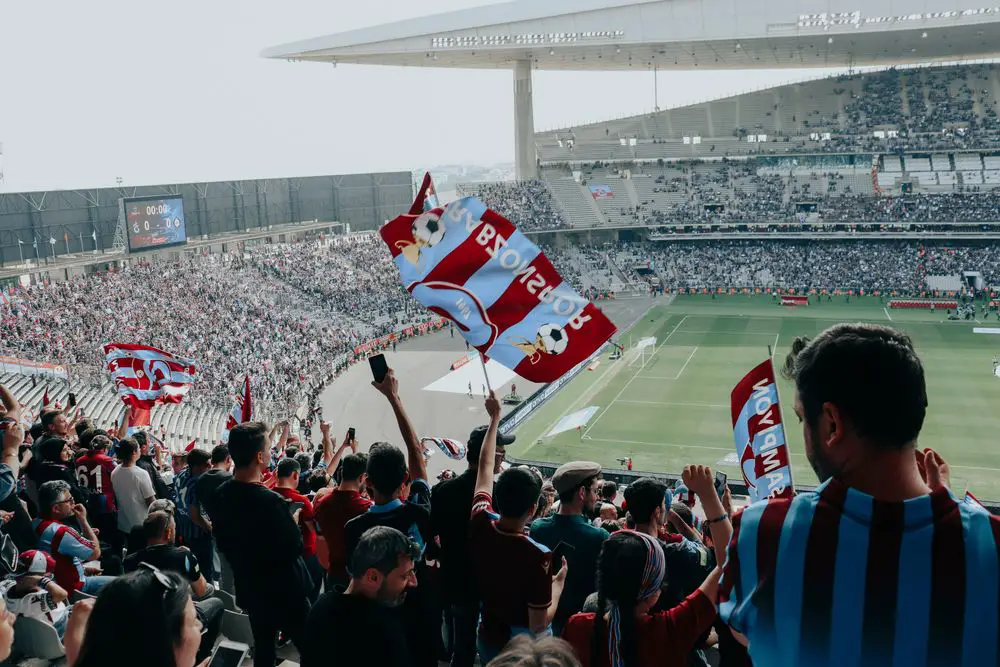
The next afternoon, Kelly carried that sign through the stadium like it was priceless, holding it against her chest between poster and body whenever we navigated a crowded section, unfolding it proudly the moment we found our seats. People noticed. A man near the concession stand gave her a thumbs-up as we passed. Another fan, an older woman a few rows over, read it and quietly said, “Sorry about your dad, kiddo,” and Kelly answered the same way every single time someone commented on it that day.
“Thanks. He would’ve loved this.”
Our seats were close enough to the field that we could watch warmups clearly, and Kelly narrated everything happening below us with the same fierce expertise she’d once reserved for the living room couch.
“That’s Marcus,” she said, pointing. “Mom, he’s Dad’s favorite player.”
“I know.”
“No, you don’t.”
“I’ve heard the name,” I said, and she gave me a look that made it clear my familiarity fell well short of her standards.
“Mom, he’s Dad’s favorite player,” she repeated, more slowly, as though I might have missed the significance the first time.
“I knew that part,” I said, though honestly, my knowledge extended only slightly further, a fact I didn’t bother explaining.
Marcus was a veteran wide receiver, someone Austin had owned the jersey of and had also spent an absurd amount of time defending during a rough season two years earlier, arguing with the television whenever sports commentators questioned whether the team should trade him. Kelly knew every single warmup drill happening on the field below before I understood anything about what was going on.
Then Kelly stood up near the railing separating our section from the field, holding her sign up high enough that it caught the afternoon light.
Marcus jogged past once during warmups. Then stopped. He looked up toward the stands, and Kelly went incredibly quiet as they made eye contact, her sign held perfectly still.
He read it. Then read it again.
“He’s pointing at me,” Kelly whispered, though he was pointing directly at her, unmistakably, his finger extended toward exactly where she stood.
She looked at me. “Mom.”
“I see him.”
“He’s pointing at me.”
“I see that too.”
Marcus picked up a football from a nearby equipment cart, gestured once more toward Kelly to confirm he’d understood her sign correctly, and then he tossed it, a smooth, easy arc that carried it directly over several rows of reaching adult hands. Several people around us instinctively reached upward, that automatic reflex crowds get whenever a ball comes anywhere near them, but a man sitting behind us yelled, “For the kid!” loud enough to cut through the noise, and everyone’s hands dropped away.
The ball dropped straight into Kelly’s arms. She caught it against her chest, and for one second, she didn’t make a sound at all, simply stood there frozen, staring down at the ball like she couldn’t quite believe it was real.
Then she screamed. “Mom!”
She was laughing and crying at the same time, the ball clutched tight against her small chest. “Mom, look!”
“I see it,” I said, my own eyes filling despite myself.
“Daddy would’ve gone crazy!” she shouted.
“He would’ve told everyone he caught it himself,” I said, laughing through tears, and Kelly laughed too, hard enough that she had to sit down, hugging the football against her.
Then a hand came across in front of me.
A woman beside us reached over, pulled the football directly out of Kelly’s arms, and handed it to the teenage boy sitting next to her.
Kelly gasped, her hands still curved in the shape of holding something that was no longer there.
I stared at the woman. “What are you doing?”
She adjusted her coat, entirely unbothered. “He’s been playing football for three years. My son should have it.”
I thought I’d genuinely misheard her. “Excuse me?”
“He threw it into the crowd,” she said. “Ethan here has a right to it.”
Her son, maybe fourteen, held the football but wouldn’t look at either of us, his expression somewhere between uncomfortable and mortified.
I stood up. “That player threw the ball to my daughter.”
The woman rolled her eyes, entirely unmoved. “He threw it into the crowd. It’s fair game.”
“He pointed at her first,” I said, my voice rising despite my effort to stay calm.
“So?” the woman said.
I could see tears welling in Kelly’s eyes, threatening to spill over, and she whispered, “Mom,” in a small, uncertain voice that changed something in me immediately, some protective instinct snapping fully into place.
I held out my hand toward the woman. “Give it back.”
She laughed once, sharp and dismissive. “No.”
“Give my daughter her football.”
“Girls don’t understand football,” she said. “My son deserves it more.”
“Why?” I demanded.
“Because he actually plays,” she said, glancing dismissively at Kelly’s sign, still clutched in her other hand. Then she said something I still, months later, cannot fully believe an adult said out loud to a grieving eight-year-old girl at a football stadium.
“It’s not like this really matters. She’ll forget about this tomorrow.”
A man behind us said, loud and incredulous, “Lady, seriously?”
Her son looked like he genuinely wanted to disappear into the concrete beneath his seat. The woman ignored all of it entirely, nodding toward Kelly. “Buy her a doll or something.”
I held out my hand again. “Give it back.”
Then the people sitting behind us started shouting, though not at her, not at any of us.
Toward the field.
I turned to look. Marcus was staring directly at our section, and he wasn’t smiling anymore. He pointed toward Kelly, then toward the football now sitting in Ethan’s hands, his expression unmistakably serious. A team staffer standing near the sideline followed his gesture, glancing between Marcus and our section with visible confusion.
Then Marcus reached for a microphone one of the staffers offered him.
“I threw that ball to the little girl holding the sign,” he said, his voice carrying clearly through the stadium speakers.
The general stadium noise dipped noticeably. Kelly grabbed my hand, squeezing my fingers so tightly my knuckles actually ached.
“The young man holding it knows who it belongs to,” Marcus continued, looking directly toward our section.
A second later, the giant screen above the field changed. There we were, magnified for the entire stadium to see. Kelly. Me. The woman beside us. And Ethan, standing there holding the football, his expression caught somewhere between confusion and dawning horror.
His mother’s mouth shut tight the instant she saw herself on the screen. “Ethan,” she whispered.
He looked up at the screen, then back at Kelly.
A man behind us laughed in disbelief. An usher and a security officer appeared at the end of our row within moments.
The woman pointed at me immediately. “She’s been harassing me.”
The same man behind us laughed again, louder this time. “Lady, the whole stadium just heard him.”
The security officer looked at Ethan, waiting. His mother started, “It went into the—”
“Mom,” Ethan said, cutting her off.
“Stop,” he said, still staring at the football in his own hands.
Her face changed, something between disbelief and dawning defeat. “Ethan—”
“I was trying to help you,” she said.
“He threw it to her,” Ethan said. “I didn’t ask you to take it.”
“You said you wanted a game ball,” she protested.
“Not hers,” he said.
Then he stood up, walked past his own mother, and crossed toward Kelly, holding out the football.
“I’m sorry,” he said.
Kelly hesitated for a moment before taking it back from him, cradling it carefully.
“It’s okay,” she said.
Ethan shook his head. “No, it isn’t.”
His mother’s face went entirely red, though she said nothing further. I glanced toward the field and saw Marcus give Ethan a small, approving nod before the stadium screen switched back to the ongoing warmup feed.
The usher bent toward me. “Would you and your daughter stay here for a minute?”
I frowned, confused. “Why?”
He glanced toward the field. “Someone asked to see her after warmups.”
Kelly’s eyes went wide. “Mom.”
“I heard him,” I said, barely able to process what was happening myself.
A few minutes later, the same usher returned and led us down a concrete hallway beneath the stadium seating, Kelly holding the football against her chest the entire way, her steps quick and eager beside mine.
“Am I in trouble?” she asked at one point.
“No.”
“Are you sure?”
“Mostly,” I said, and when her eyes widened further, I added quickly, “I’m kidding.”
A door opened near the tunnel leading to the field, and Marcus was standing there waiting.
Kelly stopped walking entirely. “Oh my God.”
Marcus smiled at her. “Hey.”
She hid halfway behind me, suddenly shy in a way I rarely saw from her.
“I saw your sign,” he said, crouching down so he was closer to her eye level. “You’re Kelly, right?”
She nodded, her fingers tightening around mine.
“What was your dad’s name?” Marcus asked, gently.
“Austin,” Kelly said.
Marcus nodded slowly. “My dad taught me football too. Everything I knew as a kid.”
Kelly looked up at him, surprised. “He did?”
“Sounds like Austin knew what he was doing,” Marcus said, glancing briefly at me.
“My dad explained penalties because Mom doesn’t understand them,” Kelly said, entirely matter-of-fact, and Marcus laughed, a warm, genuine sound.
“Sounds like Austin knew what he was doing,” he said again, and Kelly smiled properly this time, some of her shyness fading.
He pulled a marker from his pocket. “Can I see that?” he asked, nodding toward the football.
She handed it to him without hesitation.
“Usually I just sign my name,” he said, uncapping the marker. Then he looked at me. “How do you spell Austin?”
My throat tightened immediately. “A-U-S-T-I-N.”
He wrote beneath his own signature, careful and deliberate, and then handed the ball back to Kelly.
She read it, her lips already starting to tremble.
For Kelly and Austin — keep cheering together.
She traced Austin’s name twice with one finger before hugging the ball tightly against her chest again, and then she cried, full, unrestrained eight-year-old crying, the kind that comes from somewhere deep and doesn’t care who’s watching.
Marcus looked briefly panicked. “Good tears?”
Kelly nodded hard, still crying. “Good tears.”
I was crying too by then, unable to hold it back any longer. “Thank you,” I managed.
Marcus smiled. “Actually, if Mom says it’s okay, I’ve got another question.”
Kelly wiped her cheeks quickly. “What?”
“You want to stand by the tunnel for introductions?”
Her mouth dropped open entirely. She looked at me. “Mom.”
I laughed, wiping my own eyes. “Yes.”
“Mom!”
“I said yes.”
When the team ran out onto the field a short while later, Kelly screamed so loudly, standing right there at the edge of the tunnel with Marcus’s team, that I genuinely thought she might lose her voice entirely by the end of the day. She held the signed football against her chest the whole time, and for a little while, standing there in that roaring stadium, she wasn’t crying because she missed Austin.
She was crying because something good had happened, something entirely her own, and I understood, watching her, that this particular kind of tears mattered just as much as the other kind, maybe more.
After the game, making our way back through the crowded concourse, we passed Ethan standing several feet from his mother, who was on her phone, apparently already deep in some other conversation entirely. He lifted one hand toward us.
“Hey,” he said.
Kelly stopped, still hugging the football against her chest.
“I’m sorry again,” he said.
“You already said that,” Kelly told him.
“I should’ve given it back right away,” he said. “I know.”
He shoved his hands into his jacket pockets, looking younger suddenly, uncertain in a way that made him seem less like the boy who’d taken her football and more like a kid who genuinely felt bad about it.
Kelly considered this for a moment. “Probably. But I would have hesitated as well,” she said, with the kind of blunt, generous honesty only a child can offer.
I almost laughed despite myself.
Ethan smiled, a little relieved. “I hope the rest of your day goes smoother.”
“Thanks,” Kelly said.
Then we kept walking, and that, somehow, felt like enough, a small, imperfect resolution that didn’t need to be anything grander than it was.
That night, Kelly put the football carefully on our coffee table, positioned exactly so the signatures faced up. She draped Austin’s jersey over his old chair, the way she did every Sunday by then, and then she sat there for a while, staring at both, the ball and the jersey, quiet in the particular way I’d learned to recognize as her processing something rather than simply being sad.
“You okay?” I asked.
She nodded. “Dad would’ve been jealous.”
“Extremely,” I agreed.
“He would’ve touched the ball too much,” she said.
“Definitely,” I said, and she smiled, small and genuine.
Then she looked down at the writing on the football again, tracing Austin’s name once more.
“Mom?”
“Yeah?”
“Do you think Dad saw?”
I knew exactly what she meant. The game. The sign. Marcus. All of it, every improbable, beautiful piece of that afternoon.
I sat down beside her on the couch. “I don’t know,” I said honestly. “I hope so.”
“So do I,” she said.
A few weeks later, Kelly wrote Marcus a thank-you letter, sitting at the kitchen table with far more care than she usually gave her actual school assignments, asking me twice how to spell certain words correctly. At the bottom, she added one sentence in her own careful handwriting.
The ball is beside my dad’s jersey now. I think he’d like that.
We mailed it to the team’s public relations office, and I honestly don’t know whether it ever reached him personally, though I’d like to think it did.
Then life kept moving, the way it eventually does, even through grief, even through the particular, jagged process of learning to live around an absence rather than waiting for it to disappear entirely.
Sunday football still feels different than it used to, before Austin, and it probably always will. Austin’s chair is still there in our living room, and Kelly still drapes his jersey over it before kickoff, an unbroken ritual now going on well over a year. The signed football stays permanently on the coffee table, moved only for cleaning and always replaced in exactly the same spot afterward.
Last Sunday, I sat at the far end of the couch while Kelly watched a replay of a close game from earlier that week, the way she’d started doing whenever the actual live game didn’t hold enough drama for her particular taste.
“Dad would’ve explained this play to you already,” she said, not looking away from the screen.
“Sit closer,” she added, patting the cushion beside her without turning her head.
“I’m comfortable,” I said.
She patted the cushion again, more insistently. “Dad would’ve explained this play to you already.”
I moved over anyway, settling closer to her. “Fine. Explain it.”
Kelly pointed at the television. “Okay. Watch the safety.”
“The person who stops people from being safe?” I asked, and Kelly stared at me for a long moment before laughing, hard, the same full laugh Austin used to have.
“That was when I was six,” she said. “That is not what a safety does.”
“Then educate me,” I said.
“I remember important things,” she said, still laughing, and then she started explaining coverage and routes with the same fierce, patient seriousness Austin used to bring to those same explanations, and I realized, sitting there beside her, that she was teaching me now, exactly like he once taught her.
I understood maybe half of what she was explaining. But I watched her face while she talked, animated and sure of herself, entirely in her element.
I looked once at Austin’s empty chair, the jersey draped carefully over its back.
Then back at Kelly.
For the first time since he died, the empty place beside us wasn’t the only thing I could see.

Specialty: Emotional Turning Points
Rachel Monroe writes character-driven stories about betrayal, second chances, and unexpected resilience. Her work highlights the emotional side of family conflict — the silences, the misunderstandings, and the moments when someone quietly decides they’ve had enough.