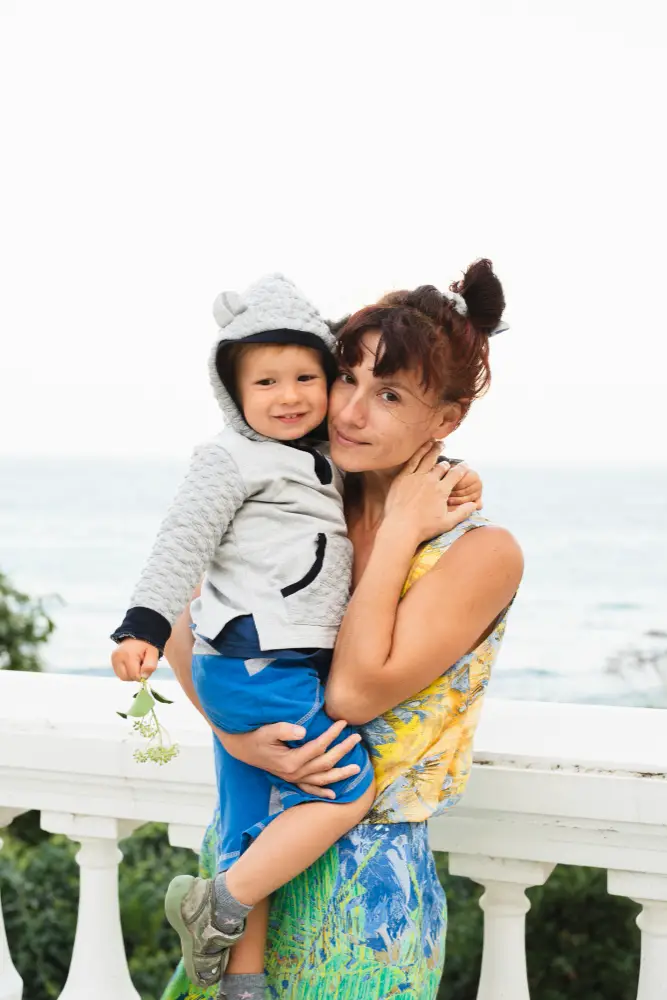
The knock came while Ivy was still wrapped in a hotel towel, sand stuck to her ankles, her hair dripping salt water onto the carpet.
“Room service?” she asked me hopefully.
“We didn’t order room service, baby.”
I opened the door.
A man in a gray suit was standing in the hallway. He was maybe sixty, with neat white hair and a name tag on his jacket that said T. ASHBY, MANAGER. He was holding a small wooden box wrapped in brown paper and tied with string.
He looked nervous. Hotel managers aren’t supposed to look nervous.
“I’m sorry to disturb you, ma’am,” he said. “But there’s something about this trip you don’t know.”
I didn’t move.
“I was asked to give this to you and Ivy personally,” he said. “The person who asked me was very specific about that.”
He held out the box.
Behind me, Ivy was hopping from one foot to the other on the carpet. “Mommy, what is it? Is it a present? Is it for me?”
I took the box. It was light. The paper was soft, like it had been wrapped and unwrapped more than once.
I didn’t know it yet, but inside that box was the end of the life I thought I’d been living for twenty-two years.
My name is Renata. I’m twenty-six years old, and I’m a single mom.
My daughter, Ivy, was six when the doctor sat us down in a small room with a box of tissues on the table and a poster about hand-washing on the wall.
I remember the tissues. I remember thinking, Why are there tissues? Nobody needs tissues for good news.
The doctor was a tall woman named Dr. Pryor. She had kind eyes and a quiet voice. She looked at Ivy’s scans on her computer for a long time before she turned the screen away from us.
Then she sighed.
That sigh. I knew before she said anything.
“I’m so sorry,” she said. “This is incredibly hard to say. But treatment can only slow things down now. It can’t stop them.” She paused. “She may have less than a year.”
Ivy was in the hallway with a nurse, picking out a sticker. I could hear her through the door, asking if they had any with dolphins.
I sat very still in that plastic chair.
My heart didn’t break the way they say it does in movies. It didn’t shatter into a million pieces. It was quieter than that. It felt more like something inside me just stopped. Like a clock that had been ticking my whole life suddenly went silent.
“Stage four,” Dr. Pryor said gently. “It’s spread to her bones and her liver. I’m so sorry, Renata.”
I wasn’t ready to hear it.
But who could ever be ready for something like that?
We tried everything.
Chemo first. Then a clinical trial two states away, where I slept in a motel room with a broken air conditioner for three weeks while Ivy got an experimental drug through a tube in her chest. Then a second opinion from a famous doctor in a big city hospital, who gave us the exact same news in much gentler words.
I prayed every single night. I’m not even that religious. But I got down on my knees on the cold floor next to her hospital bed and I begged anyone who might be listening.
I started doing math I never wanted to learn. Sitting in waiting rooms, counting months. If she has eleven months, that’s Christmas. If she has nine, that’s not. If she has seven, that’s not even Halloween.
My calendar used to have normal things on it. School registration. A dentist appointment. Summer camp sign-up.
Now it was full of scans.
The only family I have besides Ivy is my father, Samuel.
My mother died when I was four. At least, that’s what I believed.
Dad raised me by himself after that. He was a mailman for thirty-one years, and he never missed a single one of my school plays, even the one where I was a tree and didn’t have any lines.
Ivy adored him.
She called him Grandpa Sam, and when she was really little, she called him Grandpa Ham, and he answered to both.
When she started chemo, Dad came to almost every session. He’d sit in the ugly vinyl chair next to her bed for hours and read to her. His reading glasses would slide down his nose, and he’d push them back up with one finger, and he did all the voices. Every single one. The witch. The prince. The talking crab.
“Do the crab again, Grandpa,” Ivy would say.
“I’ve done the crab four times.”
“Do it five.”
He did it five.
Her favorite story was The Little Mermaid. She’d make him read it twice in a row sometimes. She loved anything about the ocean. She had ocean pajamas and an ocean nightlight and a stuffed dolphin named Bubbles that went to every single appointment.
She’d never actually seen the ocean.
We live in the middle of the country. The closest ocean is a thousand miles away. We’d never had the money to go.
One afternoon in October, Ivy was lying in the hospital bed after a hard chemo session. She was pale and tired and her hair was mostly gone by then. She was holding Grandpa Sam’s hand.
“Grandpa,” she said quietly. “I wish I could see the ocean myself someday. The real one. Not just the pictures in the books.”
Dad didn’t say anything. He just squeezed her hand.
But I saw his face.
Later that night, in the hospital parking lot, he stopped me by my car.
“Renata,” he said. “Take her.”
“Take her where?”
“To the ocean.”
I laughed. It wasn’t a happy laugh. “Dad, I can barely pay the hospital bills. I’ve maxed out two credit cards. I can’t—”
“I’ll pay for it,” he said.
I stared at him.
My father has never been a man who pays for things. Not because he’s cheap. Because he never had much. He lives in the same small house I grew up in. He drives a car from 2004. He clips coupons.
“Dad, that’s thousands of dollars.”
“I have some savings,” he said. “It’s what they’re for.”
“What are you saving them for? Your retirement? Your—”
“Please, Renata.” His voice cracked. “Even if it’s only for a few days. Please. Take her so she can see the ocean.”
I didn’t understand why it mattered so much to him. Not then. I thought he was just a grandfather who loved his granddaughter.
Later, I understood exactly why that trip meant more to him than any gift he’d ever given me.
Dr. Pryor gave us careful permission to travel. A short trip. No more than a week. A list of emergency hospitals near the coast. A bag full of medications and a letter explaining everything, in case anybody at the airport asked.
“Go,” she said, and hugged me, which she’d never done before. “Go make a memory.”
Dad picked the place. A little town on the coast called Driftwood Bay. He booked us a room at a hotel called the Marlow Coast Inn.
“Why there?” I asked. “It’s so small. There are bigger beaches.”
He was quiet for a second.
“I’ve heard it’s nice,” he said. “Quiet. Good for her.”
I didn’t think about it again.
We flew out on a Thursday in early November. Ivy had never been on a plane. She pressed her face to the window the whole time and narrated everything. That cloud looks like a bunny. That cloud looks like a bunny eating a sandwich. That cloud looks like Grandpa.
We landed. We took a taxi. We checked into the Marlow Coast Inn, which was an old white building with blue shutters, right on the beach. We dropped our bags in the room.
And then I took my daughter to the ocean.
She saw it before I did.
We came over the top of a little sand dune, and she stopped. Just stopped. Her mouth fell open.
The ocean was right there. Huge and gray-blue and moving, spreading out forever until it touched the sky. The waves came in with a long, low sound, like something breathing. The air smelled like salt.
Ivy didn’t say anything for a long moment.
Then she screamed. Not a scared scream. The happiest sound I’d ever heard her make.
And she ran.
She hadn’t run in months. The chemo made her so tired she could barely walk to the bathroom some days. But she ran down that beach like she’d been saving up every bit of energy she had just for this.
She ran straight into the water, sneakers and all. A wave came in and hit her knees and she shrieked and ran backwards. Then she ran right back in. She splashed. She kicked. She fell down on her bottom in the wet sand and laughed so hard she couldn’t get back up.
“Mommy! Mommy! It’s so big! It’s bigger than the book!”
I stood at the edge of the water with her jacket in my arms and watched her.
This small, sick, bald, joyful girl, running into the waves like she’d been waiting her whole short life for this exact moment.
For a few minutes, just a few, I let myself forget everything else. The scans. The math. The calendar.
It was just my daughter. And the ocean.
It was the happiest I’d seen her since the day of the tissues.
We stayed on the beach until her lips turned blue and I made her come inside.
Back in the room, I was trying to get the sand out of her ears with a washcloth when the knock came.
And Mr. Ashby handed me the box.
I sat on the edge of the bed and untied the string. I unfolded the brown paper. Inside was a small wooden box with a hinged lid. Old wood, dark and smooth.
Ivy climbed up next to me, still in her towel.
I opened the lid.
And I went completely still.
Inside, on a folded piece of soft white cloth, sat a pair of tiny baby shoes.
Old. Worn soft. Pale pink leather, gone a little gray with age. Each one had a single small pearl button on the strap.
I knew those shoes.
My father kept a photograph on his nightstand my whole life. A black-and-white picture of a baby sitting on a blanket on a beach. Me. The baby was wearing these exact shoes. The pink ones, with the pearl buttons.
I had looked at that photograph a thousand times.
The shoes were smaller than I remembered from the picture. Tiny. They fit in the palm of my hand. The kind of thing a mother would choose carefully, in a store, for a daughter she loved.
Tucked into one of the shoes was a small folded card.
My hands started shaking.
I unfolded it.
On the front, in blue ink, it said: For Renata and Ivy.
I turned it over.
On the back, there was just one line, and a signature.
I never stopped. All my love, Mom.
I hadn’t seen that handwriting in twenty-two years.
But I knew it. The way you know your own name. It was the handwriting on the back of the few photographs Dad kept of her. The handwriting in the cookbook in our kitchen, with little notes in the margins. Too much salt. Samuel likes this one.
My mother’s handwriting.
My mother, who died when I was four.
Mr. Ashby was still standing in the doorway. He must have seen the color leave my face.
“Ma’am?” he said. “Are you alright?”
I couldn’t answer him.
“Mommy,” Ivy said, tugging my sleeve. “Who’s it from?”
“I don’t know yet, sweetheart,” I said. My voice barely worked.
I grabbed my phone off the nightstand. My fingers were shaking so badly I dialed the wrong number the first time. I tried again.
Dad picked up on the second ring.
“Renata? Did you make it? Did she see it? Did she—”
“Dad,” I said. “There’s a box here. The hotel manager gave it to me. Baby shoes. My baby shoes. From the picture.”
Silence.
“And a card,” I said. “Signed by Mom.”
The silence on the line went on and on.
“Dad. Answer me.“
I heard him take a breath. A long, shaky breath.
“I need to tell you something,” he said finally. “Something I should have told you twenty-two years ago.”
“Tell me the truth. Right now.”
“Your mother isn’t dead,” he said.
I didn’t say anything.
“She never died, Renata. I lied to you. I’ve been lying to you your entire life.”
The whole hotel room tilted.
I sat down hard on the edge of the bed. I didn’t remember standing up. Ivy’s small hand was still gripping my sleeve. I was pressing the phone so hard against my ear that hours later, I noticed a red mark on my cheek.
“That’s not possible,” I said. “I remember the funeral. I remember it. I was wearing a black dress with a white collar. I held your hand. There were lilies.”
“You remember a funeral I set up,” my father said. His voice was very quiet. “A closed casket. There was nobody in it.”
“Stop.”
“It was weighted. Like everything else about that lie.”
“Stop,” I said. “Why? Why would you do that? To me? To us?”
He didn’t answer right away.
When he did, his voice sounded older than I’d ever heard it.
“Your mother got sick,” he said. “After you were born. Not the kind of sick you could see. The doctors called it postpartum psychosis, eventually. But by the time anyone had a name for it, things had gone much too far.”
I didn’t say anything.
“It got worse over the years. Not better. She’d have good months, and then bad ones. She heard voices. She believed things that weren’t true. Some days she didn’t know who I was. Some days she didn’t know who you were.” He stopped. “She wasn’t safe to be around you, Renata. Some days she wasn’t safe around herself.”
And suddenly, sitting on that hotel bed, I remembered things.
Fragments. Pieces I’d always thought were dreams.
A woman’s voice, singing something off-key in a dark hallway. A song I didn’t know the words to.
A door that was locked from the outside.
My father’s hands, shaking, as he carried me through the dark to the car in the middle of the night. The smell of his coat. His voice saying, It’s okay, it’s okay, we’re just going to Aunt Carol’s for a little while.
I’d spent twenty-two years thinking those were nightmares.
They were memories. All of them.
I pressed my hand over my mouth.
Ivy’s small hand found my other hand and held on.
“She tried to hurt you once,” my father said. “Not on purpose. It wasn’t really her anymore, by then. I came home from work early and I found you both in the bathtub. The water was too high. Way too high. You were crying. And she was talking to someone who wasn’t there. Laughing. Talking to the wall.”
I closed my eyes.
“I got you out,” he said. “You were fine. You were fine. But I panicked, Renata. I was so scared. And I made a decision that night that I’ve spent twenty-two years telling myself was the right one.”
“You could have told me the truth,” I said. “Instead of a grave. Instead of a funeral I cried at. Instead of every single year on her birthday, standing at that stone, putting flowers down on nothing.”
“I know,” he said. His voice broke. “I stood at that grave with you every year. Every single year, Renata. Do you know what that did to me? Watching you grieve somebody who was alive and breathing two hours away?”
“Then why didn’t you stop it? Any year. Any single year, you could’ve told me.”
“Because every year made it harder,” he said. “The lie got heavier the longer I carried it. Not lighter. I kept saying, next year. When she’s older. When she’s in high school. When she’s out of college. When she’s settled. When the baby’s born.” He took a ragged breath. “There was never going to be a good time. I understand that now.”
“You thought a dead mother was kinder?”
“Yes,” he said quietly. “I thought a dead mother was kinder than a mother locked in a hospital. I thought you deserved to grieve something that was finished. Not something ongoing. Something scary and complicated that you’d have to visit on weekends through a glass window.” He paused. “I was wrong. I’ve known I was wrong for years. I just never figured out how to undo it.”
“Where is she now?” I asked. My voice was flat. I didn’t feel anything. It was like all my feelings had been unplugged.
“She’s stable,” he said. “She’s been stable for a long time. Medication that actually works now. Therapy. She lives in a small apartment two hours from Driftwood Bay. She’s not the woman I found in that bathtub anymore. She’s been asking about you for years.” He hesitated. “I kept telling her you weren’t ready.”
“How long?” I asked.
“How long what?”
“How long has she been stable?”
He was quiet for a very long time.
“Fifteen years,” he said finally. “Maybe more.”
That one hit harder than anything else he’d said.
Fifteen years.
Not the illness. Not the bathtub. Not the terrible night.
Fifteen years of her being well. Fifteen years she could have been my mother. Fifteen years of Christmases and birthdays and my high school graduation and Ivy’s birth.
And he’d kept us apart for all of it.
“You decided that too,” I said. “Same as you decided everything else.”
“Yes,” he said. “I did.”
“Why now? Why send the shoes now?”
“Because Ivy is running out of time,” my father said. And for the first time in the whole conversation, his voice broke completely. “Because your mother found out about the diagnosis, and she said, If there’s ever going to be a right moment, it has to be before it’s too late for either of them to know each other at all.“
“How did she find out? About Ivy?”
“I told her,” he admitted. “I’ve kept her updated. For years. From a distance. Photos. School pictures. Your report cards. Your wedding—”
“I didn’t have a wedding.”
“The one you almost had,” he said quietly. “With Tom. I sent her the engagement photo.”
I didn’t know whether to laugh or scream.
“She’s never once tried to contact you,” Dad said. “She made me promise, a long time ago, that if you ever reached out, it had to come from you. When you were ready. She said she’d already taken too much from you without meaning to. She wasn’t going to take your choice too.”
“So she’s seen pictures of me my whole life,” I said slowly. “And of Ivy.”
“Every school photo. Every holiday card. She kept them all.” He almost laughed. “She has more of your childhood in albums than I do, honestly.”
“That’s not fair,” I said. “You made that decision for both of us. Twenty-two years ago. You never once asked me what I wanted.”
“I know,” he said. “I’ve had a long time to sit with how unfair that was.”
“Did you pick this hotel on purpose?”
He didn’t answer.
“Dad.“
“The photograph on my nightstand,” he said. “The one of you in the pink shoes. It was taken on that beach. Right in front of that hotel. It was the last good summer. Before she got really sick. We stayed at the Marlow for a week. You were nine months old.”
I looked out the window at the gray ocean.
“I need to think,” I said. “Don’t call me again tonight.”
I hung up before he could answer.
Mr. Ashby cleared his throat quietly in the doorway. I’d forgotten he was there.
“I’ll leave you two alone,” he said. “I’m very sorry to have been the one to deliver something so difficult.”
“It’s not your fault,” I said. I barely heard myself say it.
He nodded. He hesitated in the doorway another moment, like he wanted to say something comforting and couldn’t find the words.
“She stayed here last week,” he said finally. “Your mother. She came in and asked me if she could leave something at the front desk for a guest arriving on Thursday. She sat in the lobby for two hours after that. Just looking at the water.” He paused. “I thought you might want to know that.”
Then he closed the door very gently behind him.
I sat on that hotel bed for a long time, the open box in my lap.
Ivy climbed up beside me, still in her towel. She leaned against my arm. She was small and warm and she smelled like salt water.
“Mommy,” she said. “Are you sad?”
“I’m something,” I said. “I don’t have a word for it yet.”
“Is it about Grandma?” she asked. “The one who died? In the story?”
I looked at my daughter.
Six years old. And already she knew more about losing things than any child should ever have to. She knew words like port and platelets and remission. She knew what the inside of an MRI machine sounded like. She knew that when grown-ups used gentle voices, it meant bad news.
And I realized I had a choice to make that night.
I could lie to her. The way my father had lied to me. Tell her it was nothing. Tell her the box was a mistake.
Or I could tell her the truth.
“Grandma didn’t die, baby,” I said slowly. “That’s what I just found out. She’s been alive this whole time. She was sick. In a different way than you’re sick. In her brain, not her body. But she’s better now.”
Ivy’s face went through about six different expressions all at once.
“So I have a grandma I never met?”
“You do,” I said. “If you want to meet her. That’s completely up to you.”
She thought about that.
“Does she like the ocean too?”
I laughed. I couldn’t help it. A wet, startled sound.
“I don’t actually know,” I said. “It turns out I don’t know very much about her at all.”
“Can I decide too?” Ivy asked. “If I want to meet her? Or is it only your decision?”
I got down on my knees on the hotel carpet in front of her. I was struck by the question. By how fast she’d understood something it had taken me an entire phone call to figure out.
Nobody had asked me. For twenty-two years. Nobody had asked me what I wanted.
“It’s absolutely your decision too,” I said. “Your feelings matter just as much as mine. Maybe more. She’s your grandma either way.”
Ivy considered this very seriously. She had a way of doing that, even when she was tiny. Thinking about things like a small old woman.
“I think I want to meet her,” she said finally. “Everybody deserves a chance to say sorry. That’s what you always tell me.”
I didn’t sleep that night.
I lay next to Ivy in the big hotel bed and listened to her breathe. In, out. In, out. Slower than it used to be. I’d started counting her breaths at night months ago. I couldn’t stop.
I thought about twenty-two years of birthdays. Every September 14th, Dad and I drove to the cemetery with a bunch of yellow roses. Mom’s favorite, he told me. We’d stand in front of the gray stone with her name on it. Eleanor Marie Cole. Beloved Wife and Mother. Dad would put his hand on my shoulder. I’d cry. Every year, I cried.
He stood there every single year and watched me cry.
Around three in the morning, I got up and went out onto the little balcony. It was cold. I wrapped myself in the hotel blanket and sat in a plastic chair and listened to the ocean in the dark.
A few hours ago, that ocean had been the most beautiful thing I’d ever seen. Just beautiful. Simple.
Now it felt like something else. Something with things hidden under the surface.
I wondered how many other lies were sitting quietly in my life. Just under the waves. Waiting for their own hotel manager to knock on the door.
By morning, I’d made up my mind.
I called my father at seven.
He answered on the first ring. I could tell he hadn’t slept either.
“I want to meet her,” I said. “Not for me. For Ivy. Ivy doesn’t have time to wait for me to work through twenty-two years of anger first.”
“I’ll arrange it,” my father said. His voice was rough. “Renata. I am so sorry.”
“I know,” I said. “That doesn’t fix it. But I heard you.”
My mother’s name was Eleanor.
I hadn’t let myself say that name in years. Not really. Not as a real woman. She’d been a name on a stone. A handwriting in a cookbook. A face in five photographs.
Now she had an address. A phone number. A voice.
She would come to the Marlow Coast Inn in two days. My father would drive her.
I spent those two days trying to get Ivy ready. I didn’t know how to explain it. How do you explain to a six-year-old that some sicknesses live in your mind instead of your body?
We sat on the beach and built a lopsided sandcastle, and I tried.
“So her brain got sick,” Ivy said slowly. “Kind of like my body did.”
“Kind of like that.”
“And it made her do scary things. But she didn’t mean to.”
“She didn’t mean to.”
“And then she took medicine and got better.”
“A lot of medicine. For a long time.”
Ivy patted the side of her sandcastle with her small hand.
“That makes sense,” she said. “I’m not scared of her.”
I looked at my daughter. She’d had more medicine in six years than most people have in their whole lives. She knew exactly what it felt like to have your body do things you didn’t choose.
“I know you’re not,” I said.
I called my father twice more during those two days.
They were small, careful conversations. Nothing like the first one. Both of us testing the ground, the way you’d step onto a frozen pond. Checking if it would hold.
“Thank you,” I told him on the second call, “for not pushing me. For letting me decide on my own time.”
“I’d wait as long as you needed,” he said. “I already took twenty-two years I shouldn’t have. A few more days felt like the least I could do.”
She arrived on a Sunday afternoon.
I was standing in the lobby of the Marlow Coast Inn. Ivy was upstairs in the room, resting. I wanted to see my mother first, alone. I wanted to make sure. I don’t know what I needed to make sure of. That she was real, maybe.
My father’s old car pulled up out front.
He got out first. He looked terrible. Gray-faced and tired, like he’d aged ten years in four days. He looked at me through the glass doors and didn’t come in.
Then the passenger door opened.
And a woman got out.
She was small. Much smaller than I remembered, or maybe I’d just grown. She had short gray hair and wore a plain blue cardigan and dark pants. She was holding her purse in front of her with both hands, tight, like it was the only thing keeping her standing up.
She came through the doors and stopped in the middle of the lobby.
She looked at me.
She looked like someone who’d practiced this moment a thousand times and still didn’t trust herself to get through it.
“Renata,” she said.
My name came out of her carefully. Like something fragile. Like something she wasn’t sure she still had permission to hold.
“Mom,” I said.
I hadn’t said that word out loud to a living person in twenty-two years. It felt strange in my mouth. Like a word in a foreign language.
We didn’t hug.
We just stood there, a few feet apart, in the middle of that hotel lobby. Two women separated by a lie neither of us had asked for. People walked around us with suitcases. Somebody laughed at the front desk. A phone rang.
Nobody knew anything enormous was happening at all.
“I don’t expect you to forgive me,” Eleanor said. “I don’t think I’ve earned that. Not yet. Maybe not ever.” Her hands tightened on her purse. “I just wanted the chance to know you. Both of you. Before it’s too late for one of us.”
“That’s a lot to ask,” I said. “Given everything.”
“I know,” she said. “I’m not asking for anything more than that today. Just the chance. Whatever you’re able to give.”
I studied her face.
I was looking for the woman in my nightmares. The one who sang off-key in the dark hallway. The one who talked to the wall.
I didn’t see her.
I just saw a small, frightened, gray-haired woman in a blue cardigan, trying very hard not to cry in a hotel lobby.
I brought her up to the room.
Ivy was sitting cross-legged in the middle of the big bed in her ocean pajamas, with Bubbles the dolphin in her lap. She’d put on a little knitted hat to cover her bald head. She’d insisted on it.
“I want to look nice for Grandma,” she’d said.
She watched Eleanor walk into the room with wide, open, curious eyes.
“Ivy,” I said. “This is your grandma. Eleanor.”
Ivy looked at her for a very long moment.
“You look like the lady in Mommy’s old picture,” she said finally. “The one on the beach.”
Eleanor’s eyes filled up instantly.
“That picture was taken right here,” she said. Her voice shook. “This beach. A long time ago. Before everything happened.”
“You look sad when you say that,” Ivy said. She said it the way she said everything, very direct, like she was reporting the weather. “Are you sad about the picture? Or about something else?”
Eleanor laughed. A small, surprised laugh, right through the tears.
“Something else, mostly,” she said. “You’re a very smart little girl for noticing.”
“Will you tell me a story?” Ivy asked.
It was such a brave thing to ask a stranger. Only a six-year-old could do it that easily.
“Grandpa tells me The Little Mermaid,” Ivy said. “Do you know it?”
Eleanor looked at me. I nodded.
She sat down very carefully on the edge of the bed.
“I know a different version,” she said. “Would you like to hear mine?”
Ivy nodded so hard her little hat fell over one eye.
Eleanor told the story.
And her voice found some old rhythm. Something slow and soft and steady. I didn’t recognize the words, but I recognized the sound. Something buried deep. Deeper than twenty-two years.
In her version, the mermaid didn’t lose her voice to a witch.
She lost it to a sickness.
A sickness that made her say things she didn’t mean. That made her frighten the people she loved most in the whole world. So she went away. Deep under the waves, where nobody could get hurt while she got better.
The other sea creatures didn’t understand, Eleanor said. They thought the mermaid had just stopped loving her family. That she’d chosen to go away. Because sometimes, when a sickness lives inside somebody’s mind, people think it’s a choice. Instead of a storm that nobody chose.
It took a very long time, Eleanor said. And a lot of medicine that tasted like the bitterest seaweed. And many kind healers who understood her particular kind of storm. But finally, one day, the mermaid found her voice again.
It was quieter than before. Steadier. But it was hers.
And when she finally swam back home, her family didn’t remember her the way she remembered them.
“But the ocean remembered her,” Eleanor said softly. “And the ocean brought her home anyway. Slowly. One tide at a time.”
Ivy listened with her mouth a little open.
She had no idea she was hearing her grandmother’s confession, dressed up as a fairy tale.
But I did.
“Did she get to stay?” Ivy asked when the story was over. “The mermaid. Did her family let her stay?”
Eleanor looked at me before she answered.
“I don’t know yet,” she said honestly. “That part of the story is still being written.”
Ivy frowned. She thought about it with her whole face.
“I think she should stay,” she said. Decisively. Like a judge banging a gavel. “I think everybody deserves an ending where they get to stay. After they’ve done all the hard work of getting better.”
Eleanor didn’t say anything. I don’t think she could.
She just reached over and took Ivy’s small hand in hers. And the two of them sat there together, quiet, holding that sentence between them.
I stood by the window and watched my daughter and my mother together for the very first time in my life.
A whole relationship, squeezed into borrowed time.
And something cracked open in my chest. Something that had been sealed shut since I was four years old, standing at a funeral in a black dress with a white collar, holding my father’s hand, crying over an empty box.
That night, after Ivy finally fell asleep, Eleanor and I sat together on the little hotel balcony.
The ocean was dark. You could only hear it. That long, slow breathing.
For a while, neither of us said anything.
“I have so many questions,” I said finally. “I don’t even know where to start.”
“Start anywhere,” Eleanor said. “I owe you every single answer you want. However long it takes.”
I thought about it.
“What was I like?” I asked. “Before. As a baby. Dad barely talks about those years. There’s nobody left who remembers except you and him.”
Eleanor’s whole face changed. It went soft. Something old and tender rose up in it.
“You hated sleeping,” she said. “Oh my goodness. You screamed bloody murder every single night for the first four months. Your father used to drive you around the block at two in the morning in his pajamas. And then one day, you just stopped. You slept through the whole night like you’d been doing it your whole life.”
I laughed.
“And you loved the rain,” she said. “The sound of it on the windows. You’d point at it and babble. Like you were trying to have a conversation with the storm.”
“I still love the rain,” I said quietly.
“I know,” she said. “Your father told me. When you were twelve, you slept on the porch during a thunderstorm.”
I stared at her.
“He told you that?”
“He told me everything he could,” she said. “It was all I had.”
“I don’t remember any of the baby stuff,” I said.
“I know,” she said. “That’s part of what I lost too. The chance to be the one who remembered it for you. The way mothers usually get to.”
We sat quietly for a while.
“Tell me something harder,” I said. “About the illness. I want to actually understand it. Not the soft version.”
Eleanor was quiet for a long time. She looked out at the dark water.
“It felt like drowning inside my own head,” she said finally. “Voices that weren’t real. Being completely sure of things that made no sense. And underneath all of it, this terror. A terror I couldn’t explain to anyone, because I could barely explain it to myself.” She took a breath. “Losing you was the second tragedy. The first one was losing myself.”
We talked for almost two hours that night.
She told me about her own mother, who’d been “nervous,” which is what people called it back then. About the doctors who didn’t understand. About the hospital where she lived for three years. About the day, fifteen years ago, when a new doctor tried a new medicine, and she woke up one morning and the world was quiet for the first time in a decade.
We both cried more than once.
We both laughed too, a few times. Which surprised us every single time.
We stayed at Driftwood Bay three days longer than we’d planned.
The hotel extended our room without charging us a cent. I found out later that Mr. Ashby had quietly covered it himself.
Every morning, Eleanor and Ivy built sandcastles together.
I watched them from the balcony with my coffee going cold in my hands. I couldn’t decide if the sight of them healed something in me or just tore it open in a different shape.
Ivy was the boss. Of course she was. She directed the whole operation like a tiny, bald architect. No, Grandma, the tower goes HERE. That’s the moat. You’re standing in the moat.
Eleanor followed every instruction with real, patient delight. She didn’t hurry. She didn’t get bored. She got down on her knees in the wet sand, at sixty-one years old, and dug moats for an hour.
Every single morning, they built something big and complicated. And every single afternoon, the tide came in and washed it away. No matter how carefully they built the walls.
Ivy didn’t mind.
“We’ll just build a new one tomorrow,” she’d say.
Mr. Ashby had a daughter, a girl of eleven named Caroline, who helped at the hotel after school. She started coming down to the beach in the afternoons to help with the castles. She and Ivy became best friends in about four minutes, the way only kids can.
“Ivy says the drawbridge has to face the ocean,” Caroline reported to me one day, very seriously. “So the mermaids can come in.”
One evening, while Ivy was asleep, Eleanor told me something.
“I used to be terrified of the water,” she said. “When I was sick. The ocean felt too big. Too much like something that could swallow me whole. It took years of treatment before I could stand near it again without panicking.”
I looked at her.
“Then why did you come here?” I asked. “Knowing that?”
“Because Ivy loves it,” Eleanor said simply. “Some fears are worth standing next to. If it means being there for someone else’s joy instead of your own old wounds.”
I thought about that sentence for a long time afterward.
I turned it over and over in my mind, the same way I’d turned over those baby shoes in the wooden box.
My father came to visit twice during those extra days.
The first time, he mostly just sat with us on the beach. He barely said a word. He sat on a towel a little way off and watched Eleanor and Ivy building their castle. Like a man who wasn’t sure he’d earned the right to be part of this.
The second time, I asked him to come up to the balcony with me.
Down below, Eleanor and Ivy were building one more castle. We could hear Ivy’s bossy little voice floating up. Grandma, that’s not a turret, that’s a blob.
“I’m still furious with you,” I told him.
“I know.”
“Twenty-two years, Dad. You don’t get to undo that with one box of shoes.”
“I know,” he said. “I’m not asking you to undo it.”
“Then what are you asking?”
He looked down at his hands on the railing.
“I’m asking you to let me spend whatever time is left actually making it right,” he said. “Instead of just saying sorry once and calling it finished.”
“That’s going to take a long time,” I said.
“I have time,” he said. “I intend to use every bit of it.”
We flew home a week later than we’d planned.
Ivy was exhausted and sunburned and happier than I’d seen her since the day of the tissues. She fell asleep on the plane with Bubbles under her chin and sand still stuck in the cuffs of her pants.
Eleanor followed us home two days later.
She’d asked me, very carefully, on our last night, whether I’d mind if she moved closer. Just for a while. Just to be part of whatever time was left.
I didn’t answer right away.
“I won’t if you don’t want me to,” she said. “I mean that. I’ll go home and I’ll wait for you to call. However long it takes.”
I thought about Ivy on the beach. About the moat and the blob.
“Come,” I said.
She rented a tiny furnished apartment fifteen minutes from our house. It had one window that looked out at a parking lot. She said it was perfect.
The next few months moved in a strange, aching rhythm.
Hospital visits. Eleanor visits. More hospital visits. Ivy’s sickness moved forward, slowly, steadily, like the tide coming in. And at the same time, her relationship with a grandmother she’d known for only a few weeks grew deeper and faster than any of us expected.
Eleanor learned Ivy’s whole world, fast.
She learned that Bubbles had to come to every appointment, and that if we forgot him, we had to turn the car around, no matter how late we were. She learned which songs helped when the nausea was bad. She learned which nurses Ivy actually trusted, and which ones she just put up with. Nurse Denise was trusted. Nurse Carl was put up with, mostly because he had cold hands.
One afternoon, I found a small spiral notebook on my kitchen table. Eleanor had left it by accident.
I opened it.
It was full of notes. Page after page, in that handwriting I’d grown up seeing in a cookbook.
Ivy likes the purple popsicles, not the red. Red “tastes like medicine.”
Favorite color: ocean blue. NOT regular blue.
Scared of the MRI noise. Sing “You Are My Sunshine” but change the words to be about dolphins.
Hates when people say she’s brave. Says “I’m not brave, I just don’t have a choice.”
Wants to be a marine biologist or a mermaid. Undecided.
I sat down in a kitchen chair and read the whole thing.
She was trying to catch up. Twenty-two years of missed birthdays and Christmases, squeezed into a few months. She was writing down everything about a granddaughter she knew she wouldn’t have nearly enough time with.
I put the notebook back exactly where I found it.
I never told her I read it.
Eleanor came to every appointment she was allowed to.
She sat quietly in waiting rooms. She learned all the words. Port. Platelets. Neutrophils. She learned them the same way, decades ago, she’d had to learn the words for her own illness.
One day in December, Ivy had a very bad chemo session. She was pale and shaking and throwing up into a pink plastic tray.
Eleanor sat beside her and held the tray.
“I know what it’s like,” Eleanor told her quietly. “When your body does things you can’t control. It’s scary. And it’s not your fault. None of this is your fault. Not one single bit.”
Ivy, exhausted, sick, reached out and grabbed her grandmother’s hand.
Not mine. Eleanor’s.
And I let her.
It surprised me how easy it was to let her. I understood something that afternoon, sitting in the corner of that hospital room. Love isn’t a pie. You don’t get less of it when more people share it.
There was a boy in the room next to Ivy’s during those weeks. His name was Marcus. He was seven. He had the same kind of cancer. He had a gap in his front teeth and a collection of rubber dinosaurs that he lined up on his windowsill.
His mother was named Tanya. She and Eleanor started talking in the hallway, the way people do in those places. Two people who knew the same language.
“Your mother’s good with her,” Tanya told me one day, outside the infusion room. “Really good. You can tell she’s done this kind of waiting before. Somehow.”
I didn’t correct her.
I didn’t know yet how to explain the kind of waiting my mother actually knew.
Marcus died three weeks later.
It rippled through the whole children’s floor. The nurses cried in the break room. Somebody put one of his rubber dinosaurs on the nurses’ station counter, a green one, and nobody moved it for weeks.
Eleanor sat with Tanya for two hours the day it happened. She barely said a word. She just sat there. Present. Steady. The same quiet presence she was slowly, carefully, rebuilding with me.
That night, I sat at my kitchen table and couldn’t stop shaking.
“That’s going to be us,” I told Eleanor. “Someday soon. That’s going to be us.”
She didn’t argue with me. She didn’t tell me not to think that way.
“I don’t know how you sat with her like that,” I said. “Two hours. I couldn’t even walk past the door.”
“Because someday it might be me sitting with you,” Eleanor said quietly. “And I’d rather learn how to do it properly now. While I still have a chance to practice.”
I started therapy that same month.
Her name was Dr. Halloway. She had an office above a bakery, and it always smelled like cinnamon rolls. She had a big gray cat named Dennis who slept on the windowsill during every session and snored.
“I keep waiting to forgive my father,” I told her in one of our first sessions. “All the way. Some days I do. And then the next day, I want to scream at him about the exact same thing I screamed about last week.”
“Forgiveness usually isn’t one decision,” Dr. Halloway said. “It’s more like a practice. Some days you’ll be better at it than others. The bad days don’t undo the good ones.”
“What about my mother? Is it the same thing?”
“Different wound,” Dr. Halloway said. “Similar practice.” She leaned forward a little. “But I want to point something out, gently. You keep saying you’re trying to forgive your mother for leaving.”
“She did leave.”
“Did she?” Dr. Halloway asked. “From what you’ve told me, she didn’t leave. She was taken away. First by an illness. And then she was kept away. By your father’s decision.” She paused. “Those are very different things to forgive.”
I sat with that for a long time.
That night, I drove home the long way. I didn’t go straight to the hospital. I needed the extra twenty minutes, just driving, just letting it settle.
She didn’t leave.
She was taken.
And then she was kept away.
It changed something in me that I hadn’t known needed changing.
A few weeks later, Dr. Halloway asked me what I wanted my relationship with my father to look like in five years.
I didn’t have an answer. I’d been living week to week for so long. Scan to scan. I hadn’t let myself imagine any kind of future that wasn’t organized around a crisis.
“Start smaller,” she said. “What do you want it to look like next month?”
“Honest,” I said.
The word came out so fast it surprised me.
“Just honest,” I said. “That’s all I want from either of them now.”
I held on to that word through the months that followed. Through days I managed grace, and days I only managed tired, flat tolerance. My father took both versions of me without complaining. He seemed to understand that he’d earned exactly whatever I had to give him on any given day.
No more. No less.
He came over on Tuesday nights and made spaghetti. He wasn’t good at it. The sauce was always too watery. Ivy ate it anyway and told him it was the best spaghetti in the world, and he believed her every time.
Ivy’s condition got worse through the winter.
The scans got harder to look at. The doctors’ voices got gentler, even as their words got harder to hear. Every month, there was a little less to try.
And Ivy seemed to understand more than any of us wanted her to.
She asked questions. Blunt ones. The kind only kids ask. About what happens after. About whether it hurts. About whether Grandma Eleanor would be sad for a long time.
One night in February, we were curled up together on her bed watching cartoons that neither of us was really paying attention to.
Out of nowhere, she said, “Will it hurt?”
I didn’t pretend I didn’t know what she meant.
“The doctors are going to make sure it doesn’t,” I said. My voice came out steadier than I felt. “That’s their whole job right now. Making sure you’re comfortable.”
She thought about that.
“Will you be okay after?” she asked. “You and Grandma and Grandpa?”
I didn’t have an honest answer for that. Not really.
So I gave her the truest one I could find.
“We’re going to be sad for a very long time,” I said. “But we’re going to be sad together. Instead of alone. And that’s already so much better than how things used to be in this family.” I kissed the top of her fuzzy head. “You did that. You brought us all together.”
She seemed happy with that answer. She snuggled deeper into my side.
I held her tighter. I tried to memorize the exact weight of her against my chest.
In early March, Dr. Pryor asked us to come in for a meeting.
The small room again. The tissues on the table.
Eleanor sat on one side of me. My father sat on the other.
Dr. Pryor told us, very gently, that it was time to stop treatment. Time to focus on comfort. On making whatever time was left as good as it could be.
No parent should ever have to sit through that conversation.
But I wasn’t sitting through it alone.
That was the only thing that made it bearable. My mother’s hand in my left hand. My father’s hand in my right. The three of us in that tiny sterile room, absorbing the words together.
“We’ll make whatever time she has left as good as it can possibly be,” Dr. Pryor said. “That’s still very much in our power. Even now.”
Eleanor moved into our spare room after that.
Neither of us planned it. She came over one night to help, and it got late, and she slept on the couch. And then the next night she slept in the spare room. And then she went home and came back with a suitcase, and neither of us said anything about it.
Three generations of women under one roof. Finally. After decades of absence none of us had chosen.
My father came almost every day. He never slept over. But he was there every afternoon, reading to Ivy in the big chair in her room. Doing the voices. The crab. Always the crab.
We fell into a strange, tender rhythm.
Eleanor took the night shifts, when Ivy’s pain medication needed adjusting. I took the days, the appointments, the phone calls with the hospice team. We traded off in the kitchen, making meals none of us wanted to eat but made anyway. For Ivy. For each other.
Some nights, after Ivy was finally asleep, Eleanor and I sat together at the kitchen table. We didn’t say much. We didn’t need to.
“I keep thinking about all the years I missed,” Eleanor said one of those nights. She was turning a mug of cold tea around and around in her hands. “And now I’m going to miss the rest of hers too. Before I even got to know the beginning.”
“You’re here for this part,” I said. “That has to count for something. Even if it’s not the part either of us would pick.”
“It counts for more than I deserve,” she said quietly.
“Stop saying that.”
She looked up.
“You keep saying you don’t deserve it,” I said. “Mom. You got sick. You didn’t choose it. And then you spent fifteen years getting better and waiting for me. That’s not someone who doesn’t deserve things.”
She stared at me.
It was the first time I’d called her Mom without thinking about it first.
She noticed. She didn’t say anything. She just put her hand on top of mine on the kitchen table and left it there.
Near the very end, Ivy asked for the ocean again.
“I want to see it one more time,” she said.
She was lying in her bed, very small against the pillows. Her voice was barely louder than a whisper. But it was certain. The way it always was. There was no room to argue.
“With Grandma this time,” she said. “And Grandpa. All of us together.”
Her hospice team made it happen.
I don’t know how. There were medical transport arrangements and portable oxygen and a special wheelchair and a nurse named Bettina who would ride with us. There was a tiny window of time when Ivy’s body could still handle the trip. Every detail was managed by people who had clearly done this before. For other families. In other rooms like ours.
We drove back to Driftwood Bay on a warm morning in late April.
Ivy was wrapped in blankets in the back seat. Eleanor sat next to her the whole way, holding her hand. My father followed behind us in his old car.
Ivy slept most of the drive. She woke up every so often and asked, “How much further?” The question every kid asks on every long car trip. Except this time it made my throat close every single time she said it.
During one of the times she was awake, Eleanor sang to her.
Quietly. An old, simple song. Something about a boat and the moon.
I knew that song.
I didn’t know how I knew it. But I knew it. It was buried somewhere even deeper than the bathtub memory. Somewhere underneath everything. The off-key voice in the dark hallway. It hadn’t been a nightmare.
It had been my mother, singing me to sleep.
I cried silently the whole rest of the drive. I kept my eyes on the road so neither of them would notice.
Mr. Ashby was waiting for us in the lobby of the Marlow Coast Inn.
He recognized us right away. I watched his face change. That particular gentleness. He understood exactly what kind of visit this was.
“Whatever you need,” he said quietly. “Anything at all.” He paused. “This family has become important to this hotel. Whether that makes sense to you or not.”
Caroline was standing behind the front desk. She’d made a sign out of poster board. It said WELCOME BACK IVY in blue marker, with a drawing of a mermaid.
She ran out from behind the desk and hugged the wheelchair, very carefully.
“I kept the drawbridge rule,” she whispered to Ivy. “Every castle. Facing the ocean. For the mermaids.”
Ivy smiled at her. It was a small smile. It took a lot of effort.
“Good,” Ivy whispered back.
We wheeled her down to the sand that afternoon.
It was slow. The wheels kept catching in the soft sand. My father and Eleanor took turns pushing. Bettina the nurse walked beside us, watching Ivy’s color and her breathing. We moved at whatever pace Ivy’s small body needed. Not the pace any of us would have chosen.
None of us said it out loud. But we all knew this was probably the last time.
We stopped right at the edge of the wet sand, where the waves came in and went out.
She couldn’t run this time. Not like that first afternoon, when she’d charged into the water in her sneakers and fallen down laughing.
She could only watch.
Propped up against pillows in the wheelchair. Wrapped in a blanket with dolphins on it. Bubbles tucked under her arm.
The ocean was spread out in front of her, gold and endless in the afternoon light.
I knelt down in the sand beside the wheelchair.
“Are you scared?” I asked her quietly. I couldn’t hold the question in anymore.
“A little,” Ivy said. She was quiet for a moment. “But not as much as I thought I’d be. I think it’s because everybody I love is right here.”
“We’re not going anywhere,” I said. “None of us.”
She looked out at the water for a long time.
“It’s still here,” she said softly. “The ocean. It didn’t go anywhere.”
Eleanor knelt down on the other side of the wheelchair.
“It never does,” she said. “That’s the whole point of oceans, baby. They stay. Even when everything else changes.”
Ivy reached out. She took my hand. And then she took Eleanor’s hand. And she brought them together over her lap and held them there, on top of the dolphin blanket.
It was a small thing. But she did it on purpose. Slowly. Deliberately. Like she understood something the rest of us were only starting to figure out.
“Promise me you’ll come back here,” she said. “After. Both of you. Together.”
“I promise,” Eleanor said immediately. Her voice broke right in half.
“I promise too,” I said.
The words came so easily. I was surprised by how easily. Twenty-two years of anger, and suddenly it weighed less than the six years of love sitting right in front of me.
My father knelt down in the sand too. His knees cracked. He took Ivy’s other hand.
The four of us made a small circle there, at the edge of the enormous ocean she loved so much, for such a short time.
“I love you, Grandpa,” Ivy whispered. Her voice was barely there. “Thank you for the shoes. Even though it made everybody sad at first. I’m glad you sent them.”
My father couldn’t answer her.
He just pressed her small hand against his lips. His shoulders shook, silently, for a long time.
We stayed on that beach until the light started to go. None of us wanted to be the first to say we should head back.
Ivy died eleven days later.
At home. In her own bed. In her ocean pajamas, with Bubbles under her chin.
My father was on one side of her. Eleanor was on the other. I was holding her hand in the middle of all of it.
Three generations, finally, completely present. For the ending none of us wanted. But all of us showed up for.
It happened in the middle of the night. Very quietly. Her breathing just slowed down. And then it stopped. Somewhere between one moment and the next. So gently that for a minute, none of us were sure it had really happened.
I kept counting. In, out. In.
And then there was no out.
Bettina came in a few minutes later. She checked. She nodded, softly.
The four of us sat there together for a long time after that. None of us was ready to let go of her hands.
The funeral was small and quiet. Exactly what Ivy would have wanted.
No big performance. No closed casket built on a lie.
Just the truth.
We held it in a little chapel near our house. Plain glass windows, not stained glass. Sunlight came through them in long white stripes. Bubbles was tucked in beside her. A few of her friends from the hospital came with their families and sat quietly in the back rows. Tanya came, and sat next to Eleanor, and held her hand.
I spoke. Just for a minute. My voice shook through almost all of it.
I told them about a little girl who loved the ocean before she’d ever seen it. Who, in six short years and one terrible diagnosis, somehow healed a rift in her family that had lasted longer than she’d been alive.
“She used to tell me,” I said, “that everybody deserves a chance to say sorry.”
I looked at my mother in the front row. Then at my father beside her.
“She lived by that better than any grown-up I’ve ever known,” I said. “Including me.”
My father read a short passage he’d picked himself. Something about the sea. His voice was steady until the very last line.
Then it broke.
And Eleanor reached over, without even hesitating, and took his hand. And held it through the rest of the reading.
Two people who hadn’t been able to comfort each other for twenty-two years.
Finally doing it. For Ivy.
In a quiet chapel full of sunlight.
Flowers came from Driftwood Bay. A huge bunch of sunflowers, and a card in careful eleven-year-old handwriting.
The whole hotel misses her sandcastle instructions. Love, Caroline. P.S. The drawbridge always faces the ocean now. Forever.
I kept that card. I keep it with everything else worth keeping.
We waited until early summer to keep her promise.
Eleanor and I drove to Driftwood Bay together. My father followed a little way behind. Between us, on the seat, was a small blue urn.
The beach looked exactly the same as it had on that first afternoon. Gulls circling. Waves coming in and going out with that same slow breathing. The ocean didn’t know anything about the year we’d had. It didn’t know about the joy, or the tissues, or the sandcastles, or the long drive, or the night everything went quiet.
It just kept doing what it does.
Mr. Ashby met us at the entrance. He didn’t say anything this time. He just nodded at us. A small, simple nod. It meant more than any words could have.
We walked down to the water. To the exact spot where Ivy had first run in, laughing, in her sneakers.
“I used to think oceans were something to be afraid of,” Eleanor said. She was standing beside me at the water’s edge. “Ivy taught me they’re something else. Something worth standing next to. Even when you’re scared.”
“She taught me that too,” I said. “About you. About all of it. I don’t think I’d have found my way here without her.”
We opened the urn together.
The wind was gentle. The tide took the ashes out slowly. The same water that gave my daughter the happiest afternoon of her whole short life, carrying the very last of her somewhere neither of us could follow.
Eleanor reached for my hand.
This time, I didn’t hesitate. I just took it.
“I’m not asking you to forgive me today,” she said quietly. “I know that part’s still being written too.”
“I know,” I said. “But I’m here. That has to count for something.”
“It counts for everything,” she said.
I thought about Ivy’s words. In the hotel room, in her little knitted hat. I think everybody deserves an ending where they get to stay. After they’ve done all the hard work of getting better.
And I understood, standing there with my mother’s hand in mine, that Ivy hadn’t just been talking about the mermaid.
She’d been talking about my mother.
And she’d been talking about me.
My father was standing a little way behind us. Watching the water too. Alone.
After a long moment, Eleanor turned around. She reached back and took his arm. And she pulled him, gently, into the little circle we’d made.
The three of us stood there together at the edge of the water. A shape none of us could have imagined a year before.
“We should come back every summer,” my father said quietly. “For her. For all of us.”
“Every summer,” Eleanor said. Her voice was thick with something that was half grief and half something else. Something like gratitude.
“Every summer,” I said.
And I found that I meant it completely.
I think about that hotel room a lot.
The knock on the door. Ivy in her towel with sand stuck to her ankles. Mr. Ashby holding out a small wooden box and saying, There’s something about this trip you don’t know.
I understand now that some gifts show up looking like disasters.
A pair of baby shoes. A signature I thought I’d never see again. Cracking open a silence that hadn’t protected anyone. Hadn’t comforted anyone. Hadn’t done anything at all, really, except spare my father a hard conversation he should have had with me twenty years earlier.
I’ve forgiven him. Mostly.
In the uneven, practicing way Dr. Halloway talked about. Some days more than others. But I don’t wake up angry anymore. Not like those first raw weeks. He still comes over on Tuesdays and makes his watery spaghetti. I still eat it. Sometimes I tell him it’s the best spaghetti in the world, and he still believes me.
Eleanor and I talk almost every day now. About nothing, mostly. What she had for lunch. A show we’re both watching. Whether it’s going to rain. Small, ordinary conversations. The kind of boring closeness that most mothers and daughters take for granted.
A relationship that finally gets to just exist. Without a crisis organizing every word of it.
Ivy never got the ordinary life any parent wants for their child.
She got something else instead. Something smaller and somehow bigger at the same time. Six years, and a handful of final months that brought her whole broken family back together. Something decades of ordinary life might never have managed on their own.
I keep the wooden box on my dresser now.
The baby shoes are still inside. The pink ones, with the pearl buttons. And the little card. I never stopped. All my love, Mom.
Sometimes I take the shoes out and hold them. They’re so small. So worn. So impossibly soft. And I think about the woman who picked them out, carefully, in a store, twenty-six years ago, for a daughter she loved. Long before a sickness neither of them chose stole twenty-two years from both of them.
I’ve started adding to the box.
Ivy’s first shoes are in there now too. Tiny white sneakers with blue laces, the ones she took her first steps in, in our kitchen, when she was eleven months old. And the sneakers she wore into the ocean that first afternoon at Driftwood Bay. Still stiff with salt. Still with a little sand in the toes. I never cleaned them.
Three generations of shoes, sitting together in one small wooden box.
Where for twenty-two years, there was only a lie.
Some secrets cost twenty-two years.
Some cost a lot more than that.
Ours cost exactly as much time as it took for the truth to reach the people who needed it most. It came in a small wooden box, from a hotel manager in a little beach town, on the very first day my daughter ever saw the ocean.
It came at exactly the moment we needed it.
Even if none of us knew that at the time.
And every summer now, on a warm day in June, two women and an old man drive to Driftwood Bay. We walk down to the edge of the water. We stand there for a while, not saying much.
Sometimes Caroline comes down from the hotel and builds a sandcastle.
The drawbridge always faces the ocean.
For the mermaids.
Specialty: Emotional Turning Points
Rachel Monroe writes character-driven stories about betrayal, second chances, and unexpected resilience. Her work highlights the emotional side of family conflict — the silences, the misunderstandings, and the moments when someone quietly decides they’ve had enough.