“Is your mom coming tomorrow?”
Harold asked me that while I was sitting halfway up our stairs with one crutch wedged under my arm and Nicki’s winter coat stretched across my lap.
I stared at him.
He was holding a cup of coffee. A full one. Still steaming. He was wearing his good gray suit and the blue tie I bought him for his birthday, and he smelled like the expensive aftershave he only wears on days when he has meetings.
I was trying to work a stuck zipper with one hand while balancing a seven-year-old’s sleeve over the gray cast that ran from my left ankle all the way up past my knee.
“No,” I said. “My mother is not driving an hour here, taking the girls to school, driving an hour home, and then doing it all over again tomorrow.”
Harold checked his watch.
“What about Linda next door?”
“Linda has a job.”
“So do I.”
I stopped fighting with the zipper.
“Harold. They’re your children.”
“I know that.”
“Then take them.”
“The school is across town.”
“So leave earlier. Or work from home once in a while and take them then.”
He took a slow sip of coffee.
“Scarlett, that’s not practical.”
Nicki was standing on the step below me with one arm in her coat and one arm out. She looked from her father to me and back again.
“Mommy’s leg isn’t practical either, Dad,” she said.
From the kitchen, Sasha shouted, “Nicki took my blue marker!”
“I did not!” Nicki yelled back.
“You literally have it! It’s in your pocket! I can see it!”
Harold picked up his briefcase from beside the front door.
“See?” he said. “Mornings are chaos.”
And then he left.
I sat there on the stairs and listened to his car start in the driveway. I listened to it back out. I listened to it drive away.
Nicki pulled the blue marker out of her pocket, looked at it, and put it back.
“I’ll give it back later,” she said.
“Give it back now.”
She sighed the way only a seven-year-old can sigh and stomped off toward the kitchen.
I got the zipper unstuck on the fourth try. Then I called my neighbor Linda and asked, for the fourth time in two weeks, if she could possibly, maybe, just this once, drive my daughters to school.
Three weeks earlier, I’d slipped on wet tile outside the grocery store.
It was raining. I had two bags of groceries in my arms and my phone in my hand, because Sasha had texted me from my mother’s old phone that she needed “a shoebox for science by TOMORROW.” I was typing what kind of shoebox when my left foot went out from under me on the tile by the automatic doors.
I heard the bone go before I felt it. A sound like a stick snapping.
Then I felt it.
A teenage boy in a green apron came running out. He knelt down next to me in the rain and said, “Oh my God, ma’am, don’t move, don’t move,” while eggs leaked out of my grocery bag onto the sidewalk.
“I have to pick up my kids,” I told him. My voice sounded very far away.
“Ma’am, I think you need an ambulance.”
“I have to pick up my kids at three-fifteen.”
He called the ambulance anyway.
I called Harold from the back of it. He didn’t answer. I called again from the emergency room. He didn’t answer. I finally called my mother, who answered on the first ring and said, “What’s wrong?” before I’d said a word, because mothers know.
“I broke my leg. I need someone to get the girls.”
“I’m on my way,” she said. She lives an hour away. She was at the school by three-twenty.
Harold called me back at five-thirty.
“Sorry, I was in back-to-back meetings. What’s up?”
“I’m in the hospital.”
There was a pause. “What? Why?”
“I broke my leg. They’re doing surgery tomorrow.”
“Oh my God. Scarlett. Are you okay?”
“No,” I said. “I’m not okay. My leg is broken in two places.”
“I’ll be right there,” he said.
And to be fair to him, he was. He came straight to the hospital. He held my hand. He talked to the doctor. He was there when I woke up after surgery with a plate and six screws in my leg, and he fed me ice chips and made a joke about me setting off airport metal detectors for the rest of my life.
He was sweet. He was worried. He was good in a crisis.
It was everything after the crisis that he couldn’t seem to manage.
The doctor told me no driving for at least six weeks. Maybe eight. No weight on the leg at all. Crutches everywhere.
“Do you have help at home?” she asked me at my discharge.
“My husband,” I said.
She nodded and wrote something on her clipboard.
I didn’t think about that question again until much later.
Before I broke my leg, I handled everything in the mornings. Breakfast. Lunches. Finding shoes. Signing permission slips. Brushing Nicki’s hair, which she hates and screams through like I’m pulling out her soul. Checking Sasha’s homework folder. Remembering which day was library day and which day was gym day and which day was pajama day, which only happened twice a year and which I somehow always forgot until 7:45 that morning.
And then the drive. Twenty-five minutes across town, in traffic, to a school we picked because it had a good art program and because Sasha’s best friend Priya went there. I dropped the girls off at 8:10 and then drove to my own job at the insurance office, where I work part-time, four days a week.
Now I couldn’t drive. I couldn’t even work. My boss put me on leave.
Harold never actually said the mornings were my job. He never said, That’s your responsibility. He never said anything at all.
He just became busy at exactly the right moments.
He’d be in the shower when Nicki needed help with her shoes. He’d be on a work call when the lunchboxes needed packing. He’d be looking for his keys when the permission slip needed signing. And by the time he found his keys, I’d already done it.
It happened so slowly, over nine years, that I never noticed it happening at all.
Until I couldn’t do it anymore.
The first week after my surgery, my mother came.
She drove in every single morning at six-thirty. She made the girls pancakes, which I never do on weekdays because who has time. She brushed Nicki’s hair without any screaming, which I still don’t understand. She drove them to school, drove back to our house to check on me, made me lunch, drove back to pick them up, made dinner, and then drove an hour home.
She is sixty-eight years old.
On the fifth day, I found her sitting in her car in our driveway after dropping off the girls. The engine was off. Her eyes were closed.
I crutched out to the porch.
“Mom? Are you okay?”
She opened her eyes and rolled down the window.
“I’m fine. Just resting my eyes.”
“You’re exhausted.”
“I’m sixty-eight, Scarlett. I’m always exhausted. It’s my natural state.”
I crutched down the porch steps, very slowly, and leaned against her car door.
“Mom. You can’t keep doing this.”
She looked at me for a long time.
“Where’s Harold?” she asked.
“At work.”
“I know he’s at work. I mean in the mornings. Where is he in the mornings?”
“He leaves at seven-fifteen.”
“And the school is on his way?”
“No. It’s the other direction.”
“So he can’t take them.”
“He says he can’t be late for work.”
My mother’s mouth went into a thin, flat line. I know that line. I’ve known that line since I was four years old and got caught drawing on the living room wall with lipstick.
She didn’t say anything else. She didn’t have to.
“I’ll figure something out,” I told her.
“I know you will,” she said. “You always do.” She paused. “That’s sort of the problem, honey.”
After my mother, Linda from next door helped for three mornings.
Linda is a nurse. She works twelve-hour shifts at the children’s hospital. She rearranged her whole schedule to drive my girls to school on her days off. She wouldn’t take any money. She wouldn’t even take the banana bread I tried to bake her, standing on one leg in my kitchen, which came out flat and slightly burned.
“Keep it,” she said. “You need the calories. Crutches burn a lot of energy.”
On the third morning, she brought the girls back to the car after drop-off because Nicki had forgotten her lunchbox. She came to the door holding it.
“I’ll run it back,” she said.
“Linda, you don’t have to.”
“It’s fine. Honestly.” She hesitated on the porch. “Scarlett, can I ask you something?”
“Of course.”
“Is Harold okay? Is he sick or something?”
I blinked. “No. Why?”
“I just—” She shifted Nicki’s lunchbox from one hand to the other. “I see him leave every morning. He’s fine. He’s got his coffee. He waves at me.” She looked uncomfortable. “I just thought maybe there was something going on. Some reason he couldn’t.”
“He says he can’t be late for work.”
Linda looked at me for a moment.
“Okay,” she said. And she went to drive the lunchbox across town.
I stood in the doorway and felt my face go hot.
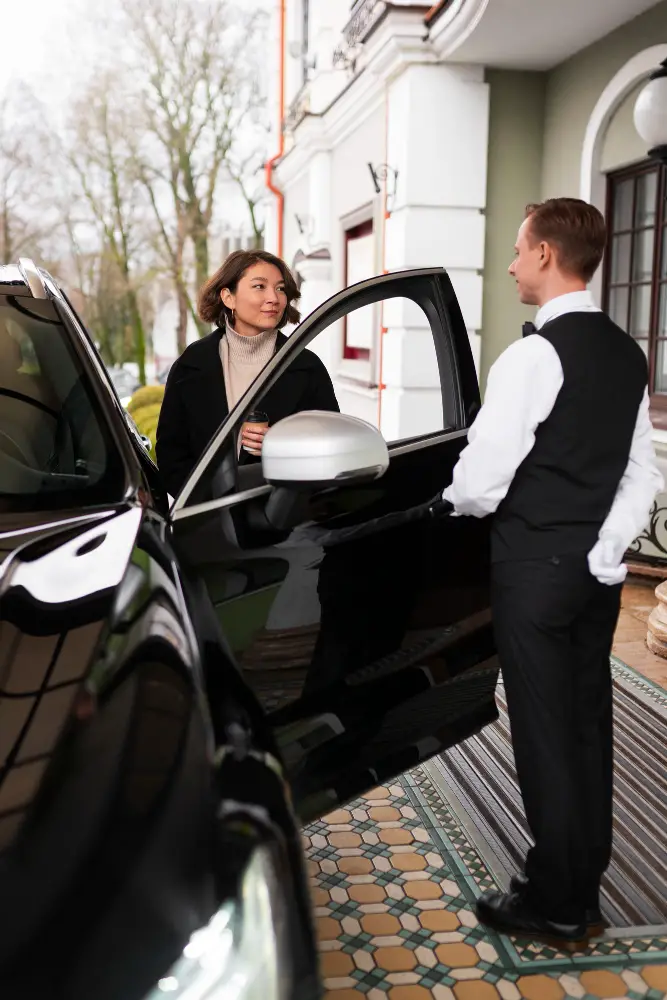
On the fourth morning, when neither my mother nor Linda could come, I paid for a car service. Forty-two dollars one way. I stood on the porch on my crutches and watched my daughters climb into the back seat of a stranger’s black sedan with their backpacks on, and Nicki waved at me through the window with a scared little face, and I waved back and smiled and then went inside and cried in the downstairs bathroom.
The whole time, the other parent in my house drove to work alone every morning in his blue car with two empty seats in the back.
Every time I asked Harold, he said the same thing.
“I can’t be late for work.”
If I pushed him, he said it again. Slower. Like I hadn’t heard him the first time.
“Scarlett. I can’t be late for work.”
One night, after the girls were in bed, I tried again. I was lying on the couch with my leg up on three pillows. He was on the other end of the couch, scrolling through his phone.
“What if you just left fifteen minutes earlier?” I said. “You’d drop them off at 7:50, and you’d still be at work by 8:30.”
“The school doesn’t open the doors until 7:55.”
“So they wait five minutes on the steps.”
“By themselves? Nicki’s seven.”
“There’s a teacher on the steps. There’s always a teacher on the steps.”
He didn’t look up from his phone. “I have a lot going on right now, Scarlett. We’ve got the Henderson account. Everybody’s watching.”
“Everybody’s watching you arrive at 8:30 instead of 8:15?”
“It’s not that simple.”
“Then explain it to me.”
He put his phone down on his chest and sighed. That long, patient sigh, like I was a customer who kept asking the same question.
“I just can’t be late for work,” he said.
I gave up.
And then came my hospital appointment.
It was a Tuesday, three weeks after the surgery. A follow-up with the orthopedic doctor to check on the plate and the screws.
Linda had already agreed to drive the girls that morning. She’d switched a shift. I felt terrible about it.
I took a taxi to the hospital.
The doctor checked my leg. She took an X-ray. She pointed at the screen, at the white lines of the screws in my bone, and told me the healing looked good.
“Better than good, actually,” she said. “You’re ahead of schedule.”
“So I can drive?”
She laughed. “Absolutely not. Don’t get overconfident. You’re still on crutches for at least three more weeks.”
“I promise,” I said.
I crutched out through the big glass doors of the hospital entrance, into the cold morning air. I was looking for my taxi.
And I saw Harold’s car.
It was right there. His blue sedan. With the dent in the back bumper from when he backed into a pole at the gas station last spring, and the little stick-figure family decal Nicki put on the rear window. Four stick figures and a cat we don’t have.
For one second, my heart jumped.
I thought something had happened. Something with the girls. Or maybe he’d come to find me. Maybe he’d moved a meeting and come to surprise me at my appointment.
Then I noticed he wasn’t parked at the hospital.
He was across the street, in front of an apartment building. A tall brick building with a green awning over the door.
And a woman came hurrying out.
She was carrying a laptop bag and a travel mug. She had long, dark, shiny hair that swung when she walked. She was wearing a cream-colored coat and black heels.
Adele.
I’d met her once. At Harold’s company Christmas party the year before. She’d been standing by the punch bowl, and Harold had introduced us. This is Adele, she just joined our team. She was twenty-something, maybe thirty. Pretty. The kind of person who somehow looks put together at eight in the morning, when the rest of us are wearing yesterday’s mascara and a sweatshirt with a yogurt stain on it.
Harold got out of the car.
He walked around to the passenger side. He opened the door for her.
She smiled at him and said something. He laughed.
She got in.
He closed her door, walked back around, and got behind the wheel.
And they drove off together, toward his office.
I stood there on the sidewalk on my crutches and watched his taillights disappear around the corner.
The taxi driver pulled up next to me and honked twice before I noticed him.
“Ma’am? You Scarlett?”
“Yes.”
“You getting in?”
I got in.
For about ten minutes, on the ride home, I let myself imagine the obvious.
I’m not proud of it. But I’d just seen my husband open a car door for a young, pretty woman at 8:05 in the morning outside her apartment building. My mind went exactly where you’d think it would go.
I imagined texts I hadn’t seen. Lunches I didn’t know about. Late nights at the office.
Then, somewhere around the third red light, I remembered something.
At that Christmas party, Adele had talked to me for twenty minutes by the punch bowl. And almost the whole time, she’d talked about her boyfriend. His name was Marcus. He was a firefighter. He’d just gotten promoted. She’d shown me pictures of their dog on her phone, a giant fluffy thing named Waffles. She’d said, I think he’s going to propose this spring. Don’t tell anyone.
That didn’t prove anything.
Neither did Harold opening a car door. Harold opens doors for everybody. He opens doors for old men at the post office.
But it proved one thing. One thing I couldn’t explain away, no matter how many times I turned it over in my head in the back of that taxi.
He had time.
He had time for Adele.
He just didn’t have time for us.
That evening, I waited until the girls were upstairs.
Sasha was in the bath. Nicki was supposed to be brushing her teeth, but I could hear her singing to herself in the mirror, which meant she wasn’t brushing her teeth.
Harold was in the kitchen, opening the refrigerator.
“I saw you this morning,” I said.
He looked over his shoulder. “At the hospital?”
“Near it.”
His hand stopped on the milk carton.
“Adele got into your car,” I said.
And he relaxed. So much, and so fast, that I almost laughed. His whole body let go. His shoulders dropped.
“Oh,” he said. “That.”
“Yes. That.”
“Her car broke down.” He pulled out the milk and closed the fridge. “Transmission. It’s been in the shop for two weeks.”
“And?”
“And I’ve been giving her a ride.”
He said it like it was nothing. Like he was telling me he’d picked up milk on the way home.
I shifted my crutches against the counter so I could lean on it.
“You told me,” I said slowly, “you can’t take Sasha and Nicki to school because it’ll make you late.”
“It will.”
“But picking up Adele won’t?”
“Her apartment is closer to the office.”
“It’s nowhere near our house, Harold. It’s on the complete other side of the river.”
He poured the milk into a glass. “It’s not that bad.”
I stared at him.
For eleven mornings, my sixty-eight-year-old mother had crossed half the city. Our neighbor had rearranged her hospital shifts. I’d paid a stranger forty-two dollars to put my daughters in the back of a black car. I’d been balancing cereal bowls against my cast every morning because standing at the counter on one leg made my hip ache.
And Harold was standing in our kitchen explaining that his coworker’s neighborhood wasn’t that bad.
“You’d rather drive across town for Adele,” I said, “than take your own daughters to school.”
He frowned. “Don’t make this weird.”
“I’m not making anything.”
“Her car’s in the shop,” he muttered. “Who else is supposed to give her a ride?”
I blinked at him.
“Apparently,” I said, “the same mysterious person who’s been taking your daughters.”
He rubbed his forehead with the heel of his hand.
“Scarlett. Come on. You have your mom. You have Linda.”
There it was.
You have your mom.
You have Linda.
Not we. Not us. Not our kids.
You.
“Coworkers need help too,” Harold said.
I looked at him for a long moment.
“Of course they do,” I said.
Something in my voice made him frown. He looked up from his milk.
“What does that mean?”
“Nothing,” I said.
And for once, I stopped arguing.
I crutched out of the kitchen and went upstairs to make sure Nicki was actually brushing her teeth.
She wasn’t.
I didn’t sleep much that night.
I lay in bed next to Harold, who was snoring lightly, and stared at the ceiling. My leg throbbed under the cast. The plate and the screws ached when the weather changed, and it was supposed to rain.
I kept thinking about his face in the kitchen. How relieved he’d looked. How easy it had been for him.
Her car broke down.
It’s not that bad.
Don’t make this weird.
Around two in the morning, I started thinking about something else. About how I’d gotten here. About how many years I’d been doing the mornings. About how I couldn’t actually remember the last time Harold packed a lunch.
Then I remembered.
It was three years ago. When Nicki was four and Sasha was six. I had the flu, a bad one, and I couldn’t get out of bed. Harold packed their lunches.
He gave Sasha a whole jar of peanut butter and a spoon. No bread. Just the jar.
He gave Nicki three string cheeses and a single, unpeeled orange. Nicki couldn’t peel oranges. She was four.
I found out when the school called me at noon.
The next morning, sick as I was, I got up and packed the lunches myself.
He never packed another one.
I don’t remember him ever offering. And I don’t remember myself ever asking.
The next morning, Sasha was working at the kitchen table while Harold got ready for work.
She was doing her school project. The first draft of it covered half the table. A huge piece of white poster board, with markers scattered everywhere. Mostly blue. Nicki had apparently returned the marker.
The assignment was about community. Every kid in the third grade had to make a poster about the people who help them.
At the top of the poster, in purple marker, Sasha had written in big bubble letters:
PEOPLE WHO HELP MY FAMILY
There were drawings underneath. Lots of them.
On the far left was Grandma. Sasha had drawn her with gray curly hair and a steering wheel. Underneath, she’d written: Drives a really long way. Makes pancakes.
Next to Grandma was Linda. Sasha had drawn her in blue scrubs with a stethoscope. Our neighbor. Is a nurse. Takes us to school on her day off.
Then the car service driver. Just a black car with a man inside wearing sunglasses. A man named Kevin. We don’t know him.
And then me.
I recognized myself right away by the long red hair and the enormous gray cast. Sasha had drawn the cast about the size of my entire body. It looked like I was dragging a canoe.
Under MOM, Sasha had written:
Takes us to school.
Makes lunch.
Knows where everything is.
And squeezed in underneath, in Nicki’s messy block letters, crooked, going uphill:
EVEN WITH THE GIANT LEG.
I laughed out loud.
“Thank you,” I said. “I think.”
Nicki was sitting across the table, eating cereal. She grinned at me with milk on her chin.
Then I looked at the right side of the poster.
DAD.
Harold was drawn inside a blue car. Sasha had even drawn the dent in the bumper.
And next to him, in the passenger seat, sat a stick figure with long, black, swooshy hair.
Underneath, Sasha had written, in neat third-grade handwriting:
Takes Miss Adele to work because her car is broken.
And below that, in Nicki’s big, crooked, unmistakable block letters:
OUR SCHOOL IS TOO FAR.
I looked at that poster for a long time.
Apparently, the girls had heard everything. Every argument. Every I can’t be late for work. Every you have your mom, you have Linda. The one in the kitchen last night, too, even though I thought they were upstairs. Kids hear everything. They hear it through walls and floors and closed bedroom doors.
I looked at the poster. Then I looked toward the hallway.
Harold was sitting on the bottom stair, tying his shoes. He was humming.
“Sasha,” I said quietly. “Where did you hear about Miss Adele?”
Sasha shrugged without looking up. She was coloring Grandma’s steering wheel.
“Dad told Grandpa on the phone. On Sunday. He said he was helping out a lady at work whose car broke.” She kept coloring. “And then you and Dad were talking about it last night. In the kitchen.”
“You were supposed to be in the bath.”
“The bathroom is right above the kitchen,” Sasha said. “The vent is really loud.”
“Are you going to put that on the real poster?” I asked.
“This is just the first draft,” Sasha said. “Mrs. Patterson said we could put everything on the first draft and then pick the best ones for the real one.”
“Everything,” Nicki repeated, pointing her spoon at the poster. “It has to be true, though. Mrs. Patterson said. You can’t make stuff up.”
“No,” I said. “You definitely can’t make stuff up.”
I didn’t add a word to that poster.
I didn’t cross anything out. I didn’t explain anything. I didn’t say anything to Harold, still humming on the bottom stair.
When the girls went upstairs to brush their teeth, I leaned over, one hand on the table and one on my crutch, and I folded the poster in half. Then in half again. I folded it carefully, so all the drawings were tucked inside and only the plain white back of the poster board was showing.
Then I crutched out the front door, down the porch steps, very slowly, and across the driveway.
Harold’s car was unlocked. It always is. He says nobody would steal a car with a stick-figure family and a cat we don’t have.
I opened the passenger door and laid the folded poster flat on the passenger seat.
Then I closed the door and crutched back inside.
My heart was pounding. I don’t know what I thought would happen. Maybe I thought he’d see it when he got in. Maybe he’d open it at a red light. Maybe he’d feel a little guilty.
That was all I wanted, really. For him to feel a little something.
I didn’t think past that.
Harold came downstairs, kissed the top of my head, grabbed his coffee and his briefcase, and walked out the door.
He didn’t even look at the passenger seat.
I watched through the front window as his car backed out of the driveway.
Then Linda knocked on the door to take the girls to school.
An hour later, my phone rang.
I was sitting on the couch with my leg up and a cup of coffee in my hand. I’d just turned on the TV.
It was Harold.
I answered.
“Scarlett!” he shouted. “What did you do?”
I held the phone a little farther from my ear.
“Good morning to you too.”
“Adele saw it!”
I put my coffee down on the table.
“Saw what?”
“You know exactly what! That—that thing!”
I smiled at the window. Outside, it had started to rain, just like the weather said.
“Sasha’s first draft?”
“She opened it! In the car!”
“Why would she open it?”
“Because she sat on it!” His voice went up an octave. “It was folded up with the blank side showing. I thought it was just a piece of scrap poster board. Some junk the girls left in there. So I didn’t move it. And she sat down, and she said, ‘Oh, what’s this?’ and she pulled it out from under her, and she unfolded it—”
That was unfortunate.
For him.
“Then what happened?” I asked.
“What do you think happened?”
I waited.
He lowered his voice. I could hear the sound of the turn signal clicking.
“She read it.”
“And?”
There was a pause. A long one.
And then I heard a woman’s voice. Somewhere near him. Close to the phone.
“Tell her,” the woman said. “Tell her what you told me.”
Adele.
Harold said something I couldn’t hear. Something low and muttered.
Adele spoke again. Louder this time.
“Harold.“
I sat up straighter on the couch.
“Adele?” I said. “What did he tell you?”
Another silence. I heard the turn signal stop clicking. I heard the engine idling. They’d pulled over.
Then Adele answered. Her voice was calm, but it was the calm of somebody who was trying very hard to stay calm.
“He told me,” she said, “that he already drives the girls to school every morning. Before he picks me up.”
I looked toward the stairs.
Sasha’s backpack had been sitting there an hour ago, right next to Nicki’s, waiting for somebody else to take them.
“He said what?”
Harold jumped in fast.
“I didn’t say every day.”
Adele made a sound. It was short and sharp and it didn’t need any translation at all.
“You said,” she said, “and I quote, ‘It’s no problem, I’m already out with the girls anyway.'”
“I didn’t say every day,” Harold said again, weaker.
I closed my eyes.
“Adele,” I said. “Did you ask him to pick you up?”
“No,” she said. “God, no. When my car broke down, I told everybody at work I’d just get a rideshare. It’s like fifteen bucks. It’s fine. And Harold said, ‘Don’t be silly, I’ll get you, I’m already out doing school drop-off, it’s right on the way.'”
“This is ridiculous,” Harold said.
Adele ignored him completely.
“He’s been picking me up for two weeks,” she said. “Every single morning. I thought he was dropping off his kids first. I asked about them. I asked how the girls were doing at school. I asked him how you were doing, with the leg.” Her voice cracked a little. “He said you were doing great. He said you were really managing.”
I laughed. I couldn’t help it. It just came out.
Managing.
Then I heard a car door open.
“Adele?” Harold said. “Where are you going?”
“I’m getting out.”
“You don’t have to do that.”
“Yeah, Harold. I think I do.”
The car door slammed so hard I heard it through the phone.
For a moment, there was nothing but the sound of rain on the car roof.
Then Harold came back on the line.
“Do you have any idea,” he said, “how embarrassing that was?”
I looked down at my cast.
Then at the kitchen, where two lunchboxes had been packed and zipped and sent out the door before seven o’clock that morning. By me. Standing on one leg.
“Harold,” I said. “I didn’t write it. Your daughters did.”
He let out a long breath.
“You put it in my car.”
“Yes.”
“You knew she’d see it.”
“I knew it was there,” I said. “I didn’t realize your coworker provided complimentary document review with every ride.”
“Scarlett.“
“If the passenger seat was unavailable, I suppose that became a problem.”
He went quiet.
For a long time, he didn’t say anything. I could hear the rain. I could hear him breathing.
“She’s walking,” he said finally. “In the rain. She’s walking down the street. She won’t get back in.”
“She has a rideshare app.”
“She’s not even using it. She’s just walking.”
“Then maybe she needs to walk.”
More silence.
“I have to go,” he said.
“Don’t be late,” I said.
He hung up.
I expected him to come home angry that night.
I spent the whole afternoon getting ready for it. Practicing what I’d say. Rehearsing my arguments in my head while I sat on the couch with my leg up and folded laundry into piles on the cushion next to me.
Instead, Adele called me.
It was a little after two. My phone rang with a number I didn’t recognize.
“Hi,” said a woman’s voice. “Is this Scarlett? This is Adele. From Harold’s work. I got your number from the emergency contact list. I hope this isn’t inappropriate.”
I was sitting on the couch with my leg elevated on three pillows and a basket of laundry beside me that I’d given up pretending I could carry up the stairs.
“Today passed inappropriate around 8:30,” I said.
She laughed. A real, surprised laugh.
Then she stopped.
“I’m really sorry,” she said. “About this morning. About all of it. If I’d known—I would never have let him drive me. Not once. I would’ve taken the bus. I would’ve walked.”
“You didn’t know,” I said. “That’s not your fault.”
“I still feel terrible.”
“Did you get to work okay?”
“I walked eight blocks in the rain in heels,” she said. “And then I got a rideshare. The driver’s name was Kevin.”
“Kevin?”
“Yeah. Black car. Sunglasses.”
I burst out laughing. I laughed so hard my leg hurt.
“What?” said Adele. “What’s funny?”
“Nothing,” I said. “Kevin’s on the poster. Kevin is doing a lot of heavy lifting for this family.”
She didn’t understand, but she laughed anyway. She had a nice laugh.
Then there was a pause.
“There’s something else,” Adele said.
“What?”
“Harold talks about you. At work.”
My fingers stopped in the middle of folding one of Nicki’s socks.
“What does he say?”
“Nothing terrible,” Adele said quickly.
That sentence has never once, in the history of the world, improved anybody’s afternoon.
“He says you’re very particular,” Adele said.
“About what?”
“Everything, I guess? He says he tries to help out at home, but you always redo it. The dishes, the laundry, packing the kids’ bags. So you’ve both kind of learned it’s just easier if you handle the house and he handles, you know. Other stuff.”
I stared at the laundry basket.
“He says it like it’s a joke,” Adele said. “Like, Oh, my wife won’t even let me load the dishwasher. Everybody laughs. I laughed.” She paused. “I’m sorry. I don’t know why I’m telling you this.”
I didn’t say anything for a while.
I was remembering things. Not the peanut butter jar. Other things.
The school bag he packed for Sasha once, two years ago, when I was at a work conference overnight. He’d put in three Barbie dolls, a kazoo, and a yogurt. No homework. No spoon. No library book, on library day. Sasha had to eat the yogurt by drinking it out of the cup.
The time he loaded the dishwasher and jammed a big wooden cutting board right up against the spray arm, so it couldn’t spin, and every single dish came out dirty and I had to wash them all again by hand.
The time he folded the laundry, and put all of Nicki’s clothes in Sasha’s drawers, and all of Sasha’s clothes in Nicki’s drawers, and my underwear in with his.
Each time, I’d fixed it.
Each time, I’d said something like, It’s okay, I’ll just do it.
And eventually I stopped asking. Because redoing the same thing over and over took longer than just doing it myself in the first place.
I never told him not to help.
I just stopped asking him to.
And he never, not once, noticed the difference.
“He makes it sound like you don’t let him help,” Adele said quietly.
I picked up Nicki’s sock and folded it in half.
“No,” I said.
“No?”
“I stopped asking,” I said. “That’s different.”
There was a long silence on the other end of the phone.
“Yeah,” Adele said slowly. “Yeah. I think it is.”
Before we hung up, she said, “My boyfriend’s going to drive me to work tomorrow. Marcus. He switched his shift.”
“The firefighter?”
“You remember that?”
“You showed me pictures of your dog. Waffles.”
She laughed. “Oh my God. I did. I’m so sorry. I was on my third glass of punch.”
“Did he propose?”
“In April,” Adele said. “At the dog park. Waffles had the ring on his collar.”
“Congratulations,” I said, and I meant it.
“Thanks.” She paused. “Scarlett? For what it’s worth. I think your daughters made a really good poster.”
After we hung up, I sat on the couch for a long time.
Then I opened the map app on my phone.
I typed in our house. Then the girls’ school. Then Harold’s office.
Twelve extra minutes, it said. Twelve minutes out of his way to take his daughters to school.
Then I typed in our house. Then Adele’s apartment. Then Harold’s office.
Twenty-five extra minutes.
I looked at those two numbers side by side for a long time.
Then I left both routes up on the screen, and I put the phone on the couch beside me, and I finished folding the laundry.
Harold came home just after six.
The girls were doing homework at the kitchen table. Sasha had math. Nicki had a worksheet about telling time where she had to draw the hands on the clocks, and she was drawing faces on them instead.
Harold put his keys in the bowl by the door. He put his briefcase down. He stood in the doorway of the kitchen and looked at me.
He looked tired. His good gray suit was wrinkled. His tie was loose.
“We need to talk,” he said.
“Great,” I said.
I picked up my phone and turned the screen toward him.
“Why,” I said, “was twenty-five minutes for Adele easier than twelve minutes for them?”
Harold looked at the screen.
Sasha leaned across her math worksheet to look too.
“Twelve is smaller,” she said.
Nicki looked up from her clock faces. She squinted at the phone.
“Way smaller,” she said.
Harold closed his eyes.
“Thank you both,” he said.
“You’re welcome,” said Nicki.
I almost smiled. I held it in.
Harold pulled out a kitchen chair and sat down across from me. He looked at the phone for a long time. Then he pushed it back across the table toward me.
“It’s not about the minutes,” he said.
“Then what is it about?”
He didn’t answer right away.
For once, he didn’t have something ready. No I can’t be late for work. No mornings are chaos.
Sasha erased something on her worksheet. Nicki counted on her fingers.
The kitchen clock ticked.
Finally, Harold said, “Adele appreciated it.”
I stared at him.
He rubbed his thumb slowly along the edge of the table.
“Every morning,” he said, “she’d get in the car and say thank you. Every single day. She called me a lifesaver. She brought me a coffee on Friday. She told everybody at work what a nice guy I was.” He was quiet for a moment. “It felt good. I felt—I don’t know. Like a hero. Like I was doing something nice for somebody.”
“And your daughters?”
“They don’t—”
He stopped.
“They don’t what?” I asked.
He looked at Sasha, bent over her math.
Then at Nicki, drawing a face on a clock.
“They don’t thank me,” he said quietly, “for being their father.”
I sat back in my chair.
“No, Harold,” I said. “They don’t.”
He looked almost relieved. Like he’d finally explained himself and I’d finally understood.
Then I finished.
“Because fatherhood isn’t customer service.”
His eyes dropped to the table.
“Nobody thanks me either,” I said. “Nobody thanks me for packing the lunches. For finding Nicki’s other shoe. For remembering pajama day. For signing the permission slip for the field trip to the aquarium that’s next Thursday, which you didn’t know about.” I shrugged. “They don’t thank me because that’s not what it’s for. It’s not a favor. It’s just what you do. Because they’re yours.”
I tapped my cast with one finger.
“I shouldn’t have had to break a bone,” I said, “for you to notice mornings existed.”
Nobody said anything for several seconds.
Even Nicki had stopped drawing.
Then Harold asked, very quietly, “What do you want me to do?”
That question.
That question used to make me start assigning jobs. I’d get out a piece of paper and make a list. Okay, you do the lunches on Tuesday, and I’ll do Wednesday, and you check the backpacks, and here’s where the permission slips go. And I’d explain everything. And he’d nod. And then two weeks later, I’d be doing it all again.
This time, I didn’t make a list.
“Tomorrow morning is yours,” I said.
He looked up. “What does that mean?”
“It means all of it.”
“Breakfast?”
“All of it.”
“Lunches?”
“All of it.”
“School bags?”
I picked up my coffee.
“You’re getting warmer,” I said.
Sasha raised her hand. Like she was at school.
Harold stared at her. “What?”
“I need poster board tomorrow,” Sasha said. “For the real poster. The final one. It’s due Friday.”
Harold’s eyes moved to me. Automatically. Just like they always did.
I took a slow sip of coffee.
“Don’t look at me,” I said.
He looked back at Sasha.
He opened his mouth. Closed it. Opened it again.
“What kind?” he asked.
Sasha smiled.
And for the first time since I broke my leg, maybe for the first time in years, Harold took out his phone and typed a note into it before anybody asked him to. Before anybody thanked him.
Poster board. White. Big.
“Glitter,” Sasha added.
He typed glitter.
“And markers,” Nicki said. “New ones. So nobody has to steal anybody’s blue.”
“I didn’t steal it,” Nicki added, to nobody. “I borrowed it.”
Harold typed markers. Then he looked up at both of them.
“Anything else?”
Sasha and Nicki looked at each other.
“Pancakes,” Nicki said. “Grandma makes pancakes.”
Harold looked at me.
“Don’t look at me,” I said again.
He typed pancakes.
At 6:35 the next morning, Harold appeared beside our bed.
He was wearing his suit pants and an undershirt. He had a spatula in one hand.
“Where are Nicki’s sneakers?”
I opened one eye.
“Ask Nicki.”
“She says she doesn’t know.”
“Then you’re both having an exciting morning.”
He looked at me for a second. Then he left.
I lay in bed and listened.
Ten minutes later, Sasha yelled from her room that nobody had woken her up.
“You have an alarm!” Harold called from the bottom of the stairs.
“I turned it off!”
“Why would you turn it off?”
“Because it was loud!”
Nicki shouted from the kitchen, “We’re children!”
I pulled the blanket over my face.
A few minutes later, I smelled something burning.
Then I heard the smoke alarm.
Then I heard Harold say a word he’d told the girls never to say, and then Nicki said, “Daddy! Language!” and Sasha said, “That’s a quarter in the swear jar,” and Harold said, “I know, I know,” and the smoke alarm stopped.
I heard the back door open. Probably to let the smoke out.
I stayed in bed.
It was the hardest thing I’ve done in years.
Every part of me wanted to get up. To grab my crutches and go down there and find Nicki’s sneakers, which I knew were under the couch in the living room, where she kicks them off every single night. To make the pancakes, which I knew he’d put on high heat, which is why they burned. To wake Sasha properly. To pack the lunches the right way, with the sandwiches cut in triangles for Nicki and squares for Sasha, because they both have strong opinions about sandwich geometry.
But I didn’t.
I lay in bed, and I let him burn the pancakes.
Because if I got up, I’d fix it. And if I fixed it, it would be mine again. And I’d be right back where I started, on the stairs, with a coat on my lap, watching his taillights disappear.
At 7:40, I heard the front door open.
I crutched to the bedroom window and looked down at the driveway.
Harold was loading the girls into the back of his car. Sasha had her backpack on inside out. Nicki was wearing two different shoes. One sneaker and one rain boot. Her hair was in a ponytail that sat almost on the side of her head, like a unicorn horn that had slid off.
Harold was carrying three lunchboxes. We only have two kids. I have no idea who the third one was for.
He buckled Nicki in. He buckled Sasha in. He closed the door. He stood in the driveway for a moment and looked up at the sky, like he was praying.
Then he got in and drove away.
Somehow, they got to school on time.
Barely. Sasha told me later they were the last car in the drop-off line. The teacher on the steps was already holding the door closed. She had to open it again.
“Mrs. Garcia looked at Dad really funny,” Sasha said.
“Why?”
“Because Nicki was wearing a rain boot and it wasn’t raining.”
“And Dad forgot my library book,” Nicki added. “And it was library day.”
“And my lunch was just crackers,” Sasha said. “And a whole cucumber. Not cut up. A whole one.”
“What did you do with the cucumber?”
“I traded it to Tyler for a cookie,” Sasha said. “He really likes cucumbers.”
“Whose was the third lunchbox?”
Both girls shrugged.
“It had a banana in it,” Nicki said. “And a fork.”
That evening, Harold came home carrying two grocery bags.
Inside were a giant piece of white poster board, a tube of silver glitter, a new pack of markers with an extra blue one, a box of pancake mix, and a bag of little bread rolls, the good kind from the bakery.
He put them on the kitchen counter. Then he came and stood in the living room doorway.
“My boss said I can start fifteen minutes later,” he said. “While your leg heals.”
I looked up from the couch.
“You asked him?”
“Today.”
“And?”
“He said okay.” Harold stood there holding the bag of bread rolls. “He said, ‘Of course. Why didn’t you ask before?'”
He looked at me.
“I never asked before,” he said.
“I know.”
He came over and sat down beside me on the couch. He put the bread rolls on the coffee table.
“Fifteen minutes,” he said. “That’s all it was. Fifteen minutes. And he just said yes. Like it was nothing.”
“I know.”
“Everybody at work has kids. Janet in accounting leaves at three every Wednesday for her son’s therapy. Mike works from home on Fridays. I just never—” He shook his head. “It never even occurred to me to ask. Because you were always handling it. So it never came up.”
He was quiet for a moment.
“I didn’t realize how much you did,” he said.
I shook my head.
“You didn’t have to know everything I did,” I said. “You just had to notice I was doing it.”
He nodded slowly.
He didn’t say anything else.
No flowers arrived the next day. No jewelry. No big apology speech.
That helped more than flowers would have. Because flowers would have been a thank-you. A little gift for putting up with him. And I didn’t want a thank-you.
I wanted him to show up.
The second morning was a little better.
He found Nicki’s sneakers under the couch. Both of them. On the first try.
The pancakes burned again, but only one side.
The third morning, he woke Sasha up with her alarm and then again ten minutes later by standing in her doorway and singing the theme song from her favorite cartoon, very badly, until she got out of bed just to make him stop.
The fourth morning, he asked me how to do a French braid.
I watched him from my chair at the kitchen table while he stood behind Nicki with his big clumsy hands in her hair and his tongue sticking out of the corner of his mouth in concentration. Nicki sat very still, which she never does for me.
The braid was lumpy. It was crooked. It had a big bump on one side.
Nicki looked at it in the hall mirror.
“I love it,” she said.
The fifth morning, I came into the kitchen on my crutches at seven-fifteen and found the lunches already packed and zipped and sitting on the counter. Two of them. Just two.
I unzipped Sasha’s to look. I couldn’t help it.
A turkey sandwich. Cut into squares. A bag of carrot sticks, cut up this time. An apple. A juice box. And a small folded note in Harold’s handwriting.
Have a good day. Love, Dad. P.S. No cucumbers.
I zipped it back up before anybody saw me looking.
My mother came to visit that weekend. Just to visit this time. No driving the girls anywhere.
She sat in the kitchen with me on Saturday morning drinking coffee while Harold made pancakes. They were only slightly burned now. Around the edges.
She watched him flip one. It landed half on the pan and half on the stove.
“Well,” my mother said quietly. “Look at that.”
“He’s trying.”
“I can see that.” She sipped her coffee. “How did you get him to do it?”
“I didn’t,” I said. “The girls did. And his coworker. And a man named Kevin.”
My mother raised her eyebrows. “Who’s Kevin?”
“It’s a long story.”
She looked at Harold. He was scraping the pancake off the stove with the spatula and muttering to himself.
“You know,” she said, “your father was exactly like that. The first ten years.”
“Dad? Really?”
“Oh, God, yes. He thought the laundry did itself. Thought dinner appeared on the table by magic.”
“What changed?”
My mother smiled into her coffee cup.
“I had your brother,” she said. “Very fast. In the car. On the way to the hospital. Your father had to deliver him himself on the side of Route 9.” She shrugged. “After that, he never complained about changing a diaper again.”
I laughed so hard I nearly fell off my chair.
“So I guess it takes something big,” I said.
“Sometimes,” my mother said. She looked at my cast. “Sometimes it takes a broken leg.” Then she looked at me. “And sometimes it just takes somebody finally deciding to stop fixing everything.”
Adele sent a card about two weeks later.
It came in the mail, addressed to Sasha and Nicki.
Inside was a picture of a big fluffy dog wearing a bow tie. Waffles. On the back of the photo, she’d written:
Dear Sasha and Nicki,
I heard you made a really great poster. Thank you for telling the truth. That takes a lot of guts. Waffles says hi.
Love, Miss Adele
P.S. My car is fixed now.
Sasha read it out loud at the kitchen table. Nicki took the photo of Waffles and stuck it to the refrigerator with a magnet shaped like a strawberry.
Harold looked at it for a long time.
“She’s getting married,” he said. “In the fall. She invited the whole office.”
“Are you going?”
“Yeah,” he said. He was quiet for a moment. “I’m going to bring you. If you want to come.”
“By then, I’ll be off crutches.”
“Then we’ll dance,” he said.
“You can’t dance.”
“I know,” he said. “I’ll learn. I’ve learned French braiding. How hard can it be?”
A week after that, Harold owned the mornings without asking me for any instructions at all.
He knew which day was library day. He knew Nicki needed her sneakers for gym on Tuesdays and Thursdays. He knew Sasha liked her sandwiches in squares and Nicki liked hers in triangles, and that you should never, under any circumstances, put the carrot sticks touching the sandwich in Nicki’s lunchbox, because then the sandwich tastes like carrot, and she won’t eat it.
He knew all of it now.
He even remembered pajama day. Before I did.
“It’s pajama day,” he told me one Wednesday morning, coming down the stairs. He was holding Nicki’s pajamas with the little moons and stars on them. “They sent a note home last week. It was in Sasha’s folder.”
I stared at him.
“You read the folder?”
“I read the folder,” he said. “Every night. You never told me there was a folder.”
“I thought you knew.”
“I didn’t know there was a folder, Scarlett.” He shook his head. “Nine years. Nine years of folders.”
The final poster was due on a Friday.
That morning, Sasha was hunting through the papers on the kitchen counter for her spelling list, and she found the first draft. The one with Adele on it. Harold had brought it back home that first night and put it under a stack of mail, and nobody had touched it since.
“I forgot about this!” Sasha said.
She pulled it out and unfolded it across the breakfast table, right between Harold’s coffee and Nicki’s cereal bowl.
Harold saw his blue car. With the dent in the bumper. And the stick figure with the long black swooshy hair sitting next to him.
He groaned.
“Please,” he said. “Please tell me that’s not being displayed anywhere.”
“It’s just the first draft,” Sasha said. “The real one’s already at school. Mrs. Patterson hung it up in the hallway yesterday.”
“Oh, thank God.”
Sasha looked at the first draft for a long moment. Then she grabbed a marker out of the new pack. A purple one.
“I have to fix it,” she said.
“Fix what?” said Harold.
“It’s wrong now,” Sasha said. “Mrs. Patterson said it has to be true.”
Under DAD, next to the drawing of the blue car, Sasha wrote in her neat third-grade handwriting:
Takes us to school.
She capped the marker. She looked at it, satisfied.
Then Nicki leaned over her shoulder. She took the purple marker right out of Sasha’s hand.
“Hey!” said Sasha.
Nicki uncapped the marker. And right underneath Sasha’s line, in her big, crooked, unmistakable block letters, she added one more word.
NOW.
“Nicki!” Sasha said.
“What?” Nicki said. She put the cap back on the marker. “It’s true.”
The kitchen went quiet.
Harold looked at the poster for a long time. At the blue car. At the stick figure with the long hair. At Takes Miss Adele to work because her car is broken and OUR SCHOOL IS TOO FAR.
And at the new line underneath.
Takes us to school.
NOW.
Then he looked at his daughters. Sasha in her school sweater. Nicki with her lumpy French braid, sitting on the edge of her chair, waiting to see what he’d do.
He held out his hand.
Nicki hesitated. Then she put the purple marker in it.
For a second, I thought he was going to change it. Cross out the NOW. Or cross out the old line about Adele. Make it prettier. Make himself look better.
He looked at the marker in his hand.
Then he handed it back to her.
“Leave it,” he said.
Sasha folded the poster carefully in half, and then in half again. She put it in her backpack.
“I’m going to keep it,” she said. “For my memory box.”
“Your memory box,” Harold repeated.
“Where I keep important stuff,” Sasha explained. “Like my first tooth and the ticket from the aquarium.”
Harold nodded slowly. He didn’t say anything.
He picked up both backpacks off the floor. He checked inside each one. Homework folder. Library book. Lunchbox. He zipped them both up.
Then he looked at the clock on the stove.
7:43.
“Come on,” he said. “We’re going to be late.”
And he held the front door open for his daughters, and they ran out into the driveway, and climbed into the back seat of his blue car with the dent in the bumper and the stick-figure family and the cat we don’t have.
I stood on the porch on my crutches and watched them go.
Nicki waved at me through the back window. Both hands. Grinning.
I waved back.
Then I went inside, and I sat down at the kitchen table, and I poured myself a cup of coffee, and I drank the whole thing while it was still hot.
For the first time in nine years, I didn’t have anywhere to be at eight-ten in the morning.
It felt strange.
It felt wonderful.

Laura Bennett writes about complicated family dynamics, difficult conversations, and the quiet moments that change everything. Her stories focus on real-life tensions — inheritance disputes, strained marriages, loyalty tests — and the strength people find when they finally speak up. She believes the smallest decisions often carry the biggest consequences.