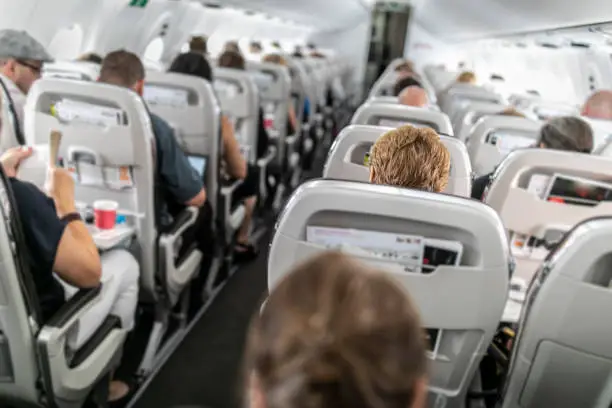
“Mrs. Walsh, why did you choose seat 34A?”
I was standing in the aisle of the airplane beside my grandmother when the pilot asked her that.
He was young, maybe thirty, with a crisp white shirt and gold stripes on his shoulders. He’d walked all the way from the cockpit to the back of the plane, checking row numbers, and stopped right here. At row 34.
Grandma’s fingers closed around the old leather purse in her lap. Her knuckles went white.
Twenty minutes earlier, I’d been sure she’d just grabbed whatever economy seat happened to be open. I’d been annoyed about it. Honestly, I’d been more than annoyed.
Now she looked up at the pilot and whispered, “Because that’s where he told me to sit.”
I froze.
“Who told you?” I asked.
Grandma didn’t answer me.
Instead, she opened her purse. Slowly. Carefully. She reached into the inside pocket, the one with the broken zipper that she’d never let me fix, and pulled out an old boarding pass. It was yellowed and soft, folded into quarters, the creases worn almost white.
The pilot took it from her gently, like it might fall apart in his hands.
He unfolded it. He read it.
His whole face changed.
Then he turned toward the front of the plane and raised his voice.
“Captain,” he called, “you need to come back here.”
None of this made any sense to me.
Especially because the man my grandmother seemed to be talking about had been dead for twenty-seven years.
It had all started that morning with what I thought was a simple birthday gift.
Actually, it started two weeks before that, at Grandma’s eightieth birthday party.
Her name is Margaret Walsh, but almost everyone calls her Maggie. Everyone except the pharmacist, who she says hasn’t earned it yet.
She spent most of my childhood insisting she didn’t need anything. Every Christmas, every birthday, it was the same.
“Grandma, what do you want this year?”
“Nothing, sweetheart. I have everything.”
“You have to want something.”
“I want you to stop spending money on me.”
It made buying presents for her almost impossible. Over the years, I’d given her scarves she never wore, a bread maker she used as a doorstop, and a tablet she called “the tiny television that judges me.”
So for her eightieth, I decided to just ask her directly. No guessing. We were sitting in her kitchen after the party, after all the cousins had gone home, eating leftover cake straight out of the box with two forks.
“Okay, Grandma. Eighty is a big one. What do you want? And don’t say nothing.”
She took a bite of cake and chewed slowly. She looked out the kitchen window at the bird feeder in her backyard.
Then she surprised me.
“I’d like to see California again.”
I almost dropped my fork. “California?”
“San Francisco. I haven’t been in a very long time.”
“Grandma, you haven’t been on a plane in almost thirty years.”
“I’m aware of that.”
“You once took a fourteen-hour bus to Aunt Diane’s wedding because you said airports were organized extortion.”
“They are organized extortion.” She pointed her fork at me. “That doesn’t mean I don’t want to see California.”
I stared at her. She stared back, completely calm, like she’d just asked for a new pair of slippers.
“Okay,” I said slowly. “Okay. I’ll take you.”
That night, I went home and bought two tickets from Chicago to San Francisco.
Mine was economy. Hers was first class.
It cost more than I want to admit. More than my rent. But she was turning eighty. She’d raised me half my life while my mom worked double shifts. She’d sat through every terrible school play and every piano recital and every breakup. She’d never once asked me for anything.
She deserved a big, wide seat with a real blanket and a glass of champagne.
When I showed her the ticket on my phone, she stared at the screen for several seconds without saying a word.
Then she looked up at me. “Sarah. How much did you spend?”
“That’s not how gifts work, Grandma.”
“It is when the person receiving the gift has lived long enough to recognize financial irresponsibility.”
I laughed.
She didn’t.
“I’m serious,” she said. “You could have bought a used car.”
“I don’t want a used car. I want you to have a nice flight.”
She looked at the screen again for a long time. Then she sighed, reached up, and kissed my cheek.
“Thank you, sweetheart.”
“You’re welcome.”
“You’re still financially irresponsible.”
“I know.”
Everything seemed fine after that. She packed three days early. She called me every night that week to ask if she needed to bring her own pillow, whether they still gave you peanuts, and if it was true that you had to take your shoes off at security.
“Only sometimes,” I told her. “You’re over seventy-five, so you probably won’t have to.”
“Good. My feet are nobody’s business.”
On the morning of the flight, I picked her up at five-thirty. She was already standing on her front porch in her good navy coat, holding her old leather purse against her chest with both hands. Her suitcase was beside her, the same brown one with the broken wheel that she’d owned since the eighties.
“You’re early,” she said when I pulled up.
“I’m right on time.”
“Then I’m early. Help me with the bag, the wheel sticks.”
On the drive to O’Hare, she was quiet. She watched the city go by in the gray dawn light. She kept her purse in her lap the whole time, and every few minutes, she’d run her thumb over the little pin near the zipper.
I’d known that purse my entire life. The leather was scratched all over. One handle had been repaired twice, once by a shoe shop and once by Grandma herself with brown thread. And beside the zipper was a tiny pin shaped like silver pilot’s wings.
When I was a kid, maybe six or seven, I’d asked her about it once. I was sitting on her lap, playing with it.
“What’s this, Grandma?”
“Those are Grandpa’s,” she said.
That was all. She didn’t explain. And Grandpa was right there in the next room, watching baseball, so I figured it was something he’d picked up somewhere. A cheap souvenir from some airline. The kind of thing they used to give kids on planes.
I never asked again.
Security was fine. They didn’t make her take off her shoes. She seemed personally satisfied about that.
We found our gate with an hour to spare. Grandma sat down in one of the plastic chairs by the window and watched the planes taxiing on the runway. She didn’t blink much.
“I’m going to get coffee,” I said. “You want anything?”
“No, thank you.”
“A muffin?”
“No.”
“You sure? It’s a long flight.”
“Sarah. Go get your coffee.”
The line at the coffee shop was long. By the time I came back, carrying a latte and a blueberry muffin she was definitely going to eat half of, I saw Grandma standing at the gate counter. She was talking to the gate agent. Leaning in close. The agent was typing something on her computer and nodding.
I walked faster.
By the time I got there, Grandma had turned away from the counter. She was holding a new boarding pass.
“What happened?” I asked.
“Nothing.”
“What’s that?”
“My boarding pass.”
“You already had a boarding pass. It’s on my phone.”
“Now I have a paper one.”
I took it from her hand before she could stop me.
34A.
I read it twice.
“Grandma. That’s economy.”
“I know.”
“That’s the back of the plane.”
“I know that too.”
I looked over at the gate agent. She gave me a small, sympathetic smile and went back to her computer.
I thought there had been some mistake. Some computer glitch. Maybe they’d overbooked.
There hadn’t been any mistake.
She had walked up to that counter and voluntarily given up the first-class seat I’d bought her.
“Grandma,” I said. My voice came out tighter than I meant it to. “That ticket cost me a fortune.”
“I know, sweetheart.”
“Then why would you give it up?”
She took the boarding pass back from me and folded it carefully in half.
“I’d rather sit in the back.”
“Why?”
She reached over and squeezed my hand.
“Because I would.”
That answer irritated me more than it should have. Much more.
“That’s not a reason,” I said.
“It’s my reason.”
“Grandma, I saved for months—”
“And I’m grateful. I am.” She looked at me with those clear gray eyes. “But I’d like to sit in 34A.”
I opened my mouth. I closed it. The boarding announcement came over the speaker. First class was boarding first.
My seat was 22C. Economy. Twelve rows ahead of hers.
“Fine,” I said.
It wasn’t fine. We both knew it wasn’t fine.
We boarded separately. She went down the jet bridge ahead of me, slow and careful, holding the railing. I watched the flight attendant greet her at the door. Watched her walk past the big leather seats in first class without even glancing at them.
The seat that was supposed to be hers stayed empty. I checked. Somebody got upgraded into it about ten minutes later. A man in a golf shirt who looked like the happiest person on earth.
I sat in 22C and stewed.
For the first hour of that flight, I was genuinely angry. I kept replaying it in my head. All those months of putting money aside. All that planning. I’d wanted to watch her face when she saw that big seat. I’d wanted her to feel like a queen for once in her life.
And she’d just handed it back like I’d given her the wrong size sweater.
The plane climbed over Lake Michigan. The seatbelt sign went off. A flight attendant came by with drinks. I ordered a ginger ale and drank it too fast.
And then, somewhere over Iowa, the guilt got the better of me.
Grandma was eighty years old. She was on her first flight in almost three decades. She was sitting alone in the back of the plane. And I was sulking twelve rows away because she hadn’t accepted my gift the right way.
What kind of granddaughter does that?
I unbuckled my seatbelt and went back.
She was sitting beside the window in 34A. The middle seat and the aisle seat next to her were both empty. She was staring outside at the clouds. Her leather purse was pressed tight against her chest, both arms wrapped around it.
“You okay?” I asked, sliding into the aisle seat.
“Perfectly.”
She wasn’t.
I could see it. Her hands were trembling. Just slightly. The kind of tremble you only notice if you’ve known someone your whole life.
I leaned closer. “Are you scared?”
“No.”
“Then what’s wrong?”
She kept looking out the window. The clouds below us were thick and white, like a field of snow.
“Some places remember you,” she said quietly.
“What does that mean?”
Before she could answer, a flight attendant came down the aisle. She was polite but firm.
“Ma’am, that seat isn’t assigned to you. We’re expecting some turbulence soon. I’ll need you to return to your own seat, please.”
“She’s my grandmother.”
“I understand. But I need you back in your assigned seat.”
Grandma patted my hand. “Go on. I’m fine.”
“You’re not fine.”
“Sarah. Go sit down.”
I went. But I kept turning around in my seat to look back at her. All I could see was the top of her gray hair and the edge of the window.
Some places remember you.
What did that even mean?
About twenty minutes later, the cockpit door opened.
One of the pilots stepped out. The young one. He said something quietly to a flight attendant in the galley. She looked at a piece of paper in her hand, then pointed toward the back of the plane.
Then he started walking down the aisle.
Slowly. Looking at the row numbers on the overhead bins. People looked up from their phones and their movies as he passed. Pilots don’t usually walk around the cabin in the middle of a flight.
He passed my row. I turned around to watch him.
Row 28. Row 30. Row 32.
When he reached row 34, he stopped.
His eyes went straight to Grandma.
Then they went down to the silver wings on her purse.
I was already out of my seat. I didn’t even think about it. I walked back down the aisle as fast as I could without running. The flight attendant saw me and opened her mouth, then seemed to decide it wasn’t worth it.
By the time I got there, the pilot was crouching down beside Grandma’s row.
“Ma’am,” he said softly. “Where did you get those?”
He was pointing at the pin.
Grandma touched it with two fingers. “My husband gave them to me.”
The pilot stared at her for a long moment. Then he said, “Ms. Margaret?”
Grandma nodded.
And that’s when he asked the question I told you about at the beginning.
“Mrs. Walsh, why did you choose seat 34A?”
And she said, “Because that’s where he told me to sit.”
And she pulled out that old boarding pass, and he read it, and he called for the captain.
The captain came down the aisle a minute later.
He was older than the first pilot, maybe in his early sixties. Tall and gray-haired, with deep lines around his eyes like he’d spent his whole life squinting into the sun. He moved through the cabin with a kind of calm that made people sit up a little straighter.
The young pilot handed him the boarding pass without a word.
The captain looked at the faded paper for a long time. I watched his jaw tighten. His throat moved like he was swallowing something hard.
Then he did something I didn’t expect. He sat down in the empty aisle seat beside my grandmother. Right there in economy. In his full uniform.
“Margaret,” he said gently. “I’m Captain Hayes.”
Grandma’s whole face changed at the last name. Her eyes went wide.
“Hayes?”
He nodded. “My father was Robert.”
Grandma stared at him. Her lips parted. For a second, she didn’t breathe.
Then she reached over and took his hand in both of hers.
“Oh,” she said.
Just that. One word. But it held something I didn’t understand. Something big and old and heavy.
I crouched down in the aisle beside them. My knees were shaking.
“Grandma. Who’s Robert?”
She looked at me. Her eyes were wet.
“Your grandfather’s best friend.”
Grandpa Jack died when I was nine years old. A heart attack, sudden, on a Tuesday afternoon while he was raking leaves in the backyard. One minute he was there, and the next he wasn’t.
What I remembered most about him was his laugh. It was big and loud and came all the way up from his belly. I remembered that he always smelled like peppermint gum. And I remembered how he used to lift me up onto the kitchen counter when Grandma was cooking, even though she always told him not to.
“Jack, she’ll fall.”
“She won’t fall. She’s got good balance. Don’t you, kiddo?”
“I’ve got good balance!”
“See, Maggie? She’s got good balance.”
I’d known he worked around airplanes when he was younger. Somebody mentioned it at his funeral, I think. But Grandma rarely talked about that part of their life.
There were no model airplanes in her house. No framed photos of cockpits. No stories about exotic places they’d flown to. Nothing.
After Grandpa died, it was like flying had been packed into a box along with his clothes and put in the attic.
Captain Hayes turned the boarding pass over in his hands. “My father kept a copy of this.”
“Why?” I asked.
He glanced at Grandma before he answered me. Like he was asking permission.
“Because your grandfather saved his life.”
Grandma immediately shook her head. “No. Jack would’ve hated you saying it that way.”
The captain smiled. It was a warm smile. It made him look younger.
“My father said you’d say that. Word for word.”
And then he told me the story.
Jack and Robert had flown together for a regional airline in the 1970s and early 1980s. Grandpa was a pilot. Robert was a flight engineer back then, before he later became a captain himself.
They’d met years earlier, during training, and apparently they argued about almost everything.
“Your grandfather thought my father drank terrible coffee,” Captain Hayes said.
“He did drink terrible coffee,” Grandma said immediately. “He put three sugars in it. Three. And powdered creamer.”
The captain laughed. “My father said Jack was incapable of admitting when he was lost.”
“Also true,” Grandma said. “We once drove two hours in the wrong direction to Milwaukee because he refused to stop and ask for directions. Two hours. I had to pretend I was sick so he’d pull over at a gas station.”
For the first time since we’d boarded, Grandma looked relaxed. Her shoulders came down. Her grip on the purse loosened.
The young pilot was standing in the aisle behind me, listening, smiling.
Then Captain Hayes’s voice got quieter.
“In 1982, there was a flight to San Francisco,” he said.
He told it simply. During the descent into San Francisco, a warning light came on in the cockpit. Robert looked at it and was convinced it was just a faulty instrument. A bad sensor. It happened sometimes. He wanted to keep going and land.
Jack disagreed.
He insisted that they stop the approach. Pull up. Circle around and work through the problem properly instead of just dismissing the warning.
“They had a real argument about it,” Captain Hayes said. “In the cockpit. My father told me that he was angry. He thought Jack was being overly careful. They were already running late.”
“But Jack made the call,” Grandma said quietly.
“He made the call. They circled for forty minutes. Checked everything. Landed safely. And the delay caused a lot of questions afterward. From the airline. From management. People wanted to know why they’d wasted forty minutes and all that fuel on a bad sensor.”
“But it wasn’t a bad sensor,” I guessed.
“No,” Captain Hayes said. “Maintenance found a real fault. A serious one. If they’d landed the way my father wanted to, it could have been very bad.”
I looked at Grandma. “So Grandpa prevented an accident?”
She gave me a stern look. The same look she used to give me when I tracked mud into her kitchen.
“He did his job.”
That sounded exactly like something she’d say.
Captain Hayes nodded. “My father always said the same thing. Jack just did his job. But he also said Jack took most of the criticism that day, because he was the one who insisted they abandon the approach. And he never complained about it. Not once.”
I looked down at the old boarding pass in the captain’s hands.
“But what does any of this have to do with 34A?”
Grandma reached over and took the boarding pass back from the captain. She held it in her lap and smoothed it out.
“It wasn’t Grandpa’s boarding pass,” she said.
I didn’t understand.
“It was mine.”
“What?”
“I was on that flight. In 1982. In seat 34A.”
I stared at her. “You were there?”
She nodded. A small smile tugged at the corner of her mouth.
“I was surprising him. It was our anniversary that weekend. I bought a ticket without telling him. I thought it would be romantic. I’d get off the plane in San Francisco and he’d see me and we’d have dinner by the water.”
“He didn’t know you were on the plane?”
“Not until after we landed.” She laughed softly. “Nobody told him. I made the flight attendants promise.”
“So you were sitting back here while they were circling for forty minutes with a warning light?”
“I didn’t know anything was wrong. The captain just said there was a small delay. I read my book. I ate my peanuts.” She shook her head. “I didn’t know until much later.”
“What happened when he found out you were on board?”
Grandma laughed. A real laugh, bright and young.
“He came out of the cockpit after everyone got off, looking furious. Absolutely furious. He’d had a terrible day. Then he saw me standing there in the aisle with my suitcase.”
“What did he say?”
“He asked what idiot had put his wife on his flight.”
Captain Hayes laughed out loud. The young pilot laughed too. A woman across the aisle who had clearly been listening the whole time laughed into her hand.
“And what did you say?” I asked.
Grandma lifted her chin.
“I told him the idiot had paid full price.”
That sounded exactly like her too.
Then she looked down at the silver wings on her purse. Her smile softened.
“That evening, at dinner, Jack gave me these.”
She touched the pin gently.
“He’d gotten them when he first qualified as a pilot. They were the most precious thing he owned. He took them off his uniform and pinned them on my dress right there at the table.” She paused. “He said if I was foolish enough to keep marrying a pilot every single morning, I should at least have proof.”
I smiled. My eyes stung.
But something still didn’t fit.
“Grandma,” I said carefully. “Why haven’t you flown since Grandpa died?”
Her smile disappeared.
She didn’t answer right away. She just turned the old boarding pass over in her hands.
There was writing on the back. I’d seen it earlier when the pilot was holding it, but I’d assumed it was just airline printing. Terms and conditions. Baggage rules.
It wasn’t.
It was handwriting. Faded blue ink. Slanted and a little messy.
Grandpa’s handwriting. I’d know it anywhere. He used to write jokes on my lunch bags.
Grandma held it out so I could read it.
“Maggie, someday you’ll fly without me. When you do, sit by the window. You always complained I got the better view. 34A. Jack.”
I stopped reading. I read it again. My throat closed up.
“Grandpa wrote this?”
“Years later,” Grandma said.
She told me that Jack had found the old boarding pass while cleaning out his desk one Sunday afternoon. By then, he’d left commercial flying. His eyes weren’t good enough anymore, and he’d taken a job managing a small airfield outside the city.
He sat down at the desk and wrote that message as a joke. Then he tucked the boarding pass into her purse, into the inside pocket, without telling her.
“I found it a week later,” she said. “I was looking for my car keys. I laughed so hard I had to sit down in the grocery store parking lot.”
“Did you tell him you found it?”
“I told him he was ridiculous.” She smiled sadly. “He said, ‘That’s why you married me.'”
Then he died unexpectedly less than a year later. Raking leaves in the backyard on a Tuesday.
Grandma hadn’t boarded another plane since.
Not once. Not in twenty-seven years.
Until today.
She rubbed one corner of the boarding pass with her thumb. Back and forth. Back and forth.
“For years,” she said quietly, “every time someone suggested a trip, I found a reason not to go. Too expensive. Too far. Bad timing. My knees. The weather.”
“You were afraid to fly?” I asked.
She thought about that for a long time. The plane hummed around us.
“Not of the airplane,” she finally said.
Her eyes moved to the window. To the clouds outside.
“I was afraid I’d get up here and realize how much of him was still waiting for me.”
I didn’t know what to say. I just sat there in the aisle, holding on to the armrest.
For twenty-seven years, I’d thought Grandma simply didn’t like flying. That she was cheap, or stubborn, or old-fashioned.
She had driven six hours to my college graduation rather than fly. She’d taken trains to weddings in three different states. She’d once spent fourteen hours on a bus to Aunt Diane’s wedding in Denver because she claimed airports were organized extortion.
I’d laughed about that for years. We all had. It was a family joke.
Suddenly, all those little decisions looked completely different.
“You could’ve told me,” I said.
“I could have.”
“Why didn’t you?”
“Because you’d have worried.”
“I worried anyway.”
That earned the smallest smile.
“I noticed.”
I looked at the boarding pass again. At Grandpa’s handwriting. 34A.
“You didn’t give up first class because of the money,” I said slowly.
“No.”
“You wanted 34A.”
She nodded. “I looked up the seating chart for this airplane before we left home. I wanted to make sure it was a window.”
That explained why she’d been so calm at the gate. So certain. She hadn’t just impulsively downgraded herself because first class seemed too fancy.
She’d come prepared. She’d planned it.
“I would’ve traded seats with you,” I said. “If you’d just asked me.”
“I know.”
“So why didn’t you?”
Grandma looked almost embarrassed. She glanced at Captain Hayes, then back at me.
“Because you’d have made it into something.”
“Into what?”
“A moment.”
I nearly laughed out loud. I had spent my entire life thinking I was the emotionally reserved one in the family. Apparently, I’d inherited it from someone.
She continued, more quietly.
“I didn’t know what I’d feel when I sat down here. I didn’t know if I’d cry, or panic, or want to get off the plane. I didn’t want you watching me to find out.”
That shut me up completely.
Captain Hayes was still sitting beside her. He cleared his throat softly.
“My father talked about Jack until the day he died,” he said.
Grandma turned to him. “When?”
“Six years ago.”
She nodded slowly. “I’m sorry. I didn’t know.”
“He had a good life. A long one.” Captain Hayes smiled. “He told the story of that San Francisco flight at every family dinner. Every Thanksgiving. My kids can recite it.”
He glanced toward the front of the plane, toward the cockpit.
“He taught me to fly, you know. When I was sixteen. In a little Cessna.”
The young pilot, still standing in the aisle behind me, smiled. “And Captain Hayes taught me.”
Grandma looked between the two of them. The old captain and the young one. Three generations of pilots, all connected somehow to a warning light over San Francisco in 1982.
And for the first time that morning, I noticed that her hands had stopped trembling.
Then Captain Hayes noticed something.
“May I?” he asked, pointing at the silver wings on her purse.
Grandma hesitated for just a second. Then she unfastened the pin and placed it in his palm.
He turned it over. On the back, there were two tiny letters engraved in the silver. So small you’d need to squint to see them.
JW.
Captain Hayes shook his head slowly. He smiled.
“My father described these to me. He said Jack had his initials engraved on the back so nobody could ever steal them.”
Grandma smiled. “Your father tried to steal them once.”
“He told me. He said Jack accused him of being jealous.”
“He was jealous,” Grandma said. “He didn’t qualify until two years later. He was furious about it.”
The captain laughed and handed the wings back to her. She held them in her closed hand.
He stood up and straightened his uniform. Then he looked down at her.
“Margaret, would you like to visit the cockpit after we land? I’d be honored to show you.”
Grandma hesitated. She looked out the window. Then back at him.
Then she nodded.
“After,” she said.
That word mattered. And he understood it. I could see it on his face.
The rest of the flight belonged to her.
He nodded once, touched her shoulder gently, and walked back up the aisle toward the cockpit. The young pilot followed him.
I stood up too.
“I’ll go back to my seat,” I said.
Grandma caught my hand. “Sarah.”
“Yeah?”
“Thank you for the ticket. I mean it.”
“The ticket you gave away.”
“The ticket that got me on this plane.” She squeezed my fingers. “I wouldn’t have come without it. I’ve been waiting for a reason for twenty-seven years. You gave me one.”
I couldn’t talk. I just nodded, squeezed her hand back, and walked up the aisle to 22C.
This time, I wasn’t offended that she hadn’t let me sit beside her.
I understood now.
I sat in my seat and looked out my own window for a long time. At the clouds. At the sun on the wing. I thought about Grandpa Jack writing a joke on the back of a boarding pass at his desk on a Sunday afternoon, not knowing he had less than a year left. Not knowing she’d carry it for twenty-seven years.
When we began descending toward San Francisco, I went back one more time.
I didn’t sit down. I didn’t interrupt her. I just stood quietly at the end of the row.
Grandma was sitting exactly where Grandpa had told her to sit.
34A.
Her forehead was resting lightly against the window. Her eyes were open. She was looking down.
Below us, California stretched out under the clouds. The bay shining silver. The hills gold and green. The bridge, tiny and red, like a toy.
She’d pinned the silver wings back on her purse. Her hand rested on top of them.
I didn’t know if she was crying. I didn’t look closely enough to find out. That moment wasn’t mine.
I went back to my seat and buckled in.
After we landed, Captain Hayes met us near the gate.
He’d changed out of his cap, and he was holding something in his hand. A photograph. Old, with white borders and a little crease in one corner.
“My father kept this for decades,” he said. “I brought it with me today. I don’t really know why. I just grabbed it this morning. It’s been in my flight bag.”
He held it out.
It was a black-and-white photo of two young men standing beside an airplane. Both skinny, both in uniform, both grinning at the camera like they’d just gotten away with something.
One of them was Grandpa Jack. I’d have known that grin anywhere. Twenty-something years old, with a full head of dark hair.
The other one had to be Robert. He was holding a coffee cup.
Grandma took the photo with shaking fingers. She stared at it for a long time.
“Look at them,” she whispered. “Look how young they were.”
Then she turned it over.
On the back, in faded pencil, Robert had written: “Jack was right again. Don’t tell him I admitted it.”
Grandma laughed. She laughed so loudly that people all around the gate turned to look at us. She laughed until tears ran down her face and she had to hold on to my arm to stay standing.
“That man,” she said. “That stubborn, ridiculous man. He never did tell Jack.”
“He told me,” Captain Hayes said. “About a hundred times.”
He held out his hand. “Please. Keep it.”
Grandma looked at the photo one more time. Then she shook her head and handed it back to him.
“No. Your father kept it all those years. You keep it.”
He hesitated. Then he took it and put it carefully back in his jacket pocket.
And then Grandma surprised both of us.
She reached down and unfastened the silver wings from her purse.
For one awful second, I thought she was going to give them away. I actually opened my mouth to stop her.
Instead, she held them out toward the captain.
“Would you pin these on me?”
He looked at her for a moment. Then he took the wings very carefully.
Grandma straightened her navy jacket and stood tall. As tall as a five-foot-two, eighty-year-old woman can stand.
Captain Hayes leaned forward and fastened Grandpa’s wings on her jacket, right above her heart. His hands were very gentle.
Then Grandma hugged him. A real hug, arms all the way around.
“Thank you,” she said into his shoulder. “Thank you for coming back to row 34.”
“Thank you for sitting there,” he said.
We spent four days in California.
Grandma walked much more than I expected. We rode a cable car, and she held on to the pole and refused to sit down. We ate clam chowder out of bread bowls on the pier. We drove across the Golden Gate Bridge, and she made me pull over at the lookout point so she could stand at the railing and look at the water for a long time.
She complained about restaurant prices at every single meal.
“Eighteen dollars for a sandwich. Eighteen. In my day, you could buy a whole car for eighteen dollars.”
“Grandma, that’s not true.”
“It’s nearly true.”
She beat me at cards every single night. Gin rummy. She’d been beating me at gin rummy since I was seven.
On our last evening, we sat by the big window in our hotel room, watching the lights come on across the city. The bridge lit up in the distance. Fog was rolling in over the water.
She was wearing the silver wings on her sweater. She hadn’t taken them off once since the airport.
“Grandma,” I said. “For the flight home tomorrow. Do you want first class?”
I’d already checked. There were seats available. I’d been saving the question for the right moment.
She gave me a look.
“After what you paid? Absolutely.”
I laughed. “So 34A was a one-time thing?”
She was quiet for a moment. She reached up and touched the wings on her sweater.
“No,” she said.
She looked out the window, toward the bay, toward the place where a plane had circled for forty minutes a very long time ago with her in the back reading a paperback book.
“It was a promise.”
On the flight home, she took the first-class seat I’d originally wanted her to have. She put her feet up. She accepted the warm towel and the champagne and the little bowl of warm nuts. She told the flight attendant that the nuts were acceptable.
But before we boarded, at the gate, she stopped beside the counter.
For a second, my stomach dropped. I thought she was changing seats again.
Instead, she asked the gate agent for a pen.
The agent handed her one. Grandma stepped aside, pulled the old boarding pass out of the inside pocket of her purse, and unfolded it on the counter.
She wrote something underneath Grandpa’s message. It took her a few seconds. She wrote slowly and carefully.
Then she folded it back into quarters, along the same old creases, and returned it to the same worn pocket where she’d carried it for twenty-seven years.
She handed the pen back. “Thank you, dear.”
I didn’t ask what she’d written. Not on the plane. Not in the car on the way home from O’Hare.
I waited.
A week later, I was at her house helping her finish unpacking. She’d taken her time about it, the way she takes her time about everything. Her suitcase with the broken wheel was still sitting open in the hallway.
Her purse was on the kitchen table. The boarding pass was sticking out of the inside pocket.
Grandma was at the counter, making tea. She saw me looking.
“Go ahead,” she said, without turning around.
I pulled out the boarding pass. I unfolded it slowly.
Under Grandpa’s faded blue handwriting, the words I now knew by heart, were six new words. In Grandma’s neat, careful cursive. Black ink, still dark and fresh.
“I finally took the window seat.”
I read it three times. Then I had to put it down on the table and look at the ceiling for a while.
When I could see again, I looked across the kitchen.
Grandma had brought her tea to the table and sat down across from me. She’d taken the little silver wings off her sweater, and she was pinning them back onto the purse. Right beside the zipper. Where they’d lived my whole life.
I watched her push the pin through the old leather and close the clasp.
This time, her hands weren’t shaking at all.
“There,” she said, patting the purse. “Back where they belong.”
“Where are we going next?” I asked.
She looked up at me. A small smile crept across her face.
“I’ve always wanted to see Hawaii,” she said.
“Hawaii? That’s a long flight, Grandma.”
She took a sip of her tea.
“Then you’d better start saving,” she said. “I’ll want the window.”

Lila Hart is a dedicated Digital Archivist and Research Specialist with a keen eye for preserving and curating meaningful content. At TheArchivists, she specializes in organizing and managing digital archives, ensuring that valuable stories and historical moments are accessible for generations to come.
Lila earned her degree in History and Archival Studies from the University of Edinburgh, where she cultivated her passion for documenting the past and preserving cultural heritage. Her expertise lies in combining traditional archival techniques with modern digital tools, allowing her to create comprehensive and engaging collections that resonate with audiences worldwide.
At TheArchivists, Lila is known for her meticulous attention to detail and her ability to uncover hidden gems within extensive archives. Her work is praised for its depth, authenticity, and contribution to the preservation of knowledge in the digital age.
Driven by a commitment to preserving stories that matter, Lila is passionate about exploring the intersection of history and technology. Her goal is to ensure that every piece of content she handles reflects the richness of human experiences and remains a source of inspiration for years to come.