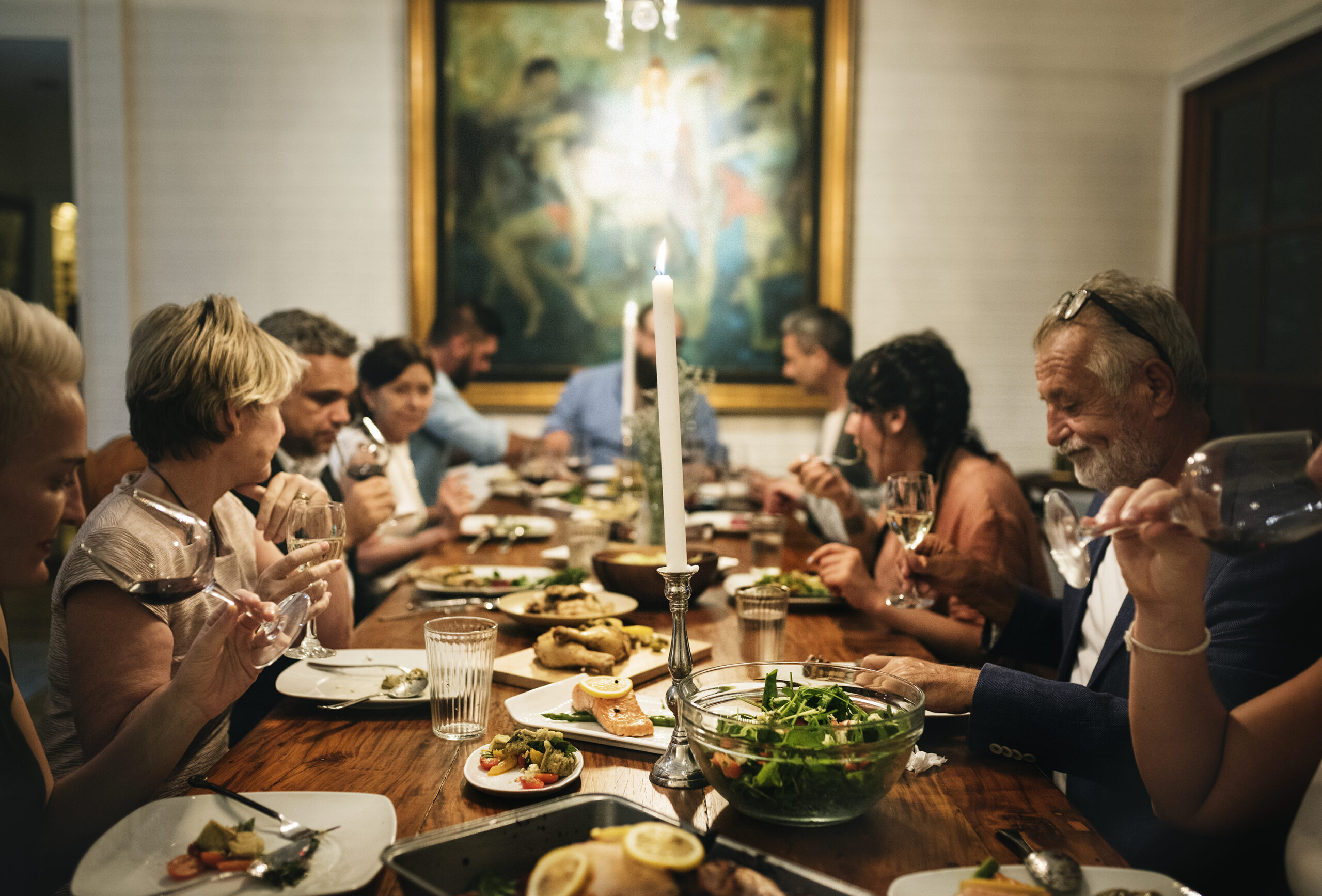
When my mother lifted her champagne glass and announced that my younger sister had finally bought her dream house, the entire dining room burst into applause.
Crystal glasses chimed beneath the warm glow of the chandelier. My aunts leaned across the table to congratulate Vanessa, my uncles nodded approvingly at her fiancé, and several cousins crowded around the framed photograph she had brought with her. In the picture stood a newly built suburban house with pale stone walls, four bedrooms, a wraparound porch, and a perfect green lawn that looked as though it had never known a fallen leaf.
Vanessa sat at the center of it all, smiling like a queen receiving tribute.
“We closed last week,” she said, deliberately loud enough for everyone to hear. “It took almost everything we had saved, but Mark and I wanted to invest in a real future.”
My mother pressed one hand dramatically to her chest.
“My youngest daughter,” she said, her eyes shining. “A homeowner before thirty-one. I always knew you would make something of yourself.”
More applause followed.
I remained seated near the end of the table, quietly turning the stem of my wineglass between my fingers, watching the whole performance unfold the way you might watch a play you’d already read the script to years earlier. I knew every beat of it before it happened. I knew the photograph would make its way around the table twice. I knew my uncle Gerald would ask about the square footage. I knew my mother would find a way, before the night ended, to turn her youngest daughter’s triumph into a referendum on her eldest.
I had known the evening would become a celebration of Vanessa before I ever arrived. My mother had made that perfectly clear when she called me three weeks earlier, her voice brisk and businesslike in the way it always was when she wanted something from me without appearing to want anything at all.
“This Christmas is important,” she had said. “Your sister has wonderful news, and I expect you to come. Whatever feelings you have about the family, put them aside for one evening.”
She had not asked how I was doing. She had not mentioned that we had barely spoken in two years. She had not apologized for the last Christmas dinner I attended, when she had announced in front of everyone that my business was “a phase” and advised me to apply for a stable office job before I became unemployable. I remembered standing in my own kitchen holding that phone, feeling the old familiar tightness return to my chest, the one I’d spent years and a great deal of money on a very good therapist trying to dissolve.
She had simply expected me to appear.
For reasons I could not fully explain at the time, I agreed.
Perhaps some part of me still hoped that distance had softened her. Perhaps I wanted to believe that after two years, she might finally see me as a daughter instead of a cautionary tale she used to keep Vanessa properly grateful. Or perhaps I was simply tired of letting her version of my life remain the only one the family ever heard, tired of being discussed at holidays I didn’t attend as though I were a specimen under glass, the daughter who got away, the daughter who hadn’t settled.
The moment I stepped inside her house that evening, I understood that nothing had changed.
The foyer was draped in garlands, gold ribbon, and tiny white lights, exactly as it had been every Christmas of my childhood, down to the particular shade of red bow she tied around the banister. The scent of cinnamon, pine, and roasting turkey filled the air. Christmas music played softly from hidden speakers, creating the appearance of warmth, the kind of calculated coziness my mother had always been expert at staging.
But my mother’s greeting was cold.
She gave me a brief embrace, the kind that doesn’t quite close around you, and then held me at arm’s length and examined my coat, shoes, and jewelry as though searching for evidence of struggle, cataloging me the way an appraiser catalogs a piece she suspects is a fake.
“You made it,” she said.
“I said I would.”
“Well, try not to make anything awkward tonight. This evening is about Vanessa.”
It was the first full sentence she had spoken to me in months, and it managed, in under fifteen words, to remind me that I was a guest in a narrative that had never been mine to begin with.
Inside the living room, Vanessa was surrounded by relatives. Her diamond ring flashed every time she gestured toward the photograph of her new home, a habit I suspected she’d practiced in a mirror without quite realizing it. Mark sat beside her, smiling politely, though there was a stiffness in his shoulders that suggested he was less comfortable with the attention than she was, a man enduring a spotlight rather than basking in it.
When Vanessa noticed me, her smile changed.
“Sophie,” she said. “I’m surprised you came.”
“Merry Christmas to you too.”
She laughed lightly, making sure the people nearest us heard. “I just assumed you’d be busy with one of your mysterious projects.”
That phrase—mysterious projects—was how my family referred to my career. It made my work sound imaginary, as if I spent my days moving colored paper around a desk and calling it entrepreneurship. I had heard some version of it at every gathering for nearly a decade, delivered always with the same light, dismissive laugh, as though my entire professional life were a running joke the family had agreed to be fond of without ever actually examining.
I had learned not to correct them.
Eight years earlier, I had left a promising position at a national advertising company. I was twenty-six, exhausted, and increasingly convinced that I was spending my best years building someone else’s vision while watching men with half my instincts get promoted past me because they golfed with the right people. I had developed a strategy for helping small companies expand through digital campaigns, data analysis, and brand restructuring, but my supervisors dismissed the idea as too risky, too far outside the established playbook the agency had been running since the nineties.
So I resigned and built the company myself.
My mother called it reckless. Vanessa called it embarrassing. Neither of them asked me a single question about what the work actually involved.
For the first year, perhaps they were right to worry. I worked from a cramped apartment where the heater failed every winter, where I kept a space heater running under my desk and wore fingerless gloves while typing through January. I slept four hours a night, ate meals over my keyboard, and accepted nearly every client willing to trust me, including a man who ran a regional plumbing supply company and paid me partly in cash and partly in a promise I had to chase for months. There were months when I barely covered rent, when I sat at my kitchen table doing the math on whether I could afford groceries or the electric bill and chose, more than once, neither.
But I did not fail.
By the third year, I had employees, three of them at first, crammed into a converted loft with mismatched chairs I’d found on clearance. By the fifth, my firm was managing campaigns for major companies across three states, and I had stopped doing the math on groceries because it had simply stopped mattering. Soon afterward, I began investing the profits into commercial real estate and early-stage businesses, careful, deliberate moves I researched for months before committing to, the same discipline I’d once applied to building ad campaigns now applied to building an actual fortune.
None of my family knew. They never asked questions because they believed they already understood me. To them, I was still the impulsive daughter who had walked away from security and refused to settle down, frozen permanently at twenty-six, eating ramen over a laptop in a cold apartment, chasing something foolish.
As dinner continued, my mother praised Vanessa’s discipline, her marriage plans, her mortgage, and her “mature choices.” Each compliment carried a hidden comparison, and everyone at the table understood who stood on the losing side. I watched my aunt Lorraine’s eyes flick toward me more than once, a flash of something like sympathy that never quite translated into speech.
Then my mother raised her glass again.
“To Vanessa and Mark,” she declared. “A couple who worked hard, listened to good advice, and built a real life.”
Her eyes shifted toward me.
The smile on her face was almost gentle, which made what came next feel even crueler.
“If only everyone in this family understood the value of growing up,” she said. “When are you finally going to settle down, Sophie? Or are you planning to stay lost forever?”
The room fell quiet.
Vanessa lowered her glass, hiding a smirk behind its rim.
They were waiting for the version of me they remembered—the woman who would stare at her plate, swallow the humiliation, and pretend the insult had not hurt, the way I had done at every holiday for as long as any of them could recall.
But that woman had disappeared years ago.
I placed my fork beside my plate and looked directly at my mother.
For the first time that evening, I smiled.
“Settling down is a matter of perspective,” I said.
My voice was calm, but the silence in the room made every word carry, the way a single dropped coin can sound enormous in an empty hall.
My mother’s smile tightened. She had expected embarrassment, perhaps anger, but not composure.
“What does that mean?” Vanessa asked.
“It means buying a house is a wonderful accomplishment. I’m happy for you.” I looked at her, then back at my mother. “But you shouldn’t assume that because I don’t announce every detail of my life, I haven’t built one.”
My aunt Lorraine shifted in her chair. One of my cousins stopped chewing. Mark looked down at his plate, suddenly very interested in his cranberry sauce.
My mother gave a short laugh. “No one is saying you haven’t done anything, Sophie. We’re only concerned. You’ve spent years moving from one project to another, and no one knows whether you have stability.”
“That’s because none of you ever asked.”
“We shouldn’t have to interrogate you to know what is happening in your life.”
“You never had trouble interrogating me when you thought I was failing.”
Her face hardened.
Vanessa sighed impatiently. “Can we not do this tonight? Mom was making a toast.”
“No,” I said. “She was making me the joke at the end of your toast.”
“You always take everything personally.”
“And you always enjoy it when she humiliates me.”
A faint flush spread across Vanessa’s cheeks, the first sign of real discomfort I’d seen on her all evening.
My mother placed her glass on the table with unnecessary force.
“This is exactly what I warned you about. You arrive after avoiding us for two years, and instead of celebrating your sister, you create conflict.”
I reached beside my chair and lifted my structured leather handbag onto my lap, feeling the small, familiar weight of what I’d brought settle against my knees.
“I didn’t come here to create conflict.”
From inside the bag, I removed a dark velvet folder.
“I came prepared in case you did.”
I placed it on the table and slid it across the white cloth. It passed beside Vanessa’s plate and stopped in front of my mother.
She stared at it. “What is this?”
“Open it.”
My mother hesitated, perhaps suspecting a letter or some dramatic declaration. At last, she pulled the folder toward her and lifted the cover.
The first page was a certified copy of a property deed.
Her eyes moved across the printed lines. Her expression changed so gradually that I almost missed it. The irritation faded first, then the certainty. Her lips parted.
Vanessa leaned closer. “What does it say?”
My mother did not answer.
I did.
“That is the deed to my primary residence in Carmel. It’s an oceanfront estate on just over seven acres.”
Vanessa snatched the page from my mother’s hands and read it herself.
“That can’t be right.”
“It is.”
Her eyes jumped toward the purchase price, and the color drained from her face, the same slow drain I’d watched happen to clients when they finally understood the true cost of a project they’d underestimated.
My cousin Daniel leaned forward. “Is that amount real?”
“Yes.”
The house had cost several million dollars. I had purchased it three years earlier after closing the largest contract in my company’s history, a deal that had taken four months of careful negotiation and nearly cost me a partnership before it finally came together. The estate had floor-to-ceiling windows overlooking the Pacific, a private trail descending toward the cliffs, a guesthouse, a library lined with the books I’d never had time to read during the lean years, and an office where I could watch storms roll across the water while conducting meetings, the thunder sometimes loud enough that I’d have to mute myself and apologize.
It was not a symbol I had bought to impress anyone. It was the first place that ever felt entirely mine, the first roof I’d ever owned outright that nobody could dismiss as a phase.
My mother looked from the deed to me.
“You have a house in Carmel?”
“I do.”
“With a mortgage?”
“No. It was paid in full.”
A heavy silence settled over the table.
Vanessa’s dream home, beautiful though it was, had required nearly all her savings and a thirty-year loan. She had spent the evening presenting it as proof that she had surpassed me. Now she stared at the deed as if it were a personal betrayal, as if the mere existence of my house diminished the one she’d just unveiled with such ceremony.
My mother turned to the next page. It contained an overview of my company, its holdings, and several publicly verifiable transactions. I had removed confidential information but left enough to make the truth undeniable.
“What is Alden Strategy Group?” Aunt Lorraine asked.
“My firm.”
My mother looked up sharply. “I thought your business was called Sophie Alden Consulting.”
“It was, during the first eighteen months. We restructured after expanding.”
“How many people work for you?” Mark asked, and I noticed something shift in his posture, a flicker of genuine professional curiosity cutting through the social discomfort.
“Directly? One hundred and forty-three. More if you include contractors and partner agencies.”
Vanessa gave a brittle laugh. “You expect us to believe you employ more than a hundred people?”
“You don’t have to believe me. The corporate filings are included.”
My mother continued turning the pages, each one stripping away another assumption she had repeated for years, the sound of paper against tablecloth somehow louder than it should have been in that quiet room.
The consulting company she had called a hobby had generated millions in annual revenue. The apartment she believed I still rented had been replaced by an oceanfront estate. The unstable daughter she pitied owned stakes in hotels, office buildings, and coastal developments.
I watched her struggle to fit the evidence into the story she had built about me, the way you watch someone try to force a key into a lock that’s already been changed.
Then Vanessa reached the final section.
Her hand stopped.
Mark noticed the logo at the top of the page before she did. His posture changed instantly.
“Sophie,” he said carefully, “why is Hamilton Urban Partners listed here?”
“Because my investment agency owns sixty percent of it.”
His face went still.
Hamilton Urban Partners was the development firm where Mark worked as a senior project director. He had recently helped close a major downtown commercial development and had spent much of dinner discussing its importance, describing the zoning challenges and the city council negotiations with real pride, the one moment all evening where he’d seemed entirely at ease.
Vanessa turned toward him. “Is that true?”
Mark swallowed. “I knew there was a majority investment group, but the ownership was handled above my level.”
“You work for her?”
“No,” I said. “He works for Hamilton. I am one of the managing partners who owns the controlling interest.”
Vanessa stared at me. “You knew?”
“I recognized his name when I reviewed the project team last month.”
“And you didn’t say anything?”
“You never asked what I did.”
My sister looked around the table, realizing that the spotlight she had enjoyed all evening had turned harshly against her, her eyes moving from face to face as though searching for someone who might still be looking at her the way they had an hour earlier.
“This is unbelievable.”
My mother finally looked up from the documents.
For the first time in my life, she seemed unable to find the right words.
The silence did not last.
My mother had always been skilled at reshaping reality when facts became inconvenient. I watched the process begin behind her eyes, the way you watch a machine warming up before it starts running. Shock gave way to calculation, and calculation softened into an artificial smile.
“Well,” she said, clearing her throat, “this is certainly a surprise.”
“That was the idea,” I replied.
She ignored the remark. “You always were very private, Sophie. I suppose I never realized quite how successful things had become.”
“You never tried to realize it.”
Her smile twitched.
“A mother cannot know what her child refuses to share.”
“A mother also cannot know her child when she only listens for evidence that confirms what she already believes.”
Several relatives looked down at their plates. No one wanted to become involved, but none of them could pretend they had not heard the truth. Over the years, they had watched my mother praise Vanessa while criticizing me. Some had joined in, laughing along at the right moments. Others had stayed silent, which I had come to understand was its own kind of participation.
My mother folded her hands over the velvet folder.
“You should have told us.”
“Why?”
“Because we’re family.”
“You spent eight years telling me my business would fail.”
“We were worried.”
“You told Aunt Lorraine that I would come crawling home once I ran out of money.”
My aunt’s eyes widened.
My mother shot her a glance. “That was taken out of context.”
“You told Vanessa I was jealous of her because she had a respectable career.”
“I don’t remember saying that.”
“You said it at her engagement party.”
Vanessa crossed her arms. “This is ridiculous. You’ve been keeping secrets for years, and now you’re acting like the victim.”
I turned toward her.
“I kept my life private because every time I shared anything, you and Mom found a way to diminish it.”
“That is not true.”
“When I landed my first national client, you called it luck. When I hired my first ten employees, Mom said I was playing boss. When I bought my first commercial building, neither of you asked where it was. You assumed I was exaggerating.”
Vanessa’s mouth opened, but no answer came.
Mark remained quiet. He looked embarrassed, though whether for himself, for Vanessa, or for the entire family, I could not tell, and I suspected he couldn’t fully tell either.
My mother tapped one finger against the folder.
“This could have been a beautiful family celebration if you had not chosen to reveal it in such a hostile manner.”
I almost admired the speed with which she transformed my defense into an attack, a skill she’d honed over decades, the way some people get better at chess or crossword puzzles.
“I placed documents on a table,” I said. “You publicly called me lost.”
“You came prepared to embarrass us.”
“I came prepared to defend myself.”
Vanessa pushed back her chair.
“You wanted to make my house look small.”
“No. Your house is not small. Your accomplishment is not small. But your happiness should not require my humiliation.”
Her eyes filled with anger.
“You could have told me privately.”
“You could have defended me publicly.”
That stopped her.
For years, Vanessa had allowed our mother to use her achievements as weapons against me. She never objected because the comparison always favored her. Even when we were children, she learned that approval came easiest when she stood beside my failures. When I received an art scholarship in high school, my mother praised Vanessa for winning a middle-school attendance award. When I graduated near the top of my university class, my mother spent the dinner discussing Vanessa’s future college prospects. When I left my corporate job, Vanessa shook her head and said she hoped I knew what I was doing.
She never asked what I was building.
Now she looked down at the deed again.
“How much are you worth?” she asked.
The question revealed more than she intended.
I closed the folder.
“That’s not your concern.”
My mother leaned forward.
“Sophie, there is no reason to be defensive. We’re proud of you.”
I laughed softly. It was the first sound anyone had made that resembled amusement, though there was no humor in it.
“You became proud of me approximately ninety seconds ago.”
“That’s unfair.”
“No, it’s accurate.”
My mother lowered her voice, adopting the gentle tone she used when she wanted something, a tone I’d recognized since childhood and could still feel myself instinctively softening toward, old wiring that took real effort to override.
“Whatever mistakes were made in the past, we can move forward. This changes things.”
“It changes nothing.”
“Of course it changes things. We finally understand the scale of what you’ve accomplished.”
“You understand the size of my bank account. That is not the same as understanding me.”
She looked offended, but I could see another thought forming behind her eyes, the gears turning in that particular way they always did right before she pivoted toward whatever she actually wanted.
Her gaze shifted briefly toward Vanessa, then back to me.
“As long as we are speaking honestly,” she began, “your sister and Mark have stretched themselves very thin buying their home.”
Vanessa’s expression changed. She knew what was coming.
“The mortgage rate is much higher than they expected,” my mother continued. “They used nearly all their savings for the down payment. Now that we know you’re in such a fortunate position, perhaps you could help them refinance or pay down part of the loan.”
There it was.
Not an apology. Not regret. An invoice, presented as naturally as if she were asking me to pass the gravy.
I leaned back in my chair.
“You mocked me five minutes ago, and now you’re asking me for money.”
“I am not asking for myself.”
“That does not make it better.”
“We are family. Families help each other.”
“Families also respect each other.”
Vanessa’s embarrassment hardened into entitlement, a transformation I watched happen in real time across her face.
“You own an estate worth millions. Helping us would barely affect you.”
“You have no idea what would affect me.”
“Come on, Sophie. You just showed everyone how rich you are. What was the point if you weren’t going to help?”
“The point was to stop being treated like a failure.”
“And now you’re punishing us?”
I stared at her, stunned by how naturally she reframed my refusal as cruelty, as though the entire exchange had been rewritten in the span of a single sentence into a story where she was somehow owed something.
“No, Vanessa. I’m declining to finance someone who spent the evening laughing at me.”
Her face reddened.
Mark finally spoke. “Vanessa, stop.”
She turned on him. “Why? Because she controls your company?”
“No. Because this has gone far enough.”
My mother raised a hand. “Everyone needs to calm down.”
“I am calm,” I said.
And I was.
That was what frightened them most.
For most of my life, anger had been the easiest emotion for my family to use against me. Whenever I raised my voice, my mother called me unstable. Whenever I defended myself, Vanessa accused me of jealousy. If I walked away, they said I was dramatic. If I stayed silent, they treated that silence as proof that they were right. There had never been a version of my reaction that didn’t somehow confirm whatever story they’d already decided to tell about me.
So I had learned to remain composed.
I reached across the table and gathered the documents one by one. The soft scrape of paper against the tablecloth seemed unnaturally loud, the kind of sound that fills a room when every other sound has stopped.
My mother placed her hand over the final page.
“Don’t leave like this.”
I looked at her fingers resting on my company portfolio.
“How should I leave?”
“We need to talk.”
“We’ve had years to talk.”
“You disappeared.”
“I stepped away after you told me I ruined Vanessa’s engagement dinner by mentioning that I had received an industry award.”
“That is not why the dinner was ruined.”
“You said no one cared about my little internet company.”
My mother removed her hand.
Her face had begun to flush, and the relatives around us shifted uncomfortably. They had expected Christmas dinner, not the public collapse of a family myth they’d all quietly agreed to maintain for years.
Aunt Lorraine spoke quietly.
“Margaret, you did say something like that.”
My mother turned toward her.
“This is between me and my daughter.”
“It became everyone’s business when you asked her that question in front of us,” my aunt replied.
For a brief second, I saw genuine surprise on my mother’s face. She was accustomed to controlling the emotional weather of every room she entered. No one challenged her, especially not during family gatherings, and certainly never Lorraine, who had spent two decades as the quiet, agreeable sister-in-law.
My cousin Daniel cleared his throat.
“I think Sophie has a point. None of us really knew what she did because we never asked.”
My mother stared around the table as if betrayal had spread from chair to chair, as if the whole family had quietly organized a coup she’d somehow failed to notice assembling.
Vanessa crossed her arms.
“So now everyone is taking her side because she has money.”
“No,” Daniel said. “We’re saying she shouldn’t have been mocked.”
The distinction seemed incomprehensible to Vanessa, who sat there blinking as though Daniel had spoken in a foreign language.
Mark rubbed a hand over his jaw.
“I owe you an apology,” he said to me.
Vanessa turned sharply. “For what?”
He ignored her.
“I’ve heard things about you for years, and I accepted them without questioning whether they were true.”
I nodded.
“Thank you.”
His apology was simple, but it was the first honest thing anyone had said since I arrived, and something in my chest loosened slightly, hearing it.
My mother stood.
“This entire conversation has become completely inappropriate.”
“You started it,” I reminded her.
“I made one harmless comment.”
“It was not harmless. It was the summary of everything you have believed about me for a decade.”
“I wanted you to find direction.”
“I found direction years ago. You just didn’t approve of where it led.”
She looked at the folder in my hands, then toward my coat hanging near the doorway.
“What do you expect me to say?”
The question surprised me.
For a moment, I considered telling her exactly what I had wanted all those years. I wanted her to admit that she had judged me unfairly. I wanted her to acknowledge that her praise for Vanessa had often been designed to wound me. I wanted her to say that she was sorry, not because I had become wealthy, but because I had been her daughter even when I was struggling, even when I was sleeping four hours a night and eating cold soup over a laptop.
But as I looked at her, I realized she was not asking what she should say to repair the damage.
She was asking what words would prevent me from leaving.
“I don’t expect anything anymore,” I said.
Her expression faltered.
I placed the folder back into my handbag and rose from the table.
“Thank you for dinner.”
Vanessa laughed bitterly.
“That’s it? You come here, humiliate everyone, announce that you secretly own half the world, and then leave?”
“I don’t own half the world.”
“You know what I mean.”
“I came because Mom demanded that I attend. I stayed while both of you insulted me. I told the truth, and now I’m going home.”
My mother moved between me and the doorway.
“We can start over.”
“Can we?”
“Yes. We’re family.”
“Would you be saying that if the folder contained bankruptcy papers?”
Her silence answered.
I stepped around her and walked toward the foyer. Behind me, chairs scraped against the floor. My mother called my name, but I kept moving. I collected my coat and slipped it over my shoulders with hands that were far steadier than I expected.
Vanessa followed me.
“Sophie, wait.”
I opened the front door. Cold night air rushed inside, carrying the scent of winter and distant chimney smoke, the ordinary smell of other people’s Christmases continuing uninterrupted down the street.
“What?”
Her anger had softened into something more complicated.
“Are you really going to let this destroy the family?”
I looked at my sister—the woman who had spent years accepting our mother’s favoritism because it benefited her, who had never once, in thirty years, stepped between me and a comment designed to cut.
“I didn’t destroy anything tonight. I only stopped pretending it wasn’t already broken.”
She glanced toward the dining room.
“What about Mark’s job?”
“What about it?”
“Are you going to fire him because of this?”
“No. His position has nothing to do with you or me. His work will be evaluated fairly, as it always has been.”
She seemed almost disappointed that I had denied her another accusation, as though she’d been hoping to catch me in one more act of cruelty to justify her own.
“And the mortgage?”
“You and Mark bought the house. You will manage the mortgage.”
“You could help us.”
“I could.”
Hope flickered across her face.
“I’m choosing not to.”
Her expression hardened again.
I stepped outside and closed the door behind me.
For the first time that evening, I could breathe.
My phone began vibrating before I reached the end of the driveway.
The first message was from my mother. Come back inside. We should resolve this privately before everyone leaves.
The second arrived seconds later. I’m sorry you misunderstood my comment.
Then came Vanessa. You ruined the most important Christmas of my life.
Another followed. At least help with the mortgage if you actually care about this family.
By the time I reached my car, seven messages were waiting. Some were apologetic. Some were angry. Several asked questions about my business, my house, and my wealth. Not one asked whether I was all right.
I sat behind the wheel for a moment, listening to the muffled sound of voices inside the house. Through the front window, I could see shadows moving between the dining room and foyer. My mother stood near the curtains, watching to see whether I would return, a silhouette I’d watched countless times before from this exact angle, always waiting, always expecting the old pattern to reassert itself.
For years, that look would have been enough to pull me back.
I had spent most of my childhood trying to earn her approval. Vanessa received affection naturally, while I treated it like a prize hidden behind an endless series of tests. Better grades were not enough. Promotions were not enough. Sacrifice was praised only when it followed the path my mother chose.
When I left the corporate world, I finally stopped competing in a game designed for me to lose.
But leaving the game did not mean I stopped wanting to win.
In the beginning, every business milestone carried a secret thought: Maybe now she will be proud of me. When I signed my first major client, I imagined calling her. When my company became profitable, I considered inviting her to the office, picturing her walking through the door and seeing, finally, what I’d built with my own hands. When a business publication named me among the region’s most promising entrepreneurs, I nearly mailed her a copy, had actually gotten as far as addressing the envelope before I stopped myself.
Each time, I remembered her voice describing my work as foolish, and I put the envelope back in the drawer.
Eventually, success became private. It stopped being evidence I collected for my mother and became something I built for myself.
I started the engine and connected my phone to the car. The screen filled with notifications. I opened the settings and blocked my mother’s number.
Then Vanessa’s.
I hesitated before blocking Mark. He had apologized, and I did not blame him for the behavior of the woman he planned to marry. Instead, I muted his messages and decided that any future professional communication would pass through the proper company channels, the same channels I’d use for any other employee’s spouse who happened to find himself in an awkward family position.
As I pulled away from the house, my mother opened the front door and called after me.
I did not stop.
The streets were quiet, lined with glowing windows and wreaths. Families gathered behind curtains, their silhouettes moving through warm rooms. For a moment, grief pressed against my chest, unexpected and heavy.
I was not grieving the family I had left behind. I was grieving the family I had spent years hoping they might become.
The drive to Carmel took me along the coast. Moonlight spread across the dark ocean, and the road curved between cliffs and silent stretches of trees. With every mile, the tension in my body loosened, muscle by muscle, the way it always did once I put enough distance between myself and that house.
By the time I reached the gates of my estate, midnight was approaching.
The house stood against the sea, its wide windows glowing softly. I parked beneath the covered entrance and remained seated for a moment, listening to the waves break far below, that steady, indifferent rhythm that had talked me through more hard nights than any person ever had.
Inside, my closest friend, Elena, was staying in the guesthouse for the holidays. She had offered to come with me to dinner, but I told her it was something I needed to face alone.
When I entered the main house, I found her asleep on the living room sofa with a book open across her lap. The fire had burned low. A small Christmas tree stood beside the windows, decorated with ornaments we had collected during years of traveling together—a tiny brass compass from Lisbon, a hand-blown glass bird from a shop in Vermont, a cheap plastic snowman Elena had bought ironically in Florida that had somehow become one of my favorites.
Elena woke when I removed my coat.
“You’re back early.”
“It lasted longer than it should have.”
She studied my face. “What happened?”
“I told them.”
“All of it?”
“Enough.”
“And?”
“My mother asked me to help pay Vanessa’s mortgage.”
Elena stared at me for two seconds, then began laughing. I laughed too, not because it was funny, but because the audacity was so enormous that laughter was the only response left, the particular hysterical laughter that arrives when something is too absurd for any other reaction to properly fit.
She poured us two glasses of wine, and we sat near the windows while the ocean moved beyond the glass, dark and endless, lit here and there by the faint glow of distant boats.
I told her everything—the toast, the insult, the folder, Vanessa’s expression when she recognized Mark’s company, and my mother’s sudden transformation from contempt to pride. Elena listened without interrupting, the way she always did, occasionally shaking her head at a particular detail, once actually setting down her glass when I described the look on Vanessa’s face as she read the deed.
When I finished, Elena was quiet.
“Do you regret showing them?”
I looked toward the dark horizon.
“No.”
I had wondered the same thing during the drive. Part of me believed silence might have been more dignified. I could have stood, thanked them for dinner, and left them forever with their assumptions, taking the high road straight into another decade of being quietly misunderstood.
But silence had protected them for years. It had let them invent a version of me that cost them nothing and comforted them considerably—the flighty daughter, the one who hadn’t settled, the convenient contrast against which Vanessa’s every achievement could be measured favorably.
They had used my privacy as an empty space in which to invent failure. Revealing the truth was not about proving that my house was larger or that my company was more valuable. It was about refusing to carry the identity they had assigned to me one more year, one more holiday, one more toast.
Over the following days, relatives began reaching out.
Some apologized for believing my mother’s stories, careful, slightly embarrassed messages that arrived late at night, the kind people send when they’ve been turning something over in their heads long enough to work up the nerve. Others offered sudden congratulations that felt suspiciously enthusiastic, the tone shifting so completely from six months earlier that I almost laughed reading them. One uncle asked whether I had investment opportunities available, apparently having decided that family loyalty and portfolio diversification were not mutually exclusive concerns. A cousin I had not heard from in six years suggested we “reconnect over lunch,” a phrase that told me everything about what she actually wanted to discuss.
I declined most invitations.
My mother sent an email after realizing her calls could not reach me. It contained several paragraphs about family unity, forgiveness, and the pain I had caused by leaving Christmas dinner. Near the end, she included a detailed explanation of Vanessa’s mortgage and how a relatively small contribution from me could transform their future. I read it twice, noting with a kind of weary precision exactly how many sentences were devoted to her feelings and how many to an actual acknowledgment of what she’d said to me at that table. The ratio told its own story.
There was no real apology.
I did not respond.
Vanessa tried once more through Mark. He contacted me through my executive assistant and requested a brief professional meeting. When we spoke, in a small conference room on the fourteenth floor with the city spread out gray and ordinary beyond the windows, he apologized again and assured me he had not known Vanessa planned to ask for money.
“I’m not asking you to change your decision,” he said. “I only wanted you to know that I’m embarrassed by what happened.”
“I appreciate that.”
He hesitated.
“Vanessa believes you revealed everything to punish her.”
“I revealed the truth because she and my mother demanded an explanation for why they considered me a failure.”
He nodded slowly.
“I understand.”
I never learned what he said to Vanessa afterward, but their engagement ended four months later. According to Aunt Lorraine, the argument at Christmas exposed problems that had existed long before I placed that folder on the table—a pattern of entitlement, a habit of treating other people’s generosity as inevitable rather than earned, that Mark had apparently been quietly cataloging for longer than any of us realized.
I took no satisfaction in the breakup.
Vanessa eventually kept the house by refinancing and accepting a promotion at the marketing firm where she’d worked for years without much apparent ambition. For the first time in her life, she had to build something without being able to compare it to me, without a convenient older sister’s failures to measure her own success against.
My mother continued sending messages on birthdays and holidays. Some were angry, others sentimental. I read none of them after the first year.
People sometimes describe cutting off family as a single dramatic act, but it is not. It is a decision that must be repeated whenever guilt returns, whenever nostalgia softens the truth, and whenever someone insists that shared blood requires unlimited forgiveness. It is a decision I made, in small ways, dozens of times over those three years—every unanswered message its own quiet renewal of the same choice.
I did forgive them eventually.
But forgiveness did not mean reopening the door.
It meant I stopped carrying their voices into every room I entered.
Three years have passed since that Christmas. My company has expanded internationally, with a satellite office now open in London that I visit twice a year, and the estate in Carmel has become more than a home. It is where my friends gather for holidays, where my employees celebrate major victories, where Elena spends every August working on the novel she swears she’ll finish eventually, and where I finally learned that peace is not loneliness.
Last Christmas, twelve people sat around my dining table.
No one was ranked. No one’s achievement was used to diminish someone else. We toasted new jobs, difficult recoveries, growing businesses, and quiet personal victories that would never appear in a newspaper—a junior employee’s first solo-closed deal, a friend’s six months of sobriety, Elena’s finished first chapter, finally, after four years of threatening to write it.
At midnight, I walked onto the terrace and listened to the ocean.
For decades, I believed settling down meant fitting into the life my mother had chosen for me. I thought a real family was something I had to preserve, regardless of how much pain it caused, the way you might preserve a house that’s slowly rotting because you can’t bear to admit the foundation is gone.
I know better now.
Settling down is not surrendering to someone else’s expectations. It is finding the place where you no longer have to defend your existence. It is surrounding yourself with people who do not need you to fail in order to feel successful.
My mother asked whether I planned to stay lost forever.
The truth was that I had already found my way.
I had built a home, a company, a community, and a life that belonged entirely to me. The only thing missing had been the courage to stop asking permission to enjoy it.
That Christmas did not destroy my family.
It revealed that the life I had been mourning had never truly existed.
And once I accepted that, I was finally free.

Sophia Rivers is an experienced News Content Editor with a sharp eye for detail and a passion for delivering accurate and engaging news stories. At TheArchivists, she specializes in curating, editing, and presenting news content that informs and resonates with a global audience.
Sophia holds a degree in Journalism from the University of Toronto, where she developed her skills in news reporting, media ethics, and digital journalism. Her expertise lies in identifying key stories, crafting compelling narratives, and ensuring journalistic integrity in every piece she edits.
Known for her precision and dedication to the truth, Sophia thrives in the fast-paced world of news editing. At TheArchivists, she focuses on producing high-quality news content that keeps readers informed while maintaining a balanced and insightful perspective.
With a commitment to delivering impactful journalism, Sophia is passionate about bringing clarity to complex issues and amplifying voices that matter. Her work reflects her belief in the power of news to shape conversations and inspire change.