The summer I was seventeen, I painted the lake every single morning.
It was called Lake Milton, and it sat at the bottom of a long gravel road outside our little town in northeastern Ohio. My father had a fishing shack on the north shore with a screened porch that leaned to one side. Every morning that summer, I got up at five, before anybody else, and rode my bicycle down that gravel road with a wooden box of watercolors strapped to the back.
I’d sit on the end of the old dock with my feet in the water and paint the sunrise.
It was never the same twice. Some mornings, the mist sat on the water so thick you couldn’t see the far shore. Some mornings, the sky turned pink, then orange, then gold. Some mornings, a great blue heron stood in the shallows near the reeds, perfectly still, like he was posing for me.
I painted it all. Dozens of paintings. I kept them in a shoebox under my bed.
My art teacher, Mrs. Kowalski, said I had a gift. She said I should apply to the art school in Cleveland. She said she’d write me a letter.
That was the summer of 1967.
That was also the summer George Harmon started riding his bicycle down the gravel road to Lake Milton every morning.
He said he was going fishing. He never caught a single fish. He’d sit on the end of the dock next to me with his line in the water and watch me paint.
He was nineteen. Tall and skinny, with big ears and a laugh that came out of him all at once, like a sneeze. He worked at his uncle’s garage. He’d graduated the year before.
He didn’t talk much. He just watched.
One morning in late August, he said, “You’re really good, Judy.”
“It’s just the lake,” I said.
“No,” he said. “It’s not just the lake. It’s the lake the way you see it. That’s different.”
I didn’t know what to say to that. Nobody had ever said anything like that to me.
Two weeks later, he got his draft notice.
He was leaving on a Tuesday in October. For basic training in Kentucky. And then, everybody knew, for Vietnam.
The Sunday before he left, he rode his bicycle down to the lake one last time. I was on the dock. I’d been painting the sunrise, but I couldn’t concentrate. My hands kept shaking.
He sat down next to me. We didn’t say anything for a long time.
Then I opened my wooden box and took out a painting. A small one. Just five inches by seven. The best one I’d done all summer.
It was the lake at sunrise. The mist lifting off the water. The sky going from pink to gold. The great blue heron standing in the reeds on the left side, on one leg, perfectly still. And in the bottom right corner, very small, the end of our dock.
I’d painted it that morning in August when he said I was really good.
I’d signed it in the bottom corner in tiny letters, the way Mrs. Kowalski taught me.
J. Owens ’67.
Owens was my maiden name.
I held it out to him.
“Take this,” I said. “So you don’t forget what home looks like.”
He looked at the painting for a long time. He didn’t say anything. His eyes got wet.
He took out his wallet. He took out his driver’s license and his money and a picture of his mother. He put the painting inside, carefully, behind the little plastic window where the license used to go. It fit perfectly.
“I’ll bring it back,” he said. “I promise. I’ll bring it back to this dock.”
Then he kissed me. For the first time. On the end of the dock at Lake Milton, with the sun coming up.
He was gone for two years.
He wrote me letters. Every week. Short ones, on thin blue paper. He couldn’t say much about where he was or what he was doing. He said he was a medic. He said he flew in helicopters. He said the people he worked with called it Dustoff. He said they picked up wounded soldiers and flew them to the hospital.
He said it was hot. He said it rained every afternoon. He said he looked at my painting every night before he went to sleep.
Then, in the spring of 1968, the letters changed.
They got shorter. Then they stopped mentioning the painting.
When I asked about it in my letters, he didn’t answer.
He came home in the fall of 1969. Thinner. Quieter. Older in the face than he should have been at twenty-one.
He rode his bicycle down to Lake Milton on his first morning home. I was waiting on the end of the dock.
He sat down next to me. He didn’t say anything for a long time.
“George,” I said finally. “Where’s the painting?”
He looked at the water.
“I lost it, Judy,” he said. “Over there. I’m sorry. I’m so sorry.”
“How?”
He shook his head. He didn’t answer.
I didn’t push. You didn’t push the boys who came back from Vietnam. Everybody knew that.
He asked me to marry him on that dock a month later. I said yes.
We got married in June of 1970, at St. Michael’s, in a dress my mother sewed.
I never went to art school in Cleveland.
There was no money. George was working at his uncle’s garage again. I got a job at the bank as a teller. Then I got pregnant. Then I got pregnant again.
I put my wooden box of watercolors in the attic. I told myself I’d get back to it someday.
We had four children in seven years. Brian. Theresa. Doug. And Katie, the baby, born in 1977.
I raised them. I worked at the bank for thirty-one years. I made lunches and drove carpools and sat through school plays and Little League games. I sewed Halloween costumes. I nursed four children through chicken pox in one terrible February. I balanced the checkbook every Sunday night at the kitchen table.
George worked at the garage until his uncle died, and then he bought it, and then he worked there until his hands got too stiff to hold a wrench.
He was a good husband. Gentle. Steady. He never raised his voice. He never talked about the war. Not once in forty years. Some nights, he’d wake up shouting, and I’d hold him until he stopped shaking, and in the morning, neither of us would mention it.
He was a good father too. He just wasn’t a talker.
The children grew up. They moved out. They got married. They had children of their own.
And then they started needing things.
Brian needed a loan when his landscaping business went under. Twelve thousand dollars. He said he’d pay it back in a year. He paid back three thousand.
Theresa needed a babysitter. Every Tuesday and Thursday. For six years. For her three kids. While she worked. She never once asked if I had something else to do on Tuesdays and Thursdays.
Doug needed money for his divorce lawyer. Then money for his apartment deposit. Then money for a car when his old one died.
Katie, the baby, was different. She moved to Portland, Oregon, for college and stayed there. She called every Sunday. She never asked for anything. She’d say, “How are you, Mom? Really?” And she’d actually wait for the answer.
The others called when they needed something.
A babysitter. A loan. A ride to the airport. A casserole when somebody was sick. Help moving.
Rarely just to ask how I was.
I didn’t mind. That’s what I told myself. That’s what mothers do. You give and you give and you don’t keep score.
But somewhere in there, between the loans and the Tuesdays and the airport rides, I stopped being Judy.
I was Mom. I was Grandma. I was the bank.
I hadn’t opened my wooden paint box in forty-three years.
George died twelve years ago. A stroke. In his garage, on a Saturday morning, working on an old Mustang he was restoring for a customer.
He was sixty-three.
I found him. I’d brought him a thermos of coffee.
I don’t remember much about the year after that. I know I got up every morning. I know I went to the bank, and then I retired from the bank, and then I sat in our house on Maple Street and looked at the walls.
The children came for the funeral. They stayed for three days. Then they went home.
Brian asked about the garage. Whether he could have it. To sell.
Theresa asked if I could still do Tuesdays and Thursdays.
Doug asked if George had left any money.
Katie flew in from Portland and stayed for two weeks. She slept in her old bedroom. She cooked. She sat with me at night. She was the only one who cried at the grave.
It took me years to feel like myself again. If I ever did.
I babysat. I loaned money. I went to church. I watered George’s tomato plants until they died, and then I didn’t plant new ones.
And then, one morning in March of last year, I woke up and looked at myself in the bathroom mirror.
I was sixty-nine years old.
I looked at the gray hair and the lines around my eyes and the brown spots on the backs of my hands. And I thought, When did this happen?
And then I thought about all the things I’d said someday to.
Someday I’ll paint again. Someday I’ll see the ocean. Someday I’ll go to Paris. Someday I’ll travel. Someday, when the kids are grown. Someday, when we retire. Someday, when George’s hands get better. Someday, when I’m not so tired.
Someday never came.
And if I waited any longer, it never would.
I sold the house.
It took three months. A young couple with a baby bought it. They loved the big oak tree in the backyard. The wife cried when she saw the kitchen.
After paying off what was left of the mortgage and the real estate agent, I had about two hundred and eighty thousand dollars.
I booked a trip around the world. Not a cruise. Not a tour bus. Just me, and a backpack, and a list of places I’d always wanted to see.
Ireland. Italy. Japan. Australia. New Zealand. Peru.
Twelve months. Maybe more, if I felt like it.
I called the children to tell them.
They were furious.
Brian called first. “You’re being selfish, Mom,” he said. “Completely selfish. What are we supposed to do? Who’s going to help with the grandkids?”
Theresa called next. “What about my Tuesdays and Thursdays?” she said. “You know I need you. I can’t afford daycare.”
“You’re forty-eight, Theresa,” I said. “Your youngest is twelve.”
“That’s not the point!”
Doug called that night. “You’re seriously going to waste all that money traveling?” he said. “Do you know what that money could do? I’ve been trying to start a business for three years. You could’ve invested.”
“It’s my money, Doug.”
“It was Dad’s house,” he snapped. “That house was supposed to stay in the family.”
When I refused to change my mind, Brian and Doug blocked my number.
I found out because my calls to them stopped going through. They just rang once and went to voicemail.
That hurt more than I admitted. To anyone. Even to myself.
Theresa didn’t block me. She just stopped calling.
Katie called that weekend. From Portland.
“Mom,” she said. “Are you really doing this?”
“I’m really doing it.”
She was quiet for a moment.
“Good,” she said. “Good for you, Mom. You deserve it. You’ve given everybody everything for fifty years.” She paused. “Send me postcards. Real ones. With stamps.”
I cried after we hung up. Happy tears, I think. Mostly.
The night before I left, I went up to the attic of the house on Maple Street for the last time. The new owners were moving in the next week.
In the corner, under a pile of George’s old army blankets, I found it.
My wooden paint box.
It was dusty. The latch was stiff. When I opened it, the little cakes of watercolor were dried and cracked. The brushes were stiff. There was a dead moth in the corner.
I almost left it there.
Then I didn’t.
I put it in my backpack.
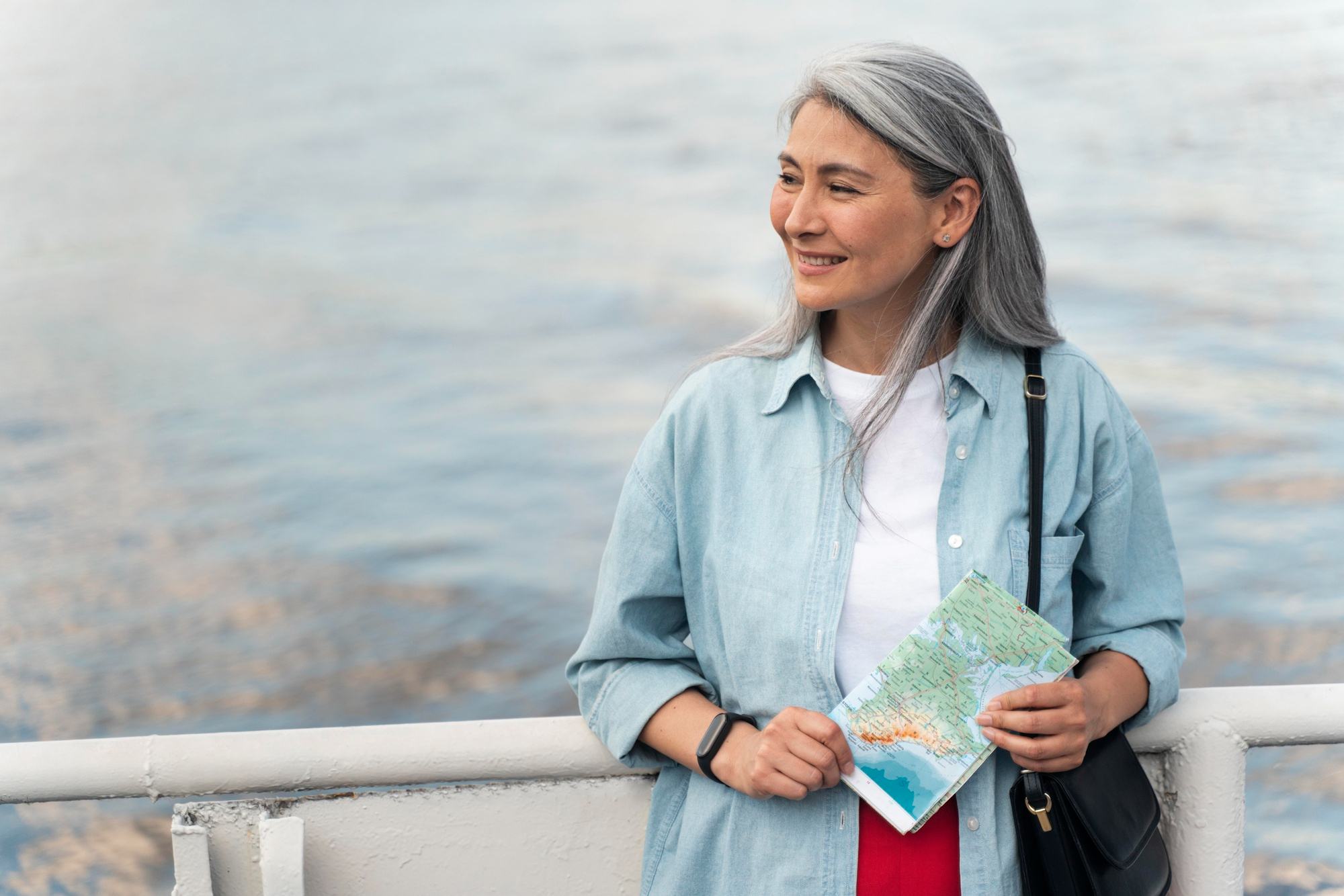
Ireland was my first stop. Galway, on the west coast. I stayed in a little bed-and-breakfast run by a woman named Siobhan who made the best brown bread I’ve ever eaten. I walked along the stone walls of the Aran Islands in the rain. I listened to fiddle music in a pub until midnight. I hadn’t been up until midnight in twenty years.
Italy was second. Florence. I stood in front of a painting in the Uffizi Gallery for an hour and a half. A Botticelli. A woman rising out of the sea on a shell. I cried in the middle of the gallery, and an old Italian man in a wool coat handed me his handkerchief without saying a word.
Japan was third. Kyoto. Cherry blossoms. Temples. A little ryokan with paper walls and a hot bath. I sat on a bench in a temple garden by a pond with a single heron standing in the reeds, perfectly still, and something in me cracked open.
That night, in my room in the ryokan, I opened my wooden paint box.
I bought new brushes at a little art shop near the station. I bought a small pad of watercolor paper. I wet the old dried cakes of paint with a little water.
They came back. All of them. Like they’d just been waiting.
I painted the heron in the temple garden.
It was terrible. My hand was stiff. The lines were shaky. The colors were muddy.
I painted it again the next morning. And again.
By the time I left Kyoto, it was less terrible.
Australia was my fourth stop.
I flew into Sydney in late October. It was spring there. Everything upside down. The trees were blooming purple. Jacarandas, a woman at the hostel told me.
I rented a little apartment in a neighborhood called Balmain for a month. On a hill above the harbor. It had a balcony where I could sit in the morning with my coffee and watch the ferries go back and forth.
I painted on that balcony every morning. Just like I used to at the lake.
In the afternoons, I explored. And on my third day, I found a little jazz café near the water. It was called The Blue Room. It had low lights and old posters of Billie Holiday and Louis Armstrong on the walls and a piano in the corner that an old man played on Tuesday and Thursday afternoons.
I sat at a table by the window with a cup of tea and a detective novel, and listened.
There was a man at the table next to mine.
He was older than me. Seventy-something. Tall and thin, with white hair and a tan face and big ears. He was wearing a straw hat and a faded blue shirt. He had a cup of black coffee and a detective novel of his own.
The same detective novel. An Agatha Christie. The Murder of Roger Ackroyd.
He noticed at the same time I did. He held his book up. I held mine up. We both laughed.
“Don’t tell me who did it,” he said. He had a broad, warm Australian accent.
“I already know who did it,” I said. “I’ve read it four times.”
“Then don’t spoil it for me,” he said. “I’ve only read it three.”
His name was Arthur Pell.
He was seventy-one. A widower, like me. His wife, Margie, had died six years earlier. Cancer. He’d been a high school science teacher for thirty-five years. He had two grown sons, one in Melbourne and one in Perth. Five grandchildren.
He loved old movies. Jazz. Gardening. Detective novels.
So did I.
We met at The Blue Room the next Tuesday. And the Thursday after that. And then we started meeting on the other days too.
We talked about everything. Books. Movies. Our children. Our late spouses. He told me about Margie. How she used to sing in the kitchen. How she grew the best roses in their neighborhood. How she used to steal the last biscuit off his plate and blame the dog.
I told him about George. How he never talked. How he restored old cars. How he used to sit on the dock and watch me paint without saying a word.
“You paint?” Arthur asked.
“I used to,” I said. “When I was a girl. I just started again. In Japan.”
“What do you paint?”
“Water, mostly,” I said. “Lakes. Ponds. Herons.” I laughed. “I’m a little bit obsessed with herons.”
Arthur looked at me for a long moment. Something moved in his face. Something I didn’t understand.
“Herons,” he said slowly.
“Great blue herons,” I said. “There was one on the lake where I grew up. In Ohio. I painted him every morning one summer.”
Arthur didn’t say anything for a while. He looked out the window at the harbor.
“Where in Ohio?” he asked.
“A little town near Youngstown. You wouldn’t know it.”
“Try me.”
“Lake Milton,” I said.
Arthur’s coffee cup stopped halfway to his mouth.
He set it down very carefully on the saucer.
“Arthur?” I said. “Are you all right?”
He looked at me. His eyes were strange. Wet.
“I’m fine,” he said. “Just a bit of indigestion. Old man’s stomach.” He smiled. It didn’t reach his eyes. “Judy, would you come round to my place this Saturday? For coffee? I’ve got a whole shelf of old records you’d love. Dizzy Gillespie. Ella Fitzgerald. And there’s something else I’d like to show you.”
“What?”
“A painting,” he said. “My favorite painting. I’ve had it a very long time.” He paused. “I think you’d appreciate it. As a painter.”
I trusted him.
I want to be honest about that. I’m sixty-nine. I’ve been around long enough to know when a man is up to something. Arthur wasn’t. Arthur was kind. He held doors. He paid for my tea twice and let me pay for his once, without making a fuss about it. He listened when I talked. He laughed at my jokes. He called me “Judy” like it was a word he liked saying.
So on Saturday afternoon, I took the ferry across the harbor to a neighborhood called Mosman. I walked up a steep, quiet street lined with jacaranda trees. Purple petals all over the sidewalk.
His house was at the top. A small yellow cottage with a red tin roof and a garden full of roses.
Margie’s roses, I thought.
He was waiting on the front porch. He’d put on a clean blue shirt. He’d combed his white hair.
“You found it,” he said.
“The roses are beautiful,” I said.
“Margie planted every one,” he said. “I just try not to kill them.”
His home was warm and ordinary. Old furniture. Worn rugs. Bookshelves full of detective novels. A cat asleep on the windowsill.
Along the hallway, there were family photos. His sons as little boys. His wedding to Margie. Grandchildren at the beach. A young man in a uniform. Arthur, I realized. Very young. Maybe twenty. Thin and serious, in an Australian army slouch hat with the brim pinned up on one side.
“Vietnam?” I asked.
“Sixty-seven, sixty-eight,” Arthur said. He didn’t look at the photo. “I’ll put the kettle on.”
He went into the kitchen.
“Make yourself at home,” he called. “The records are in the living room. Through there.”
So I stepped into the living room.
And I froze.
It was a small room. Comfortable. A brown leather sofa with a crocheted blanket over the back. A record player on a wooden cabinet. Shelves of old vinyl.
And a fireplace. Brick. With a wooden mantel.
Above the fireplace, in a heavy dark frame with a wide cream mat, there was a painting.
A small one. Five inches by seven.
It was a lake at sunrise. The mist lifting off the water. The sky going from pink to gold. A great blue heron standing in the reeds on the left side, on one leg, perfectly still. And in the bottom right corner, very small, the end of a wooden dock.
My hands started shaking.
I walked across the room. Slowly. I couldn’t feel my feet.
I stood in front of the fireplace and looked up.
The colors had faded a little. The pink was softer. The gold was paler. There was a faint brown stain along the top edge, like water damage. Or something else. There was a crease across one corner where it had once been folded.
But it was the lake. My lake. Lake Milton. The way I saw it, that morning in August, when a skinny boy with big ears said I was really good.
And in the bottom corner, in tiny letters, so small you’d only see them if you knew to look:
J. Owens ’67.
Something that had no reason to be in Australia.
Something I’d put in a nineteen-year-old boy’s wallet on the end of a dock fifty-eight years ago.
Something he told me he’d lost.
I didn’t hear Arthur come in. He was standing in the doorway with two cups of coffee. He was watching me.
“You recognize it,” he said quietly. It wasn’t a question.
I turned around. I couldn’t speak. My whole body was shaking.
“Owens,” Arthur said. “J. Owens. I’ve looked at that name every single day for fifty-seven years. I never knew what the J stood for.” He set the coffee cups down on the side table. His hands were shaking too. “When you told me on Thursday that you painted herons. That you grew up on a lake. In Ohio. Lake Milton.” He swallowed. “George told me it was Lake Milton. He said it was the most beautiful place in the world.”
“George,” I whispered.
“George,” Arthur said. “Your George. I’d bet my life on it. Tall. Skinny. Big ears like mine. Laughed like a sneeze. A Dustoff medic. From Ohio.” He looked at me. “Is that him?”
I sat down on the brown leather sofa. My legs wouldn’t hold me anymore.
“That’s him,” I said.
Arthur sat down next to me. Not too close. He handed me one of the cups of coffee. I couldn’t hold it. He took it back and set it on the table.
“I want to tell you how I got it,” he said. “If you’ll let me.”
I nodded.
He looked up at the painting over the fireplace for a long time before he started.
“March of 1968,” he said. “Phuoc Tuy Province. I was twenty. With the Royal Australian Regiment. Our boys were out on patrol in the scrub north of Nui Dat. We walked into an ambush. Mortars. Machine guns. Everything.” He stopped. “I took a round in the chest and two in the leg. I went down in a clearing. I couldn’t move. I lay there for three hours. In the heat. In the mud. Bleeding. I could hear the other boys calling. Some of them stopped calling.”
I put my hand over my mouth.
“Our own choppers couldn’t get in,” Arthur said. “Too much fire. But there was an American Dustoff in the area. A Huey. With a big red cross on the nose. They came in anyway. Right into the clearing. Under fire. I remember the sound of it. The rotors. I thought it was the most beautiful sound I’d ever heard.”
He looked down at his hands.
“A medic jumped out,” he said. “Before the skids even touched the ground. Ran across that clearing with bullets kicking up the mud around him. Skinny bloke. Big ears. No helmet. He’d lost it somewhere. He knelt down next to me and put his hands on my chest and pressed down. He said, Hey, Aussie. I’m George. From Ohio. You’re not dying today. Okay? Not on my watch.“
Arthur’s voice cracked.
“He carried me to that chopper,” he said. “By himself. Over his shoulder. I was bigger than him. I don’t know how he did it. He got me in. He got two more of our boys in. And they flew us out.”
He told me about the hospital. The American evacuation hospital at Vung Tau, on the coast. He’d been in surgery for six hours. They didn’t think he’d make it. His lung had collapsed. He’d lost so much blood. When he woke up, he couldn’t move. Tubes everywhere.
“I didn’t want to live,” Arthur said quietly. “I’ll be honest with you, Judy. I’d seen what I’d seen in that clearing. My mate Robbie, who I grew up with, died next to me. Three feet away. I lay there in that hospital bed and I thought, what’s the point? Even if I live, what’s there to go back to?”
He was looking at the painting.
“On the third day, George came,” he said. “To the hospital. In his flight suit. He’d heard I was there. He said he always checked on the ones he picked up, when he could. He sat down on the edge of my bed. And he saw my face. And he knew. Medics always know.”
“Know what?” I whispered.
“That I’d given up,” Arthur said.
He was crying now. Quietly. Tears running down his face.
“George didn’t say anything for a long time,” he said. “He just sat there. Then he reached into his pocket. He took out his wallet. He took out this little painting. From behind the plastic window. He unfolded it. It had been folded once. You can still see the crease.” He pointed at the corner of the painting over the fireplace. “And he held it up so I could see it.”
I couldn’t breathe.
“He said, This is Lake Milton. In Ohio. My girl painted it. Her name’s Judy. She gave it to me so I wouldn’t forget what home looks like. I look at it every night.” Arthur’s voice broke completely. “He said, You hold onto this, Aussie. You look at it every night. And you remember there’s a sunrise somewhere waiting for you. And when this is over, you bring it back to me. To that dock. I promised her I’d bring it back.“
He covered his face with both hands.
“I said, I can’t take this, mate. It’s yours. It’s your girl’s. And he said, You need it more than I do right now. I’ve got the real one waiting for me.“
I sat on Arthur Pell’s brown leather sofa in Sydney, Australia, and cried like I hadn’t cried since the day I found George on the floor of his garage.
George.
My quiet George. Who never talked about the war. Not once in forty years. Who woke up shouting in the night and never said why. Who told me, on the end of the dock in 1969, I lost it, Judy. I’m sorry.
He didn’t lose it.
He gave it away.
He gave the only thing he had from home, the thing he looked at every night, to a dying stranger in a hospital bed. Because that stranger needed a reason to live more than he did.
And he never told me. Not once. In forty years of marriage.
He let me think he’d lost it. He let me be disappointed. He let me wonder, for forty years, if it really meant so little to him.
Because telling me would have meant talking about the clearing. And the mud. And the boys who stopped calling. And George couldn’t talk about any of it.
“Why didn’t you bring it back?” I asked finally. My voice was hoarse. “He asked you to bring it back.”
“I tried,” Arthur said. “God knows I tried.”
They flew him to Australia two weeks later. To a hospital in Sydney. He was there for four months. He looked at the painting every night, just like George told him. On the bad nights, he held it on his chest.
“It kept me alive,” he said simply. “I’m not being poetic. I’m a science teacher. I don’t believe in that kind of thing. But I’m telling you, that painting kept me alive. Every night I’d look at that heron standing in the reeds, so calm, so still, and I’d think, there’s a place like that somewhere. A place with no mud and no mortars. And a girl named Judy who painted it. And a skinny Yank named George who’s going home to her. And I’d think, I want to see a sunrise like that. Just once. And I’d make it through to morning.”
When he got out of the hospital, he wrote to the U.S. Army. He didn’t know George’s last name. He’d been too out of it to read the name tape. He just knew George. A Dustoff medic. From Ohio. Who’d been flying out of Vung Tau in March of 1968.
The Army wrote back. They said they couldn’t help him without more information. There were hundreds of medics named George.
He wrote again. And again. Over the years, he wrote to veterans’ organizations. To Dustoff reunion groups. In the nineties, when the internet came, he posted on message boards. Looking for a Dustoff medic named George, from Ohio, who flew out of Vung Tau in March 1968. I have something that belongs to him.
Nobody ever answered.
“George never went to the reunions,” I said quietly. “He never joined the veterans’ groups. He never talked about it. Not to anybody.”
“I figured as much,” Arthur said. “The ones who did the most usually say the least.”
He looked up at the painting.
“So I kept it,” he said. “I married Margie. I put it over our fireplace. She knew the whole story. She used to dust it every week and say, Good morning, Judy. Every Sunday morning. Good morning, Judy. Like you were living here with us.” He smiled a little. “My boys grew up with it. They called it the lake. When they were little, they thought it was in heaven.”
He wiped his eyes.
“I didn’t know what the J stood for,” he said. “Not until Thursday. When you said herons. And Lake Milton. And I went home and looked at the signature for two hours, and I thought, it couldn’t be. It couldn’t possibly be.“
“Why didn’t you tell me then?”
“Because I wanted you to see it,” Arthur said. “I wanted to see your face. When you saw it.” He looked at me. “I’ve been waiting fifty-seven years to keep my promise to George. I wanted to do it right.”
He stood up. He went to the fireplace. He reached up and took the painting down off its hook. Carefully. With both hands. Like it was made of glass.
He turned around and held it out to me.
“George asked me to bring this back to you,” he said. “On a dock. I can’t do the dock. I’m sorry. My knees won’t make the flight to Ohio.” He smiled through his tears. “But I can do this.”
I looked at the painting in his hands. My lake. My heron. My signature in the corner.
I didn’t take it.
“Arthur,” I said. “No.”
He looked confused.
“George gave it to you,” I said. “He gave it to you because you needed it. And you’ve needed it for fifty-seven years. It’s been over your fireplace through your whole marriage. Your boys grew up with it. Margie said good morning to it every Sunday.” I shook my head. “It’s yours. It’s always been yours. He made sure of that.”
“But he promised you,” Arthur said. “He promised to bring it back.”
“He did bring it back,” I said.
Arthur stared at me.
“Look at it,” I said. “Look where it is. I’ve been carrying around a stupid little wound for fifty-seven years. That my husband lost the first thing I ever gave him. That it didn’t matter to him.” My voice broke. “And it was here. The whole time. Keeping a man alive. In a house full of roses. With a woman saying good morning to me every Sunday.”
I stood up. I put my hands over Arthur’s hands. Both of us holding the painting.
“That’s not lost, Arthur,” I said. “That’s the most found thing in the world.”
He hung it back over the fireplace. We both stood there and looked at it for a long time.
Then we drank our coffee, which was cold by then. And he put on an Ella Fitzgerald record. And we sat on the brown leather sofa and talked until it got dark.
He told me things about George I never knew. Things George never told me in forty years. How brave he was. How he ran across that clearing with no helmet. How he made jokes in the chopper to keep the wounded boys calm. How he sat on the edge of a hospital bed and gave away the only thing he had from home.
“He talked about you,” Arthur said. “In the hospital. For an hour. You were all he talked about. Judy and the lake. Judy and her paints. He said you were going to art school in Cleveland. He said you were going to be famous someday. He said he was going to marry you and build you a studio with big windows so you could paint the light.”
I didn’t say anything.
“Did you?” Arthur asked gently. “Go to art school? Become famous?”
I laughed. It came out wet.
“No,” I said. “I worked at a bank for thirty-one years. I raised four kids. I put my paints in the attic in 1971 and didn’t open them again until three weeks ago.”
Arthur was quiet for a while.
“Why?” he asked.
“Because there was never time,” I said. “Because there was always somebody who needed something. George needed help at the garage. The kids needed lunches and rides and money. My grandkids needed a babysitter. There was always somebody.” I looked at the painting. “And I thought, someday. Someday I’ll get back to it.”
“And now?”
I thought about it.
“Now I’m sixty-nine,” I said. “And I sold my house. And two of my children have blocked my phone number because I spent my own money on myself for the first time in fifty years.” I wiped my eyes. “And I’m sitting in a stranger’s living room in Australia, looking at the last thing I painted before I stopped being Judy.”
Arthur looked at me for a long moment.
“You’re not a stranger,” he said. “You’ve been over my fireplace for fifty-seven years.”
I stayed in Sydney for two more months instead of one.
I painted every morning on the balcony of my little apartment in Balmain. The harbor. The ferries. The jacaranda trees. And then I’d take the ferry to Mosman and paint in Arthur’s garden. Margie’s roses. The old lemon tree. The cat on the windowsill.
Arthur would sit in a deck chair next to me with his detective novel and watch. He didn’t talk much while I painted. He just watched.
Like George used to, on the end of the dock.
“You’re really good, Judy,” he said one afternoon. Looking at a painting of the roses.
I had to put my brush down. I had to go inside for a minute.
I wrote to Katie. A long letter. On real paper. With a stamp, like she asked. I told her everything. The Blue Room. The Agatha Christie novel. Arthur’s yellow house. The painting over the fireplace. The clearing in Phuoc Tuy. The hospital bed. You need it more than I do right now.
She called me three days after it arrived. She was crying so hard I could barely understand her.
“Dad did that?” she said. “Dad? Our Dad? Who never said anything?”
“Our Dad,” I said.
“He gave it away. To save somebody. And he never told you.”
“Never,” I said.
“Mom,” Katie said. “You have to tell the others.”
“They’ve blocked my number, honey.”
“Then I’ll tell them,” she said.
I don’t know exactly what Katie said. I know she called each of them. Brian. Theresa. Doug. I know she read them my letter over the phone.
A week later, I got an email from Theresa. The first one in four months.
It was short.
Mom. Katie told us about Dad. And the painting. I didn’t know. None of us knew.
I’m sorry about what I said. About Tuesdays and Thursdays. I’m sorry I never asked what you wanted to do with your Tuesdays.
What do you want to do with your Tuesdays?
— T
I wrote back.
Paint, I said. I want to paint.
Two days later, my phone rang. It was Brian. He’d unblocked me.
He didn’t say anything for a long time. I could hear him breathing.
“I always thought Dad lost it,” he said finally. “The painting. You told us the story once, when we were kids. About the lake and the painting you gave him. And how he lost it in the war. And I always thought… I don’t know. I thought maybe he didn’t care that much.”
“So did I,” I said.
“He gave it to somebody who was dying,” Brian said. His voice cracked. “He gave away the only thing he had. And then he came home and worked in that garage for forty years and never said a word.”
“Yes.”
“Mom,” Brian said. “I’ve been an idiot. About the house. About the money. About calling you selfish.” He swallowed. “Dad gave away everything he had to a stranger. And you gave away everything you had to us. For fifty years. And the first time you kept something for yourself, I blocked your number.”
I didn’t say anything. I couldn’t.
“I’m sorry,” Brian said. “I’m really sorry, Mom.”
Doug never called. I’ve learned to live with that.
But in January, I got a package in the mail at Arthur’s address, where I’d been getting my mail. It was from Doug. No note. Inside, there was a small framed photograph.
It was George. Maybe twenty years old. In his flight suit. Standing in front of a Huey helicopter with a big red cross on the nose. Grinning. Big ears. No helmet.
On the back, in Doug’s handwriting: Found this in Dad’s things in the garage. Thought Arthur should have it. For next to the painting.
I’m not in Australia anymore.
I went to New Zealand in February. Then Peru in April. I hiked to Machu Picchu at seventy years old with a walking stick and a guide named Rodrigo who called me “Abuelita” and held my arm on the steep parts.
I painted everything. The mountains. The llamas. The clouds below me. I have three sketchbooks full now. And a whole box of finished paintings.
Katie came and met me in Peru for a week. She took a hundred photos of me painting on a stone wall in Cusco. She posted one on her Instagram with the caption: My mom, 70, finally being Judy.
It got four thousand likes. I don’t really understand Instagram. But Katie says that’s a lot.
In May, I went back to Sydney.
I told myself it was because I’d left some things at Arthur’s. A sketchbook. A sweater.
That wasn’t why.
He was waiting on his front porch when my taxi pulled up. In his straw hat. In a clean blue shirt. The roses were in full bloom.
“You came back,” he said.
“I left my sketchbook,” I said.
“You did,” he said. “It’s on the kitchen table. I didn’t look at it.” He paused. “Much.”
We had dinner on his back porch that night. He grilled fish. I made a salad. We drank a bottle of Australian wine. We put on a Dizzy Gillespie record and left the back door open so we could hear it.
After dinner, we went into the living room.
The painting was over the fireplace where it had always been. Lake Milton at sunrise. The mist. The heron. The dock. J. Owens ’67.
Next to it, on the mantel, there was the photo Doug sent. George in his flight suit. Grinning. No helmet.
And on the other side of the painting, there was another photo. A woman with curly gray hair, laughing in a rose garden.
Margie.
Arthur had put them on either side. George on the left. Margie on the right. And my lake in the middle.
“I hope you don’t mind,” Arthur said. “I thought they should be together. The three of them. The people who kept that painting safe.”
I looked at it for a long time.
George and Margie. The two people we’d each loved for forty years. The two people we’d each lost.
And in between them, a little painting of a lake in Ohio that had traveled ten thousand miles in a dead boy’s wallet. Through a war. Through a hospital. Through fifty-seven years over a fireplace in Australia.
Back to me.
“It’s perfect,” I said.
There’s one more thing.
Last month, Arthur and I flew to Ohio together. His knees were better. Or he said they were. He’d been doing his exercises.
We drove out to Lake Milton. It took us an hour to find the old gravel road. It’s paved now. There are big houses on the north shore where my father’s fishing shack used to be.
But the dock is still there.
Not the same dock. They’ve replaced it three or four times since 1967. But it’s in the same spot. On the same piece of shore. Facing east.
We got there before sunrise. Arthur had insisted. It was cold and dark and the mist was sitting on the water so thick you couldn’t see the far shore.
We walked out to the end of the dock. Arthur was carrying something wrapped in a towel.
We sat down. Our feet dangling over the water. Like I used to with George.
Arthur unwrapped the towel. It was the painting. He’d taken it off his wall in Sydney. He’d carried it on the plane in his lap the whole way. Fourteen hours. He wouldn’t put it in the overhead bin.
He held it up. In front of us. So we could see both. The little painting from 1967. And the real lake, right there, in front of us, starting to turn pink.
“I promised George,” he said quietly. “Fifty-eight years ago. In a hospital bed in Vung Tau. I promised I’d bring it back to the dock.”
He looked out at the water.
“It took a while, mate,” he said. To nobody. To the mist. “Sorry about that. But I got here.”
The sun started coming up. Pink. Then orange. Then gold. The mist lifted off the water in long slow ribbons.
And in the reeds on the left side, near the shore, something moved.
A great blue heron. Standing on one leg. Perfectly still.
Arthur saw it at the same time I did. He grabbed my hand.
We didn’t say anything. We just sat there on the end of the dock at Lake Milton, holding hands and holding the painting, watching the heron in the reeds while the sun came up.
We flew back to Sydney the next week. Arthur hung the painting back over his fireplace. Between George and Margie.
I’m living in Australia now. For a while, anyway. I rented a little flat around the corner from Arthur’s. I don’t live with him. Not yet. We’re both old, and we’ve both been married, and we’re taking our time.
I go over every morning. I paint in Margie’s garden. He sits in his deck chair and reads his detective novels and watches. In the afternoons, we go to The Blue Room and listen to the old man play piano.
My children call now. All of them except Doug. Not when they need something. Just to call.
Theresa called last Tuesday. She asked what I was painting.
“Roses,” I said.
“Can you send me one?” she asked. “For my kitchen?”
“Of course,” I said.
“Mom,” she said. “I’m sorry it took us so long. To see you. Not just as Mom. As you.”
“It took me a long time too,” I said.
I’m seventy now. I’ve been to Ireland and Italy and Japan and Australia and New Zealand and Peru. I’ve painted over two hundred paintings. Some of them are even good.
People ask me if I regret selling the house. If I regret spending the money. If I regret leaving when my children begged me to stay.
I tell them the truth.
I spent fifty years being the person who gave everything away. I gave my money. I gave my Tuesdays and Thursdays. I gave my paints to the attic and my someday to everybody else.
I thought that’s what love was.
And then, in a little yellow house in Australia, I found out what my husband did with the only thing I ever gave him.
He gave it away too. To a dying stranger. Because that stranger needed it more.
And it kept that stranger alive for fifty-seven years.
So I don’t think giving things away is wrong. I think it’s the most beautiful thing a person can do.
But I learned something on the end of that dock, watching that heron come out of the mist.
You can’t give someone a sunrise you’ve never let yourself see.
George knew that. That’s why he told Arthur to look at the painting every night. So he’d remember there was a sunrise waiting somewhere.
It took me fifty years and a trip around the world to figure out that the sunrise was waiting for me too.
This morning, I sat in Arthur’s garden with my paints. He was in his deck chair with his book. The roses were blooming. A kookaburra was laughing in the lemon tree.
I painted the light coming through the leaves.
When I finished, Arthur put down his book. He looked at the painting for a long time.
“You’re really good, Judy,” he said.
I didn’t go inside this time. I didn’t need to.
I just smiled, and signed it in the corner. In tiny letters. The way Mrs. Kowalski taught me.
J. Harmon ’26.

Specialty: Quiet Comebacks & Personal Justice
David Reynolds focuses on stories where underestimated individuals regain control of their lives. His writing centers on measured decisions rather than dramatic outbursts — emphasizing preparation, patience, and the long game. His characters don’t shout; they act.