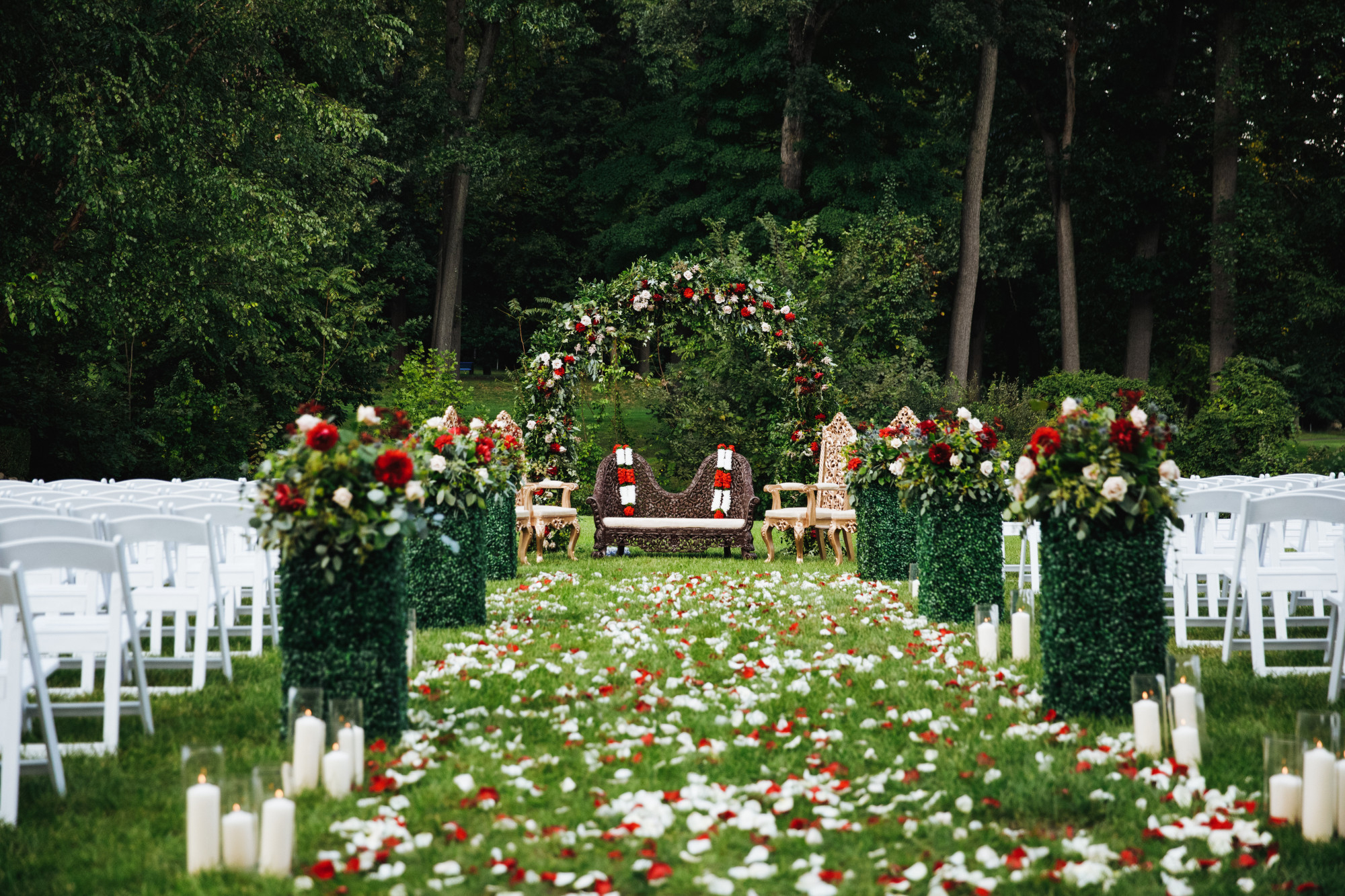
By the time I got back up the hill, it was pouring.
Not a sprinkle. A real downpour, out of nowhere. The kind that comes sideways and soaks you in about ten seconds.
The cocktail hour fell apart. People were screaming and laughing and running for the barn with napkins over their heads. Waiters were grabbing trays. Kyle the photographer was shielding his camera under his jacket. Somebody’s toddler was crying. My mom was standing under the overhang of the barn yelling, “The centerpieces! Somebody get the centerpieces!”
The venue staff were dragging the round tables inside the barn as fast as they could. The string lights in the field swung wildly in the wind.
I ran past all of it, straight to the cottage.
The door was closed.
I stood on the little porch with water dripping off my hair into my eyes.
I knocked.
“It’s me.”
No answer.
I knocked again.
“Claire. I know you’re in there. Jen, if you’re in there, could you… could you give us a minute?”
There was a pause. Then the door opened, and Jen came out. She looked at me like she wanted to push me off the porch into the mud.
“You have five minutes,” she said. “And if she’s crying more when I come back, I’m telling your mother you cried at Toy Story 3.”
“She already knows.”
“I’ll tell her you cried at Toy Story 2.”
She stomped off through the rain toward the barn.
I went in and closed the door behind me.
Claire was sitting on the edge of the bed, next to the dress in its plastic cover. She’d taken off the suit jacket. It was lying across her lap. She was just in the white shirt and the dark tie and the huge trousers held up with a belt that had about five extra holes punched in it. Her makeup was ruined. Her feet were bare.
She didn’t look up.
I didn’t know where to start. So I just sat down on the floor in front of her, on the rug, in my soaking wet suit.
“What I said,” I started. “About the ghost. That was the worst thing I’ve ever said to anyone. I don’t think it. I’ve never thought it. I was embarrassed and I was hurt that you didn’t tell me, and I wanted you to feel as bad as I did, for a second. And that’s… that’s not who I want to be. Especially not today.”
She was looking at the jacket in her lap. Running her thumb along the edge of a lapel.
“I’m sorry,” I said. “I’m really, really sorry.”
Silence. Rain hammered on the roof.
“Your mom told me,” I said. “About the shop. About him being sick. About him measuring himself the way he used to be.”
Claire’s thumb stopped moving.
“She told you that?”
“She told me he said, ‘That’s the man who should be walking her.'”
Claire made a small sound and pressed the back of her wrist against her mouth.
“I didn’t know any of it,” I said. “And that’s partly on you, because you didn’t tell me. But it’s partly on me too. Because I never asked. Not really. Every time you closed the door, I was kind of relieved. Because then I didn’t have to figure out what to say. I told myself I was being patient. I wasn’t being patient. I was being lazy.”
She finally looked at me.
“You weren’t lazy,” she said. “You were kind. You were trying to be kind.”
“Maybe. But it was the easy kind.”
She looked down at me sitting on the floor in a puddle of my own rainwater.
“You’re ruining the rug,” she said.
“I don’t care about the rug.”
“It’s a rented rug, Ben. We’re going to get charged.”
I laughed. I couldn’t help it. And then she laughed too, the wet, broken kind of laugh where you’re still half crying.
“Will you tell me about him?” I said. “Not all of it. Not now. Just one thing. Anything.”
She was quiet for a long time.
Then she said, “He used to hum when he sewed. Always the same song. ‘Moon River.’ He couldn’t sing to save his life. Totally off-key. But he hummed it every single day. Customers would come in and he’d be humming. My mom said he hummed it at their wedding during the vows by accident.”
She smiled a little.
“When he got really sick, near the end, he couldn’t sew anymore. His hands shook too much. So I’d sit with him in the back room and I’d hum it for him. And he’d correct me. He’d go, ‘No, kiddo, the note goes up there.’ Even though he was always the one who got it wrong.”
She wiped her eyes.
“That’s one thing,” she said.
“Thank you,” I said. And I meant it more than anything I’d said all day.
After a minute, I said, “Your mom said there’s something in the pocket.”
Claire’s hand went flat against the jacket on her lap. Right over the left side.
“She told you that too?”
“She said you found it eight months ago and never opened it. She said you were going to give it to me tonight.”
Claire looked at the jacket. Then she slid her hand inside the left breast pocket and took out an envelope.
It was small. Old. The paper had gone soft and yellow. On the front, in handwriting that shook a little, it said:
To the man who marries my Claire.
She held it in both hands for a long moment.
“I read the front,” she said. “And I put it back. It wasn’t mine.” She held it out to me. “It’s yours.”
My hands were wet. I wiped them on my shirt, which didn’t help, because my shirt was also wet. I took the envelope carefully.
“Do you want me to read it alone?”
She shook her head. “No. Read it here.” She swallowed. “Out loud. If you can. I want to hear what he said.”
I opened it.
There was one sheet of paper inside, folded twice. The handwriting was big and slanted and got shakier toward the bottom, like he’d had to stop and rest.
I read it out loud.
To whoever you are,
If you’re reading this, she wore the suit. Which means she was brave enough to do something strange in front of a lot of people for an old man who couldn’t make it. That’s my girl.
I don’t know you. I’m sorry about that. I wanted to give you a hard time at the rehearsal dinner and ask what your intentions were and make you nervous. I was looking forward to it.
Here’s what I know about Claire that you might not know yet.
She’s going to lock a door sometimes. She’ll go quiet and close herself off. You’re going to think she’s keeping you out. She’s not. She’s afraid that if she lets you see the hard stuff, you’ll leave. She thinks she has to be easy to love.
She doesn’t. Knock anyway. Knock every time. Even when she says she’s fine. She’s never fine when she says she’s fine.
And when she finally opens the door, don’t run. That’s all I’m asking. Don’t run.
Take care of her. Let her take care of you, too. She’s good at it. She took care of me this whole last year and I never told her how much it meant. Tell her for me.
Ray
P.S. Make sure she gets that jacket dry cleaned. Don’t let anybody put it in a washing machine. I’ll know.
I lowered the paper.
Claire was crying. Not quiet crying. The real kind, with her shoulders shaking and her hands over her face.
I got up off the floor and sat next to her on the bed and put my arms around her. She leaned into me. Her whole weight. I held her the way I should have held her five years earlier, the first time she ever went quiet on me and I let her.
“He said to tell you,” I said into her hair. “That it meant everything. The year you took care of him. He said to tell you.”
She cried harder.
I just held on.
Outside, the rain kept coming down. Somewhere in the barn, faintly, I could hear the DJ testing his speakers. And my mother’s voice, even over all of it, saying, “No, the centerpieces go in the middle of the table.”
When Jen came back exactly five minutes later, she found us both sitting on the bed, red-eyed, wet, laughing at the P.S.
She stood in the doorway and looked at us.
“Is she crying more or less?” she asked me.
“Both,” Claire said.
Jen considered this. “I’ll allow it.”
She helped Claire fix her makeup as well as anyone could. Claire put the jacket back on. She buttoned it. She rolled the sleeves back once so her hands could get out.
I put the letter in the inside pocket of my own suit jacket, over my heart.
“Okay,” Claire said, looking at herself in the mirror. “Okay. Are we going back out there?”
“There’s a lot of angry wet people in that barn,” Jen said. “And Ben’s mom is about to stage a coup over the centerpieces.”
“Then we’d better go,” I said.
I held out my hand.
Claire took it.
The barn was chaos.
The tables were all crammed in, some of them crooked. Half the centerpieces had blown over and been put back wrong. Everyone was damp. Some people had obviously been drinking a lot faster than planned during the storm. A few of the white tablecloths had muddy footprints on them.
When we walked in, the room got quieter.
Not silent. But people stopped talking and turned to look. I felt Claire’s hand tighten around mine.
My mom was standing by the head table with her arms crossed. Her hair, the hair she’d had done at seven a.m., had been completely destroyed by the rain. It was hanging flat on one side.
She saw us. She marched over.
“There you are,” she said. “Where have you been? Everyone’s been asking. The caterer’s been asking. And Claire, honey, I’m sorry, I have to say something, I just think everyone deserves to know what’s going on with—”
“Mom,” I said.
“—because people are talking, Ben, and the photographer—”
“Mom.“
She stopped.
I don’t raise my voice at my mother. Ever. I didn’t raise it then either. I just said it in a way I’d never said it before.
“I’m going to explain,” I said. “To everybody. Right now. But I need you to sit down. Please.”
She looked at me for a long second. Then she looked at Claire. Then, for some reason, she looked at Claire’s sleeve.
She sat down.
The DJ was a guy named Rocco with a ponytail even longer than Kyle the photographer’s. I walked up to his table and asked to borrow the microphone. He handed it to me like it was hot.
“You good, man?”
“I’m good. Do you have ‘Moon River’?”
He blinked. “Like… the old one?”
“The old one.”
He scrolled on his laptop. “Uh. Yeah. Couple versions. Which one?”
“The simplest one you’ve got. Just wait till I tell you.”
I turned around and faced the barn. Eighty people looked back at me. Some of them were drunk. Some of them were annoyed. My mom’s cousin Debbie had her phone out like she was going to record something.
I tapped the mic. It squealed. Everybody winced.
“Sorry,” I said. “Hi. I’m Ben. Some of you know me. Most of you know me. I’m the guy who just married Claire.”
A few people laughed. Not many.
“I know a lot of you are confused about what happened out there. With the suit.” I looked over at Claire. She was standing by the head table next to her mom. She was holding Maureen’s hand. I’d asked her on the walk over. Can I tell them? She’d thought about it. Then she’d said, Yes. No more closed doors.
“I was confused too,” I said. “I’m not going to lie. I was standing up there and I had no idea what was going on. I was embarrassed. I was mad. One of you asked if it was a joke.” I didn’t look at Debbie. I didn’t have to. Everyone else did. “And honestly? For a second, I wondered the same thing.”
I took a breath.
“It’s not a joke. It’s her dad’s suit. Ray Donnelly. He was a tailor. He made it for himself while he was dying. So he could walk Claire down the aisle someday. He knew he wasn’t going to make it. He made it anyway.” My voice started to go. I made myself keep going. “There’s a label sewn inside the sleeve. It says, ‘If I can’t be there, wear it for me. I’ll be there anyway.'”
Nobody said anything.
The whole barn was silent except for the rain on the roof.
Then I heard a sound from the corner. It was Uncle Pete. He’d come back in from the field at some point. He was standing in the corner with his hand over his face.
“So she wore it,” I said. “She walked down the aisle by herself in a suit three sizes too big. In front of all of you. Because she promised her dad she would. And I didn’t know, because she was scared to tell me. And I wasn’t paying close enough attention to ask.” I looked at Claire. “That’s on me. And I’m going to spend the rest of my life getting better at it.”
I turned to Rocco.
“We were supposed to have a father-daughter dance tonight. Claire cut it from the schedule a long time ago. She told me it didn’t matter. I believed her.” I looked at Claire. “I don’t believe her anymore.”
I held out the microphone to Rocco.
“Okay,” I said. “Now.”
The song started.
Just a piano, slow and simple.
Claire’s hand went to her mouth.
I walked across the dance floor toward her. When I got there, I didn’t hold out my hand. Instead, I turned and looked at Maureen. Then at Pete in the corner.
“He doesn’t get to have this dance,” I said quietly. “So I don’t think it should be me. I think it should be the people who knew him.”
Maureen’s face crumpled.
Claire looked at me. She looked at her mom.
Then Maureen let go of the table and took her daughter’s hand and led her out onto the middle of the dance floor.
They didn’t really dance. Not properly. They just held each other and swayed back and forth. Claire’s big sleeves hung down Maureen’s back. Maureen’s head was on Claire’s shoulder, on the padded shoulder of the jacket her husband had sewn for himself twelve years earlier.
After a minute, Uncle Pete came out of the corner. He walked across the dance floor slowly. He put his huge arms around both of them.
And then, very softly, so softly I almost didn’t hear it, Pete started humming along.
Off-key.
Way off-key.
Claire laughed in the middle of crying. She pulled back and looked up at him.
“You sound just like him,” she said.
“Bad?” Pete asked.
“Terrible,” she said. “Perfect.”
I stood at the edge of the dance floor with my hands in my pockets and couldn’t see anything for a minute because my eyes were full.
Someone moved next to me.
It was my mother.
Her ruined hair was hanging in her face. Her mascara was running. She’d been crying. My mother, who had spent the whole afternoon furious about a two-hundred-dollar dress.
She didn’t say anything for a while.
Then she said, “I’m going to go apologize to her.”
“You don’t have to do it right now.”
“I know I don’t have to.” She sniffed. “I want to. Before I lose my nerve.” She straightened her shoulders. “And then I’m going to go yell at Debbie.”
“Mom.”
“Just a little.”
She walked out onto the dance floor. She waited until the song ended. Then she went up to Claire and said something I couldn’t hear. And Claire hugged her. A real hug. Long enough that my dad, sitting at the table, said, “Well, would you look at that,” and went back to his salad.

Specialty: Quiet Comebacks & Personal Justice
David Reynolds focuses on stories where underestimated individuals regain control of their lives. His writing centers on measured decisions rather than dramatic outbursts — emphasizing preparation, patience, and the long game. His characters don’t shout; they act.