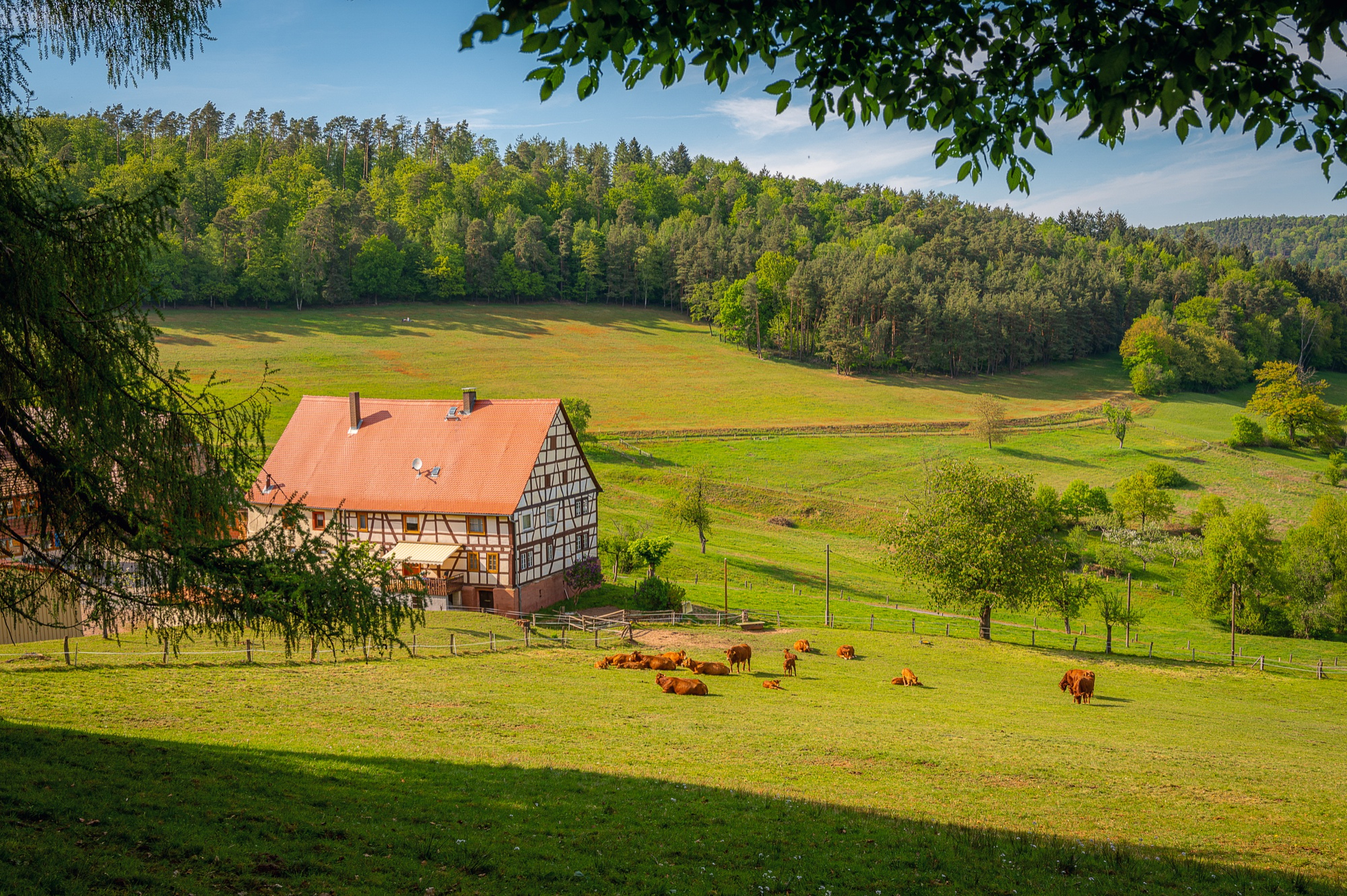
Michael grew thinner. His knees stiffened. The porch sagged more every season. The same little house held on the way old houses do, not because they are strong, but because nobody has given them permission to fall.
Sarah grew older too, but age did not soften her. It sharpened her. She spoke of Michael’s life as if it were a cautionary tale she had personally survived. He could have had more. He could have sold that place. He could have remarried. He could have done anything except raise a child who was never his.
Michael heard it more than once. He never corrected her. Maybe because he was tired. Maybe because he had learned that some people confuse silence with surrender.
Twenty-five years after that muddy evening, Michael sat on the porch holding a paper coffee cup in both hands. The morning had been cool, but the afternoon had warmed the boards under his boots. A small American flag still hung from the porch railing, faded now at the edges.
Sarah stood near the steps with two neighbors, talking as if he were no longer fully present.
“He wasted his whole life,” she said. “On a child who never even belonged to him.”
Michael looked down into his coffee. His hands were not as steady as they used to be. He thought of the hospital waiting room. He thought of the laundry basket lined with towels. He thought of Noah at six, holding up that drawing with Dad written above his head.
He did not think of it as waste. He thought of it as the only thing he had ever done that made the rest of his life make sense.
Then tires crunched on the gravel drive.
Sarah turned first. A dark SUV rolled slowly toward the house, clean but not flashy, the kind of vehicle that said someone had worked hard enough to stop apologizing for needing reliability. The engine went quiet. The driver’s door opened.
Noah stepped out in work boots and a clean jacket.
For a second, nobody spoke.
Michael’s face changed before the rest of him did. Age seemed to loosen its grip on him for one breath. His mouth opened. The paper coffee cup slipped from his hand and cracked against the porch step. Coffee spread across the wood and dripped through the gap between the boards.
Sarah gave a small laugh. “Well,” she said, “look who finally remembered where he came from.”
Noah did not look at her. That was the first thing everyone noticed. He looked only at Michael.
Then he walked around to the passenger side of the SUV and opened the door.
Sarah’s smile stayed in place, but it had begun to work too hard.
Noah reached inside. His hand came out holding something folded. At first it looked like nothing. Just cloth. Old cloth. Blue cloth.
Michael’s hand went to the porch rail.
Noah held the blanket under one arm carefully, almost protectively. The faded edge showed first. Then the frayed corner stitching. Then the small patch near the fold where Michael had once sewn it by hand after Noah dragged it through the yard at three years old.
Sarah saw it. Every bit of color drained from her face.
“No,” she whispered.
Noah finally turned toward her. “Yes,” he said.
The neighbors stood completely still. One of them covered her mouth. The other stared down at the broken coffee cup as if looking anywhere else would make her responsible for what she was witnessing.
Noah walked to the porch steps and stopped below Michael. For a moment he was the newborn in the blue blanket and the boy with a lunchbox and the teenager on the bus platform and the man standing in the driveway all at once.
Michael could not speak.
Noah lifted the blanket toward him. “I kept it,” he said. “You thought I forgot where I came from. I didn’t. I knew exactly where I came from.”
Sarah found her voice, but it came out brittle. “A blanket does not change blood.”
Noah reached back into the SUV and took out a brown envelope. “No,” he said. “But records do.”
The envelope had been handled many times. The corners were soft. Across the front, in black marker, were the words COUNTY FINAL ORDER.
Michael sank slowly onto the porch chair.
Noah opened the envelope and pulled out a stack of copies. Hospital intake form. Police report. Child services placement notes. A final order signed years earlier, confirming what Michael had lived every day without needing paper to prove.
Sarah stared at the documents. Her mouth opened, closed, opened again.
“He never told me,” she said.
Noah’s eyes did not leave hers. “Because you never asked what was true,” he said. “You only repeated what made you feel right.”
The words landed harder than shouting would have.
Michael put one hand over his eyes. He was not hiding tears. He was trying to hold himself together in front of a life that had finally come back and spoken plainly.
Noah climbed the steps and knelt in front of him. The blanket lay across both their knees.
“Dad,” he said, and the word made Michael’s shoulders shake. “I came home because I bought the house.”
Michael froze. Sarah’s head snapped up.
Noah pulled another document from the envelope. Plain paper has a way of humiliating people who built their cruelty on rumors.
“The rent note, the back taxes, the repairs,” Noah said. “All of it. I took care of it through the county clerk’s office and the bank. You don’t owe anyone on this porch another apology.”
Michael stared at him. “Noah,” he whispered, “you shouldn’t have done that.”
Noah smiled through wet eyes. “A son gets to send his father into old age with something under his feet,” he said. “Don’t take that from me.”
It was the same sentence, turned around by time.

Adrian Hawthorne is a celebrated author and dedicated archivist who finds inspiration in the hidden stories of the past. Educated at Oxford, he now works at the National Archives, where preserving history fuels his evocative writing. Balancing archival precision with creative storytelling, Adrian founded the Hawthorne Institute of Literary Arts to mentor emerging writers and honor the timeless art of narrative.