I almost didn’t go.
Every single day that week, I changed my mind. I’d pack my suitcase in the morning, and by afternoon I’d be unpacking it. I’d call the cruise line to cancel, and hang up before anyone answered.
David finally sat me down at the kitchen table.
“Mom,” he said. “Dad made you promise.”
“I know.”
“He never broke a promise to you. Not once. You told me that yourself.”
“I know, David.”
“So don’t break this one.” He took my hand. “Go. For him. I’ll drive you to the airport. I’ll fly with you to Barcelona and put you on the ship myself if I have to.”
“You have your girls. Your job.”
“My boss already gave me the time off.” He smiled a little. “I asked him before the funeral. Just in case.”
I looked at my son. He had Martin’s crooked nose. Martin’s brown eyes. When he smiled, it was like seeing a ghost.
“Okay,” I whispered.
He helped me pack. My good dresses. Comfortable shoes for walking. A sweater for the evenings. My reading glasses. My heart pills. Martin’s old navy blue cardigan, the one that still smelled faintly like him, folded on top.
David put a few things in my suitcase too. I didn’t pay attention. I was too tired. A small wooden box he wrapped in a towel and tucked into the corner. “Something Dad wanted you to have on the trip,” he said. “Don’t open it until the ship asks you to.”
I didn’t understand what he meant. I didn’t ask.
I’d find out.
David flew with me to Barcelona. He walked me all the way to the cruise terminal. When we got to the security line, he hugged me for a long time.
“I love you, Mom.”
“I love you too.”
“Dad’s going to be with you,” he said. “I know he will.”
I watched him walk away. Then I turned around and looked at the ship.
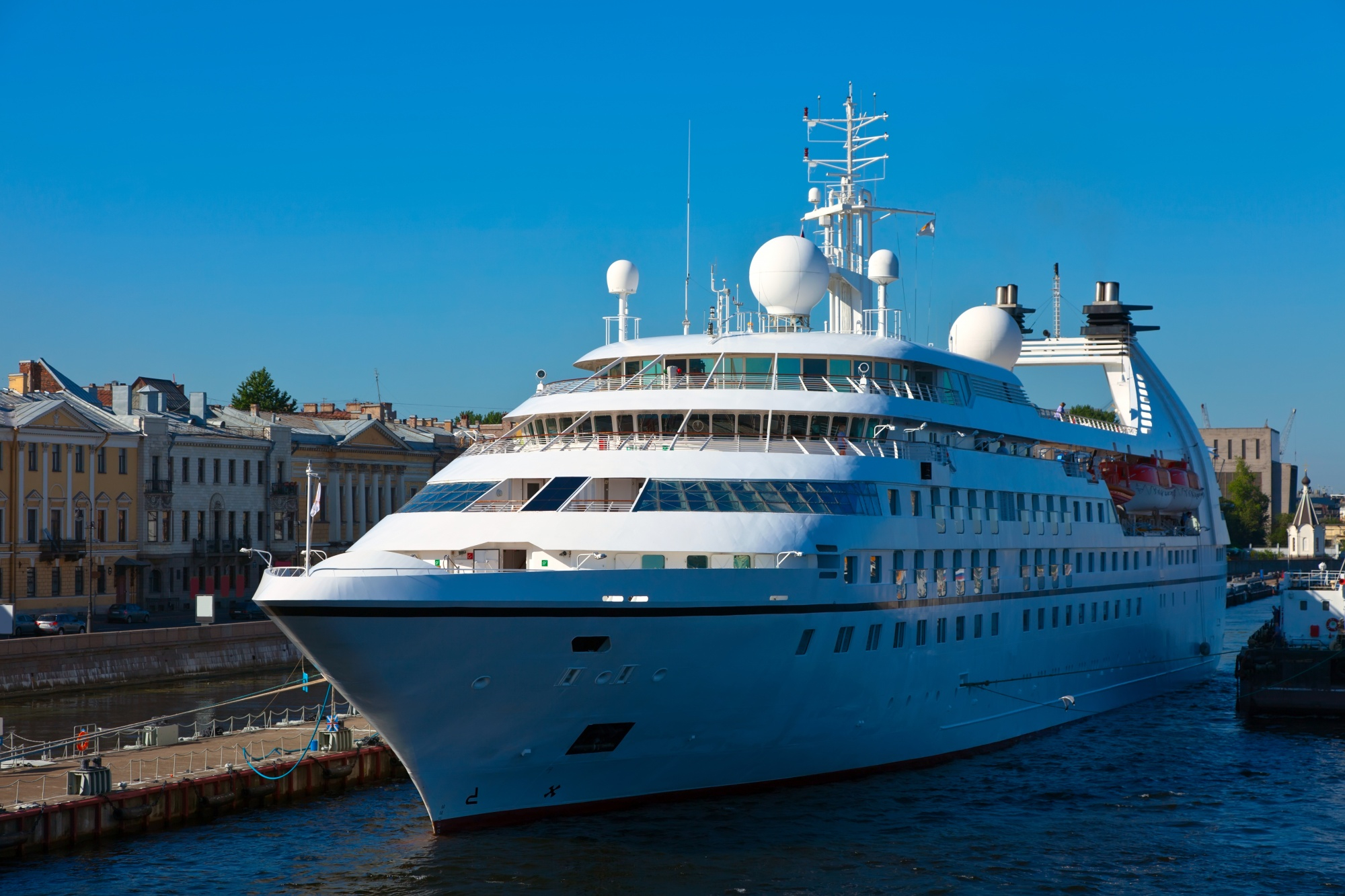
The Aurelia was enormous. I’d seen pictures of her for twelve years. Martin had them all over his study. But the pictures didn’t prepare me. She was twelve decks of gleaming white, rising out of the harbor like a building. Like a city. Hundreds of windows glinting in the Spanish sun. Her name painted in gold on the side.
AURELIA.
My husband’s ship.
My knees started shaking. Just like they had in January, under the kitchen table.
And underneath the ship, dark and moving and endless, was the water.
I couldn’t do it. I stood on the dock with my suitcase handle in my hand and I couldn’t make my feet move. I could hear my heart pounding in my ears. I could see Tommy’s head going under at Higgins Beach. The water closing over him.
People walked around me. Families with kids. Couples holding hands. Everyone laughing, excited, taking pictures.
I just stood there.
Then a young woman in a crisp white uniform came over. She had a name tag that said MARIA — GUEST SERVICES and a kind face.
“Ma’am? Are you all right? Can I help you?”
“I’m afraid,” I said. My voice came out very small. “Of the water. I’ve never been on a ship.”
Maria looked at me for a moment. Then she held out her arm.
“Then we’ll walk together,” she said. “Very slowly. You can hold on to me. And you don’t have to look down at all.”
I took her arm.
We walked up the gangway together. Step by step. I kept my eyes fixed on the ship. On the white wall in front of me. On the doorway at the top.
And then I was inside.
For the first few days, I walked around in complete awe.
The Aurelia was like nothing I’d ever imagined. There was a three-story atrium with a glass elevator and a crystal chandelier that looked like falling rain. There were restaurants and theaters and a library with leather armchairs. There was a ballroom with a polished wooden floor and a stage and real velvet curtains.
And Martin was right. You really couldn’t feel the water. The ship was so big and so steady that some hours I actually forgot where I was.
Some hours. Not all of them.
The first night, I couldn’t sleep. My cabin was beautiful. A balcony cabin on Deck Nine, with sliding glass doors that opened onto a little private terrace. But I kept the curtains closed tight. I couldn’t look. I could feel the ship moving very slightly underneath me, a slow, gentle rocking, and every time it moved, my heart jumped.
I lay in bed in Martin’s old cardigan and cried until three in the morning.
But in the morning, we were in Marseille.
I went ashore. I walked through the old port, with its colorful fishing boats and its fish market and its narrow streets climbing up the hill. I bought a bar of lavender soap and a postcard. I sat in a little café and drank a café au lait and watched the sun on the water.
I sat there for a long time.
The water in Marseille is the color of sapphires. Deep and clear and glittering. I’d seen that color before. On a postcard in shoebox number four. Marseille, 1989. Evie — Look at this blue. You’d love it here. Wish you were here.
I took out the postcard I’d just bought. I wrote on the back.
Martin — You were right. It’s beautiful. I’m here. — Evie
I didn’t know where to mail it. So I put it in my purse.
Then Monaco. Then Florence. Then Rome.
Every port, I went ashore. Every port, I bought a postcard. Every port, I sat somewhere and looked at the water and wrote Martin a message I couldn’t send.
Monaco — The yachts are ridiculous. You’d make fun of them. I miss your laugh.
Florence — I saw the David. He’s shorter than I thought. I ate gelato for lunch. Don’t tell the doctor.
Rome — I threw a coin in the Trevi Fountain. They say it means you’ll come back. I wished you were here instead.
The crew was kind to me. Very kind. Kinder than I expected. My cabin steward, a cheerful young man from the Philippines named Joel, left a little towel animal on my bed every night. A swan. A monkey. A dolphin. On the third night, it was a mermaid.
I stared at that mermaid for a long time.
The waiters in the dining room remembered my name. They always gave me the same table by the window. A woman from the spa sent a free massage voucher to my cabin with a note: For Mrs. Hale. With our warmest regards.
I thought they were just being nice to an old widow traveling alone.
I didn’t understand yet.
On June eleventh, we were at sea. A full day sailing between Rome and Santorini.
It would have been our fiftieth wedding anniversary.
I woke up early. I didn’t open the curtains. I sat on the edge of the bed in Martin’s cardigan and looked at the photograph I’d brought with me. Our wedding picture. 1976. Me in my lace dress. Martin in his rented tuxedo with the ruffled shirt, grinning like an idiot.
“Happy anniversary, sailor,” I whispered.
I spent most of the day in my cabin. I read a little. I napped. I cried. In the afternoon, I walked around the promenade deck once, holding tightly to the railing, not looking down at the water.
I was planning to have a quiet dinner by myself. Room service. A small piece of cake, maybe. I’d ordered it in advance. A slice of vanilla cake, like our wedding cake. I’d light a candle. I’d look at our picture. I’d tell him all about the trip.
And then I’d go to bed and try to forget what day it was.
At six-thirty, I was sitting on the bed in my robe, waiting for room service, when someone knocked on the door of my cabin.
I thought it was the food. I opened the door.
But it wasn’t room service.
A man in uniform was standing there. A crisp white officer’s uniform, with gold stripes on the shoulders. Four of them. Captain’s stripes. Or almost. I wasn’t sure. Martin had explained it to me a hundred times. I’d never paid attention.
He was tall and broad-shouldered, with dark skin and close-cropped gray hair. I recognized him immediately.
Thomas Okafor. The man who’d sat beside Martin’s bed for three hours in May.
He immediately introduced himself.
“Mrs. Hale. I’m Thomas Okafor. Staff Captain. We met at your home. I worked with Martin for eleven years.”
“Yes,” I said. “I remember.”
He smiled at me. A warm smile. But his eyes were wet.
“Ma’am,” he said, “I’m very glad to see you here. Martin hoped you would come.”
My palms instantly started sweating.
“Excuse me,” I said. “What do you mean?”
He didn’t answer right away. He reached into the inside pocket of his uniform jacket and pulled out an envelope. Cream-colored. Thick. Sealed. He held it out to me.
I took it. My name was written on the front.
Evie.
In Martin’s handwriting.

Sophia Rivers is an experienced News Content Editor with a sharp eye for detail and a passion for delivering accurate and engaging news stories. At TheArchivists, she specializes in curating, editing, and presenting news content that informs and resonates with a global audience.
Sophia holds a degree in Journalism from the University of Toronto, where she developed her skills in news reporting, media ethics, and digital journalism. Her expertise lies in identifying key stories, crafting compelling narratives, and ensuring journalistic integrity in every piece she edits.
Known for her precision and dedication to the truth, Sophia thrives in the fast-paced world of news editing. At TheArchivists, she focuses on producing high-quality news content that keeps readers informed while maintaining a balanced and insightful perspective.
With a commitment to delivering impactful journalism, Sophia is passionate about bringing clarity to complex issues and amplifying voices that matter. Her work reflects her belief in the power of news to shape conversations and inspire change.