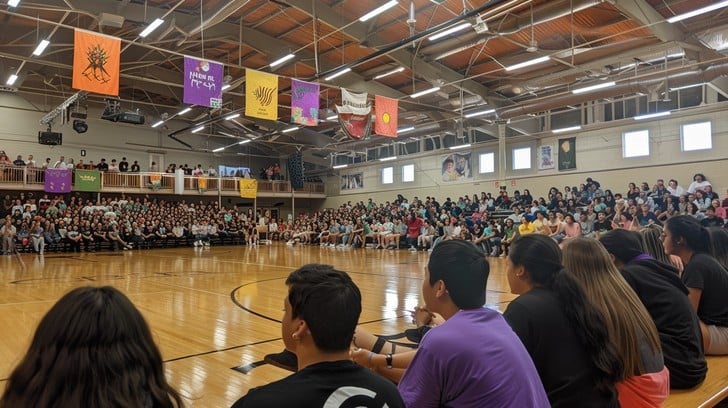
Dr. Ostrander stood at center court with the microphone, and the whole gym stayed on its feet.
“Thirty years ago this fall,” he said, “I was eight years old. I was in third grade at this school. I rode Route Seven. Mr. Pfeiffer’s bus.”
He paused.
“In October of 1994, I was diagnosed with acute lymphoblastic leukemia.”
The gym was completely silent.
“I spent the next seven months either at the children’s hospital in Minneapolis, or at home in bed. Mostly in bed. My immune system was gone from the chemotherapy. I couldn’t be around other kids. I couldn’t go to school. I couldn’t go anywhere. For seven months, the only things I saw were my bedroom, the hospital, and the inside of my parents’ car.”
He looked at my dad.
“My bedroom was on the second floor of our farmhouse. It had one window. It looked out over the north field and down to the township road. Gravel. Nothing ever came down that road. A tractor maybe, a couple times a week.”
He took a breath.
“Route Seven didn’t go down that road. It turned off a mile and a half before our place, at the Lindgren corner, and went east toward the river.”
I felt my mother’s hand tighten on mine.
“The first week I was home from the hospital,” Dr. Ostrander said, “I was lying in bed on a Monday morning, and I heard something I didn’t expect. I heard a diesel engine. Coming up the township road. And I crawled over to the window.”
He stopped. He looked down at the floor for a second.
“And it was Mr. Pfeiffer’s bus.”
Somewhere in the bleachers, someone made a small sound.
“It came up the road from the south and it stopped right at the end of our driveway. And every single kid on that bus had their face pressed against the windows on my side. Twenty-six kids. And they were waving.”
He couldn’t talk for a second.
“They were holding up signs. Paper signs. Some of them were spelled wrong. One just said CALEB with a smiley face. One said GET BETTER. One said WE MISS YOU in purple crayon. And Mr. Pfeiffer honked the horn. Twice. Two short ones. And then he drove on. He turned around in the Ostrander field approach and went back down the road the way he’d come and picked up Route Seven again at the Lindgren corner.”
He looked up at the bleachers.
“He did that every school day. For seven months. A three-mile detour every single morning. Rain. Snow. Twenty below. Every morning, I would hear that engine, and I would get out of bed, and I would go to the window. And twenty-six kids would wave at me. And he would honk. Two short ones.”
He turned and looked at my father.
“Some mornings, that was the only reason I got out of bed. Some mornings, I didn’t think I’d make it to the next one. And then I’d hear the engine.”
I was crying. My mother was crying. I looked around and I couldn’t find anybody in that gym who wasn’t.
I had been on that bus.
I had been sitting in the third seat on the right.
I had pressed my face to that window and waved.
And I had forgotten. I had been eleven, and it had just been something we did, every morning, the way you do things when you’re a kid. Something my dad did. Like the radio, or the coat that showed up in January.
I had never once thought about what it meant.

Specialty: Quiet Comebacks & Personal Justice
David Reynolds focuses on stories where underestimated individuals regain control of their lives. His writing centers on measured decisions rather than dramatic outbursts — emphasizing preparation, patience, and the long game. His characters don’t shout; they act.