The box was white, the size of a small suitcase, tied with a pale blue satin ribbon.
A nurse carried it into Emily’s hospital room at nine fifteen in the morning, holding it out in front of her like it might break.
“Someone left this at reception for your family,” she said. “The front desk said it was dropped off about an hour ago. No name.”
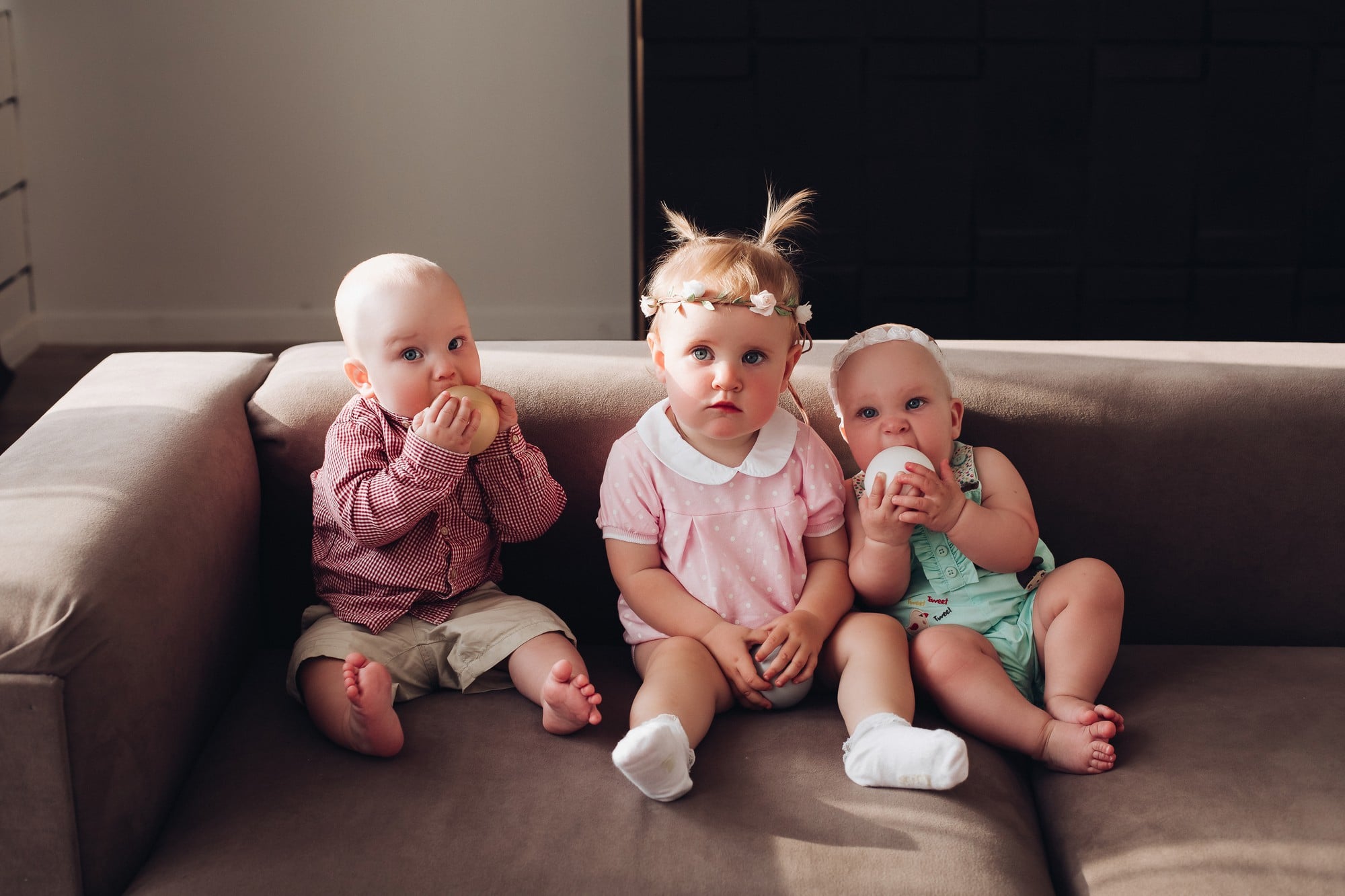
I was sitting in the chair by the window with one of my granddaughters asleep on my chest. Emily was in the bed, propped up on pillows, pale and exhausted and glowing in that way women glow after they’ve done something impossible. The other two babies were asleep in their clear plastic bassinets beside her, wrapped up tight in pink-and-blue-striped hospital blankets, like three little burritos in a row.
“From who?” Emily asked.
“No card on the outside,” the nurse said. “It’s addressed to ‘The Carter Triplets.’” She set it on the foot of the bed. “Congratulations again. Ring if you need anything.”
She left.
Emily looked at me. I looked at the box.
“Well,” I said. “Open it.”
She pulled the ribbon. It slid off like water. She lifted the lid.
And neither of us said anything for a long time.
Inside, nested in layers of white tissue paper, were three miniature wedding dresses.
Real ones. Not costumes. Not doll clothes. Real tiny wedding gowns, small enough for a newborn. Ivory silk. Lace sleeves, so fine you could see light through them. Rows of tiny pearl buttons down the back, each one smaller than a grain of rice. And on top of each dress, folded carefully, a tiny veil of white tulle on a little satin headband.
They were the most beautiful things I’d ever seen.
They were also the most frightening.
“Mom,” Emily whispered. “Who would send something like this?”
I didn’t answer. I couldn’t.
Emily lifted the first dress out of the tissue paper. Very carefully. Like it might dissolve. It hung from her fingers, swaying a little, catching the morning light from the window.
“These are handmade,” I said slowly. “Look at the stitching. Look at the lace. Somebody spent months on these.”
At the bottom of the box, under the last layer of tissue, there was a card.
A small cream-colored card. Old-fashioned. The kind with a deckled edge. Emily picked it up and turned it over.
Three lines. In fountain pen. In beautiful, shaky, old-fashioned handwriting.
Three brides.
Just as we agreed.
H.
My stomach tightened.
We hadn’t agreed to anything.
I’m going to back up and tell you who we are. Because what happened next only makes sense if you know.
My name is Diane Whitmore. I’m fifty-six. I live in Minneapolis with my husband, Tom. I teach third grade at an elementary school in Richfield. Tom is an engineer for the county. We’ve been married thirty-three years.
We have one daughter. Emily. She’s thirty-two.
Emily and her husband, Josh Carter, had been trying to have a baby for seven years.
Seven years. I’m not going to tell you everything about those years, because they’re Emily’s to tell. But I’ll tell you there were two miscarriages. I’ll tell you there were four rounds of IVF. I’ll tell you there were nights when Emily called me at two in the morning, crying so hard she couldn’t speak, and I sat on the edge of my bed in the dark with the phone pressed against my ear and listened to my daughter fall apart.
The fifth round of IVF, they transferred two embryos. One of them split.
Triplets.
Three girls.
They were born by C-section on a Thursday evening in March at Abbott Northwestern Hospital, at thirty-four weeks. Four pounds two ounces. Four pounds even. Three pounds eleven ounces. Small. But healthy. Breathing on their own. Crying loud enough to bring tears to the eyes of every nurse in the delivery room.
Our entire family was overjoyed.
Tom cried when he held them. My husband, who didn’t cry at his own father’s funeral. Josh cried. Josh’s parents, who’d driven down from Duluth, cried. I cried so hard the nurse brought me a box of tissues and a juice box, like I was the one who’d had surgery.
Emily didn’t cry. Emily just lay in the bed and looked at them, with a strange calm expression on her face, like she’d finally found something she’d been looking for her whole life.
“Hi,” she kept whispering to them. “Hi. Hi. It’s you. It’s you.”
That was Thursday night.
The following morning, Friday, the box came.
Josh had gone home at seven to shower and pick up the car seats. Tom had gone to work for a few hours. It was just Emily and me and the three babies, and the white box with the blue ribbon, and the card.
Three brides. Just as we agreed.
“Mom,” Emily said. Her voice was shaking. “What does that mean? Who’s H?”
“I don’t know, honey.”
“Is this some kind of. I don’t know. Some kind of threat? Some kind of weird stalker thing?” She put the dress back in the box like it had burned her. “Who sends wedding dresses to newborn babies? Who says ‘brides’ about babies that are one day old?”
I didn’t have an answer. My skin was crawling.
“Maybe it’s a gift,” I said. “From somebody at Josh’s work. Or one of your friends. Somebody with a strange sense of humor.”
“With no name? Just ‘H’?” Emily shook her head. “None of my friends could make something like this. Look at it, Mom. That’s real lace. Real silk. These must have cost thousands of dollars.”
She was right. I’d never seen handwork like it.
“Just as we agreed,” Emily whispered, reading the card again. “Agreed to what? I didn’t agree to anything. Josh didn’t agree to anything.”
“Let’s not panic,” I said, even though I was panicking. “We’ll ask Josh when he gets back. And Tom’s mother is coming at ten. Maybe she knows something. She knows everybody.”
Tom’s mother.
Margaret Whitmore.
I should tell you about Margaret.
Margaret is my mother-in-law. She’s seventy-nine years old. She was born and raised in Duluth, the daughter of a bank president. She married Tom’s father, Robert Whitmore, in 1967. He was a lawyer. They moved to Minneapolis in 1970 and had Tom in 1971. Robert died in 2010 of a heart attack.
Margaret is tall and thin and straight-backed, even at seventy-nine. She has white hair she wears in a neat bun and blue eyes like chips of ice. She wears pearls every day. She plays bridge on Tuesdays and sits on the board of the Minneapolis Institute of Art and has never in her life been seen in public without lipstick.
And she has never, in thirty-three years, liked me.
She was polite. Always. Cool and polite and correct. She sent me a card on my birthday every year. She asked about my students. She came to Christmas dinner and complimented my gravy, every single year, in exactly the same words: “Very nice, Diane.”
But she never hugged me. Never called me by a pet name. Never told me anything about her life before she married Robert. When I asked, she’d change the subject. When Emily was little and asked her what it was like growing up in Duluth, Margaret would smile thinly and say, “Cold, darling. Very cold.” And that was all.
Tom said she’d always been that way. Even with him. He said she was a private person. He said I shouldn’t take it personally.
I’d taken it personally for thirty-three years.
An hour later, at ten o’clock exactly, Margaret arrived.
She came in wearing a camel-colored wool coat and her pearls and pale pink lipstick, carrying a small bouquet of white roses. She was smiling. Not the thin polite smile I’d known for thirty-three years. A real smile. A big one. Her blue eyes were shining.
“Where are they?” she said, before she’d even taken off her coat. “Where are my girls?”
“Hi, Grandma Margaret,” Emily said.
“Emily, darling.” Margaret bent and kissed her forehead. Then she turned to the bassinets.
She stood there for a long time, just looking at them. Three tiny faces. Three little pink hats. Margaret’s hand went to her chest, over her pearls.
“Oh,” she said softly. “Oh, look at them. Oh, Emily. They’re perfect.”
“Do you want to hold one?” I asked.
She looked at me. For a second, something passed over her face. Something I’d never seen before. Not coolness. Not politeness.
Gratitude.
“Yes,” she said. “Yes, Diane. I would like that very much.”
I gave her the baby I was holding. The middle one. Four pounds even. Margaret sat down in the chair by the window and held her great-granddaughter against her camel-colored coat, very carefully, the way you’d hold something made of glass, and she looked down at that little face and started to hum.
I’d never heard Margaret hum. Not once in thirty-three years.
It was an old song. Something I didn’t recognize. Slow and sweet.
She was smiling.
She was smiling until she noticed the dresses.
The box was still open on the foot of the bed. Emily hadn’t wanted to touch it again. The three tiny gowns were lying there in their tissue paper, ivory and lace, catching the light.
Margaret’s eyes went to them. Just a glance at first.
Then she stopped humming.
Her face went completely white.
I watched it happen. The color just drained out of her, from her forehead down, like somebody had pulled a plug. Her lips went pale under her pink lipstick. Her blue eyes went very wide.
“Margaret?” I said.
She didn’t answer. She stood up slowly, still holding the baby. She handed the baby back to me without looking at me. Her hands were already starting to tremble.
She walked to the foot of the bed. She reached into the box.
She picked up one of the tiny gowns.
She turned it over. She lifted the little lace collar at the back of the neck, very gently, with one shaking fingertip.
And there, hidden beneath the collar, sewn into the ivory silk so small you’d never see it unless you knew exactly where to look, were three tiny blue stitches.
Three little crosses. In pale blue thread. Side by side.
Margaret stared at them.
“Oh, dear God,” she whispered.
“Margaret? What’s wrong?”
She didn’t answer. She put the first dress down. She picked up the second one. She turned it over. She lifted the collar.
Three blue stitches.
She put it down. She picked up the third.
Three blue stitches.
Her hands were shaking so badly now she could barely hold the dress. She looked at the card lying in the tissue paper. She picked it up. She read it.
Three brides. Just as we agreed. H.
She made a sound. A small, broken sound, like something tearing.
“Who brought these here?” she said. Her voice was barely a whisper. She turned and looked at me. “Diane. Who brought these here?”
“We don’t know,” I said. “A nurse said somebody left them at reception. No name. Just the card.” I stepped toward her. “Margaret, what is it? Do you know who sent them?”
She opened her mouth.
And before I could answer, before she could say anything, her eyes rolled back, and her knees buckled, and she collapsed.
She went down hard. I couldn’t catch her. I was holding the baby. She hit the floor beside the bed, the tiny wedding dress still clutched in her hand.
Emily screamed.
I hit the call button so hard I bruised my thumb.
The nurses rushed in. Three of them. Then a doctor. They lifted Margaret onto a gurney. They checked her pulse, her blood pressure, her pupils. Somebody put an oxygen mask over her face. Somebody else wheeled her out of the room and down the hall to an empty room next door.
I gave the baby to Emily and followed them.
Fortunately, Margaret regained consciousness within minutes.
Her blood pressure had dropped, the doctor said. A vasovagal response. Probably from shock, or stress, or standing up too fast. He wanted to keep her for a few hours to monitor her heart, just in case. At seventy-nine, you couldn’t be too careful.
I sat beside her bed while they hooked her up to the monitors.
She opened her eyes. She looked at the ceiling. She looked at the IV in her arm. She looked at the beeping machine.
Then she saw me standing beside her bed.
She grabbed my wrist.
Hard. Harder than I would have thought a seventy-nine-year-old woman could grab anything. Her thin fingers dug into my skin.
“Diane,” she said. Her voice was hoarse and urgent. “Listen to me. Listen carefully.”
“I’m listening, Margaret.”
“Don’t let Emily put those dresses on the babies.”
I stared at her.
“What?”
“Don’t let her,” Margaret said. Her blue eyes were wild. “Promise me. Please. Don’t let anyone put those dresses on those girls. Not yet. Not until I. Not until…” She stopped. She was breathing hard. “Promise me, Diane.”
“Margaret, what’s going on? Who sent them? What do the stitches mean?”
She let go of my wrist. She closed her eyes.
“I can’t,” she whispered. “Not now. I need to think.”
“Margaret…”
“Please,” she said. “Please, Diane. Just promise me.”
Before I could ask what she meant, my phone buzzed in my pocket.
I pulled it out. The screen said: UNKNOWN NUMBER.
I almost didn’t answer. I almost sent it to voicemail. Something made me pick it up.
I stepped out into the hallway. I pressed the phone to my ear.
“Hello?”
For several seconds, no one spoke.
I could hear breathing on the other end. Slow. Labored. With a faint mechanical hiss behind it, every few seconds, like an oxygen machine.
“Hello?” I said again. “Who is this?”
Nothing.
Then a man’s voice. Very old. Very quiet. Barely more than a whisper. With a faint accent I couldn’t place. Scandinavian, maybe.
“Please,” he whispered. “Please don’t hang up.”
My heart was pounding.
“Who is this?”
“Is she alright?” the voice whispered. “I saw them take her down the hallway. On the bed. Is Maggie alright?”
The hair on the back of my neck stood up.
Maggie.
Nobody called Margaret Maggie. Nobody. Not her husband. Not her son. Not her friends at bridge. In thirty-three years, I had never once heard anyone call her anything but Margaret.
And this man had seen them take her down the hallway.
Which meant he was here. In the hospital. Watching.
“Who are you?” I said. My voice was shaking. “How did you get this number? Are you the one who sent the dresses?”
The breathing on the line hitched.
“Yes,” he whispered. “I sent them. I’m sorry. I didn’t mean to frighten anybody. I didn’t mean for her to…” He stopped. The oxygen machine hissed. “I just wanted to keep my promise. Before I run out of time.”
“What promise? Where are you?”
“Downstairs,” he whispered. “In the lobby. By the gift shop.” A long pause. “Please. Tell Maggie that Henry kept his word.”
The line went dead.
I stood in the hallway of the maternity ward with the phone in my hand, shaking.
I want to be honest about what I did next. I did what any grandmother would do.
I called hospital security.
I told them there was a strange man in the lobby who’d sent an anonymous package to my daughter’s room. Who’d called my private cell phone, which I’d never given him. Who seemed to know my family. Who’d watched them take my mother-in-law down the hall. Who said he’d been waiting to “keep a promise.” I told them I was scared he might be dangerous.
Then I went back into Emily’s room and closed the door and locked it.
“Mom?” Emily said. She was sitting up in bed holding two of the babies, one in each arm. Her face was white. “Mom, what’s happening? Is Grandma okay?”
“She’s okay. She fainted. She’s awake now.” I went to the bassinet and picked up the third baby. I held her against my chest. “Honey, call Josh. Tell him to come back right now.”
“Why? What’s wrong?”
“Somebody called me,” I said. “A man. He says he sent the dresses. He says he’s downstairs.”
Emily’s face went from white to gray.
“Oh my God,” she said. “Oh my God. Mom. What does he want?”
“I don’t know. Security’s going down there now. Call Josh.”
She called Josh. Her hands were shaking so badly she dropped the phone twice. I took it from her and dialed for her.
“Josh,” I said, when he answered. “It’s Diane. Where are you?”
“In the parking garage. I just got back. I’ve got the car seats. What’s wrong? You sound…”
“Come up to the room. Right now. Don’t stop anywhere.”
“Diane, what’s going on?”
“Just come up, Josh.”
I sat down on the edge of Emily’s bed with my granddaughter against my chest and stared at the white box on the foot of the bed. The three tiny dresses. Three blue stitches under every collar.
Three brides. Just as we agreed.
Henry kept his word.
Fifteen minutes later, there was a knock on the door. I nearly jumped out of my skin.
“Mrs. Whitmore? It’s security.”
I unlocked the door. A tall security guard in a navy uniform was standing in the hallway. His name tag said DESHAWN. He was frowning. Not angry. Confused.
“Ma’am,” he said. “We found the gentleman.”
“Is he dangerous? Did you arrest him?”
Deshawn hesitated.
“Ma’am,” he said slowly. “He’s eighty-one years old. He’s in a wheelchair. He’s on oxygen. His nurse is with him.” He paused. “He’s crying.”
I stared at him.
“His nurse?”
“From a nursing home in Duluth,” Deshawn said. “She drove him down this morning. He’s got a heart condition. Congestive heart failure. She says he’s only got a few months.” He shifted uncomfortably. “He says he knows your family, ma’am. He says he’s family. He’s asking to see somebody named Maggie.”
Behind me, Josh came around the corner of the hallway at a run, carrying two car seats, out of breath.
“Diane? What’s going on? Emily said…” He stopped when he saw the security guard. “What happened?”
“Josh,” I said slowly. “Do you know anybody named Henry? An old man. From Duluth. In a wheelchair.”
Josh stared at me.
Then his face went completely blank.
“Grandpa Henry?” he said.
Every hair on my body stood up.
“Your grandfather?”
“My mom’s dad,” Josh said. “Henry Lindqvist. He’s in a nursing home in Duluth. He had a stroke two years ago. He couldn’t come to the wedding. He’s been really sick.” Josh looked at the security guard. “He’s here? Grandpa Henry’s here?”
“In the lobby, sir,” said Deshawn. “By the gift shop.”
Josh dropped the car seats in the hallway and ran.
I went after him. I don’t know why. I couldn’t have stopped myself.
He was sitting in a wheelchair in the hospital lobby, beside the gift shop window with its rows of pink and blue balloons.
He was very small. Smaller than you’d think a man could be. Thin, almost transparent, with a few wisps of white hair on a spotted head and big hands with swollen knuckles, folded in his lap on top of a plaid wool blanket. A clear oxygen tube ran from his nose to a small green tank hanging off the back of the wheelchair. Every few seconds, the tank hissed.
He was wearing a suit. An old brown wool suit, too big for him now, with a white shirt and a narrow blue tie. Somebody had combed his hair very carefully.
A heavyset woman in purple scrubs, maybe fifty, stood beside him with one hand on the back of his chair. His nurse. She looked worried.
He was crying. Quietly. Not making a sound. Just tears running down the deep lines of his face and dripping onto his blue tie.
Josh stopped about ten feet away.
“Grandpa?”
The old man looked up. His eyes were pale gray-blue and watery behind thick glasses.
“Joshua,” he said. His voice was the voice from the phone. Thin and soft. “Joshua. I’m sorry. I didn’t mean to make trouble.”
Josh crossed the lobby and knelt down in front of the wheelchair. He took his grandfather’s big swollen hands in his.
“Grandpa, what are you doing here? How did you get here? Mom said you couldn’t travel.”
“Linda drove me,” the old man said, nodding at the nurse. “I asked her to. I begged her. I paid her for her day off.” He tried to smile. “She thinks I’ve gone senile.”
“I didn’t say that, Henry,” said the nurse.
“You thought it.”
“I thought it a little,” the nurse admitted.
Josh looked up at her. “Is he okay?”
“He’s tired,” the nurse said. “He’s not supposed to be traveling. His heart’s not good. But he’s been sewing those dresses for five months, and when you called his room last night and told him they were born, he said he had to come. He said he wouldn’t go to sleep until he did.” She shook her head. “I’ve never seen him so determined. He wouldn’t take no for an answer.”
“Sewing,” I said.
Everybody turned and looked at me.
“You made them,” I said to the old man. “The dresses.”
Henry Lindqvist looked up at me. He looked at my face for a long time.
“You must be Diane,” he said. “Maggie’s daughter-in-law. Emily’s mother.”
“How do you know that?”
“I saw you at the wedding,” he said. “In the photographs. Joshua’s mother brought them to me. I wasn’t well enough to go.” He looked down at his hands. “That’s when I saw her. In the photographs. Standing next to you. In her pearls.” His voice cracked. “Sixty years. And I’d know her face anywhere.”
“Grandpa,” Josh said slowly. “What are you talking about? Who?”
“Maggie,” said Henry. “Margaret. Your wife’s grandmother.” He swallowed. “Is she alright? I saw them take her down the hall. I saw it from the elevator. I came up to see if she’d gotten the box. And I saw her fall.”
“She’s alright,” I said. “She fainted. She’s awake now. They’re watching her heart.”
Henry closed his eyes. His shoulders sagged with relief.
“Thank God,” he whispered. “Thank God. I’d never forgive myself.”
“Mr. Lindqvist,” I said carefully. “What’s going on? How do you know Margaret? What did the card mean? Three brides, just as we agreed. Agreed to what?”
Henry was quiet for a long time. The oxygen tank hissed.
Then he looked up at me with his pale, watery eyes.
“Would you take me to her?” he said. “Please. I’ll tell you everything. But I want to tell her first. I’ve waited sixty-one years to tell her.”
We went up in the elevator. Henry in his wheelchair. Linda, his nurse, pushing. Josh walking beside him, holding his hand. Me. Deshawn the security guard, who said he wanted to make sure everything was okay, but who I think was just curious.
When we got to Margaret’s room, I went in first.
She was sitting up in the bed with the oxygen mask off now. The color had come back into her face, a little. She was staring at the wall. One of the tiny wedding dresses was lying in her lap. She’d asked a nurse to bring it to her. She was holding it with both hands, running her thumb over the three blue stitches under the collar.
“Margaret,” I said. “There’s somebody here to see you.”
She looked up at me.
“I know,” she said quietly. “I knew the second I saw the stitches.” She took a breath. “Is he here?”
“He’s in the hallway.”
Margaret closed her eyes. Her lips moved. I think she was praying.
Then she opened her eyes. She smoothed the hospital blanket over her knees. She reached up and touched her hair, her white bun, making sure it was neat. She touched her pearls.
“Let him in,” she said.
I opened the door.
Linda wheeled Henry into the room.
He stopped just inside the door. He looked across the room at Margaret in the hospital bed.
She looked back at him.
Neither of them said anything. Not for a long time. The monitor beeped. The oxygen tank on Henry’s chair hissed. Out in the hallway, somewhere, a baby was crying.
They just looked at each other. A seventy-nine-year-old woman in a hospital bed with a tiny wedding dress in her lap. An eighty-one-year-old man in a wheelchair with an oxygen tube in his nose and tears running down his face.
“Hello, Maggie,” Henry said finally.
Margaret’s chin trembled.
“They told me you were dead,” she whispered.
Henry flinched like she’d struck him.
“Who told you?”
“My father,” said Margaret. “In 1966. He said you enlisted. He said you went to Vietnam. He said you were killed.” Her voice cracked. “He showed me a letter. From the Army. He said your mother had sent it to him. To tell me.”
Henry stared at her.
“I never enlisted,” he said slowly. “I never went anywhere. I was in Duluth. The whole time. Working in my father’s tailor shop.” His voice broke. “Your father told me you’d married a lawyer. In Minneapolis. He told me you never wanted to see me again. He told me you’d asked him to tell me to stop writing.”
“I never got your letters,” Margaret whispered.
“I wrote you every week,” Henry said. “For a year. Every single week.”
They stared at each other.
Josh and Emily and I stood in the doorway. Nobody moved. Nobody breathed.
“He lied,” Margaret said slowly. “My father. He lied to both of us.”
“Yes,” said Henry.
Margaret put her face in her hands.
It took a long time for the story to come out. Most of it came from Margaret. Henry was too tired to talk much. He sat in his wheelchair beside her hospital bed, and she held his swollen hand in both of hers, and she told us.
She was seventeen in the summer of 1964. Margaret Ellison. The daughter of Charles Ellison, president of the First National Bank of Duluth. She lived in a big stone house on the hill above Lake Superior with her parents and her younger brother and a housekeeper named Mrs. Berg.
Henry Lindqvist was nineteen. The son of a Swedish immigrant tailor named Anders Lindqvist, who had a little shop on Superior Street where he made suits for the bankers and lawyers of Duluth. Including Charles Ellison.
Henry was apprenticed to his father. He was learning to be a tailor. He was very good. Better than his father, by the time he was eighteen. He could make a suit that fit you like your own skin.
“He came to our house that summer,” Margaret said. “With his father. To fit my father for a new suit. I came downstairs in my tennis clothes. And he was kneeling on the floor of the library, pinning up my father’s pant leg.” She almost smiled. “He looked up at me. And he stuck himself with a pin.”
“Right through the thumb,” said Henry softly. “I bled on your father’s trousers. He was furious.”
“I laughed,” said Margaret. “I laughed so hard. My father sent me out of the room.”
They saw each other all summer. In secret. At first just walking along the lakeshore. Then sitting on the rocks at Brighton Beach, watching the ore boats come into the harbor. Then in the back room of the tailor shop after it closed, where Henry taught her to sew.
“He was making a wedding dress that summer,” Margaret said. “For a customer. A girl from Superior. He let me watch him. He let me help him with the buttons.” She looked at Henry. “He told me every dress he ever made, he put three blue stitches under the collar. Where nobody would see. Something blue, he said. For luck. For the bride.”
“Three,” Henry said. “One for the bride. One for the groom. And one for forever.”
Margaret closed her eyes.
“By August,” she said, “we were in love. Real love. The kind you only get once, when you’re young and stupid and you think the whole world will step aside for you.” She opened her eyes. “We were going to get married. When I turned eighteen. In the spring. We’d planned it all.”
“What happened?” Emily asked quietly.
“My father found out,” said Margaret.
Charles Ellison had other plans for his daughter. He’d already chosen a husband for her. Robert Whitmore. The son of his law partner in Minneapolis. A good family. A Princeton boy. A future lawyer.
He was not going to let his only daughter marry an immigrant tailor’s son.
“He sent me away,” Margaret said. “In September. To my aunt’s house in Chicago. He said it was for finishing school. He took away my letters. He watched my phone calls. He told the housekeeper to burn anything that came for me from Duluth.” She swallowed. “And then, the next summer, he showed me the letter. From the Army. Saying Henry had been killed in a training accident at Fort Leonard Wood.”
“It was forged,” said Henry quietly.
“I know that now,” said Margaret. “I didn’t know it then.” She looked at him. “I was eighteen, Henry. I believed my father. I grieved you. I wore black for a month. My mother thought I’d lost my mind.” She pressed his hand against her cheek. “And when Robert proposed the next year, I said yes. Because I didn’t care anymore. About anything. Because you were dead. And nothing mattered.”
Henry was crying again.
“Your father came to the shop,” he said. “In 1967. In June. He brought a suit for my father to alter. And he told me, standing right there at the counter. ‘My daughter is married now, Lindqvist. To a good man. In Minneapolis. She asked me to tell you to stop writing. She never wants to hear from you again.’” He shook his head slowly. “I believed him. Why wouldn’t I? I hadn’t heard from you in three years.”
“Oh, Henry.”
“I married a girl from church in 1970,” Henry said. “Ingrid. She was kind. We had one daughter. Karen.” He looked at Josh. “Your mother.”
Josh made a small sound.
“Ingrid died in 2015,” Henry said. “Cancer. I took care of her for two years. I loved her, Maggie. I want you to know that. I loved her very much.” He paused. “But not the way I loved you. Never the way I loved you. She knew. She always knew. She was a very wise woman.”
Margaret didn’t say anything. She was crying too, silently, with her face pressed against his swollen hand.
“Tell her,” said Henry softly. “Tell her about the promise, Maggie. I can’t.”
Margaret lifted her head. She wiped her eyes. She looked at Emily.
“On the last night,” she said, “before my father sent me to Chicago, Henry and I sat on the rocks at Brighton Beach. In the dark. Watching the lighthouse.” She took a breath. “We knew it was over. We knew my father would never let us marry. We were crying. Both of us.”
“And I said something foolish,” Henry said. “Something young and foolish and romantic.”
“He said,” Margaret said, “‘If we can’t be together, then maybe someday our families will be. Our children. Or our grandchildren. Or theirs. Someday, somehow, your blood and my blood will come together. And when they do, I’ll make the dresses.’”
“I said I’d make the wedding dresses,” said Henry. “For our daughters. Or granddaughters. Or whoever came after us. I said I’d put three blue stitches in every one. So they’d know. So they’d know where they came from.”
“And I said,” Margaret whispered, “‘We’ll have three girls. Three brides. I’ll need three dresses.’”
“And I said,” said Henry, “‘Three brides. I promise. Just as we agreed.’”
The room was absolutely silent.
Emily was staring at the old man in the wheelchair. Her face was wet.
“Josh,” she said slowly. “Your grandfather. And my grandmother.”
“I didn’t know,” said Josh. His voice was shaking. “Em. I swear to God. I didn’t know any of this. Grandpa never told me.”
“I didn’t know either,” said Henry. “Not until two years ago. When Karen brought me your wedding photographs.” He looked at Emily. “I was in the nursing home. Just after my stroke. I couldn’t speak yet. Karen sat by my bed and showed me the pictures one by one on her tablet. You and Joshua at the altar. Your parents. Joshua’s parents.” He swallowed. “And then a picture of the head table. And there, at the end, in pearls…”
“Grandma,” said Emily.
“Maggie,” said Henry. “I knew her instantly. Sixty years. I knew her face.” His voice broke completely. “I made Karen go back to the picture forty times. I couldn’t talk. I just kept pointing. She thought I was having another stroke. Finally, she read me the names off the seating chart. Margaret Whitmore. Maiden name Ellison.” He closed his eyes. “My grandson had married her granddaughter. And neither of them knew.”
“Your blood and my blood,” Margaret whispered. “Together. Just like you said.”
“Just like I said,” Henry said.
“And then,” said Emily slowly, “when we told everybody we were pregnant. With triplets. Three girls.”
“Three brides,” said Henry. He opened his eyes and looked at her. “Just as we agreed.” He tried to smile. “I started sewing the next week.”
His nurse, Linda, spoke up from behind his wheelchair.
“Five months,” she said. “He sewed every single day. In his room at the nursing home. With his hands like that.” She nodded at his swollen arthritic knuckles. “Some days he could only do a few stitches before the pain was too bad. He’d sit there by the window with his little magnifying glass. The other residents thought he was crazy. Making doll clothes.” Her voice softened. “He made us promise not to tell anybody. Not even Karen. He said it was a surprise.”
“I didn’t want to frighten anybody,” Henry said. He looked at me. “I didn’t sign my name because I didn’t know if Maggie would want to see me. I didn’t know if she’d even remember. Sixty-one years.” He looked down. “I thought she’d see the stitches. And she’d know. And she could decide.”
“I knew,” Margaret said softly. “The second I saw them.”
“And then you fell,” said Henry. “And I thought I’d killed you.”
“You almost did,” said Margaret. And she laughed. A wet, broken laugh.
“Why did you tell me not to put the dresses on the babies?” I asked her. “In the hospital bed. You grabbed my wrist.”
Margaret looked at me.
“Because I was ashamed,” she said quietly. “I thought if Emily put those dresses on those girls, everybody would ask. Where did they come from? Who made them? What do the stitches mean? And I’d have to tell. Everything. About Henry. About my father. About why I married Robert. About why I’ve been so…” She stopped. She looked down at her hands. “So cold, Diane. All these years. To you.”
I didn’t say anything.
“I married a man I didn’t love,” Margaret said. “Because I thought the man I loved was dead. Robert was a good man. He was kind to me. But I never loved him. Not really. Not the way I should have. And I think he knew.” She swallowed. “And when Tom brought you home. Thirty-three years ago. A schoolteacher from Rochester. With no family money. And Tom was so in love with you. So happy. Looking at you the way Henry used to look at me.” Her voice broke. “I couldn’t stand it. I was jealous. Of my own son. And his wife. Because you had what I’d lost. And I took it out on you. For thirty-three years.”
I stood very still.
“I’m sorry, Diane,” Margaret said. “I’m so sorry. You deserved better from me. You deserved a mother-in-law who loved you. And I couldn’t. I couldn’t let myself love anybody. Not after Henry.”
I looked at this woman in the hospital bed. My mother-in-law. Seventy-nine years old. In her pearls and her pale pink lipstick. Crying. Holding the hand of a man she’d thought was dead for sixty years.
I’d spent thirty-three years thinking she didn’t like me.
She’d spent thirty-three years grieving.
I walked across the room. I sat down on the edge of her bed. And I did something I’d never done in thirty-three years.
I hugged her.
She stiffened at first. Then she melted. She put her thin arms around me and held on, and cried into my shoulder like a little girl.
“It’s okay, Margaret,” I said. “It’s okay. I understand.”
“Maggie,” she said into my shoulder. “Call me Maggie. Please. Nobody’s called me that in sixty years.”
Henry and Margaret talked for three hours that afternoon.
The rest of us left them alone. Josh and Emily went back to the babies. Linda, the nurse, went to get coffee. Deshawn, the security guard, went back to his post, but not before he shook Henry’s hand and said, “Sir, that’s the best thing I’ve ever seen in this hospital.”
I sat in the hallway outside Margaret’s door, on a plastic chair, and listened to them talk through the door. I couldn’t hear the words. Just the voices. Hers and his. Soft. Sometimes laughing. Sometimes crying. Sixty-one years of things to say.
At about four o’clock, the door opened. Linda wheeled Henry out into the hallway.
He looked exhausted. Gray. His breathing was worse. The oxygen tank was hissing faster.
But he was smiling.
“Mrs. Whitmore,” he said. “Diane. Would you take me to see the girls? Before I go? I’d like to see them. Just once.”
I looked at Linda. She nodded.
“Just for a few minutes,” she said. “Then we have to get him back to Duluth. His heart’s not good.”
We went down the hall to Emily’s room. Margaret came too. She insisted. She walked beside his wheelchair in her hospital gown and her pearls, holding his hand, refusing to let the nurses put her back in bed.
Emily was sitting up in bed with two of the babies. Josh was in the chair by the window with the third.
Henry stopped just inside the door. He looked at the three bassinets. At the three tiny babies in their pink hats.
“Oh,” he said. Very softly. “Oh, look at them.”
Josh got up and carried the baby over. He knelt down beside the wheelchair.
“Grandpa,” he said. “Do you want to hold her?”
Henry looked at his big, swollen, arthritic hands. They were shaking.
“I don’t know if I can,” he said. “My hands.”
“I’ll help,” said Margaret.
She knelt down beside the wheelchair. At seventy-nine, in a hospital gown. She took the baby from Josh. She placed her very carefully in Henry’s arms, on top of the plaid blanket on his lap. She kept her own hands under the baby, holding her steady, supporting Henry’s shaking arms with her own.
The two of them held the baby together.
Henry looked down at that tiny face for a long time.
“Your blood and my blood,” he whispered.
“Together,” said Margaret.
“Just like we said.”
“Just like we said.”
Henry started to cry again. So did Margaret. So did Emily and Josh and Linda and me. We all stood around that wheelchair in the hospital room crying, and the baby just slept through all of it, the way babies do.
“What are their names?” Henry asked finally. “I didn’t put names on the card. I didn’t know them yet.”
Emily looked at Josh. Josh looked at Emily.
“We had names picked out,” Emily said slowly. “Ava, Grace, and Lily.”
“Those are beautiful names,” said Henry.
Emily was quiet for a long moment. She looked at Margaret. At her grandmother, kneeling on the hospital floor in her pearls, holding a baby with the man she’d loved for sixty years.
“Grandma,” she said. “When you were seventeen. And you said you wanted three girls. Three brides. Did you ever pick names?”
Margaret looked up at her. Her face went very still.
She looked at Henry. He looked back at her.
“Margaret Anne,” said Henry softly. “After her.”
“Ingrid,” said Margaret. “After your mother. You told me about her. She came over from Sweden alone when she was sixteen.”
“And Hope,” they said together.
Emily put her hand over her mouth.
“Hope,” Henry whispered. “Because that’s all we had.”
That night, after Henry and Linda had driven back to Duluth, and Margaret had been discharged and sent home with Tom, Emily and Josh and I sat in Emily’s hospital room with the three babies.
The white box was on the windowsill. The three tiny dresses were folded back inside in their tissue paper.
“Ava, Grace, and Lily,” Josh said. “Or Margaret Anne, Ingrid, and Hope.”
Emily didn’t say anything for a long time.
“I think,” she said finally, “they’ve been named for sixty-one years. We just didn’t know it.”
Josh smiled. He took her hand.
“Margaret Anne, Ingrid, and Hope,” he said.
“Margaret Anne, Ingrid, and Hope,” Emily agreed.
Then she looked at the white box on the windowsill.
“Mom,” she said. “Grandma said not to put the dresses on them.”
“She said that because she was ashamed,” I said. “She’s not ashamed anymore.”
Emily nodded slowly.
“They’re not wedding dresses,” she said. “Not really. Not for babies.” She looked at the box. “They’re christening gowns. That’s what they’d be. For a baptism.”
“I think that’s exactly what they’re for,” I said.
The baptism was three weeks later.
At St. Mark’s Episcopal Church in Minneapolis, the same church where Margaret had married Robert Whitmore in 1967. Margaret insisted on it. She said it was time for something good to happen there.
Henry came.
Linda drove him down from Duluth again. He wasn’t supposed to travel. His doctors said absolutely not. His heart was getting worse. His daughter Karen begged him not to go.
He went anyway.
“I’ve been waiting sixty-one years for this,” he told Karen. “I’m not going to miss it for a little thing like dying.”
He came in a wheelchair, in the same old brown wool suit, with the same blue tie. Somebody had combed his hair very carefully again.
Margaret sat next to him in the front pew. In a pale blue dress. Holding his hand. The whole time.
When Emily and Josh carried the babies up to the font, all three of them were wearing the dresses.
Three tiny ivory silk gowns with lace sleeves and rows of pearl buttons. Three little tulle veils on satin headbands. And under each collar, hidden where nobody could see, three little blue stitches.
One for the bride. One for the groom. One for forever.
The priest poured the water over their heads. Margaret Anne Carter. Ingrid Carter. Hope Carter. Margaret Anne screamed. Ingrid slept through it. Hope grabbed the priest’s finger and wouldn’t let go.
In the front pew, Henry Lindqvist sat in his wheelchair and watched with tears running down his face. Margaret held his hand.
After the service, in the parish hall, with coffee and cake, Henry asked for the babies one more time.
Margaret knelt down beside his wheelchair again. She helped him hold them. One at a time. Margaret Anne. Then Ingrid. Then Hope.
When he got to Hope, he lifted the collar of her tiny dress with one shaking finger. He looked at the three blue stitches.
“I made that,” he said softly, to nobody. “I made that with my own hands. Just like I promised.”
“You did,” said Margaret.
He looked at her.
“Maggie,” he said. “Do you remember what you said? That last night? On the rocks at Brighton Beach?”
Margaret was quiet for a long moment.
“I said,” she whispered, “‘Someday, Henry. Someday we’ll get our happy ending. Even if it’s not ours.’”
Henry smiled.
“It’s ours,” he said. “It’s ours, Maggie. It was always going to be ours.”
Henry Lindqvist died eleven weeks later, on a Tuesday morning in June, in his room at the nursing home in Duluth, looking out the window at Lake Superior.
Margaret was with him.
She’d moved to Duluth three weeks after the baptism. She rented a little apartment two blocks from the nursing home. She sold her house in Minneapolis. She resigned from the board of the art institute. She quit bridge. Tom thought she’d lost her mind.
“She hasn’t lost her mind,” I told him. “She’s found her heart. It’s a different thing.”
She visited Henry every single day. Morning and afternoon. She read to him. She held his hand. She sat with him by the window and watched the ore boats come into the harbor, the way they did when they were seventeen and nineteen, sitting on the rocks at Brighton Beach.
Linda told me later that the other residents called them “the lovebirds.” She said they’d hold hands at lunch. She said Henry would hum that old song, the one I’d heard Margaret humming in the hospital room, the one I didn’t recognize. She said it was a Swedish lullaby his mother used to sing.
On the last morning, Linda said, Margaret was sitting by his bed holding his hand. The window was open. It was the first warm day of June. You could hear the gulls over the lake.
Henry opened his eyes and looked at her.
“Maggie,” he said. “Did I keep my promise?”
“You kept your promise, Henry.”
“Three brides?”
“Three brides,” said Margaret. “Just as we agreed.”
He smiled. He closed his eyes.
Linda said he went very peacefully. With the window open and the gulls calling and Margaret holding his hand.
Margaret is eighty now.
She still lives in Duluth. In the little apartment two blocks from the nursing home. She says she’s not going back to Minneapolis. She says she spent sixty years in the wrong city.
She comes down every month to see the girls. They’re eight months old now. Margaret Anne is the loud one. Ingrid is the sleepy one. Hope is the one who grabs everything and won’t let go.
Margaret calls me every Sunday. We talk for an hour. About the babies. About Emily. About Tom. About my third graders. About her life in Duluth. She tells me stories now. About growing up in the big stone house on the hill. About her father, who she’s forgiven, mostly. About Robert, who she says was a good man and deserved a better wife. About Henry.
She calls me “dear” now. She hugs me at the door. She told me last month that I was the daughter she never had.
I cried for an hour after that phone call.
The three tiny dresses are in a cedar box in Emily’s closet. Wrapped in tissue paper. With the card from Henry tucked inside. Three brides. Just as we agreed.
Emily says they’ll come out again someday. For real this time. When the girls get married. She says she’ll have them made into something. A handkerchief. A garter. A little piece of lace sewn into each of their real wedding dresses.
So they’ll know where they came from.
Last month, Margaret came down for a weekend. On Saturday afternoon, I found her sitting at my dining room table with my old sewing kit open in front of her, a needle in one hand and a spool of pale blue thread in the other, and a magnifying glass on a stand.
“What are you doing, Maggie?”
She looked up at me. She smiled.
“Henry taught me,” she said. “That summer. In the back of the shop. How to do the stitches.” She held up a piece of white cotton. A small square. On it, very tiny, in the corner, were three blue crosses. Not quite straight. A little crooked. “I’m out of practice. My hands aren’t what they were. But I want to teach you.”
“Me?”
“You,” said Margaret. “So you can teach Emily. And Emily can teach the girls.” She held out the needle. “Somebody has to keep the promise going, dear. After I’m gone. Somebody has to put the stitches in.”
I sat down next to her at the table.
She showed me how. Her thin old hands over mine, guiding the needle. Over and under. One for the bride. One for the groom. One for forever.
My first one was terrible. Crooked and uneven. Margaret laughed and said Henry’s first one was worse. My second one was a little better. By the tenth one, she said I was a natural.
We sat at my dining room table for three hours that afternoon, stitching little blue crosses into squares of white cotton while the babies slept in the next room. Margaret told me stories about Henry. About the shop on Superior Street. About the ore boats and the lighthouse and the rocks at Brighton Beach.
When it got dark, I turned on the lamp. Margaret held up the last square of cotton to the light.
Three little blue stitches. Mine. Crooked. But there.
“There,” she said softly. “Now you know.”
“Now I know,” I said.
She folded the square of cotton very carefully and pressed it into my hand.
“Keep that,” she said. “For someday. For the girls.”
Then she got up from the table and went into the next room, where Margaret Anne and Ingrid and Hope were asleep in their cribs in a row, and she stood over them for a long time in the dark.
And I heard her humming.
That old Swedish lullaby. The one Henry’s mother used to sing. The one his own grandmother brought across the ocean when she was sixteen and alone.
Slow and sweet and very old.
Just the way he taught her.

Adrian Hawthorne is a celebrated author and dedicated archivist who finds inspiration in the hidden stories of the past. Educated at Oxford, he now works at the National Archives, where preserving history fuels his evocative writing. Balancing archival precision with creative storytelling, Adrian founded the Hawthorne Institute of Literary Arts to mentor emerging writers and honor the timeless art of narrative.