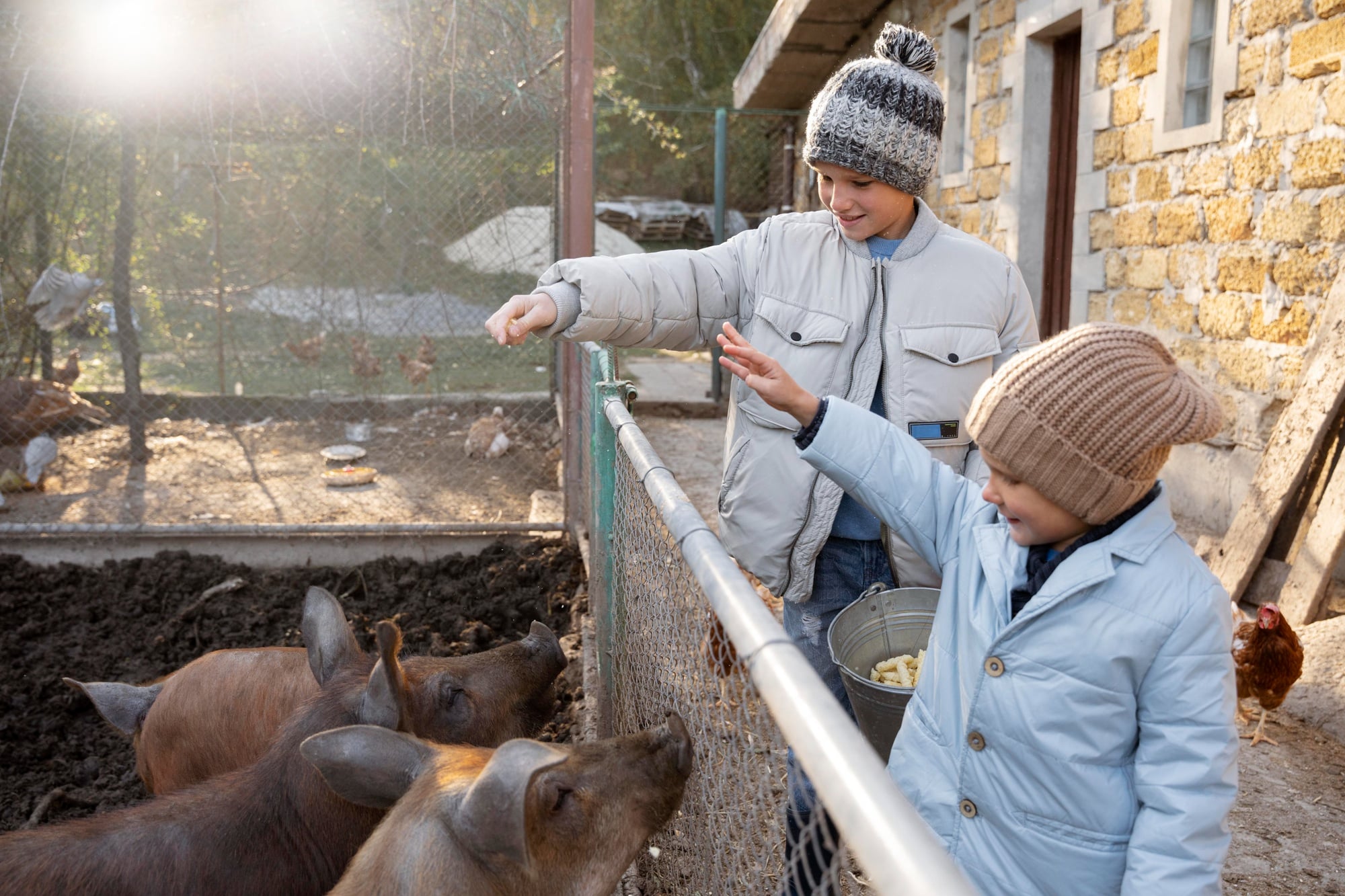
The Pig Business
“Don’t bring the kids. They’ll embarrass us.”
My mother sent that text six hours before Grandpa’s eightieth birthday dinner.
I read it standing in a walk-in cooler at thirty-four degrees, surrounded by about twelve thousand dollars’ worth of pork.
Then another text came in.
It’s BellaForte, Dwight. Five stars. The Hendersons are coming. Richard and Elaine. Important people. Please wear a real suit. No work boots.
And a third.
And please don’t talk about the pig business. Not tonight. Just this once.
I put my phone in my pocket.
I looked down at my boots. Brown leather. Steel toe. Stained with things you don’t want to know about. I’d had them resoled three times.
I looked at the meat.
Hanging from steel hooks along the cooler rail were six halves of Berkshire hog. Pasture-raised. Fourteen months old. Dry-aging for the restaurants. Beautiful marbling. Deep red. The kind of pork that makes chefs close their eyes when they taste it.
The one closest to me was a big boar half we’d named Gerald back when he was a piglet. He used to chase my son around the pasture and knock him over and then lie on top of him until Noah laughed so hard he couldn’t breathe.
“Gerald,” I said. “Apparently neither of us is sophisticated enough for dinner.”
Gerald didn’t say anything.
He took the news better than I did.
My name is Dwight Mercer. I’m thirty-eight years old.
I’m a farmer and a butcher. I raise heritage pigs on forty-two acres outside Millbrook, Ohio. Berkshires and Red Wattles and a few Mangalitsas that look like sheep and taste like heaven. I sell meat directly to families who drive out from Columbus and Cincinnati and Dayton. I sell to eleven restaurants. I have a little butcher shop in a converted barn at the end of my driveway with a hand-painted sign that says MERCER FAMILY MEATS — EST. 2014.
I employ six people.
I’m proud of every single one of them.
The land belonged to my grandfather.
Otis Mercer. My mother’s father. He farmed it his whole life. So did his father. Corn and soybeans and hogs. Three hundred acres back in the sixties. A big white farmhouse. A red barn. A windmill that doesn’t spin anymore.
By the time I was born, he’d sold most of it off. Developers. A Walmart. A subdivision called Meadow Ridge with fourteen identical beige houses.
He kept forty-two acres. The house. The barn. The creek. The old oak at the top of the hill.
When I was twenty-six, he sold those forty-two acres to me for one dollar.
He was seventy. His knees were shot. He couldn’t do the work anymore.
He handed me the deed at his kitchen table and said, “Don’t you dare grow soybeans. Soybeans are boring. Raise something that looks back at you.”
So I raised pigs.
My wife, Sarah, is a large-animal vet. We met at the Ohio State Fair in 2009. She was checking a sow in the swine barn. I was showing a Berkshire boar named Mr. Pickles who weighed eight hundred pounds and was afraid of balloons.
She laughed at Mr. Pickles.
I married her two years later.
We have two kids.
Emily is eleven. She’s in sixth grade. She reads everything. She wants to be a veterinarian like her mother. She can tell you the difference between a Berkshire and a Duroc from fifty yards. She can also tell you the difference between a ribeye and a strip and a tenderloin and why it matters.
Noah is eight. He’s in second grade. He has no filter. None. He says exactly what he’s thinking, the second he’s thinking it. He once asked the pastor at church why God made mosquitoes. In the middle of the sermon.
The pastor didn’t have an answer.
They know how to behave in restaurants.
They say please and thank you. They put their napkins in their laps. They don’t run around. They don’t scream. They eat what’s put in front of them, mostly.
They also know where bacon comes from.
Apparently, that was the problem.
My mother is Gail Mercer Whitfield.
She’s sixty-three. She lives in a big gray colonial in Upper Arlington, the wealthy suburb of Columbus. With my father. Wayne Whitfield. A retired regional manager for an insurance company. They belong to the Scioto Country Club. They have a sailboat at Hoover Reservoir they take out twice a year.
My mother does not like the pig business.
She has never liked the pig business.
At Thanksgiving last year, she served a ham.
A twenty-two-pound bone-in heritage ham. Smoked over applewood for fourteen hours. Glazed with my wife’s bourbon and brown sugar.
From my farm.
She’d called me the week before. Dwight, honey, could you bring a ham for Thanksgiving? One of your nice ones? The Hendersons might stop by for dessert.
So I brought one.
At the table, in front of my sister and my brother and their families and my father’s brother from Akron, Noah looked at the ham.
“Grandma,” he said. “Is this from our farm? Is this one of our pigs?”
My mother’s face went tight.
She leaned toward him and whispered, “We don’t talk about things like that at the table, sweetheart.”
Noah frowned.
“But you asked Daddy to bring it,” he said. “On the phone. I heard you.”
The whole table went quiet.
I had to excuse myself and go stand in the downstairs bathroom for five minutes so I wouldn’t laugh into the cranberry sauce.
For years, I supplied the family with holiday hams. Ribs for Fourth of July. Sausage for Christmas morning. Bacon. Pork belly. Tenderloins. Every birthday. Every holiday.
Usually free.
I never minded. It’s what I do. It’s what Grandpa did. You feed your family.
I’d also picked up a lot of expensive dinner checks.
More than I want to admit.
It started small. Mom’s sixtieth birthday. A steakhouse downtown. Eight hundred dollars. Dad reached for his wallet, patted his pockets, said Oh, I think I left it in the car, and looked at me.
I paid.
Then Vanessa’s engagement dinner. Eleven hundred.
Then Mom and Dad’s fortieth anniversary. Fourteen hundred.
Then Trevor’s I just got a new job dinner. Nine hundred. He lost the job three months later.
Then Easter brunch. Then Mother’s Day. Then Christmas Eve.
It became a family tradition.
Here’s how it worked.
Mom organized the evening. Picked the restaurant. Made the reservation. Invited the guests.
My sister, Vanessa, spent the whole meal looking at her phone. Vanessa is thirty-five. She sells luxury real estate in Dublin and New Albany. She has very nice eyebrows and a white Range Rover.
My brother, Trevor, vanished. Trevor is thirty-two. He does something he calls strategic operations. Nobody knows what that means. Including, I suspect, Trevor. When the check came, Trevor always had to go to the bathroom. Or take a call. Or check on his car.
And Dad looked in my direction.
That was all. He never said anything. He never asked. He just looked at me. With the leather folder sitting in front of him. Unopened.
Until I paid.
Sarah used to get so mad.
“They make more money than we do,” she’d say. In the truck on the way home. “Your dad has a pension. Vanessa sold a three-million-dollar house last month. Why do you always pay?”
“Because somebody has to,” I’d say.
“Why is it always you?”
I never had an answer.
I think, honestly, I liked it. Being the one who took care of things. The one they needed. It was the only time I felt like I belonged at that table.
The pig farmer who paid.
Now Mom wanted to exclude my children.
While keeping the man who usually covered the bill.
I drove home from the butcher shop at four o’clock.
Sarah was in the kitchen. She’d just gotten back from a calving emergency at the Yoders’ farm. She still had straw in her hair.
She looked at my face.
“What happened?”
I showed her the texts.
She read them. She read them again.
She set my phone down on the counter very carefully. Like it might explode.
“They’ll embarrass us,” she said.
“Yep.”
“Don’t talk about the pig business.”
“Yep.”
“It’s your grandfather’s eightieth birthday,” Sarah said. “He loves those kids more than anything in the world.”
“I know.”
“Are you going?”
I thought about it.
“For Grandpa,” I said. “I’ll go for Grandpa.”
Sarah tied my tie.
I can’t tie a tie. I’ve tried. My hands are too big and too clumsy. I can break down a three-hundred-pound hog in forty minutes, but I cannot tie a Windsor knot.
Sarah stood in front of me in our bedroom and tied it. Navy blue. With little silver dots.
She looked at me in my charcoal suit. The only suit I own. I bought it for Sarah’s sister’s wedding in 2019.
“You look handsome,” she said.
“I look like a farmer in a suit.”
“You look like a farmer in a suit,” Sarah agreed. “It’s my favorite look.”
Emily came to the bedroom door.
She was holding a card. Hand-drawn. Construction paper. A picture of a birthday cake with eighty candles on it. She’d drawn every single candle.
“Daddy,” she said. “Why can’t me and Noah go to Grandpa’s birthday?”
I didn’t know what to say.
I’d thought about lying. It’s a grown-up dinner. It’s past your bedtime. It’s too fancy.
I looked at Sarah.
Sarah looked back at me. Shook her head. Just slightly.
So I told the truth.
“Grandma thinks you might embarrass her,” I said.
Emily stood very still.
Then Noah’s voice came from down the hall.
“Is it because I asked Aunt Vanessa if her eyebrows were permanent?”
Sarah covered her face with both hands.
Her shoulders were shaking.
Noah came around the corner. In his pajamas. Covered in little cartoon pigs. Sarah’s mother bought them.
“Because I didn’t mean it in a bad way,” Noah said. “I really wanted to know. They don’t move. Even when she’s surprised. I tested it. I said boo and they didn’t move.”
Sarah made a sound behind her hands.
“It’s not because of your question, buddy,” I said.
“Then what is it?”
I knelt down in front of my son.
“Grandma’s worried about the people who are coming,” I said. “Some fancy friends of hers. She wants everything to be perfect.”
Noah thought about that.
“And we’re not perfect?” he said.
“Nobody’s perfect, bud.”
“Then why does she want everything to be perfect?”
I didn’t have an answer.
I wished my mother could have heard him.
Instead, I kissed the kids goodbye.
Emily handed me her card. “Give this to Grandpa,” she said. “Tell him I drew all eighty candles. Even though it took forever.”
“I’ll tell him.”
“And tell him we already said happy birthday,” Noah said. “At breakfast. So it counts.”
“It counts,” I said.
That morning, Sarah and the kids and I had taken Grandpa to breakfast.
At the Millbrook Diner. Where he’s eaten breakfast every Saturday since 1971. Booth by the window. Two eggs over medium. Bacon. Wheat toast. Black coffee. He doesn’t need a menu.
We brought him his present. A new hat. A John Deere cap to replace the one he’d been wearing since 1994, which was more hole than hat.
Noah wrapped it himself. In newspaper. With about forty feet of tape.
Grandpa took ten minutes to unwrap it.
When he got it open, he put it on. Right there in the diner. He looked at himself in the reflection of the napkin dispenser.
“Well,” he said. “Don’t I look like a million bucks.”
“You look like a farmer,” Noah said.
“Same thing,” Grandpa said.
The waitress, Darlene, brought out a pancake with a candle in it. The whole diner sang. Grandpa pretended to be embarrassed.
He wasn’t.
I drove alone to BellaForte.
It’s in the Short North in Columbus. A converted warehouse. Exposed brick. Edison bulbs. A wine list the size of a phone book. Valet parking.
I’d been there before.
Many times.
Through the kitchen door.
My mother brightened when I walked into the private dining room.
She was standing near the head of the table in a champagne-colored dress and pearls. She’d had her hair done. She looked at me in my charcoal suit and my navy tie and my black dress shoes.
“Dwight,” she said. “You look wonderful.”
Then she looked behind me.
She saw no children.
She brightened even more.
“You look so nice,” she said again. She came over. She kissed my cheek. She leaned in close. “And you don’t smell like the farm at all.”
“I showered, Mom.”
“I can tell,” she said. “Thank you. Really. Tonight’s important.”
Grandpa was already seated.
At the head of the table. In a brown corduroy jacket he’s owned since the Carter administration. A clean white shirt. A bolo tie.
And his new John Deere cap.
My mother had clearly tried to get him to take it off. He clearly hadn’t.
He saw me.
His whole face lit up.
“There he is,” he said. “There’s my boy.”
I went over and hugged him. He smelled like Old Spice and coffee. He always does.
He looked past me.
At the door.
“Where are my little criminals?” he asked.
I hesitated.
“Home,” I said. “Apparently this is an adult dinner.”
His smile disappeared.
Just like that. Like somebody flipped a switch.
He looked at me. Then at my mother, standing at the other end of the table talking to the waiter.
“What did she say?” he asked. Quietly.
“I’ll tell you later.”
“Dwight.”
“Later, Grandpa,” I said. “It’s your birthday.”
He looked at me for a long moment.
Then he nodded.
But he didn’t smile again for a while.
I handed him Emily’s card.
He opened it. He looked at the cake. At the eighty hand-drawn candles.
He counted them.
All eighty.
“She drew every one,” he said.
“She did.”
He put the card in the inside pocket of his corduroy jacket. Over his heart.
He didn’t say anything else.
There were eleven adults at the table.
Grandpa. Mom and Dad. Me. Vanessa and her husband, Blake. Trevor and his girlfriend of the month, a very tan woman named Kenzie. Mom’s sister, my Aunt Ruthie, and her husband. And the important people.
Richard and Elaine Henderson.
Mom’s friends from the country club. Richard was sixty-five. Tall. Silver hair. A navy blazer with gold buttons. Elaine was the same age. Small. Sharp. Short white hair. A string of pearls bigger than my mother’s.
Mom had told me about them in the car at Thanksgiving. Richard was something in business. Elaine was on the board of the Columbus Museum of Art. They had a house in Naples, Florida, and a membership at Muirfield.
Important people, my mother said. Please, Dwight. Just this once.
The first hour was fine.
Appetizers. Burrata with heirloom tomatoes. Seared scallops. A charcuterie board.
I looked at the charcuterie board.
I recognized the coppa. And the lonza. And the salami.
I didn’t say anything.
Then Richard set down his wine glass.
“So,” he said. Looking around the table. “What does everybody do? Let’s hear it. I love hearing what people do.”
Mom smiled. A big, bright, nervous smile.
“Oh, Richard,” she said. “You don’t want to hear all that.”
“Sure I do,” Richard said. “Vanessa? You first.”
Vanessa put down her phone. For the first time all night.
She talked about luxury real estate. For eleven minutes. The market in New Albany. The new development off Route 161. A five-bedroom with an indoor pool she’d just listed. The commission structure.
Richard nodded politely.
Then Trevor.
Trevor described something called strategic operations.
“So basically,” Trevor said, “I help companies, like, optimize their operational strategies. Holistically. From a, like, leveraged perspective.”
Richard nodded.
“Which company?” he asked.
Trevor paused.
“It’s sort of a freelance thing right now,” he said. “Between, like, engagements.”
Kenzie patted his arm.
Then Richard turned to me.
“And you, Dwight?”
My mother answered first.
Fast. Before I could open my mouth.
“Dwight works in food distribution,” she said.
She smiled at Richard. A tight smile.
“Supply chain,” she said. “Wholesale. That kind of thing.”
I looked at my mother.
She was looking at me. With her eyes. Pleading.
Just this once.
I thought about Emily’s card in Grandpa’s pocket. Eighty candles. Every one.
I thought about Noah. And we’re not perfect?
“Pork,” I said.
The table went quiet.
“I raise pigs,” I said. “Heritage breeds. On forty-two acres in Millbrook. And I butcher them. I have a shop. I sell directly to families and restaurants.”
My mother looked like I’d spilled gravy on the tablecloth.
She actually closed her eyes for a second.
Dad stared at his plate.
Vanessa picked her phone back up.
Richard leaned forward.
Delighted.
“Pigs?” he said. “Really? What kind?”
“Berkshire, mostly,” I said. “Some Red Wattles. A few Mangalitsas.”
“Mangalitsas!” Richard said. “The woolly ones! I read about those! In the Times! Don’t they look like sheep?”
“They look exactly like sheep,” I said. “My son calls them sheep-pigs.”
Richard laughed. Loud. A big belly laugh.
“Elaine,” he said. “Elaine, did you hear that? He raises Mangalitsas.”
Elaine had put down her fork.
She was looking at me with an expression I couldn’t read.
“Pasture-raised?” she asked.
“Pasture-raised,” I said. “Rotational grazing. They’re on grass and woods from April to November. Supplemented with non-GMO feed. And in the fall, they finish on acorns and hickory nuts. We’ve got a big stand of oak on the north side.”
Elaine’s eyes went wide.
“Acorn-finished,” she said. “Like Ibérico.”
“Like Ibérico,” I said. “On a much smaller scale. And in Ohio.”
“Do you sell direct?” Richard asked. “To consumers?”
“Mostly,” I said. “We’ve got a waiting list. About four hundred families. We do quarter-hogs and half-hogs. And individual cuts at the shop.”
“How do you handle the processing?” Elaine asked. “Do you send them out?”
“No, ma’am,” I said. “We do it ourselves. On-site. USDA-inspected. I built the facility in 2017.”
They asked questions for forty-five minutes.
About the breeds. About the feed. About the breeding program. About the dry-aging. About how I got started. About why I did it.
Richard took notes. On his phone.
Elaine asked about my grandfather’s land. About the old farm. About what it was like when he was young.
I looked at Grandpa.
Grandpa was smiling.
For the first time since I’d walked in.
Suddenly, my supposedly embarrassing profession was the most interesting conversation at dinner.
My mother didn’t say a word the whole time.
She sat at the end of the table with her wine glass. Very still. Smiling a smile that wasn’t a smile.
Then the entrées arrived.
Dad had ordered the special. The waiter set it down in front of him with a flourish.
Heritage pork chop. Two inches thick. Bone-in. Dry-aged twenty-one days. Apple mostarda. Charred brassicas. Sorghum jus.
Dad cut into it.
He took a bite.
He closed his eyes.
“Oh my God,” he said. “This is outstanding. This is the best pork chop I’ve ever had.”
Mom tried a bite from his plate.
“Oh, Wayne,” she said. “You’re right. That’s incredible.”
Vanessa reached over and took a bite too.
“It tastes completely different from normal pork,” she said. “Like, actually different. It’s so rich.”
“This restaurant has exceptional suppliers,” Mom said. She looked at Richard. “That’s why I chose it. Antoine only works with the very best farms.”
At that exact moment, the kitchen door opened.
Chef Antoine Dubois came into the private dining room.
Fifty-two. White chef’s coat. A white towel over his shoulder. Gray hair cut short. Forearms covered in burn scars.
He’d come out to wish Grandpa a happy birthday. Mom had arranged it. She’d mentioned it to me on the phone. The chef himself is going to come out. Isn’t that wonderful?
Antoine walked to the head of the table.
He saw me.
He stopped.
His face broke into a huge grin.
“Dwight!” he said.
He came around the table. He grabbed my hand. He shook it with both of his. He clapped me on the shoulder.
“I didn’t know you would be here!” he said. “Why didn’t you tell me? I would have come out sooner!”
“It’s my grandfather’s birthday,” I said. I nodded at Grandpa.
Antoine turned to Grandpa.
“Monsieur!” he said. “Happy birthday! Eighty years! Félicitations!”
He shook Grandpa’s hand. Then he looked back at me.
Then he turned to the whole table.
“You know,” he said, “this man is one of my most important suppliers. One of BellaForte’s most important local farms. For six years now.”
He put his hand on my shoulder.
“The pork tonight,” Antoine said, “is from Dwight’s farm.”
Dad stopped with his fork halfway to his mouth.
There was a piece of pork chop on the end of it. Dripping sorghum jus.
He didn’t move.
Grandpa started laughing.
Not a chuckle. A real laugh. A big, booming, eighty-year-old farmer’s laugh. He laughed so hard the table shook. The wine glasses rattled. He had to take off his new John Deere cap and wipe his eyes with his napkin.
My mother stopped moving entirely.
She sat at the end of the table in her champagne dress and her pearls. Frozen. Like a photograph.
I looked at my father.
At the fork. At the pork chop. Halfway to his mouth.
“Careful, Dad,” I said. “That pig had a very respectable upbringing.”
Richard choked on his wine.
Elaine put her napkin over her mouth.
Antoine looked around the table. Confused. Smiling. He didn’t understand what was happening.
“His name was Clarence,” I said. “The pig. Fourteen months. Acorn-finished. He liked to have his ears scratched. My daughter used to read to him.”
Dad slowly lowered the fork.
He put it down on his plate.
“Le cochon,” Antoine said happily. “Beautiful animals. Beautiful farm. You should all visit. The pigs live better than most people in Paris.”
He shook Grandpa’s hand one more time.
“Bon anniversaire,” he said. “Enjoy. Dessert is on the way.”
He went back to the kitchen.
The room was silent.
Grandpa put his cap back on.
He looked down the table.
At my mother.
“Gail,” he said.
My mother didn’t answer.
“Gail,” Grandpa said again. “Look at me.”
She looked at him.
“Why do you consider Dwight’s work embarrassing,” Grandpa said, “while you’re happily eating it?”
My mother’s face went red.
“I never said that,” she said. “Dad. I never said that. I don’t know where you’re getting—”
I took out my phone.
I put it on the table.
I opened the text.
I slid it down the white tablecloth to Grandpa.
He picked up the phone.
He took his reading glasses out of his jacket pocket. He put them on.
He read it.
Don’t bring the kids. They’ll embarrass us.
It’s BellaForte, Dwight. Five stars. The Hendersons are coming. Important people. Please wear a real suit. No work boots.
And please don’t talk about the pig business. Not tonight. Just this once.
He read it twice.
Then he took off his reading glasses.
He looked at my mother.
For a long time.
“They’ll embarrass us,” Grandpa said slowly.
My mother didn’t say anything.
“My great-grandchildren,” Grandpa said. “On my eightieth birthday. Emily, who drew me a card with eighty candles on it. Every single one. And Noah, who wrapped my birthday present in newspaper with forty feet of tape.”
He patted the pocket of his jacket. Where Emily’s card was.
“They’ll embarrass us,” he said again.
“Dad,” my mother said. Her voice was shaking. “Please. Not here. Not in front of—”
She glanced at Richard and Elaine.
Grandpa looked at Richard and Elaine too.
Then he looked back at my mother.
“Gail,” he said. “You’re eating the pig business.”
Somebody laughed. I think it was Elaine. She covered her mouth.
My mother looked like she wanted the floor to open up and swallow her.
Dessert arrived.
The waiter set down a cake. Chocolate. With Happy 80th Otis written in gold leaf. And eighty tiny candles. Already lit.
My mother jumped up.
“Oh! Look! The cake! Everybody, let’s sing! Happy birthday to you—”
Nobody sang with her.
She stopped.
Grandpa blew out the candles.
All eighty. In one breath. He’s still got lungs like a bellows.
Then he turned to me.
“Tell me about Emily,” he said. “How’s the science fair project going? The one about pig intelligence?”
“She’s testing whether pigs can learn their names,” I said. “Faster than dogs.”
“Can they?”
“So far, the pigs are winning.”
Grandpa laughed.
“And Noah? Did he ever find out about the mosquitoes?”
“He’s moved on,” I said. “Now he wants to know why we can’t see air.”
Grandpa laughed again.
My mother tried to change the subject three times.
Grandpa ignored her every time.
He asked about Emily and Noah for twenty minutes. Every detail. Their grades. Their friends. What they were reading. What Noah said to the pastor.
Richard and Elaine leaned in and listened.
Elaine laughed so hard at the mosquito story she had to wipe her eyes.
And then the waiter brought the check.
A black leather folder.
He set it down next to my father.
Dad opened it.
He looked at the total.
$2,670.00.
Eleven people. Four bottles of wine. Two bottles of champagne. The private room fee. The cake. The charcuterie board with my coppa on it.
Dad closed the folder.
And without a word, without looking at me, without asking, he slid it across the white tablecloth.
Toward me.
Vanessa checked her phone.
Trevor found his water glass fascinating.
Kenzie looked at Trevor.
My mother waited.
With the pleasant expression she always wore. The one I’d seen a hundred times. At steakhouses and anniversary dinners and Easter brunches.
The expression she wore when someone else’s money was about to solve her problem.
I looked at the leather folder.
Sitting in front of me. On the white tablecloth.
I thought about the text.
Don’t bring the kids. They’ll embarrass us.
I thought about Noah in his pig pajamas. And we’re not perfect?
I thought about Emily drawing eighty candles.
I stood up.
I buttoned my jacket.
“The man you told not to bring his kids,” I said, “also didn’t bring his wallet.”
I pushed my chair in.
“Good night,” I said.
The room went dead silent.
“Dwight,” Dad said. “Dwight. Wait. What are you doing? You always take care of these dinners.”
I stopped.
I turned around.
I looked at my father. Sixty-six years old. In his blue blazer. With his heritage pork chop half-eaten on his plate.
“My children are family,” I said. “You decided they weren’t appropriate for tonight.”
I looked at my mother.
“Apparently their father’s credit card isn’t appropriate either,” I said.
Nobody said anything.
I walked to the head of the table.
I bent down.
I kissed the top of my grandfather’s head. Right through his new John Deere cap.
“Happy birthday, Grandpa,” I said.
He reached up and grabbed my hand.
He squeezed it.
“Best part of my birthday,” he said. Loud enough for the whole table to hear. “Was breakfast. This morning. At the diner. With Dwight and Sarah and my little criminals.”
He picked up his coffee cup.
He raised it.
“To breakfast,” Grandpa said.
On my way out, I stopped the waiter.
A young guy named Tomás. Twenty-four, maybe. He’d been watching the whole thing from the corner.
“The man in the John Deere hat,” I said. “It’s his birthday. He doesn’t pay a cent. Okay?”
Tomás looked at me.
He looked at the table.
He nodded.
“Yes, sir,” he said. He almost smiled. “I’ll make sure.”
I walked out of BellaForte.
Past the hostess stand. Past the bar. Past the Edison bulbs and the exposed brick.
The valet brought my truck around. A 2016 F-150. Mud on the wheel wells. A bale of straw in the bed.
I tipped him twenty dollars.
I got in.
I sat there.
I left the two-thousand-six-hundred-and-seventy-dollar bill with the adults who’d ordered it.
I didn’t drive away right away.
I sat in my truck in the BellaForte valet lane with my hands on the steering wheel.
I was shaking.
I’d never done that. Not once. In thirty-eight years. I’d never walked away from my family. I’d never said no to my father.
I’d never left a check on the table.
My phone buzzed.
Sarah.
How’s it going?
I typed back.
I left the check.
Three dots.
Then:
You WHAT?
Then:
Come home right now and tell me everything. I’m opening wine.
Then my phone rang.
Grandpa.
I answered.
“Where are you?” he said.
“In the truck. Out front.”
“Don’t leave,” Grandpa said. “I’m coming out.”
“Grandpa, it’s your birthday. Stay. Have your cake.”
“I don’t want any more cake,” Grandpa said. “I want to go to the farm. I want to see the pigs.”
“It’s nine-thirty at night.”
“Pigs don’t care what time it is,” Grandpa said. “Don’t you dare leave.”
He hung up.
He came out four minutes later.
In his corduroy jacket and his John Deere cap. With his cane. Walking slow. His knees.
He opened the passenger door of my truck. He climbed in. It took him a while.
He buckled his seat belt.
He looked at me.
“Drive,” he said.
I drove.
Out of the Short North. Onto I-71 north. Toward Millbrook.
Grandpa didn’t say anything for a long time.
Then he laughed.
“That pig had a very respectable upbringing,” he said.
And he laughed until he coughed.
“What happened?” I asked. “After I left?”
He wiped his eyes.
“Your father picked up the folder,” Grandpa said. “He looked at it for about a minute. Like it was a snake. Then he handed his credit card to the waiter.”
“And?”
Grandpa was quiet.
“It got declined,” he said.
I took my eyes off the road.
“Declined?”
“Declined,” Grandpa said. “The waiter came back. Very politely. Said there was a problem with the card. Your father gave him another one.”
“And?”
“Also declined,” Grandpa said.
I gripped the steering wheel.
“Your mother went to the ladies’ room,” Grandpa said. “She was in there for twenty minutes.”
“And the bill?”
“Vanessa and Blake paid half,” Grandpa said. “Trevor and his girlfriend put three hundred on her card. Your Aunt Ruthie put in two hundred.”
“And the rest?”
Grandpa looked out the window.
“Richard Henderson,” he said. “He reached into his jacket and pulled out his wallet and said, Let me get the rest. Please. It’s been the most entertaining dinner I’ve had in years.”
I didn’t say anything for a while.
“Dad’s cards got declined,” I said finally. “Both of them.”
“Both of them,” Grandpa said.
We drove in silence.
Past the exit for Delaware. Past the sign for Millbrook. Past the Walmart that used to be Grandpa’s cornfield. Past Meadow Ridge and its fourteen beige houses.
Down the gravel road. Past the hand-painted sign. MERCER FAMILY MEATS — EST. 2014.
I pulled up next to the barn.
Grandpa didn’t get out right away.
“Dwight,” he said. “I need to tell you something. About your mother.”
I turned off the truck.
It was dark. Quiet. The only light was the bulb over the barn door. Moths circling it.
Somewhere out in the pasture, a pig grunted.
“Your mother grew up here,” Grandpa said. “On this farm. You know that.”
“I know.”
“She raised pigs,” Grandpa said. “In 4-H. From the time she was nine. She was good. Really good. She won a blue ribbon at the Delaware County Fair in 1972. Grand champion market hog. A Hampshire barrow named Duke.”
I stared at him.
“Mom raised pigs?”
“Mom raised pigs,” Grandpa said. “She loved them. She’d sit in the pen with them for hours. She read to them. She used to sing to Duke. Patsy Cline.”
I couldn’t picture it.
My mother. In the champagne dress and the pearls. Sitting in a pig pen. Singing Patsy Cline.
“What happened?” I asked.
Grandpa was quiet for a long time.
“Junior high,” he said finally. “Seventh grade. She went to the consolidated school in town. Big school. Kids from all over the county. Town kids.”
He took off his cap. He held it in his lap.
“They called her Pig Girl,” he said.
I didn’t say anything.
“She smelled like the farm,” Grandpa said. “We didn’t have a lot of money. One bathroom. Your grandmother did the laundry once a week. Your mother did chores every morning before school. In the barn. Feeding the hogs. And then she’d get on the bus.”
He shook his head.
“Kids made oinking noises when she walked down the hall,” he said. “They put mud in her locker. Somebody stuck a picture of a pig on her back in the cafeteria. With a sign that said SOOEY.”
I closed my eyes.
“She came home crying every day,” Grandpa said. “For two years. Your grandmother would hold her at the kitchen table. I didn’t know what to do. I was a farmer. I didn’t know how to fix that.”
“She stopped going to the barn,” Grandpa said. “When she was fourteen. She sold Duke’s sister at the fair that year and never raised another pig. She started showering three times a day. She bought perfume with her babysitting money. She got a job at the Kroger in town so she wouldn’t have to do chores.”
He was quiet.
“She went to Ohio State,” he said. “On a scholarship. She met your father. A boy from Upper Arlington. His father was a dentist.”
“And she never came back,” I said.
“She never came back,” Grandpa said. “Not really. Holidays. A few hours. She’d stand in the kitchen and not touch anything.”
He looked at me.
“And then her son came back,” Grandpa said. “And bought the farm for a dollar. And started raising pigs. Right where she used to.”
I sat in my truck in the dark.
I thought about my mother at Thanksgiving. Whispering to Noah. We don’t talk about things like that at the table.
I thought about the text. Please don’t talk about the pig business. Just this once.
I thought about you don’t smell like the farm at all.
“She’s not ashamed of you, Dwight,” Grandpa said quietly. “She’s ashamed of herself. Of the girl she was. The Pig Girl.”
He put his cap back on.
“And every time she looks at you,” he said, “she sees that girl.”
“That doesn’t make it okay,” I said. “What she said about Emily and Noah.”
“No,” Grandpa said. “It doesn’t.”
“They’re kids, Grandpa. They didn’t do anything. They’re not ashamed of where they come from. Noah asks if the ham’s from our farm because he’s proud of it.”
“I know.”
“And she told them they’d embarrass her.”
“I know,” Grandpa said. “That’s why I laughed so hard. At the table.”
He looked at me.
“Because Noah’s exactly what she was,” he said. “Before the town kids got to her. He’s the Pig Girl. Before they called her that.”
We got out of the truck.
We walked out to the pasture. Slowly. Grandpa leaning on his cane and on my arm.
The pigs were asleep in the woods. Under the oaks. Huddled together in the leaves.
One of them woke up. A big Berkshire sow named Margaret. She grunted. She walked over to the fence.
Grandpa reached through the boards.
He scratched her ears.
“Hello, beautiful,” he said.
Margaret leaned into his hand.
“I’m eighty,” Grandpa said. Scratching Margaret’s ears. “And that was the worst birthday dinner I’ve ever had.”
“I’m sorry, Grandpa.”
“Don’t be,” he said. “It was also the funniest.”
He looked out at the dark pasture.
“Dwight,” he said. “I want a real birthday party.”
“What do you mean?”
“Here,” Grandpa said. “On the farm. Next Saturday. A pig roast. Like we used to have. When your mother was little. Before.”
He turned around. He looked at me.
“With Emily and Noah,” he said. “And Sarah. And your crew. All six of them. And their families.”
“Okay.”
“And the chef,” Grandpa said. “Antoine. Invite him.”
“Okay.”
“And that Henderson fellow,” Grandpa said. “And his wife. I liked them.”
“Okay.”
“And your mother,” Grandpa said.
I looked at him.
“Grandpa—”
“Invite her,” he said. “And your father. And your brother and sister.”
“Why?”
Grandpa looked back at Margaret.
“Because it’s my birthday,” he said. “And I want to see if the Pig Girl will come home.”
The family group chat exploded the next morning.
I’d muted it. Sarah unmuted it. She read it out loud to me at the kitchen table while I made pancakes.
VANESSA: I can’t believe Dwight did that. Humiliating Mom in front of the Hendersons. On Grandpa’s birthday.
TREVOR: Seriously not cool bro.
VANESSA: And then he just LEFT. With Grandpa. Without saying goodbye. Mom was crying in the bathroom for half an hour.
TREVOR: Kenzie had to pay $300. She’s not even family.
VANESSA: Dad’s cards got declined. In front of EVERYONE. Do you know how embarrassing that was?
Sarah set down my phone.
“Should I respond?” she said. “I’d love to respond.”
“Don’t respond.”
“I have a very good response.”
“I know you do,” I said. “Don’t.”
She picked up the phone again.
“Wait,” she said. “There’s one more.”
MOM: Dwight. Please call me.
I didn’t call.
Not that day.
My father called that afternoon.
I was in the shop. Breaking down a hog with my butcher, Luis.
I almost didn’t answer.
I did.
“Dwight,” Dad said.
“Hi, Dad.”
He didn’t say anything for a long time.
“I need to talk to you,” he said finally. “Can I come out to the farm?”
He came at four.
He drove up in his silver Lexus. He parked next to my truck. He got out.
He was wearing khakis and a golf shirt. Loafers. He looked at the gravel. He looked at the barn. He looked at the pigs in the pasture.
He’d been to the farm maybe four times in twelve years.
He walked to the shop door. He stood in the doorway.
“Can I come in?”
“Wash your hands,” I said. “Sink’s on the left. Put on a hairnet.”
He looked at me.
Then he washed his hands. He put on a hairnet.
My father. Sixty-six years old. Retired insurance regional manager. Scioto Country Club. Standing in my butcher shop in a hairnet.
Luis didn’t look up from his work. But I saw him smile.
“The cards,” Dad said.
We were in my little office. A desk. Two chairs. A calendar from a feed supply company.
“Both of them,” I said.
Dad looked at the floor.
“We’re in trouble, Dwight,” he said.
He told me.
All of it.
The country club membership. Eighteen thousand a year. The sailboat. The slip at Hoover. The lease on the Lexus. The second mortgage on the house in Upper Arlington. The home equity line they used for the kitchen renovation. The credit cards.
His pension was smaller than he’d let on. The insurance company changed the formula in 2015. He’d lost a third of it.
My mother didn’t know how bad it was.
“She thinks it’s a cash flow thing,” Dad said. “Temporary. I keep telling her that.”
“How much?”
He told me.
I sat back in my chair.
“That’s why I always looked at you,” Dad said quietly. “At the dinners. When the check came. I knew the cards might not go through. I couldn’t—I couldn’t let Gail see that. In front of her friends.”
He put his face in his hands.
“So I let my son pay,” he said. “For six years. Because I was too proud to tell my wife we were broke.”
I didn’t say anything.
“And last night,” Dad said. “When I slid it to you. And you stood up. And said the man you told not to bring his kids also didn’t bring his wallet.”
He lifted his head.
“I was so angry,” he said. “For about five minutes. And then the waiter came back with my card and said I’m sorry, sir, it’s been declined. In front of Richard Henderson.”
He laughed. A terrible laugh.
“And I realized,” he said, “you’d been covering for me. For years. And you didn’t even know it.”
“Dad,” I said. “Why didn’t you just tell me?”
He looked at me.
“Because you’re the pig farmer,” he said quietly. “And I’m the insurance man from Upper Arlington. I was supposed to be the one who had it all together.”
He shook his head.
“Your mother’s been telling people for twelve years that you work in food distribution,” he said. “And I let her. Because I was embarrassed too. Not of you. Of me. Because my son the pig farmer makes more money than I do and owns his land outright and has six employees and I’m drowning in a house I can’t afford.”
I didn’t know what to say.
So I said the only thing I could think of.
“Do you want a pork chop?” I said.
Dad looked at me.
“What?”
“A pork chop,” I said. “We’ve got some in the case. From Clarence’s brother. Same litter.”
Dad stared at me.
Then he started laughing.
He laughed until he cried.
He left at six with two pork chops wrapped in white butcher paper.
And a plan.
He’d sell the sailboat. Cancel the club. Turn in the Lexus. Meet with a financial planner Sarah’s brother knows.
And tell my mother the truth.
“Tonight,” he said. At his car. “I’m going to tell her tonight.”
“Okay.”
“She’s going to be so angry.”
“Probably.”
He looked at the pasture.
“Your grandfather invited us,” he said. “To the pig roast. Saturday.”
“I know.”
“Do you want us there?”
I thought about it.
“Grandpa does,” I said.
Dad nodded slowly.
“Will Emily and Noah be there?” he asked.
“It’s on the farm, Dad. They live here.”
He almost smiled.
“Good,” he said. “I’d like to see them.”
He got in the car.
Then he rolled down the window.
“Dwight,” he said. “The pork chop. Last night. At BellaForte.”
“Yeah?”
“It really was the best I’ve ever had,” he said.
Richard Henderson called on Wednesday.
“Dwight,” he said. “Richard Henderson. From the—well. From the dinner.”
“Mr. Henderson.”
“Richard,” he said. “Please. Listen. I wanted to apologize. For whatever part I played in all that. I had no idea your mother felt that way about the farm. If I’d known, I wouldn’t have asked.”
“I’m glad you asked,” I said.
Richard laughed.
“So am I,” he said. “Listen. I didn’t tell you at dinner because your mother was already having a very bad night. But I’m the chairman of the food and beverage committee at Muirfield.”
I stopped.
Muirfield Village Golf Club. Jack Nicklaus’s club. The Memorial Tournament.
“We’ve been looking for a heritage pork supplier for the clubhouse restaurant,” Richard said. “For two years. Our chef’s been trying to source Berkshire from a farm in Kentucky. It’s been a disaster.”
He paused.
“Would you be interested in a conversation?” he said.
“And Dwight,” Richard said. “There’s something else.”
“Yes, sir?”
“Elaine wanted me to tell you something,” he said. “She didn’t want to say it at the table. With your mother there.”
“Okay.”
“She grew up on a hog farm,” Richard said. “In Iowa. Outside Ames. Her father raised Durocs. Four hundred head.”
I didn’t say anything.
“The kids at her school called her Hog Girl,” Richard said quietly. “She told me that on our third date. Forty years ago. She said she spent her whole life trying to scrub it off.”
He paused.
“She cried in the car on the way home Saturday night,” he said. “She said, Richard, that boy’s not ashamed. Not even a little. And his mother is.”
Grandpa’s real birthday party was on Saturday.
We roasted a whole hog.
A two-hundred-pound Berkshire. In a cinder-block pit Grandpa and I built in 2015. Over hickory and apple wood. For fourteen hours. Starting at four in the morning.
Chef Antoine came at six a.m. In jeans and a flannel shirt. He brought his own knives and a cooler of beer and a bag of French bread.
“I’ve never done this,” he said. Looking at the pit. “In Lyon, we don’t roast the whole pig. We’re too sophisticated.”
“You’re about to learn,” Grandpa said.
People came all afternoon.
My crew. Luis and his wife and three kids. Tamika, who runs the shop, and her husband. Jake and Brody, the brothers who do the pasture work. Old Hank, who’s sixty-eight and helps with the breeding and has been working pigs since Eisenhower. And Destiny, our eighteen-year-old summer hire, who wants to be a vet like Sarah.
Darlene from the diner came. She brought pie.
Sarah’s parents drove up from Marietta.
Richard and Elaine came at three.
Richard was wearing a Muirfield polo and khaki shorts. Elaine was wearing jeans.
And boots.
Real boots. Old leather work boots. Scuffed. Cracked at the toes.
“My father’s,” she said, when she saw me looking. “I’ve kept them in my closet for forty years. I’ve never worn them. Not once since I left Iowa.”
She looked out at the pasture.
At the pigs in the woods.
“I thought today might be a good day,” she said.
Emily took Elaine on a tour.
She showed her the Berkshires and the Red Wattles and the Mangalitsas. She explained rotational grazing. She explained acorn-finishing. She showed her the science fair project. A notebook of data on how fast each pig learned its name.
“Margaret learned hers in four days,” Emily said. “My friend’s golden retriever took two weeks.”
Elaine knelt down in the dirt in her father’s boots.
She scratched Margaret’s ears.
She started crying.
Emily didn’t know what to do. She looked at me.
I shook my head. It’s okay.
Emily knelt down next to Elaine.
She didn’t say anything.
She just scratched Margaret’s other ear.
Noah found Richard.
“Are you the man who paid for Grandpa’s dinner?” he asked.
Richard looked down at him.
“Part of it,” he said. “Yes.”
“Why?”
Richard thought about it.
“Because I’d had the best time I’d had in years,” he said. “And somebody had to.”
Noah considered that.
“My dad usually pays,” he said. “But he didn’t that time. Because Grandma said we’d embarrass her.”
Richard was quiet.
“Do you think we’d embarrass you?” Noah asked.
Richard knelt down.
He was sixty-five. His knees cracked. He didn’t care.
“Son,” he said. “You’d be the best thing at any dinner I’ve ever been to.”
Noah grinned.
“Do you want to see the sheep-pigs?” he said.
“More than anything,” Richard said.
Trevor came at four.
Alone. Without Kenzie. They’d broken up on Tuesday. Over the three hundred dollars.
He stood at the edge of the yard in his designer jeans and his clean white sneakers.
He looked lost.
I walked over.
“Hey,” I said.
“Hey.”
“Want a beer?”
He took one.
We stood there and watched the pit. The smoke rising.
“I’m sorry, man,” Trevor said. “About the group chat. About not cool bro. It wasn’t cool. What Mom said. About the kids.”
“Thanks.”
He was quiet.
“I don’t really do strategic operations,” he said. “I got laid off in March. I’ve been doing DoorDash. Nobody knows.”
I looked at him.
“Do you know how to use a hose?” I said.
“What?”
“A hose,” I said. “Water. The pigs need their wallows filled. Every afternoon. Jake’s been doing it but he’s got a bad shoulder.”
Trevor stared at me.
“Is this a job offer?”
“It’s a hose,” I said. “Fifteen bucks an hour. You start Monday. Bring boots.”
Trevor looked at his white sneakers.
He laughed.
“I don’t own boots,” he said.
“There’s a Tractor Supply on Route 23,” I said.
Vanessa didn’t come.
She texted Grandpa. So sorry, can’t make it, showing a house!
Grandpa read the text.
He put his phone in his pocket.
“Her loss,” he said. “More pig for us.”
My parents came at five-thirty.
The Lexus was gone. They drove up in my mother’s old Camry. Dad was driving.
They parked at the end of the gravel drive. By the sign. MERCER FAMILY MEATS.
They didn’t get out right away.
I watched them from the pit.
They sat in the car for five minutes.
Then the passenger door opened.
My mother got out.
She wasn’t wearing the champagne dress.
She wasn’t wearing pearls.
She was wearing jeans. A plain white T-shirt. A cardigan.
And on her feet, a pair of rubber barn boots.
Green. New. The tags still on the back.
She’d bought them at the Tractor Supply on Route 23.
She stood at the end of the drive.
She looked at the farm.
At the white farmhouse where she grew up. At the red barn. At the windmill that doesn’t spin.
At the pasture. At the oak trees on the hill.
At the pigs.
She didn’t move.
Grandpa saw her.
He got up from his lawn chair by the pit. He picked up his cane. He walked across the yard. Slowly. Across the grass and the gravel.
He stopped in front of her.
They looked at each other.
A father and a daughter. Eighty and sixty-three.
“Hello, Gail,” Grandpa said.
“Hi, Daddy,” my mother said.
I couldn’t hear the rest.
They stood at the end of the drive and talked for a long time.
At one point, my mother put her hands over her face.
Grandpa put his arm around her.
Then they walked together.
Not to the party. Not to the pit.
To the pasture.
I followed them. At a distance.
Grandpa walked her to the fence. Where Margaret was standing. Big. Black. With white feet and a white blaze. Grunting.
My mother stood at the fence.
She looked at Margaret for a long time.
Then, very slowly, she reached through the boards.
She put her hand on Margaret’s head.
Margaret leaned into it.
My mother started to cry.
Not delicate crying. Not the bathroom-at-BellaForte crying.
She stood at the fence in her brand-new green barn boots with her hand on a pig’s head and sobbed.
Noah found her there.
He came running across the pasture. In his overalls and his muck boots. Covered in mud. He’d been in the wallow with Trevor.
He stopped next to my mother.
He looked up at her.
“Hi, Grandma,” he said. “That’s Margaret. She’s my favorite. She knows her name. Emily proved it.”
My mother looked down at him.
At his muddy face. At his overalls.
At her grandson. Who wasn’t ashamed. Not even a little.
“Hi, Noah,” she said.
“Why are you crying?”
My mother wiped her face.
“Because I used to have a pig,” she said. “When I was a little girl. Right here. On this farm.”
Noah’s eyes went wide.
“You had a pig?”
“I did,” my mother said. “His name was Duke. He was a Hampshire. Black with a white belt. He won a blue ribbon at the county fair. Grand champion.”
Noah stared at her.
“Grandma,” he said. “You won a blue ribbon? For a pig?”
“In 1972,” my mother said.
“Why didn’t you ever tell us?”
My mother didn’t answer right away.
She looked at Margaret.
“Because some kids at my school were mean to me,” she said. “About the pigs. They called me names. And I got embarrassed. And I stopped talking about it.”
Noah thought about that.
“That’s dumb,” he said.
My mother laughed. Through her tears.
“It is,” she said. “It’s very dumb.”
“Grandma,” Noah said. “Is that why you didn’t want us at the fancy dinner? Because you thought we’d talk about pigs?”
My mother went very still.
She knelt down.
In the mud. In her new green boots. So she was eye level with my son.
“Noah,” she said. “I said something very wrong. About you and Emily. I said you’d embarrass me.”
“Dad told us,” Noah said.
“I know,” my mother said. “I’m so sorry. I was wrong. You could never embarrass me. Not ever.”
She took his muddy face in her hands.
“I was embarrassed of me,” she said. “Not you. The little girl who loved pigs. I spent fifty years being embarrassed of her. And then you came along. And you love pigs too. And you’re not embarrassed at all.”
Noah looked at her.
“Why would I be embarrassed?” he said. “Pigs are awesome.”
My mother laughed so hard she sat down in the mud.
Emily came over. With Elaine.
They stood by the fence.
My mother looked up at Elaine Henderson. In her dead father’s work boots.
Elaine looked down at my mother. In her brand-new barn boots with the tags still on.
Neither of them said anything for a long time.
Then Elaine said, “Hog Girl. Ames, Iowa. 1971.”
My mother stared at her.
“Pig Girl,” my mother said. “Millbrook, Ohio. 1974.”
Elaine knelt down in the mud next to her.
They sat there together.
Two women from Upper Arlington. In the mud. By a pig fence.
Laughing and crying.
We ate at seven.
Long tables in the yard. Under string lights Sarah and the kids hung in the oak tree. Paper plates. Mason jars of sweet tea.
Antoine carved the hog. He kept saying mon Dieu. He said it was the best pork he’d ever tasted in his life. He said he was going to put a whole-hog roast on the BellaForte menu.
“Twelve hundred dollars a table,” he said.
“Nobody will pay that,” Grandpa said.
“In the Short North?” Antoine said. “They’ll pay two thousand.”
My mother sat next to Grandpa.
She ate pulled pork with her fingers.
She didn’t use a napkin.
Before cake, Grandpa stood up.
He tapped his mason jar with a fork.
Everybody got quiet.
“I’m eighty years old,” Grandpa said. “And this is the best birthday I’ve ever had.”
People cheered.
“Last week,” Grandpa said, “I sat at a five-star restaurant in Columbus. With crystal glasses and gold leaf on the cake. And it was the worst birthday dinner of my life.”
Some people laughed.
My mother looked down at her plate.
“Because somebody wasn’t there,” Grandpa said. “Two somebodies.”
He looked at Emily and Noah.
“My little criminals,” he said.
Then he looked at my mother.
“And one more somebody,” he said quietly.
“A little girl named Gail. Who used to sit in the pen right over there and sing Patsy Cline to a pig named Duke. Who won a blue ribbon in 1972. Who I haven’t seen in fifty years.”
My mother’s chin trembled.
“She’s back,” Grandpa said. “In barn boots.”
He raised his mason jar.
“To the Pig Girl,” he said. “Welcome home.”
Everybody raised their glasses.
Noah stood up on his chair.
“TO THE PIG GIRL!” he shouted.
My mother put her face in her hands.
And laughed.
Later, after cake, after the sun went down, my mother found me at the pit.
I was cleaning up. Shoveling ashes.
She stood next to me.
“Dwight,” she said.
“Hi, Mom.”
She didn’t say anything for a while.
“Your father told me,” she said finally. “About the money. The cards. The club. All of it.”
“I know.”
“He said you’d been paying,” she said. “At the dinners. For years. Because he couldn’t.”
“I didn’t know that’s why.”
“I know you didn’t,” she said. “You just paid. Because somebody had to.”
She looked at the ashes in the pit.
“And I told you not to bring your children,” she said. “And not to talk about the thing that’s paid for half the dinners I’ve ever bragged about.”
“I’m sorry,” she said. “I’m so sorry, Dwight.”
“I know, Mom.”
“I’ve been telling people you work in food distribution for twelve years.”
“I know.”
“Do you know why?”
“Grandpa told me,” I said. “About Pig Girl.”
My mother closed her eyes.
“I hated that girl,” she said. “For fifty years. I hated her so much. And every time I looked at you, I saw her. Happy. Muddy. In a pig pen. Not ashamed.”
She opened her eyes.
“I was jealous of my own son,” she said. “Because you got to be her. And I didn’t.”
I put down the shovel.
I put my arm around my mother.
She leaned into me. Like Margaret leans into a hand through the fence.
“You can still be her,” I said.
“I’m sixty-three.”
“Grandpa’s eighty,” I said. “And he still scratches Margaret’s ears every Saturday.”
My mother laughed.
My mother comes to the farm every Saturday now.
In her green barn boots. The tags are off.
She helps in the shop. She’s good at the register. She talks to the customers. She tells them about the breeds. About acorn-finishing. About rotational grazing.
When they ask how she knows so much, she says, My son raises them. And I used to.
Dad sold the sailboat. And the Lexus. They canceled the club.
They put the house in Upper Arlington on the market in the spring. They bought a little ranch house in Millbrook. Two miles from the farm.
Dad volunteers at the county extension office. He helps 4-H kids with their record books.
He’s very good at it. He was an insurance man for thirty-eight years. He knows a spreadsheet.
Trevor bought boots.
He’s been working on the farm for six months. He fills the wallows. He moves the fences. He helps Hank with the breeding.
He’s good at it. Better than I expected.
Last month, he asked if he could take over the Mangalitsas. The sheep-pigs.
“They’re kind of my thing now,” he said.
I said yes.
Vanessa still hasn’t come.
She sends Grandpa a text on holidays.
Grandpa says that’s her loss.
More pig for us.
Mercer Family Meats supplies Muirfield now. And BellaForte. And nine other restaurants.
Antoine put the whole-hog roast on the menu. Twelve hundred dollars a table.
There’s a waiting list.
This summer, Emily raised her first 4-H pig.
A Hampshire barrow. Black with a white belt.
She named him Duke.
She worked with him every day. Feeding. Walking. Washing. Training him to move with a show stick. Teaching him his name.
My mother helped.
Every Saturday. In her green boots. In the pen.
I’d walk past the barn and hear her.
Singing.
Patsy Cline.
Walkin’ after midnight.
Duke would lean against her legs and close his eyes.
The Delaware County Fair was in September.
The whole family went. Me and Sarah. Noah. Grandpa in his John Deere cap. Dad with Emily’s record book under his arm. Trevor in his boots. Richard and Elaine, who drove up from Upper Arlington.
And my mother.
In the stands of the swine barn. In the front row.
In green barn boots.
Emily walked Duke into the show ring.
Eleven years old. In a white shirt and jeans. With her hair in a braid. Holding a show stick.
She walked him in a slow circle. Keeping his head up. Keeping him moving. Keeping her eyes on the judge.
The way her grandmother taught her.
The judge was an old farmer from Morrow County. He walked around the ring. He looked at every pig. He ran his hands along their backs.
He stopped at Duke.
He looked at Duke for a long time.
He looked at Emily.
He pointed.
Blue ribbon.
Grand champion market hog.
My mother stood up in the front row of the stands.
She didn’t cheer. She didn’t scream.
She just stood there. With both hands over her mouth.
Crying.
After, at the fence, Emily brought Duke over.
She held up the blue ribbon.
“Grandma,” she said. “I won. Like you. In 1972.”
My mother reached through the fence.
She took the ribbon.
She looked at it.
Then she handed it back.
“No, baby,” she said. “Not like me.”
Emily frowned.
“What do you mean?”
My mother knelt down. In the sawdust. In her green boots.
“When I won,” she said, “I was so proud. For about one week. And then I let some kids at school make me ashamed of it. For fifty years.”
She put her hand on Emily’s cheek.
“You’re going to be proud of this forever,” she said. “Promise me.”
Emily looked at the ribbon.
“Why would I ever be ashamed?” she said. “Pigs are awesome.”
My mother laughed.
So did Grandpa.
So did everybody.
People ask me sometimes about that dinner.
BellaForte. The heritage pork chop. That pig had a very respectable upbringing. The two-thousand-six-hundred-and-seventy-dollar check.
They ask if I felt bad. Walking out. Leaving my parents with the bill.
I tell them the truth.
I’d been paying for years.
Not just the checks.
I’d been paying for my mother’s shame. For a thing that happened to a twelve-year-old girl in a junior high hallway in 1974.
I paid every time I let her call it food distribution. Every time I didn’t bring up the farm. Every time I let her whisper to my son that we don’t talk about where the ham comes from.
I paid for it in a currency that wasn’t money.
And my kids were about to start paying too.
Don’t bring the kids. They’ll embarrass us.
That’s when I stopped.
Not because of the money.
Because Noah asked, And we’re not perfect?
And I realized that if I paid one more time, my children would learn exactly what my mother learned in seventh grade.
That who you are is something to hide.
That where you come from is something to scrub off.
That if you love something real and muddy and alive, you should keep it quiet at the table.
I wasn’t going to let that happen.
So I stood up. And buttoned my jacket.
And left the bill on the table.
Gerald, by the way, ended up at Muirfield.
The tenderloin, anyway. For the Memorial Tournament dinner. Richard told me Jack Nicklaus had seconds.
I told Noah.
He thought about it for a long time.
“So Gerald was sophisticated enough after all,” he said.
“Turns out,” I said.
“I knew it,” Noah said. “Gerald was always sophisticated. He just didn’t care if anybody noticed.”
That’s the thing, I think.
About pigs.
And about people.
The good ones don’t need anybody to tell them they belong at the table.
They just show up.
Muddy boots and all.

Lila Hart is a dedicated Digital Archivist and Research Specialist with a keen eye for preserving and curating meaningful content. At TheArchivists, she specializes in organizing and managing digital archives, ensuring that valuable stories and historical moments are accessible for generations to come.
Lila earned her degree in History and Archival Studies from the University of Edinburgh, where she cultivated her passion for documenting the past and preserving cultural heritage. Her expertise lies in combining traditional archival techniques with modern digital tools, allowing her to create comprehensive and engaging collections that resonate with audiences worldwide.
At TheArchivists, Lila is known for her meticulous attention to detail and her ability to uncover hidden gems within extensive archives. Her work is praised for its depth, authenticity, and contribution to the preservation of knowledge in the digital age.
Driven by a commitment to preserving stories that matter, Lila is passionate about exploring the intersection of history and technology. Her goal is to ensure that every piece of content she handles reflects the richness of human experiences and remains a source of inspiration for years to come.