Fourteen Hundred Dollars
At exactly seven o’clock in the morning, someone knocked on our front door.
Not a regular knock. Three hard raps. The kind that rattles the little window in the door.
I was standing at the kitchen counter in my bathrobe, pouring coffee into my husband’s travel mug. Ben had already left for work. He’s a lineman for the electric company and his shift starts at six-thirty. I was alone in the kitchen with the radio on low and the smell of toast.
The knock came again.
I set down the coffee pot.
Nobody knocks on our door at seven in the morning. Not in our neighborhood. Not on a Tuesday.
I hurried down the hallway, pulling my robe tighter, and opened the door.
Two police officers stood outside.
Their patrol car was parked at the curb. Black and white. Lights off. The engine was still running. I could see the exhaust curling up into the cold October air.
“Good morning, ma’am,” the taller officer said. “Are you Sarah Vance?”
My stomach dropped.
You know that feeling. Every mother knows it. When you see a police officer on your doorstep and your brain runs through every person you love in about half a second.
Ben. Is it Ben? Was there an accident? A downed line? He works with live wires twenty feet in the air.
My mother in assisted living.
My sister in Tulsa.
Julian.
Julian.
He was upstairs. I’d heard him in the shower ten minutes ago.
He was upstairs. He was safe.
“Yes,” I said. My voice sounded strange. “I’m Sarah Vance. Is everything all right?”
“I’m Officer Daniels,” the taller one said. “This is Officer Cooper. We’d like to speak with you. And your son. Julian.”
Officer Daniels was maybe fifty. Gray mustache. Broad shoulders. A face that looked like it had been kind once and then had seen too much.
Officer Cooper was younger. Thirty, maybe. Short dark hair. A woman. She was holding her hat in her hands.
Neither of them looked angry.
But neither of them was smiling, either.
“Julian?” I said. “What—why do you need to talk to Julian?”
Before they could answer, I heard footsteps on the stairs behind me.
“Mom? What’s going on? Who’s at the door?”
Julian came down the stairs. Thirteen years old. Still in his pajama pants and his old Nirvana T-shirt. His hair wet from the shower and sticking up in the back.
He reached the bottom step.
He saw the officers.
His face went completely white.
I reached back without thinking.
I took his hand.
His fingers were cold.
“Officers,” I said. “Please. Tell me what this is about. Has he done something wrong?”
Officer Daniels looked at Julian.
He looked at him for a long time.
Then he looked back at me.
“Ma’am,” he said quietly. “There’s something about yesterday that you don’t know yet.”
I turned toward Julian.
His face was gray. His eyes were wide. He was holding my hand so tight it hurt.
And in that moment, standing in my front hallway in my bathrobe with two police officers on my porch, I realized that the missing guitar might only be part of the story.
I need to go back.
To the guitar.
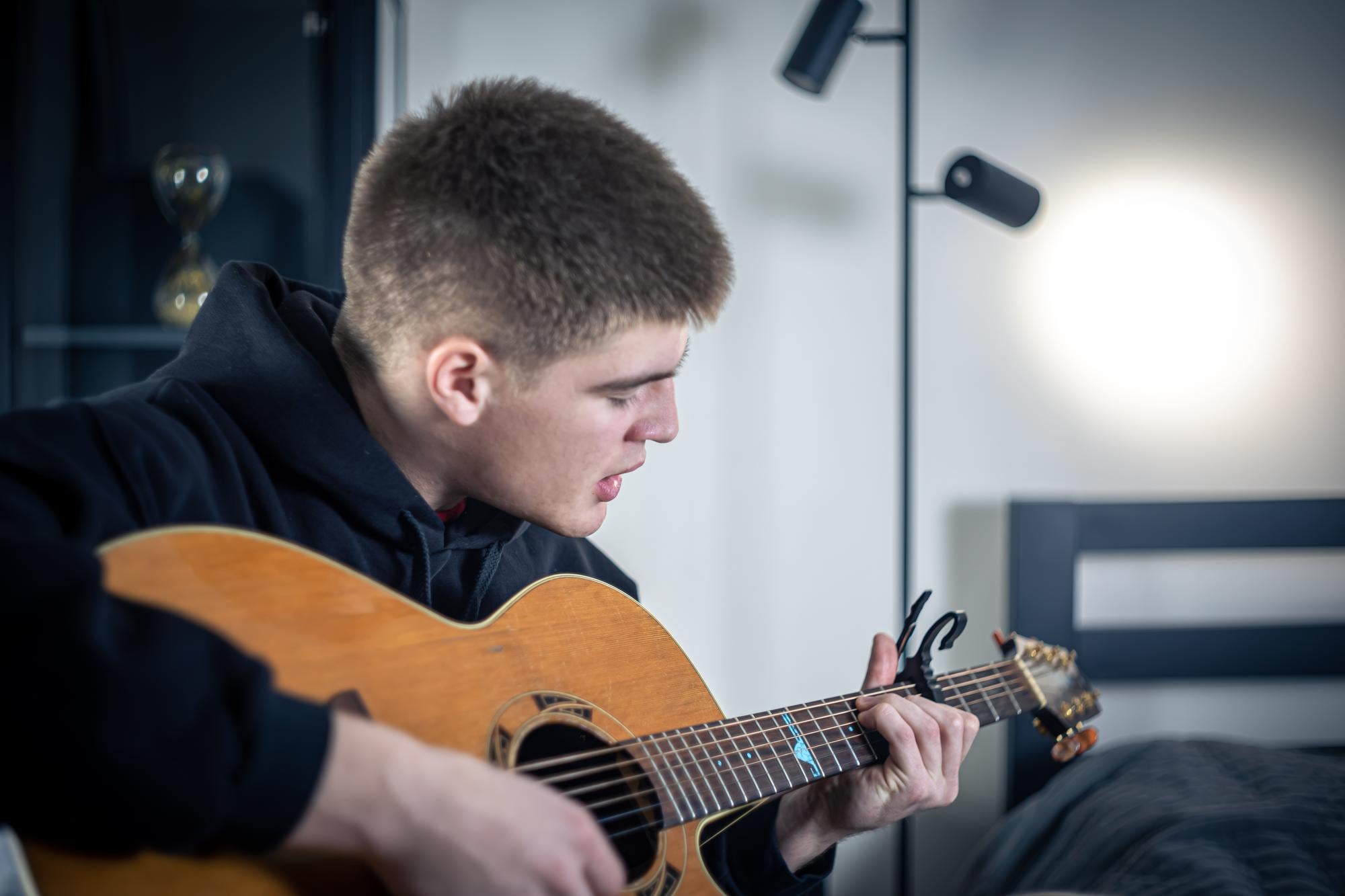
Julian loved his custom Fender Stratocaster from the moment we gave it to him.
His twelfth birthday. Last March.
He’d wanted it since he was nine. Since the first time he heard Jimi Hendrix on his grandfather’s old record player. He used to stand in front of the guitars at Westbrook Music Exchange on Main Street with his nose practically pressed against the glass.
There was one in particular. A Stratocaster. Sunburst finish. Rosewood neck. Hand-wired pickups. Custom built by a luthier in Nashville.
Two thousand, one hundred dollars.
Ben and I don’t have two thousand dollars lying around.
Ben works for Tri-County Electric. I’m a dental hygienist at a practice on Fifth Street. We have a mortgage on a three-bedroom ranch house. Two car payments. A dog with hip dysplasia.
We’re fine. We’re not rich.
But we saved.
For eleven months. Fifty dollars from every paycheck. I took on Saturday hours. Ben worked every storm callout he could get. We put it in an envelope in the back of the freezer, behind the frozen peas, where Julian would never look.
On his twelfth birthday, we gave him the case.
His face when he opened it.
I’ll never forget it.
He didn’t say anything. He didn’t scream or jump or run around the room. He just sat there on the living room floor. Staring at it. With both hands pressed flat against his cheeks.
Then he started crying.
“This is the one,” he whispered. “This is the one from the store. The one I always look at.”
“Happy birthday, buddy,” Ben said.
Julian looked up at his father.
“How?” he said. “This costs so much. How did you—”
“We saved,” Ben said. “That’s all. We just saved.”
Julian set the case down very carefully.
Then he got up and hugged his father so hard Ben almost fell over.
It was the most expensive birthday present we ever bought.
And it was worth every single dollar.
He treated that guitar like a priceless treasure.
He wiped it down every night with a special cloth. He changed the strings himself. He looked up videos on how to adjust the action and the intonation. He kept it on a stand next to his desk where he could see it from his bed.
He wouldn’t let anybody else touch it. Not his friends. Not his cousins. Not even Ben.
“Just look,” he’d say. “Don’t touch. It’s custom.”
Almost every afternoon, music drifted through our house.
He’d come home from school. Drop his backpack in the hallway. Go straight to his room. Close the door.
And play.
Sometimes it was songs I knew. Hendrix. Nirvana. The Beatles. Sometimes it was songs I didn’t know. Things he found on YouTube. Indie bands with strange names.
Sometimes it was songs I’d never heard before.
His own.
He’d play the same melody twenty times. Thirty. Until he got it right. I’d be in the kitchen making dinner and I’d hear the same four bars over and over and over. Then a pause. Then the same four bars again, slightly different.
It drove Ben crazy.
I loved it.
So when I walked into his room last Monday carrying a basket of clean laundry, and noticed the empty guitar stand beside his desk, I immediately stopped.
The stand was there.
Black metal. The one he’d bought with his own allowance. Next to the desk. Where it always was.
The guitar wasn’t.
At first I thought he’d taken it to school. Sometimes he did. For music class. Or to show his friends.
But it was Monday. He didn’t have music on Monday.
I set down the laundry basket.
I checked the closet. Under the bed. Behind the bedroom door. In the hard-shell case, which was leaning against the wall.
The case was empty.
I stood in the middle of his room and felt sick.
Stolen. That was my first thought. Somebody broke in. Somebody stole it.
But nothing else was missing. The TV in the living room. My laptop on the kitchen table. Ben’s tools in the garage.
Just the guitar.
A few minutes later, Julian came home from school.
I heard the front door open. His backpack hit the floor in the hallway. Same as always.
I walked out of his room.
He was standing in the hallway. Taking off his shoes.
“Sweetheart,” I said. “Where’s your Fender?”
He stopped.
One shoe on. One shoe off.
His eyes dropped toward his sneakers.
He didn’t say anything for a long time.
“Julian?”
“Mom,” he said quietly. “I sold it.”
I nearly lost my grip on the laundry basket. I’d picked it back up without realizing.
“You sold your guitar?” I said. “Julian, why?”
He swallowed.
He looked up at me.
“Because Maya needed a new wheelchair,” he said.
For a moment, I couldn’t think of anything to say.
Maya.
I knew Maya. Sort of.
Maya Medina. A girl in Julian’s eighth-grade class at Westbrook Middle School. I’d seen her at school drop-offs. Pickup. The spring concert.
She’d used a wheelchair since elementary school. Since second grade, I thought. I’d heard there was an accident. A car accident. I didn’t know the details.
She was a bright, friendly girl. Long dark hair in a braid. Glasses with purple frames. She always greeted the other kids with a big smile. She sang in the chorus. She had a beautiful voice. Clear and strong. I remembered that from the concert.
That was all I knew about Maya Medina.
Apparently, my son knew a lot more.
“Her wheelchair is really old, Mom,” Julian said.
He’d taken off his other shoe. He was standing in the hallway in his socks.
“Like, really old,” he said. “She’s had it since fourth grade. The front wheels keep getting stuck. The little ones. They’re called casters. One of them’s bent. It catches on everything.”
I set the laundry basket down on the floor.
“It’s getting harder for her to move between classrooms,” Julian said. “Westbrook’s really old. The hallways are long. There’s that ramp by the science wing that’s really steep. She has to push really hard.”
He paused.
“Sometimes she gets to class late,” he said. “Because the chair won’t move right. Mr. Patterson gave her a tardy last week. In front of everybody. He didn’t even ask why.”
I felt my chest tighten.
“And last Thursday,” Julian said, “she missed most of lunch. The caster got stuck in the doorway of the cafeteria. On the metal strip. She was stuck there for like ten minutes. Trying to get it loose.”
“Didn’t anybody help her?”
Julian looked at the floor.
“Some people walked around her,” he said quietly. “Some people laughed.”
I sat down on the edge of the stairs.
“The seat’s worn out too,” Julian said. “The cushion. It’s like, flat. She told me it hurts her back by the end of the day. And it makes this squeaking noise. Every time she pushes. Eek. Eek. Eek.”
He made the sound. Quietly.
“And a few kids have been making jokes about it,” he said.
“What kind of jokes?”
Julian’s jaw tightened.
“Tyler Hutchins and those guys,” he said. “They do the squeak. When she goes by. Eek, eek, eek. Like a mouse. They call her Squeaky.”
I put my hand over my mouth.
“Maya tries to laugh it off,” Julian said. “She pretends it doesn’t bother her. She says haha, very funny and keeps going.”
He looked up at me.
“But I can tell it bothers her, Mom,” he said. “I can tell.”
I didn’t say anything for a while.
Then I asked, “Doesn’t her family know she needs a new one?”
“They know,” Julian said. “But they’ve been struggling with medical bills. From the accident. And from her surgeries. She’s had like six surgeries.”
He sat down on the stair next to me.
“And the wheelchair she needs is expensive,” he said. “Like, really expensive. Insurance only pays for a new one every five years. And she got hers four years and two months ago. So they won’t pay for another one until next September.”
“Next September?”
“Eleven more months,” Julian said. “Of the caster getting stuck. And the seat hurting. And eek, eek, eek.”
He was quiet for a moment.
“She told me her parents were trying to save money for one,” he said. “On their own. Without insurance. But her dad got hurt at work too. And her mom works two jobs. And they’re behind on stuff.”
I glanced back up the stairs. Toward his room. Toward the empty guitar stand.
“And you decided to sell your Fender,” I said.
Julian nodded.
“Mom,” he said. “That guitar was worth a lot of money. I figured I could use it to help her.”
I stared at my son.
Thirteen years old. In his socks on the stairs. With wet hair sticking up in the back.
He’d given up the thing he’d dreamed about since he was nine years old. The thing his father and I saved eleven months to buy. The thing he wiped down every single night with a special cloth.
Because a girl in his class had a bent caster and a flat cushion and a squeaky wheel.
“Julian,” I said. “Why didn’t you tell me first?”
His eyes filled with tears.
“Because I thought you’d say we should wait,” he said. “And organize a fundraiser. Or a GoFundMe. Or talk to the school. Or the PTA.”
I didn’t say anything.
Because that’s exactly what I would have said.
“And that would take forever,” Julian said. “Months. And meanwhile Maya’s stuck in the cafeteria doorway. And Mr. Patterson’s giving her tardies. And Tyler’s going eek, eek, eek.”
He wiped his nose on his sleeve.
“Maya needs a wheelchair now, Mom,” he said. “Not in a few months. Now.”
He took a shaky breath.
“I know I should’ve asked you,” he said. “I’m sorry.”
I moved closer. I put my arms around him.
“Oh, sweetheart,” I said.
For several moments, I couldn’t speak.
I was upset. I want to be honest about that. I was upset that he’d sold something that valuable without talking to us. Something his father and I sacrificed for. Without even a conversation.
But I was also so moved I could barely breathe.
“You have a wonderful heart, Julian,” I whispered into his wet hair. “You know that? You have the best heart.”
He nodded against my shoulder.
“Next time,” I said, “we’ll find a way to help together. Okay? You come to me. And we’ll figure it out. Together.”
“Okay,” he whispered.
Then I asked the question that had been bothering me since he said Maya.
“Did you get enough money?”
He hesitated.
“For the wheelchair?” I said. “Did the guitar cover it?”
“Almost,” he said.
“What do you mean, almost?”
Julian glanced up the stairs.
Toward his room.
Then he got up. He went upstairs. I followed him.
He went to his desk. He opened the top drawer.
Inside was a small metal savings tin. Red. With a picture of a 1950s jukebox on the lid. His grandfather gave it to him when he was six. He’d been putting money in it ever since. Birthday money. Christmas money. Allowance. Lawn-mowing money from the neighbors.
I knew there’d been a lot in it. Almost four hundred dollars. He was saving for an amplifier.
He opened the lid.
It was empty.
“Julian?”
He looked at me nervously.
“I used my birthday savings too,” he said.
I stared at him.
“All of it?”
He nodded.
Then he looked at the shelf above his TV.
I looked too.
It was empty.
His PlayStation. Gone. The controllers. Gone. The stack of games he’d collected over three years. Gone.
“And,” Julian said quietly, “I sold my PlayStation. And the games.”
My mouth fell open.
“Your PlayStation?”
“I needed a little more money,” he explained. “The wheelchair cost fourteen hundred dollars.”
Fourteen hundred dollars.
I looked around his room.
The guitar stand. Empty.
The gaming shelf. Empty.
The savings tin. Empty.
My son hadn’t simply sold one treasured possession.
He’d given up almost everything he owned.
“Julian,” I whispered. “Why would you do all that?”
His answer was so simple that it brought tears to my eyes.
“Because I can save up for another guitar someday, Mom,” he said. “But Maya needs to get around school comfortably right now.”
I hugged him again.
I didn’t know what else to do.
That evening, at dinner, Julian told us the rest.
He’d done the research himself. Online. For two weeks. He’d found a lightweight manual wheelchair. Titanium frame. Better casters. A pressure-relief cushion. A medical supply company in Dallas that would ship it in three days.
Fourteen hundred and twelve dollars. With shipping.
He’d sold the guitar on Saturday. To Lenny Marsh at Westbrook Music Exchange. The same store where he used to press his nose against the glass.
Eight hundred dollars.
“He said that’s what he could do for a used one,” Julian said. “He said he’d have to sell it for more than that to make money.”
Ben put his fork down.
“Eight hundred,” he said quietly. “For a twenty-one-hundred-dollar custom Strat.”
“It’s used now,” Julian said.
“You’ve had it seven months.”
Julian shrugged.
He’d sold the PlayStation and games at the GameStop on Highway 9 on Sunday. Two hundred and forty dollars.
And emptied the savings tin. Three hundred and eighty-two dollars.
One thousand, four hundred and twenty-two dollars.
Ten dollars left over.
“I bought Maya a cookie at lunch,” Julian said. “With the ten. Chocolate chip. She likes those.”
Ben didn’t say anything for a long time.
Then he got up from the table.
He walked around to Julian’s side.
He put his hand on the back of Julian’s neck. The way he did when Julian was little.
“I’m proud of you, son,” he said. His voice was rough. “I’m mad you didn’t ask. But I’m so proud of you I can’t see straight.”
Julian looked up at his father.
“Are you mad about the guitar?” he asked. “Since you and Mom saved for it?”
Ben was quiet.
“No,” he said finally. “We saved for it so you’d have something you loved. And you gave the thing you loved to somebody who needed it more.”
He squeezed Julian’s neck.
“That’s exactly what we saved for,” Ben said.
The wheelchair had already been delivered.
That afternoon. To the Medinas’ house on Cedar Street. Julian had used the school directory to get the address.
He’d included a card.
He wouldn’t tell me what it said.
“It’s private,” he said.
I went to bed that night feeling emotional. Proud. Still amazed by what my son had done.
I lay next to Ben in the dark and said, “He sold everything, Ben. Everything.”
“I know.”
“He’s thirteen.”
“I know,” Ben said. “We did something right, Sarah.”
I thought that was the biggest surprise.
Discovering how generous my son could be.
I was wrong.
At exactly seven the next morning, someone knocked on our front door.
“Ma’am,” Officer Daniels said. “There’s something about yesterday that you don’t know yet.”
I turned to Julian.
“Sweetheart,” I said. “Is there something else you need to tell me?”
He shook his head. Fast.
“I don’t know, Mom,” he said. “I don’t know. I didn’t do anything else. I swear.”
Officer Cooper stepped forward.
She looked at Julian. Her face softened.
“Julian,” she said. “You’re not in trouble. Okay? I need you to hear that first. You’re not in any trouble at all.”
Julian stared at her.
“Mrs. Vance,” Officer Cooper said. “Your son isn’t in trouble. But someone contacted our department last night. And there’s a very important reason we’re here.”
“What reason?”
Officer Cooper glanced back at the patrol car. Still running at the curb.
Then she looked at Julian.
“Someone wants to meet your son,” she said. “And they’ve asked us to bring you both.”
I was completely confused.
“Who?” I said. “Who wants to meet him?”
Officer Cooper looked at Officer Daniels.
Officer Daniels took off his hat.
“Mrs. Vance,” he said. “Does the name Rafael Medina mean anything to you?”
“Medina,” I said slowly. “Maya’s father?”
“Yes, ma’am.”
“I don’t know him,” I said. “I’ve never met him. I’ve seen Maya at school, but—”
“Sergeant Rafael Medina,” Officer Daniels said, “has been with the Westbrook Police Department for nineteen years.”
I stopped breathing.
“He’s our sergeant,” Officer Cooper said quietly. “He trained both of us.”
I looked at Julian.
Julian’s mouth was open.
“Maya’s dad is a cop?” he said.
“He’s on desk duty,” Officer Daniels said. “Has been for six years. Since the accident.”
“What accident?” I asked.
Officer Daniels didn’t answer right away.
“Can we talk in the car?” he said. “Sergeant Medina asked us to bring you to the station. By seven-thirty. Before roll call.”
“Roll call?”
“He wants to meet Julian,” Officer Cooper said. “In front of the whole morning shift.”
Julian looked at me.
I looked at him.
“Get dressed,” I said. “Real clothes. Not pajamas.”
“What about school?”
“I’ll call the office,” I said. “I think this counts.”
Julian wore his one nice shirt. Blue. A button-down from his cousin’s wedding. It was a little too small. He tucked it into his jeans.
I threw on jeans and a sweater and pulled my hair into a ponytail.
We got into the back of the patrol car.
Julian had never been in a police car. He sat very straight. With his hands on his knees. Looking at the cage between the front and back seats.
“This is weird,” he whispered to me.
“Very weird,” I whispered back.
Officer Cooper drove. Officer Daniels sat in the passenger seat.
He turned around to face us.
And he told us about Rafael Medina.
“Six years ago,” he said, “Rafael was driving Maya home from a birthday party. A Saturday night. She was seven. In the back seat. In her booster.”
Julian went very still.
“A drunk driver ran a red light at Fourth and Pine,” Officer Daniels said. “Doing sixty in a thirty. Hit the back passenger side. Right where Maya was sitting.”
I put my hand over my mouth.
“Rafael was off duty,” Officer Daniels said. “He got out of the car with a broken arm and three broken ribs and pulled his daughter out of the back seat before the car caught fire.”
He paused.
“Her spinal cord was damaged,” he said. “T-twelve. She’s paralyzed from the waist down.”
Julian didn’t say anything.
He was staring at the back of Officer Cooper’s seat.
“Rafael hurt his back too,” Officer Daniels said. “Pulling her out. Herniated disc. Two surgeries. He can’t do patrol anymore. He’s been on the desk since. Paperwork. Dispatch. Training.”
“And the bills,” I said quietly.
“The bills,” Officer Daniels said. “The drunk driver had minimum insurance. Twenty-five thousand. That was gone in the first week. Maya’s had six surgeries. Rehab. Physical therapy. A ramp for the house. A van with a lift.”
He shook his head.
“His wife, Elena, works two jobs,” he said. “She’s a nurse at Mercy in the day and does medical billing from home at night. They refinanced their house twice.”
“Did the department help?”
Officer Daniels and Officer Cooper looked at each other.
“We tried,” Officer Cooper said. “Every year. The union offered. The department offered. We tried to set up a fund. Five years in a row.”
“And?”
“And Rafael said no,” Officer Daniels said. “Every time.”
“Why?”
Officer Daniels was quiet.
“Because he was driving,” he said. “That night. He thinks it’s his fault. That he should’ve seen the car coming. That he should’ve stopped at the yellow. That he should’ve taken a different route home. He’s never forgiven himself.”
He looked out the window.
“He thinks he doesn’t deserve help,” he said. “He thinks he has to fix it himself. Pay for it himself. Carry it himself. Because he’s the one who broke it.”
Julian was staring at his hands.
“So when the wheelchair came,” Officer Cooper said, “yesterday afternoon. To their house. Fourteen-hundred-dollar chair. Titanium. Brand new.”
“He thought it was us,” Officer Daniels said. “The department. He thought we went behind his back. He called me at nine o’clock last night. Furious. Yelling. Said he’d told us a hundred times he didn’t want charity.”
“And then,” Officer Cooper said, “Maya showed him the card.”
Julian’s face went red.
“What did the card say?” I asked.
Julian didn’t answer.
Officer Daniels reached into his breast pocket.
He took out a folded piece of notebook paper.
“Rafael sent me a picture of it,” he said. “Last night. At eleven. I printed it out this morning.”
He handed it back through the gap in the cage.
I took it.
I unfolded it.
It was Julian’s handwriting. Messy. Pencil. On lined paper torn from a spiral notebook.
Maya,
This is for you. It’s not charity. It’s not from the school or the church or anybody like that. It’s just from me.
Remember in fourth grade when I broke both my legs falling off the Hendersons’ trampoline and I had to use a wheelchair for three months?
Everybody laughed at me. Tyler said I looked like an old man. Nobody would sit with me at lunch.
Except you.
You were new. You’d only been at Westbrook for like two weeks. And you rolled over to my table and said, “Want me to show you how to do a wheelie?”
And you taught me. In the parking lot. Every day at recess for three months. You taught me how to go down ramps backwards and how to not get stuck in doorways and how to pop the front wheels up over the cafeteria strip.
You said, “The chair is just how you get places. It’s not who you are.”
I never forgot that.
When I got my casts off, I never said thank you. I just went back to walking and forgot about it. I’m sorry.
So this is me saying thank you. Four years late.
The casters are the kind that swivel 360. They won’t get stuck on the cafeteria strip. And the cushion is gel. And it doesn’t squeak. I checked the reviews. Somebody said it’s “silent as a ninja.”
Now you can be a ninja.
Your friend,
Julian Vance
P.S. I sold my guitar. Don’t tell anybody. Especially not my mom.
I put the paper down in my lap.
I looked at my son.
He was staring out the window. His face bright red. His jaw tight.
“You broke both your legs in fourth grade,” I said slowly.
“Yeah.”
“On the Hendersons’ trampoline.”
“Yeah.”
“You were in a wheelchair for three months. I pushed you. I drove you to school every day. I remember.”
“I know,” Julian said.
“I didn’t know about Maya,” I said. “I didn’t know she taught you. I didn’t know she sat with you.”
Julian shrugged.
“You never asked,” he said. “I never said.”
I sat there in the back of the patrol car and remembered.
Fourth grade. Julian in a wheelchair. Both legs in casts up to his knees. Miserable. Angry. Embarrassed.
And then, after a few weeks, something changed. He started coming home in a better mood. He started going faster. Doing tricks in the driveway. Popping wheelies.
I’d thought he’d just adjusted.
I’d never asked how.
“Rafael read that card at nine-fifteen last night,” Officer Daniels said. “And he called me back at eleven.”
“What did he say?”
Officer Daniels looked at me.
“He was crying,” he said. “I’ve known Rafael Medina for nineteen years. I’ve seen him pull bodies out of the river. I’ve seen him walk into a house with a man holding a knife. I’ve never once heard him cry.”
He looked at Julian.
“He said, Mike, a thirteen-year-old kid sold his guitar for my daughter. A kid. Sold everything he had. Because she was nice to him once.”
Officer Daniels’s voice got rough.
“And then he said, And I’ve been saying no to my own brothers for six years.”
We pulled into the parking lot of the Westbrook Police Department at 7:24.
A two-story brick building on Main Street. Across from the courthouse. Three blocks from Westbrook Music Exchange.
The parking lot was full.
Not just patrol cars. Personal cars. Pickup trucks. Minivans. More cars than I’d ever seen there.
Officer Cooper parked. She turned around in her seat.
“Julian,” she said. “Are you ready?”
Julian looked at me.
“Ready for what?” he whispered.
They took us in through the side door.
Down a hallway. Past offices and a break room with a coffee maker and a bulletin board covered in flyers.
To a set of double doors.
ROLL CALL ROOM.
Officer Daniels put his hand on the door.
He looked at Julian.
“Son,” he said. “Whatever happens in there. You remember you didn’t do anything wrong. You did something right. Okay?”
Julian nodded. He looked terrified.
Officer Daniels pushed the door open.
The room was full.
Packed.
Rows of folding chairs. Every one of them taken. More people standing along the walls. In the back. In the corners.
Police officers. In uniform. Dozens of them. Fifty, maybe sixty. The whole morning shift. And the night shift, who’d stayed late. And people in plain clothes too. Detectives. Dispatchers. Office staff.
And other people.
A woman in hospital scrubs. A man in a mechanic’s jumpsuit. An old man with a cane.
And standing in the front of the room, in front of a whiteboard with the day’s assignments written on it, was a man in uniform.
He was in his forties. Medium height. Thick black hair going gray at the temples. A mustache. Broad chest.
He stood very straight. Like it took effort. Like his back hurt.
His sergeant’s stripes were on his sleeve.
MEDINA.
And next to him, in a brand-new wheelchair, was Maya.
She was wearing a green sweater. Her dark hair in a long braid. Her purple glasses.
The wheelchair was sleek. Black. Titanium frame. Small swivel casters in front. A gray gel cushion.
She saw Julian in the doorway.
Her whole face lit up.
The room went silent.
Sixty police officers turned around and looked at my son.
Julian stood in the doorway in his too-small blue shirt.
He didn’t move.
I felt him take my hand.
Sergeant Medina stepped forward.
Slowly. Like his back was hurting him. But he didn’t let it show on his face.
He walked down the center aisle. Between the rows of chairs.
He stopped in front of Julian.
He looked down at him.
He didn’t say anything for a long time.
“You’re Julian Vance,” he said finally.
His voice was deep. Rough. A little shaky.
Julian nodded.
“I’m Rafael Medina,” he said. “I’m Maya’s dad.”
Julian nodded again.
He looked like he wanted the floor to swallow him.
“I’m sorry,” Julian said suddenly. Fast. “I’m sorry if I did something wrong. I didn’t mean to make you mad. I know you said you didn’t want help. Maya told me. She said you always say no. I just—I just thought—”
He stopped.
“I just thought she shouldn’t have to get stuck in the doorway anymore,” he said.
Sergeant Medina looked at my son.
His face did something I’ll never forget.
It crumpled.
Just for a second. Like a wall coming down.
Then he got it back.
He knelt down.
Slowly. Painfully. His back made him wince. One knee on the linoleum floor.
So he was eye level with Julian.
“Julian,” he said quietly. “Six years ago, I was driving my daughter home from a birthday party. And I didn’t see a car coming. And she’s been in a wheelchair ever since.”
Julian didn’t say anything.
“And for six years,” Sergeant Medina said, “every single person in this room has tried to help my family. Every Christmas. Every birthday. Every time Maya had surgery. They tried to give me money. They tried to start a fund. They tried to pay for her wheelchair. Her van. Her ramp.”
He looked over his shoulder. At the room full of officers.
“And I said no,” he said. “Every time. To every one of them. Because I was driving. Because it was my fault. Because I thought if I let anybody help me, it meant I couldn’t take care of my own daughter.”
He turned back to Julian.
“And then yesterday,” he said, “a thirteen-year-old boy I’ve never met sold his guitar. And his PlayStation. And emptied his piggy bank.”
His voice cracked.
“And bought my daughter the wheelchair I couldn’t afford,” he said. “Without asking me. Without asking anybody.”
The room was dead silent.
“Maya showed me your card,” Sergeant Medina said. “Last night. About fourth grade. About the wheelies.”
He swallowed.
“I didn’t know that,” he said. “Maya never told me. I didn’t know she taught you.”
He looked over at his daughter.
Maya was crying. Smiling and crying.
“She came home every day that spring,” Sergeant Medina said, “and told me about a boy with two broken legs who was really bad at going down ramps. She called him the trampoline kid. I never knew his name.”
He looked back at Julian.
“She was eight,” he said. “We’d only lived in Westbrook for two weeks. She’d only been in the chair for eight months. She was so angry. She cried every night. She hated school. She hated everything.”
He put his hand on Julian’s shoulder.
“And then she met the trampoline kid,” he said. “And she taught him wheelies. And for the first time since the accident, she came home happy.”
Julian was crying now.
Silently. Tears running down his face.
“She told me,” Sergeant Medina said, “that helping you made her feel like the chair wasn’t the end of her life. It was just how she got places. She said I’m the expert now, Papa. I get to teach somebody.”
His voice broke completely.
“You gave her that,” he said. “When you were nine. And you didn’t even know.”
Sergeant Medina stood up.
Slowly. His back. One hand on Julian’s shoulder to steady himself.
He turned around.
He faced the room.
“Six years,” he said. Loud enough for everybody to hear. “Six years I’ve been saying no to every person in this room. Out of pride. Out of guilt. Out of shame.”
He looked at Julian.
“And it took a thirteen-year-old with a guitar to show me how stupid I’ve been,” he said.
Somebody laughed. Softly. Not cruelly.
Sergeant Medina almost smiled.
“So,” he said. “I’m saying yes.”
The room erupted.
Not clapping. Not cheering. Just a sound. A big, collective breath. Like sixty people had been holding it for six years.
Officer Daniels was wiping his eyes. Officer Cooper had her hand over her mouth.
Then Sergeant Medina turned to the side of the room.
“Lenny,” he said.
A man stood up from a folding chair near the wall.
Sixty-something. Gray ponytail. A faded Rolling Stones T-shirt under a corduroy jacket. Reading glasses on his head.
Lenny Marsh. From Westbrook Music Exchange.
He was holding something.
A hard-shell guitar case. Black. With a strap.
Julian saw it.
He stopped breathing.
Lenny walked down the aisle. He stopped in front of Julian.
He held out the case.
“Kid,” he said. “I think this belongs to you.”
Julian didn’t move.
He stared at the case.
“I sold it to you,” he whispered. “You paid me eight hundred dollars.”
“I did,” Lenny said.
“Then it’s yours.”
Lenny shook his head.
“Rafael came by the store last night,” he said. “At ten o’clock. I was closing up. He banged on the door. He asked if a kid named Julian Vance had sold me a guitar.”
He set the case down on the floor in front of Julian.
“I told him yeah,” Lenny said. “A custom Strat. Sunburst. Nashville build. The one the kid used to stare at through my window for three years.”
He looked at Julian.
“I knew it was you,” Lenny said. “When you walked in on Saturday with it. I knew exactly who you were. The kid with his nose on my glass.”
Julian’s face crumpled.
“I asked you why you were selling it,” Lenny said. “You said I need the money for something important. That’s all you’d say.”
He shook his head.
“I gave you eight hundred,” he said. “I felt lousy about it. I almost called your mom.”
“Rafael tried to buy it back,” Lenny said. “Last night. Offered me nine hundred. Out of his own pocket.”
He looked at Sergeant Medina. Then back at Julian.
“I told him no,” Lenny said.
Julian looked up.
“I told him,” Lenny said, “You’re not buying that guitar. Nobody’s buying that guitar. That guitar’s going back to the kid. Free.”
Julian burst into tears.
He knelt down on the linoleum floor of the Westbrook Police Department roll call room.
He opened the case.
There it was. The Stratocaster. Sunburst. Rosewood neck. Exactly the way he left it. Strings still tuned.
He didn’t pick it up.
He just put both hands flat on the body of the guitar.
And he cried.
“There’s more,” Officer Daniels said.
He stepped aside.
Behind him, on a folding table, was a PlayStation.
Julian’s PlayStation. With the scratch on the top where he dropped it in the driveway. The controllers. The stack of games.
“The manager at GameStop,” Officer Cooper said. “On Highway 9. He hadn’t put it out on the floor yet. When Sergeant Medina explained, he gave it back. Said to tell you to keep your high score on the racing game. He said it was impressive.”
Julian laughed. Through his tears.
And next to the PlayStation was a red metal tin.
With a picture of a 1950s jukebox on the lid.
Officer Daniels picked it up. He handed it to Julian.
It was heavy.
Julian opened it.
It was full.
Not with the three hundred and eighty-two dollars he’d had.
With a lot more than that.
Bills. Fives. Tens. Twenties. Folded and crammed in. Coins. A few checks.
“We passed a hat,” Officer Daniels said. “Last night. At shift change. And again this morning.”
Julian stared at the tin.
“Every person in this room,” Officer Daniels said. “Every person who’s tried to help Rafael for six years. Who he kept saying no to.”
He put his hand on Julian’s shoulder.
“He finally said yes,” he said. “So we had to put it somewhere.”
Julian looked at the tin.
He looked at the guitar.
He looked at the PlayStation.
Then he looked at Maya.
She was sitting in her new wheelchair at the front of the room. Crying. Smiling.
Julian stood up.
He closed the tin.
He held it out.
To Sergeant Medina.
“I can’t take this,” Julian said.
The room went quiet.
“Son,” Sergeant Medina said. “It’s yours. It’s to replace what you—”
“No,” Julian said.
His voice was shaking. But it was clear.
“I didn’t give Maya the wheelchair so I’d get my stuff back,” he said. “I gave it to her because she needed it. If I take all this back, then it’s not a gift anymore. It’s a trade.”
He swallowed.
“I don’t want a trade,” he said. “I wanted to give her something.”
Nobody said anything.
Sergeant Medina looked at my son for a long time.
“Then what do you want to do with it?” he asked.
Julian looked at the tin.
Then he looked at Maya.
“Maya,” he said. “How many kids at Westbrook use wheelchairs?”
Maya blinked.
“In the whole district?” she said. “Like eleven. I know them from therapy. And from the adaptive sports league.”
“Are any of their chairs broken?”
Maya thought about it.
“Devon’s,” she said. “In sixth grade. His brakes don’t work. He has to use his hands to stop. He burned his palms last month on the ramp.”
She thought some more.
“And Priya,” she said. “In fifth. Her chair’s too small. She grew. Insurance won’t replace it for two more years. Her knees hit the front.”
“And there’s a little kid,” she said. “At Lincoln Elementary. Second grade. Isaiah. He’s using his cousin’s old chair. It doesn’t even fit him. It’s way too big. He can barely reach the wheels.”
Julian turned back to the room.
To sixty police officers.
“Then that’s what it’s for,” he said.
He held up the tin.
“Devon’s brakes,” he said. “Priya’s chair. Isaiah. Whoever else needs it.”
He looked at Sergeant Medina.
“Can you do that?” he said. “Can you make it so this goes to kids whose chairs are broken? So they don’t have to wait eleven months for insurance?”
Sergeant Medina didn’t answer.
He couldn’t.
He was standing at the front of the roll call room with his hand over his mouth. Crying.
Officer Daniels answered for him.
“Yes,” he said. “Yes, son. We can do that.”
I stood in the back of the room.
Watching my son.
Thirteen years old. In a too-small blue shirt. Holding a red tin full of money in front of sixty police officers.
Giving it away.
Again.
Ben was there.
I hadn’t seen him come in. He must have gotten the call from Officer Cooper. He was standing in the back. In his Tri-County Electric jacket. With his hard hat under his arm.
He’d left a job site.
He came and stood next to me.
He took my hand.
He didn’t say anything.
He didn’t have to.
Then Maya rolled forward.
In her new chair. The swivel casters gliding silently across the linoleum.
No squeak.
She stopped in front of Julian.
She looked up at him.
“Julian,” she said. “Can I show you something?”
He nodded.
She grabbed the push rims.
She leaned back.
And she popped a wheelie.
Right there in the middle of the Westbrook Police Department roll call room. Balanced on her back wheels. Perfectly still.
Sixty police officers started cheering.
“Silent as a ninja,” Maya said.
Julian laughed so hard he cried.
She came down off the wheelie.
She held out her hand.
Julian took it.
“Thank you,” she said. “For the chair. For the card. For remembering.”
“Thank you,” Julian said. “For the wheelies. For sitting with me. In fourth grade.”
“You said that in the card.”
“I know,” Julian said. “I wanted to say it out loud. I never said it out loud.”
Then Maya said something else.
Something I don’t think anybody in that room expected.
“Julian,” she said. “Will you play something? On your guitar?”
Julian looked at the case on the floor.
“Here?” he said. “Now?”
“Please,” Maya said.
Somebody found an amplifier. A little practice amp. One of the detectives kept it in his car. He played in a cover band on weekends.
Julian picked up the Stratocaster.
He held it for a long moment. Running his fingers over the body. Over the strings.
He plugged it in.
He looked at Maya.
“What do you want me to play?”
Maya thought about it.
“The one you’re always practicing,” she said. “In the music room. At lunch. The one you play over and over.”
Julian’s face went red.
“You heard that?”
“Everybody’s heard that,” Maya said. “You play the same four bars like a hundred times.”
Julian looked at me.
I didn’t know what song she meant.
He took a breath.
And he played.
It was a song I’d heard a thousand times.
Through his bedroom door. While I was making dinner. The same four bars. Over and over and over. Driving Ben crazy.
I’d never heard the whole thing.
He played the whole thing.
It was slow. Gentle. A melody that went up and came down and went up again. Like something rolling. Like wheels. Like somebody going down a ramp backwards for the first time.
He’d been working on it for four years.
Since fourth grade.
When he finished, the room was silent.
Maya was crying.
“What’s it called?” she asked.
Julian looked at the guitar.
“I didn’t have a name for it,” he said. “For a long time.”
He looked at her.
“I call it The Wheelie Song,” he said. “I started it in fourth grade. When I was in the chair. After you taught me. I wanted to write something that sounded like how it felt. Going fast. Not being stuck.”
Maya put her hand over her mouth.
“I never finished it,” Julian said. “Until last week. After I ordered your chair.”
Sergeant Medina was standing next to his daughter.
He had his hand on her shoulder.
He was crying too.
He looked at me. Across the room.
And he mouthed two words.
Thank you.
That was eight months ago.
The fund is called Maya’s Wheels.
The department set it up through the police union. The red jukebox tin sits on the front desk at the station. People drop money in it. Every day.
Lenny Marsh put a jar on the counter at Westbrook Music Exchange. The GameStop on Highway 9 put one by the register.
In the first month, it raised eleven thousand dollars.
Devon got new brakes. Two weeks after the roll call.
Priya got a new chair. One that fits. Her knees don’t hit the front anymore.
Isaiah, the second-grader at Lincoln Elementary, got a chair his own size. Bright red. He picked the color.
He did his first wheelie in March.
Maya taught him.
So far, Maya’s Wheels has helped fourteen kids.
Fourteen.
In eight months.
Sergeant Medina finally let the union help his family.
They paid off the second mortgage. They bought Maya’s family a new van. With a ramp that actually works.
Elena Medina quit her night job.
She sleeps now.
And something else happened.
Something nobody planned.
In January, Sergeant Medina went to see a counselor.
Officer Daniels told me. Rafael had never talked to anybody. About the accident. About Fourth and Pine. About the night he didn’t see the car coming.
Six years.
The department has a peer support program. Officers helping officers. Rafael had been eligible for it the whole time.
He’d always said no.
In January, he said yes.
“He told me something,” Officer Daniels said. He came by the house in February. To drop off a check for the fund. He sat at our kitchen table with a cup of coffee.
“He said the hardest part wasn’t the accident,” Officer Daniels said. “Or his back. Or the bills. He said the hardest part was letting people see him need something.”
He looked at Julian. Doing homework at the end of the table.
“He said your boy did that,” Officer Daniels said. “Not on purpose. He just did. A thirteen-year-old kid needed nothing from him. Wanted nothing back. Just gave.”
He shook his head.
“And Rafael said, If a kid can give without needing anything back, then maybe I can take without it meaning I’m not enough.”
Tyler Hutchins doesn’t make squeaking noises anymore.
I don’t know exactly what happened. Julian won’t tell me.
But Maya told me. At the spring concert. In May.
She said that the day after the roll call, a picture went around school. Somebody’s older brother was a dispatcher at the station. He’d taken a video of Maya popping a wheelie in front of sixty cops. And of Julian playing The Wheelie Song.
The video got shared about four thousand times.
“Tyler came up to me in the hallway,” Maya said. “He said, Is it true a kid sold his guitar for your chair?”
“What did you say?”
Maya grinned.
“I said, Yeah. What have you ever sold for anybody?”
Tyler didn’t have an answer.
But two weeks later, he put twenty dollars in the jar at GameStop.
Maya saw him do it.
She didn’t say anything.
She just did a wheelie as she rolled past him.
Silent as a ninja.
The spring concert at Westbrook Middle School was in May.
Maya sang a solo.
Julian played guitar.
The Wheelie Song.
Maya had written words to it. She’d been working on them since the roll call. She wouldn’t let anybody hear them until the concert.
I sat in the third row of the auditorium with Ben.
Sergeant Medina and Elena sat next to us. In uniform. He’d come straight from the station.
Behind us, Officer Daniels. Officer Cooper. Lenny Marsh in his Rolling Stones T-shirt. The manager from GameStop.
And Devon. And Priya. And little Isaiah in his bright red chair. In the aisle.
Maya rolled out onto the stage.
Silent. Swivel casters.
Julian walked out behind her. With his Stratocaster. He plugged it into the amp.
He looked out at the audience.
He found me in the third row.
He smiled.
Then he looked at Maya.
She nodded.
He started to play.
I won’t tell you all the words. Maya asked me not to. She says they’re hers.
But I’ll tell you the last verse.
She sang it alone. Julian stopped playing. Just her voice. Clear and strong. Filling the whole auditorium.
The chair is just how I get places,
It’s not who I am.
Somebody taught me that once,
And then I taught somebody back again.
And he sold the thing he loved the most
To help me roll on through.
So if you see somebody stuck in a doorway,
Don’t walk around.
Help them through.
The auditorium was silent.
Then it exploded.
Everybody stood up. Everybody. Parents. Teachers. Kids. Officers in uniform.
Isaiah popped a wheelie in the aisle.
Sergeant Medina stood next to me with tears running down his face.
He reached over.
He took my hand.
“Your boy,” he said.
“Your girl,” I said.
People ask me sometimes about that morning.
Seven a.m. Two police officers on my porch. Mrs. Vance, we need to speak with you about your son.
They ask if I was scared.
I tell them the truth.
I was terrified.
For about forty minutes.
Until I walked into a room full of sixty police officers and watched a man who’d said no to everyone for six years kneel down on a linoleum floor in front of my thirteen-year-old.
I used to think generosity was something you taught your kids.
Like manners. Like saying thank you. Like holding the door.
I thought you had to sit them down and explain it. Organize the fundraiser. Set up the GoFundMe. Talk to the PTA.
Let’s wait. Let’s do it the right way. Let’s think it through.
I was wrong.
My son didn’t wait.
He didn’t organize anything. He didn’t ask permission. He didn’t think it through.
He just remembered.
A girl in a wheelchair who rolled over to his table in fourth grade when nobody else would sit with him.
Want me to show you how to do a wheelie?
He carried that for four years.
And when she needed help, he didn’t stop to calculate what it would cost him.
He just gave.
Everything.
And it turns out, when you give like that, it doesn’t stay with one person.
It goes somewhere.
It goes to a man who said no for six years and finally said yes.
To a music store owner who wouldn’t take money for a guitar.
To a red jukebox tin on a police station desk.
To Devon’s brakes and Priya’s chair and Isaiah’s first wheelie.
To fourteen kids who don’t get stuck in doorways anymore.
Julian still plays The Wheelie Song.
Every afternoon. In his bedroom. With the door closed.
I still hear the same four bars over and over while I make dinner.
It still drives Ben crazy.
I still love it.
The guitar stand is never empty anymore.
The Stratocaster sits on it. Next to his desk. Where he can see it from his bed.
He still wipes it down every night with a special cloth.
But there’s something new.
Taped to the guitar stand, right at the top, where he sees it every time he picks up the guitar, there’s a folded piece of notebook paper.
He wrote it the night after the roll call.
In pencil. In his messy handwriting.
Don’t walk around.
Help them through.

Adrian Hawthorne is a celebrated author and dedicated archivist who finds inspiration in the hidden stories of the past. Educated at Oxford, he now works at the National Archives, where preserving history fuels his evocative writing. Balancing archival precision with creative storytelling, Adrian founded the Hawthorne Institute of Literary Arts to mentor emerging writers and honor the timeless art of narrative.