They signed the new agreement at eleven forty.
I won’t pretend it was a tidy moment. Curtis’s hand shook so badly that Patrice had to steady the paper. Amber signed last, with the same thin silver pen, but her hand wasn’t light this time. She pressed hard. When she finished, she looked at the signature as if she’d never seen her own name.
Beverly Tran, the notary, a small woman in a lilac cardigan, had come from her kitchen two blocks away at Patrice’s request. She stamped the page. “Done,” she said gently. “And I’d like to say, if I may, that I’m glad to see this settled in a family way.”
Marjorie, I noticed, had put her arm around her daughter. It was a stiff, unpracticed gesture. But she kept it there.
Ted cleared his throat.
“Darlene,” he said. “I’d like to say something, and I’d like you to let me finish.”
“Go ahead.”
“I’m a man who spent thirty years selling people insurance. I’ve sat across from a lot of folks on the worst days of their lives. I thought I understood what people owed each other.” He looked down at his hands. “I’ve been sitting at that Thanksgiving table for six years, eating a turkey while your name came up as a joke. I never said a word.”
“Ted.”
“I should have. That’s on me.” His voice cracked. “I’d like to make it right. Not with money. I’d like to host Thanksgiving. At your house.”
I blinked.
“At my house?”
“If you’ll have us. Next year. All of us.” He glanced at his wife. “I’d bring the turkey. Smoked. And I’d like to learn how to make that stuffing, if you’ll teach me.”
I looked at this tall, gray, dry man, and saw, for the first time, a person.
“It’s Frank’s mother’s recipe,” I said.
“Then I’d be honored.”
I laughed. It came out wet and shaky. “All right, Ted. It’s a deal.”
It’s been a year since that Saturday.
I’d like to tell you the hurt went away. It didn’t. It softened, the way a bruise softens, from purple to green to a faint, almost pleasant yellow. Some mornings I still wake with the memory of Curtis’s voice, the line about the seat at the table, and my chest tightens. But the memory is no longer sharp. It’s a small, smooth stone I carry in my pocket.
Curtis made every payment. Four hundred dollars, on the first of every month, deposited straight into my account at Willamette Credit Union. In March he sent two payments at once, with a note on the memo line. Bonus. Thank you for waiting. In August, he called me, out of nowhere, on a Tuesday afternoon, to tell me he’d gotten a promotion, and that the first person he wanted to tell was me.
“I’m calling because I want to, Mom. Not because I need anything.”
“I know, honey.”
“I just wanted you to hear it from me.”
I sat in my kitchen with the phone against my ear and a little bubble of joy rising in my chest.
“Tell me everything,” I said.
He did.
Amber paid back her parents on her own schedule, in small monthly sums, with a rigor that astonished everyone. She took a second job, doing graphic design on weekends. She’d begun, I heard, to see a therapist. In October, she came to my house alone, on a Sunday, with a small box of lemon bars and red-rimmed eyes.
“Darlene,” she said, on my porch. “I wanted to say it without anyone else in the room.”
“You don’t have to.”
“I do.” She held out the box. “I’m so sorry. For the lie, and the laugh, and, I don’t know, for six years of treating you like an ATM.”
“Amber.”
“I told myself you didn’t mind. It was easier than thinking about what I was doing.” Her voice shook. “I’d like to start over. If you’ll let me. I’d like to know you.”
I looked at her for a long time. At the glossy, frightened, brave young woman on my porch with a box of lemon bars.
“Come in,” I said. “I’ll put the kettle on.”
We sat at my kitchen table for three hours. We talked about Frank, and about her father, and about the awful, aching shame of being afraid of your own life. She cried twice. I did, once. When she left, she hugged me, a real hug, with both arms, and I felt her heart pounding against mine.
Thanksgiving came around again.
I’d cleaned the house for three days. I’d ironed Frank’s mother’s tablecloth. I’d put a leaf in the dining table and borrowed folding chairs from the church. I’d made twice as much stuffing as anyone could eat.
They arrived at noon. Curtis and Amber, with Owen and Mari, who ran straight into my arms. Ted and Marjorie, in matching wool coats, with a smoked turkey in a cooler, which Ted carried in like a newborn. Pam, who’d driven from Spokane the night before. Patrice, who I’d invited on a whim, and who’d arrived with a pie.
The house filled up. It was loud and warm and a little chaotic. Owen knocked over a glass. Mari asked if she could have two desserts. Marjorie, in my kitchen, in an apron, stood beside me stirring gravy with a look of deep concentration.
“Is it supposed to be this lumpy?”
“It’s supposed to be lumpy,” I said. “That’s how you know it’s real.”
She laughed. It was an actual laugh, warm and surprised.
We sat down at two. Ted carved the turkey. The stuffing was a little dry. Nobody mentioned it.
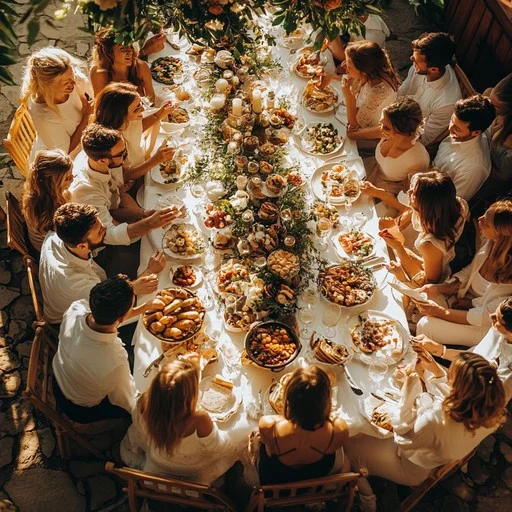
At the head of the table, in Frank’s old chair, I looked down the long length of oak, past the candles and the blue cups and the cranberry sauce. I saw my son laughing with his daughter on his lap. I saw Amber passing the potatoes to her mother. I saw Pam, quiet, content, her hand resting on my arm.
“Mom,” Curtis said, “would you like to say something?”
I looked at them. At the whole imperfect, scarred, hard-won circle.
“I’ll keep it short,” I said. “I once thought a seat at the table was something you earned. Or paid for.” I set down my fork. “I was wrong. It’s something you set. For each other. Over and over. And you keep setting it, even after somebody laughs.”
Nobody spoke.
“Thank you for coming,” I said. “There’s plenty.”
Ted raised his glass. “To the table.”
“To the table.”
We clinked. Owen, who was seven, asked loudly, “Can we eat now?”
And a great laugh went up around the oak, the kind that fills a house.
After dinner, when the dishes were done and the kids had fallen asleep on the living room carpet in a heap of limbs and blankets, I slipped out onto the back porch with a cup of coffee.
It was a cold, clear night. The sky was crowded with stars, and the big fir at the edge of the yard stood black against them. The kitchen light made a golden square on the grass.
I heard the screen door creak. Curtis came out beside me, in his socks, with his hands in his pockets.
“Mom.”
“Hello, honey.”
We stood side by side, looking at the stars.
“Dad would’ve loved today,” he said.
“He would.”
“He’d have eaten three plates of stuffing.”
“Four.”
He laughed. Then he was quiet.
“Mom,” he said. “I never said it right. What I should have said, on the phone, that day.”
“You don’t have to.”
“I do.” He turned to face me. His eyes were wet. “I should have said that I’m grateful. Not for the money. For you. For all of it. For being the person who’d keep a seat at the table for me even when I didn’t deserve one.”
I swallowed.
“I’m sorry I made you wonder.”
I reached up and touched his cheek, the way I had when he was small and feverish. His whiskers were rough under my fingers.
“There’s always a seat,” I said. “That’s all I ever wanted you to know.”
He covered my hand with his own. We stood there in the cold, with the stars wheeling overhead, a mother and a son on a porch, with a house full of sleeping children behind us.
Inside, the kitchen light burned warm and steady, and somewhere in the dining room, a clock began to chime.
Nobody had paid for the evening.
And every chair was full.

Sophia Rivers is an experienced News Content Editor with a sharp eye for detail and a passion for delivering accurate and engaging news stories. At TheArchivists, she specializes in curating, editing, and presenting news content that informs and resonates with a global audience.
Sophia holds a degree in Journalism from the University of Toronto, where she developed her skills in news reporting, media ethics, and digital journalism. Her expertise lies in identifying key stories, crafting compelling narratives, and ensuring journalistic integrity in every piece she edits.
Known for her precision and dedication to the truth, Sophia thrives in the fast-paced world of news editing. At TheArchivists, she focuses on producing high-quality news content that keeps readers informed while maintaining a balanced and insightful perspective.
With a commitment to delivering impactful journalism, Sophia is passionate about bringing clarity to complex issues and amplifying voices that matter. Her work reflects her belief in the power of news to shape conversations and inspire change.