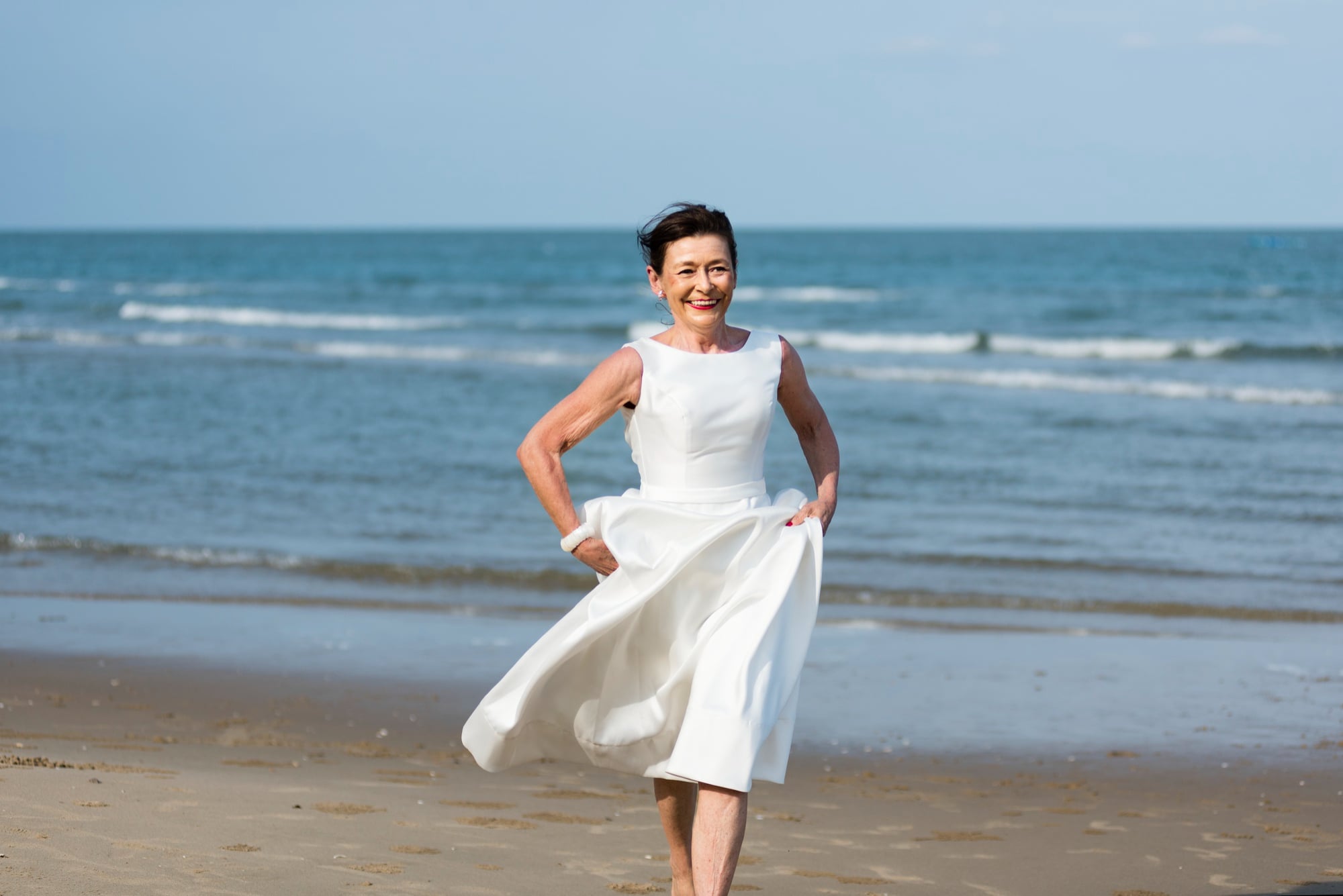
The Crimson Envelope
The envelope was heavier than it looked.
I remember that. The weight of it in my hands. Thick. Stiff. Crimson paper, the color of a cardinal’s wing. The kind of envelope you’d find in a stationery store that sells fountain pens and wax seals.
Across the front, in black ink, in Bennett’s careful, slanted handwriting:
IRIS HALE.
My daughter’s name.
“Bennett,” I said. My voice came out thin. “Why do you have an envelope with Iris’s name on it?”
He was sitting in his wheelchair beside the desk in his study. The room was dark except for a green-shaded lamp. Rain was beating against the tall windows. Somewhere down the hall, a grandfather clock struck eleven.
He was still wearing the gray suit he’d been married in. Four hours earlier. His tie was loosened. His hands were folded in his lap.
They were shaking.
His eyes filled with tears.
“Vivian,” he said quietly. “There’s no going back now. The marriage is official. The documents have already been filed.”
He reached out. He put his hand over mine. Over the envelope.
“There’s something I should have told you six months ago,” he said. “Something about Iris.”
He swallowed.
“And the real reason I chose you.”
I stared at him.
I couldn’t speak.
Then I slowly opened the envelope.
But I need to go back.
To before I knew. To before the rain and the crimson paper and the clock striking eleven.
To a highway at night, eight months earlier.
And my daughter, stopping.
My name is Vivian Hale. I’m forty-three years old.
At forty-three, I never imagined I’d become the wife of a millionaire young enough to be my son.
But desperation can make you consider things you once thought impossible.
I’m a home health aide. I’ve been one for nineteen years. Since Iris was a baby and her father walked out of our apartment in Akron, Ohio, with a duffel bag and the car keys and never came back.
I bathe people. I feed them. I help them in and out of bed. I sit with them when they’re dying. I learned to do it when I was twenty-four because it was the only job I could get that let me take my daughter with me to some of the clients’ houses when the babysitter fell through.
Iris grew up in other people’s living rooms.
Watching me work.
She was nineteen when it happened.
A freshman at the University of Akron. Nursing. She wanted to be an ER nurse. She’d wanted it since she was eight. Since she sat in Mrs. Kowalski’s kitchen and watched me change the dressing on Mrs. Kowalski’s diabetic foot and said, Mama, I want to do that. But faster. For people who are really hurt.
She worked part-time at a Panera to help with tuition. She studied at our kitchen table until two in the morning. She had a laugh you could hear from the parking lot.
She was my whole life.
It was a Saturday night in February.
She was driving home from a study group in Cleveland. Interstate 77 southbound. Eleven-forty p.m. Rain turning to sleet.
About a mile past the Route 21 exit, she came around a curve and saw headlights in the median.
A car. Upside down. In the grass between the northbound and southbound lanes. Wheels still spinning.
Smoke.
Most people kept driving.
The police said later that at least nine cars went by in the two minutes after the crash. Nine. They had the toll data. Nine vehicles. Nobody stopped.
Iris stopped.
She pulled onto the shoulder. She put her hazards on. She called 911. The call is on record. 11:43 p.m. Her voice. Calm. Steady.
There’s a car upside down in the median. I-77 southbound near mile marker 133. There’s smoke. I’m going to check for people.
The dispatcher told her to stay in her car.
She said, I’m a nursing student. I can help.
She hung up.
She crossed the median in the sleet.
She found three people.
Two in the front seats. Not moving.
One in the back. A young man. Conscious. Trapped. Screaming that he couldn’t feel his legs.
The smoke was getting worse.
She got the back door open. She unbuckled him. She dragged him out by his shoulders. Fifty feet across wet grass. Away from the car. Away from the smoke.
She laid him down. She took off her coat. She put it over him.
She knelt beside him and held his head still. The way they teach you. In case of spinal injury.
She talked to him. To keep him awake.
Then she went back for the others.
She was halfway across the median when the second vehicle came.
A black SUV. Coming fast. Northbound. It swerved toward the median. Toward the crash. Maybe the driver saw the smoke and panicked. Maybe he lost control on the ice.
It went off the road.
It hit my daughter.
The police found her forty feet away.
In the sleet. Face down in the grass.
The SUV was gone.
Hit-and-run, they said.
Unidentified vehicle. Driver fled the scene.
They never found it.
The two people in the front seat of the overturned car died at the scene.
The young man Iris pulled out survived.
I didn’t know who he was.
Nobody told me.
I didn’t ask.
I was too busy sitting in the ICU at Akron General watching my daughter breathe through a tube.
Traumatic brain injury.
Diffuse axonal injury, the neurologist said. Her brain had been shaken so hard the nerve fibers tore. She had a skull fracture. A broken pelvis. Three broken ribs. A collapsed lung.
They put her in a medically induced coma for ten days to let the swelling go down.
When they stopped the medication, she didn’t wake up.
Eight months.
She didn’t open her eyes for eight months.
They moved her from the ICU to a step-down unit. Then to a long-term acute care hospital. Then to a skilled nursing facility in Cuyahoga Falls. She was breathing on her own after the first month. She opened her eyes sometimes, but they didn’t track. She didn’t respond to my voice. She didn’t squeeze my hand.
Persistent vegetative state, one doctor said.
Minimally conscious state, another doctor said. A little better. A little hope.
Then, in August, a new neurologist.
Dr. Priya Raman. Young. Sharp. She looked at Iris’s scans. She looked at Iris.
“I’ve seen patients like her recover,” she said. “Not all of them. But some. With the right program.”
“What program?”
“There’s a disorders-of-consciousness rehabilitation program at a hospital in Pittsburgh,” she said. “Intensive. Specialized. Three to six months inpatient. Neurostimulation. Amantadine trials. Intensive therapy. They’ve had remarkable results with young patients like Iris.”
“How much?”
Dr. Raman looked at me.
“It’s not covered by her insurance,” she said. “Not most of it. It’s considered experimental.”
“How much?”
“Somewhere between two hundred and three hundred thousand dollars,” she said.
I sat in the hallway of the nursing facility in Cuyahoga Falls.
On a plastic chair.
And I did the math.
I’d already sold my car. A 2014 Corolla. Four thousand dollars.
I’d drained my savings. Eleven thousand dollars. Nineteen years of putting twenty dollars a week in a coffee can.
I’d cashed out my retirement. Such as it was. Six thousand.
I’d borrowed from my sister in Dayton. Five thousand. From my church. Three thousand. A GoFundMe that a girl from Iris’s nursing class set up. Eighteen thousand.
Forty-seven thousand dollars.
I needed two hundred and fifty.
“Even if you could get her in,” Dr. Raman said gently, “we can’t promise she’ll recover. You need to understand that.”
“I understand.”
“It might not work.”
“I know.”
“You might spend all of it,” she said, “and she might not wake up.”
I looked at her.
“She stopped,” I said.
Dr. Raman didn’t understand.
“On the highway,” I said. “Nine cars went by. She stopped. She didn’t know if it would work either. She didn’t know if those people would live. She stopped anyway.”
I stood up.
“I’m going to stop for her,” I said.
That’s when I was offered the job.
It came through the home health agency. Mercy Home Care. I’d worked for them for eleven years. My coordinator, a woman named Dolores, called me into her office in early September.
“Vivian,” she said. “I have something unusual.”
She slid a file across the desk.
Client: Bennett A. Vale. Age 20. Spinal cord injury. T-10 complete. Paraplegia. Requires full-time live-in aide. Location: Bath Township.
“Bath Township,” I said.
That’s the wealthy part of Akron. The estates. The big houses behind gates.
“His family’s very private,” Dolores said. “They asked for somebody experienced. Discreet. Somebody older.”
She looked at me.
“It pays three times what you make now,” she said. “Live-in. Room and board. Benefits.”
Three times.
I did the math again.
It still wasn’t two hundred and fifty thousand dollars.
But it was something.
“Why me?” I asked.
Dolores shrugged.
“They asked for you,” she said. “By name.”
I should have asked why.
I didn’t.
Bennett Vale was the twenty-year-old heir to one of the wealthiest families in Ohio.
The Vale family made their money in rubber. Back when Akron was the rubber capital of the world. Vale Tire & Rubber. Founded 1911. Sold to a Japanese conglomerate in 1987 for an amount that made the front page of the Wall Street Journal.
They’d been living off it ever since. Investments. Real estate. A foundation that put their name on hospital wings and university buildings and a concert hall in downtown Akron.
Bennett had lost both his parents eight months earlier.
In a car accident.
On a highway.
At night.
I didn’t connect it.
I want to be honest about that. People have asked me since. How did you not know?
I was living at a nursing home in Cuyahoga Falls. I wasn’t reading the newspaper. I wasn’t watching the news. I was learning how to suction my daughter’s tracheostomy and turn her every two hours so she wouldn’t get bedsores.
Somebody might have mentioned it. In passing. A rich family. A crash.
It didn’t register.
There are a lot of crashes.
The Vale estate was enormous.
A stone mansion on forty acres behind a black iron gate. Built in 1924. Thirty-one rooms. A ballroom. A library with a rolling ladder. A greenhouse. A pool covered for the winter.
Servants. A housekeeper named Mrs. Dunleavy who’d been there since 1989. A cook named Teodoro. Two groundskeepers. A driver.
And at the end of a long hall on the first floor, in rooms that had been converted for a wheelchair, a twenty-year-old boy.
He was sitting by the window when I walked in.
Thin. Pale. Dark hair that needed cutting. A gray sweatshirt with Kenyon College on it. A blanket over his legs.
He turned his chair around.
He looked at me.
For a long time.
Longer than people usually look at a new aide.
“You must be Vivian,” he said.
“Yes, sir.”
He winced.
“Please stop calling me sir,” he said. “I’m twenty. Not eighty.”
I laughed.
It surprised me. It came out of nowhere.
I hadn’t laughed in eight months.
He smiled.
A small, crooked smile. One side higher than the other.
“Better,” he said.
For six months, I took care of him.
His day started at six-thirty. I’d help him with his catheter. His morning medications. Baclofen for the spasms. Gabapentin for the nerve pain. Something for the migraines.
I’d help him shower. Transfer him from the bed to the shower chair. Wash his hair. Help him dress.
He hated it.
Not me. The helplessness. The needing.
“I used to run cross-country,” he told me one morning. While I was buttoning his shirt because his hands were too stiff from the cold. “At Kenyon. Eight-kilometer races. I was the third-fastest freshman.”
He looked at his legs.
“Now I need somebody to button my shirt,” he said.
“Bennett,” I said. “Can I tell you something?”
He looked at me.
“I’ve been buttoning people’s shirts for nineteen years,” I said. “Senators’ widows. Retired steelworkers. A man who played second base for the Cleveland Indians in 1954.”
He almost smiled.
“Every single one of them,” I said, “hated it at first. Every one.”
“And then?”
“And then,” I said, “they figured out that needing somebody isn’t the same as being nothing.”
He was quiet for a long time.
Then he said, “Your daughter. Iris. Dolores told me. In the file.”
I went still.
“She’s in a coma,” he said. “Since February.”
“Yes.”
“I’m sorry,” he said.
He said it strangely. Heavily. Like the words cost something.
I accompanied him to his medical appointments. Neurology. Urology. Physical therapy at the Cleveland Clinic. Every Tuesday and Thursday.
His driver, a quiet man named Silas, drove us in a black van with a lift.
I sat beside Bennett in the waiting rooms. I held his coffee. I took notes when the doctors talked too fast.
I read to him when the migraines got bad.
They were terrible. Two or three times a week. He’d lie in the dark with a cold cloth over his eyes and grind his teeth.
The doctors said it was from the head injury. From the accident. Post-traumatic.
He asked me to read to him. Anything. To give him something to listen to besides the pain.
I read him The Count of Monte Cristo.
It took us four months.
He made me do all the voices.
He knew about Iris.
He asked about her every day. Not in a polite way. In a real way. Did she open her eyes today? Did the occupational therapist come? How’s her skin? Is she getting enough protein?
Sometimes he sent flowers to her room in Cuyahoga Falls. White roses. Every Friday. No card. Just the roses.
Sometimes, in the afternoon, he’d say, “Vivian, go. Go see her. Silas will drive you. I’ll be fine.”
“Bennett, it’s my shift.”
“Mrs. Dunleavy can do my four o’clock meds,” he’d say. “Go. Please.”
I trusted him.
Then, one rainy afternoon in late February, he rolled into the kitchen.
I was chopping onions. For a soup Teodoro had taught me. Iris’s favorite. Potato leek. I was going to take some to the nursing home that night. She couldn’t eat it. She had a feeding tube. But I liked to hold it under her nose. I liked to think she could smell it.
Bennett stopped his chair at the edge of the kitchen island.
He watched me chop for a while.
Then he said something that left me speechless.
“Vivian,” he said. “Marry me.”
I nearly dropped the knife.
I actually did drop it. It clattered on the cutting board. An onion rolled off onto the floor.
“What?”
“Marry me,” Bennett said again.
I stared at him.
“Bennett,” I said. “You’re twenty. I’m old enough to be your mother.”
“But you’re not my mother,” he said quietly.
“No.”
“And you’re the only person I completely trust,” he said.
I stared at him.
“Why would you possibly want to marry me?”
His expression changed.
It went somewhere I’d never seen it go. Not even during the worst migraines. Something dark. Frightened. Desperate.
“There’s something important I need to do,” he said. “I can’t explain everything yet.”
“Bennett—”
“But if you marry me,” he said, “I’ll make sure Iris gets the treatment she needs. All of it. The program in Pittsburgh. Whatever it costs. For as long as it takes.”
I refused immediately.
“No,” I said. “Absolutely not. Bennett, I don’t know what’s going on with you, but no. I’m not going to marry a twenty-year-old boy for his money. I’m not that person. I’d never be that person.”
“I know you’re not,” Bennett said. “That’s why I’m asking you.”
“No.”
He looked at me for a long moment.
Then he nodded.
“Okay,” he said.
He turned his chair around.
At the kitchen door, he stopped.
He didn’t turn back.
“If you change your mind,” he said, “I’ll be in the library.”
That evening, the hospital called.
Not the nursing home. The hospital in Pittsburgh. The disorders-of-consciousness program.
A woman named Karen. From admissions.
“Mrs. Hale?” she said. “I’m calling about your daughter. Iris. Dr. Raman referred her in September.”
“Yes.”
“A place has opened in our program,” Karen said. “A bed. For an admission in March. We’d like to offer it to Iris.”
I couldn’t breathe.
“But Mrs. Hale,” Karen said. “I have to be honest with you. We’d need a deposit. And a financial guarantee for the full course of treatment. Within two weeks. Or we’ll have to offer the bed to the next patient on the list.”
“How much?” I whispered.
“The deposit is seventy-five thousand,” Karen said. “The full guarantee is two hundred and forty.”
Two weeks.
I spent two sleepless nights beside my daughter’s hospital bed.
In Cuyahoga Falls. In the plastic chair. Holding her hand.
She looked so small. She’d lost thirty pounds since February. Her hair had grown out. The nurses braided it for me. A single braid over her shoulder.
Her eyes were open.
Sometimes they’re open. They look at nothing. They don’t follow you.
I talked to her anyway.
“Iris,” I said. “Baby. There’s a boy.”
Her eyes looked at the ceiling.
“He’s twenty,” I said. “He’s in a wheelchair. His parents died. He’s lonely. He’s funny. He likes The Count of Monte Cristo. He makes me do the voices.”
I squeezed her hand.
“He asked me to marry him,” I said. “And he said if I did, he’d pay for Pittsburgh. All of it.”
Her eyes didn’t move.
“I said no,” I said. “Because it’s wrong. Because it’s crazy. Because I’m not that kind of woman.”
I put my head down on the edge of her bed.
“But you might wake up,” I whispered. “In Pittsburgh. You might wake up.”
The second night, I read her the last chapter of The Count of Monte Cristo.
The part at the very end. Where the Count writes a letter.
“All human wisdom is contained in these two words: Wait and Hope.”
On the third morning, I accepted Bennett’s proposal.
I didn’t do it blindly.
I want to be clear about that.
I called a lawyer. My own. A woman named Ruth Abernathy. She did pro bono work for a legal aid clinic in Akron. My church found her for me.
She met with me and Bennett and Bennett’s lawyer. A tall, quiet man named Julian Okafor.
They drew up an agreement.
A prenuptial agreement. But backward.
Vivian Hale waives all claim to the estate, assets, trusts, and property of Bennett Vale, now and in the event of divorce or death.
Bennett Vale shall establish an irrevocable trust for the medical care of Iris Hale, in the amount of five hundred thousand dollars, funded on the date of marriage, administered independently, which shall not be revoked regardless of the status of the marriage.
The marriage may be dissolved by either party at any time, for any reason, with no financial consequence to either party.
Vivian Hale shall retain full independence of residence, employment, and personal life.
Ruth read it four times.
She looked at me.
“Vivian,” she said. “This is the strangest contract I’ve ever seen.”
“I know.”
“He gets nothing,” she said. “You get nothing. Except your daughter’s medical care.”
She looked at Bennett.
“Why?” she asked him. “What do you get?”
Bennett looked at Julian.
Julian looked at the table.
“A wife,” Bennett said quietly. “Legally. On paper. That’s all I need.”
Ruth didn’t like it.
But she couldn’t find anything wrong with it.
We married nine days later.
The ceremony was small. At the Summit County Courthouse. In a judge’s chambers.
Two witnesses. Julian Okafor. And Mrs. Dunleavy, the housekeeper, who cried the whole time.
I wore a simple dress. Navy blue. From the Macy’s at Summit Mall. Bennett wore a gray suit. Silas had brought a handful of white roses. The same kind he sent to Iris every Friday.
The judge was a woman in her sixties. She looked at us for a long time. A forty-three-year-old home health aide and a twenty-year-old in a wheelchair.
She didn’t say anything.
She just married us.
But I noticed something strange.
When Bennett slipped the ring onto my finger, his hands were trembling.
Not from the cold. Not from nerves.
Shaking. Hard. Like a man who’d just done something he couldn’t undo.
The ring was plain. White gold. A thin band.
When it was on my finger, he held my hand for a moment.
He looked up at me.
His eyes were wet.
“I’m so sorry,” he whispered.
I didn’t know what he meant.
That evening, back at the mansion, he asked everyone to leave us alone.
Mrs. Dunleavy. Teodoro. Silas. Julian.
“Please,” he said. “Just for tonight. I need to talk to Vivian.”
They left.
The house was silent.
Rain beat against the windows.
Bennett wheeled himself down the long hall to his study.
I followed.
He rolled behind the big mahogany desk.
He opened a drawer.
He took out a crimson envelope.
IRIS HALE.
My stomach dropped.
“Bennett,” I said. “Why do you have an envelope with Iris’s name on it?”
His eyes filled with tears.
“Vivian,” he said. “There’s no going back now. The marriage is official. The documents have already been filed.”
He held out the envelope.
“There’s something I should have told you six months ago,” he said. “Something about Iris. And the real reason I chose you.”
I took it.
My hands were shaking.
I opened it.
Inside were four things.
The first was a photograph.
Printed. Grainy. Black and white. A still from a video. A timestamp in the corner.
02/14 23:47:12
A highway at night. Sleet. Headlights.
In the median, an overturned car.
And in the foreground, on the grass, a figure kneeling. A young woman. In a light-colored coat. Bending over someone lying on the ground. Her hands on either side of his head.
Holding it still.
I knew that coat.
Cream-colored. Wool. From the Goodwill on Arlington Street. Iris bought it for eight dollars in November. She was so proud. She said it made her look like a grown-up.
The police gave it back to me in March. In a plastic bag. It was ruined. Mud and blood.
I looked up at Bennett.
“That’s Iris,” I whispered.
“Yes,” Bennett said.
“Who’s she holding?”
Bennett didn’t answer right away.
He looked down at his legs. At the blanket over them.
“Me,” he said.
I sat down.
I didn’t decide to. My legs just gave out. I sat down in the leather chair across from his desk.
I couldn’t breathe.
“February fourteenth,” Bennett said quietly. “Valentine’s Day. My parents were driving me back to Kenyon after a family dinner in Cleveland. My father was driving. My mother was in the passenger seat. I was in the back.”
He looked at the window. At the rain.
“A drunk driver crossed the median,” he said. “Northbound. He hit us head-on. Glancing. On the driver’s side. We flipped. Twice. We landed upside down in the grass.”
He swallowed.
“My father died instantly,” he said. “My mother was alive for about four minutes. I could hear her breathing. Then I couldn’t.”
“I couldn’t move my legs,” Bennett said. “I couldn’t get out. The car was filling with smoke. I was screaming.”
He looked at me.
“And then a girl opened the door,” he said.
I put my hand over my mouth.
“She was so calm,” Bennett said. “She said, Hi. My name’s Iris. I’m a nursing student. I’m going to get you out. Don’t move your neck.”
His voice broke.
“She unbuckled me,” he said. “She dragged me out. Fifty feet. Across the grass. In the sleet. I’m a hundred and seventy pounds. She was maybe a hundred and twenty.”
He wiped his eyes.
“She put her coat over me,” he said. “She knelt down and held my head. She kept talking to me. She asked me my name. She asked where I went to school. She asked if I had a girlfriend.”
He almost laughed.
“I said no,” he said. “She said, That’s okay. You’ve got time.”
“She asked if my parents were in the car,” Bennett said. “I said yes. She said, Okay. I’m going to go check on them. Don’t move. I’ll be right back.”
He looked at the photograph in my hands.
“She stood up,” he said. “And she started walking back toward the car.”
He stopped.
He couldn’t keep going.
I looked down at the photograph.
The young woman kneeling in the grass. Her hands on his head.
My daughter.
“And then,” I whispered.
Bennett closed his eyes.
“And then the SUV came,” he said.
The second thing in the envelope was another photograph.
Same timestamp. Thirty-one seconds later.
02/14 23:47:43
The same highway. The same sleet.
And a black SUV. Coming off the northbound lanes. Into the median. Its headlights blazing.
And in the path of the headlights, a small figure in a light-colored coat.
I couldn’t look at it.
I put it face down on the desk.
“Where did these come from?” I said. My voice didn’t sound like mine. “The police said there was no video. They said there were no cameras on that stretch.”
“There weren’t,” Bennett said. “Not highway cameras.”
He looked at me.
“Dashcam,” he said.
“Whose?”
Bennett didn’t answer.
The third thing in the envelope was a document.
Typed. Two pages. Notarized.
At the top:
SWORN STATEMENT OF OWEN T. PRYCE
I read it.
I, Owen T. Pryce, was employed as Director of Security for the Vale family from 2011 until April of this year.
On the evening of February 14, I was driving a black 2023 Chevrolet Tahoe registered to Vale Holdings LLC. My passenger was Graham Vale, brother of Andrew Vale and uncle of Bennett Vale.
Mr. Graham Vale and I had attended the same family dinner in Cleveland. We left approximately twenty minutes after Andrew, Catherine, and Bennett Vale.
At approximately 11:30 p.m., Mr. Graham Vale insisted on driving. He had consumed a significant amount of alcohol at dinner. I objected. He was my employer. He took the keys.
At approximately 11:47 p.m., traveling northbound on I-77, Mr. Graham Vale saw the overturned vehicle in the median and recognized it as his brother’s car. He swerved toward the median at high speed. He lost control on the ice.
The vehicle struck a young woman who was walking across the median toward the overturned car.
Mr. Graham Vale did not stop.
He drove to the next exit. He called the family attorney. He instructed me to take the vehicle to a private garage in Hudson owned by a Vale family business associate. The vehicle was repaired within forty-eight hours. The dashcam footage was removed from the vehicle. I was instructed to destroy it.
I did not destroy it.
I was paid one hundred and fifty thousand dollars to remain silent. I accepted the payment. I am ashamed that I accepted it.
In April, after learning that the young woman had not regained consciousness, I resigned my position. I provided a copy of the dashcam footage and this statement to Bennett Vale.
I am prepared to testify to these facts under oath.
— Owen T. Pryce
I read it three times.
Then I put it down.
I looked at Bennett.
“Your uncle,” I said.
Bennett didn’t say anything.
“Your uncle hit my daughter,” I said. “Drunk. In a car. And drove away. And paid people to hide it.”
“Yes,” Bennett said.
“While she was walking back to save your mother.”
“Yes.”
The room was silent.
The grandfather clock in the hall ticked.
The rain beat on the windows.
“How long have you known?” I said.
Bennett looked at me.
“Since April,” he said.
April.
“You hired me in September,” I said.
“Yes.”
“You asked for me. By name. Through Mercy Home Care.”
“Yes.”
“You knew,” I said. “The first day. When I walked into your room. You knew who I was.”
Bennett’s face crumpled.
“Yes,” he said.
“Six months,” I said.
I stood up.
“Six months, Bennett. I bathed you. I buttoned your shirts. I read you The Count of Monte Cristo. I did the voices. I told you about Iris every single day. Every single day. She opened her eyes today. She squeezed the nurse’s hand. The occupational therapist says she might be tracking.”
I was shaking.
“And you knew,” I said. “The whole time. You knew she was lying there because of your family. You knew your uncle did it. You knew there was a video.”
“Vivian—”
“You sent her roses,” I said. “Every Friday. White roses. And you never once told me why.”
Bennett was crying.
“I couldn’t,” he said.
“Why not?”
“Because I’m not allowed to,” he said.
The fourth thing in the envelope was a court document.
IN THE PROBATE COURT OF SUMMIT COUNTY, OHIO
IN THE MATTER OF THE CONSERVATORSHIP OF BENNETT ANDREW VALE
ORDER APPOINTING GRAHAM R. VALE AS CONSERVATOR OF THE PERSON AND ESTATE
“In March,” Bennett said quietly, “while I was still in the ICU at the Cleveland Clinic, my uncle filed a petition in probate court. He said I’d suffered a traumatic brain injury in the accident. He said I wasn’t competent to manage my own affairs. He asked to be appointed my conservator.”
I stared at the document.
“The judge granted it,” Bennett said. “Temporarily. Based on my uncle’s testimony and a letter from a doctor my uncle paid for.”
He looked at his hands.
“Since March,” he said, “my uncle controls everything. My money. My trust. My medical decisions. Where I live. Who I can hire. Who I can talk to. What lawyers I can see.”
He looked at me.
“I’m twenty years old,” he said. “And legally, I’m a child.”
I sat back down.
“He hired you,” Bennett said. “Technically. My uncle’s office approved your contract. I asked for you by name. I told them I’d heard you were the best aide at Mercy. They didn’t check. They didn’t care. They thought I just wanted somebody old who wouldn’t steal anything.”
He swallowed.
“They read my email,” he said. “They listen to my phone calls. Mrs. Dunleavy reports to my uncle every week. She doesn’t want to. She has to. Silas too. Everybody in this house works for Graham.”
He looked at the dark window.
“If I’d told you,” he said, “the day you walked in—if I’d said My uncle hit your daughter, here’s the proof—Graham would have known within an hour. He would have fired you. He would have moved me to a facility in Florida. He’s threatened to. Twice. He would have destroyed the video.”
He looked at me.
“And Owen would have disappeared,” he said. “Owen’s terrified. He’s in Arizona now. Graham doesn’t know where.”
“So why tell me now?” I said. “Tonight?”
Bennett looked at me.
“Because tonight,” he said, “you’re my wife.”
He told me the rest.
Slowly. In the green lamplight. While the rain came down.
His father’s will. Andrew Vale. Written in 2018. When Bennett was thirteen.
Old-fashioned. Andrew’s own father had put the same clause in his will in 1974. And his grandfather before that.
Upon the marriage of my son, or upon his attaining the age of twenty-five, whichever occurs first, the Vale Family Trust shall vest fully in him, and any guardianship or conservatorship of his estate shall be subject to immediate review by the court with a presumption in favor of termination.
“It’s a stupid clause,” Bennett said. “From 1911. The idea was that a married man was a grown man. My great-great-grandfather put it in. Nobody ever took it out.”
He looked at me.
“Ruth didn’t know,” he said. “Your lawyer. Julian told her the marriage was for personal reasons. That I needed a spouse for medical consent. That’s true too.”
“What else?”
“A spouse has priority,” Bennett said. “Over a conservator. For medical decisions. In Ohio. If a court finds the conservatorship was obtained improperly.”
He took a breath.
“Julian filed the marriage certificate with the probate court at four-fifteen this afternoon,” he said. “Right after the ceremony. Along with a motion to terminate the conservatorship. And a competency evaluation from two independent neurologists at University Hospitals. They examined me in January. During my Thursday appointments. When you were in the waiting room holding my coffee.”
I stared at him.
“They found me fully competent,” Bennett said. “Both of them.”
“There’s a hearing Monday,” Bennett said. “At nine a.m. The judge will see the marriage. The evaluations. And the question of why my uncle wanted me declared incompetent three weeks after he ran over a nineteen-year-old girl in the median of I-77.”
He picked up Owen Pryce’s statement.
“Julian is filing this with the court Monday too,” he said. “And with the Summit County prosecutor. And the Ohio State Highway Patrol. Owen will testify. By video. From Arizona.”
“Why me?” I whispered.
Bennett put down the statement.
He looked at me.
For a long time.
“Because I needed someone I could trust,” he said. “Completely. Someone who’d never sell me out to Graham. Someone who’d never take his money. Someone who’d fight for me even if it cost her everything.”
He swallowed.
“Iris did that,” he said. “On a highway. For a stranger. She didn’t know who I was. She didn’t know my family had money. She just saw somebody stuck in a car and she got him out.”
He looked at me.
“And I watched you for six months,” he said. “Sitting next to her bed. Selling your car. Draining your savings. Borrowing from your church. Reading to her. Holding soup under her nose.”
His voice broke.
“I thought,” he said, “that’s where she learned it.”
I couldn’t speak.
“And because,” Bennett said quietly, “you deserved to be the one who brought this to the light. Not a lawyer. Not a prosecutor. You.”
He looked at the crimson envelope in my lap.
“Iris’s name is on the envelope,” he said, “because it’s hers. All of it. The truth. The proof. The trust. Everything in there belongs to her.”
He looked down at his legs.
“She gave me my life,” he said. “My family took hers. I couldn’t give it back. I couldn’t make her wake up.”
He looked at me.
“But I could make sure the world knew what she did,” he said. “And what they did to her.”
I didn’t stay that night.
I couldn’t.
I stood up. I put the photographs and the statement and the court order back in the crimson envelope. I held it against my chest.
“Vivian,” Bennett said.
I didn’t look at him.
“I’m sorry,” he said. “I should have found a way. Six months ago. I should have trusted you sooner.”
I stopped at the door of his study.
I didn’t turn around.
“You let me thank you,” I said quietly. “Every Friday. For the roses.”
Bennett didn’t answer.
“I thanked you, Bennett,” I said. “For sending flowers to my daughter. Every week. And you knew your uncle put her there.”
I left.
I drove to Cuyahoga Falls. In Bennett’s car. Silas gave me the keys. He didn’t ask why. He just handed them to me at the front door. His eyes were red.
“I’m sorry, Mrs. Vale,” he said.
It was the first time anybody called me that.
I sat next to Iris until dawn.
I held the crimson envelope in my lap.
I didn’t open it again.
I just held her hand.
“Baby,” I whispered. Around four in the morning. “You pulled him out.”
Her eyes were closed.
“Nine cars went by,” I said. “And you stopped. And you pulled a boy out of a burning car. And you put your coat on him. And you told him he had time.”
I put my forehead against her hand.
“And then you went back,” I said. “For his mother.”
Her fingers moved.
I sat up.
Her fingers. On my hand.
They curled.
Very slightly.
Around mine.
I’d felt that before. Reflexes. The doctors called them. Primitive grasp. Not purposeful.
I’d stopped getting my hopes up in May.
“Iris,” I said. “Iris. If you can hear me. Squeeze my hand.”
Nothing.
I sat there in the dark.
Holding my breath.
Then.
Very slowly.
So slowly I almost didn’t feel it.
She squeezed.
The hearing was Monday morning.
Summit County Probate Court. Courtroom 3. A wood-paneled room with fluorescent lights and a flag in the corner.
I sat in the second row.
Bennett was at the front. In his wheelchair. Next to Julian Okafor. In a navy suit.
He looked back once when I came in.
I didn’t nod.
But I didn’t leave.
Graham Vale was at the other table.
Fifty-six. Tall. Silver-haired. Tanned in March. An expensive gray suit. A Rolex. Three lawyers.
He looked exactly like the kind of man who gets a building named after him.
He looked at me when I sat down.
He smiled.
Polite. Warm. Like we’d met at a fundraiser.
He didn’t know who I was.
The judge was a woman named Hon. Margaret Szymanski. Sixties. Gray hair. Reading glasses.
She looked at the motion to terminate the conservatorship.
She looked at the marriage certificate.
She looked at Bennett.
She looked at me in the second row.
“Mr. Okafor,” she said. “Your client married on Friday?”
“Yes, Your Honor.”
“His spouse is present?”
“She is, Your Honor.”
Judge Szymanski took off her reading glasses.
“Mrs. Vale,” she said. “Would you stand, please?”
I stood.
Graham’s lawyer stood up too.
“Your Honor,” he said. “We object to any reliance on this so-called marriage. Mr. Bennett Vale is not competent to enter into a marriage contract. This woman is his paid caregiver. Twenty-three years his senior. She has clearly exploited a vulnerable young man for financial gain.”
He held up a piece of paper.
“We’d like to file a motion to annul the marriage on the grounds of incapacity and undue influence,” he said.
Judge Szymanski looked at me.
“Mrs. Vale,” she said. “Is that true? Did you marry Mr. Vale for financial gain?”
I looked at Graham Vale.
At his Rolex. His tan. His silver hair.
At the man who got behind the wheel of a Tahoe drunk on Valentine’s Day and drove into the median of I-77 and hit my daughter and kept driving.
“Your Honor,” I said. “I married him for my daughter.”
The room went quiet.
“My daughter’s name is Iris Hale,” I said. “She’s nineteen. She’s been in a coma since February fourteenth.”
Graham Vale’s face changed.
Just slightly. A flicker.
“On February fourteenth,” I said, “at eleven-forty-three p.m., she was driving home on I-77 southbound when she saw a car upside down in the median. Nine cars drove past it. My daughter stopped.”
Graham Vale had gone very still.
“She pulled a young man out of that car,” I said. “She dragged him fifty feet in the sleet. She put her coat over him. She held his head.”
I looked at Bennett.
“That young man is my husband,” I said.
The courtroom was dead silent.
“Then she went back,” I said, “for his mother. And on her way, she was struck by a black Chevrolet Tahoe that came off the northbound lanes. The driver didn’t stop.”
I turned and looked at Graham Vale.
“The driver,” I said, “is sitting at that table.”
Graham’s lawyer was on his feet.
“Objection. Your Honor, this is outrageous. This is slander. This has nothing to do with the conservatorship—”
“It has everything to do with the conservatorship,” Julian Okafor said quietly.
He stood up.
He held up a crimson envelope.
“Your Honor,” he said. “We’d like to submit the sworn statement of Owen Pryce, former Director of Security for the Vale family. And dashcam footage from the vehicle in question. Both of which were provided to my client in April. Both of which explain why Mr. Graham Vale petitioned this court to have his nephew declared incompetent three weeks after the accident.”
Judge Szymanski looked at the envelope.
She looked at Graham Vale.
She looked at me.
“Mr. Okafor,” she said. “Approach.”
She watched the dashcam footage in her chambers.
She came back out forty minutes later.
Her face was gray.
She terminated the conservatorship.
Immediately.
From the bench.
The court finds no credible evidence of incapacity. The court further finds substantial evidence that the petition for conservatorship was filed for improper purposes.
She denied the motion to annul.
The court finds Mr. Bennett Vale fully competent to enter into marriage.
And she referred the matter to the Summit County Prosecutor.
Graham Vale was arrested eleven days later.
At his house in Hudson. At six in the morning. Ohio State Highway Patrol.
Aggravated vehicular assault. Leaving the scene of an accident with serious physical harm. Tampering with evidence. Obstruction of justice. Bribery.
The garage in Hudson gave up the repair records. The family attorney gave up the phone records in exchange for his law license.
Owen Pryce testified at the preliminary hearing. By video. From Arizona. He cried through the whole thing.
Graham pleaded guilty in October.
Eight years.
Iris went to Pittsburgh in March.
The disorders-of-consciousness program at UPMC Mercy. Bennett’s trust paid for all of it. The trust he’d set up the day we married. Five hundred thousand dollars. Irrevocable. Administered by a bank in Cleveland. In Iris’s name.
It didn’t matter what happened between me and Bennett.
It was hers.
I moved to Pittsburgh with her.
A little studio apartment three blocks from the hospital. I went every day. Eight in the morning to eight at night.
The first month, nothing changed.
The second month, she started tracking. Her eyes followed me across the room. They followed the nurse. They followed a red ball the therapist moved slowly in front of her face.
The third month, she squeezed on command. Every time. Iris, squeeze my hand. Squeeze.
The fourth month, she blinked yes and no.
The fifth month, in July, she said a word.
I was sitting next to her bed. Reading. Not The Count of Monte Cristo. Something else. A book of poems. Mary Oliver. Iris loved Mary Oliver. She had a line from one of the poems on a sticky note on her bathroom mirror at home.
I was reading Wild Geese.
You do not have to be good.
You do not have to walk on your knees
for a hundred miles through the desert, repenting.
I looked up.
Iris was looking at me.
Really looking. Her eyes on my face. Focused. Clear.
Her lips moved.
Dry. Cracked. Slow.
“Mama.”
She came home in December.
Not all the way back. Not yet. She uses a walker. Her left hand doesn’t work right. Her speech is slow. She gets tired. She can’t remember things from the months before the accident. She can’t do math the way she used to.
But she’s Iris.
She laughs the same. You can hear it from the parking lot.
The first thing she asked, when she could ask things, was about the car.
“Mama,” she said. In August. In Pittsburgh. Slowly. Choosing each word. “The boy. In the car. On the highway.”
I went very still.
“Did he live?” she asked.
I couldn’t answer.
I just nodded.
Iris closed her eyes.
“Good,” she said.
Then, a long time later:
“His mom?”
I shook my head.
Iris started crying.
“I was going back,” she said. “For her. I was going back.”
“I know, baby.”
“I didn’t get there.”
“I know.”
Bennett came to Pittsburgh in September.
He asked first.
He called me. The first time since the hearing in March.
“Vivian,” he said. “I know I don’t have the right to ask. But I’d like to see her. If she wants. If you’ll let me.”
I thought about it for a long time.
About the crimson envelope. About six months of roses. About I’m so sorry when he put the ring on my finger.
About Owen Pryce crying on a video screen in a courtroom. About Graham Vale in handcuffs in Hudson.
About a twenty-year-old boy, legally a child, watched and recorded in his own house, sitting in a wheelchair across a kitchen island from the mother of the girl who saved him. Every single day. For six months.
Unable to tell her.
“Ask her,” I said.
He came on a Tuesday.
Silas drove him. Five hours from Akron.
He rolled into Iris’s room at UPMC Mercy.
She was sitting up in bed. Her hair in a braid. A Pitt sweatshirt.
She looked at him.
At the young man in the wheelchair.
She didn’t recognize him.
She’d only seen him once. In the dark. In the sleet. Upside down and screaming.
“Hi,” Bennett said.
“Hi,” Iris said. Slowly.
“I’m Bennett,” he said.
Iris tilted her head.
The way she does when she’s thinking hard.
“Bennett,” she said. “Kenyon.”
Bennett stopped breathing.
“Cross-country,” Iris said. “Third-fastest. Freshman.”
She smiled.
Lopsided. One side of her mouth higher than the other. From the brain injury.
“No girlfriend,” she said.
Bennett put his face in his hands.
“You have time,” Iris said.
He sat with her for six hours.
I left them alone for most of it.
When I came back, they were watching a movie on her laptop. The Count of Monte Cristo. The 2002 version. With Jim Caviezel.
Bennett was doing the voices.
Iris was laughing so hard she had to use her inhaler.
We dissolved the marriage in January.
Quietly. By mutual agreement. Exactly the way the contract said we could.
Ruth handled it. She charged nothing.
“Strangest contract I ever saw,” she said, when it was done. “And the cleanest divorce.”
Bennett gave me the ring back.
Well. He tried.
I was in his study. In Bath Township. Signing the last papers.
He held out the white gold band.
“Keep it,” he said. “Please.”
“Bennett, I can’t.”
“It’s not a wedding ring anymore,” he said. “It’s just a ring.”
He looked at it.
“It’s a thank-you,” he said.
I took it.
I didn’t put it on my left hand.
I put it on my right.
The Vale estate is quieter now.
Mrs. Dunleavy still runs the house. She doesn’t report to anyone anymore. She told me the day the conservatorship ended, she went into the pantry and cried for an hour.
Silas still drives. He drives Bennett back to Kenyon three days a week. He went back in the fall. Part-time. He’s studying neuroscience.
He doesn’t run anymore.
He swims. He says in the water, he doesn’t need anybody to button his shirt.
He started a foundation in the spring.
It doesn’t have the Vale name on it.
It’s called the Iris Fund.
It pays the medical bills of people who get hurt helping strangers. Good Samaritans. People who stop on the highway. Who run into burning buildings. Who jump into rivers.
Who don’t stop to ask if it’s their business.
There have been fourteen recipients so far.
A man in Toledo who pulled a family out of a frozen pond and lost three toes to frostbite.
A teenage girl in Columbus who was stabbed breaking up a fight between two strangers on a bus.
A nurse in Youngstown who stopped at a crash on I-680 and was hit by a second car.
She’s in rehab now. She’s going to walk again.
Iris is home now.
In Akron. In our little apartment off Arlington Street. With a ramp Bennett paid for, and a walk-in shower, and grab bars everywhere.
She’s going back to school in the fall.
Not nursing. Not yet. She can’t lift patients. Her left hand isn’t strong enough.
She’s going to study social work.
She says she wants to help families. The ones who sit in hospital hallways on plastic chairs doing math.
She has the coat.
The cream-colored one. From the Goodwill. Eight dollars.
I had it cleaned. Professionally. It took three tries. There’s still a faint stain on the left sleeve.
She wears it anyway.
And on her bedroom wall, framed, there’s a crimson envelope.
Empty now.
The photographs went to the prosecutor. Owen’s statement went to the court. The conservatorship order went in a shredder in Judge Szymanski’s chambers.
But the envelope is still there.
IRIS HALE.
In Bennett’s handwriting.
She asked me once why I kept it.
We were sitting on the couch. Watching Jeopardy! She’s terrible at it now. She used to be good. She laughs about it.
“Mama,” she said. “That envelope. It was full of bad things. The worst night of my life. The man who hit me. Why’d you frame it?”
I thought about it for a long time.
“Because it had your name on it,” I said. “On the outside. In black ink. In capital letters.”
Iris looked at me.
“For eight months,” I said, “nobody knew your name. The police said the victim. The news said a nineteen-year-old woman. The hospital said the patient in 412.”
I looked at the envelope.
“Bennett knew,” I said. “From the first night. He knew your name. He knew you stopped. He knew you were coming back for his mother.”
I looked at my daughter.
“He wrote it on the outside,” I said. “So that whoever opened it would know whose it was.”
Iris looked at the envelope for a long time.
“Mama,” she said slowly. “If you’d known. That first day. When you walked into his room. If he’d told you his uncle hit me.”
“Yes?”
“Would you have taken the job?”
I didn’t answer right away.
“I don’t know,” I said finally. “I’d like to say yes. I’d like to say I would’ve stayed and helped him. But I don’t know. I think I might have walked out. I think I might have hated him.”
Iris nodded.
“He was twenty,” I said. “In a wheelchair. Watched by everybody in his own house. With proof in his drawer that his family ran over a girl. And no way to use it without losing it.”
I looked at her.
“He spent six months,” I said, “waiting for the right moment. Sending you roses. Listening to me talk about you every day. Knowing.”
I shook my head.
“I don’t know if that’s cowardice or courage,” I said. “I’ve gone back and forth for a year.”
Iris was quiet.
Then she said something I’ll never forget.
“Mama,” she said. “On the highway. When I stopped. Do you know what I was thinking?”
“What?”
“I was thinking, I don’t know if I can help,” Iris said. “I’m a freshman. I’ve only had one semester. I don’t know how to do this. I might make it worse.”
She looked at me.
“I stopped anyway,” she said. “Not because I knew what to do. Because I couldn’t drive past.”
She looked at the crimson envelope on the wall.
“I think that’s what he was doing too,” she said. “For six months. He didn’t know how to fix it. He didn’t know if it would work. He didn’t know if you’d hate him.”
She smiled. Her lopsided smile.
“He just couldn’t drive past,” she said.
Bennett comes for dinner on Sundays.
Silas drives him. He brings white roses.
Iris and I make potato leek soup. Teodoro’s recipe.
We eat at our little kitchen table. The three of us. Sometimes Silas too.
Bennett and Iris argue about The Count of Monte Cristo. Iris thinks the Count should have forgiven everybody sooner. Bennett thinks he was right to wait.
“Wait and hope,” Bennett says.
“Wait and hope,” Iris says. “Is what you say when you’re too scared to do anything.”
“Or,” Bennett says, “it’s what you say when you’re getting ready.”
They go back and forth for an hour.
I clear the dishes.
I listen.
Last Sunday, at the door, Bennett stopped his chair.
He looked up at me.
“Vivian,” he said. “Can I ask you something?”
“Of course.”
“When you opened the envelope,” he said. “On our wedding night. In my study. What did you feel?”
I thought about it.
The crimson paper. The black ink. The photographs. The sleet. The figure in the light-colored coat kneeling in the grass.
My daughter.
Holding a stranger’s head still.
“Rage,” I said. “At your uncle. At you. At everyone.”
Bennett nodded.
“And under that,” I said.
He waited.
“Pride,” I said.
Bennett looked at me.
“For eight months,” I said, “I’d been sitting next to her bed thinking, Why did you stop? Why couldn’t you just keep driving like everybody else? Why did it have to be you?”
I looked back into the apartment. At Iris on the couch. With her laptop. Laughing at something.
“And then I opened your envelope,” I said. “And I saw her. Kneeling in the sleet. With her coat off. Holding your head.”
My voice cracked.
“And I thought,” I said, “Of course it was you. Of course you stopped. That’s who I raised.”
Bennett didn’t say anything.
He reached up.
He took my hand.
The right one.
With the white gold ring.
“Thank you,” he said, “for raising her.”
“Thank you,” I said, “for writing her name on the outside.”
He let go.
Silas wheeled him down the ramp.
At the bottom, Bennett turned his chair around.
He looked back up at the apartment. At the window. At the shadow of a young woman on a couch, holding a laptop, wearing an old cream-colored coat with a faint stain on the sleeve.
He raised his hand.
In the window, Iris raised hers back.
Neither of them said anything.
They didn’t need to.
Nine cars drove past that night on I-77.
One stopped.
That’s the whole story, really.
Not the money. Not the marriage. Not the courtroom or the conservatorship or Graham Vale in handcuffs in Hudson.
A girl in an eight-dollar coat who saw smoke in the median and couldn’t keep driving.
And a boy who never forgot her name.

Adrian Hawthorne is a celebrated author and dedicated archivist who finds inspiration in the hidden stories of the past. Educated at Oxford, he now works at the National Archives, where preserving history fuels his evocative writing. Balancing archival precision with creative storytelling, Adrian founded the Hawthorne Institute of Literary Arts to mentor emerging writers and honor the timeless art of narrative.