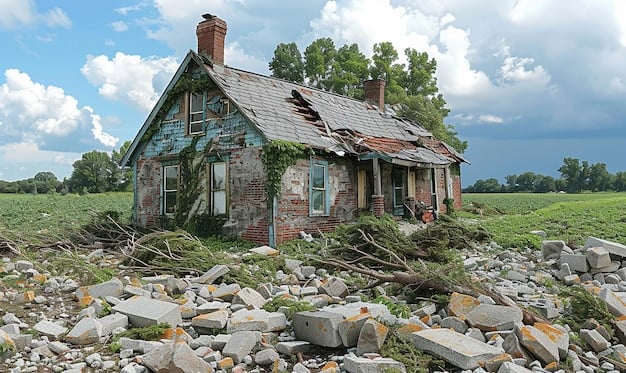
That spring, our life became work.
Monday through Friday, I sat in a gray cubicle in the insurance billing department at Lakeview County Hospital, fighting with claim denials and coding errors and explaining to crying people why their deductible was $4,500. I was good at it. I could read a bank statement or an explanation of benefits faster than most people can read a menu.
Every Friday night, Saturday night, and Sunday morning, I waited tables at the Crossroads Truck Stop out on Highway 30. Chicken-fried steak. Bottomless coffee. Truckers who tipped in quarters and truckers who tipped twenty dollars on a nine-dollar breakfast because I remembered they took their eggs over hard.
I kept every tip in a coffee can on top of our refrigerator. Every single one.
Nate spent his evenings in other people’s machine sheds, flat on his back under broken combines with a drop light, getting home at eleven smelling like hydraulic fluid and dust.
In June, he sold his fishing boat. The sixteen-foot aluminum Lund he’d saved for since high school. A guy from Spencer gave him $3,800 cash for it.
I watched the man tow it out of our driveway. Nate stood next to me with his hands in his pockets.
“It’s just a boat,” he said.
His ears were red.
We ate eggs. Scrambled eggs, fried eggs, egg sandwiches, egg casserole. I learned eleven ways to make eggs taste like something else. We canceled the streaming services. We turned the thermostat down to sixty-two in the winter and wore sweatshirts in the house.
And we told nobody.
Not Judy. Not Ron. Not Nate’s brother or sisters. Mentioning that we were struggling would have sounded like we were asking for a check. And I would rather have eaten eggs for the rest of my life.
At Thanksgiving, Kim showed us pictures of her new kitchen. Stacy and Kyle had closed on the house on Birch Street. Jeff had a three-car garage.
“How’s the apartment?” Judy asked us, passing the stuffing.
“Cozy,” I said.
Ron chuckled. “That’s what I like to hear. These two don’t need anybody.”
Nate passed the rolls without a word.
Two springs went by like that.
Then, in April, an ad appeared in the back of the Lakeview County Register.
Notice of Tax Sale. The county was auctioning the old Miller property out on Route 9 for unpaid property taxes. The owners had died. Their heirs lived out of state and hadn’t paid the taxes in six years. Nobody had lived there that whole time.
I’d driven past it a hundred times. A white two-story farmhouse sitting back from the road on four acres, with a sagging front porch and a barn leaning a little to the left. The yard was full of weeds as tall as my waist. Somebody had spray-painted a smiley face on the mailbox.
“Let’s go look,” Nate said.
We walked the property on a Sunday afternoon. We weren’t allowed inside, so Nate walked around the outside of the house three times. He crouched by the foundation. He knocked on the siding with his knuckles. He lay down in the weeds and looked under the porch with a flashlight.
Finally, he stood up and brushed off his jeans.
“The bones are good,” he said. “Somebody built this right. Somebody built this to last a hundred years.”
I looked at that sinking porch and those broken windows and I saw a house. A real one. Ours.
“How high can we go?” he asked me.
I’d already done the math in my head a hundred times. Our savings account at First Farmers Bank. The boat money. Two years of overtime. And the coffee can.
“Forty-two thousand,” I said. “Not one dollar more.”

Specialty: Legal & Financial Drama
Michael Carter covers stories where money, power, and personal history collide. His writing often explores courtroom battles, business conflicts, and the subtle strategies people use when pushed into a corner. He focuses on grounded, realistic storytelling with attention to detail and believable motivations.