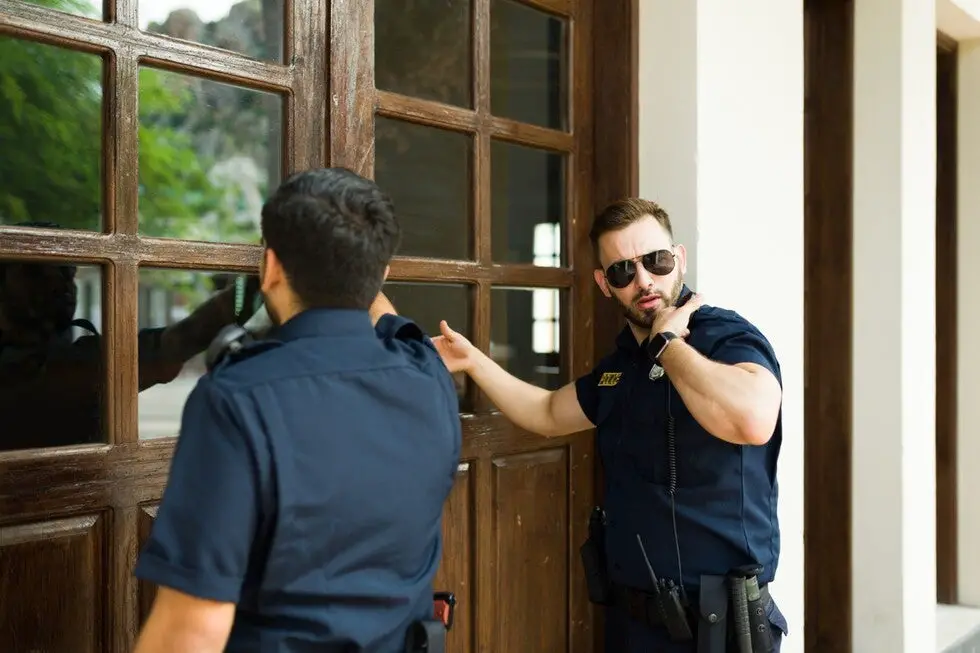
They moved back into the house on Larch Street on a Saturday in October. All three of them.
Josephine had asked me to come.
When I pulled up, the first thing I noticed was the blinds. Every single one of them was open. Light was pouring through the front windows. A bright red bicycle with training wheels lay on its side in the front yard.
The leaning mailbox had been straightened. Someone had painted it blue.
And the welcome mat was gone. In its place was a brand-new one. It said: COME IN. WE’VE GOT LEMONADE.
Curtis met me on the porch with a toolbox in one hand.
“Officer Dunham,” he said. “You want to see something?”
He led me down the narrow hallway to the back bedroom. The one with the bolt.
The bolt was gone. Four little screw holes in the door frame, filled in with putty, waiting for paint.
Inside, the duct tape was gone from the window. The blinds were open. Through the glass I could see those old red roses climbing the side of the house, the ones I’d noticed that first day.
“Grandpa Harold planted those for her in 1971,” Curtis said. “The day they moved in. Grandma used to cut them and put them on her desk at school.”
The room was Eli’s now. A twin bed with a dinosaur comforter. A bookshelf. A small desk under the window with a cup of sharpened yellow No. 2 pencils.
“Grandma said she didn’t want to sleep in there ever again,” Curtis said. “Eli asked for it. He said he wanted to make it a happy room.”
Josephine had taken the front bedroom, the sunny one. She was sitting in her old wooden rocking chair on the front porch when I came back out, with a glass of lemonade and a crossword puzzle in her lap.
“Officer Dunham,” she said. “Sit down. You look tired.”
I sat on the porch step beside her rocking chair.
“I’ve been meaning to tell you something,” she said. “And I’ve been waiting until I could say it on my own porch.”
“Go ahead, Mrs. Marsh.”
“That Friday at Rieke Elementary. Must have been 2004. You read the chapter where Charlotte dies.” She set down her pencil. “You had to stop in the middle. You stood up in front of twenty-six third graders and said you needed a drink of water. And you went out in the hallway.”
I didn’t say anything. I remembered.
“I followed you out,” she said. “You were standing by the drinking fountain with your back to me, wiping your eyes with your sleeve. Big policeman with a mustache, crying over a spider.”
“I remember,” I said quietly.
“I knew right then,” Josephine said, “that you were the kind of man a child could trust. So when I was locked in that room, and my great-grandson asked me who he could tell, I didn’t have to think twice.”
She reached down and patted my hand.
“I told him to find the policeman who cries about spiders.”

Lila Hart is a dedicated Digital Archivist and Research Specialist with a keen eye for preserving and curating meaningful content. At TheArchivists, she specializes in organizing and managing digital archives, ensuring that valuable stories and historical moments are accessible for generations to come.
Lila earned her degree in History and Archival Studies from the University of Edinburgh, where she cultivated her passion for documenting the past and preserving cultural heritage. Her expertise lies in combining traditional archival techniques with modern digital tools, allowing her to create comprehensive and engaging collections that resonate with audiences worldwide.
At TheArchivists, Lila is known for her meticulous attention to detail and her ability to uncover hidden gems within extensive archives. Her work is praised for its depth, authenticity, and contribution to the preservation of knowledge in the digital age.
Driven by a commitment to preserving stories that matter, Lila is passionate about exploring the intersection of history and technology. Her goal is to ensure that every piece of content she handles reflects the richness of human experiences and remains a source of inspiration for years to come.