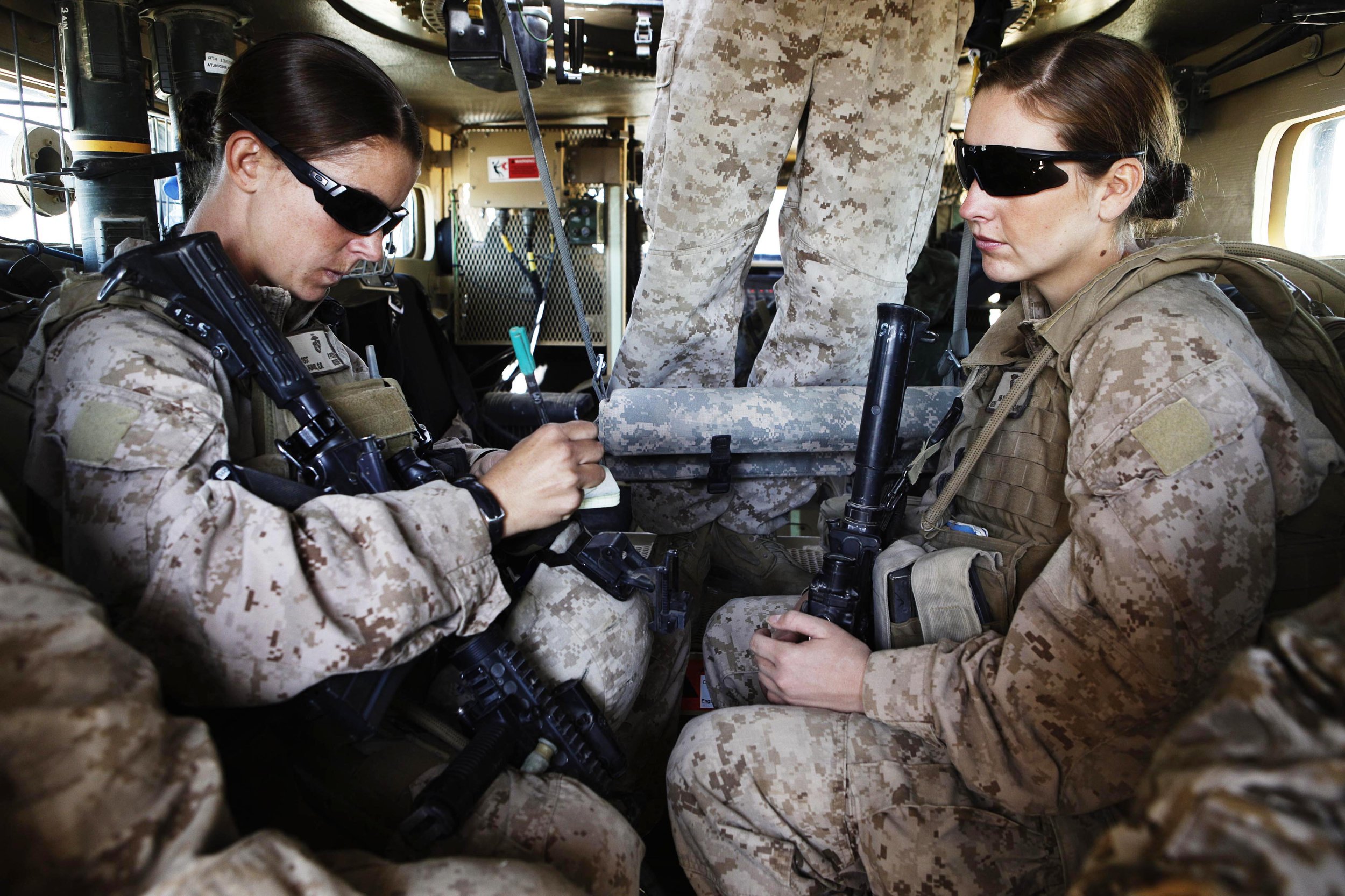
Every Veterans Day for nine years, an old Marine came into my diner, ordered two coffees, and left one untouched across the table. I always paid his bill. This year, he didn’t come. A young Marine in dress blues did. He handed me an envelope.
“He said you’d want to know who the second coffee was for.”
I didn’t know yet that my whole life was inside that envelope. I didn’t know that a man I’d poured coffee for once a year had been carrying my family for fifty-seven years. I only knew my hands were shaking, and that my new boss was standing two feet away, tapping his headset, waiting for me to get back to work.
But let me start at the beginning.
My name is Roberta Kane. Everybody calls me Bobbie. I’m fifty-eight years old. I’ve waited tables at the Harbor Diner in Oceanside, California, for twenty-two years.
Oceanside is a Marine Corps town. Camp Pendleton sits right up the road, and you can hear the helicopters some mornings over the sound of the fryer. We see a lot of uniforms. Young ones, mostly. Kids with fresh haircuts and big appetites who call me ma’am and leave too much on the table because their mothers raised them right.
And we see the old ones too. The ones who come in alone.
Nine years ago, on November 11th, an old man walked in at seven in the morning and sat down in Booth 4.
Gray crew cut. A faded Marine Corps ball cap. A Vietnam service ribbon pinned to the front of a brown canvas jacket that had seen better decades. He walked slow, like his knees were arguing with him, but he held his back straight as a flagpole.
I brought him a menu.
He didn’t open it.
“Two coffees, please, ma’am,” he said. “Black.”
“Somebody joining you?”
He looked at the empty seat across from him. Then he looked back at me.
“Two coffees,” he said again. Quiet. Polite. Final.
So I brought them. He took one cup and slid the other one across the table, all the way to the edge, right in front of the empty seat. He turned the handle so it faced outward, like somebody was about to reach for it.
He didn’t touch it.
He sat there for three hours. He stared out the window at the parking lot and the gray ocean beyond it. He drank his one coffee. I refilled it four times. The other cup went cold and grew a skin on top, and he never moved it an inch.
When he finally stood up to pay, his hands were shaking so bad he dropped his wallet on the floor.
I bent down and picked it up for him. I didn’t give it back right away.
“It’s on me today,” I said.
He started to argue. I shook my head.
“Thank you for your service, sir.”
He looked at me then. Really looked. Then his eyes dropped to my name tag, and he stared at it for a long time. Longer than a person usually looks at a name tag. His jaw moved like he was about to say something big.
Instead he said, “Thank you, Roberta.”
Nobody calls me Roberta. My name tag says it because the old owner, Walt, ordered the tags himself and never asked anybody what they went by.
The old man put on his cap and walked out into the morning fog.
<!–nextpage–>
I figured that was that.
But the next November 11th, at seven o’clock on the dot, the bell over the door jingled, and there he was.
Same jacket. Same cap. Same slow walk to Booth 4.
“Two coffees, please, ma’am. Black.”
I already had them on the tray.
He came back the year after that. And the year after that. Every Veterans Day for nine years. Same booth. Same two coffees. Same untouched cup pushed across the table with the handle turned out.
His name was Mr. Cyrus Lambert. That’s all he ever told me. I found it out the third year, when I finally just asked.
“Cyrus Lambert,” he said. “Lance Corporal, once upon a time. Just Cyrus now.”
“I’m Bobbie.”
“I know who you are,” he said.
I thought he meant the name tag.
Every year, once the breakfast rush slowed down, I’d take five minutes and slide into the booth beside him. Never across from him. Never in the seat with the cold coffee. Something told me that seat wasn’t mine to sit in.
We didn’t talk much. He’d ask how I was doing. I’d tell him about the price of eggs, or my car’s transmission, or my mother’s knees. He’d listen like I was reading him the Declaration of Independence.
One year I told him I’d been passed over for the assistant manager job. Walt had given it to a nineteen-year-old kid who knew how to work the new computer system.
Cyrus frowned. “Your father would’ve had something to say about that.”
I laughed. “You didn’t know my father.”
He went very still. Then he picked up his coffee and took a long sip and changed the subject.
I didn’t think anything of it. Old men say strange things sometimes.
And every year, when he got up to leave, I paid his bill. Two coffees. Three dollars and forty cents the first year. Four dollars and ten cents by the ninth. I always left a tip on it for myself, as a joke, and he always noticed and always smiled.
Here’s the thing I never told anybody.
My father was a Marine too.
Sergeant Thomas Kane. Everybody called him Tommy. He shipped out to Vietnam in the spring of 1968 when my mother was six months pregnant with me. I was born in August. He was killed in November, when I was three months old.
I never knew him. Not his voice. Not his laugh. Not the way he took his coffee.
I have one photograph of him. It’s black and white, with a crease running across the corner. He’s in his uniform, standing in the hallway of the naval hospital, holding a tiny bundle in a hospital blanket. That bundle is me. He got a short leave right before he deployed again. My mother said he wouldn’t put me down the whole three days.
He’s grinning in that photo. A big, goofy grin, like he’d just won the lottery.
That’s all I have of him. One picture and a folded flag in a triangle case on my bookshelf.
So maybe that’s why I always sat with Mr. Lambert. Maybe some part of me thought that if I took care of one old Marine, somewhere, somehow, it would count for something.
<!–nextpage–>
Last spring, Walt Brennan, the owner of the Harbor Diner for thirty-four years, finally retired. His back was shot and his wife wanted to see Arizona before they died. He shook my hand on his last day and told me the place couldn’t run without me.
Then he handed the keys to his son.
Chad Brennan is thirty-one years old. He wears a wireless headset even when nobody is calling him. He has a business degree from a school in Orange County and an app on his phone that tracks something he calls “table turnover velocity.”
The first week, he took down the photos on the wall. Forty years of pictures. Marines from Pendleton who’d eaten at the counter before shipping out. A signed photo of a general. A picture of Walt’s own father in his World War II uniform.
“It’s cluttered,” Chad said. “We’re going for a cleaner brand.”
The second week, he cut the free coffee refills for anybody in uniform. Walt had done that since 1991.
“It’s a margin problem,” Chad said. “Nothing personal.”
The third week, he called me into the back office, which used to be a supply closet, and showed me a spreadsheet.
“Bobbie, you’re my highest-paid server. Twenty-two years of raises. That’s a lot of overhead for one person.”
“I’m also your fastest server,” I said. “And the regulars come in for me.”
He smiled like I’d said something cute. “Regulars don’t scale.”
I didn’t quit. I thought about it. I sat in my car in the parking lot that night and did the math on a napkin, the way I do math about everything.
I’m fifty-eight. I rent a one-bedroom apartment on Mission Avenue for $2,150 a month. I’ve got $9,412 in a savings account at Pacific Coast Credit Union, and that’s every dime to my name. No 401(k). Walt never offered one, and I never had extra to put away anyway. My Social Security statement says that if I keep working until sixty-seven, I’ll get about $1,640 a month. That doesn’t even cover my rent.
And then there’s my mother.
Margaret Kane is eighty-one. She lives at Seaview Gardens, an assisted-living place in Carlsbad, because her memory started going about four years ago. Medicare doesn’t pay for assisted living. Most people don’t know that until it’s their mother. Her widow’s pension from the military and her Social Security cover most of the $6,800 a month. The other $1,100 comes out of my paycheck. Every single month.
So no. I wasn’t going to quit. Not at fifty-eight. Not with Mom’s bill due on the first.
I put the napkin in my glove box and went home.
<!–nextpage–>
This Veterans Day, I came in at five-thirty like always. I tied on my apron. I started the coffee.
Then I went to Booth 4 and set it up the way I had for nine years. Two white mugs. A fresh pot. Two napkins. I even wiped the window so he’d have a clean view of the ocean.
Chad came in at six-fifteen, talking into his headset about a produce order. He stopped when he saw the booth.
“Who’s that for?”
“Mr. Lambert. He comes every year on Veterans Day.”
Chad pulled his headset down around his neck. “Wait. The old guy? The one who sits for three hours and orders two coffees? My dad told me about him.”
“That’s him.”
He actually rolled his eyes. A grown man, rolling his eyes like a teenager.
“Three hours. One booth. During the holiday rush. Zero tip.” He laughed. “That’s a cheapskate, Bobbie, not a customer.”
“I pay his bill.”
“That’s the problem.” He crossed his arms. “This is a restaurant. It’s not a museum for old soldiers. If he comes in today, he orders food or he leaves. Fifteen-minute limit on booths until eleven. And you’re not paying for anybody anymore. If you comp something, that’s coming out of your paycheck from now on.”
I looked at him for a long second.
I’ve worked for a lot of managers in my life. Most of them don’t last. The ones who think people are numbers usually find out the hard way that numbers don’t come back on Veterans Day.
I didn’t argue.
I just poured the coffee into both cups and went to check on table six.
The diner filled up fast. Veterans Day always brings them in. Old men in VFW caps. Young families with little kids holding paper flags. A table of four Marines from Pendleton in their camouflage utilities, laughing and shoveling down pancakes. Two retired Navy nurses who come every year and argue about the Padres.
Seven o’clock came.
The bell over the door didn’t ring.
I kept looking at it anyway. Every time somebody walked past the window, my heart jumped.
Seven-thirty.
The coffee in Booth 4 stopped steaming.
“Bobbie,” Chad called from the register. “That booth’s been empty for an hour and a half. I’ve got a party of five waiting.”
“Give him a few more minutes.”
“He’s not coming.”
Eight o’clock.
I went over and poured fresh coffee into both cups. Chad watched me do it. I could feel his eyes on the back of my neck.
Mr. Lambert didn’t come.
And somewhere deep in my chest, I already knew. Nine years. He’d never been late. Not once. Not even the year it rained so hard the parking lot flooded and he walked in soaked to the knees.
At 8:15, the bell over the door rang.
<!–nextpage–>
It wasn’t Mr. Lambert.
A young man stepped inside. Tall. Early twenties. Shoulders like a doorframe. He was wearing Marine Corps dress blues, the full uniform, the dark blue coat with the high collar and the red trim, the white belt, the brass buttons. His white cover was tucked under his left arm. Every button was shining like he’d spent all night on them.
The whole diner went quiet.
I mean quiet. The forks stopped. The Navy nurses stopped arguing. Even the four Marines in utilities set their coffee down and sat up straighter. One of them whispered something, and they all turned in their seats.
The young man stood inside the door and looked around the room slowly. He was searching for something. He looked at the faces. Then he looked at the name tags.
When he saw mine, he stopped.
He walked straight across the diner toward me. His shoes clicked on the linoleum. Nobody said a word.
“Ma’am,” he said. “Are you Roberta Kane?”
“Yes.” My voice came out small.
“I’m Corporal Devin Lambert. Cyrus Lambert was my grandfather.”
Was.
That one little word hit me like somebody had opened a freezer door on my heart.
“He passed away in September,” Devin said gently. “Heart failure. It was peaceful. He was at home.”
I put my hand on the back of a chair. I didn’t trust my knees.
“I’m so sorry,” I whispered.
“He made me promise to come here today,” Devin said. “On Veterans Day. In uniform. At this diner. And to give you this.”
He reached inside his coat and held out a thick, worn envelope. It was the old-fashioned kind, the heavy manila kind, soft at the corners from being handled too many times. My name was written across the front in shaky blue ink.
Roberta.
Not Bobbie. Roberta.
Before I could take it, Chad walked over. He had his manager smile on. The one he uses when a customer complains about cold fries.
“Sir, thank you for your service. Just so you know, we have a fifteen-minute booth limit during the holiday rush. And Bobbie’s on the clock, so if she could keep this short—”
The young Marine didn’t even look at him.
He kept his eyes on me. Steady. Kind.
“Ma’am,” he said. “My grandfather told me something before he died.”
He put the envelope in my hands and closed my fingers around it with his.
“He said you’d want to know who the second coffee was for.”
<!–nextpage–>
Chad opened his mouth again.
That’s when a voice came from the counter.
“Chad. Let the woman sit down.”
Every head turned.
Walt Brennan was sitting on the third stool from the end, where he’d sat for thirty-four years before he ever owned the place. I hadn’t even seen him come in. He’d driven back from Arizona for the holiday, it turned out. Wanted to surprise his son. He was wearing his own old VFW cap. Walt did two tours in the Navy, on a destroyer off the coast of Vietnam. He never talked about it.
“Dad,” Chad said. “It’s the rush. We’ve got people waiting.”
“Then I’ll wait tables,” Walt said, sliding off his stool. “I did it for thirty years. I think I remember how.”
He walked behind the counter, pulled an apron off the hook, and tied it on over his golf shirt. Then he looked at me.
“Booth 4, Bobbie. Go.”
I went.
Devin followed me. I slid in on the side where I always sat. Then I stopped. I looked at the seat across from me, the one with the cold cup of coffee and the handle turned out.
“Sit there,” I said to Devin. “Please. I think he’d want somebody to.”
Devin looked at the cup for a long moment. His throat moved.
Then he sat down. He moved the coffee cup an inch to the side, carefully, like it was made of glass, and he set his white cover on the table beside it.
I opened the envelope.
Inside there was a letter, three pages folded together, written on yellow legal paper. There was an old photograph wrapped in a plastic sandwich bag. There was a business card from a law office in Vista. And there was something heavy at the bottom that slid into the corner when I tilted it.
I took out the photograph first.
My breath stopped.
It was two young Marines, sitting on a pile of sandbags somewhere hot and green. They were shirtless and filthy and grinning. Each of them was holding a dented metal canteen cup, raised like they were making a toast. One of them was skinny and young, maybe nineteen, with big ears and a crew cut.
The other one was my father.
I knew that grin. I’d looked at it every day of my life, in a hallway, in a hospital, holding a baby in a blanket.
“That’s him,” I said. My voice cracked down the middle. “That’s my dad.”
“Yes, ma’am,” Devin said softly. “And the one with the ears is my grandpa.”
I turned the photo over. On the back, in faded pencil, somebody had written: Tommy & Cy. Coffee time. An Hoa, Oct. ’68.
October 1968. One month before my father died.
I set the photograph down on the table between the two cups. Then I unfolded the letter. My hands were shaking so badly that the paper rattled.
<!–nextpage–>
Dear Roberta,
If you’re reading this, then I finally ran out of Novembers, and I’m sorry. I’m sorry for a lot of things. Mostly I’m sorry that I sat across from you for nine years and never had the guts to tell you the truth. I was a Marine for four years and a coward for fifty-three. Let me try to fix that now.
The second coffee was for your father.
His name was Sergeant Thomas Kane, and he was the best man I ever knew.
I was nineteen when I got to Vietnam. I was scared out of my mind and I didn’t know anything. Your daddy was my squad leader. He was twenty-four, which seemed real old to me then. The first night, I was shaking so bad I couldn’t sleep. He sat down next to me with two cups of coffee and handed me one.
He said, “Lambert, we’re going to drink this together every morning until we both go home. That’s an order.”
And we did. Every morning. Black coffee, boiled in a can over a heat tab, so bitter it could strip paint. We’d sit on the sandbags and he would talk about you. Every single morning, Roberta. He talked about his baby girl. He had a picture of you in a hospital blanket that he kept in his helmet band. He’d show it to me like I hadn’t already seen it a hundred times.
“Her name’s Roberta,” he told me. “After my mother. But I’m going to call her Bobbie. She’s going to be tough. Look at that chin.”
I stopped reading. I couldn’t see the words anymore.
Devin pulled a napkin from the dispenser and handed it to me without a word.
Across the diner, I realized nobody was talking. The Marines at the corner table were watching. The Navy nurses had their hands over their mouths. Walt was standing at the end of the counter holding a coffee pot, not pouring it.
Chad was standing by the register. He wasn’t on his headset.
I wiped my eyes and kept going.
On the morning of November 11th, 1968, we were on patrol southwest of Da Nang. We walked into an ambush. I got hit in the leg and went down in an open rice paddy. I couldn’t move. I couldn’t do anything but lie there in the water and wait to die.
Your father came out and got me.
He ran across sixty yards of open ground under fire. He picked me up and threw me over his shoulder like a sack of flour. He got me to the tree line. He laid me down behind a dike and said, “You’re okay, Cy. You’re okay. We still have coffee in the morning.”
Then he went back out for Hernandez.
He didn’t come back.
<!–nextpage–>
I had to put the letter down.
I pressed both hands over my mouth and just breathed. In and out. The diner was so quiet I could hear the walk-in cooler humming in the back.
My mother had told me my father died in combat. That’s all the Marine Corps had told her. A telegram, then two officers at the door, then a flag. She never knew how. She never knew where. She never knew he’d been carrying my picture in his helmet.
Devin reached across the table. He didn’t take my hand. He just set his hand flat on the table near mine, close enough that I could reach it if I wanted.
I wanted. I held onto it.
“Keep going,” he said quietly. “There’s more. He told me there was more.”
I picked the letter back up.
I was medevaced out that afternoon. Before they put me on the helicopter, the corpsman handed me your father’s helmet. I don’t know why. Maybe he thought we were related. Maybe he just needed to hand it to somebody. Your picture was still in the band.
I’ve had it for fifty-seven years. It’s at the bottom of this envelope. I should have given it back a long time ago. Every year I told myself I would. Every year I sat in that booth with it in my jacket pocket and I couldn’t do it. Because giving it to you meant telling you he died saving me. And I never felt like I was worth what he paid.
I reached into the envelope. My fingers found something stiff, wrapped in tissue paper.
I unwrapped it slowly.
It was the photograph. Not a copy. The original.
A baby in a hospital blanket. Small and cracked and stained brown along one edge. Somebody had written on the back in pencil, in big, careful letters: MY BOBBIE. COMING HOME TO YOU.
I made a sound I have never made before in my life. It came from somewhere below my ribs. Half a sob and half something else.
Walt came over then. He didn’t say anything. He just set a fresh cup of coffee in front of me and put his hand on my shoulder for a second and walked away.
I held my own baby picture in one hand, the one my father had carried into the war, the one he looked at every morning, and I held Devin Lambert’s hand with the other.
And I read the rest.
<!–nextpage–>
When I got home, I went looking for your mother. I want you to know that. It took me ten years to work up the nerve, and by then I’d made a mess of my own life, drinking and fighting and losing jobs. But in 1979, I got sober, and I found her. Margaret Kane, on Pier View Way, in a little blue house with a broken porch step.
I parked across the street and watched for three days. I saw a little girl in pigtails riding a bicycle up and down the sidewalk. Ten years old. She had his chin.
I never knocked. I couldn’t.
But I found out something. I went to the county recorder’s office, and I looked up the house. There was a notice of default recorded against it. Your mother was four months behind on the mortgage with Home Federal Savings. They were going to foreclose.
I had $6,200 in the bank. It was every penny I had from my disability back pay. I got a cashier’s check and I mailed it to the bank with your mother’s loan number on it and no name. Just a note that said “From a friend of Tommy’s.”
I stopped reading and stared at Devin.
“The angel check,” I said.
“Ma’am?”
“My mother called it the angel check.” My voice was shaking. “I was ten. I remember her crying at the kitchen table with a letter from the bank. They were going to take the house. She’d lost her job at the cannery. And then one day the bank called and said somebody had paid it. Paid all of it, plus the late fees. She never found out who. She went to church every Sunday for the rest of her life and thanked God for the angel who saved our house.”
I looked down at the shaky handwriting.
“It was him,” I whispered. “It was your grandfather.”
Devin’s eyes were wet now too. He blinked hard and looked out the window.
“He never told anybody,” he said. “Not my grandma. Not my dad. Nobody. He lived in a mobile home in Fallbrook for forty years and drove the same truck since 1994. We all thought he was just cheap.”
Cheapskate, Chad had called him. I didn’t look at Chad. I didn’t have to.
The letter went on.
After that, I lost track of you. Your mother sold the house in 1991 and moved, and I didn’t know how to find you without explaining myself. My wife, Ruth, got sick around then, and life just took over.
Ruth died ten years ago. After the funeral, I was going through her papers, and I realized I didn’t have much time left either. So I hired a man to find you. It took him two weeks. He said you were waiting tables at the Harbor Diner in Oceanside.
The first time I walked in, I was going to tell you everything. I had it all planned. Then you walked up to my table and I saw your name tag. Roberta. And you smiled at me, and you had his smile too, and I just fell apart inside.
So I ordered two coffees. One for me. One for Tommy. Like we did every morning.
And then you paid for it. Tommy Kane’s daughter paid for my coffee and thanked me for my service.
Roberta, I’ve never been so ashamed or so grateful in my whole life.
<!–nextpage–>
I had to stop again.
I looked across at the cup of cold coffee sitting in front of Devin. Nine years of cold coffee. Nine years of a handle turned out, waiting for a hand that was never going to reach for it.
He wasn’t waiting for a stranger. He wasn’t lonely. He wasn’t strange.
He was having coffee with my father.
And I’d been sitting right there next to them both. Every year. Five minutes at a time. Talking about the price of eggs.
“Your father would’ve had something to say about that,” he’d told me, the year I got passed over for the job.
He knew. He knew every single time.
I turned to the last page. The handwriting got worse here. Shakier. Like he’d written it on a different day, when he was sicker.
Now for the practical part. Tommy would’ve wanted me to take care of the practical part. He was always the one who made sure we had dry socks.
Twenty years ago, I took out a life insurance policy through the VA’s veterans’ life insurance. Ruth was the beneficiary. When she died, I changed it. You are now the sole beneficiary. The policy is worth $250,000.
My attorney is Ellen Marsh in Vista. Her card is in this envelope. She has the policy paperwork and a copy of my will. My house and truck go to Devin, because he’s my grandson and he deserves them. But the insurance is yours. Ellen says it doesn’t have to go through probate, since you’re named directly on the policy. She’ll help you with the claim forms.
Don’t argue with me about this. I can’t hear you anyway.
This isn’t charity. This is a debt. Your father paid for my whole life. Every breath I’ve taken since November 11th, 1968, was on his tab. I’m just trying to settle up.
Take care of your mother. Fix that transmission you’re always complaining about. And for God’s sake, Roberta, retire someday. Sit down. Let somebody else pour the coffee for once.
Tommy would’ve wanted that. He talked about you every morning. Now I’ve told you about him. I guess we’re even.
Semper Fidelis,
Cyrus Lambert
Lance Corporal, USMC
Third Squad, Second Platoon
The man your father carried
P.S. He took his coffee black. Same as me. Same as you, I noticed.
I folded the letter closed and held it against my chest.
And then I cried. Not polite crying. Not the kind you can hide behind a napkin. The kind that shakes your whole body. Fifty-eight years of not knowing my father, and in the space of three yellow pages, he was sitting right there in the booth with me.
He boiled coffee in a can. He kept my picture in his helmet. He called me Bobbie before I could even hold my head up. He was going to come home to me.
He ran across sixty yards of open ground for a scared nineteen-year-old kid with big ears.
<!–nextpage–>
I don’t know how long I sat there. Long enough for Walt to refill my coffee twice.
When I finally looked up, the diner was still quiet. But something had changed.
The four Marines from the corner table were standing up. All four of them. They’d pushed their chairs back and they were standing at attention beside their table, facing Booth 4. One of them was a Gunnery Sergeant with gray at his temples. He was the one who’d started it.
Then the old men in the VFW caps stood up. Slowly, some of them gripping the backs of their chairs for balance. Then the Navy nurses. Then the young family with the little kids and the paper flags. The father lifted his little boy off the seat and stood him on the floor and whispered something in his ear, and the boy put his hand over his heart.
Walt stood at the end of the counter with the coffee pot in his hand and his VFW cap on his head, and he stood up straight like he was nineteen again on the deck of a destroyer.
Every single person in the Harbor Diner was standing.
Except Chad.
He was standing behind the register, but not like the others. He was just standing there, frozen, with his mouth slightly open and his headset still hanging around his neck. He looked like somebody had pulled the floor out from under him.
Then Devin slid out of the booth.
He stood up tall in his dress blues. He picked up the cold cup of coffee, my father’s coffee, the one his grandfather had poured for nine years. He held it in both hands.
“Sergeant Thomas Kane,” Devin said. His voice was strong and clear and carried to every corner of the room. “United States Marine Corps. Killed in action, November 11th, 1968, while saving the life of Lance Corporal Cyrus Lambert.”
He raised the cup.
“Semper Fi, Sergeant.”
“Semper Fi,” the Marines answered. Four voices together, loud enough to rattle the window.
“Semper Fi,” the old men said, rougher, quieter.
And then Devin did something I will never forget as long as I live. He held the cup out to me.
I stood up. I took it with both hands. It was stone cold.
I drank it. Every bitter drop. Black, the way my daddy took it.
It was the best coffee I’ve ever had.
<!–nextpage–>
People started sitting back down. Somebody started clapping, and then everybody was clapping, and then the little boy with the paper flag ran over and handed me his flag and ran back to his mother, and that set me off crying all over again.
Devin sat back down. So did I.
Walt brought over two plates of pancakes nobody had ordered. “On the house,” he said. Then he glanced over at his son. “Right, Chad?”
Chad swallowed. He walked over slowly. He stopped at the end of the booth.
For a while, he didn’t say anything. He just looked at the photograph of the two young Marines on the sandbags with their canteen cups. Then at the baby picture with the brown stain. Then at me.
“Bobbie,” he said. His voice was quiet. No headset voice. No manager voice. “I didn’t know.”
“No,” I said. “You didn’t.”
“I called him a cheapskate.” He looked at Devin. “Corporal, I’m sorry. I called your grandfather a cheapskate. And he—” Chad stopped. He shook his head. “He paid off a stranger’s mortgage with every dollar he had.”
“She wasn’t a stranger to him,” Devin said. “Not for one day.”
Chad nodded. He looked down at his shoes. Then he reached into his back pocket and pulled out his phone and opened something on the screen. He stared at it for a second, and I realized it was his spreadsheet. The one with my name on it. The one with the overhead.
He locked the phone and put it away.
“Booth 4 doesn’t have a time limit today,” he said. “Or any Veterans Day. Not while I own this place.”
He turned to go back to the register. Then he stopped and turned around.
“And nobody’s paying for those coffees out of their paycheck,” he said. “Not today. Not ever.”
Walt, standing behind the counter, didn’t say anything. But I saw him look at his son for a long moment. And I saw something in his face soften, like maybe the boy he’d raised was still in there somewhere under all that turnover velocity.
<!–nextpage–>
Devin and I sat in Booth 4 for three hours that morning.
Three hours. The same three hours his grandfather used to sit there.
He told me about Cyrus. How he taught Devin to fish off the Oceanside pier when he was six. How he never missed a single one of Devin’s football games in high school, even the away ones in El Centro. How he cried at Devin’s graduation from boot camp at the Recruit Depot in San Diego, the only time Devin ever saw him cry.
“He pinned my Eagle, Globe, and Anchor on me himself,” Devin said. “And he said, ‘Now you carry it for the ones who didn’t come home.’ I didn’t know what he meant. I thought he was talking about Marines in general.”
He looked at the photograph of the sandbags.
“He was talking about your dad.”
“How long have you known?” I asked him. “About all of it?”
“About three weeks before he died. He called me into his bedroom and made me sit down. He told me the whole story. Took him two hours. He kept stopping to catch his breath.” Devin rubbed his thumb across the edge of the table. “At the end, he made me promise. Come here on Veterans Day. Wear the blues. Find Roberta Kane. Give her the envelope. And tell her who the second coffee was for.”
“Why the blues?” I asked.
Devin smiled for the first time all morning. It was Cyrus’s smile. I don’t know how I’d never noticed that crooked smile on the old man before.
“He said Sergeant Kane deserved a Marine in dress uniform at his table. He said nobody ever gave your dad a proper send-off, because nobody here knew he was gone. Just a telegram and a flag.”
I looked down at the photo in my hands.
“He gave him one every year,” I said. “For nine years. Two coffees at seven in the morning.”
“Yes, ma’am. He did.”
Before he left, Devin wrote his phone number on a napkin. He’s stationed at Camp Pendleton, with the 1st Marine Division. The same division my father served in. The same division Cyrus served in.
“Same division,” I said, holding the napkin.
“Grandpa made sure of it,” Devin said. “He made a lot of calls.”
He stood up. He put on his white cover. He straightened his coat.
Then he looked at me and said, “Ma’am, would it be okay if I came back next year? On Veterans Day?”
I couldn’t speak. I just nodded.
“Seven o’clock?” he said.
“Seven o’clock,” I said. “I’ll have the coffee ready.”
<!–nextpage–>
The next Tuesday, I drove up to Vista on my day off and sat in the waiting room of Marsh & Delgado, Attorneys at Law. It was on the second floor of a building above a dentist’s office. The carpet was blue and the magazines were from last year.
Ellen Marsh was in her sixties, with silver reading glasses on a beaded chain and a firm handshake. She had a thick folder on her desk with Cyrus Lambert’s name on the tab.
“I’ve been waiting for you,” she said. “Cyrus told me you’d come eventually. He also told me you’d probably try to give the money back.”
I laughed, even though my eyes were stinging. “He knew me pretty well, for somebody I only talked to five minutes a year.”
“He came in here four times in the last year,” Ellen said. “He wanted every detail right. He changed the beneficiary on the life insurance policy nine years ago, actually. The same month he first walked into your diner. He just never told you.”
She slid a document across the desk. It was the beneficiary designation form for the veterans’ life insurance policy. Under “Primary Beneficiary,” in that same shaky handwriting, it said: Roberta Margaret Kane. Daughter of Sgt. Thomas J. Kane, USMC.
He’d written my father’s name on it. Like a reason. Like an explanation he couldn’t say out loud.
Ellen walked me through the claim forms. She needed a certified copy of the death certificate, which Devin’s father had already sent over. She needed my identification and my Social Security number for the claim form. She told me the payout would come by direct deposit or check, usually within a few weeks once everything was submitted.
“Because you’re named directly as beneficiary,” she said, “this doesn’t go through his estate. His will handles the house in Fallbrook and the truck and a few personal items. Those go to Devin. The insurance goes straight to you.”
“What about taxes?” I asked. My voice was small. I was thinking about the napkin in my glove box. About my $9,412.
“Life insurance proceeds paid to a named beneficiary generally aren’t counted as taxable income,” she said. “But you should still talk to a tax preparer about your own situation. Especially once you start investing it.”
Investing. Like I was somebody who invested things.
I signed the claim form at 10:42 a.m. on a Tuesday in November. My signature looked like a stranger’s because my hand wouldn’t stop shaking.
Then Ellen opened a drawer and took out one more thing. A small cardboard box, the kind jewelry comes in.
“He asked me to give you this in person,” she said. “He didn’t want it in the envelope in case it got lost.”
Inside was a dented metal canteen cup.
The same kind from the photograph. Olive drab, with the folding handle, scratched and blackened on the bottom from a hundred heat tabs. Somebody had scratched letters into the side with the tip of a knife.
T. KANE.
“It was in his pack when they evacuated him,” Ellen said. “He’d been holding onto it since that morning.”
I held my father’s coffee cup in my lap and sat in that blue-carpeted office and cried until Ellen Marsh had to get me a second box of tissues.
<!–nextpage–>
That Saturday, I drove to Seaview Gardens to see my mother.
She was sitting by the window in the common room, wrapped in the purple cardigan I’d bought her at Kohl’s three Christmases ago. She was watching the birds at the feeder. Some days she knows me. Some days she thinks I’m the nurse. Some days she thinks it’s 1975 and asks me if I’ve finished my homework.
I sat down next to her and took her hand.
“Mom. It’s Bobbie.”
She turned and looked at me for a long time. Then she smiled. “Bobbie. You cut your hair.”
I hadn’t, but I let it go. “I brought you something.”
I took out the photograph. The one from the sandbags. Two young Marines with canteen cups, grinning in the jungle.
My mother looked at it.
And her whole face changed.
It was like watching the sun come out from behind a cloud. Her eyes cleared. Her mouth fell open. Her fingers came up and touched the photograph, right on my father’s face.
“Tommy,” she said.
“Yes, Mom.”
“That’s my Tommy.” Her voice was young. It was the voice of a twenty-two-year-old girl. “Look at him. Look at that silly grin. Where did you get this?”
“From a friend of his,” I said. “His name was Cyrus. Dad saved his life.”
She was quiet for a while. She kept touching the photograph.
“He always did that,” she said softly. “Ran toward things. Ran toward trouble. I used to yell at him for it.”
Then she looked at me, and her eyes were so clear and so present that it took my breath away.
“Bobbie. The angel check. Remember? When they were going to take the house?”
My throat closed up.
“I remember, Mom.”
“I always wondered who it was.”
I squeezed her hand. I leaned in close so she could hear me over the television.
“It was Cyrus,” I said. “It was the man in the picture. The one Daddy saved. He paid off our mortgage because Daddy saved his life. He wrote ‘From a friend of Tommy’s.’ Remember? That’s what the note said.”
“From a friend of Tommy’s,” she whispered.
She held the photograph against her chest the same way I’d held the letter in the diner.
“Tommy sent him,” she said. “Tommy sent him to take care of us.”
Then the clouds came back. I watched it happen. Her eyes went soft and far away, and she looked out at the bird feeder and asked me if it was going to rain.
But she didn’t let go of the picture. The nurse told me later that she slept with it under her pillow that night. And the next. And every night since.
On my way out, I stopped at the front office and asked about the bill. Then I asked something I’d never been able to ask before.
“How much for a private room? One with a window that faces the garden?”
The office manager looked it up. It was a lot more.
I told her to start the paperwork.
<!–nextpage–>
The check came three weeks later. $250,000, made out to Roberta M. Kane.
I sat in my car in the Pacific Coast Credit Union parking lot holding it for twenty minutes before I could make myself walk inside.
The branch manager, a young woman named Priya Shah, met with me in her little glass office. She saw the amount on the check and raised her eyebrows. Then she saw the name of the insurer and the word “beneficiary” and her face softened.
“I’m so sorry for your loss,” she said.
“He wasn’t family,” I said. Then I stopped. “Actually. Yes, he was.”
She helped me open a high-yield savings account. She set up a meeting for me with a financial planner, a man named Gordon Reyes who’d been a Marine himself, it turned out. Gordon helped me open my very first retirement account at fifty-eight years old. He showed me a chart of what it could look like by the time I’m sixty-seven.
For the first time in my adult life, the numbers didn’t scare me.
I paid off my car. I fixed the transmission, like Cyrus told me to. I moved my mother into the private room facing the garden at Seaview Gardens. I paid her bill through the end of next year, all at once, and I sat in my car afterwards and laughed out loud for no reason.
And I did one more thing.
I went to the Harbor Diner on a Wednesday afternoon when it was slow. Chad was in the back office, the old supply closet, doing payroll.
I knocked on the door frame.
“Bobbie.” He stood up fast. He’d been different since Veterans Day. Quieter. He’d started saying good morning to the cooks. He’d put Walt’s photographs back up on the wall, every single one of them, plus one new one.
The new one hung right above Booth 4. It was a framed copy of the picture from the sandbags. Two young Marines with canteen cups. Under it, a small brass plate that said: Sgt. Thomas Kane & LCpl. Cyrus Lambert. Coffee Time. Always a seat for them here.
Chad paid for it himself. I know because Walt told me.
“I’m not quitting,” I said, before he could look worried. “I just want to set something up.”
I slid an envelope across his desk. Inside was a cashier’s check for $5,000.
“What’s this?”
“It’s for coffee,” I said. “For anybody in uniform. Active duty or veteran. Any day. Free coffee, refills too. When this runs out, call me and I’ll put more in.”
Chad looked at the check. Then he looked at me. Then he did something I didn’t expect. He pushed it back across the desk.
“Keep it,” he said. “I already brought back the free coffee. Monday. Dad didn’t even have to tell me to.”
He rubbed the back of his neck. “I ran the numbers. We sold more breakfasts this month than any November in five years. Turns out Marines bring their families when you treat them right.”
I almost laughed. “So it’s good for the margins.”
“It’s good for the margins,” he admitted. Then he looked at the framed picture through the office doorway, the one hanging over Booth 4. “But that’s not why I did it.”
I believed him.
<!–nextpage–>
Devin and I talk every couple of weeks now.
He comes into the diner on Sunday mornings when he’s not in the field. He sits at the counter and eats the Marine Special, three eggs, bacon, hash browns, and a short stack, and he tells me about his week. He’s up for sergeant next spring. He’s got a girlfriend named Kaylee who’s a dental hygienist in Carlsbad, and he wants me to meet her.
Sometimes he talks about his grandfather. Sometimes I talk about my father. It’s a strange thing, getting to know your dad through the grandson of the man he died for. But it’s the only way I’ve got. And I’ll take it.
Last month he asked me something.
“Bobbie, do you ever get angry? That Grandpa waited so long to tell you?”
I thought about it for a long time. I was wiping down the counter, and I just kept wiping the same spot over and over.
“I used to think I would be,” I said finally. “But no. I don’t think so.”
“Why not?”
“Because he never really waited,” I said. “He told me every year. He just didn’t use words. Two coffees. One for him. One for my dad. Pushed across the table with the handle turned out. He was telling me the whole time. I just didn’t know how to listen yet.”
Devin was quiet for a moment.
“He would’ve liked that answer,” he said.
<!–nextpage–>
It’s November again now. One year later.
This morning I came in at five-thirty like always. I tied on my apron. I started the coffee.
Then I went to Booth 4 and set it up.
But not two cups this time. Three.
Two white diner mugs. And between them, in the middle of the table, a dented olive-drab canteen cup with T. KANE scratched into the side.
Chad came in at six. He saw the booth. He didn’t say anything about table turnover. He just walked over and straightened the framed photo on the wall above it, the one of the sandbags, so it hung perfectly level.
“Need anything, Bobbie?” he asked.
“No,” I said. “I’ve got it.”
At 6:55, the bell over the door jingled.
Devin Lambert walked in wearing his dress blues. Every button shining. He’s Sergeant Lambert now. He made it early. He took off his white cover and tucked it under his arm, and the whole diner went quiet, the same way it did a year ago.
He walked to Booth 4. He didn’t sit down yet.
He looked at the canteen cup in the middle of the table. Then he looked at me.
“Three coffees,” he said. “Black, please, ma’am.”
I poured them. One for Devin. One for Cyrus. And one, into the old dented canteen cup, for my father.
Devin slid into the seat across from me. The seat where the cold coffee always used to sit. He moved his grandfather’s mug so it sat beside my father’s cup, handles turned out, side by side, like two young men on a pile of sandbags in the morning.
“To Sergeant Kane,” Devin said, lifting his mug.
“To Lance Corporal Lambert,” I said, lifting mine.
We clinked our cups against the two that nobody would drink.
Outside the window, the fog was lifting off the ocean. Somewhere up the road at Camp Pendleton, a helicopter was thumping across the sky. The diner was filling up with uniforms, old and young, and Walt was behind the counter in his VFW cap pouring free coffee for every one of them.
I sat there with my coffee and my father’s coffee and the grandson of the man my father saved.
And for the first time in fifty-eight years, it felt like my dad was finally home.
My name is Roberta Kane. Everybody calls me Bobbie. My father named me that before I could hold my head up. He said I’d be tough.
He kept my picture in his helmet. He ran across sixty yards of open ground for a scared kid with big ears. He never got to come home to me.
But every Veterans Day, at seven o’clock in the morning, there’s a seat for him in Booth 4 at the Harbor Diner in Oceanside, California.
And the coffee is always on me.

Adrian Hawthorne is a celebrated author and dedicated archivist who finds inspiration in the hidden stories of the past. Educated at Oxford, he now works at the National Archives, where preserving history fuels his evocative writing. Balancing archival precision with creative storytelling, Adrian founded the Hawthorne Institute of Literary Arts to mentor emerging writers and honor the timeless art of narrative.