My husband cheats on me every single day, and I love him for it.
I know exactly how that sounds. I have watched it land on people’s faces — the flinch, the pity, the quick private math about what kind of woman stays with a man like that. They hear the word and they think they already know the rest of my story.
They don’t. They never do.
The Question At The Dinner Table
It came up, the way these things do, over a casserole.
My friend Donna had come by on a Friday with a dish and a bottle of cheap wine, the way she’d been doing since my surgery, and somewhere between the salad and the second glass she got brave. She set down her fork and looked at me with the careful expression people use when they’ve decided to say the thing they’ve been holding.
“Carol,” she said. “Can I ask you something, and you won’t get mad?”
“You’re going to ask anyway,” I said.
“How do you stay with a man who lies to you? Eddie lies to you constantly. I’ve watched him do it to your face. I love him, you know I do, but how do you live with a man who can’t tell you the truth?”
Lily had already gone up to bed. The kitchen was quiet except for the hum of the old refrigerator we kept meaning to replace.
I didn’t get mad. I smiled, and I think it was a sad smile, because Donna’s face changed when she saw it.
“You’re right,” I said. “He lies to me every single day. He’s been lying to me for nineteen years.”
“Then how —”
“Because the only thing he’s ever cheated on,” I said, “is the truth. And he only ever does it to protect me.”
Donna got quiet.
“He tells me work was easy when he comes home so tired he can barely lift his fork,” I said. “He tells me he already ate when I know for a fact he gave his lunch money to Lily for the book fair. He tells me he doesn’t need new boots when the soles are flapping loose. He tells me, every single night, that everything is fine.”
I looked at her across my own kitchen table.
“That’s the only way my husband has ever cheated on me, Donna. He cheats me out of the worry. He always has. And for a long time, I let him, because I didn’t understand how much it was costing him.”
She didn’t have anything to say to that. Most people don’t, once they understand what I actually mean.
But I’m getting ahead of myself. To understand the day I found out the truth — the day I ended up on the dirty linoleum floor of a pawn shop on Route 9, crying so hard the owner brought me a folding chair — you have to understand the man first.
The Man I Married
Eddie and I met when we were both nineteen, at a roller rink that’s a self-storage place now. He wasn’t smooth. He spent our first three dates talking about the proper way to change a serpentine belt because he was too nervous to talk about anything else.
What he had, even then, was a kind of quiet steadiness, like a porch light somebody leaves on for you. The first time he met my father — a hard man who’d buried two friends in the mill and didn’t waste warmth on anyone — my dad shook his hand, looked him over, and later said the highest compliment he knew how to give: “That one’ll show up.”
He was right. Eddie shows up.
When my mother was dying, he drove the two hours to her hospice every weekend for nine months and read her the western paperbacks she loved in a voice that did all the characters, even though it embarrassed him. When Lily was born six weeks early and spent a month in the NICU, Eddie slept in a plastic chair the whole time and never once let me see him cry, though I knew he did, in the stairwell, where he thought nobody could hear.
He took a job at Hartwell Manufacturing the year we married, running a press that stamped brackets for truck frames. It was loud, hot, repetitive work that wore his hands into something like leather. He never complained about it once in nineteen years. Not once. He’d come home, wash up, and ask me about my day as if his own had been a pleasant little errand.
His one treasure in this world was his father’s watch — a plain old Hamilton with a worn leather band that his dad had worn every day of his working life and that had been handed to Eddie across a hospital bed with the words, “You’re the man of it now.” Eddie wore it every single day. He’d tap it twice with two fingers when he was thinking, a habit so much a part of him I stopped seeing it.
I tell you all this so you understand: I was not married to a liar. I was married to a man who had decided, somewhere deep down, that it was his job to stand between his family and every cold wind, alone, and never let us feel it.
I just didn’t know yet how hard that wind had started to blow.
The Small Lies
Eight months before that dinner with Donna, my heart tried to quit on me.
It started as a tiredness I blamed on everything else, and it ended on an operating table, with a surgeon repairing a valve that had been failing quietly for years. I came home with a scar down the center of my chest, a fistful of prescriptions, and a single instruction the cardiologist repeated at every visit until it lost all meaning: avoid stress. Whatever you do, Mrs. Brennan, keep her calm.
Eddie heard that instruction the way other men hear a starting gun.
He took it as a sacred duty. If stress could hurt my heart, then by God I would not have any. And so the small lies, which had always been there in little doses, became a daily weather system.
“How was work?” I’d ask.
“Easy day,” he’d say. “Slow. They’ve got us coasting.”
I found out much later that Hartwell had cut everyone to thirty hours that month, and that an “easy day” meant he’d spent it driving forty minutes to a temp agency on his unpaid time, asking for anything, anything at all.
“You hungry? I saved you a plate,” I’d say.
“Already ate at work,” he’d say, patting his stomach. “Stuffed.”
He hadn’t. I know now that for most of that winter, Eddie ate one real meal a day so that Lily and I would never open a thin refrigerator. He’s a big man, and he got smaller that year, and when I mentioned it he laughed and said he was finally getting around to that diet.
“Those boots are falling apart, Eddie. Let me order you new ones.”
“These? These are broken in just right. Throw away a good boot, that’s just wasteful.”
The sole of his right boot was held on with electrical tape he refreshed every few days, in the garage, where I wouldn’t see.
“Are you worried about the bills?” I asked him once, in the dark, after a thick envelope from the hospital had come and he’d whisked it off the counter before I could read it.
He pulled me in against his shoulder. I could hear his heart going, steady and slow, the heart that worked when mine didn’t.
“Not even a little,” he said. “We’re fine, Carol. I’ve got it handled. You just rest.”
It was the biggest lie he ever told me, and he told it so gently that I believed it for months.
When The Wind Came
The bills did not stop coming. Hospitals, it turns out, are very patient and very thorough.
There was the surgery itself, and the part insurance decided wasn’t their problem. There was the anesthesiologist who billed separately, the way they do. There were the follow-ups, the medications, the cardiac rehab. And then, that spring, Hartwell announced it was moving a whole line to a plant down south, and Eddie’s shift — the one he’d worked for nineteen years — was on the list.
He did not tell me that, either.
What he told me was that they’d put him on “a new schedule.” What that actually meant was that the plant work was drying up, and that Eddie had quietly picked up a second job — overnights, eleven to seven, at a distribution warehouse two towns over, loading trucks in the cold under fluorescent lights.
He’d come home from the plant, eat his single plate of food, sit with Lily while she did her homework, kiss me goodnight, wait until I was asleep, and then get up, dress in the dark, and drive forty-five minutes to lift boxes until the sun came up. Then he’d drive home, shower, and go to whatever shift Hartwell still had for him.
He was sleeping, by my best guess, three hours a night. For months.
And every morning he’d find me in the kitchen and smile that smile and say he’d slept like a rock.
I want to tell you I noticed. I want to tell you that the love of my life was disappearing in front of me and I caught it. But I had a healing heart and a head full of my own fear, and he was so good at it — so practiced, so determined — that I let myself be protected. That is the part I have to live with.
It was Lily who finally cracked it open. It’s almost always the children who tell the truth, because no one has taught them yet that they’re supposed to lie to be kind.
What Lily Said
It was an ordinary Tuesday. I was folding laundry on the couch and Lily, who was nine and missed nothing, was drawing at the coffee table.
“Mama,” she said, not looking up from her crayons, “is Daddy sad?”
“Why would you think that, baby?”
“Because he’s smiling.” She kept coloring. “Daddy always smiles when he’s sad. He smiles the big way. When he’s really happy he doesn’t smile that big, he just gets quiet and his eyes go soft.” She held up her drawing. “See? This is happy Daddy and this is sad Daddy. The sad one has the big smile.”
I looked at the two stick figures my daughter had drawn, and the whole careful structure my husband had built around me cracked straight down the middle.
Because she was right. I thought of his face that morning — the wide, bright, immediate smile he’d given me over his coffee — and I understood, with a cold drop in my stomach, that I had been seeing that smile for months. The big one. The sad one.
My nine-year-old had read her father more honestly than I had, because she hadn’t wanted to be protected from what she saw.
“No, baby,” I lied — and I heard myself do it, heard myself become him for a second. “Daddy’s just tired.” Then I put down the laundry and went to find out exactly how tired my husband really was.
What I Found
I am not proud of what I did next, but I would do it again.
While Eddie was at the plant, I went looking. Not for evidence of an affair — I never once thought that. I went looking for the truth he kept taking off the counter before I could see it.
It was all in the garage, in an old toolbox under the workbench, the one place in the house he knew I never went.
There were the hospital bills, a stack of them, with a yellow legal pad on top where he’d been doing the math in his small square handwriting, the same numbers added and re-added in different orders, the way you do when you’re hoping they’ll come out differently this time.
There were pay stubs from a company I’d never heard of — Meridian Logistics — overnight shifts going back five months.
There was a second little notebook, and this is the one that undid me, where he’d written out a budget so lean it was barely a meal: the mortgage, the medicine, Lily’s field trip, my prescriptions circled and starred so they’d never be the thing that got cut. At the bottom of one page, by itself, not meant for any eyes but his, he had written: Whatever it takes. She rests. They never feel it.
And then, at the very bottom of the toolbox, folded twice, was a receipt from Delgado’s Pawn & Loan on Route 9.
I read it three times before the words arranged themselves into sense.
One men’s wristwatch, Hamilton, vintage, leather band. Forty dollars.
He had sold his father’s watch. The one thing he owned that was only his, the thing his dying father had pressed into his hand. He had sold it for forty dollars to a pawn shop, and I would have bet my life he’d told himself it was just an old watch, that it didn’t matter, that nothing mattered except the prescriptions circled in his notebook.
I sat down on the cold garage floor with that receipt in my hand and I thought about every morning he’d reached for his coffee with his bare left wrist, and I had not even noticed. I had not noticed the absence of the thing he loved most, because I had been so busy being protected.
There were other receipts under it, smaller ones, that I made myself read. His grandfather’s shotgun. The good wool coat he’d had since before Lily was born. A box of tools. He had been quietly selling off the pieces of his own life, one at a time, in an order he’d clearly thought about — the things he could lose without us asking where they’d gone. The watch had been near the end of that list. He must have fought to keep it the longest.
That was when I started to cry, and I didn’t stop for a long time.
The Pawn Shop
I didn’t confront him that night. I had something to do first.
The next morning, after he left for the plant, I drove out to Route 9 with the receipt in my purse and Lily’s piggy bank in the passenger seat, because when I’d told her, carefully, that we were going to buy back Daddy’s special watch, she had run upstairs and come down with the whole jar and said, “Use mine. He gave me his lunch.”
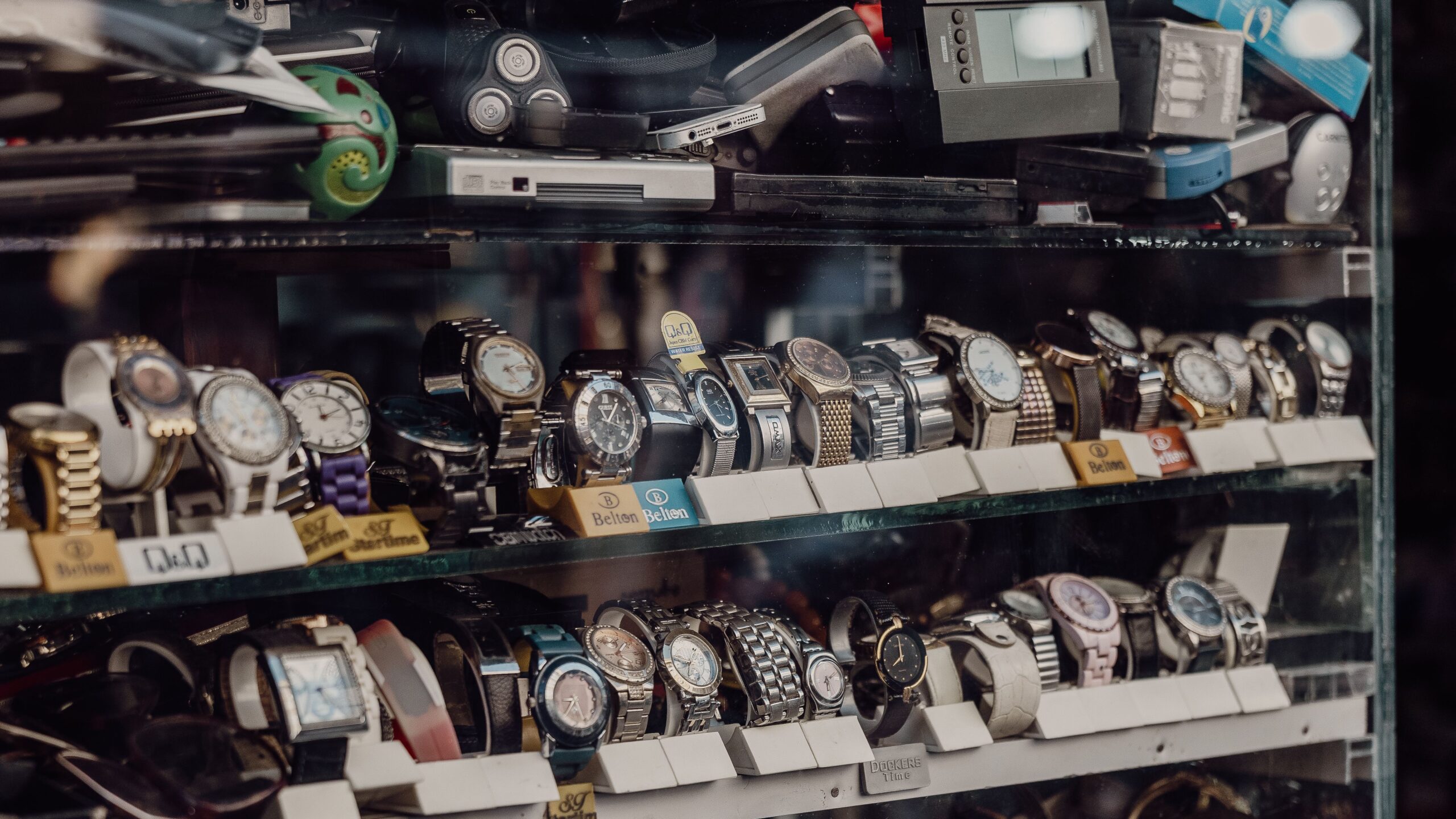
Delgado’s was a low brick building with bars on the windows. The man behind the counter was about seventy, with reading glasses pushed up on his forehead, and when I slid the receipt across to him and asked about the Hamilton, he looked at it, then looked at me, and something in his face softened.
“The fella that brought this in,” he said slowly. “Big guy. Tired-looking. Wouldn’t haggle. I offered him sixty and he said forty was fine, he just needed it quick.” He paused. “I see a lot of people in here on the worst day of their lives, ma’am. Most of ’em are angry. He wasn’t angry. He apologized to the watch. Said it out loud, like the watch could hear him. ‘Sorry, Pop.'”
And that was when my legs went, and the old man came around the counter and got me into a folding chair and brought me a paper cup of water while I cried in the middle of his shop with a child’s piggy bank clutched against my chest.
He hadn’t sold the watch yet. He told me, gruff, that he’d had a feeling about that one and set it in the back instead of the case. He charged me the forty dollars he’d paid, and nothing more, and when I tried to give him extra he wouldn’t take it. “Just bring the big guy back in someday,” he said, “so I can tell him I’m sorry I ever took it.”
I have thought about that man, the pawn shop owner, many times since. The world is full of more kindness than we let ourselves see, because we’re all so busy protecting each other from the storm.
No More Storms Alone
Eddie came home that night the way he always did. Washed up. Asked about my day. Smiled the big smile.
I had set the table with the good plates, the wedding ones we never used. He noticed, and a flicker of worry crossed his face — Eddie could read a set table like a weather report — and he said, too lightly, “What’s the occasion?”
“Sit down,” I said. “I made enough for two. Real plates. And you’re going to eat all of it, because I know you haven’t been.”
He started to say he’d already eaten at work, the old reflex, and then he looked at my face and the words died in his throat.
I put the toolbox notebook on the table between us. The budget. Whatever it takes. She rests. They never feel it.
For a long moment he didn’t move. My steady, unbreakable husband, the porch light, the man who shows up — he put his rough hands over his face and his shoulders started to shake, and for the first time in nineteen years he let me watch him cry, right there at the kitchen table, instead of in a stairwell where he thought no one could hear.
“I didn’t want you to be scared,” he managed. “The doctor said — he said keep her calm, and I thought if I could just hold it together until you were strong again, you’d never have to — I’m sorry. I sold my dad’s —” He stopped. He couldn’t say it.
“I know,” I said. “I know what you sold. I know about Meridian and the overnight shifts and the boots and the lunches. I know all of it, Eddie.”
“Carol, your heart —”
“My heart,” I said, “is going to break a lot worse watching you disappear than it ever would from the truth.”
I reached into my pocket and I set the watch on the table in front of him. His father’s Hamilton, with the worn leather band, ticking away like nothing had happened.
He looked at it like it had come back from the dead. He picked it up with both hands, and his face did something I had never seen it do — it just broke completely open, all the weather of that whole terrible year coming out at once.
“Lily gave her piggy bank,” I said, my own voice gone. “She wanted you to know it was from her. Because you gave her your lunch.”
And then I said the thing I had driven home from that pawn shop rehearsing, the thing I needed him to hear more than I’d ever needed anything.
“You don’t have to protect us from every storm by yourself, Eddie. That was never the deal. I didn’t marry a wall. I married a man, and I want all of him — the tired parts, the scared parts, the parts that can’t make the numbers come out right. You’ve been standing out in the rain for nine months so Lily and I could stay dry. Come inside. We’d rather get a little wet and have you in here with us.”
He reached across the good plates and took my hand, the way he had in a snowstorm and a NICU and a hundred ordinary nights, and for the first time all year, he didn’t tell me everything was fine.
He told me the truth.
All of it. The hours, the fear, the bottom of the toolbox. We sat at that table until two in the morning, and it was the hardest and the best night of our marriage, and not one single time did either of us pretend.
After
I wish I could tell you the money fixed itself overnight. It didn’t. That’s not how it works, and you’d know I was lying.
But things got better, the way they actually do — slowly, and together.
I went back to work part-time at a dental office once the cardiologist cleared me, answering phones and scheduling cleanings, and it turned out my heart could handle a great deal more than everyone had been so afraid of. Eddie quit the overnight job, because we made a rule that night at the table: no more secret second shifts, no more carrying it alone. Hartwell laid him off that summer after all, and it was awful, and we got through it because we got through it as two people instead of one man pretending.
He found work at a smaller shop across town. Less money, better hours. He’s home for dinner now. He eats off a full plate. He has new boots — I bought them and he let me, which is its own kind of love.
On Sundays now the three of us sit at the kitchen table and do the bills together, out loud, the scary envelopes and all. Lily has appointed herself the keeper of the calculator. It is not a fun hour, and we do not pretend it is, but no one in this house carries a number alone anymore, and there is a strange kind of peace in that — the peace of a weight set down in the middle of the table where everyone can get a hand under it.
And the watch is back on his wrist, where it belongs. He taps it twice with two fingers when he’s thinking, and now when I see him do it, I notice. I make myself notice. I will never again be too protected to see the man in front of me.
Donna came by again a few weeks ago, with another casserole, and she asked me — gently this time — if Eddie still lied to me.
I thought about it honestly. “No,” I said. “He stopped. The day he found out I’d rather have the truth than the shelter, he stopped.”
“So he doesn’t cheat on you anymore,” she said, smiling.
And I laughed, because here is the thing nobody tells you about a man like mine.
“Oh, he still cheats,” I said. “Last week he told me his shoulder didn’t hurt so I wouldn’t fuss. This morning he said the coffee I made was good, and it was terrible. He’ll spend the rest of his life trying to carry a little more than his share so the people he loves carry a little less. That’s just who he is. I’m never going to fully cure him of it.”
“Then why are you smiling?” she asked.
“Because now,” I said, “I cheat right back. I tell him I’m not tired when I am. I sneak the heavier bag of groceries. I love him in all the small, dishonest, beautiful ways he taught me, and we spend our days quietly trying to out-protect each other.”
That’s the secret I learned on the floor of a pawn shop on Route 9, with my daughter’s piggy bank against my chest.
My husband cheats on me every single day. He always will.
And it is, and will always be, the truest love I have ever known.

Ethan Blake is a skilled Creative Content Specialist with a talent for crafting engaging and thought-provoking narratives. With a strong background in storytelling and digital content creation, Ethan brings a unique perspective to his role at TheArchivists, where he curates and produces captivating content for a global audience.
Ethan holds a degree in Communications from Zurich University, where he developed his expertise in storytelling, media strategy, and audience engagement. Known for his ability to blend creativity with analytical precision, he excels at creating content that not only entertains but also connects deeply with readers.
At TheArchivists, Ethan specializes in uncovering compelling stories that reflect a wide range of human experiences. His work is celebrated for its authenticity, creativity, and ability to spark meaningful conversations, earning him recognition among peers and readers alike.
Passionate about the art of storytelling, Ethan enjoys exploring themes of culture, history, and personal growth, aiming to inspire and inform with every piece he creates. Dedicated to making a lasting impact, Ethan continues to push boundaries in the ever-evolving world of digital content.