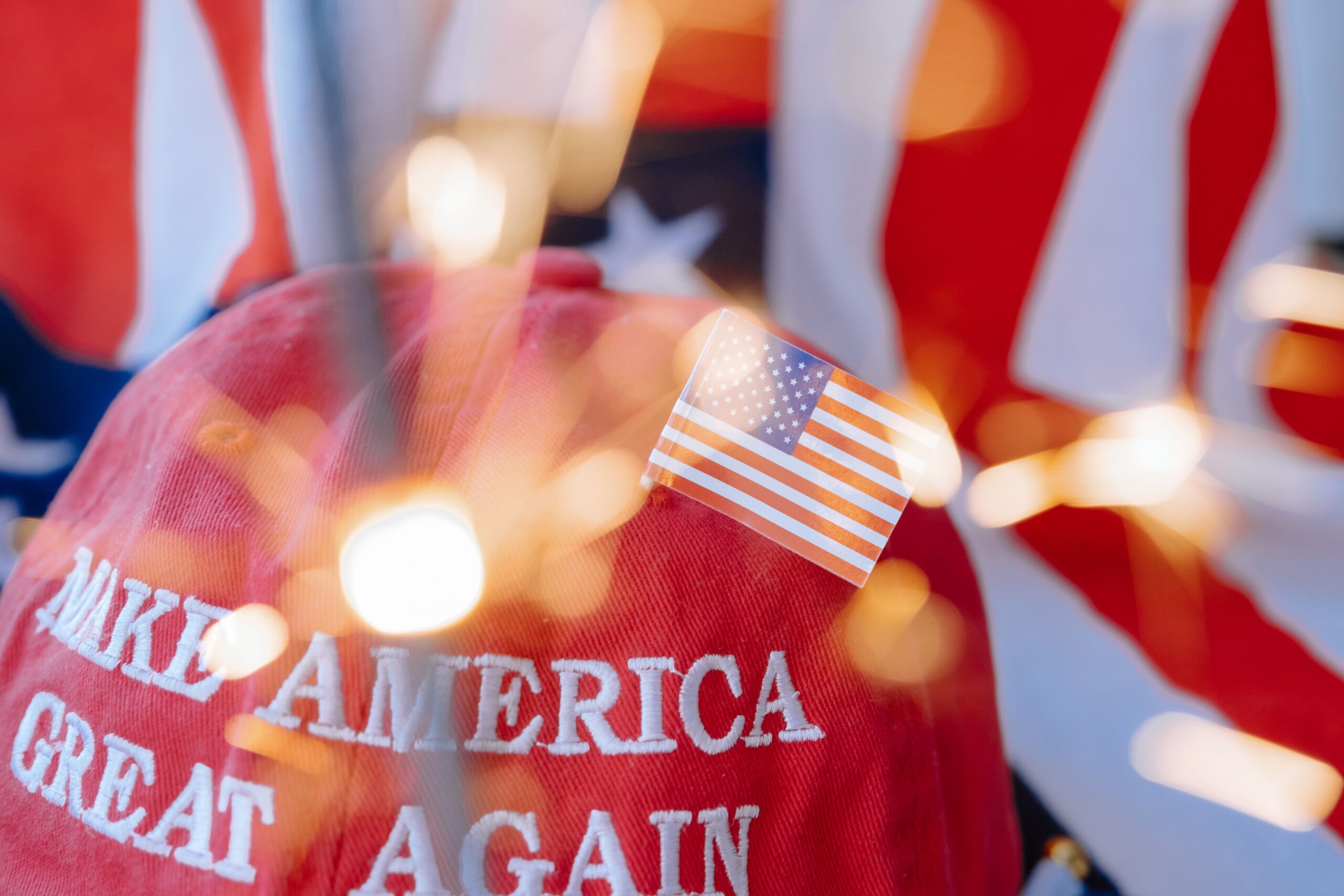
I found the hat on a Thursday afternoon while looking for a tire pressure gauge.
It was shoved beneath the driver’s seat of my husband’s truck, tucked so far back that I almost missed it entirely.
The bright red fabric immediately caught my eye.
For a few seconds, I just stared at it. Then I pulled it out.
My name is Rachel Harper, and after twenty-two years of marriage, I thought I knew every secret my husband was capable of keeping. I was wrong.
Mark and I had built a life together in a small North Carolina town where everybody knew everybody. We weren’t rich. We weren’t flashy. We were the kind of family that spent Friday nights at high school football games and Sunday afternoons helping neighbors move furniture.
That’s why finding the hat felt so strange. Not because of politics. Because it didn’t belong to him.
I knew that instantly.
The hat was old. Faded. Sweat-stained. The stitching along one side had begun to fray. This wasn’t something recently purchased. It had history. And somehow my husband had hidden it from me.
That evening I carried it into the kitchen and placed it on the table between us.
Mark looked at it once. Then his entire expression changed.
I had seen that look only twice before. The day his father died. And the day we buried our son.
Suddenly the hat wasn’t just a hat anymore. It was a wound.
“Where did you find that?” he asked quietly.
I told him. For a long moment he said nothing. Then he sat down. And for the first time in twenty-two years, my husband told me a story he had never shared with anyone.
The hat had belonged to his older brother, Daniel. The brother I never met. The brother nobody in town ever talked about. The brother whose photograph disappeared from every family album after an argument that tore the family apart decades earlier.
The brother who vanished.
The Story Mark Never Told
Mark turned the hat over in his hands as if it might come apart in them.
“His name was Daniel,” he said. “He was four years older than me. And for thirty years, I let this whole town believe he was the worst thing that ever happened to it. To save myself.”
I sat down across from him. The porch light clicked on outside, the way it did every evening, and I remember thinking how ordinary the night was, how it had no idea what it was about to hold.
I’ll be honest about what had run through my head all afternoon, because I’m not proud of it. I had built a dozen small, ugly theories about that hat. I’d wondered if it belonged to another woman. I’d wondered if my own husband had been hiding some belief, some anger, some whole half of himself he thought I couldn’t love. I had braced myself, on the drive home, to meet a stranger.
I was not braced to meet a ghost.
The Night On Miller’s Road
Thirty years ago, Mark was nineteen years old, and Daniel was twenty-three.
There had been a party out at the lake, the kind every small town has, with a bonfire and a cooler and too many young people who thought they were immortal. Mark had been drinking since the sun went down. So had a girl named Katie Mercer, nineteen, who everybody in town adored — homecoming court, church choir, the whole bright future ahead of her.
When the party broke up near midnight, Mark got behind the wheel of his father’s truck with Katie in the passenger seat. He was, in his own words that night in our kitchen, “too drunk to find my own feet.”
He doesn’t remember the curve on Miller’s Road. He remembers headlights, and then he remembers the world turning over, and then he remembers being on his hands and knees in the wet grass with the truck on its side and a silence that was somehow louder than any sound.
Katie Mercer died before the ambulance reached them.
Mark told me he can still smell that night when he closes his eyes — gasoline and crushed grass and the copper smell of blood — and he can still hear the one cricket that kept on chirping somewhere in the dark, as if nothing in the world had changed, while a girl who was supposed to grow old lay still in the wet ditch and his life quietly ended and restarted as something cheaper.
And Daniel — who had followed them in his own car because he didn’t trust how much his little brother had been drinking, who had been a hundred yards back the whole time trying to wave Mark over — Daniel was the first one to the wreck.
“He pulled me out of that driver’s seat,” Mark said, and his voice had gone somewhere far away. “He had maybe ninety seconds before the first headlights came over the hill. And he made a decision in ninety seconds that cost him his entire life.”
By the time the sheriff’s deputy arrived, Daniel was sitting in the driver’s seat. And Daniel said he had been the one driving.
What Daniel Did
It was a lie everyone wanted to believe, which is the most dangerous kind.
Daniel was the older brother, the wild one, the one who’d already gotten a speeding ticket and a reputation. Mark was the good son, the careful one, the one their father had decided long ago was going to make something of himself. When Daniel said he’d been driving, no one looked twice. Why would the golden boy take the blame for the troublemaker? It made no sense. So the lie became the truth.
Daniel pleaded guilty to driving under the influence and vehicular manslaughter. He served six years.
Mark went to the courthouse on the day of the sentencing. He sat in the back row with his hands shaking, certain that at any moment he would stand up and shout the truth and end the whole charade. He didn’t. He watched the judge call his brother a danger to the community. He watched them lead Daniel out in handcuffs. And Daniel, passing the row where Mark sat frozen, turned his head just slightly and mouthed two words: be good. Then he was gone through a steel door, and Mark walked back out into the sunshine a free man.
Their father never visited him once. Not in six years. The old man stood in our same kitchen, Mark said, the night of the arrest and told Daniel he was dead to him — that he’d killed a beautiful girl and dragged the family name into the dirt. Daniel didn’t argue. He couldn’t. The argument would have ended with Mark in that cell instead.
“He looked at me across that room,” Mark said, “while our father screamed at him, and he gave me the smallest shake of his head. Just barely. It meant don’t. It meant let me. It meant I’ve got this, little brother, the way he’d been saying it our whole lives.”
And Mark, nineteen and terrified and weak in the exact way that ruins people, said nothing.
He let his brother carry it. He let his brother walk into a courtroom and take the blame for a death that belonged to Mark. He told himself, for thirty years, that he hadn’t asked Daniel to do it, as if that made him innocent.
“I have never told that to a living soul,” Mark said. “Until tonight.”
The Years Of Silence
When Daniel got out of prison, there was nothing left for him here. A town that called him a killer. A father who’d erased his photographs. A mother too frightened of her husband to fight for her own son.
So Daniel left. He didn’t say where. He simply drove out of town one gray morning and did not come back, and the Harper family closed over the empty space he left like water closing over a stone.
They took his pictures out of the albums. They stopped saying his name at Thanksgiving. When people asked, they said Daniel “moved away,” in the flat tone that tells you not to ask the next question. Within a few years, it was as if he had never existed at all.
Mark married me two years after Daniel disappeared. He sat across from me on our first dates — I remember this now with a chill — and talked about tire pressure and serpentine belts because, I think, it was the only territory in his life that didn’t have a body buried in it.
He never told me he had a brother. For twenty-two years, I believed Mark was an only child. I had no reason not to. There was no photograph to contradict him, no name on a Christmas card, nothing. An entire human being had been edited out of my husband’s history before I ever arrived, and I married into the silence without ever knowing it was there.
The Boy We Named Daniel
There is a detail I have to tell you here, because it is the hinge the whole story turns on, and it is the part that still takes my breath.
When our son was born, Mark wanted to name him Daniel.
He didn’t tell me why. He just said he’d always loved the name, that it felt strong, and I thought it was sweet and I agreed. We called him Danny. He had Mark’s stubborn chin and my mother’s laugh, and he was the joy of both our lives for twelve years before the leukemia took him.
I used to catch Mark watching Danny across a room with an expression I couldn’t read — something soft and grieved and grateful all at once. I thought it was just the way fathers look at sons they’re afraid of losing. I know now he was looking at two people at the same time.
I have stood beside my husband at exactly one grave that destroyed him, and it was our boy’s.
But there was a man at Danny’s funeral I didn’t know.
He stood at the very back, in a dark coat, an older man with Mark’s same shoulders and a face I couldn’t quite see. I noticed him only because he wept the entire service — silently, helplessly, a stranger crying for my son as if the loss were his own. When I turned to find him afterward, he was gone.
I asked Mark about him once, years later. He said he hadn’t seen anyone. I let it go.
That night in our kitchen, with the red hat between us, Mark finally told me who that man was.
“That was Daniel,” he said. “I don’t know how he knew. I never told him. But somehow my brother found out that I’d named my son after him, and that the boy had died, and he drove all night to stand in the back of a church and grieve a nephew he was never allowed to meet — for a brother who never deserved it.”
“And I let him slip out the back,” Mark whispered. “Again.”
The Secret Mark Kept
It was Danny’s death, in the end, that broke the spell.
“I buried my son,” Mark told me, “and I thought, I am not going to spend whatever I have left letting the people I love disappear into the dark while I keep quiet to feel safe. I’d already done that once. I couldn’t do it twice.”
So six years ago, Mark went looking for his brother. He didn’t tell me — and I understand now why, though it cost me something to understand it. To tell me where he was going meant telling me everything: Miller’s Road, Katie Mercer, the ninety seconds, the lie. He wasn’t ready. He wasn’t sure I’d ever look at him the same way again.
He found Daniel in a small town in Ohio, working as a mechanic, living alone in a tidy little house with a dog and a vegetable garden. An ordinary, quiet man who had built an ordinary, quiet life out of the wreckage someone else had handed him.
“I knocked on his door,” Mark said, “and I was ready for him to slam it in my face. I’d have deserved it. And he just looked at me for a long second, and then he said, ‘Took you long enough, little brother,’ and he hugged me, and we both stood on his porch and cried like we were boys again.”
They had six years.
I have spent a lot of nights since trying to picture those weekends — my husband, who I thought was at a fishing cabin, sitting instead in a stranger’s kitchen nine hours away, slowly becoming a brother again. Mark says the first thing Daniel ever cooked for him was breakfast for dinner, eggs and bacon at nine at night, because that’s what their mother used to make them on the good days before everything broke. They ate it without saying much. Some kinds of forgiveness don’t need a lot of words. They just need somebody to show up and sit down at the table.
Mark would invent a fishing trip, or a work conference, and drive nine hours to spend a weekend with the brother he’d thrown away. They talked about everything and nothing. Daniel had grown into a man who wore that faded red hat every single day and had opinions Mark didn’t always share, and they’d argue about all of it across the kitchen table and it never once mattered. “He was my brother,” Mark said simply. “You don’t have to agree with your brother to love him with your whole heart.”
Daniel never asked Mark to confess. He never wanted the truth told. “It’s done,” he’d say. “I made my peace with it the day I sat down in that seat. Let it stay buried.”
For six years, my husband had a brother again. And he carried that, too, in secret, alone — the joy of it on top of the guilt of it — because the whole thing was woven through with a truth he couldn’t bring himself to give me.
The Phone Call
Four months ago, Mark told me he was going fishing.
He came back three days later looking like a man who had aged a decade, and when I asked what was wrong he said he was just tired, just coming down with something, and I believed him because I had no reason in the world not to.
Daniel had died of a heart attack in his tidy little house in Ohio. He was fifty-three years old. A neighbor found him. Mark was listed in his phone, the only family Daniel had let back in, and so it was Mark who got the call, Mark who drove through the night, Mark who stood almost entirely alone at the funeral of a man this town would have told you died thirty years ago.
“There were six people there,” Mark said. “A coworker. Two neighbors. The woman from the diner he had coffee with. The man who runs the hardware store. And me. That was the whole life of the best man I have ever known, reduced to six folding chairs, because of a lie I let him tell to save me.”
He had brought home only one thing of Daniel’s. The hat. He hadn’t been able to make himself bring it into the house, so he’d shoved it under the seat of his truck, where he could go and sit with it alone, the way some men go and sit at a grave.
That was the grief I’d seen flicker across his face when I set it on the table. The third time. The one he thought he’d have to carry by himself forever.
He told me he sat in his truck in our own driveway for almost an hour the night he got home from that funeral, holding the hat, not able to come inside and not able to throw it away, caught exactly between the two halves of a life he’d been keeping apart for thirty years. In the end he wedged it under the seat and walked in and asked me how my day had been. I had made meatloaf. I remember being mildly annoyed that he was so quiet at dinner. That is the thing about the people we love most — we can be sitting right across the table from the worst night of their life and never know it, if they’ve decided we shouldn’t.
What Was Tucked Inside The Hat
I picked the hat up off the table. I don’t know what made me do it. And when I turned it over in my hands, my fingers found something tucked up inside the sweatband — a square of paper, folded small and soft from handling, the way paper gets when someone has opened and refolded it a hundred times.
Mark went very still. He had never found it. He’d never thought to look.
It was Daniel’s handwriting, in pencil, the letters careful, the way a man writes when the words matter more than the speed.
It said: “Mark — if you’re reading this, then I’m gone, and you finally went through my things, you nosy kid. So listen to me one last time. It was mine to give. It always was. I have never spent one single night regretting it, because the math was simple — one of us got to have a life, and I wanted it to be you. Stop carrying it. That was never the gift. The gift was watching you live. Tell Rachel everything now. Let her love the whole man, not the half you let her see. And quit hiding my hat, you coward. Wear it. Argue with the TV. Be happy. That’s the only payment I ever wanted. — D.”
I read it out loud because Mark couldn’t. By the end neither of us could see.
Setting It Right
We sat at that table until the sky started going gray, and somewhere in those hours, Mark stopped being a man with a secret and became, finally, just my husband again — all of him, the brave parts and the broken parts and the thirty years of weight he’d never set down.
I won’t pretend I wasn’t hurt that he’d kept it from me. I was. But sitting there, I understood that he hadn’t been lying to deceive me. He’d been doing the same thing his brother did on Miller’s Road — standing in front of someone he loved to take the blow alone. It runs in that family like a stubborn chin. And I told him what Daniel had spent six years trying to tell him: that the people who love you would rather share the weight than be protected from it.
Two weeks later, Mark did the bravest thing I have ever seen a person do.
He drove to the small brick house where Katie Mercer’s mother still lives, the woman who had spent thirty years believing Daniel Harper killed her daughter, and he sat in her living room and he told her the truth. All of it. That it was him behind the wheel. That his brother had taken the blame. That he had let an innocent man be called a murderer for three decades to save himself.
I went with him. I held his hand the whole way and I have never been prouder to be anyone’s wife.
Mrs. Mercer was eighty-one years old. She listened to the whole thing without saying a word. And when Mark finished, shaking, waiting for her hatred, she reached over and put her papery hand on top of his and said, “Thank you for giving me back the truth before I die. And son — Katie wouldn’t want you to carry it either. Neither of you. Put it down.”
There were no charges. The statute had long run out, and the only people left to judge Mark had decided, somehow, on mercy instead.
In the spring, we brought Daniel home. We buried his ashes in the Harper family plot, beside the father who disowned him and the nephew who bore his name, under a stone that finally, after thirty years, says his real name out loud. Half the town came. People who’d whispered about him for decades stood at that graveside and learned, all at once, what kind of man he had actually been.
I watched faces change at that graveside. I watched a town rewrite a man in real time — the killer they’d carried in their heads for thirty years dissolving and reassembling into someone who had loved his little brother enough to give up everything and never once send a bill for it. A few of the older folks cried. One man, a retired deputy who’d worked the scene that night, came up to Mark afterward, shook his hand a long time, and couldn’t get a single word out. He didn’t have to. Some apologies are just a handshake that goes on too long.
After
The hat sits on the mantel now, beside a photograph of Daniel that Mark dug out of a box in the attic — one the family had missed, somehow, when they erased him. A young man with Mark’s shoulders, squinting into the sun, laughing at something just out of frame.
Some Saturdays, Mark takes the hat down and wears it out to the garage and putters around with the radio on, and yes, he argues with whatever’s playing, the way his brother told him to. I don’t always share what’s on that hat. It doesn’t matter. It never did. It’s not a political statement on my husband’s head. It’s a brother’s hand on his shoulder, finally allowed to rest there in the open.
People ask me, sometimes, how I felt when I found out the man I’d been married to for twenty-two years had been keeping a secret that big.
And I tell them the truth.
I went looking for a tire pressure gauge, and I found a faded red hat under a truck seat, and I thought I knew exactly what it meant. I thought it was something small and shameful and hidden.
I was completely wrong.
It was the largest, most generous, most heartbroken love I have ever come close to — a love that gave up an entire life without ever once asking for thanks. It had been sitting under that seat the whole time, waiting thirty years for someone to finally bring it into the light.
I’m just grateful I’m the one who got to carry it in.

Laura Bennett writes about complicated family dynamics, difficult conversations, and the quiet moments that change everything. Her stories focus on real-life tensions — inheritance disputes, strained marriages, loyalty tests — and the strength people find when they finally speak up. She believes the smallest decisions often carry the biggest consequences.