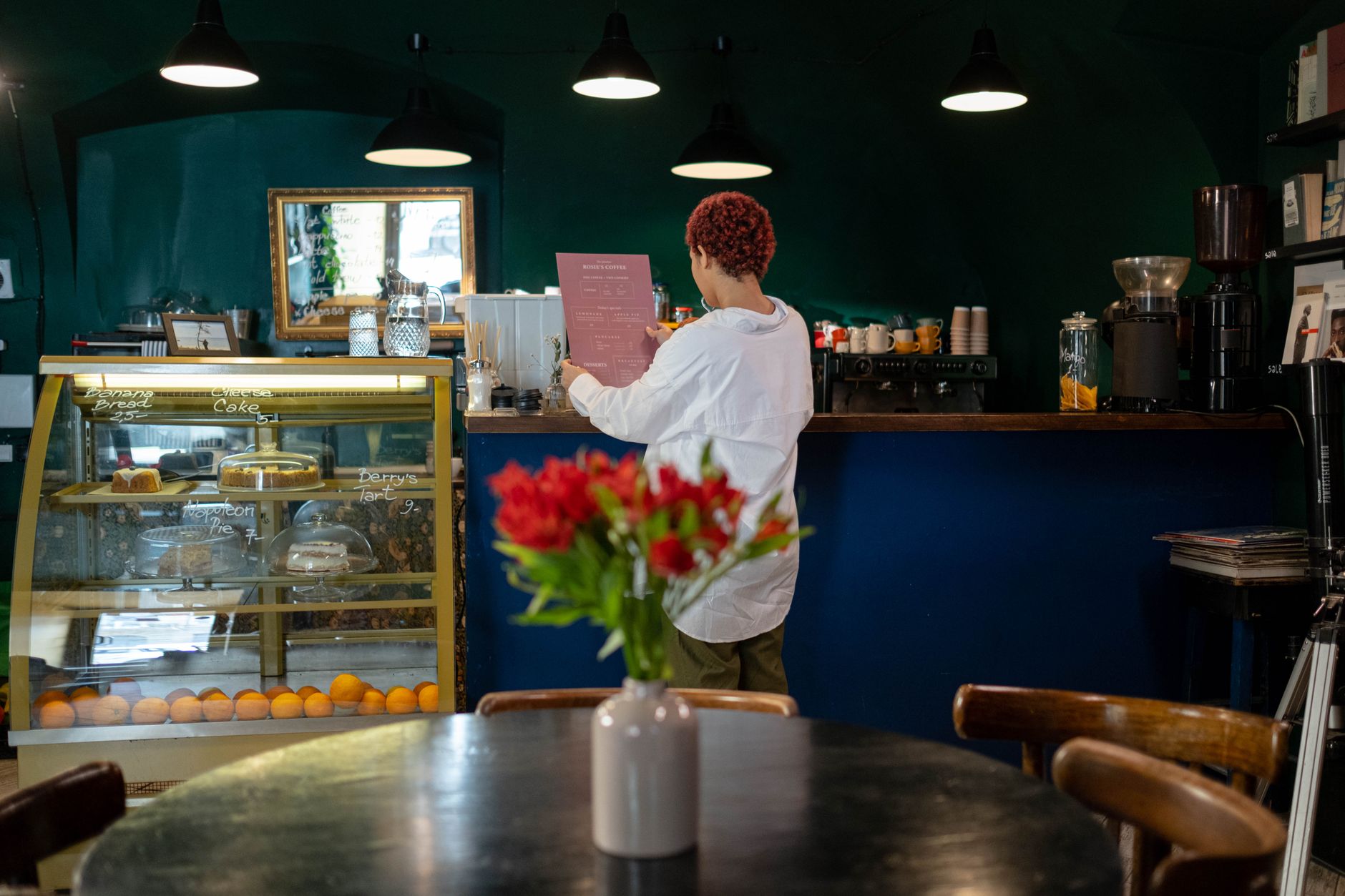
The first thing the new owner said to me, after he had owned the place for exactly four days, was that I should smile more. He said it the way men say it, not as a request but as a correction, and then he stood there in the doorway of the kitchen in his good shoes and watched me carry three plates up one arm to a table of truckers who tipped better than he ever would.
I am sixty-three years old. I have worked at the Route 9 Diner since I was nineteen. I want you to understand what that number means before I tell you the rest, because everything that happened after only makes sense if you understand the years first. Forty-four years. I have poured coffee at that counter through four presidents and two of my own husbands and one funeral I never thought I would walk away from. I have worked the breakfast rush so many thousands of mornings that my body wakes at four-fifteen on its own, on Christmas, on the days I have nowhere to be, the way a farm animal wakes whether or not there is anyone left to feed it.
And on the fourth day of his ownership, a man named Brandon Tisdale told me to smile more, and then he told the room, loud enough for the regulars to hear, “She’s been here forever. Don’t mind her. She’s just a waitress.”
Just a waitress.
I have thought about those three words more than I have thought about almost anything else in my life. I have turned them over the way you turn over a stone you found in your shoe, looking for the sharp edge. He did not even say it to hurt me. That is the part people get wrong when I tell this story. He was not cruel the way you imagine cruelty, red-faced and shouting. He said it the way you would describe a fixture. The way you would point at the old ceiling fan and say, that thing’s been here forever, it’ll probably outlast the building. He said it kindly, almost. He smiled while he said it. And that was so much worse than if he had screamed, because a man who screams at you has at least noticed you are a person. Brandon had decided I was furniture, and he was simply telling the room which piece.
I want to tell you what I did in that moment, because it is the truest thing about me. I smiled. I said, “More coffee, hon?” to the trucker nearest me, and I poured it, and my hand did not shake, and nobody in that room knew that something had just gone very quiet and very still inside me, the way the air goes still before the kind of storm that takes the roof off.
I want to tell you the whole thing. It takes a while. It took me nine years.
The diner before him
Let me tell you about the diner first, because you cannot understand what was taken unless you understand what it was.
The Route 9 Diner is not on a postcard. It sits on a state road between two towns that nobody famous has ever come from, a long low building with a counter and twelve booths and a parking lot that floods in the spring. The sign out front is original, 1961, a great steel arrow that used to light up in pink neon before the transformer died in 1998 and the previous owner decided pink neon was a luxury a place like ours could not afford. I always loved that sign. Even dark, you can see the shape of it against the sky when you pull in before dawn, and for forty-four years that arrow pointing down at the door was the first thing I saw every working morning of my life.
I started in 1981. I was nineteen and pregnant and married to a man named Dale who I will not spend many words on, because he did not spend many years on me. The owner then was a woman named Ruth Kessler, a widow who ran the place with a cigarette in one hand and a spatula in the other, and Ruth hired me because, she said, I had the look of a girl who would show up. I did not know what that meant at nineteen. I know now. Showing up is the entire job. Showing up is most of life. Ruth taught me the counter, taught me how to carry, taught me how to read a room of tired men and know which ones wanted to talk and which ones wanted to be left alone with their eggs. She taught me that the coffee is never really about the coffee. People do not come to a diner for the food. The food at the Route 9 was fine, never famous. They came because somebody knew their name and their order and asked about their daughter’s surgery. They came to be seen. I was the one who saw them.
Ruth died in 1994. The diner went to her nephew, a decent man named Carl who lived three states away and did not want it but could not bring himself to sell it, so for almost thirty years Carl let it run itself, which mostly meant he let me run it. There was a manager on paper, a series of them, but the regulars knew. If you wanted to know whether the freezer was going out or the new cook was any good or whether we could squeeze in your daughter’s graduation breakfast for twenty on a Sunday, you asked me. I made the schedules. I trained every cook and every kid who ever tied on an apron. I knew which supplier was shorting us and which dishwasher was stealing and exactly how much money sat in the register on a good Saturday, because I was the one who counted it.
I never owned a single percent of it. It never occurred to me that I could. I was a waitress. That is the box the world puts you in at nineteen, and the box is comfortable, and forty years go by, and you have been inside it so long you stop checking whether the lid is even on.
Then Carl got old and tired the way we all do, and in the spring of the year I want to tell you about, he sold the Route 9 Diner to a man named Brandon Tisdale.
The new owner
Brandon was forty-one when he bought us. He had made some money, the way men make money now, in something to do with buying buildings and selling them, and he had a notion, he told us all at the first staff meeting, that a place like the Route 9 was “an underleveraged asset with real upside.” He actually said that. To a room of cooks and waitresses with a combined hundred and fifty years behind that counter, he said the word underleveraged, and he smiled like he had handed us a gift.
He was not a monster. I have to keep saying that, because the story is more dangerous if you think he was. He did not yell. He did not steal wages, not technically. He was pleasant in the way of a man who has read that you should be pleasant. What he was, was certain. He was certain that nothing of value had happened at the Route 9 before he arrived, and that everyone in it who was older than the espresso machine he installed was a cost to be managed.
He cut my hours first. Not cruelly. He framed it as a kindness. “You’ve been carrying this place forever,” he told me, in the cramped back office that I had organized and he had taken over. “Let’s get some younger energy on the floor. You can step back.” Younger energy. He hired two girls, nineteen and twenty, and put them on the good shifts, the breakfast rush where the tips are real, and he moved me to the slow afternoons, the dead hours between two and five when the only customers are old men nursing one cup for an hour and the tip jar barely covers the gas to get there.
He changed the menu. He took off the chicken-fried steak that the Tuesday-night regulars had eaten every Tuesday night for two decades because, he said, the margins were poor. He was right about the margins. He did not understand that the Tuesday-night regulars were not eating for the margins. He raised the coffee to three dollars and cut the free refills, and old Walt Henley, who had bought a cup of our coffee five mornings a week since Nixon, set three dollars on the counter, looked at me, and never came back. I watched a forty-year customer leave over a dollar, and Brandon counted the extra dollar a win.
There was one morning I think about more than the rest. A girl named Crystal had called out sick, one of the young ones, and the breakfast rush hit hard, and a coffee urn jammed and overflowed across the line, and Brandon stood in the doorway in his good shoes watching me clear it without stepping in to help, because helping was not, he had decided, the owner’s job. A trucker at the counter, a man named Earl I had served for fifteen years, watched Brandon watch me, and Earl said, quiet, “You ever think about taking care of the people taking care of you, son?” And Brandon laughed it off, and after Earl left, Brandon said to me, almost confiding, “These old guys. They think the world owes them a refill.” That was the morning I understood he could not even see the people who had kept the lights on. He saw a line item where Earl sat. He was going to lose all of them, one Earl at a time, and call it cost control.
And he said it, that fourth day. Just a waitress. He said it to a regional manager he had brought in to “assess operations,” a young man with a clipboard, gesturing at me the way you gesture at a problem you have inherited. She’s been here forever. Don’t mind her. She’s just a waitress.
I have told you I smiled. I have told you my hand did not shake. Here is what I did not tell you. That night, after close, I sat in my car in the flooded parking lot under that dark steel arrow, and I did not cry, which surprised me. I had expected to cry. Instead I felt the stillness, the storm-coming stillness, and out of it came one clear sentence, the way a single light comes on in a dark house.
I thought: he does not know what this place is worth, and I am the only one who does.
What I knew that he didn’t
Here is what Brandon Tisdale did not understand about the Route 9 Diner, because he had owned it for four days and I had run it for thirty years.
He did not understand that the building was the smallest part of the value. He had bought a building and a liquor-adjacent license and some old equipment. He thought that was the diner. But the diner was not the building. The diner was the fact that the high school let out at three-fifteen and four hundred teenagers walked past our door, and the ones whose parents had eaten there brought their own kids. The diner was the volunteer fire company two miles down that held its monthly meeting in our back room and ordered ninety dollars of pie every time. The diner was the trucking outfit on Route 9 whose drivers knew that ours was the only counter for thirty miles where a man could get a real breakfast at five in the morning and a woman would call him by name. The diner was the funeral home across the road that sent every grieving family to us afterward, because where else do you go after a burial but a warm booth and somebody kind.
None of that was on the deed. All of it was in my head, and in the relationships I had built one cup at a time across four decades. Brandon could fire me. What he could not do was buy what I knew, because he did not even know it existed.
And here is the second thing he did not understand, the thing that became the whole story. Carl, the previous owner, had not sold Brandon the building. He had sold him the business and leased him the building. The building, the land, that great pink arrow, all of it still belonged to Carl Kessler, three states away, who held the lease and counted the rent and otherwise never thought about us at all.
I knew that. I knew it because I had handled the rent checks for Carl for twenty years. I knew it because Carl, who trusted me, had told me things over the phone across two decades that an owner does not usually tell a waitress, including the fact that he was getting old and his children wanted nothing to do with an old diner on a state road in a county they had never visited, and that one of these days he was just going to be rid of the land and the headache both, for whatever a tired man takes to make a headache go away.
The night Brandon called me just a waitress, sitting in my car under the dark arrow, I understood for the first time in my life that the box I had been living in had no lid on it after all. I had been folding myself small inside it for forty years out of habit. I was the only person alive who knew both halves of the secret: how much the Route 9 was truly worth, and that the most valuable piece of it, the land it stood on, was quietly for sale to anyone who knew to ask Carl Kessler.
I did not have the money. Let me be clear about that. A waitress does not have the money to buy land, not on the tips Brandon left me in the dead afternoon hours. But I had something I had not known I had until that night. I had time, and I had patience, and I had a thing no younger person can fake, which is the long view of a woman who has already lost almost everything and survived it. I knew how to show up. Ruth taught me that at nineteen. Showing up is the entire job.
So I made a plan, alone, in a flooded parking lot, at sixty-three years old. I gave myself nine years, because that was how long the lease Brandon signed would run, and because nine years was how long I had waited tables at this very diner to save the money to leave Dale, back in another life, so I knew exactly what nine years of saving felt like in the body. I had done it once. I could do it again.
I would buy the ground out from under him.
The nine years
I am going to tell you how a sixty-three-year-old waitress buys a diner, because I think people imagine it must have been some dramatic stroke, a lottery, a long-lost inheritance, and it was nothing like that. It was the least dramatic thing in the world. It was exactly as boring and exactly as hard as it sounds. It was nine years.
The first thing I did was call Carl. Not to make an offer. I had nothing to offer. I called him the way I had called him for twenty years, to ask about his health and tell him the fire company still met in the back room, and somewhere in that call I said, gentle, the way you set a hook so soft the fish never feels it, “Carl, when you do decide to let the land go, will you give an old friend the first chance? I might know somebody.” He laughed. He said, “Honey, you find me a buyer who’ll keep my aunt’s sign lit, and the price is yours.” He thought he was being kind to an old waitress with a sentimental streak. He had just promised me the first right of refusal on the most valuable thing in my life, and he did not even know he had done it. I wrote down the date of that call. I write everything down.
Then I began to save. I will not pretend it was clean. Brandon had cut my hours, so I picked up work I had not done since my twenties. I cleaned two churches on Sunday afternoons after the diner closed. I did the books for the funeral home across the road, because I was good with numbers and the director’s wife had passed and he could not face the ledgers. I took in sewing. I sold my husband’s truck, the second husband, the good one, who had died and left me the truck and not much else, and it broke my heart to sell it and I sold it anyway and put every dollar in a separate account I told nobody about. I lived on almost nothing. I have always lived on almost nothing. That is one thing a lifetime of being underestimated teaches you. You learn to need very little, and need-very-little is a kind of power, though nobody tells you that when you are young and ashamed of being poor.
And while I saved, I did the other thing, the patient thing, the thing Brandon would never have thought to do because he believed value lived in a building. I protected the diner. I kept the regulars. When Brandon cut the chicken-fried steak, I learned to make it at home and I brought it, off the books, on Tuesday nights, and I told the Tuesday regulars to keep coming, that the steak would be back, to just hold on. They held on. When he raised the coffee, I started a quiet little custom of my own. The old men who could no longer afford three dollars, I rang up at two and made up the dollar from my own apron, and I told them it was a discount Brandon had approved, and Brandon never knew, because Brandon never worked the dead afternoon shift where the old men were. He thought I had been exiled to the slow hours as a punishment. I had been handed, instead, four hours a day, five days a week, alone with the soul of the diner, free to keep it alive while he was off underleveraging assets.
I want you to see what was really happening, because it took me years to see it myself. Brandon thought he had sidelined me. What he had actually done was put the one person who understood the diner in sole, daily, unsupervised charge of its heart, while he managed the spreadsheet of its corpse. He ran the numbers down year after year, cutting the things that made people loyal, and he could not understand why the place felt like it was slowly dying even though his costs were under control. It was dying. He was killing it. And every afternoon I was breathing into it just enough to keep it alive until I could take it back.
Years went by. I want to be honest about the years, because nine years is not a montage. There were stretches where I thought I was a foolish old woman with a fantasy, sewing other people’s hems and counting coins in a coffee can like a child. My knees went bad. I started kneeling on a folded towel to clean the church pews on Sundays, and some afternoons I came home and sat in the dark with my swollen feet in a basin of Epsom salt and did the arithmetic of my secret account one more time, the way other women my age might say a rosary, the same numbers over and over until they put me to sleep. I had a calendar in a kitchen drawer where I marked every deposit in pencil, a little x for each one, and on the bad nights I would take it out and look at the rows of little marks, two years of them, three, four, and they were the only proof that the thing was real and not a story I was telling a tired woman to keep her getting up at four-fifteen.
I had a scare with my heart in the seventh year, a night in the hospital with wires on my chest, and I lay there thinking I would die before I ever saw it through and it would all have been for nothing, a secret account and a dead woman’s diner and a man who never even knew he had been in a race. The nurse who took my history asked what I did for a living, and I said, out of forty years of habit, “I’m just a waitress,” and lying there in the dark with the monitor counting my heart out loud, I heard the word just come out of my own mouth, and something in me went cold and clear. I had been saying it about myself my whole life. He had only said out loud the thing I had agreed to a thousand times. But I did not die. I went back to work in three days because I could not afford not to, and because, lying in that hospital bed, I had understood something that put the iron back in me. I had understood that Brandon calling me just a waitress was not the insult I had taken it for. It was the truest thing anyone ever said about me, and the strongest. I was a waitress. I had been one for forty-four years. And being a waitress had taught me every single thing I needed to take everything he had: patience, invisibility, the long memory, the soft hook, the art of being underestimated by a man holding all the cards. He had handed me the weapon when he handed me the name.
The day I had enough
It took until the spring of the ninth year. I was seventy-two by then. The lease Brandon signed had eleven months left to run, and Carl Kessler was eighty-six and tired in a way I could hear over the phone now, the way you can hear the bottom of a coffee pot when it pours thin.
I had the money. Not a lot more than I needed. I had saved, that whole nine years, every dollar I could press out of a life already pressed thin, and I had the down payment and the bank had looked at the diner’s books, the real books, the ones that showed what the place still earned even half-killed, and the books I could show them of what it had earned before Brandon and could earn again, and a loan officer named Patrice who was fifty-eight and had waited tables herself in college looked at me across her desk and said, “Let me see what I can do.” Women who have carried trays know each other on sight.
I called Carl. I did not set a soft hook this time. I said, “Carl, it’s me. I’m the buyer. It was always going to be me.” And there was a long quiet on the line, and then that old man laughed until he coughed, and he said, “Well, I’ll be damned. The waitress.” And he said it the way you say something with love, not the way Brandon said it. He said, “You kept the sign lit all these years anyway, didn’t you. Sign’s yours. Land’s yours. Always should have been.” He sold me the land and the building and the great pink arrow for a number that was fair to both of us, the number a tired man takes to be free of a headache, given to the one person who had never once let him down in thirty years.
I signed the papers on a Thursday morning before the breakfast rush, at Patrice’s desk at the bank, and then I drove to the diner and tied on my apron and worked the lunch shift, because Brandon still owned the business for eleven more months and I was still, on paper, his afternoon waitress, and nobody at the Route 9 knew that the ground their boss stood on now belonged to me.
I worked those eleven months. I want to tell you I made them pleasant for him, and I did, because cold patience beats hot revenge every time and I had learned that lesson from forty years of biting my tongue. I smiled more, like he asked. I poured his coffee. I let him explain the business to me, the business I had run for thirty years, and I nodded. I was waiting for the lease.
The renewal
It came in the fall. Brandon’s lease was up, and he assumed, the way he assumed everything, that renewal was a formality. He had paid his rent to a property management company the whole time, a faceless account Carl had used so he would never have to be bothered, and Brandon had no idea Carl had sold. Why would he. You do not check who owns the ground under you when you are certain you are the most important person standing on it.
The management company sent him the renewal terms. New ownership, the letter said, would not be renewing the lease, and the tenant was given the standard notice to vacate the premises at lease end. Brandon came storming into the diner with that letter in his hand, and for the first time in nine years I saw him red-faced, the certainty cracked, and he was demanding to know who in God’s name had bought the building out from under him and how he was supposed to find a new location for a diner that was, he kept saying, his life’s work now, his community, his family.
His family. Nine years too late, he had figured out the thing about the diner that was never on the deed. He had finally learned that the value was the people and the place and the forty years of trust, and he had learned it at the exact moment it was being taken from him, the way I learned the lid was off my box at the exact moment Brandon set it on the floor.
I was wiping down the counter when he stormed in. I let him rage at the room for a minute, at the unfairness of it, at the faceless owner who had blindsided him. And then I dried my hands on my apron, the apron I had tied on at that diner for forty-four years, and I said the only thing I had wanted to say for nine years.
“It’s me, Brandon.” I did not raise my voice. I have never raised my voice. “I bought it. The building, the land, the sign. I’ve owned the ground you’ve been standing on for almost a year now.” The room went still, all my regulars, the truckers and the fire company men and old Walt Henley who had come back the day I quietly put the free refills on the old men’s checks. “Your lease is up,” I said. “And I’m not renewing it. You can take the business name with you. You can’t take the building, and you can’t take them,” and I nodded at the room, at the people, at the only thing that had ever made the place worth anything. “They were never yours to begin with.”
He said, and I will remember it the way I remember the day he first insulted me, “You can’t do this. You’re a waitress.”
“I know,” I said. “I’m the best one you ever met. That’s how I bought your diner.”
What I built back
Brandon left at the end of his lease. He kept the name, the Route 9 Diner being technically his, so I renamed mine. I called it Ruth’s, after the woman who hired a scared pregnant nineteen-year-old in 1981 and taught her that showing up is the entire job. I had that great steel arrow rewired and lit, pink neon again for the first time since 1998, and on the night they switched it on I stood in the flooded parking lot at seventy-three years old and watched it burn pink against the dark, and that time I did cry, in the good way, the way you cry when a thing you carried alone for nine years finally gets to be heavy in someone else’s hands too, because the whole town turned out to see the light come back on.
I put the chicken-fried steak back on the menu the first day. I put the free refills back. I rang the old men up at the price they could afford, out in the open now, no apron money, just the policy of the house, because it was my house. I rehired one of the young girls Brandon had brought in, the kinder of the two, and I taught her the counter the way Ruth taught me, and I told her the thing nobody had told me until I was forty years too far in to need it: that the box has no lid, that the world will call you just a waitress and you should let it, because they will never see you coming.
I am seventy-five now. I work the counter most mornings still, not because I have to, but because four-fifteen wakes me whether or not there is anyone to feed, and because the counter is where I have always been most myself. The regulars know who owns the place. The new ones do not, and I like it that way. They see an old woman in an apron pouring coffee and they put me in the box, and I let them, and I smile, and I pour, and somewhere a man named Brandon Tisdale is running a spreadsheet somewhere and still does not understand what happened to him.
He told me to smile more. So I do. I smile every single morning, under a pink arrow that is lit again, in a diner that is mine, with my own name on the loan and a dead friend’s name over the door. He called me just a waitress.
He had no idea what one of those can do.

Specialty: Quiet Comebacks & Personal Justice
David Reynolds focuses on stories where underestimated individuals regain control of their lives. His writing centers on measured decisions rather than dramatic outbursts — emphasizing preparation, patience, and the long game. His characters don’t shout; they act.