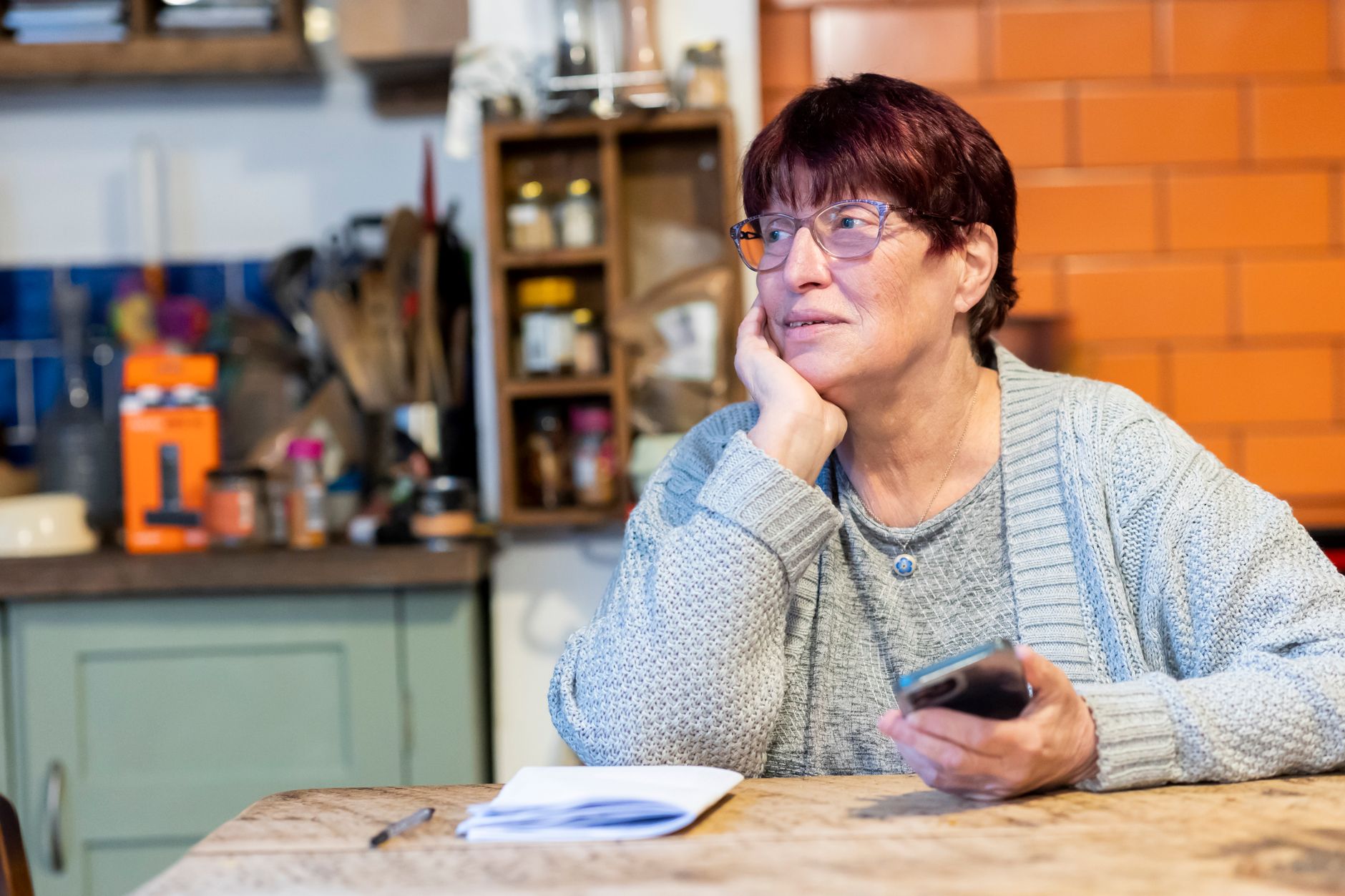
I am seventy-one years old and I have a flip phone in a drawer that I miss every single day.
My granddaughter Mara talked me into the smart one. She came over on a Tuesday two Decembers ago with a box and a roll of those little gift bows, and she stuck a bow on the box like the phone was a present she was giving me, when really it was a project she was assigning herself. She is twenty-six and she works in what she calls “user experience,” which as far as I can tell means she gets paid to be patient with people exactly like me.
“Grandma,” she said, “you are the heart of this family and you are unreachable. You answer the house phone like it’s 1987. I’m fixing it.”
So she sat at my kitchen table for three hours and set the whole thing up. She put everyone in there. All my children, both my sons and my daughter. The in-laws. The grandchildren. The two great-grandbabies who can’t read yet but whose mothers post their pictures. She made me a little folder of faces, and under each face she typed the name and, bless her, a tiny note so I would remember who was who. “Robert (son, the tall one). Denise (Robert’s wife, allergic to shellfish, don’t forget at Thanksgiving).”
And then she made what she called a group. A family group chat. She named it “The Whole Crew.” She showed me how a message I typed would go to every single person at once, like standing in the middle of the living room at a reunion and saying one thing and having all of them hear it.
“This is for announcements,” she said. “Birthdays. Who’s bringing what. Snow days. You type once, everybody gets it. No more calling fourteen people.”
I want you to hold onto that. One thing, and all of them hear it. Because that is exactly what went wrong, and it is also, in the end, exactly what went right.
—
I should tell you about the part of my family that doesn’t get put in folders.
I had three children grow up in my house, but I have loved more than three. When my kids married, I did the thing I think you are supposed to do. I opened the door wide. I did not love my children’s spouses as “in-laws.” I loved them as more children, late-arriving ones, the kind you don’t have to potty train, which is the best kind.
There was Daniel. He married my daughter Carol when they were both twenty-three and broke and certain. Daniel called me “Ma” from the second week. He fixed my gutters every fall without being asked. He learned my husband’s chili recipe before my own son bothered to. For eleven years Daniel was at every table I set.
And there was Sang. Sang married my youngest, my son Peter. Sang is the gentlest man I have ever met, a pharmacist, the kind of person who notices when your refill is due before you do and texts you about it. He brought me orchids, not the grocery store kind, the real kind, and when one died he would quietly replace it so I wouldn’t feel I’d killed it. For nine years Sang sat at my left at Christmas because he said the light from the window was best there for taking pictures of the food, and Sang loved the food.
And then, the way it goes sometimes, both marriages ended. Not in the same year, but close enough that the two holidays in between felt like a house with the furniture moved.
Carol and Daniel split when their youngest started middle school. Nobody did anything villainous. They just turned into two people standing in a kitchen who had run out of things to say that weren’t logistics. It was a quiet, sad, civilized thing, and somehow that made it worse, because there was no one to be angry at. Daniel hugged me at the door the last time and said, “Ma, I’m not going to be a stranger.” And then, because life is busy and divorces are awkward and nobody knows the etiquette, he became a little bit of a stranger. Not from anger. From not knowing he was still allowed.
Peter and Sang ended differently, with more hurt in it, the kind where people say things at the end they spend years wishing back. There was a stretch where Peter wouldn’t say Sang’s name. Where I learned not to bring him up. The orchid on my windowsill from that last Christmas finally died and I didn’t tell anyone, and I didn’t replace it, because I didn’t know who I’d be replacing it for.
Here is the thing nobody tells you about being the grandmother, the matriarch, the so-called heart of the family. When two people divorce, the family picks a side, and the side it picks is usually blood. That’s natural. That’s how it’s supposed to work, they tell you. But nobody asks the old woman in the middle who she misses. Nobody considers that I had spent eleven Thanksgivings learning Daniel’s laugh and nine Christmases learning where Sang liked to sit, and that you do not unlearn a person just because a marriage certificate got filed away.
I missed them. I missed them like you miss a room in a house you used to live in. I kept both their numbers in my old flip phone and I never called, because what would I say, and Mara, when she set up the smart phone, copied every single contact over.
Including theirs. Two faces in the folder with no note under them, because she didn’t know who they were.
Let me tell you one thing about each of them, so you understand what I had lost, because a list of years doesn’t tell you anything. Eleven years, nine years. Numbers. Here is what numbers don’t hold.
The fall before Daniel and Carol split, my furnace died in October, the cold kind of October where you can see your breath in the hallway. I was a widow on a fixed income and a new furnace was four thousand dollars I did not have, and I did not tell my children because I did not want to be a burden, which is the proudest and most foolish thing an old woman can be. Daniel found out anyway, because Daniel noticed things. He came over on a Saturday with a space heater “he wasn’t using,” and he sat at my kitchen table and got on the phone with three different furnace men and argued them down, and then he and my son Robert installed a reconditioned unit themselves over a weekend, and Daniel never once let me see the receipt, and to this day I do not know how much of it he quietly paid. That is the kind of son in law he was. The kind who keeps you warm and won’t let you thank him for it.
And Sang. The winter my eyes first started going, before I admitted it to anyone, I mixed up my blood pressure pills and my husband’s old heart pills that I’d never thrown out, and I took the wrong ones for nearly a week and felt like I was dying and thought it was just old age coming for me. It was Sang, the pharmacist, who figured it out over Sunday dinner, watching me, asking quiet questions, and then going to my medicine cabinet without making a fuss and coming back and saying, “Ma, let me organize these for you.” He built me a little plastic box with the days of the week on it and he filled it himself every Sunday for two years, and he never told Peter, never told anyone, because he didn’t want them to worry that Grandma was slipping. He just quietly kept me alive on Sunday afternoons and let me keep my dignity.
Those are the two men the family decided I wasn’t allowed to keep. The one who kept me warm and the one who kept me alive. And I let them go, both of them, because that’s what you do, they told me, that’s how it works.
—
Now. The accident.
It was the second Sunday of December, two years ago. I had a thing to announce. We had finally settled the great war of where Christmas dinner would be held, which had gone on for weeks, because Robert’s wife Denise had redone her dining room and wanted to host, and my daughter Carol said the drive was too far in the snow, and three different group texts had been spawned like rabbits.
I wanted to end it. I wanted to be the matriarch and lay down the law in one clean message to The Whole Crew. So I sat at my kitchen table with my reading glasses down on my nose and I typed it out, slow, one finger.
“Alright everyone. Christmas dinner is at MY house this year, 2 o’clock, December 25th. No more debating. I am cooking the turkey, Denise is bringing the green beans, Carol is on pies. Bring nothing else but yourselves and an appetite. I love you all. This is final. Love, Mom / Grandma / Great-Grandma.”
I was proud of it. It was firm. It had a joke in it. I felt like a general.
And then I went to send it to The Whole Crew. But the smart phone, you understand, does not have The Whole Crew sitting there waiting. You have to find it. And there is a little bar at the top where you type the first letters and it guesses. I typed “The,” and a list dropped down, and I tapped the top one because my eyes are what they are and the top one is always the right one, that’s how it worked on the flip phone’s call log, the top one is the most recent.
Except the top one was not “The Whole Crew.”
The top one was a new chat the phone helpfully invented for me when I’d fat-fingered something the week before, and into it, in my haste, I had at some point added names by tapping faces that looked familiar in the folder. I did not know I had done this. I do not to this day fully understand how I did this. Mara has tried to explain it and I have decided it is one of God’s mysteries.
What I know is this. When I hit send, my Christmas decree did not go to The Whole Crew.
It went to a chat with seven people in it, and two of those people were Daniel and Sang.
—
I did not know yet. I set the phone down. I felt like a general. I made myself a cup of tea.
The phone buzzed. I figured it was Denise confirming the green beans.
It was Daniel.
“Ma???”
Just that. Ma, with three question marks.
I will tell you my stomach went straight through the kitchen floor. I picked up the phone with both hands, the way you pick up something hot, and I read the little screen and I saw, at the top, the faces. And there, where there should have been fourteen familiar people, there were seven, and two of them were faces I had not seen at my table in years.
I had just invited my two ex sons in law to Christmas dinner. By accident. In a message that ended “This is final.”
I am not a woman who panics. I raised three children and buried a husband and I once removed a bat from a church social hall with a butterfly net. But I sat there at that table and I felt seventy-one years old and I felt like I had walked into the living room at the reunion and said the one thing, the one wrong thing, and all of them had heard it.
I started typing an apology. My hands were shaking, so it came out as “So sotry, wrong chta, plese ignore,” and before I could fix it the phone buzzed again.
Sang.
“Mrs. Albright, is this real? Are you having Christmas?”
He’d written my name the formal way, Mrs. Albright, the way he used to before he called me Ma too, and seeing him pull back to “Mrs. Albright” after years away broke something open in my chest. He sounded so careful. He sounded like a man who had been told he wasn’t allowed in the house and was checking, very gently, whether the locks had been changed.
And I looked at his careful little question, and I looked at my half-typed apology, “So sotry, wrong chta,” and I had a moment, sitting at that table, where I had to decide who I was going to be.
I deleted the apology.
I am not proud of how long I sat there with my thumb over the delete key. The apology was the easy thing. The apology was the side-picking thing, the blood thing, the thing that would smooth it all over and put both those faces back in the drawer. “Wrong chat, so sorry, ignore me.” Everybody would have. Daniel would have said “no worries Ma!” and gone back to being a stranger. Sang would have said “of course, sorry to bother you” and gone back to being Mrs. Albright’s former son in law, the gentlest man I ever met, exiled for the crime of a marriage that ended.
I deleted the apology. And instead I typed, slow, one finger, the truest thing I have ever sent on that phone.
“It is not the wrong chat.”
I sat there. I added: “I have missed you both. If you’ll come, the door is open. 2 o’clock. I mean it. Bring nothing but yourselves. Love, Ma.”
And I hit send before I could be a coward about it.
—
Now I need to tell you about the next four minutes, because in fifty-one years of marriage and motherhood I am not sure I have lived four more frightening ones.
Because the chat I had accidentally sent to was not just Daniel and Sang. It had five other people in it too, names the phone had grabbed, and two of those names were my son Peter, Sang’s ex-husband, and my daughter Carol, Daniel’s ex-wife.
So when Daniel typed “Ma???” and Sang typed “is this real,” those questions did not arrive in a private little corner. They arrived in front of Peter. In front of Carol. In front of two of my grandchildren who’d also gotten swept into the accidental chat.
My phone went quiet for ninety seconds. The worst ninety seconds. I could see the little dots appear and disappear. Someone was typing and deleting. Someone else was typing and deleting. I imagined Peter seeing Sang’s name light up after two years and I closed my eyes.
Then Carol wrote.
My daughter Carol, who had not said Daniel’s name without a flat tone in three years, wrote: “Dan, your gutters still hold up better than the new guy’s. You should come. Mom makes too much turkey anyway.”
I read it four times. There was a joke in it. After three years of logistics-voice, my daughter had made a joke at her ex-husband, warm, the old way, in front of everyone.
And Daniel wrote back, fast, like he’d been holding it: “Carol I have thought about that turkey every December. I’m in if I’m really invited. Ma, am I really invited?”
“You are really invited,” I typed. “You were always invited. I just didn’t know how to say it.”
And then there was Peter.
Peter was the one I was afraid of. Peter is my youngest and he carries things hard and the end of his marriage to Sang had teeth in it. I watched the dots start and stop, start and stop. I almost called him. I almost did the mother thing and pulled him aside out of the group, but something told me, no, let him decide in front of everyone, the same way the hurt happened in front of everyone.
Peter wrote: “Sang.”
Just his name. The way Daniel had written “Ma???”
Then, a long pause. Then: “I didn’t know my mom still had your number.”
Then, longer pause. Then, and I am going to remember this until I die: “She kept your orchid on the windowsill for a year after. I saw it every time I came over. I never said anything.”
Sang wrote back: “It died last spring. I’m sorry. I should have come and watered it.”
And Peter wrote: “Come water it. Come for Christmas. I’m not. I’m not okay yet. But I don’t want you to be a stranger to her because of me. She loved you. That part was real.”
I put the phone down on the kitchen table and I cried the way you cry when something you’d given up on quietly turns out to still be alive. Big, ugly, grateful crying, alone in my kitchen, over a group chat, at seventy-one years old.
—
I’d love to tell you it was tidy after that. It wasn’t. It was a family, and families are not tidy, they are just families, which is better.
The chat, once it got going, did not stop for three days. I have never seen anything like it. Once the dam broke, everybody had something to put in the river.
Denise, Robert’s wife, who is new enough to the family that she’d never met Daniel or Sang, wrote: “I have no idea who half of you are but I am crying at my desk and I am bringing TWO casseroles of green beans now.” Robert wrote: “babe you don’t even like those people yet.” Denise wrote: “I like them now. I’ve decided.”
My grandson Tyler, who is nineteen and communicates exclusively in what I am told are memes, sent a picture of a cartoon character wiping away a tear, and for once I understood it perfectly.
Mara, my granddaughter, the one who set the whole phone up, the one who started all of this, called me. Not texted. Called, on the phone, like it was 1987.
“Grandma,” she said, and her voice was thick. “Grandma, what did you do.”
“I hit the wrong chat,” I said.
“You did not hit the wrong chat,” she said, and she was half laughing and half crying. “Grandma, I have been trying to fix this family for three years with shared calendars and reminder apps and nobody comes to anything. You hit one wrong button and Uncle Sang is coming to Christmas. I’m in the wrong line of work.”
“It was an accident,” I told her.
“It was not an accident,” she said. “You could have apologized and you didn’t. I know you, Grandma. You saw the wrong names and you decided to keep them.”
She was right. I have stopped calling it an accident. The phone hit the wrong chat. I hit send on purpose.
—
I want to tell you about that Christmas, because that is the part you came for, and because I have learned that the audience for a story like mine wants the table, not just the texting.
They all came. All of them. I had to borrow chairs from my neighbor and a card table from the church, and we put the card table on the end of the real table so it made a long crooked line down the middle of my house, and nobody could agree whose section was the “kids’ table” because the whole thing was one table now, which I think was the point.
Daniel came an hour early with a ladder in his truck. I opened the door and before he even said hello he looked up at my gutters, which had a sag in the corner I hadn’t mentioned to anyone, and he said, “Ma, how long has that been like that?” and I said, “Since about the year you left,” and he didn’t say anything, he just got the ladder.
He fixed my gutters in his Christmas sweater while the turkey was in the oven. Carol came out onto the porch with two mugs of coffee and handed one up to him on the ladder, and the two of them, divorced three years, stood in the cold and talked about their kids’ grades while he cleaned the leaves out of my gutter, and through the kitchen window I watched my daughter laugh at something her ex-husband said, the real laugh, the one from her belly, and I had to sit down at the table again.
While Daniel was up on that ladder, the rest of them started arriving, and I want you to know what my house sounded like, because I had forgotten what it was supposed to sound like. For two Christmases my house had been quiet and correct, the right number of people being polite to each other. This was not that. Denise came through the door with her two casseroles of green beans and immediately got into a loud, delighted argument with my grandson Tyler about whether her grandmother’s recipe or the internet’s recipe was correct, and they were both wrong, and I told them so, and they both got offended, and it was wonderful. Robert had three of the grandbabies hanging off him like he was a tree. Somebody put on the old records, the real ones, my husband’s Nat King Cole Christmas album, and the house got loud and warm and full in a way that fogged up the windows.
I stood in my kitchen with a wooden spoon and I watched it through the doorway and I thought, this is what I gave up. This noise. We had all agreed to be quiet and correct and small, and I had forgotten that a family is supposed to be loud and crooked and too big for the table.
Sang came at exactly two o’clock, because Sang has never been late to anything in his life. He stood on my porch holding an orchid. The real kind. The kind he used to bring.
“I didn’t know if I should,” he said. “About the windowsill.”
“Get in here before you let the heat out,” I said, which is matriarch for I love you, and he knew it, because he laughed and called me Ma for the first time in two years and walked into my house and went straight to the window over the sink and set the new orchid down in the exact spot where the old one had died.
Peter did not come. I want to be honest with you, because a story that lies to you isn’t worth your time. Peter was not ready, and Peter did not come, and I felt that empty chair all afternoon the way you feel a tooth that’s gone.
But here is what Peter did. About an hour into dinner, my phone buzzed, in the accidental chat, the one that started all this. It was Peter. He’d written: “Is he there? Is Sang there?”
And I wrote back, “He’s at the window. He brought you an orchid too. There’s a second one. He said it’s yours.”
And the dots started and stopped for a long time. And then Peter wrote: “Tell him I said the light’s good there. For the pictures.”
I read that out loud at the table. The whole crooked table went quiet. And Sang, my gentle Sang, the gentlest man I ever met, stood up at my Christmas dinner with a napkin still tucked into his collar and he walked to the window and he took a picture of the food in the good light, the way he used to, and he sent it to Peter. Just the food. No words. The turkey and the green beans, two casseroles of them, and the pies, in the good window light.
Peter wrote back one thing. He wrote: “Perfect. Save me a plate.”
He didn’t come that year. But he asked us to save him a plate, and we did, and I drove it to his apartment myself that night, and he met me at the door and took it and we stood there and he cried into my shoulder in the hallway of his building like he was nine years old. And the next year, the next Christmas, Peter came. Peter came and Sang came and they sat at opposite ends of the long crooked table, not together, not back together, but in the same room, passing the same green beans, and that, I have decided, is its own kind of healing. Not every broken thing has to be glued back exactly. Sometimes the people just have to agree to be in the same warm room. Sometimes that is the whole miracle.
—
Mara made me a new folder on the phone after that. She kept the group chat that I’d sent the accident to, the seven people, but she let me rename it. She showed me how. I took off “The Whole Crew” because that one was for announcements, who’s bringing what, snow days. This one needed a different name.
I named it “Everybody I Love.” I made her put Daniel back in it on purpose, and Sang, and I sat there with my reading glasses down on my nose and I learned how to add a person to a chat, slow, one finger, so that the next time it would not be an accident, so that the next time I let someone back in it would be because I chose them, button by button, face by face.
She watched me do it. “You’re getting good at this, Grandma,” she said.
“I had a good accident,” I said.
—
I am seventy-one years old and I still miss my flip phone, but I will tell you what I have learned, and then I’ll let you go.
We are so careful, in families, about the rules of who is allowed to love whom. When a marriage ends we draw the lines fast and we draw them by blood, and we tell the people on the wrong side of the line that they have to go, and most of the time we don’t even say it out loud, we just stop including them, and they are too polite to ask if they’re still wanted, and so a person who fixed your gutters for eleven years becomes a stranger over nothing but everybody’s good manners.
Daniel thought he wasn’t allowed. Sang thought he wasn’t allowed. They both spent years on my doorstep in their minds, hands raised to knock, sure the locks had been changed. And the truth, the whole stupid wonderful truth, is that the locks were never changed. Nobody had locked the door. We had all just stopped opening it, and stood on either side of it, missing each other, waiting for someone to be brave enough or foolish enough or old enough to not care anymore and just hit send.
I hit send. By accident, and then on purpose.
So if there is someone you stopped including, not out of anger but out of not knowing if you were allowed, I am going to tell you what a seventy-one year old woman with a smart phone she didn’t want has figured out. You are allowed. You were always allowed. The door was never locked. You just have to be willing to walk into the middle of the living room, in front of everybody, and say the one thing, and let all of them hear it.
The green beans are getting cold. There’s a plate with your name on it. The light’s good at the window.
Come in before you let the heat out.
Love, Ma.

Specialty: Legal & Financial Drama
Michael Carter covers stories where money, power, and personal history collide. His writing often explores courtroom battles, business conflicts, and the subtle strategies people use when pushed into a corner. He focuses on grounded, realistic storytelling with attention to detail and believable motivations.