The drought broke me before it broke the wheat.
I want to start there, because most people who knew me back then would have said it the other way around. They would have said the wheat went first, and the man followed. Aldous Reike, sixty-one years old, fourth-generation grain farmer in Sefton County, lost his crop and lost his nerve right behind it. That is the clean version, the version you could fit on a feed store bulletin board next to the auction notices. But the truth ran the other direction. The faith dried up in me a long time before the field did. The field was just the part everyone could see from the county road.
I had farmed that ground outside Hartwell my whole life. My grandfather Ottmar broke the first quarter-section of it behind a team of mares in 1911, and there is a photograph of him somewhere with his hand flat on a fence post like he was steadying the whole world with it. My father, Conrad, added the south eighty and the windbreak of cedars that still runs along the creek. By the time the land came to me, it was four hundred and twenty acres of wheat ground and a barn that leaned a little to the east, the way old barns lean toward the weather they have taken the most of. I knew every low spot that held water and every rise that lost it. I knew where the soil turned to gumbo after a rain and where it stayed light and quick. I thought knowing a thing that well was the same as being safe in it.
It is not. I learned that the spring my wife, Ileana, got sick.
—
She had a cough that would not leave through the whole of seeding. I told her it was the dust. We both told ourselves it was the dust, because that was a thing you could fix with a glass of water and a screen door, and the other thing you could not fix at all. By the time the doctor in Carthage said the word out loud, the winter wheat was already a green so dark and even that it hurt to look at it, the best stand I had put in for years. Ileana stood at the kitchen window that April and looked out at it and said, “Aldous, that is a beautiful field.” She said it the way you say a thing you are glad to have seen once.
She was gone by the second cutting of the alfalfa. Forty-one years we had been married. I was fifty-eight.
I am not going to tell you that I cursed God at her graveside, because I did not. I did something quieter and worse. I simply stopped expecting anything from Him. I went to the Hartwell Federated Church the Sunday after the funeral because Ileana would have wanted me to, and I sat in our pew, third from the back on the pulpit side, and when the congregation stood to sing I stood with them, and when they bowed to pray I bowed my head too. But there was nobody home behind my eyes. I was doing the shape of a thing that had emptied out. It was like driving a truck after the engine has seized, where you still turn the wheel and the wheels still answer, but nothing under the hood is alive.
Pastor Quill came out to the place a few times that first year. He was a young man, younger than my own son would have been, with a soft handshake and an honest face, and he sat at my kitchen table and let the coffee go cold and tried to find a door in me to knock on. I did not give him one. I was polite. I have always been polite. But I had decided, somewhere down where a man keeps his real decisions, that prayer was a thing for people who had not been paying attention. I had paid attention. I had watched a beautiful field and a beautiful woman and I had learned that the rain falls where it falls and the cells grow where they grow and there is no hand in any of it. The hand my grandfather steadied the world with in that photograph was just a hand on a fence post. That is all it had ever been.
So I farmed the way a man breathes in his sleep. The land did not need my faith. It needed seed and rain and a working combine, and I had two of those three most years.
Then came the year I am telling you about. The year it was just the one.
—
It did not rain in Sefton County from the middle of April clear through to the back end of July.
You have to understand what that means in wheat country, because the word drought gets used loose. A dry spell is a worry. A drought is a slow execution you are forced to watch from the front row. The winter wheat had come up fine on the fall and winter moisture, and through March it looked like it might be an ordinary year. Then the sky just closed. Day after day of that hard, bright, pitiless blue that a farmer learns to hate the way a sailor hates a flat calm. The forecasts kept promising a system out of the southwest, and the system kept dying over the Oklahoma line before it ever reached us. You would watch the radar at night, green and yellow blooming two counties away, and you would step out on the porch and the air would be dry as a struck match and you would know it was not coming. It never came.
By the middle of June, my wheat was waist-high and the color of weak tea. The heads had filled partway and then quit, the kernels inside shriveled to little hard pellets, what we call a shrunk crop. You could walk into the field and crush a head in your palm and pour out a thin trickle of grain that should have been a fat handful. The leaves had gone crisp at the edges. When the wind came across the field it did not move like a green sea anymore. It rattled. Four hundred acres of standing wheat, and it rattled like a basket of dry corn husks.
I stopped going to the church entirely that summer. I told myself I was too busy, which was a lie, because there was almost nothing to do but watch. The truth was I could not sit in that pew and listen to other people thank a God for His provision while my own provision stood out there in the heat turning to chaff. It felt like a joke I was not in on. So I stayed home and I drank coffee on the porch and I watched the field die by inches, and I felt the last thin thread of whatever I had left just quietly let go.
I did the math the way a farmer does, on the back of a feed receipt at the kitchen table. The crop, if I cut it, might make eight bushels to the acre on the good ground and nothing on the rest. The note at the Hartwell bank was due in the fall. I had not carried crop insurance the last two years, because the premium had gone up and I had decided, in my new wisdom about how the world really worked, that I could carry my own risk. A man who has stopped believing in providence will sometimes decide he is providence. That is its own kind of pride, and it cost me. With no insurance and a shrunk crop and the note coming due, I was looking at losing the south eighty at the least and possibly the home quarter, the ground my grandfather broke. I could see the auction sign already. I had seen them on enough other fences.
And here is the thing I am most ashamed of, so I will put it down plain. By the end of July, I did not even want to cut it.
—
I had a neighbor, Bertrand Volk, who farmed the section directly north of mine. He was a big slow man, seventy then, with hands like fence mauls and a way of standing at your shoulder without saying anything until you were ready for him to. He had buried his own wife six years before mine and had never once tried to give me advice about grief, which is the only reason I could stand to be around him. He came over the last day of July and we stood at the edge of my field and looked at it.
“You going to take it off?” he said.
“I do not know that it is worth the diesel,” I said.
Bertrand was quiet a while. Then he said, “Aldous, a man takes off what he has. Even if it is little. You take off what you have so the ground knows you are still its keeper.”
I did not have an answer to that. It sounded like the kind of thing Ileana would have said, and I did not want to hear it in his rough voice any more than I had wanted to hear it in Pastor Quill’s soft one. So I said something short and he let it lie, and he got in his truck and drove back north, and I stood there in the rattling field until the sun went down and the heat came up off the ground in waves I could see.
That was a Friday. On the Saturday, I did not go out to the field at all. I sat in the house with the curtains drawn against the heat and I did not eat much and I did not pray, and somewhere in the middle of that long bright afternoon I made the decision that I think a man only makes when the engine under his hood has truly seized. I decided I was done. Not with the harvest. With the farming. I would let the wheat stand and rot. I would let the bank take what it took. I was sixty-one and I was tired in a place that sleep does not reach, and there was no one left to take off a crop for. Ileana was gone. We never had the children we wanted. The land my grandfather steadied the world with was going to go back to whoever bid on it, and I found that I did not care, or had talked myself into not caring, which is the cheaper version of the same thing.
I went to bed early that Saturday. I remember thinking, with a kind of cold relief, that I would not have to watch the field anymore. I had decided not to look.
That is the man I was the night before the trucks came. I want you to have him clear, because the next part does not mean anything unless you have him clear. A man with the faith burned out of him, who had decided to lie down in the dust and let it cover whatever it covered. That was Aldous Reike. That was me.
—
I woke before light because I heard an engine.
It was that gray hour before dawn when the birds have not started and the air is the only cool you will get all day. I lay there in the dark and listened, and the engine was not one engine, it was many, a low braided rumble coming up the county road and not passing. Diesel engines, the deep idle of farm trucks and tractors, and under it the gritty sound of gravel turning over and over under a lot of tires. I thought, in the half sleep, that there had been a wreck on the road. Then I thought it was someone lost, looking for the Volk place. Then I came fully awake, because the sound had turned in off the road and was coming up my lane.
I got up and went to the window in my undershirt and I looked out and I did not understand what I was seeing.
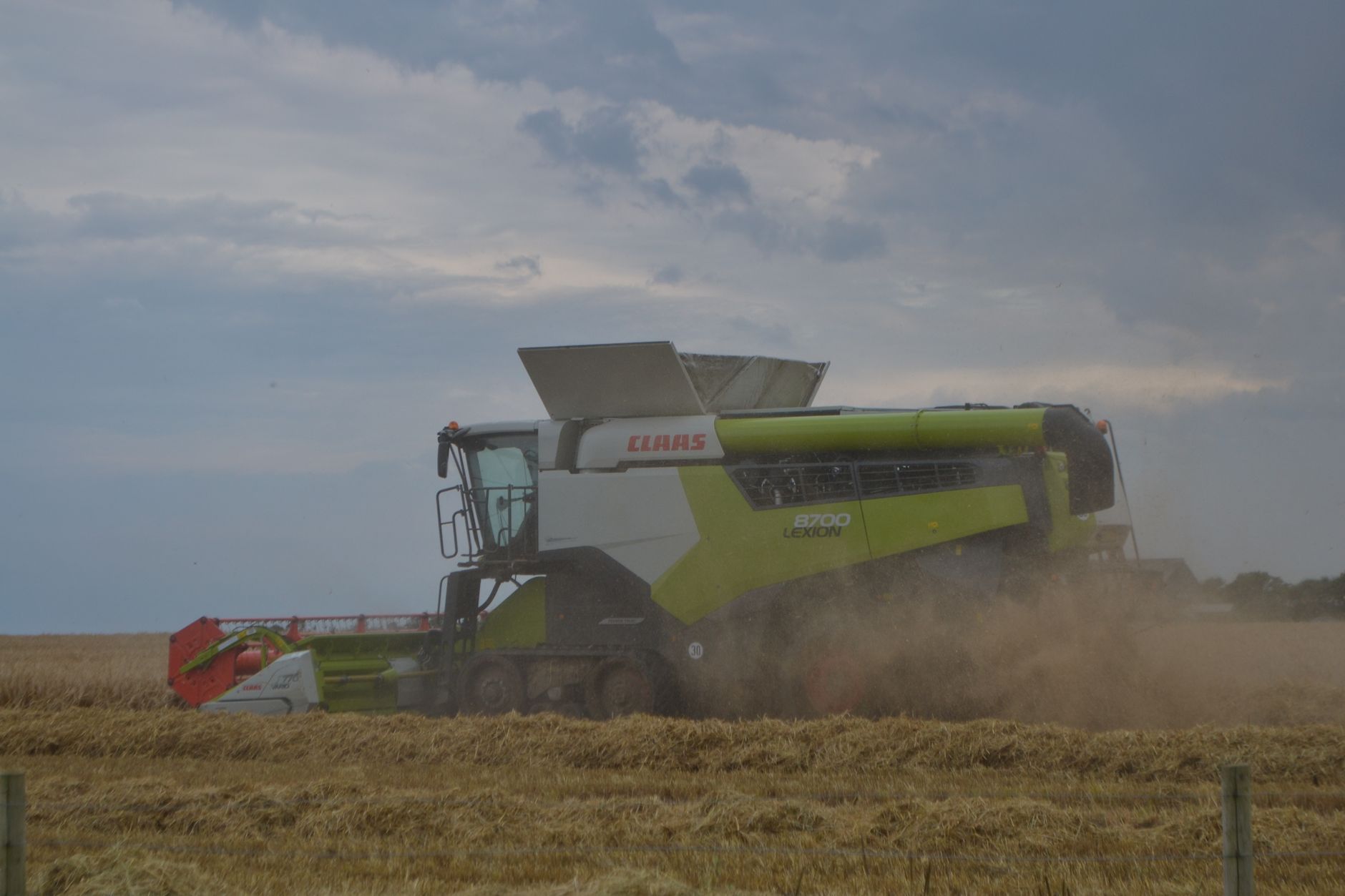
There were trucks. There were trucks all up my lane and spilling into the yard and lined along the field road, headlights cutting through the dust in long pale cones. Grain trucks, the big tandems, and pickups pulling grain carts, and I counted later, when I could count, near forty vehicles. And in the gray light I could see men and women climbing down out of them, and machinery being unloaded down ramps, and out at the head of my dying wheat field, lined up wheel to wheel like cavalry, were the combines. I counted six of them. Six combines, headers down, idling, their threshing drums already beginning to spin up with that rising mechanical whine that I have heard ten thousand times in my life and never once heard the way I heard it that morning.
They had come to bring in my harvest. The whole county had come to bring in my harvest, and not one of them had asked me.
—
I went out onto the porch in my undershirt and my work pants with my suspenders hanging down and I stood there with no shoes on in the gravel and I could not make my voice work. The first person to reach me was Bertrand Volk. He came up out of the half-dark with his old felt hat already gray with dust and he stopped at the bottom of my porch steps and he looked up at me, and his big slow face was doing something I had never seen it do. He was trying not to weep, and not managing it very well.
“Morning, Aldous,” he said, like it was any morning. “We figured your combine could use some company.”
“Bertrand,” I said. “What is this.”
“This is the harvest,” he said. “Now go put your boots on. You are not going to stand on your own porch and watch other men take off your wheat. That is not how this works.”
Behind him, the field was already filling with light and motion. The first combine had moved into the standing wheat, and I watched the header drop and the reel turn and the thin poor crop begin to feed in, and the chaff blew up gold and pink in the low sun, and I will tell you that the most ordinary sight in the world, a combine entering a wheat field at dawn, struck me that morning like the sky opening. Because I had decided not to look. And here was the whole county, looking for me.
—
Let me tell you who came, because the names matter, and I have carried every one of them since.
Bertrand Volk from the north section, with both his sons, Anselm and the younger one, Torsten, who had driven down from the city the night before when he heard. The Pruitt family from the Carthage road, all of them, the father Ezerine and three grown children and a daughter-in-law I had met exactly twice. Old Wendell Stam, who was past eighty and could not run a combine anymore but who came to drive a grain truck to the elevator and back, and who told me later that he had not slept a full night since he got the call, he had been too keyed up, like a boy before the fair. The Okafor family, who had bought the Henley place four years back and whom I am ashamed to say I had never once gone over to welcome, the way a neighbor is supposed to. Adaeze Okafor ran one of the six combines herself, a small woman in a man’s coveralls who handled that machine like she had been born in the cab.
The Hessman brothers came, Lorne and Cobb, who farmed up by the river and who I had quarreled with years back over a line fence and had not spoken a real word to since. Lorne came up to me in the yard that morning with his cap in his hand and said, “Aldous, that fence was a fool thing for both of us. I have been wanting to say so for ten years and I did not have the guts till now.” And we shook hands, and that was the end of ten years, just like that, in the dust with the combines going.
There was Halgren the implement dealer from town, who had brought a service truck and a man to keep the machines running, parts and tools and a welding rig, no charge, he said, do not even ask. There were the Lindquist sisters, Maren and Solveig, who ran the bakery in Hartwell and who had set up two folding tables in my yard before the sun was full up and were laying out coffee and cinnamon rolls and pans of eggs and sausage to feed an army, because that is what they had, an army to feed. There was Pastor Quill, in jeans and a feed cap instead of his collar, hauling fuel cans, and when he caught my eye across the yard he did not say a word about God or about the months I had stayed home. He just lifted a fuel can in salute and got back to work, and somehow that preached me a better sermon than any he had ever given from the pulpit.
And there was a boy. I have to tell about the boy. His name was Linus Pruitt, Ezerine’s grandson, nine years old, and he had been given the job of running cold water bottles out to the combine cabs, and he did it all morning at a dead sprint like the fate of the harvest rode on his small legs, and every time he handed a bottle up to a driver he said, “From the whole town,” because somebody had told him to say it, and he had decided it was the most important sentence in the English language. From the whole town. From the whole town. I must have heard that boy say it forty times before noon and it took the legs out from under me every single time.
—
I want to slow down here and tell you what it is actually like, because if you have never stood in the middle of it you will think this is just sentiment, and it is not sentiment, it is labor. Forty people and six combines and a dozen trucks do not make a harvest happen by feeling warmly about you. They make it happen by working until they cannot feel their hands.
The crop was poor, like I told you. Eight bushels where it was good and bare ground where it was not. That made the harvest harder, not easier, because a thin crop feeds unevenly and the combines have to crawl to set their machines for it and not just blow the light grain out the back. Adaeze Okafor stopped her machine three times in the first hour to climb down and check the tailings, scooping a handful from the ground behind the combine and frowning at it and climbing back up to adjust her settings until she was saving every kernel that field had to give. Nobody told her to do that. She did it because it was my grain and she was not going to waste a peck of it on the ground if she could help it. I stood and watched her do it and I thought about how I had lived next to those people for four years and never carried them so much as a pie.
By eight in the morning the heat was already building and the dust was a haze you could taste. The grain trucks ran back and forth to the Hartwell elevator in a steady relay, Wendell Stam and Torsten Volk and one of the Pruitt boys driving, and old Halgren on the radio coordinating it so there was always an empty cart waiting and never a combine sitting full with nowhere to dump. They had organized this. That is the part that undid me as the day went on. This was not forty people who happened to wander over with good intentions. Somebody had called somebody had called somebody. There were assignments. There was a plan. They had stayed up the night before, after Bertrand drove home from standing at my field with me, and they had built this whole machine of mercy in the dark, on their telephones, while I lay in my bed having decided not to look.
I found out later it was the Lindquist sisters who started it. Solveig had heard from someone at the elevator that Aldous Reike was not going to cut his wheat, and she had said to her sister, that night in the bakery kitchen, “Well, that is just not going to stand.” And the two of them got on the phone. And by morning it was the whole county.
—
I did not do much that first hour but stand in the yard and shake. I am not ashamed to say it now, though I was ashamed of it then. Bertrand finally took me by the arm and walked me out to the field and put me up in the cab of his own combine, in the buddy seat, and he ran it down the rows with me beside him and he did not say one word for twenty minutes. He just let me watch the wheat come in. The header gathering it, the poor thin heads feeding up the throat of the machine, the clean grain rising in the tank beside us a kernel at a time. And about halfway down the third pass, with the whole roaring machine around me and the dust rolling and the gold chaff flying, I put my face in my hands and I came apart.
Forty-one years married. A field my grandfather broke. A summer of standing on the porch waiting to be done. And the engine that had seized in me three years before, the one I had been turning the wheel of out of habit ever since, that morning it caught. I felt it catch. I do not have a better word for it. In the cab of Bertrand Volk’s combine, in the middle of the worst crop of my life, with my neighbors all around me bringing in a harvest I had given up on, something turned over in my chest that I had been sure was dead, and it ran.
I prayed for the first time in three years. It was not a holy prayer. It was barely words. It was just, over and over, thank you, thank you, thank you, and I could not have told you that morning whether I was saying it to God or to Bertrand or to the boy running water or to the whole county or to Ileana, and I have come to believe since that it does not matter, because it was all the same direction. Grace comes through hands. I had been waiting three years for it to come through the sky and it had been driving up my lane in a grain truck the whole time.
—
They finished the field at twenty minutes to four in the afternoon.
I know the time because Wendell Stam looked at his watch and called it out, and a kind of ragged cheer went up across the yard, the tired cheer of people who have done a hard thing together. The last combine came out of the last pass and lifted its header and the field behind it was bare gold stubble, four hundred and twenty acres of it cut clean, every kernel that drought had left taken off and trucked to the elevator and weighed in under my name. It made far more than I would have made cutting it alone, because they had run it so careful, saving grain my own hurried hands would have blown out the back. It was still a poor crop. It was still a hard year. But it was harvested, and the difference between a poor harvest and a field left to rot is the difference between a man who has a chance and a man who has lain down in the dust. They gave me back my chance.
And here is what they did then, which I did not expect and which I think about most of all. They did not make a speech. They did not gather me up in the middle of the yard and tell me what they had done and wait for me to thank them. Farmers do not do that. They began, quietly, to load up. Combines went back up onto trailers. Folding tables came down. Fuel cans went back into truck beds. Adaeze Okafor washed the dust off her face at my yard pump and shook my hand and said she was glad to meet me properly at last and that I should come for supper sometime, and then she climbed up and drove her combine out my lane and turned north toward home.
One by one they pulled out, the way they had come in, until the dust settled on an empty yard and a cut field and a man standing in the middle of it who was not the same man who had gone to bed the night before.
Bertrand was the last to leave, because of course he was. He stood with me a minute in the long evening light looking out at the bare stubble.
“You will make the note now,” he said. It was not a question. He had done the math too, the way we all do, on the backs of our own receipts.
“I will make the note,” I said. “Bertrand, I do not know how to ever pay this back.”
He looked at me then, and his big slow face was kind and a little stern, the way my father’s used to get.
“You do not pay it back, Aldous,” he said. “You are not supposed to. Next year, or the year after, or ten years from now, somebody on this road is going to be standing at the edge of his own ruin having decided to lie down in it. And you are going to be the one who makes the calls. That is how it is paid. Not back. Forward.” He put his hat on. “Now go to church Sunday. You have been missed, and not just by me.”
Then he drove home, and I stood in my yard until the stars came out over the cut field, and for the first time since I had buried my wife I was not alone in it. I had never been alone in it. I had just decided not to look.
—
I went to church that Sunday. I sat in my pew, third from the back on the pulpit side, and when the congregation stood to sing I stood with them, and this time there was someone home behind my eyes. Pastor Quill caught my gaze from the front and gave me the smallest nod, and did not embarrass me by saying anything more.
I am seventy-one years old now. Ten years have passed since the year the wheat burned and the county came up my lane in the dark. I farm still, though I have rented out half the ground to the Okafor children, who have grown into the finest neighbors a man could be given, and Adaeze and I have had more suppers across her table than I can count. Bertrand Volk passed four winters ago, and I was one of the men who carried him, and at his graveside I did not stand there empty the way I once stood at Ileana’s. I prayed. I thanked God for the gift of one stubborn slow honest man who would not let a neighbor lie down in the dust.
And I have kept his charge. Twice now I have been one of the men who made the calls. Once for a young couple out on the Carthage road who got hailed out and were about to walk away from their first place, and once for old Lorne Hessman, the line-fence quarreller turned friend, when his wife took sick and his own crop stood unattended in the field. Both times I called the Lindquist sisters first, because they know how to start a thing, and both times the whole county came, and both times I stood in another man’s yard at dawn and watched the combines line up wheel to wheel like cavalry and I thought, from the whole town, the way that boy used to say it. From the whole town.
I had it backward for three years, friends. I thought faith was a thing you waited on from the sky, and when the sky stayed shut I decided there was nothing there. But the morning forty trucks came up my lane unasked to bring in a crop that was barely worth the diesel, I understood that I had been looking in the wrong direction the whole time. The hand my grandfather steadied the world with was never just a hand on a fence post. It was every hand on this road. It was Bertrand’s, and Adaeze’s, and a nine-year-old boy’s running water in the heat. Grace had been driving up my lane the whole time. I had only had to be willing to look out the window.
I look now. Every morning of my life, I look.

Specialty: Legal & Financial Drama
Michael Carter covers stories where money, power, and personal history collide. His writing often explores courtroom battles, business conflicts, and the subtle strategies people use when pushed into a corner. He focuses on grounded, realistic storytelling with attention to detail and believable motivations.