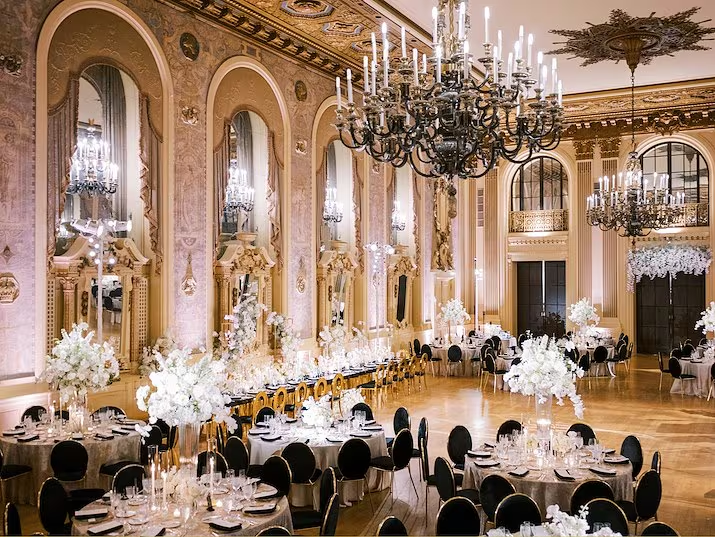
On my sixty-fifth birthday, I sat alone at a table set for nine and watched the candles slowly sink into a cake nobody had come to eat.
The house was too quiet for a place that size. Silence in a small home feels comforting, like a blanket after a long day. Silence in a mansion built for family feels almost accusing. It gathers in the corners. It presses against the windows. It makes every small sound louder than it has any right to be.
The grandfather clock in the hall struck eight with a slow, heavy patience that seemed aimed directly at me.
I looked at the table again. The brisket sat in the center on my wife’s old serving platter, the one ringed with blue flowers. I’d marinated it for two days, the way Nancy used to when Trevor was small and would wander into the kitchen begging to “test” the ends before dinner. The appetizers hadn’t been touched. The champagne sat unopened in a crystal bucket, ice melted down to clear water dripping onto the linen. The three-tier cake stood in the middle, white frosting, gold trim, the number 65 catching the light like the room was still waiting for people who had already decided I wasn’t worth showing up for.
I’d ironed the tablecloth myself that morning. That detail bothered me more than anything else, later. Not the money. Not the empty chairs. The tablecloth. I’d stood in the laundry room with steam rising off the iron, smoothing every wrinkle because I wanted the night to matter. I wanted Trevor to walk in with Melanie and the kids and see the effort. I wanted my grandchildren running through the front hall the way they used to, leaving their shoes by the door and fingerprints on the glass. I wanted to believe turning sixty-five still meant something worth pulling them away from the polished life they’d built at the far end of my own property.
The far end of my own property. That’s where they lived. A modern guest house with floor-to-ceiling windows, heated stone floors, a private patio, a two-car garage, and a kitchen Melanie once called “almost acceptable” after I paid for the second renovation. Rent-free. Cars I’d bought. Tuition I’d quietly covered for the kids’ schools. Trevor’s software company, which had never once turned a profit, stayed breathing on transfers he always called temporary. Every temporary need somehow became permanent the moment I covered it.
I told myself that was fatherhood. I told myself Nancy would have wanted me to protect him.
Nancy had been gone for years by then, but promises made in hospital rooms don’t dissolve that easily. They live in the body. They speak up when you’re tired. They tell you to forgive one more mistake, write one more check, say yes one more time, because his mother isn’t here anymore to make the world gentler for him.
So I made it gentler. For decades, I softened everything, until my own son could no longer tell the difference between being loved and being given access.
I picked up my phone for the twelfth time. No missed calls. No messages. No apology. I called Trevor. Two rings, then voicemail. I called Melanie. Her phone didn’t ring at all. Blocked, or silenced.
I set the phone face-down on the table and looked at the place cards I’d written by hand. Trevor. Melanie. Ethan. Grace. Ava. The kids’ names in blue ink, because Grace once told me blue made everything feel happier. I’d even left a small wrapped gift at each child’s seat. A wooden puzzle for Ethan. Watercolor pencils for Grace. A tiny silver charm bracelet for Ava, who had recently decided she liked “grown-up jewelry,” as long as it had stars on it.
I sat at the head of the table and felt the first real wave of humiliation move through me. Not grief. Not yet. Humiliation. The specific kind a man feels when he understands he’s set a table for people who quietly agreed not to come.
I was sixty-five years old. I’d built a logistics company out of one rented truck, two clients, and the kind of exhaustion that vibrates in your bones at night. I’d opened warehouses, negotiated contracts, survived recessions and fuel spikes, paid my employees before I paid myself, and turned a business that started in a muddy lot outside Chicago into a network worth more than I ever admitted at family dinners.
I had outworked hunger. I had outworked fear. I had outworked the memory of my mother watering down milk because payday was still two days off.
But I had never outgrown the foolish hope that my son might love me without needing something first.
The phone buzzed. The sound cut through the room sharp enough that I flinched. For half a second, hope beat pride to the punch. Maybe Trevor had texted. Maybe the flight was delayed. Maybe one of the kids was sick. Maybe there was some ordinary explanation that would let me put the cake away and forgive them by morning.
I turned the phone over.
Not a message. A social media alert. Trevor had posted a photo.
My thumb hovered over the notification. I remember that hesitation clearly. Some part of me already knew that once I opened it, I wouldn’t be able to pretend anymore.
I opened it.
The photo loaded slowly, one bright strip at a time. There they were. Trevor, Melanie, and the three kids on the deck of a luxury catamaran, tanned, smiling, under a sky so blue it looked expensive. The children wore matching linen. Melanie’s sunglasses caught the light off the water. Trevor had one arm around her waist and the other raised in a lazy wave, like he was greeting people who existed only to admire him. Behind them, the Bahamas stretched out in polished turquoise.
Then I read the caption.
Away from problems. Family time.
I stared at those words until the room blurred around me.
Away from problems. I was the problem. The man who’d paid for the vacation was the problem. The grandfather sitting alone next to a birthday cake was the problem. The father who’d wired ten thousand dollars into Trevor’s account the week before because Trevor swore his company had a payroll emergency, that father was the problem. Trevor had looked me in the eye and told me people were depending on him. He’d sounded strained, almost ashamed. I’d wired the money in under five minutes.
Now he was on a boat.
A boat I had paid for.
I stood slowly. The chair legs whispered across the hardwood. The dining room seemed to expand around me, every polished surface reflecting some new version of my own foolishness. The chandelier. The silver. The imported rug. The mahogany table. This beautiful house I’d maintained for decades as if my family’s soul still lived inside it.
That soul had left when Nancy died. I’d simply refused to accept it.
I walked to the cake, cut one clean slice, set it on a china plate, and sat back down. The vanilla sponge tasted dry, though I knew it wasn’t. Sugar turns to ash when you eat it beside an empty chair.
With the last bite, something shifted in me. Not loudly. Not dramatically. A door closed.
I carried the plate to the kitchen, rinsed it, loaded the dishwasher, and walked back to the dining room. I left everything else exactly where it was. Let the brisket cool. Let the champagne go warm. Let the candles sink into the frosting. I wanted the room to stay as evidence.
Then I went to my office.
It sat at the end of the west hallway behind a pair of pocket doors, smelling of leather, old paper, and the light cedar oil I used on the shelves. A portrait of Nancy hung above the fireplace, taken the summer before her illness came back. She was laughing in that picture, head tilted, one hand at her throat where the sapphire pendant I’d bought her in Paris caught the light.
I looked at that pendant in the portrait and felt the first real ache settle into my chest.
“Nancy,” I whispered.
Her name sounded far too alive in such an empty room.
Behind a sliding mahogany panel sat the safe. Heavy iron, old dial, the kind of machine that demands a human touch. The lock clicked sharply through the silence. Inside was the leather-bound ledger where I’d tracked assets, transfers, property agreements, investment accounts, and private loans for decades. I kept digital records too, of course. But I trusted paper, because paper never flatters you. It just waits for you to read it.
I set the ledger on the desk, switched on the lamp, and got to work.
For four straight hours, I examined my own blindness. I traced every payment made to Trevor and Melanie over the last five years. Rent I never collected. Cars I’d bought and insured. Credit card balances I’d erased after Trevor’s company missed another target. Tuition. Vacations. Furniture. “Temporary” allowances. Consulting advances. Emergency transfers that somehow appeared every single time I refused an unnecessary request.
The total was worse than I’d imagined. Not because I lacked the money. Because I had mistaken a complete lack of gratitude for stress.
Then my hand stopped on a transaction I didn’t remember making.
A withdrawal from a secondary holding account. Large. Irregular. Routed through an organization I didn’t recognize. The authorization carried a digital signature that looked like mine at first glance, but the rhythm of it was wrong. I’d signed my own name millions of times over the years, on contracts, checks, freight documents. A signature has its own anatomy. This one copied my appearance but not my hand.
I pulled up the matching bank statement.
There it was again. My name. Not mine.
The pain of my birthday shifted into something colder. This wasn’t neglect anymore. This wasn’t entitlement. This was paperwork. And paperwork carries consequences.
At 4:07 that morning, I called Valerie Knox.
Valerie wasn’t a family attorney. She wasn’t gentle. She had no interest in tea or sympathy or emotional conversations. She specialized in corporate restructuring, contested assets, the kind of legal battles where people smile across conference tables while sharpening knives underneath them. She’d represented me for fifteen years, and I trusted her precisely because she’d never once confused compassion with strategy.
She answered on the second ring. “Howard. Tell me the building isn’t on fire.”
“No,” I said. “Something worse.”
By sunrise I was sitting in her office on the forty-second floor. The city had only just started waking under a pale gray sky, cars flowing along the expressway like thin streams of light. Valerie stood by the window in a charcoal suit, holding black coffee, her expression unreadable. Steel, glass, silence, no family photographs anywhere. I’d always admired that about her.
I dropped the ledger, bank statements, property deeds, and transfer records on her desk. They landed with a heavy thud.
She read through everything without interrupting, turning each page with a calm that steadied me more than sympathy ever could. When she reached the forged signature, her eyes narrowed. When she reached the guest house deed and the secondary holding account, she took off her glasses and set them down.
“Before we cut anything,” she said, “we need to know every place your son has attached himself to you.”
“Everything,” I said. “I want everything found.”
“That includes uncomfortable discoveries.”
“I had dinner alone with a cake for nine people. I’m past comfortable.”
She studied me a moment, then pressed a button on her desk. “Send Miles in.”
Miles was her lead financial investigator, a quiet man with wire-rimmed glasses and a face that looked capable of finding deception in a grocery receipt. He came in with a tablet, a legal pad, and no wasted words. Valerie handed him the ledger.
“We start with Trevor Bloom,” she said. “Business filings, loans, personal credit, property ties, company guarantees, transfer history, public records, asset movement, Melanie’s accounts where accessible. Priority review.”
“How fast?” Miles asked.
“Yesterday.”
He left without a smile.
I sat across from Valerie and felt exhaustion creeping in around the edges of my anger. For a moment I wasn’t the founder of a logistics company or the head of a large estate. I was just a widower in a gray suit who’d spent his birthday alone with a cake.
“I promised Nancy I’d protect him,” I said.
Valerie met my eyes without softening. “What exactly did you promise?”
“That he’d never be alone. That I’d keep him safe.”
“From hardship?”
“Yes.”
“From consequences?”
I said nothing.
She leaned back. “Howard, protecting a child from ruin is love. Financing a grown man’s refusal to grow up is not love. It’s maintenance. Very expensive maintenance.” Her words landed harder than I expected. “Your wife asked you to protect your son. She did not ask you to become the financial foundation for his dishonesty.”
I looked down at my hands. Old now. Still broad, still strong, knuckles stiff, age spots across the skin. I remembered those same hands at thirty, unloading freight before sunrise because I needed cash for payroll and Trevor’s tuition. I remembered Nancy holding one of them in the hospital, her grip weak but sure. Protect our boy.
I had done exactly that. Then I’d kept doing it long after the boy became a man who’d learned to treat protection as currency.
“Do the audit,” I said.
Valerie nodded once.
Forty-eight hours later she called me back, and I knew from her voice alone that I needed to come in immediately.
When I arrived, her desk held one manila folder, dead center, nothing else. Outside, the city looked flat under a winter sky. She didn’t offer coffee this time. I sat down.
She slid the first document toward me. A notice from a commercial lender. A loan tied to Trevor’s struggling software company. Four hundred and twelve thousand dollars, overdue, secured by collateral that sent a chill straight up my spine.
The guest house. The one on my property. The one Trevor and Melanie lived in without paying a cent.
Lower on the page sat the guarantor’s signature. Howard Bloom. My name. Except it wasn’t mine.
I stared at the letters until they seemed to move on the page. “I did not sign this.”
“I know,” Valerie said, flat, professional. I appreciated that. “Miles pulled the filings. Trevor used a copied signature packet from earlier family documents. The lender accepted it. The guest house is listed as collateral, but given the parcel structure, this could put a cloud over the entire estate if it’s not handled carefully.”
I pressed my hand flat against the desk. The estate. The main house. Nancy’s gardens. The library. The dining room where my untouched birthday dinner still sat, because I hadn’t found the strength to clear it away yet.
Trevor had put all of it at risk. Not to save his children. Not for medical bills. Not to keep a roof over anyone’s head. To keep alive a company that existed mostly as a title on his business cards.
“To stop the lender,” Valerie said, “we can challenge the authorization. But that takes time. If they move first, you lose control of the timeline.”
“What’s the fastest way to clear the title?”
“Pay it off.”
I almost laughed. “That sounds like rescuing him again.”
“It would be rescuing the property,” she said. “Not him. There’s a difference, if you choose to make one.”
I understood immediately. Pay the loan, and the lender disappears. The fraudulent claim on my land vanishes. And Trevor loses the only leverage his forged signature had ever created.
“Do it,” I said.
She nodded but didn’t move. “There’s more.”
She slid a second folder across the glass. The first page was an auction listing. A sapphire pendant.
The room went impossibly quiet, like the air itself had stepped away.
Nancy’s pendant. Paris. Our tenth anniversary. A tiny jewelry shop tucked down a side street after the rain. Nancy laughing because she swore we were too practical for a stone that blue. Me fastening the clasp while she watched herself in the hotel mirror, tears shining in her eyes.
I had locked that pendant in the safe after her funeral.
The next page showed the pearl earrings that had belonged to her grandmother. Then the bracelet I’d bought her after the company landed its first national contract. Page after page. Melanie had been selling them off through online auction sites and estate resale companies for six months. The timing matched their vacations, their luxury purchases, their deposits for trips they’d described to me as “business networking opportunities.”
I couldn’t find words. Valerie gave me time.
For years, Melanie had shown up to Sunday dinner, and near the end of the evening, she’d lift two fingers to her temple. “Howard, I’m sorry. I’m getting one of my headaches. Would you mind if I lay down upstairs for a little while?”
I’d brought her water. Drawn the blinds. Asked the kids to keep quiet near the hallway. And while I stood downstairs washing dishes, she’d been in my office, opening the safe with a combination Trevor had known since he was a boy, taking pieces of my wife one at a time.
The pain felt clean. That surprised me. Clean and precise, like the edge of broken glass. Then it changed into something else. Clarity.
“Can we recover them?”
“Some,” Valerie said. “Maybe. Not all.”
I closed the folder. “Pay off the loan. Clear the property. Then sell everything.”
Her face stayed still, though one eyebrow lifted slightly. “The estate?”
“The estate.”
“All of it?”
“All of it.”
She let the silence sit. “Howard, that property has been in your life for decades.”
“No,” I said. “Nancy was in my life. The property’s just walls without her.”
By the close of business that day, the debt was paid, the lender’s claim released, the estate title clean.
The next morning I called Gordon Blake. Gordon was a developer, not a sentimental man. He bought land, not memories. He saw acreage, zoning, density, access, deadlines. I’d disliked him personally for years and respected him professionally for exactly the same reasons. If I needed someone who’d act fast, pay cash, and never ask why an old man wanted to sell a property everyone else would fight to keep, Gordon was the right man.
He arrived at the gates in a black sedan within the hour.
The estate looked perfect that morning. Winter light off the windows, frost silvering the lawn, the main house rising behind the oak trees like an old promise. Gordon barely glanced at the architecture. His attention moved straight to the property lines, the access road, the guest house, the slope of land behind it.
“What do you want?” he asked.
“A cash sale. Seven-day close. Immediate possession upon transfer.”
“That’s not a normal timeline.”
“I’m not offering a normal price.”
I gave him the figure. His expression sharpened. Under market, not recklessly so, but low enough for a predator to smell opportunity.
“What’s the catch?”
“No financing. No delays. You take everything as-is. You handle redevelopment. I don’t want to see a listing, a staging consultant, or a family conversation.”
“You understand I’d likely clear the structures.”
“I’m selling you dirt.”
That was the moment he understood I was serious. He held out his hand. I took it.
The closing moved with unsettling speed. Valerie handled the paperwork, Gordon’s team handled the money. Three days later I signed the documents in a sterile conference room, a notary watching from the corner, Gordon across from me with his pen already uncapped.
“Are you sure?” he asked once.
I looked at the line waiting for my signature. I thought of Nancy’s pendant on an auction listing. Trevor’s caption. The empty birthday table. The forged signature. The guest house glowing after dark while my own dining room sat silent.
“Yes,” I said, and signed.
The wire cleared that afternoon. The estate no longer belonged to me. That truth didn’t destroy me. It released me.
Before possession fully transferred, I hired a moving company to clear Trevor and Melanie’s belongings out of the guest house. Every item documented, photographed, boxed, inventoried, and legally transferred into a storage unit registered under their names. I covered one month and nothing beyond it. No damage, no confrontation, no room for them to accuse me of carelessness. I wanted their life packed exactly as they’d lived it: expensive, excessive, and suddenly, entirely their own responsibility.
The movers worked all day. Italian leather couches. Oversized televisions. Rows of designer clothes. Golf clubs Trevor once insisted were essential for investor meetings. Boxes of shoes. Crystalware. Rugs. Kitchen appliances still sealed in their original packaging. A whole exhibition of money spent by people who’d confused buying things with accomplishing something.
By sunset, the guest house stood empty, every room echoing. I walked through it once, not for sentiment, just to make sure nothing of Nancy’s had been left behind. Then I walked away.
The storage facility sat near the interstate, where trucks passed all night and the air smelled faintly of diesel and damp concrete. No climate control, clean enough, lawful enough, impersonal enough. When the last box went in, the foreman pulled the metal door down. I sealed the key in an envelope addressed to Trevor and gave the clerk precise instructions for when to send the notice.
Thirty days. More generous than necessary.
What came next was for me. Valerie set up a new trust, moved the sale proceeds into protected accounts, arranged for a quiet downtown penthouse purchased through a private entity, and had my old phone number permanently disconnected. Not blocked. Disconnected. A dead line. No voicemail. No begging. No grandson handed the phone to soften my resolve. No Melanie crying about another temporary crisis. No Trevor calling me Dad only when his account ran dry.
I moved with one suitcase, a canvas tool bag, Nancy’s photo albums, and the handful of things that still felt true when I held them.
The penthouse was nothing like the estate. White walls, concrete floors, tall windows over the financial district. No antiques. No long hollow hallways. No empty rooms waiting for people who’d never come. That first night I drank tomato soup out of a mug and slept nine hours straight.
On the seventh morning, Gordon’s crews came through the gates. I watched through a remote security feed Valerie had arranged for legal oversight. I didn’t want spectacle. I wanted confirmation that possession had transferred cleanly.
The excavator rolled up the gravel drive at sunrise. Watching that machine cross the property tightened my throat for a moment, not for the house, but for the man I’d been when I built it. A young father with rough hands, convinced he could build a kingdom, and that a kingdom could protect love.
It can’t. A house can shelter a family. It cannot make one.
I closed the tablet before the first wall came down. A few hours later I turned it back on.
Trevor’s black SUV had pulled up outside the temporary fence. He and Melanie, back from the Bahamas, stepped out tanned and rested, dressed for a life that no longer belonged to them. Melanie in white resort linen and oversized sunglasses. Trevor with a leather travel bag over one shoulder. They stood at the fence staring at the site where the guest house had already been opened up to the sky.
Even through the silent feed, I could tell Trevor was shouting. Arms thrown toward the workers. Melanie’s hands pressed over her mouth. The children weren’t there, thankfully, Valerie had already confirmed they were staying with Melanie’s sister after the trip. The only mercy left in the whole situation.
A security supervisor walked over and handed Trevor an envelope. He tore it open. Inside: the deed transfer notice, the possession papers, the storage unit details, and Valerie’s business card.
I watched him read. Anger kept him standing tall at first. Then confusion. Then something smaller, and far more honest.
Fear.
He reached for his phone. I knew the exact moment he tried my old number. Lips moving, staring at the screen, dialing again, then a third time. Nothing. The safety net no longer had a ringtone.
By that evening, they’d tried checking into a luxury hotel downtown and been turned away when their cards failed. They ended up in a roadside motel near the interstate. I know because Trevor called Valerie’s office at eight the next morning. Loud at first. Then louder. He insisted the sale was invalid, the trust illegal, the storage arrangement cruel, and the disconnected phone number proof someone had manipulated me.
Valerie let him finish. The moment he mentioned a power of attorney, she went perfectly still. She later told me he’d tried to rely on a document he claimed gave him authority over my finances, connected to the very same loan package that carried my forged signature.
That was the last loose thread.
They came to Valerie’s office at noon. I agreed to meet them. Not because they deserved an explanation, but because I wanted our final conversation to happen in a room full of glass, witnesses, and carefully prepared documents.
I wore a charcoal suit I hadn’t put on in years. Still fit, barely, but well enough. When I walked into the conference room, Trevor was standing beside the table, hair a mess, eyes red from too little sleep. Melanie sat stiff beside him, her resort clothes wrinkled, expensive makeup barely hiding the anger underneath.
Trevor started immediately. “You can’t do this. You sold my home.”
“I sold my property.”
“That guest house was ours.”
“You lived there.”
“We have children.”
“Yes,” I said. “And you used them as decorations when you needed sympathy, and excuses when you needed money.”
Melanie made a small sound of protest. I looked at her. She fell silent.
Valerie set a black binder on the table. No drama, just the kind of weight that changes a room’s atmosphere. Trevor stared at it.
“Open it,” I said.
He did. The first page was a photograph from my birthday night, taken at a gala Trevor and Melanie had attended after telling me the children were too exhausted to visit. The timestamp sat right beneath it. His jaw tightened.
The next section listed years of transfers, reimbursements, business bailouts, credit payments, the full sum of my generosity in plain figures. Then the loan documents. The signature. The guest house listed as collateral.
After that, he stopped looking at me entirely.
Melanie leaned over and reached the final section before he could close the binder. Auction records. Receipts. Photographs of Nancy’s jewelry. Her hand flew to her mouth.
I never raised my voice. I didn’t have to.
“Nancy loved you,” I said to Trevor. “She asked me to protect you. I turned that promise into money, because money became the only language I trusted after she died. That was my failure.” His eyes filled. I held his gaze. “But you turned my love into a system. And Melanie turned my memories into cash.”
“Howard, I—” Melanie started.
“No.” One word. Clear. Enough.
Valerie slid two folders across the table. Inside were documents ending any future claims, acknowledging the sale, confirming the end of financial support, and requiring every future communication to go through legal counsel. In exchange, I’d agree to let the civil recovery process continue without pushing further than necessary to protect myself and recover what still could be.
Trevor’s hand trembled around the pen. He looked at me, searching for the father who always softened at the first sign of fear.
That father had loved him. That father had truly tried.
That father no longer existed.
“Dad,” he said.
The word reached me. Of course it did. I’m not stone. But love isn’t a door that has to stay open while someone carries away your furniture.
“You have thirty days to retrieve your belongings from storage,” I said. “After that, the facility’s rules apply.”
His face collapsed. He signed. Melanie signed after him, her signature uneven and jagged.
When it was over, Valerie gathered the folders. Trevor sat staring at the tabletop. I stood.
“You posted that you were away from problems,” I said. “I hope you understand now. I removed myself exactly as requested.”
Neither of them spoke. I walked out before either one could ask me for anything else.
That evening I returned to the penthouse. City lights stretched out beyond the windows, each one belonging to a life I’d never know. I poured myself a glass of whiskey, the good bottle I’d saved for my birthday and never opened. The amber liquid caught the light as I lifted the glass.
“To Nancy,” I said quietly. Then, after a pause, “And to finally knowing the difference between protection and surrender.”
The whiskey warmed my chest. I stood there alone. But I wasn’t abandoned. Those aren’t the same thing.
The weeks passed. Valerie managed to recover several of Nancy’s pieces, not all of them. The sapphire pendant came back with a small scratch near the clasp. I held it in my palm for a long time before setting it into a velvet box for Grace, my oldest granddaughter, to receive when she’s ready. Not because blood automatically earns it, but because I still believe some things can be passed down without carrying the poison of what came before.
Trevor sent one letter through Valerie. I didn’t read it right away. When I finally opened it, it was less an apology than the confession of a man seeing himself clearly for the first time and not liking what he found. He admitted he’d mistaken my support for certainty. He admitted he no longer knew how to start over with nothing. He asked if there might ever come a day when we could talk again.
I folded the letter and put it in a drawer. Not thrown away. Not answered. Some doors don’t need to stay locked forever, but they have to stay closed until the person on the other side learns to knock without carrying a bill.
On my sixty-sixth birthday, I didn’t host a party. I took the train to Chicago and walked through the old industrial neighborhood where I grew up. The apartment building from my childhood was gone, replaced by a warehouse with mirrored windows. The corner grocery had become a coffee shop. I stood on the sidewalk a long time, remembering the boy who’d promised himself his family would never know poverty.
That boy kept his promise too well.
That evening, back at the penthouse, I found a small package waiting from Valerie. Inside was a simple vanilla cake from a bakery she swore was “not sentimental, just excellent,” with a single candle tucked in the box.
For the first time in weeks, I laughed.
I lit that candle on the kitchen counter, watched the flame steady itself, and made no wish. I no longer needed one.
For the first time in my adult life, my future wasn’t mortgaged to someone else’s appetite.
I cut a single slice, poured one drink, and enjoyed my birthday cake in peace.

Specialty: Quiet Comebacks & Personal Justice
David Reynolds focuses on stories where underestimated individuals regain control of their lives. His writing centers on measured decisions rather than dramatic outbursts — emphasizing preparation, patience, and the long game. His characters don’t shout; they act.