The Black Card
The first charge was $18,400 for imported orchids.
I noticed it the way you notice things that don’t belong: a single line item on a statement that my eye passed over and then returned to, the way you return to a word you’ve read correctly but that suddenly looks wrong. Imported orchids. I turned the phrase over in my mind, trying to construct a context where it made sense, where it belonged to my business or my life in some way I had temporarily forgotten.
The second charge was $62,000 to a Hudson Valley estate called Ashmore House.
That was when I put down my pen.
I was in a Monday budget meeting, the kind that occupies the third week of every month, where my controller Priya walks me through the previous quarter’s numbers with the methodical patience of someone who has worked with me long enough to know that I prefer precision to summary. The conference table was covered in printouts, and the afternoon light was coming through the east-facing windows of Bennett Event Systems’ midtown office, and everything about the moment was ordinary except for the tablet Priya slid toward me with the specific expression she uses when she has found something she cannot explain.
“Claire,” she said. “Did you authorize a platinum wedding package for Ethan Cole?”
Ethan Cole had been my boyfriend for three years. We had met at an industry conference in Chicago, where he was working as a consultant for a boutique hospitality firm and I was speaking on payment infrastructure for luxury brands. He was charming in the way of people who have studied what charming looks like and applied the findings with discipline. He remembered things you told him, asked questions that made you feel interesting, and had a talent for being present in a room that I had mistaken, for the better part of three years, for genuine attention.
When I founded Bennett Event Systems, I traveled constantly. The company handled payment logistics for luxury hotels and event venues across the country, which meant I was rarely in the same city for more than a week. Ethan’s extra card had been practical: it covered hotels when he traveled with me, client dinners when we entertained together, and the occasional emergency. An authorized user, which meant access to my account with no ownership of it.
When I ended the relationship in April, I had a reason and I had proof. Messages on his personal laptop that I had not been looking for, discovered while he was using my home office and had left the browser open. Messages to a woman named Vanessa, his business partner, which described our relationship in terms that made clear it was not the only one he had been conducting. I confronted him that evening. He left. He told me, before he did, that he would destroy the card.
He had not destroyed the card.
The statement Priya showed me detailed $347,860 in charges made between April and the current week. The Hudson Valley estate. A platinum catering package. A twelve-piece band. Couture clothing from three separate designers. Jewelry, including a specific line item I would remember later. A honeymoon suite in the Maldives. Transportation for three hundred guests.
Three hundred guests.
“Export everything,” I told Priya. “Do not contact him.”
That night, I found the wedding website.
It was elegant and carefully designed, the kind that uses a single serif font and a muted color palette to communicate taste. There were photographs of the couple at various locations around the city. In one, Ethan stood beside a vintage Mercedes-Benz that I recognized immediately because it was registered in my name, a car I had purchased two years earlier and rarely drove. In another, he was photographed in the main living area of the Manhattan apartment that Bennett Event Systems leased as a corporate residence.
Vanessa was wearing the emerald necklace.
I had seen it on the statement: $34,800, charged to my account through an estate jewelry dealer on 47th Street. She was wearing it in the lead photograph on the homepage, smiling the smile of someone who believes she has won.
The biography section described Ethan as an entrepreneur and investor who had built his professional standing alongside visionary partners. I read the sentence twice and understood it to mean that everything he was presenting as evidence of his success was borrowed from someone who had never agreed to lend it.
Several vendor contracts listed Bennett Event Systems as the corporate sponsor of the event. One contained an electronic copy of my signature.
He had not just used my card. He had used an old company login, one that our IT team had disabled three weeks after the breakup but that a misconfigured archive portal had continued to accept. Priya traced the activity to his apartment: login attempts at midnight, document uploads in the early hours of the morning, the careful assembly of forged sponsorship letters that bore my company name and my reproduced signature.
I called my attorney, Rachel Monroe, at nine the following morning.
Rachel had handled Bennett Event Systems’ legal matters for six years. She was methodical and unhurried in the way of lawyers who understand that the quality of documentation determines outcomes, and she listened to everything I had before she said anything.
“Walk me through the timeline,” she said.
I did. April through the present week. The card. The charges. The archived portal. Priya’s midnight discovery. The wedding, scheduled for that Saturday, four days away.
“I need you to preserve everything before you do anything else,” Rachel said. “Emails, device logs, vendor contracts, the security footage from your office showing when he last had legitimate access to company systems. If he used that archive portal, there are access logs on the server that need to be captured before anyone has a reason to delete them.”
By noon, we had everything.
Priya pulled the server logs that documented every session from Ethan’s old credentials after the official deactivation date. She found four separate logins, each between midnight and 3:00 a.m., each resulting in document uploads. She also found a deleted folder in his former account that she was able to recover through the system’s version history: draft copies of the forged letters in various stages of completion, and a thread of messages between Ethan and Vanessa that had been routed through the company server during a period when they were both still nominally working on a shared project.
I read the messages once.
Vanessa had written: Use Claire’s company name. Vendors won’t question a woman with an eight-figure business.
Ethan had replied: By the time she sees the statement we’ll be married and overseas. She won’t risk the scandal.
I set my phone down and looked out the window at the city for a long moment.
At 9:12 on Friday morning, I called the card issuer’s fraud division.
The investigator asked whether I wanted to place a temporary spending limit on the card.
“No,” I said. “Remove Ethan Cole as an authorized user, freeze every linked card, and flag every transaction made after April nineteenth for review. Effective immediately.”
Then I called Rachel.
By the time Ethan called me at 4:37 that afternoon, he had apparently been trying to reach vendors and had encountered the first indication that things were not proceeding as he had planned. His voice when I answered had the careful, controlled quality of someone performing calm.
“There’s a problem with the bank,” he said. “A glitch or something. I need you to call them and sort it before tomorrow.”
I looked at the complaint Rachel had filed with the New York Supreme Court two hours earlier.
“I think,” I said, “tomorrow is exactly when things get sorted.”
He was quiet for a moment. “Claire.”
“Yes?”
“Don’t do this.”
“I think we’re done with this conversation.”
He called back four times. I did not answer.
Saturday morning, the Ashmore House estate was transformed.
White tents covered the southern lawn and crystal chandeliers hung from temporary structures that his event coordinator had erected over the previous two days. Staff moved with the particular organized urgency of a large-scale event in its final preparation hours: towers of champagne glasses being arranged on linen-covered tables, flower installations still being adjusted, a string quartet warming up near the terrace while the main band’s equipment waited in transit.
Ethan’s first text arrived at 7:06.
Stop being emotional. We can discuss reimbursement after the honeymoon.
At 7:18: You’ll embarrass yourself if you interfere.
At 7:31, Vanessa sent her own: Ethan said you always calm down when people stop indulging your drama.
I forwarded all three to Rachel without responding.
The bank’s fraud team had already contacted vendors the previous afternoon to inform them that payment guarantees connected to my account had been withdrawn pending a fraud investigation. Rachel had separately sent each vendor a letter on firm letterhead explaining that Bennett Event Systems had never agreed to sponsor the event, that the sponsorship letter bearing my name and signature was forged, and that any claim against that sponsorship would be contested.
We did not order anyone to leave. We told them the truth and let them make their own business decisions about whether to continue providing services without confirmed payment.
They decided quickly.
The florist received the vendor notice at 8:15 and began dismantling the imported orchid installation by 9:00, a systematic reversal that required the same team that had spent two days assembling it. The car service recalled six of the eight vehicles scheduled for guest transportation. The band’s road manager called the venue coordinator and said they would not unload until replacement payment had cleared in a verified account. The caterer held the main course.
By noon, the venue manager had issued an ultimatum to Ethan personally: $94,000 in cleared funds by 4:00 p.m. or the reception would end.
Ethan tried five cards at the estate’s business office.
Every one declined.
He called my CFO at 1:47 and told her that I had experienced a breakdown and asked her, as a condition of my emotional recovery, to authorize the release of company funds to cover an urgent hospitality expense. He explained that it was for my benefit, that I would want this if I were in a position to think clearly.
My CFO recorded the call. It joined the rest of the documentation.
At 3:00, guests began arriving.
They were dressed with the care of people who have traveled for a celebration, many from considerable distances, some in formal wear that suggested they understood the event to be significant. Ethan had framed it as the culmination of something real, a relationship, a future, a standing in the world that he had spent three years building alongside the most significant business and personal resources available to him, which turned out to be mine.
He told arriving guests that a banking outage had delayed several vendors and that everything would be resolved within the hour.
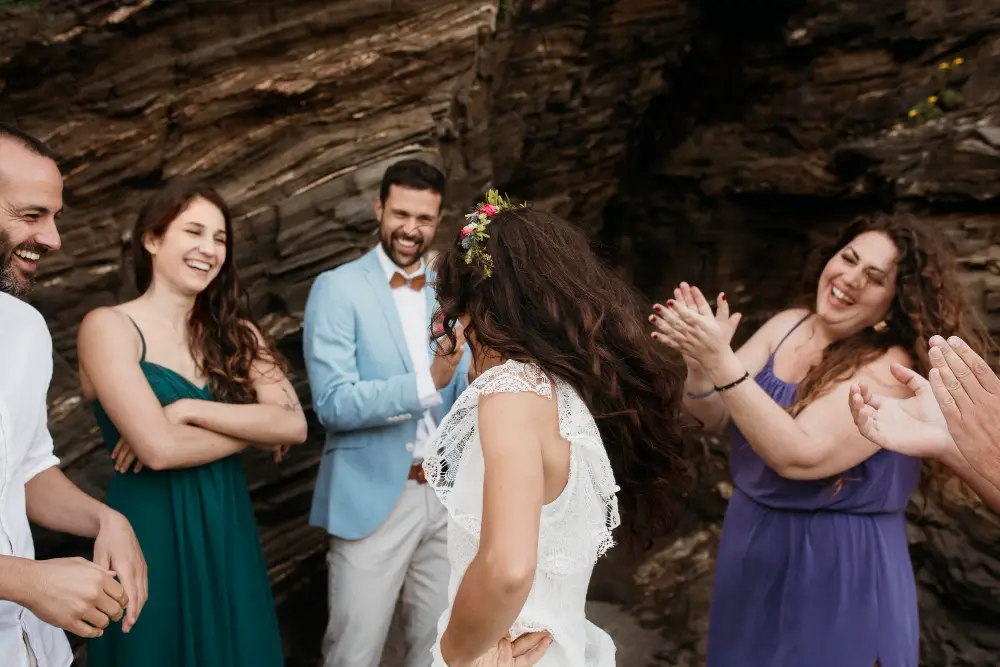
Vanessa came down the lawn in a $28,000 gown charged to my card, her hair arranged with the precision of someone who has rehearsed this moment, smiling with the particular confidence of a person who has calculated the risks and concluded that none of them apply to her. The ceremony proceeded. They exchanged vows in front of the assembled guests while somewhere across the estate a florist finished loading orchids into a refrigerated van.
The venue manager received final confirmation at 3:52 that no replacement funds were coming.
During cocktail hour, when guests moved from the ceremony lawn to the terrace where reception would begin, the deterioration became visible. Servers stopped circulating champagne. Equipment that had been positioned for the evening moved toward the service entrance. The photographer spoke quietly to the venue coordinator and began packing camera bags. The flower installation that had defined the entrance archway began to disappear through the service gate, piece by piece, while guests looked at each other with the carefully contained expressions of people who have understood something they do not want to be the first to name.
Ethan climbed the bandstand and spoke into the microphone.
The microphone had been disconnected.
That was the moment my car entered the circular drive.
I had worn an ivory pantsuit because I wanted every camera on the property to record that I was composed. Not grief, not rage, not the drama Ethan had predicted and counted on: composure. Rachel walked beside me. Behind us, a licensed process server carried two sealed envelopes.
Ethan saw us from the bandstand and crossed the lawn toward us, pushing through guests who moved aside with the instinctive clearing that happens around approaching conflict. He reached me at the edge of the terrace and gripped my elbow. His face had lost whatever performance it had been maintaining.
“Tell them this is a mistake,” he said, low and urgent.
I removed his hand from my arm.
I leaned close enough that only he and Vanessa, who had followed him, could hear.
“We’re not finished yet,” I said.
Rachel handed Ethan the complaint. The process server gave Vanessa hers. The causes of action were listed on the first page: fraud, conversion, forgery, unauthorized access to computer systems. The court had also issued a temporary restraining order preserving their devices and restricting the transfer of disputed assets.
Vanessa read the first page.
“You said she couldn’t prove anything,” she said to Ethan.
“She can’t,” he said.
Then he turned to the assembled guests, who had gone quiet with the particular attention of a crowd that has understood something significant is happening and is uncertain whether to stay or go.
“This is a jealous ex staging a scene,” he said. “She’s trying to humiliate me on my wedding day because she can’t accept that I moved on.”
I took my phone from my pocket and played the recorded call in which Ethan had contacted my CFO, claimed I had experienced a breakdown, and asked for company funds to be released for his benefit. His voice carried across the silent terrace through a portable speaker the venue manager had quietly provided.
Rachel showed Vanessa the printed messages from the recovered folder.
Use Claire’s company name. Vendors won’t question a woman with an eight-figure business.
Vanessa tore the emerald necklace from her own neck and threw it at Ethan. It caught the edge of his champagne glass. The glass tipped. Champagne spread across his jacket.
Guests stepped back.
Phones came up.
“You told me she gave you that card,” Vanessa said, at a volume that required no amplification.
“You wrote the sponsorship letter,” I said to her. “Your name is in the audit log from the server.”
For a moment, Ethan was very still. Then he came at me, and I did not fully register what was happening until his hands struck my shoulders, and the momentum carried me backward against the corner of a marble-topped side table. My phone skidded across the terrace stone. A champagne tower behind me went down. My lower lip split against my teeth.
For one second, the entire assembled crowd was completely silent.
Two estate security officers had Ethan’s arms before the next second was over. They pulled him away from me with the efficient physicality of people trained for exactly this, and he was still shouting as they moved him back, his voice carrying across the terrace and probably to the service entrance and possibly to the neighboring property.
Rachel was beside me before I had fully stabilized myself. She photographed my lip, the overturned table, the security cameras positioned above the terrace entrance, the guests who were still recording on their phones.
The venue manager was already on a call with the county sheriff.
Ethan continued shouting that I had ruined his life, that I had destroyed something beautiful, that everything he had done was justified by what I had taken from him, by the years and the relationship and the future he had planned.
I wiped the small amount of blood from my lip with the back of my hand.
“No,” I said, when there was enough quiet for it to land. “I stopped paying for the life you stole.”
The reception closed at 4:17.
The criminal case required more time than the collapse of the wedding. Criminal cases always do. The system moves at a pace designed for deliberateness rather than satisfaction, and I had to learn to trust the accumulation of evidence and the competence of the prosecutors and the fact that documented truth has a different relationship with time than humiliation does.
The security footage from the estate captured the shove in its entirety: the approach, the contact, my fall, the table, the champagne tower.
Device records tied both Ethan and Vanessa to the forged documents through timestamps that matched the midnight access logs from the archive portal.
The card issuer reversed the unsettled charges during the investigation. The settled charges, the ones that had already been paid out to vendors, were recovered through the civil settlement: Ethan’s condominium, his car, a brokerage account, and the proceeds from whatever Vanessa was able to liquidate.
Ethan pleaded guilty to identity theft, forgery, unauthorized access to computer systems, and misdemeanor assault. He served twenty-two months and was ordered to pay restitution for the remainder of the damages.
Vanessa cooperated with prosecutors in exchange for a reduced charge. She received five years of probation, surrendered the jewelry and the gown, and signed a civil judgment that would follow her credit history and professional record considerably longer than the wedding photographs remained visible on the internet.
They had vanished from every platform within six months.
Sixteen months after the estate, I stood on the balcony of Bennett Event Systems’ new headquarters, a floor we had moved into that fall after the previous space stopped being sufficient for what the company had become. The East River was visible to the south, the Brooklyn Bridge slightly east, the city doing what it does in the early evening when the light is going and everything takes on that particular quality of continuation.
We had built a fraud-detection product in the eighteen months since the wedding. It had started as an internal tool, a response to the specific vulnerabilities Ethan had exposed in our archive systems, a set of protocols for monitoring access patterns and flagging unusual activity on company accounts. Then we had shown it to several of our hotel clients during a security briefing, and three of them had asked within the week whether we were licensing it.
It was, by the time I stood on the balcony with Priya, the fastest-growing segment of Bennett Event Systems’ business.
Priya handed me a coffee.
“Do you ever think about that Saturday?” she asked.
I considered this for a moment.
“Only when the quarterly numbers are particularly good,” I said.
She smiled.
The scar beneath my lip had faded to a thin, pale line, visible only in certain light. My own doctor had described it as minimal scarring. I had stopped thinking of it as damage and started thinking of it as documentation, a physical record of the moment he had run out of everything except desperation.
I thought sometimes about the message Vanessa had sent to Ethan during the planning. Use Claire’s company name. Vendors won’t question a woman with an eight-figure business.
She had understood my reputation as a resource to exploit, my competence as a tool, my patience as a structural weakness that could be leveraged. She and Ethan had both understood access as a form of ownership and silence as permission and presence as a guarantee of continuation.
What they had not understood, and what I had spent the intervening months thinking about, was that every assumption they had made about me was a mirror. They had seen me through what they needed me to be: passive, reputation-protective, conflict-averse, more worried about scandal than about the $347,860 someone had spent on another woman’s wedding using my name.
They had seen what they needed to see, and built a plan around it, and the plan had been structurally dependent on me continuing to be that person after I found the statement.
I had not continued.
That was the whole of it.
I finished my coffee. Below, the river moved in the way rivers move at dusk, catching whatever light is available and doing something useful with it.
The city was loud and ordinary and entirely mine.

Lila Hart is a dedicated Digital Archivist and Research Specialist with a keen eye for preserving and curating meaningful content. At TheArchivists, she specializes in organizing and managing digital archives, ensuring that valuable stories and historical moments are accessible for generations to come.
Lila earned her degree in History and Archival Studies from the University of Edinburgh, where she cultivated her passion for documenting the past and preserving cultural heritage. Her expertise lies in combining traditional archival techniques with modern digital tools, allowing her to create comprehensive and engaging collections that resonate with audiences worldwide.
At TheArchivists, Lila is known for her meticulous attention to detail and her ability to uncover hidden gems within extensive archives. Her work is praised for its depth, authenticity, and contribution to the preservation of knowledge in the digital age.
Driven by a commitment to preserving stories that matter, Lila is passionate about exploring the intersection of history and technology. Her goal is to ensure that every piece of content she handles reflects the richness of human experiences and remains a source of inspiration for years to come.