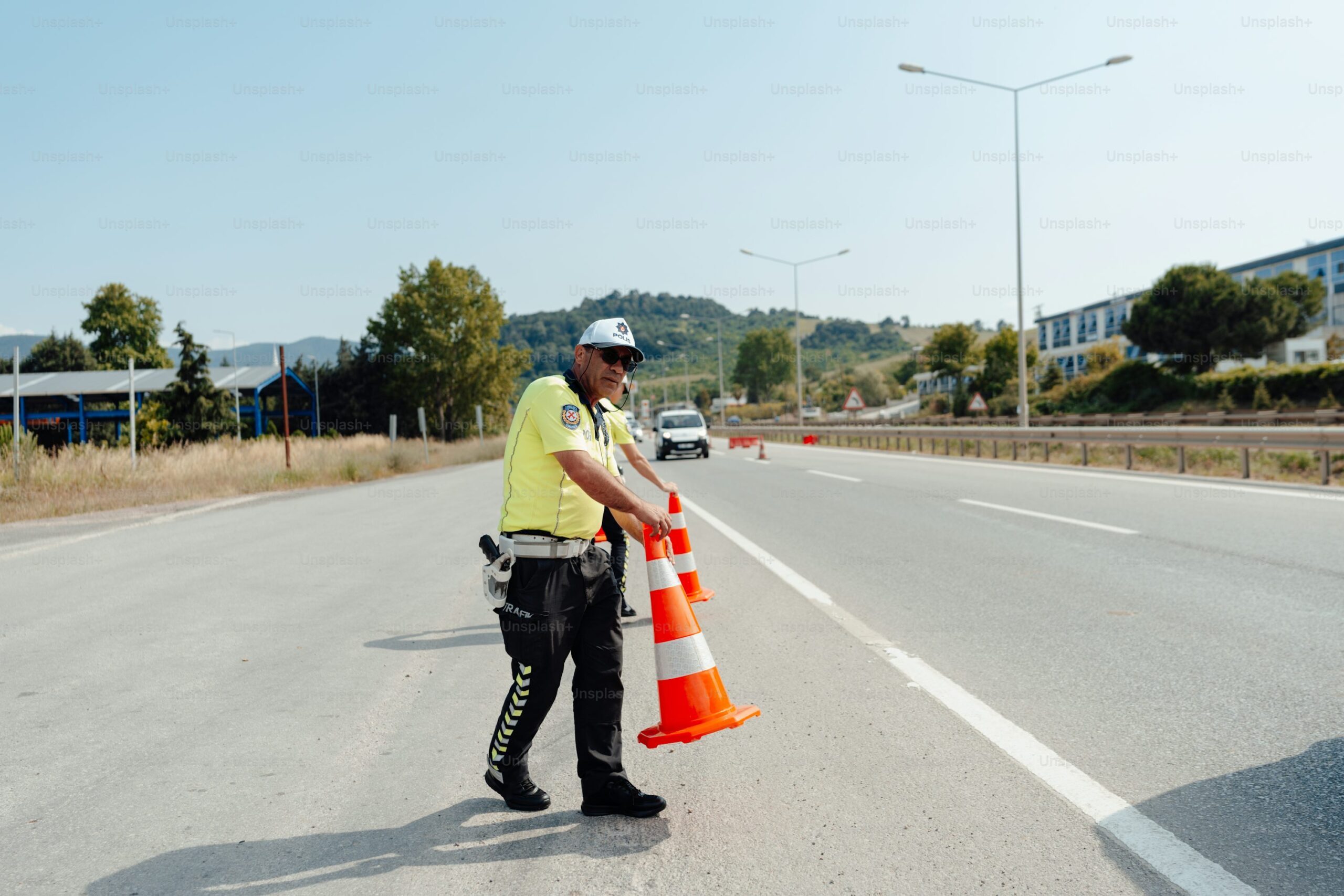
The road home was quiet that evening. Victoria drove with the windows cracked, one hand loose on the wheel, humming along to whatever was playing on the radio. She’d just left a long meeting on the other side of town, the kind that ran an hour over schedule and left her shoulders tight, and all she wanted now was her apartment, a hot shower, and silence.
The countryside opened up around her in long gold fields. Not many cars on this stretch. She kept to the speed limit out of habit more than caution — she always did, in her line of work you learned to. She checked her mirrors. She watched the signs. She wasn’t thinking about anything except getting home.
That was when the lights showed up behind her.
Blue and red, flashing steady in her rearview mirror. A patrol car, closing the distance fast. Victoria felt the small jolt of adrenaline everyone feels when they see those lights — even when you’ve done nothing wrong, some old animal part of your brain still flinches — and she eased off the gas, flicked her indicator, and pulled onto the shoulder.
She put the car in park. Rolled down her window. Waited with her hands visible on the wheel, the way she always told people to do, the way that kept things calm.
Two officers stepped out of the patrol car. The first was big — tall, thick through the shoulders, with a face that looked like it hadn’t smiled in years. He walked toward her window with the loose, rolling swagger of a man who liked being the one people were afraid of. The second one hung back a few steps, arms crossed, eyes narrow, studying her through the glass like he was deciding something.
“Documents,” the first one said. Not a greeting. Not even really a request.
Victoria reached into the glove box without hurry and handed over her license and registration. She kept her voice even.
“Good evening. Is there a problem, officer?”
He didn’t answer her. He flipped through her papers slowly, turning them over, checking them against nothing in particular. He walked a slow circle around her car, running his eyes over the tires, the plates, the windshield. He came back to her window and just stood there a moment, papers in hand, saying nothing.
“Why did you stop me?” Victoria asked, still calm. “I wasn’t speeding. I didn’t run anything. What’s the violation?”
“Routine check,” he said.
“What kind of routine check? And you haven’t introduced yourselves.”
Something shifted in his face. Just slightly. The look of a man who wasn’t used to being questioned.
The second officer pushed off from where he’d been leaning and stepped closer, a smirk pulling at his mouth.
“Little smart, aren’t you,” he said. “Sit tight and let the adults talk.”
Victoria looked at him, then back at the first officer, and didn’t back down an inch.
“I am talking calmly,” she said. “You two are the ones being aggressive, stopping a driver for no stated reason. I’d like your names and the reason for this stop, please.”
The tall one’s jaw tightened. He tossed her documents down onto the roof of her car, not even bothering to hand them back properly.
“Get out of the vehicle.”
“On what grounds?”
“I said get out.”
She could see it now, clear as day — this wasn’t about a traffic stop anymore. This was about two men who’d pulled over a young woman alone on an empty road and decided they didn’t like that she wasn’t scared. She’d seen this pattern before, more times than she wanted to count. It never ended well when you let it keep going unchecked.
She reached for her phone, meaning to turn on the camera, more out of habit than fear. Before she could even unlock the screen, the second officer yanked her door open and grabbed her wrist.
“Put the phone away. Now.”
“Don’t touch me,” Victoria said, sharp now, no longer calm exactly but not panicked either — just firm, the voice of someone who knew precisely what was happening and precisely how far outside the law it had already gone. “You are exceeding your authority.”
That was the wrong thing to say to men like this. Or maybe it was the only thing that could have been said, because it was true, and true things have a way of making certain people furious.
The tall one moved fast. He grabbed her by the arm, hauled her out of the car, and spun her around, pressing her front-first against the door. She felt the cold metal against her cheek, heard her own breath go short and quick despite herself. The second officer wrenched her arms behind her back. Metal clicked around her wrists — once, twice, tight.
“You’ll sit in a cell for a few hours,” the tall one said, close to her ear, breath hot with satisfaction. “Might make you a little more polite.”
Victoria didn’t scream. She didn’t fight the cuffs, didn’t thrash, didn’t give them the reaction they were hunting for. She just turned her head, slow, and looked at them over her shoulder, steady as still water.
“Are you sure,” she said, “you want to keep going with this?”
The tall one laughed, an ugly bark of a sound. “Threatening us now? That’s cute.”
“No,” Victoria said. “I’m telling you exactly what’s about to happen. You’ve detained me without cause. You’ve used physical force. You have filed no paperwork, read me no rights, given me no explanation. Right now, this is still something you could walk back.”
“We’ll sort it out at the station,” the tall one snapped, already turning her toward the patrol car, gripping her arm harder than he needed to.
She let a few seconds pass. The gravel crunched under their boots. The evening was so quiet you could hear the wind moving through the wheat on either side of the road.
Then she spoke again, calm as ever.
“Before we go anywhere — I need one of you to reach into the right pocket of my shorts. There’s something in there. With my hands behind my back, I can’t get it myself.”
The two men looked at each other. The second officer actually laughed out loud.
“Oh, this should be good,” he said. “What, gonna slip us a bribe? Think that’s gonna save you?”
“Just look,” Victoria said simply.
The tall one hesitated for half a second — some instinct in him, maybe, some flicker of doubt he wouldn’t have admitted to — then reached into her pocket and pulled out a small leather case.
He opened it, more out of impatience than interest, already halfway through rolling his eyes.
And then he stopped moving entirely.
For a long moment he just stood there, staring down at what was in his hand. His eyes went from the photograph to the name to the seal stamped across the top of the identification card, and something in his face began, very slowly, to drain of color.
He read it again. And again, as if the words might rearrange themselves into something less terrible the third time through.
His partner noticed the change immediately — you couldn’t miss it, the way all the bravado had gone out of the man’s shoulders in the space of two seconds.
“What,” the second officer said. “What is it?”
The tall one didn’t answer. He just held the case out, hand trembling slightly, and let his partner read it for himself.
It was Victoria’s service identification. Her photograph. Her rank. And beneath it, the name of the department she worked for — the Directorate of Internal Affairs, the unit whose entire job was investigating complaints of exactly this kind of misconduct by police officers in the field.
She had been on her way home from a work meeting. Driving her own personal car, off duty, in plain clothes. That was the only reason they hadn’t recognized her — there was nothing to recognize. She was just a young woman on a quiet road, until she wasn’t.
The second officer’s hands were shaking now too as he handed the case back. His voice, when it came, had lost every trace of the swagger from a minute ago.
“Why didn’t you — why didn’t you say something?”
Victoria met his eyes without flinching.
“Because I wanted to see how you treat ordinary people,” she said. “Now I have.”
There was a silence after that. A real, heavy silence, the kind that presses down on a scene like weather. The two men stood there in the fading evening light, and for the first time since the lights had gone on in her mirror, they looked less like officers of the law and more like two men who had just watched the ground open up in front of them.
They fumbled the cuffs off her wrists so fast the metal scraped her skin. The tall one started talking immediately, words tumbling over each other.
“This was a misunderstanding. A mix-up. You weren’t cooperating, you understand, you were being difficult, we thought — we didn’t know who you —”
“I wasn’t cooperating,” Victoria repeated, rubbing her wrist where the cuff had bitten in. “I asked for your names. I asked for the reason for the stop. I asked you not to put your hands on me. That’s not resistance. That’s the bare minimum anyone is entitled to.”
“Look,” the second officer said, and there was something close to pleading in it now, “let’s just — let’s just forget this happened, alright? No harm done. You’re fine. Nobody got hurt.”
Victoria almost laughed at that, though there was nothing funny in it.
What neither man realized — what neither of them had thought to check in the panic and adrenaline of the last several minutes — was that the dashboard camera in Victoria’s car had never stopped recording. It had captured the whole stop from the moment the patrol lights appeared in her mirror: the demand for documents, the refusal to explain the stop, the shove against the car door, the cuffs, all of it, audio and video both. And her phone — the one the second officer had grabbed and shoved back at her — had already synced the footage to a secure cloud server the instant it registered movement, a habit she’d built into her own devices years ago, back when she’d first started this job and learned exactly how often these situations could turn into he-said-she-said.
None of that would matter to forget. It was already done. It was already saved. It was already, in a sense, evidence.
Victoria climbed back into her car, put both hands on the wheel for a moment, and let herself breathe. Just for a few seconds. Her heart was still going fast, her wrist ached where the cuff had dug in, and underneath the calm she’d kept up the whole time there was something rawer — anger, mostly, and a tired, familiar sadness that this was still happening, that men still thought they could treat a person this way simply because she was young, and alone, and driving down a quiet road at the wrong time.
Then she picked up her phone and made a call.
It didn’t take long. Fifteen minutes later, a second set of headlights turned onto the shoulder behind the patrol car — a district vehicle, and out of it stepped a heavyset man in a senior officer’s uniform, along with two others Victoria recognized from her building. The district chief. He walked straight past the two patrol officers without a word to either of them and came to her window first.
“Are you alright?” he asked her.
“I’m fine,” she said, and meant it, mostly. “I’d like to show you something.”
She pulled up the footage on her phone and let it play. The chief watched in silence, his jaw growing tighter with every passing second. He watched the moment the tall officer threw her documents onto the car roof. He watched the second officer grab her wrist before she’d even unlocked her phone screen. He watched her ask, twice, calmly, for a name and a reason. He watched the cuffs go on.
When it ended, he looked up — not at Victoria, but past her, at the two men standing by their patrol car, both of them now very still, very pale, watching this unfold with the specific look of men who understood, in real time, that their careers were narrowing to a point.
“Badges,” the chief said. “Weapons. Both of you. Now.”
“Sir,” the tall one started, “if I could just explain —”
“You’ll explain plenty,” the chief said. “Not to me. To the review board. Badges and weapons. Now.”
They handed them over without another word. There was nothing left to argue.
The days that followed moved the way these things always do inside a large organization — slowly, on paper, in meetings, and then all at once. Victoria filed her formal report the next morning, attaching the dashcam footage and the phone recording, laying out the sequence of events in the same flat, precise language she used for every case that crossed her desk. She’d written hundreds of these reports over the years, always about someone else. It felt strange, writing one about herself. She kept catching herself trying to edit out the parts that made her sound less composed than she’d like to remember being — the way her voice had shaken, just slightly, when the cuffs went on — before making herself put it back in. The truth mattered more than how it made her look.
Word moved fast through the department, the way it always does. By the second day, colleagues she barely knew were stopping by her desk to ask if it was true, if she’d really been the one in that dashcam video that people were already quietly passing around on their phones. Word moved faster still through the district precinct where the two officers worked. Within a week, something else surfaced that nobody had expected — three other complaints, buried in old files, that had never been properly followed up. A delivery driver who’d claimed he was stopped and searched without cause outside city limits. An elderly woman who said an officer matching the tall one’s description had threatened to impound her car unless she paid him directly, in cash, on the spot. A teenager who said he’d been handcuffed for “talking back” during a stop that had started over a broken taillight.
None of those complaints had gone anywhere at the time. They’d been filed, stamped, and left to gather dust, the way complaints against officers sometimes did in departments that weren’t eager to look too closely at their own. But once Victoria’s case landed on the review board’s desk, with its video, its audio, its timestamp, someone finally went back and pulled those old files too. It turned out this hadn’t been one bad afternoon. It had been a pattern, and it had simply never had proof solid enough to stick — until now.
The review board convened twice. Victoria was asked to testify both times, sitting in a plain room across the table from senior officers she’d worked alongside for years, walking them through the footage frame by frame, answering every question without embellishment. She wasn’t there for revenge. She kept telling herself that, and she believed it. She was there because this was exactly the kind of thing her job existed to catch, and if she let it slide simply because it had happened to her personally, she’d have no right to hold anyone else to a different standard.
The tall officer — his name, it turned out, was Sergeant Igor Volkov, twelve years on the force — sat through his hearing with his arms crossed and very little to say. When pressed, he tried the same explanation he’d offered on the roadside: that Victoria had been uncooperative, that he’d felt threatened, that force had been necessary to control the situation. The board played the footage. There was no controlling in it, nothing that looked like a threat from her side, nothing except a young woman calmly asking two men why they were treating her this way. By the end of it, even Volkov had stopped arguing.
His partner, a younger officer named Denis Sadov with only three years on the job, took a different approach. He admitted, quietly, that he’d known during the stop that something was wrong — that they had no real cause to detain her, that the aggression had come from nowhere but Volkov’s mood and his own willingness to go along with it. He said he’d been afraid to speak up in the moment, afraid of what it would look like to contradict a senior officer in front of a civilian. It didn’t excuse what happened. But it was, at least, honest, and the board noted the difference.
The decision came down three weeks later. Sergeant Volkov was dismissed from the force entirely — unlawful detention, excessive use of force, conduct unbecoming an officer, a list of violations long enough that no one on the board argued for anything less than termination. Officer Sadov kept his job but was demoted two ranks and reassigned to a desk position for a minimum of one year, with a formal note in his file that would follow him for the rest of his career: present during, and failed to intervene in, an unlawful detention.
Victoria heard the outcome the same way everyone else in the department did, through an internal memo, though her supervisor made a point of telling her in person first, out of respect for what she’d been through. She read the memo twice at her desk, then set it down and sat there for a while, not quite sure what she felt. Not triumph, exactly. It didn’t feel like winning. It felt more like something that had needed to be set right finally being set right, which is a quieter, heavier kind of relief than people expect it to be.
A few people in the department treated her differently after that — a little warier, a little more careful about how they spoke around her, as though she might be recording every conversation now, quietly building a file on all of them too. She understood the instinct even if it stung a little. But far more people came up to her in the weeks that followed to say, quietly, that they were glad someone had finally done something about Volkov — that stories about him had been circulating for years, that people had complained before and nothing had ever come of it, that it had taken this, a random stop on an empty road, a woman who happened to carry the one kind of identification that could actually hold him accountable, for the whole thing to finally break open.
That was the part that stayed with Victoria longest, more than the fear she’d felt with her cheek pressed against the cold metal of her own car door, more than the ache in her wrists afterward. It wasn’t really about her. It could have been anyone on that road that evening — someone with no badge in their pocket, no camera quietly recording, no department behind them ready to listen. For most people who’d been stopped by Volkov over the years, it had simply ended the way it started: with an apology nobody meant, a slap on the wrist that changed nothing, and the quiet understanding that complaining wouldn’t do any good.
She thought about that delivery driver. That elderly woman. That teenager with the broken taillight. None of them had gotten justice at the time. It had taken her case cracking the door open before anyone even went back to look at theirs.
A month after it happened, Victoria drove down that same stretch of road again, on her way to another meeting on the other side of town. She slowed automatically as she passed the spot on the shoulder where it had all taken place, some instinct making her glance at it in the mirror the way you glance at a scar. Nothing marked it, of course. Just an ordinary patch of gravel beside an ordinary field, the wheat a little taller now than it had been that evening.
She kept driving. The radio was playing something she liked. The windows were down. And for the first time in weeks, the road ahead of her felt like nothing more than a road — quiet, open, and entirely her own again.

Specialty: Legal & Financial Drama
Michael Carter covers stories where money, power, and personal history collide. His writing often explores courtroom battles, business conflicts, and the subtle strategies people use when pushed into a corner. He focuses on grounded, realistic storytelling with attention to detail and believable motivations.