Thanksgiving was always the holiday where I felt most like a guest in my own family.
My name is Ryan. I’m twenty-seven, and for most of my life I occupied a particular kind of invisible space in the family dynamic. Not hated, exactly. Not targeted with anything overt. Just consistently treated as though my presence was optional, my feelings were decorative, and my opinions were a minor inconvenience to the people who actually mattered.
My sister Jenna was the golden child in the way that certain firstborns are golden children: effortlessly, totally, in a way that no one even bothered to disguise. Perfect grades, a serious boyfriend who made good money in finance, the kind of easy social fluency that made every room she entered slightly more organized around her. My mother had wanted a version of herself, and Jenna had delivered.
I was the other one. The quiet one. The artist. The kid who drew things in margins and took elective ceramics classes and did not follow a traditional career path, which in my family was considered roughly equivalent to announcing you planned to live under a bridge.
My uncle Steve had made it a habit, over many years, of summarizing me to other people at family gatherings. He had a way of delivering these summaries as casual affection, the way you might describe a family dog you are fond of but do not take seriously. Ryan’s never really grown up. Ryan’s still doing his art thing. Ryan’s got his head in the clouds, you know how he is.
Uncle Steve is the kind of man who treats every social gathering like a territory he owns and every person in it like a subject. He hosts Thanksgiving every year at his house in a suburb about twenty minutes from my apartment, a large house with a kitchen that my aunt remodeled twice in five years and a living room that has never looked fully lived in. The dinner is more performance than meal, a production he stages annually to remind everyone of his generosity, which requires their attendance to be meaningful.
I had dragged myself there every year because that is what you do when you have been told often enough that family is non-negotiable.
This year, the invitation never came.
At first I assumed it was an oversight. The family group chat had been quiet, but that was not unusual in the weeks before a holiday, when people were presumably coordinating through other channels. I waited for a text from my mother. I waited for the vague, guilt-adjacent reminder that usually arrived three days beforehand. Nothing came.
Then Jenna posted on Instagram.
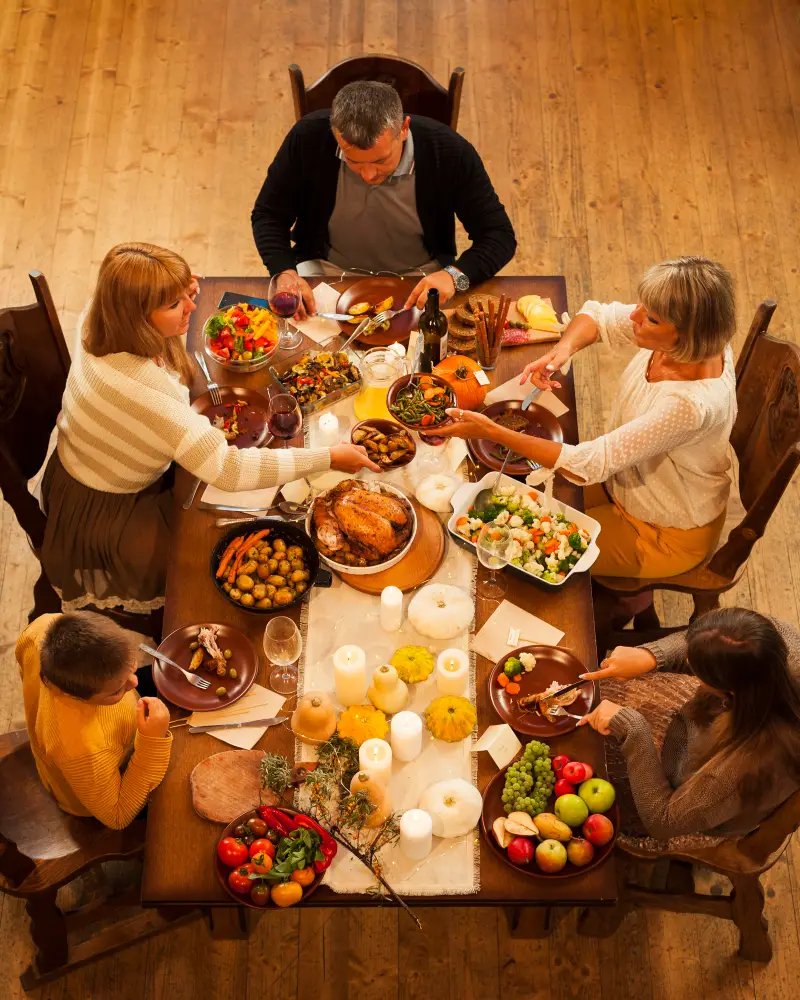
The long table already set with the good dishes. The turkey carved and arranged on the platter my aunt had owned since before I was born. Everyone dressed up and laughing, wine glasses raised, the warm amber light of Steve’s dining room making everything look like a magazine spread. My mother was at the head of the table laughing at something off-camera. Jenna was beside her, looking at her phone.
And seated across from them, raising his glass with the ease of someone who had been coming to this dinner for years, was Kyle.
Kyle, who had been my best friend since the sixth grade. Kyle, who had eaten at my kitchen table more times than I could count, who knew the full map of my family’s dysfunction the way you know a neighborhood you grew up in. Kyle, who was at that table lifting a glass of someone else’s wine, looking entirely at home.
I stared at that photo for a long time.
I gave myself every charitable explanation. The invite had gone to my spam folder. Someone had assumed I knew to come. There had been a miscommunication somewhere in the chain and everyone had believed someone else handled it. I am skilled at these explanations. I have had years of practice.
But I knew.
I got in my car anyway, because I am also someone who needs to be certain, who cannot act on an assumption when the drive is only twenty minutes and the alternative is sitting in my apartment wondering.
I told myself that if I was wrong, if somehow it was all a misunderstanding, I would walk in and laugh about it and eat too much and drive home and forget it.
I pulled into Steve’s driveway at five in the afternoon.
He was already walking toward my car before I had turned off the engine. He did not wait for me to get out. He came to the driver’s side window with his arms crossed over his chest and the particular expression he wore when he believed he held an advantage, a kind of relaxed smugness that he had mistaken for confidence his entire life.
“You weren’t invited, Ryan,” he said. “Go home.”
He said it the way you tell someone the restaurant is full. Casually. As though we were discussing something minor.
I did not answer right away. I looked past him toward the house. Through the wide front window I could see the table, the plates, the candles. My mother’s profile, turned toward someone I couldn’t quite see, laughing. Jenna, head bent over her phone, thumb moving across the screen.
Kyle, in the chair where I usually sat, raising his glass.
None of them looked toward the window.
None of them saw me standing twenty yards from a celebration they had built without me.
I looked at my uncle.
I nodded once.
Then I put the car in reverse and drove to the gas station parking lot half a mile down the road and sat there with the engine off and my forehead against the steering wheel.
I let the silence close in.
Then I made a call.
Not to a lawyer, not to anyone dramatic. I called my friend Priya, who I had known for four years, who I had done freelance graphic design work with on several projects, and who understood my family the way only someone outside it can understand something that has been explained in enough detail over enough time.
Priya managed social media for several clients, including a page with a significant following that was running a holiday feature that week. They had been soliciting personal stories under the heading: Holiday Nightmares. Tell us what happened.
I sat in that parking lot and told her everything.
Not in anger, not with any particular strategy. I just described what had occurred: the missing invitation, the Instagram photo, driving to the house anyway, my uncle meeting me at the car, seeing my mother and sister through the window, seeing Kyle with his glass raised. I did not name anyone. I kept it plain and specific, the way you tell a story when you are still inside the shock of it.
Priya was quiet through the whole thing.
Then she said, “That’s exactly what this feature is for. You okay with me posting it anonymously?”
I did not hesitate.
She posted it twenty minutes later.
My phone started buzzing before I had even made it back to my apartment.
Kyle first, then Jenna, then my mother. Calls stacking on top of calls, texts coming in like a faucet someone had left running. I let all of it go to voicemail and watched the notifications accumulate from a distance, the way you watch weather move in from across a lake.
The post had found something. Comments were flooding in from strangers who had sat at similar tables and felt similarly invisible, or had stood at the edge of a family gathering they had not been warned was happening and tried to understand what that meant about their position in the world. The shared recognition of it, the specific shape of the pain, had resonated in the particular way that true things resonate when they finally get said out loud.
Then my uncle called.
I set the phone face-down on the passenger seat and watched the screen light up through the dark fabric.
I did not answer.
I sat in my car in the parking lot of my apartment complex and breathed the cold air through the cracked window and felt, for the first time in a very long time, something that was not quite peace but was adjacent to it. The particular quiet of someone who has stopped performing.
Back inside, I heated up the food I had prepared that morning. Turkey, cranberry sauce from a jar, a slice of store-bought pumpkin pie. I had bought it earlier in the day without fully admitting to myself why I was doing it, some back-of-the-mind preparation for the possibility that the evening would go this way.
I ate at my kitchen counter and let my phone buzz on the other side of the room.
The group chat erupted at 8:52 pm, the old family thread that had been silent for weeks suddenly lighting up with messages that came in rapid sequence.
My mother asking me to call.
Jenna asking what I had done.
Kyle saying things were getting out of hand.
My uncle telling me to take the post down, that I was dragging everyone through mud, that if I wanted to air grievances there were better ways.
I read through all of it.
Then I set the phone down.
At 9:43, my mother sent a text that sat differently from the others.
We didn’t mean to hurt you. Steve said you were traveling. I thought you didn’t want to come this year.
Traveling.
I had not been out of the city in three months. I had not mentioned any travel to anyone. There was no possible source for that information except that someone had invented it, a small, convenient fiction to explain an absence that they had deliberately created, constructed retroactively to smooth over a decision they did not want to defend.
What was harder to absorb was not even the lie itself. It was the picture of the conversation that lie implied, someone at that table asking where Ryan was, and someone else supplying a comfortable answer, and everyone accepting it without picking up the phone to verify.
Because verifying would have required caring.
Kyle texted around ten. His message was longer than the others and had the quality of someone who had been composing it for a while and was not fully satisfied with the result. He said he had not known I was not invited. He said my mother had told him I had cancelled. He said he should have texted me to check and he was sorry he hadn’t.
It was weak in the way of a person who is genuinely contrite but also aware that their contrition does not quite reach the level of what they are contrite about. Kyle and I had been friends since we were eleven. He knew my family. He had watched, across years of dinners and holidays and late-night conversations in my apartment, exactly how I was treated when I was present. He had chosen to sit at that table without question.
I did not respond.
At ten-twelve, my friend messaged me that a larger national page had shared the post. Within an hour it had crossed forty thousand shares.
I checked it once, from behind the protective distance of her account rather than my own, and scrolled through comments that were still coming faster than I could read them. Strangers describing their own versions of the same story. People who had been the left-out one, the tolerated one, the one who was always somehow just slightly outside the inner circle of their own family. The recognition in those comments was not comfortable exactly, but it was real, and it was warm in the way that being seen is warm even when what you are being seen for is painful.
I went to bed at midnight.
The next morning had escalated while I slept. My inbox had messages from journalists. A podcast had sent a request. Someone from a documentary production company wanted to discuss an anonymous interview.
Around noon, my aunt Carol sent a text.
You’re ruining lives over one dinner, Ryan. Was that your plan? To embarrass everyone publicly? You’ve always been so dramatic.
I read it twice.
The word dramatic. That word again, deployed by people who have spent years dismissing your pain to explain why your pain being expressed publicly is the actual problem.
They were not panicking because the post was unfair.
They were panicking because it was accurate, and because thousands of strangers had immediately recognized it.
In their world, image was the infrastructure. The house, the table, the good dishes, the amber dining room light, all of it was about the story they told about themselves, and that story required everyone inside it to maintain their assigned role. Mine was to be invisible and uncomplaining. The moment I stopped playing it, the whole architecture became visible.
I began going through my phone. Messages, texts, voicemails, things I had received over the years and saved without fully knowing why. The forward from Jenna that included the family vacation rental link, sent to everyone except me. The text from my mother three Christmases ago telling me not to make a scene because Steve was in a difficult mood and she did not want the evening complicated. The voicemail from Steve at my college graduation dinner, telling me cheerfully that graphic design was not a real career and I should think seriously about retraining while I still had time.
I had saved all of them.
At the time I had told myself I was being paranoid. That I was making something out of nothing, reading malice into thoughtlessness, turning family dysfunction into something more deliberate than it was.
Three days after Thanksgiving, someone knocked on my apartment door.
My building has a buzzer at the entrance. I had not heard it. Three sharp knocks in the middle of the afternoon.
I looked through the peephole.
My mother was standing in the hallway with her purse strap twisted in both hands the way she held it when she was nervous. Beside her, arms crossed, jaw set, was Uncle Steve.
I stood there for a moment with my hand on the doorknob.
Then I unlatched the chain and opened the door six inches.
“What do you want?”
My mother’s expression shifted into the version of her face designed to communicate that I was breaking her heart. “Ryan, sweetheart. Can we come in? We just want to talk.”
Behind her, Steve made a sound somewhere between a sigh and a laugh. “We wouldn’t have to do this if you’d picked up the phone instead of putting our business on the internet.”
“You could have invited me,” I said.
“Ryan.” My mother stepped slightly forward. “Please. This isn’t like you.”
“Actually,” I said, “I think this is exactly like me. You’re just not used to the version of me that says it out loud.”
Steve’s voice shifted into the register he used when he wanted to convey that he was being very patient with someone who did not deserve his patience. “We’ve been getting calls, Ryan. My business partner saw that post. The neighbors are asking questions. Carol hasn’t stopped crying. You’ve turned a family dinner into a public spectacle.”
“I described what happened,” I said. “I didn’t name anyone. Whatever spectacle exists, you built it.”
My mother’s voice cracked slightly. “We didn’t know you felt this way. Steve told us you’d mentioned being busy, that you probably weren’t coming. We had no idea you wanted to be there.”
“I never said I was busy,” I said. “No one asked me. You assumed or you were told something that wasn’t true, and you didn’t check.”
They were both quiet for a moment.
Then Steve leaned slightly forward. “You’re playing the martyr,” he said. “You always do this. You want people to feel sorry for you. Grow up.”
I looked at him.
I had spent most of my life trying to decode what I had done to earn his contempt. I had been over it from every angle. And standing there in my own doorway, looking at the flat certainty on his face, I understood finally that there was nothing to decode. He had simply decided on a version of me and had maintained it for years, not because of anything I had done, but because a dismissed Ryan was more useful to him than a real one.
I closed the door.
Not a slam. Just a firm, quiet close, followed by the slide of the deadbolt.
I stood on the inside of it and listened to them murmur for a minute. My mother’s voice, something about me not thinking clearly. Steve’s footsteps, heavy and irritated, moving away down the hallway.
Then quiet.
I leaned against the door and let my breathing slow.
That evening I received a call from a number I did not recognize. I almost ignored it. Something made me answer.
A woman’s voice, careful and slightly nervous.
“Is this Ryan?”
“Who’s this?”
“My name is Emily. I’m Steve’s daughter.”
I sat down.
Emily was Steve’s child from his first marriage, a marriage that was spoken of in my family the way certain things are spoken of in families: briefly, evasively, with a tone that discouraged follow-up questions. She had disappeared from family events when I was still young, and Steve’s explanation, when anyone was brave enough to ask, was a single sentence delivered with finality. She made her choices.
“I saw the post,” she said. “I know it was you. I don’t know exactly how I knew, but I did.”
“It’s going pretty wide,” I said, not knowing what else to say.
“I’ve been reading the comments all night.” A pause. “The whole thing hit me in a way I didn’t expect. Because I thought I was the only one who got cut out like that.”
Something shifted in my chest.
“I thought I was too,” I said.
We talked for almost three hours that first night.
Emily told me things that filled in portions of my family history I had never had access to. She described a father who used financial control as a substitute for love, who gave money and withheld it in rhythm with whether you were compliant, who built narratives about the people around him that served his purposes and then distributed those narratives until they became the accepted truth.
She told me about being cut off at twenty-one, after she had started asking questions he found inconvenient. She told me about being told, by relatives she had later reconnected with, that Steve had described her as having moved on, chosen her own path, as though the distance had been her initiative rather than his punishment.
And then she told me about an email she had found years later, forwarded to her by a cousin who had thought she deserved to see it. An email Steve had written to her mother when Emily was in her early twenties. She read me a line from memory.
She’s heading the same direction as Ryan. Soft, weak. Won’t amount to much unless someone straightens him out.
I did not respond immediately.
I was twenty-seven years old and I was reading, from a secondhand account of a decade-old email, that my uncle had been actively working to ensure that the people around him understood what kind of person I was before I had any chance to demonstrate it for myself.
It was not paranoia.
It was not me being too sensitive, the way I had told myself for years when the feeling of being outside would not go away no matter how much I tried to belong.
It was a pattern, deliberate and long-running, and now I was looking at it from the outside for the first time.
Emily and I talked until nearly three in the morning.
Before we hung up she said, “You’re not alone in this. If you ever want to keep talking, I’m here.”
“I will,” I said, and meant it.
Two weeks after Thanksgiving, a letter arrived in my mailbox. Handwritten envelope, no return address, my name in my mother’s handwriting.
I opened it at the kitchen counter.
It was short. Two paragraphs, the handwriting slightly unsteady in the way of someone who has rewritten a letter enough times that the final version carries the exhaustion of the previous attempts.
She wrote that she had read the post and the comments. She wrote that she had been furious at first. She wrote that then she had remembered my face when I was a child, how I used to make myself smaller when people raised their voices, how I had learned to disappear into corners. She wrote that she had not protected me. That she had allowed other people to define me and had stood by while it happened. That she had not understood she was doing harm. That silence was a kind of harm too. That she did not expect me to forgive her. That she wanted me to know she could see it now.
I read it several times.
It was not enough. One letter does not repair years of accumulated absence. I was not ready to call her, not ready to sit across from her at a table and navigate the complicated territory of what forgiveness might eventually look like.
But it was real.
And it was the first time in years that I felt something other than performance from someone in that family.
Christmas I spent with Emily and a handful of friends who had also chosen, for their own reasons, to step away from their families that year. We ordered Thai food and played board games and watched movies I had not seen in years. Someone knocked over a glass of wine and we laughed and cleaned it up and kept eating.
Nobody performed. Nobody kept score. Nobody needed me to be quieter or easier or less.
On New Year’s Eve I sat down and wrote a follow-up post. Not on the viral page, just on my own, quiet account. No accusations, no names. Just a reflection on the year, on what it had cost me to stay silent for so long and what it had cost me to finally stop, and on the difference between those two kinds of cost.
It did not go viral. That was not the point.
The following Thanksgiving I hosted dinner at my apartment for the first time.
Emily came. Three friends came, people who had found their way to the same side of the same kind of reckoning. I made a turkey that came out better than I expected. Someone brought wine. Someone else brought a pie. We crowded around my small table with mismatched chairs and ate until the food was gone and kept talking for hours after.
At no point did anyone evaluate anyone else’s choices or assign anyone a role or remind anyone of their designated position in a hierarchy that existed only to serve the person at the top of it.
Nobody was sent home.
Nobody stood outside a window watching.
Uncle Steve never contacted me again.
Jenna sent an apology several months later. It was brief and careful, the apology of someone who is genuinely sorry and also not yet sure what they are apologizing for, but it was sincere enough that I acknowledged it, and we exist now in a cordial distance that suits both of us.
Kyle and I had one conversation, in which I told him that I understood, and that I wished him well, and that I did not have the energy to rebuild something I could not fully trust. He accepted this better than I expected. Maybe he had been waiting for permission to let it go too.
My mother and I have spoken a few times. Slowly, carefully, the way you approach something fragile that you are not certain will hold. I do not know yet what that relationship becomes. I am not in a hurry to decide.
What I know is that I stopped being the person who smiled through everything and called it peace.
Peace was what I had on Thanksgiving with Emily and a few people who had chosen to be there.
What I had in that family was not peace.
It was the performance of peace, maintained at my expense, for the comfort of people who had never once asked what it was costing me.
I am twenty-seven years old and I have a small apartment and freelance work that I love and a holiday table that belongs to me.
That is not nothing.
That is, actually, everything.

Adrian Hawthorne is a celebrated author and dedicated archivist who finds inspiration in the hidden stories of the past. Educated at Oxford, he now works at the National Archives, where preserving history fuels his evocative writing. Balancing archival precision with creative storytelling, Adrian founded the Hawthorne Institute of Literary Arts to mentor emerging writers and honor the timeless art of narrative.