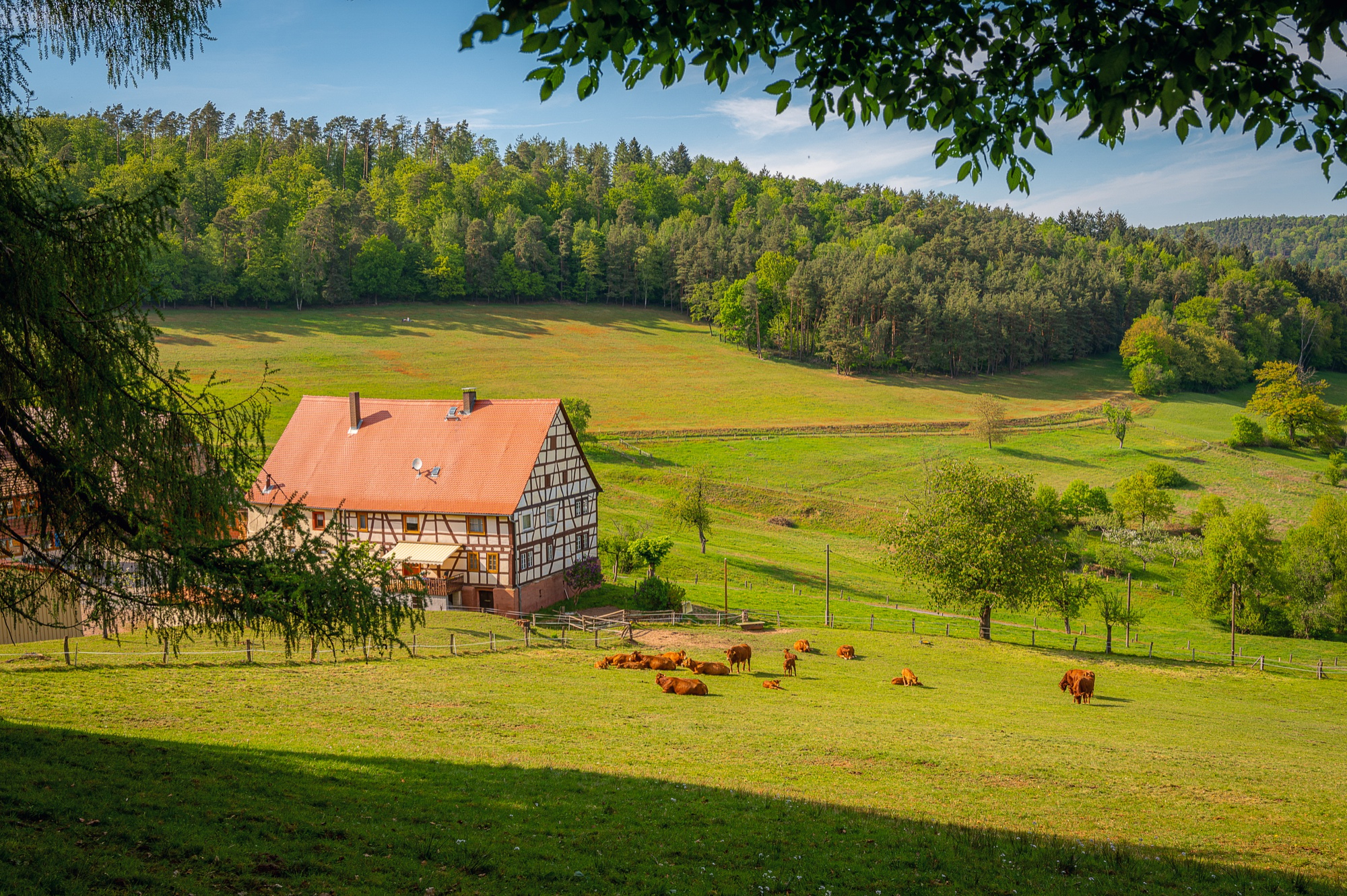
She came home for Christmas. Sometimes Thanksgiving. She’d sit at the kitchen table in her nice clothes, checking her phone, while Dad and I came in from feeding with mud on our boots.
“You smell like cows,” she’d say.
“I’ve been with cows,” I’d say.
She’d roll her eyes. But she’d always save me a plate.
I stayed.
I went to Texas A&M for two years. Agricultural science. Then Mom got sick. Breast cancer. I came home to help. I never went back.
I worked beside Dad. I fed the horses. I fixed the fences. When Dad’s heart started giving him trouble, about five years ago, I took over most of the heavy work. By the time I was twenty-six, I was running the ranch. Dad would sit on the porch with his coffee and tell me what I was doing wrong, which was his way of saying he was proud of me.
Mom died three years ago. In March. In the bedroom at the top of the stairs, with the window open so she could see the pasture. She asked Dad to open it. She said she wanted to watch the fields one more morning.
Dad died eight months later. In November. His heart. The doctor said it was a cardiac event. Dad’s friend, old Ray Dietz from the feed store, said it was a broken heart.
I believe Ray.
There’s something I need to tell you about the year before Dad died. Because it matters to everything that happened after.
About four months after Mom’s funeral, Dad called me into the kitchen one evening. It was summer. Hot. The windows were open. The cicadas were screaming.
There was a woman sitting at our kitchen table. Fifties. Gray hair in a braid. A canvas vest with a logo on it. A thick folder of papers in front of her.
“Jake,” Dad said, “this is Delia Marsh. From the Hill Country Land Conservancy.”
I shook her hand. I didn’t know what was going on.
“Sit down, son,” Dad said. “I need you to witness something.”
I sat down.
Dad explained it. Slowly. In his way.
It was called a conservation easement. A legal agreement between a landowner and a land trust. It meant the ranch could never be subdivided. Never be developed. No housing tracts. No wedding venues. No hotels. Ever. Not by us. Not by anyone who ever owned it after us. The land would always be a working ranch or open land. Forever. It was recorded with the county. It ran with the deed.
“Your mother and I talked about it before she died,” Dad said. “For years, actually. We watched what happened to the Hoffman place. And the Weber ranch. And the Lindners. Eighty years in those families. Sold to developers. Bulldozed. Now it’s two hundred houses with the same front door.” He looked at me. “We decided we didn’t want that. Not for this land.”
“Okay,” I said.
“It lowers the value,” Delia Marsh said carefully. “Significantly. A developer would pay three, four times what a rancher would pay. Once this is signed, no developer will ever want it.”
“I know,” Dad said.
“And it’s permanent,” she said. “There’s no undoing it. Not by you. Not by your children.”
“I know,” Dad said. “That’s the point.”
He signed it. Right there at the kitchen table. Then he handed me the pen.
“Sign as a witness,” he said.
I signed.
After Delia Marsh left, Dad sat at the table for a long time. Looking at the copy she’d left him.
“Your sister’s going to hate this,” he said finally.
“Why?”
He didn’t answer right away.
“Because she sees this place differently than you do,” he said. “She always has. She sees what it’s worth. You see what it is.” He folded the papers. “Don’t tell her unless you have to, Jake. It’ll just start a fight. And I’m too tired to fight with my daughter.”
“Why would I have to?”
Dad looked at me for a long moment.
“I hope you never do,” he said.
When Dad died, the will was simple. Mom and Dad had written it together, with old Judge Wendell Krause in town, ten years earlier. They’d updated it the year Mom got sick.
The ranch went to me.
Clare got everything else. Their savings. Dad’s retirement account. Mom’s teacher’s pension death benefit. The life insurance policy. A little piece of land Mom inherited from her own parents outside of Kerrville. It added up to about four hundred thousand dollars.
“They tried to make it even,” Judge Krause said, reading it in his office in town. “As close as they could. Jacob gets the land because Jacob works the land. Clare gets the liquid assets because Clare has a life in the city.”
There was one more clause. At the end. Judge Krause read it slowly.
“If any beneficiary contests this will or any of its provisions, that beneficiary shall forfeit his or her entire share.“
“A no-contest clause,” Clare said. She was sitting very straight in her chair. She’s a lawyer. She knew what it meant.
“Your parents were very clear about it,” Judge Krause said. “They didn’t want their children fighting over their estate.”
Clare nodded.
“Of course,” she said. “Neither do I.”
At first, she accepted it.
She hugged me in the parking lot outside Judge Krause’s office. She said she was glad I had the ranch. She said Mom and Dad would want me to have it. She drove back to Dallas that afternoon.
Then the comments started.
They were small at first. In text messages. On the phone.
Must be nice getting the golden ticket.
You definitely came out ahead, little brother.
Do you know what that land’s worth now? I looked it up.
Then she started showing up.
Without calling. On weekends. Sometimes with her fiancé, Bryce. Bryce was a commercial real estate developer from Dallas. Tall. Tan. Very white teeth. He wore loafers without socks on a working cattle ranch.
Clare would walk through the house like she was touring it. She moved furniture. Mom’s reading chair from the living room to the guest room. Dad’s gun cabinet from the hallway to the den. She’d say it “flowed better.”
She talked about renting out rooms. About turning the barn into an “event space.” About tearing down the old bunkhouse and putting in a pool.
“You could make a fortune with Airbnb up here,” Bryce said once. Standing in the kitchen. Looking out the window at the pasture. “Wine tourists will pay four hundred a night for something authentic like this.”
“It’s not authentic,” I said. “It’s a ranch. It’s just real.”
Bryce laughed. Like I’d said something cute.
Then one Saturday, Clare walked into my old bedroom upstairs. The one next to Mom and Dad’s. The one I moved out of when I took over the master after Dad died.
She stood in the doorway. Bryce came up behind her and put his arms around her waist.
“That would make a perfect nursery,” she said.
I was coming up the stairs with a basket of laundry. I stopped.
That was when I realized she wasn’t visiting anymore.
She was already living here. In her head. She was already picking out paint colors.
Two weeks later, she brought me paperwork.
She came on a Sunday afternoon. By herself. She seemed nicer than usual. She brought a pie from the bakery in town. Peach. Mom’s favorite.
We sat at the kitchen table. She slid a manila folder across to me.
“Just some routine estate documents,” she said. “Housekeeping stuff. To finish closing everything out. Sign where the yellow flags are.”
There were seven yellow flags.
She held out a pen.
I almost signed. I want to be honest about that. She was my sister. She was a lawyer. She’d brought Mom’s favorite pie. I had the pen in my hand.
Then I looked at the first page.
I’m not a lawyer. But I’m not stupid either. Dad made me read every contract we ever signed with the co-op. Every single word. If you sign something you didn’t read, Jake, you deserve whatever’s in it.
So I read it.
It wasn’t routine.
It was a transfer agreement. A quitclaim deed. A document that said I agreed to transfer a fifty percent undivided interest in the ranch to Clare Calloway. In exchange for, quote, ten dollars and other good and valuable consideration.
The second document was a partition agreement. If either co-owner wanted to sell, the other one couldn’t stop them.
The third was a power of attorney. Giving Clare authority to make “decisions regarding the management, encumbrance, and disposition” of the property.
I put down the pen.
“Clare,” I said. “What is this?”
“Just paperwork,” she said. She smiled. “It’s how estates work, Jake. It’s complicated. I’m trying to help.”
“This gives you half the ranch.”
“It’s what’s fair,” she said. Her smile tightened. “You got everything. I’m just trying to even things out.”
“You got four hundred thousand dollars.”
“And you got one point two million,” she said. “Do the math.”
I closed the folder. I slid it back across the table.
“I’m not signing this,” I said.
She stared at me for a long time.
Then she picked up the folder. She left the pie.
That night, I called Nadia Brooks.
Nadia and I met freshman year at A&M. She was pre-law. I was ag science. We sat next to each other in a statistics class neither of us understood and became friends out of shared suffering. She went on to UT Law. Now she practices real estate law in Austin. Mostly farm and ranch property.
I read her the documents over the phone.
She was quiet for a long time.
“Jacob,” she said finally. “Do not sign anything your sister gives you. Ever. Not a birthday card. Not a grocery list.”
“Is it bad?”
“If you’d signed that quitclaim and that partition agreement,” Nadia said, “your sister could have forced a sale of the entire ranch within a year. Legally. And you couldn’t have stopped her.” She paused. “That’s not housekeeping. That’s a demolition plan.”
“What do I do?”
“How fast can you get to Austin?”

Adrian Hawthorne is a celebrated author and dedicated archivist who finds inspiration in the hidden stories of the past. Educated at Oxford, he now works at the National Archives, where preserving history fuels his evocative writing. Balancing archival precision with creative storytelling, Adrian founded the Hawthorne Institute of Literary Arts to mentor emerging writers and honor the timeless art of narrative.