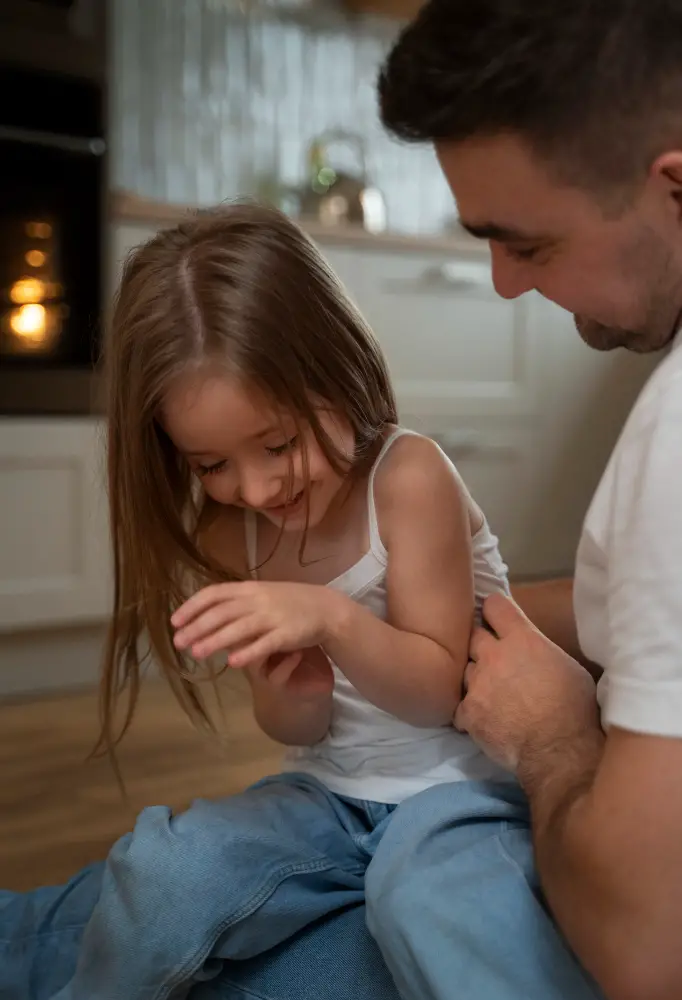
The girl did not call anyone those first hours, because there was no one obvious to call. The house phone, if the family still had one, was not where she knew to look, and the mother’s cell phone had been left, uncharacteristically, on the charger across the room rather than in her usual spot on the nightstand, a small detail that would later strike the responding officers as almost cruel in its randomness. A phone six feet away might as well have been six miles away to a six-year-old who had never been taught the passcode and who, faced with her mother unresponsive on the floor, did the only thing that made immediate sense to her overwhelmed six-year-old mind: she stayed close, and she tried to help the way she’d seen her mother help.
She brought a cup of water and tried to get her mother to drink it, the way her mother had once nursed her through a stomach flu by coaxing small sips past dry lips. Most of it ended up on the carpet. She tried cereal, dry, straight from the box, placing a few pieces near her mother’s hand as though proximity alone might coax her awake. She pulled a blanket off the bed and draped it over her mother’s shoulders because the floor seemed cold and because covering someone who was sick was, in the girl’s understanding of the world, simply what you did.
Then there were the twins.
They had been three days old when their mother collapsed, impossibly small, impossibly dependent, and entirely unaware that the only working adult in their universe had just gone silent. The girl had watched her mother feed them enough times in the preceding days to have absorbed the basic shape of it, if not the particulars. She knew the bottles lived in the refrigerator, premade, because her mother had been pumping and storing milk in anticipation of exactly this kind of exhausted week, though not, of course, anticipating quite this. She knew how to warm a bottle by running it under the kitchen tap, a technique she’d watched without fully registering she was watching, the way children file away adult competencies for no reason except that someday, apparently, they might need them.
She fed them as best she could over those three days. She changed diapers with the clumsy persistence of a child determined not to fail at something, often inefficiently, sometimes incorrectly, but consistently, every time one of the babies cried loudly enough to summon her. She slept in short, fractured stretches on the floor between the two cribs rather than in her own room down the hall, because some instinct told her that distance from the twins was dangerous in a way she couldn’t fully articulate, only feel.
By the second day, she had started talking to her mother as though she could hear her, a habit the hospital social worker would later recognize as a common, almost universal coping mechanism in children facing something too large for them. “The babies are okay,” she told the unmoving form on the floor. “I gave them their bottles. You should wake up now.” Her mother did not wake up, but the girl kept talking anyway, as though the words themselves were a kind of rope she was throwing across a gap she didn’t have the strength to cross any other way.
It was on the third day, in the early afternoon, that one of the twins went quiet in a way the girl recognized, with a child’s uncanny instinct for subtle wrongness, as different from ordinary sleep. The baby had been fussier than usual that morning, taking less of the bottle than the girl expected, and then, sometime after noon, had simply stopped making the small ordinary newborn sounds that had filled the house for days, the grunts and hiccups and half-formed cries that the girl had, without realizing it, come to rely on as proof that everything was still, somehow, functioning.
She picked the baby up. She did not have the strength or the experience to properly judge what she was feeling, only that something felt wrong, the particular wrongness of too-quiet in a creature that was supposed to be loud. She set the baby back down, gently, the way she’d seen her mother do it, and she went back to the bedroom floor and shook her mother’s shoulder one more time, harder than she ever had before, and when that produced nothing, something in the girl that had been holding steady for three days finally gave way to a different kind of instinct entirely.
Get help.
She did not have a clear plan when she first had the thought. She only knew, with the simple clarity children sometimes find in genuine emergencies, that staying in the house any longer was no longer the safest option. The problem, immediately apparent even to a six-year-old, was that she could not carry two newborns at once, not for any real distance, and the only vehicle available to her, parked beside the garden shed where it always lived, was the wheelbarrow her mother used for yard work.
She lined it with a folded blanket, the way she’d seen her mother line the babies’ bassinet. She placed both twins inside it, carefully, one at each end, propped with rolled towels so they wouldn’t shift. She took the house key, which her mother had, some weeks earlier, started keeping on a piece of string around the girl’s neck for reasons that had never been fully explained to her beyond “in case,” and she pushed the front door shut behind her, locking it out of some deep-seated instinct for doing things correctly even in crisis, and she began to push the wheelbarrow down the driveway and out toward the road.
She did not know the exact address of the nearest hospital. She knew, vaguely, the general direction her mother drove when they went to doctor’s appointments, a route she had absorbed the way children absorb the geography of their small worlds, through repetition rather than instruction. She pushed the wheelbarrow along the shoulder of the road for the better part of two miles, stopping periodically to check on the twins, readjusting the blanket when it slipped, talking to them the same steady stream of reassurance she’d been offering her unconscious mother for three days.
A driver passing in the opposite direction would later tell a local reporter that he’d nearly missed her entirely, a small girl pushing a wheelbarrow along a rural shoulder in the early afternoon, and had only slowed because something about the scene struck him as wrong in a way he couldn’t immediately place. By the time he’d turned his truck around to check, she was nearly to the edge of town, close enough to the hospital that she waved off his offer of help with the particular stubbornness of a child who has decided, after three days of making every decision herself, that she is going to be the one to finish what she started.
She arrived at the emergency room entrance on her own power, wheelbarrow and all, and it was there, finally, that the adults took over.

Sophia Rivers is an experienced News Content Editor with a sharp eye for detail and a passion for delivering accurate and engaging news stories. At TheArchivists, she specializes in curating, editing, and presenting news content that informs and resonates with a global audience.
Sophia holds a degree in Journalism from the University of Toronto, where she developed her skills in news reporting, media ethics, and digital journalism. Her expertise lies in identifying key stories, crafting compelling narratives, and ensuring journalistic integrity in every piece she edits.
Known for her precision and dedication to the truth, Sophia thrives in the fast-paced world of news editing. At TheArchivists, she focuses on producing high-quality news content that keeps readers informed while maintaining a balanced and insightful perspective.
With a commitment to delivering impactful journalism, Sophia is passionate about bringing clarity to complex issues and amplifying voices that matter. Her work reflects her belief in the power of news to shape conversations and inspire change.